

Electronic Transactions Law
    ADVERTISING AND MARKETING

1
     Department of Commercial Law
        University of Cape Town
UNSOLICITED COMMERCIAL COMMUNICATIONS
(UCC)
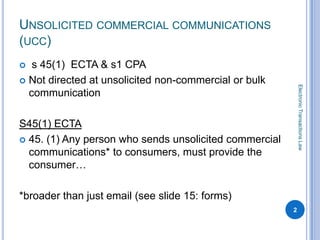
  s 45(1) ECTA & s1 CPA
 Not directed at unsolicited non-commercial or bulk


                                                            Electronic Transactions Law
  communication

S45(1) ECTA
 45. (1) Any person who sends unsolicited commercial
  communications* to consumers, must provide the
  consumer…

*broader than just email (see slide 15: forms)
                                                        2
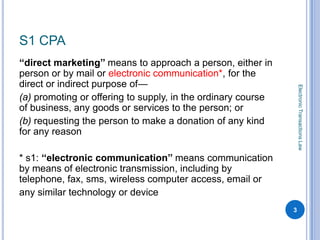
S1 CPA
‘‘direct marketing’’ means to approach a person, either in
person or by mail or electronic communication*, for the
direct or indirect purpose of—


                                                                  Electronic Transactions Law
(a) promoting or offering to supply, in the ordinary course
of business, any goods or services to the person; or
(b) requesting the person to make a donation of any kind
for any reason

* s1: ‘‘electronic communication’’ means communication
by means of electronic transmission, including by
telephone, fax, sms, wireless computer access, email or
any similar technology or device
                                                              3
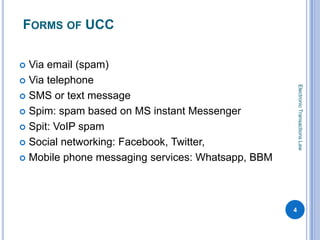
FORMS OF UCC

 Via email (spam)
 Via telephone


                                                       Electronic Transactions Law
 SMS or text message

 Spim: spam based on MS instant Messenger

 Spit: VoIP spam

 Social networking: Facebook, Twitter,

 Mobile phone messaging services: Whatsapp, BBM


                                                   4
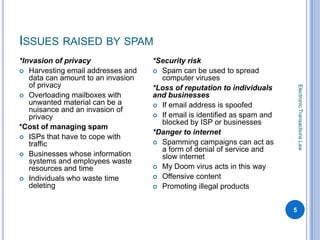
ISSUES RAISED BY SPAM
*Invasion of privacy                *Security risk
 Harvesting email addresses and     Spam can be used to spread
   data can amount to an invasion     computer viruses
   of privacy


                                                                               Electronic Transactions Law
                                    *Loss of reputation to individuals
 Overloading mailboxes with        and businesses
   unwanted material can be a        If email address is spoofed
   nuisance and an invasion of
   privacy                           If email is identified as spam and
                                      blocked by ISP or businesses
*Cost of managing spam
                                    *Danger to internet
 ISPs that have to cope with
   traffic                           Spamming campaigns can act as
                                      a form of denial of service and
 Businesses whose information
                                      slow internet
   systems and employees waste
   resources and time                My Doom virus acts in this way

 Individuals who waste time         Offensive content
   deleting                          Promoting illegal products


                                                                           5
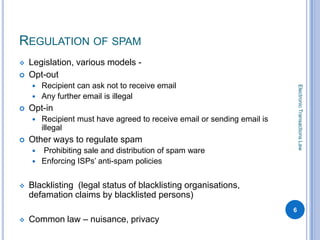
REGULATION OF SPAM
   Legislation, various models -
   Opt-out
       Recipient can ask not to receive email


                                                                              Electronic Transactions Law
       Any further email is illegal
   Opt-in
       Recipient must have agreed to receive email or sending email is
        illegal
   Other ways to regulate spam
     Prohibiting sale and distribution of spam ware
     Enforcing ISPs’ anti-spam policies


   Blacklisting (legal status of blacklisting organisations,
    defamation claims by blacklisted persons)
                                                                          6
   Common law – nuisance, privacy
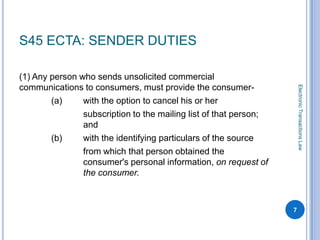
S45 ECTA: SENDER DUTIES

(1) Any person who sends unsolicited commercial
communications to consumers, must provide the consumer-


                                                                       Electronic Transactions Law
        (a)     with the option to cancel his or her
                subscription to the mailing list of that person;
                and
        (b)     with the identifying particulars of the source
                from which that person obtained the
                consumer's personal information, on request of
                the consumer.


                                                                   7
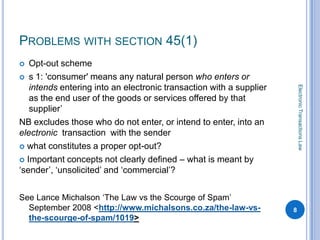
PROBLEMS WITH SECTION 45(1)
  Opt-out scheme
 s 1: 'consumer' means any natural person who enters or
   intends entering into an electronic transaction with a supplier


                                                                         Electronic Transactions Law
   as the end user of the goods or services offered by that
   supplier’
NB excludes those who do not enter, or intend to enter, into an
electronic transaction with the sender
 what constitutes a proper opt-out?

 Important concepts not clearly defined – what is meant by
‘sender’, ‘unsolicited’ and ‘commercial’?


See Lance Michalson ‘The Law vs the Scourge of Spam’
  September 2008 <http://www.michalsons.co.za/the-law-vs-            8
  the-scourge-of-spam/1019>
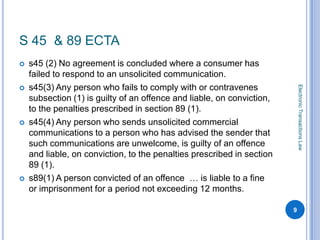
S 45 & 89 ECTA
   s45 (2) No agreement is concluded where a consumer has
    failed to respond to an unsolicited communication.
    s45(3) Any person who fails to comply with or contravenes


                                                                            Electronic Transactions Law

    subsection (1) is guilty of an offence and liable, on conviction,
    to the penalties prescribed in section 89 (1).
   s45(4) Any person who sends unsolicited commercial
    communications to a person who has advised the sender that
    such communications are unwelcome, is guilty of an offence
    and liable, on conviction, to the penalties prescribed in section
    89 (1).
   s89(1) A person convicted of an offence … is liable to a fine
    or imprisonment for a period not exceeding 12 months.

                                                                        9
CPA – S11
  S11(1) The right of every person to privacy includes the right to—
(a) refuse to accept;
(b) require another person to discontinue; or


                                                                                 Electronic Transactions Law
(c) in the case of an approach other than in person, to pre-emptively block,
any approach or communication to that person, if the approach or
communication is primarily for the purpose of direct marketing
 S11(2) a person who has been approached for direct marketing
   purposes may demand the cessation of any further approaches (opt-out)
 S11(3) Establishment of registry for pre-emptive blocks by the National
   Consumer Commission
 S11(4) A person authorising, directing or conducting any direct marketing
   must implement appropriate procedures to facilitate the receipt of opt-out
   instructions and ensure the discontinuation of communication after the
   receipt of opt-out instructions or where a person has registered a pre-
   emptive block
 S11(5) no fees may be charged by senders in relation to pot-out
   instructions or registered pre-emptive blocks
                                                                                10
CPA –S12
   No contact at home during prescribed periods s12
   Consumer Protection Regulations GNR.293 of 1 April
    2011: Regulations (Government Gazette No. 34180), Notice


                                                                                                          Electronic Transactions Law
    Prohibited time for contacting consumers
    (1)(a) Sundays or public holidays contemplated in the Public Holidays Act, 1994 (Act No. 36
    of 1994);
    (b) Saturdays before 09h00 and after 13h00; and
    (c) all other days between the hours of 20h00 and 08h00 the following day,
    except to the extent that the consumer has expressly or implicitly requested or agreed
    otherwise.
    2. Direct marketing may not be timed to be delivered to the consumer during the prohibited
    times referred to in item 1 above unless expressly, in writing, agreed to by the consumer.
    3. A direct marketer is not in breach of item 1 if it has sent out the direct marketing within the
    period provided for in item 1, even if the consumer received the direct marketing outside of
    the aforementioned period, but the onus to prove that the direct marketing was dispatched
    during the allowed period rests fully on the direct marketer.

                                                                                                         11
INDUSTRY BODIES

    Direct Marketing Association of SA: National opt-out
    register (pre-emptive block)
    established in 2007


                                                                Electronic Transactions Law

   https://www.nationaloptout.co.za/

   ISPA in favour of opt-in provisions, clauses 14 -15 Code
    of Conduct http://ispa.org.za/code-of-conduct/, see also
    http://ispa.org.za/press-release/ispa-urges-opt-in-
    approach/

   Wireless Application Service Providers’ Association
    Code of Conduct clause 5; uses an opt-out approach
    seehttp://www.waspa.org.za/code/waspa_coc_6.1.pdf          12
REFORM: PROTECTION OF PERSONAL
INFORMATION BILL S66: OPT IN
Unsolicited electronic communications
 s66. (1) The processing of personal information of a data
  subject for the purpose of direct marketing by means of


                                                                      Electronic Transactions Law
  automatic calling machines, facsimile machines, SMSs or
  electronic mail is prohibited unless the data subject—
  (a) has given his, her or its consent to the processing; or
  (b) is, subject to subsection (2), a customer of the responsible
  party
 S66 (3) Any communication for the purpose of direct
  marketing must contain—
  (a) details of the identity of the sender or the person on whose
  behalf the communication has been sent; and
  (b) an address or other contact details to which the recipient
  may send a request that such communications cease.
                                                                     13
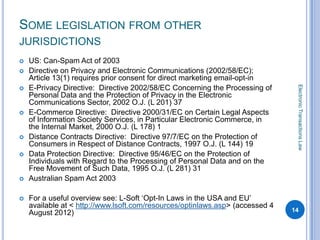
SOME LEGISLATION FROM OTHER
JURISDICTIONS
   US: Can-Spam Act of 2003
   Directive on Privacy and Electronic Communications (2002/58/EC);
    Article 13(1) requires prior consent for direct marketing email-opt-in


                                                                                Electronic Transactions Law
   E-Privacy Directive: Directive 2002/58/EC Concerning the Processing of
    Personal Data and the Protection of Privacy in the Electronic
    Communications Sector, 2002 O.J. (L 201) 37
   E-Commerce Directive: Directive 2000/31/EC on Certain Legal Aspects
    of Information Society Services, in Particular Electronic Commerce, in
    the Internal Market, 2000 O.J. (L 178) 1
   Distance Contracts Directive: Directive 97/7/EC on the Protection of
    Consumers in Respect of Distance Contracts, 1997 O.J. (L 144) 19
   Data Protection Directive: Directive 95/46/EC on the Protection of
    Individuals with Regard to the Processing of Personal Data and on the
    Free Movement of Such Data, 1995 O.J. (L 281) 31
   Australian Spam Act 2003

   For a useful overview see: L-Soft ‘Opt-In Laws in the USA and EU’
    available at < http://www.lsoft.com/resources/optinlaws.asp> (accessed 4
    August 2012)                                                               14
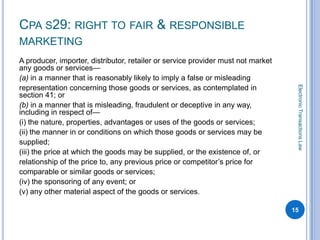
CPA S29: RIGHT TO FAIR & RESPONSIBLE
MARKETING
A producer, importer, distributor, retailer or service provider must not market
any goods or services—
(a) in a manner that is reasonably likely to imply a false or misleading


                                                                                   Electronic Transactions Law
representation concerning those goods or services, as contemplated in
section 41; or
(b) in a manner that is misleading, fraudulent or deceptive in any way,
including in respect of—
(i) the nature, properties, advantages or uses of the goods or services;
(ii) the manner in or conditions on which those goods or services may be
supplied;
(iii) the price at which the goods may be supplied, or the existence of, or
relationship of the price to, any previous price or competitor’s price for
comparable or similar goods or services;
(iv) the sponsoring of any event; or
(v) any other material aspect of the goods or services.

                                                                                  15
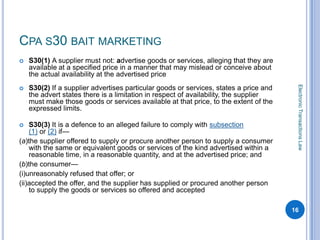
CPA S30 BAIT MARKETING
   S30(1) A supplier must not: advertise goods or services, alleging that they are
    available at a specified price in a manner that may mislead or conceive about
    the actual availability at the advertised price


                                                                                        Electronic Transactions Law
   S30(2) If a supplier advertises particular goods or services, states a price and
    the advert states there is a limitation in respect of availability, the supplier
    must make those goods or services available at that price, to the extent of the
    expressed limits.

   S30(3) It is a defence to an alleged failure to comply with subsection
    (1) or (2) if—
(a)the supplier offered to supply or procure another person to supply a consumer
    with the same or equivalent goods or services of the kind advertised within a
    reasonable time, in a reasonable quantity, and at the advertised price; and
(b)the consumer—
(i)unreasonably refused that offer; or
(ii)accepted the offer, and the supplier has supplied or procured another person
    to supply the goods or services so offered and accepted

                                                                                       16
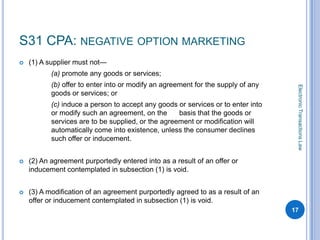
S31 CPA: NEGATIVE OPTION MARKETING
   (1) A supplier must not—
           (a) promote any goods or services;
           (b) offer to enter into or modify an agreement for the supply of any


                                                                                   Electronic Transactions Law
           goods or services; or
           (c) induce a person to accept any goods or services or to enter into
           or modify such an agreement, on the      basis that the goods or
           services are to be supplied, or the agreement or modification will
           automatically come into existence, unless the consumer declines
           such offer or inducement.


   (2) An agreement purportedly entered into as a result of an offer or
    inducement contemplated in subsection (1) is void.


   (3) A modification of an agreement purportedly agreed to as a result of an
    offer or inducement contemplated in subsection (1) is void.
                                                                                  17
CPA: OTHER PROVISIONS

 s 34 Trade coupons and similar promotions


                                               Electronic Transactions Law
 s 35 Customer loyalty programmes

 s 36 Promotional competitions

 s 38 Referral selling


                                              18
Electronic Transactions Law
  Electronic Transactions Law compiled by Caroline B
Ncube is licensed under a Creative Commons Attribution-
 NonCommercial-ShareAlike 2.5 South Africa License.
           To view this a copy of this license visit
  http://creativecommons.org/licenses/by-nc-sa/2.5/za/


                                                          19

Electronic Transactions Law - Lecture 5 : advertising and marketing

  • 1.
    Electronic Transactions Law ADVERTISING AND MARKETING 1 Department of Commercial Law University of Cape Town
  • 2.
    UNSOLICITED COMMERCIAL COMMUNICATIONS (UCC)  s 45(1) ECTA & s1 CPA  Not directed at unsolicited non-commercial or bulk Electronic Transactions Law communication S45(1) ECTA  45. (1) Any person who sends unsolicited commercial communications* to consumers, must provide the consumer… *broader than just email (see slide 15: forms) 2
  • 3.
    S1 CPA ‘‘direct marketing’’means to approach a person, either in person or by mail or electronic communication*, for the direct or indirect purpose of— Electronic Transactions Law (a) promoting or offering to supply, in the ordinary course of business, any goods or services to the person; or (b) requesting the person to make a donation of any kind for any reason * s1: ‘‘electronic communication’’ means communication by means of electronic transmission, including by telephone, fax, sms, wireless computer access, email or any similar technology or device 3
  • 4.
    FORMS OF UCC Via email (spam)  Via telephone Electronic Transactions Law  SMS or text message  Spim: spam based on MS instant Messenger  Spit: VoIP spam  Social networking: Facebook, Twitter,  Mobile phone messaging services: Whatsapp, BBM 4
  • 5.
    ISSUES RAISED BYSPAM *Invasion of privacy *Security risk  Harvesting email addresses and  Spam can be used to spread data can amount to an invasion computer viruses of privacy Electronic Transactions Law *Loss of reputation to individuals  Overloading mailboxes with and businesses unwanted material can be a  If email address is spoofed nuisance and an invasion of privacy  If email is identified as spam and blocked by ISP or businesses *Cost of managing spam *Danger to internet  ISPs that have to cope with traffic  Spamming campaigns can act as a form of denial of service and  Businesses whose information slow internet systems and employees waste resources and time  My Doom virus acts in this way  Individuals who waste time  Offensive content deleting  Promoting illegal products 5
  • 6.
    REGULATION OF SPAM  Legislation, various models -  Opt-out  Recipient can ask not to receive email Electronic Transactions Law  Any further email is illegal  Opt-in  Recipient must have agreed to receive email or sending email is illegal  Other ways to regulate spam  Prohibiting sale and distribution of spam ware  Enforcing ISPs’ anti-spam policies  Blacklisting (legal status of blacklisting organisations, defamation claims by blacklisted persons) 6  Common law – nuisance, privacy
  • 7.
    S45 ECTA: SENDERDUTIES (1) Any person who sends unsolicited commercial communications to consumers, must provide the consumer- Electronic Transactions Law (a) with the option to cancel his or her subscription to the mailing list of that person; and (b) with the identifying particulars of the source from which that person obtained the consumer's personal information, on request of the consumer. 7
  • 8.
    PROBLEMS WITH SECTION45(1)  Opt-out scheme  s 1: 'consumer' means any natural person who enters or intends entering into an electronic transaction with a supplier Electronic Transactions Law as the end user of the goods or services offered by that supplier’ NB excludes those who do not enter, or intend to enter, into an electronic transaction with the sender  what constitutes a proper opt-out?  Important concepts not clearly defined – what is meant by ‘sender’, ‘unsolicited’ and ‘commercial’? See Lance Michalson ‘The Law vs the Scourge of Spam’ September 2008 <http://www.michalsons.co.za/the-law-vs- 8 the-scourge-of-spam/1019>
  • 9.
    S 45 &89 ECTA  s45 (2) No agreement is concluded where a consumer has failed to respond to an unsolicited communication. s45(3) Any person who fails to comply with or contravenes Electronic Transactions Law  subsection (1) is guilty of an offence and liable, on conviction, to the penalties prescribed in section 89 (1).  s45(4) Any person who sends unsolicited commercial communications to a person who has advised the sender that such communications are unwelcome, is guilty of an offence and liable, on conviction, to the penalties prescribed in section 89 (1).  s89(1) A person convicted of an offence … is liable to a fine or imprisonment for a period not exceeding 12 months. 9
  • 10.
    CPA – S11  S11(1) The right of every person to privacy includes the right to— (a) refuse to accept; (b) require another person to discontinue; or Electronic Transactions Law (c) in the case of an approach other than in person, to pre-emptively block, any approach or communication to that person, if the approach or communication is primarily for the purpose of direct marketing  S11(2) a person who has been approached for direct marketing purposes may demand the cessation of any further approaches (opt-out)  S11(3) Establishment of registry for pre-emptive blocks by the National Consumer Commission  S11(4) A person authorising, directing or conducting any direct marketing must implement appropriate procedures to facilitate the receipt of opt-out instructions and ensure the discontinuation of communication after the receipt of opt-out instructions or where a person has registered a pre- emptive block  S11(5) no fees may be charged by senders in relation to pot-out instructions or registered pre-emptive blocks 10
  • 11.
    CPA –S12  No contact at home during prescribed periods s12  Consumer Protection Regulations GNR.293 of 1 April 2011: Regulations (Government Gazette No. 34180), Notice Electronic Transactions Law Prohibited time for contacting consumers (1)(a) Sundays or public holidays contemplated in the Public Holidays Act, 1994 (Act No. 36 of 1994); (b) Saturdays before 09h00 and after 13h00; and (c) all other days between the hours of 20h00 and 08h00 the following day, except to the extent that the consumer has expressly or implicitly requested or agreed otherwise. 2. Direct marketing may not be timed to be delivered to the consumer during the prohibited times referred to in item 1 above unless expressly, in writing, agreed to by the consumer. 3. A direct marketer is not in breach of item 1 if it has sent out the direct marketing within the period provided for in item 1, even if the consumer received the direct marketing outside of the aforementioned period, but the onus to prove that the direct marketing was dispatched during the allowed period rests fully on the direct marketer. 11
  • 12.
    INDUSTRY BODIES  Direct Marketing Association of SA: National opt-out register (pre-emptive block) established in 2007 Electronic Transactions Law   https://www.nationaloptout.co.za/  ISPA in favour of opt-in provisions, clauses 14 -15 Code of Conduct http://ispa.org.za/code-of-conduct/, see also http://ispa.org.za/press-release/ispa-urges-opt-in- approach/  Wireless Application Service Providers’ Association Code of Conduct clause 5; uses an opt-out approach seehttp://www.waspa.org.za/code/waspa_coc_6.1.pdf 12
  • 13.
    REFORM: PROTECTION OFPERSONAL INFORMATION BILL S66: OPT IN Unsolicited electronic communications  s66. (1) The processing of personal information of a data subject for the purpose of direct marketing by means of Electronic Transactions Law automatic calling machines, facsimile machines, SMSs or electronic mail is prohibited unless the data subject— (a) has given his, her or its consent to the processing; or (b) is, subject to subsection (2), a customer of the responsible party  S66 (3) Any communication for the purpose of direct marketing must contain— (a) details of the identity of the sender or the person on whose behalf the communication has been sent; and (b) an address or other contact details to which the recipient may send a request that such communications cease. 13
  • 14.
    SOME LEGISLATION FROMOTHER JURISDICTIONS  US: Can-Spam Act of 2003  Directive on Privacy and Electronic Communications (2002/58/EC); Article 13(1) requires prior consent for direct marketing email-opt-in Electronic Transactions Law  E-Privacy Directive: Directive 2002/58/EC Concerning the Processing of Personal Data and the Protection of Privacy in the Electronic Communications Sector, 2002 O.J. (L 201) 37  E-Commerce Directive: Directive 2000/31/EC on Certain Legal Aspects of Information Society Services, in Particular Electronic Commerce, in the Internal Market, 2000 O.J. (L 178) 1  Distance Contracts Directive: Directive 97/7/EC on the Protection of Consumers in Respect of Distance Contracts, 1997 O.J. (L 144) 19  Data Protection Directive: Directive 95/46/EC on the Protection of Individuals with Regard to the Processing of Personal Data and on the Free Movement of Such Data, 1995 O.J. (L 281) 31  Australian Spam Act 2003  For a useful overview see: L-Soft ‘Opt-In Laws in the USA and EU’ available at < http://www.lsoft.com/resources/optinlaws.asp> (accessed 4 August 2012) 14
  • 15.
    CPA S29: RIGHTTO FAIR & RESPONSIBLE MARKETING A producer, importer, distributor, retailer or service provider must not market any goods or services— (a) in a manner that is reasonably likely to imply a false or misleading Electronic Transactions Law representation concerning those goods or services, as contemplated in section 41; or (b) in a manner that is misleading, fraudulent or deceptive in any way, including in respect of— (i) the nature, properties, advantages or uses of the goods or services; (ii) the manner in or conditions on which those goods or services may be supplied; (iii) the price at which the goods may be supplied, or the existence of, or relationship of the price to, any previous price or competitor’s price for comparable or similar goods or services; (iv) the sponsoring of any event; or (v) any other material aspect of the goods or services. 15
  • 16.
    CPA S30 BAITMARKETING  S30(1) A supplier must not: advertise goods or services, alleging that they are available at a specified price in a manner that may mislead or conceive about the actual availability at the advertised price Electronic Transactions Law  S30(2) If a supplier advertises particular goods or services, states a price and the advert states there is a limitation in respect of availability, the supplier must make those goods or services available at that price, to the extent of the expressed limits.  S30(3) It is a defence to an alleged failure to comply with subsection (1) or (2) if— (a)the supplier offered to supply or procure another person to supply a consumer with the same or equivalent goods or services of the kind advertised within a reasonable time, in a reasonable quantity, and at the advertised price; and (b)the consumer— (i)unreasonably refused that offer; or (ii)accepted the offer, and the supplier has supplied or procured another person to supply the goods or services so offered and accepted 16
  • 17.
    S31 CPA: NEGATIVEOPTION MARKETING  (1) A supplier must not— (a) promote any goods or services; (b) offer to enter into or modify an agreement for the supply of any Electronic Transactions Law goods or services; or (c) induce a person to accept any goods or services or to enter into or modify such an agreement, on the basis that the goods or services are to be supplied, or the agreement or modification will automatically come into existence, unless the consumer declines such offer or inducement.  (2) An agreement purportedly entered into as a result of an offer or inducement contemplated in subsection (1) is void.  (3) A modification of an agreement purportedly agreed to as a result of an offer or inducement contemplated in subsection (1) is void. 17
  • 18.
    CPA: OTHER PROVISIONS s 34 Trade coupons and similar promotions Electronic Transactions Law  s 35 Customer loyalty programmes  s 36 Promotional competitions  s 38 Referral selling 18
  • 19.
    Electronic Transactions Law Electronic Transactions Law compiled by Caroline B Ncube is licensed under a Creative Commons Attribution- NonCommercial-ShareAlike 2.5 South Africa License. To view this a copy of this license visit http://creativecommons.org/licenses/by-nc-sa/2.5/za/ 19