e-Marketing Policy-Building
        Workshop

     Shaun Brown – nNovation LLP
  Matthew Vernhout – Transcontinental
              Interactive


     IAPP Canada Privacy Symposium
             May 4-6, 2011
Roadmap


1.   Why this matters
2.   Brief overview of requirements under CASL, Competition
     Act and PIPEDA
3.   Practical implementation issues
4.   Key considerations in developing e-marketing policies
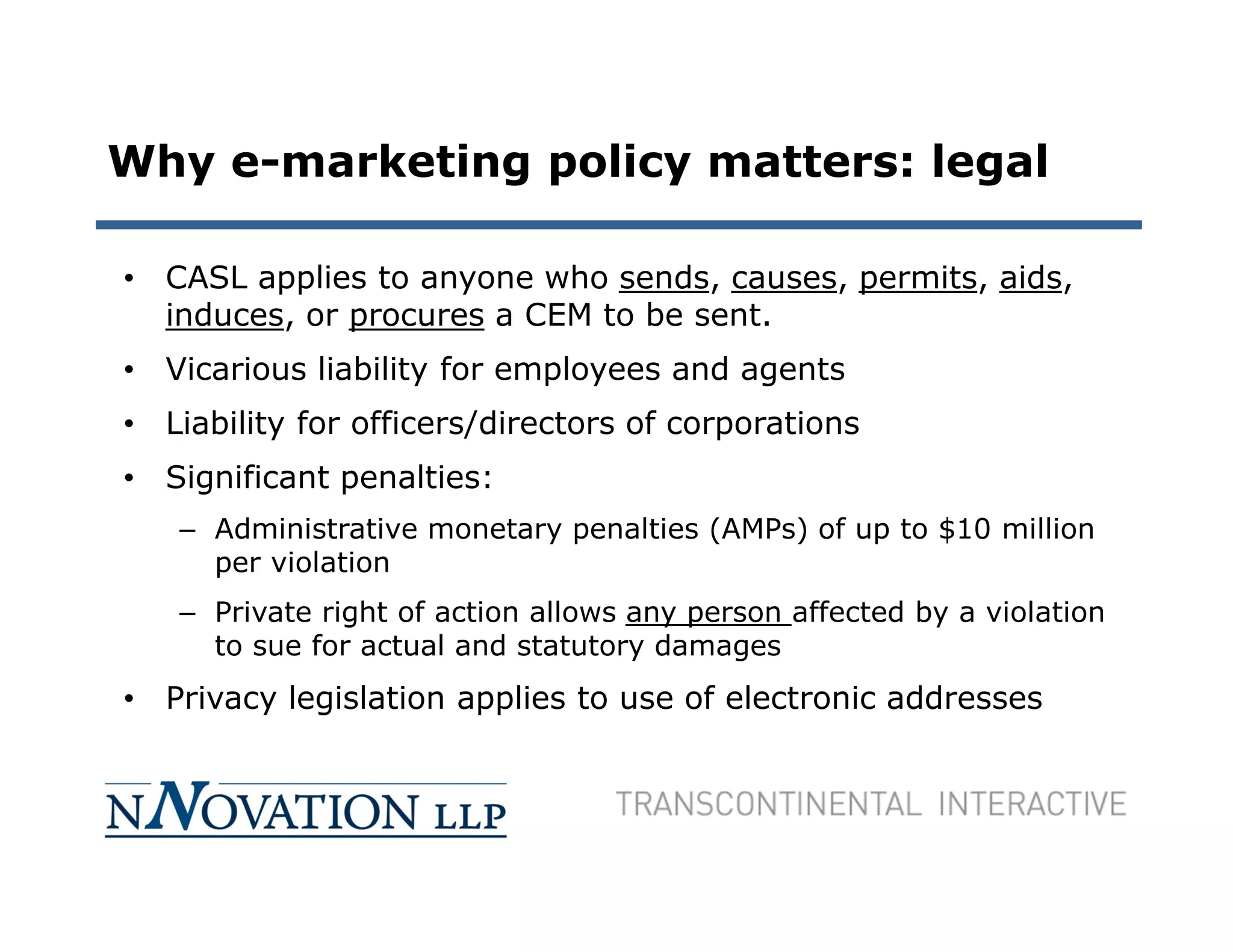
Why e-marketing policy matters: legal

• CASL applies to anyone who sends, causes, permits, aids,
  induces, or procures a CEM to be sent.
• Vicarious liability for employees and agents
• Liability for officers/directors of corporations
• Significant penalties:
   – Administrative monetary penalties (AMPs) of up to $10 million
     per violation
   – Private right of action allows any person affected by a violation
     to sue for actual and statutory damages
• Privacy legislation applies to use of electronic addresses
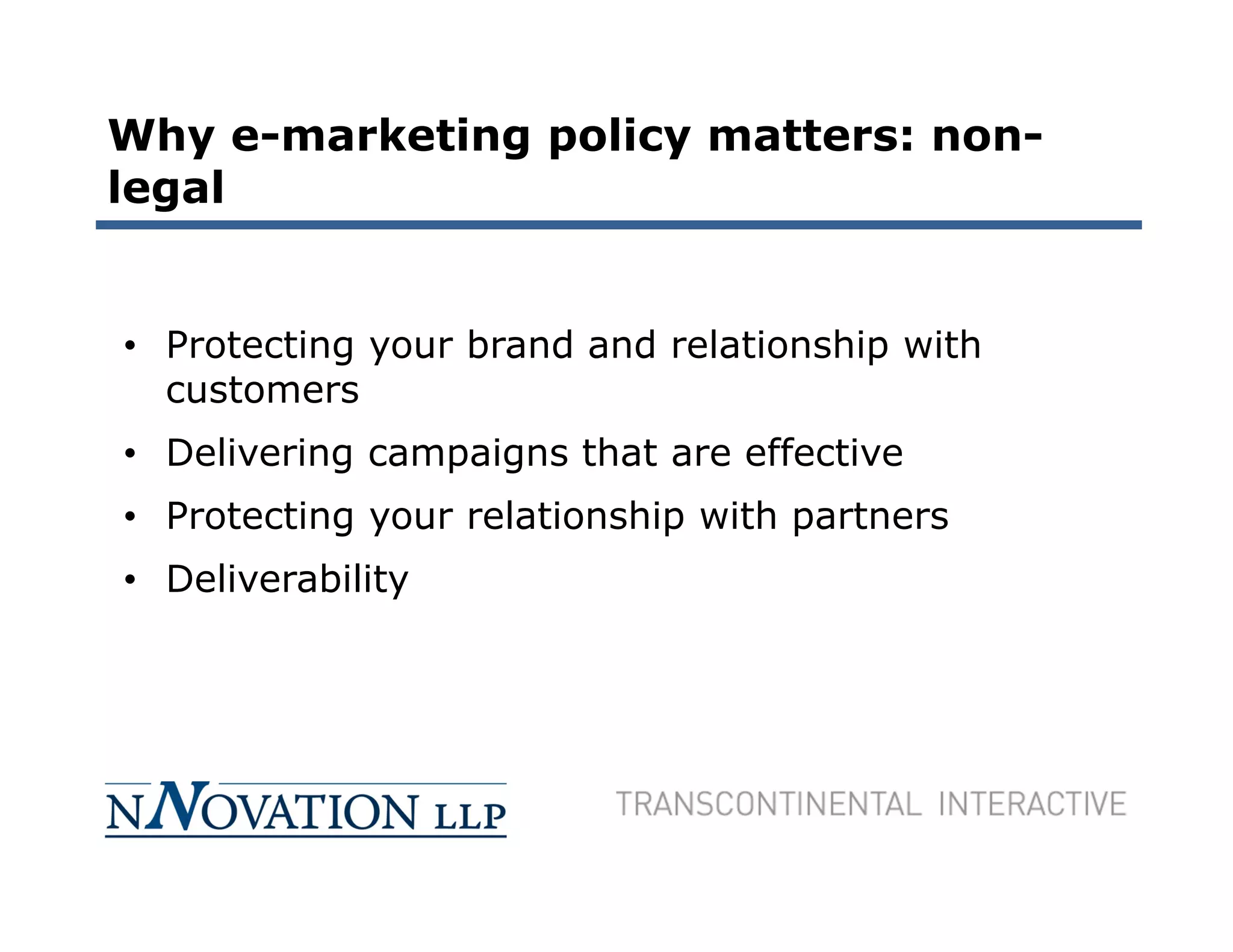
Why e-marketing policy matters: non-
legal


• Protecting your brand and relationship with
  customers
• Delivering campaigns that are effective
• Protecting your relationship with partners
• Deliverability
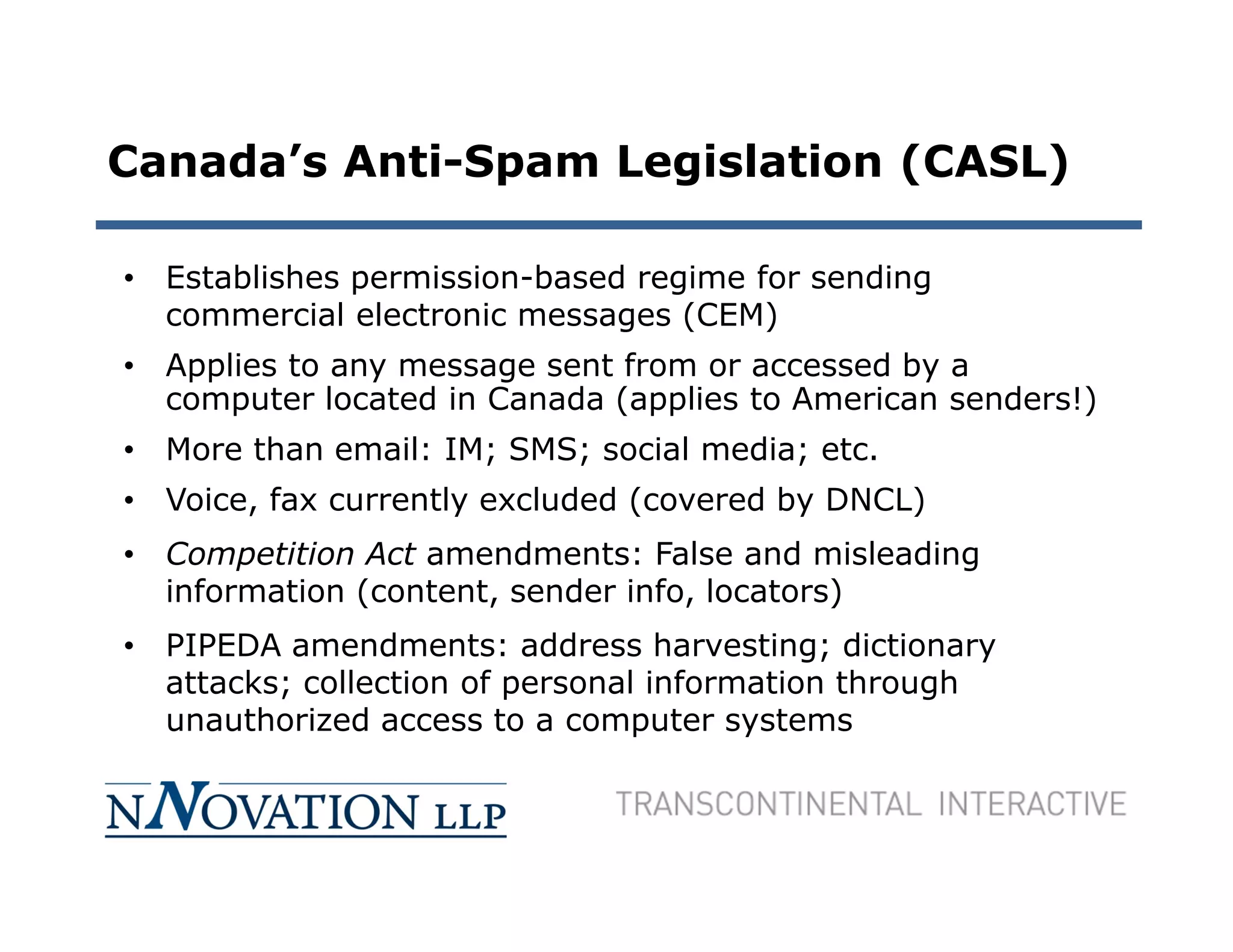
Canada’s Anti-Spam Legislation (CASL)

• Establishes permission-based regime for sending
  commercial electronic messages (CEM)
• Applies to any message sent from or accessed by a
  computer located in Canada (applies to American senders!)
• More than email: IM; SMS; social media; etc.
• Voice, fax currently excluded (covered by DNCL)
• Competition Act amendments: False and misleading
  information (content, sender info, locators)
• PIPEDA amendments: address harvesting; dictionary
  attacks; collection of personal information through
  unauthorized access to a computer systems
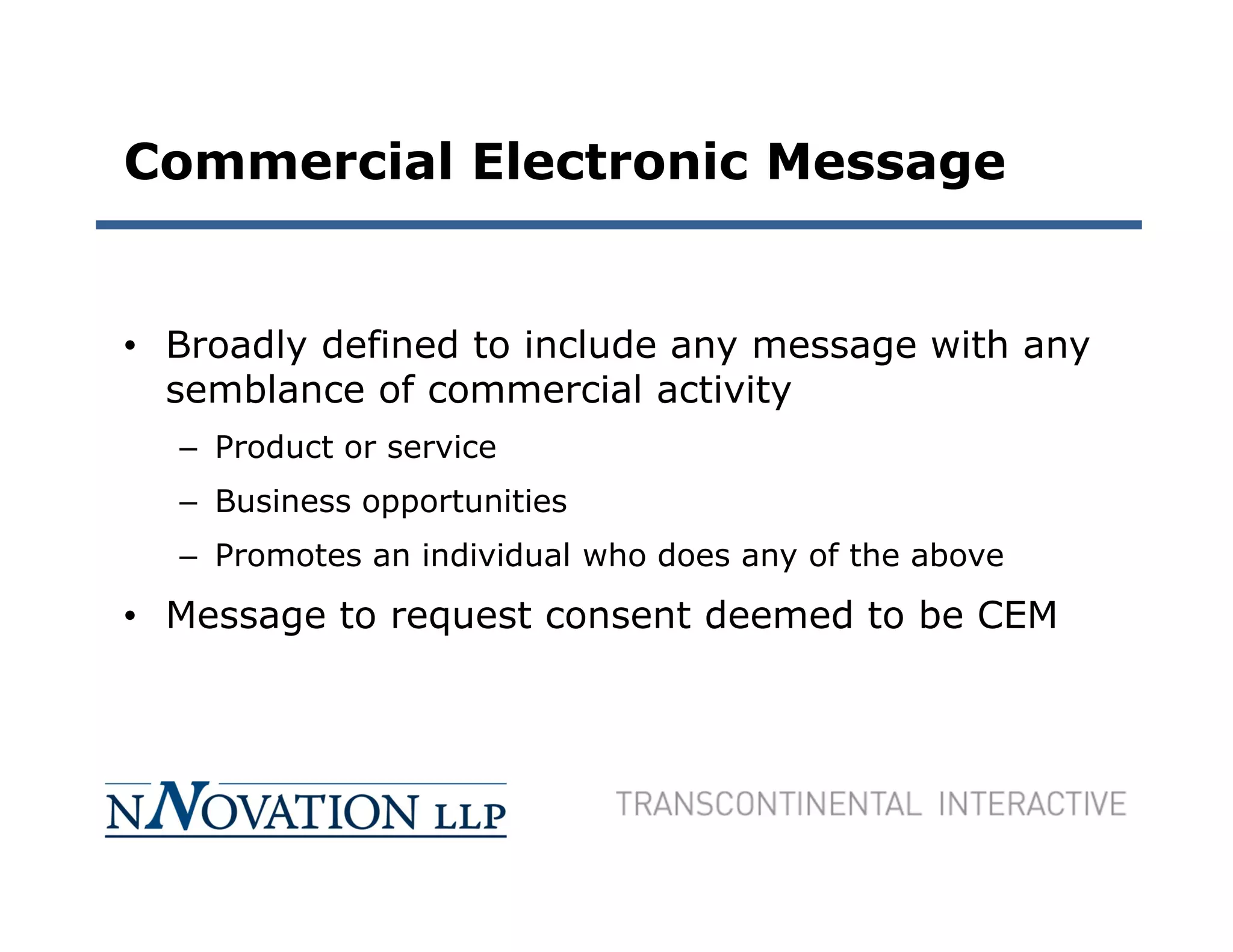
Commercial Electronic Message


• Broadly defined to include any message with any
  semblance of commercial activity
  – Product or service
  – Business opportunities
  – Promotes an individual who does any of the above
• Message to request consent deemed to be CEM
Three primary rules


1. Consent (express or implied)
2. Identification
3. Unsubscribe
1. Consent: exemptions


• Family or personal relationship (to be defined in
  regs)
• Business inquiry
1. Consent: no consent required

• Quotes or estimates, if requested
• Facilitates commercial transaction
• Warranty or safety information
• Information about ongoing subscription, membership, etc.
• Information related to employment relationship or benefit
  plan
• Delivers good or service
  *Other requirements still apply
1. Consent: implied consent

• Consent is deemed in four circumstances:
   1.   Existing business relationship
   2.   Existing non-business relationship
   3.   Conspicuous publication of electronic address
   4.   Recipient has disclosed electronic address to the sender
• No implied consent for referrals
• In most cases implied consent last for 2 years – window of
  opportunity to obtain express consent
• Transitional period for implied consent – 3 years for existing
  bus and non-bus rel’ps at coming into force
1. Consent: checklist


1.   Does section 6 apply (see exemptions)?
2.   If so, do I need consent (other requirements still apply)?
3.   If not, can I rely on implied consent?
4.   If not, how do I obtain express consent?
2. Identification


• Identify sender as well as person on whose behalf message
  is sent
   – Provide postal address
• Contact information for either of above
3. Unsubscribe mechanism


• Must be functional for 60 days
• No cost
• Same means unless impracticable
• Include either electronic address or link
• Must process without delay (no messages sent after unsub
  sent)
Defining “sent”


• Message is sent once transmission has been initiated
• Does not matter whether
   – Message reaches destination
   – electronic address exists
Enforcement


Combination of public and private enforcement:
1.   Regulatory enforcement – including administrative
     monetary penalties (AMPs)
     –   Administrative as opposed of criminal
2.   Private Right of Action
Protection for ‘honest mistakes’
1.   Undertakings & Compliance (s.21)
     – At any time
     – Restricts other action (notice of violation and statutory damages under
       PRA)


2.   Due Diligence Defence and Common Law Principles (s.33)
     – Cannot be found liable
     – Justification or excuse consistent with the Act

3.   Factors to be Considered re: AMPs (s.20)
     – Nature and scope of violation
     – Financial benefit
     – Any relevant factor
Interaction with PIPEDA


• E-marketing already captured by PIPEDA; CASL creates
  more specific rules
• PIPEDA additionally applies to:
   – Sale and purchase of personal information (e.g., email
     addresses)
   – Failure to properly secure personal information (think about
     recent ESP data breaches)
   – Collection of personal information for purposes of targeting
Express consent: requirements


• Must clearly explain purposes
   – E.g., “I would like to receive emails about offers from
     [company]”.
• Sender must identify themselves when obtaining consent
  (and other(s) where applicable)
Express consent: considerations


• What is “express” consent?
   – Opt-in vs. Opt-out; single opt-in, notified opt-in, double opt-in
• Best practice: double opt-in
• Also, think about reminding recipients why they are
  receiving your messages
Building your list: risky ideas


• Purchasing
• Email append
• Rental without assurance that lists are in compliance
• If it sounds too good to be true....
Leveraging your (others) list

• Renting not necessarily a violation, but potentially risky
• There are proper ways to send third party offers to your
  (others) subscribers
• Considerations
   – Relevance
   – Ensuring subscribers know who is sending
   – Consent allows for third party offers; e.g. “I would like to hear
     about offers from [company] and its partners.”
Organic growth is key


• Organic growth allows you to control your lists to be sure
  they are compliant
• 3 common ways to gain subscribers:
   – Online registration/sale
   – Inbound call centers
   – In-store points of sale
• Take advantage of interactions with your brand
• Implied consent provisions can be useful, but obtain
  express consent up front
Other tactics


• Sweepstakes
• Print/television/radio
• Forwarding (FTAF, SWYN)
Forwarding (FTAF, SWYN)


• Offering incentives to forward could result in liability
   – Section 9: is prohibited to aid, induce, procure or cause to be
     procured the doing of any act contrary to section 6
• Impose limits on forwards (how many, to whom)
   – Exemption under 6(5): CASL does not apply to messages sent
     between people with personal or family rel’p
• Share to social – does CASL apply?
   – CASL only applies to CEM sent to an electronic address
B2B considerations


• No general exemption for B2B
• Implied consent:
  – Conspicuous publication
  – Recipient discloses electronic address to sender
• Relevance will be a key issue
• Electronic addresses from web must be collected
  manually (address harvesting prohibited)
What about existing subscribers?


• Good time to consider quality of existing lists
• Do you have evidence of express consent?
• If express consent is required, get creative
   – Response to reconfirmation messages low
   – Offer incentives, new campaign features, etc.
Unsubscribe - considerations


• Applies once the unsub is sent, not received
• Must be implemented without delay, i.e., no
  messages can be sent after an unsubscribe is
  sent
• Pros and cons of allowing people to reply directly
  to message as well as link to unsub
   – Will have to ‘eat’ spam
   – Miss out on opportunity to ask why
ePrivacy Policies


• Key considerations
   – Length of and complexity of your policy
   – Consider the language used based on your audience
• Include vendor and third parties that you work with and the
  types of data shared
Analytics


• List your current analytics program
  – Google Analytics, AWStats, etc…
• List what you track
  – Pages, time on site, What brought you to the site, etc…
• List what you don’t track
  – IP address, etc…
Other considerations


• Responsibility for the actions of marketing dep’t
• Upper mgmt should be involved in developing
  policies
• Be clear about what marketing dep’t is authorized
  to do
• Incentives for marketing dep’t
E-marketing policies: summary

• Agreements with 3rd parties
   – Affiliates
   – Email service providers
• Focus on more than just the rules
   – Best practices
   – Provide value –make subscribers look forward to your
     announcements
• Ensure that PI is collected in compliance with PIPEDA
• Policies and procedures for ‘honest mistakes’ (e.g., contact
  CRTC, notify subscribers)
Questions?


    Shaun Brown, Counsel
    nNovation LLP
    sbrown@nnovation.com


    Matthew Vernhout, Director, Delivery & ISP
    Relations
    Transcontinental Interactive
    matthew.vernhout@transcontinental.ca
References

•   Canada’s Anti-Spam Legislation:
    http://www2.parl.gc.ca/HousePublications/Publication.aspx?Language=E&
    Parl=40&Ses=3&Mode=1&Pub=Bill&Doc=C-28_4
•   Personal Information Protection and Electronic Documents Act:
    http://www.canlii.org/en/ca/laws/stat/sc-2000-c-5/latest/sc-2000-c-
    5.html
•   Brown & Klein, A Complete Guide to e-Marketing Under Canada’s Anti-
    Spam Legislation, (Toronto: Carswell, 2011)
•   EmailKarma.net

e-Marketing Policy-Building Workshop

  • 1.
    e-Marketing Policy-Building Workshop Shaun Brown – nNovation LLP Matthew Vernhout – Transcontinental Interactive IAPP Canada Privacy Symposium May 4-6, 2011
  • 2.
    Roadmap 1. Why this matters 2. Brief overview of requirements under CASL, Competition Act and PIPEDA 3. Practical implementation issues 4. Key considerations in developing e-marketing policies
  • 3.
    Why e-marketing policymatters: legal • CASL applies to anyone who sends, causes, permits, aids, induces, or procures a CEM to be sent. • Vicarious liability for employees and agents • Liability for officers/directors of corporations • Significant penalties: – Administrative monetary penalties (AMPs) of up to $10 million per violation – Private right of action allows any person affected by a violation to sue for actual and statutory damages • Privacy legislation applies to use of electronic addresses
  • 4.
    Why e-marketing policymatters: non- legal • Protecting your brand and relationship with customers • Delivering campaigns that are effective • Protecting your relationship with partners • Deliverability
  • 5.
    Canada’s Anti-Spam Legislation(CASL) • Establishes permission-based regime for sending commercial electronic messages (CEM) • Applies to any message sent from or accessed by a computer located in Canada (applies to American senders!) • More than email: IM; SMS; social media; etc. • Voice, fax currently excluded (covered by DNCL) • Competition Act amendments: False and misleading information (content, sender info, locators) • PIPEDA amendments: address harvesting; dictionary attacks; collection of personal information through unauthorized access to a computer systems
  • 6.
    Commercial Electronic Message •Broadly defined to include any message with any semblance of commercial activity – Product or service – Business opportunities – Promotes an individual who does any of the above • Message to request consent deemed to be CEM
  • 7.
    Three primary rules 1.Consent (express or implied) 2. Identification 3. Unsubscribe
  • 8.
    1. Consent: exemptions •Family or personal relationship (to be defined in regs) • Business inquiry
  • 9.
    1. Consent: noconsent required • Quotes or estimates, if requested • Facilitates commercial transaction • Warranty or safety information • Information about ongoing subscription, membership, etc. • Information related to employment relationship or benefit plan • Delivers good or service *Other requirements still apply
  • 10.
    1. Consent: impliedconsent • Consent is deemed in four circumstances: 1. Existing business relationship 2. Existing non-business relationship 3. Conspicuous publication of electronic address 4. Recipient has disclosed electronic address to the sender • No implied consent for referrals • In most cases implied consent last for 2 years – window of opportunity to obtain express consent • Transitional period for implied consent – 3 years for existing bus and non-bus rel’ps at coming into force
  • 11.
    1. Consent: checklist 1. Does section 6 apply (see exemptions)? 2. If so, do I need consent (other requirements still apply)? 3. If not, can I rely on implied consent? 4. If not, how do I obtain express consent?
  • 12.
    2. Identification • Identifysender as well as person on whose behalf message is sent – Provide postal address • Contact information for either of above
  • 13.
    3. Unsubscribe mechanism •Must be functional for 60 days • No cost • Same means unless impracticable • Include either electronic address or link • Must process without delay (no messages sent after unsub sent)
  • 14.
    Defining “sent” • Messageis sent once transmission has been initiated • Does not matter whether – Message reaches destination – electronic address exists
  • 15.
    Enforcement Combination of publicand private enforcement: 1. Regulatory enforcement – including administrative monetary penalties (AMPs) – Administrative as opposed of criminal 2. Private Right of Action
  • 16.
    Protection for ‘honestmistakes’ 1. Undertakings & Compliance (s.21) – At any time – Restricts other action (notice of violation and statutory damages under PRA) 2. Due Diligence Defence and Common Law Principles (s.33) – Cannot be found liable – Justification or excuse consistent with the Act 3. Factors to be Considered re: AMPs (s.20) – Nature and scope of violation – Financial benefit – Any relevant factor
  • 17.
    Interaction with PIPEDA •E-marketing already captured by PIPEDA; CASL creates more specific rules • PIPEDA additionally applies to: – Sale and purchase of personal information (e.g., email addresses) – Failure to properly secure personal information (think about recent ESP data breaches) – Collection of personal information for purposes of targeting
  • 18.
    Express consent: requirements •Must clearly explain purposes – E.g., “I would like to receive emails about offers from [company]”. • Sender must identify themselves when obtaining consent (and other(s) where applicable)
  • 19.
    Express consent: considerations •What is “express” consent? – Opt-in vs. Opt-out; single opt-in, notified opt-in, double opt-in • Best practice: double opt-in • Also, think about reminding recipients why they are receiving your messages
  • 20.
    Building your list:risky ideas • Purchasing • Email append • Rental without assurance that lists are in compliance • If it sounds too good to be true....
  • 21.
    Leveraging your (others)list • Renting not necessarily a violation, but potentially risky • There are proper ways to send third party offers to your (others) subscribers • Considerations – Relevance – Ensuring subscribers know who is sending – Consent allows for third party offers; e.g. “I would like to hear about offers from [company] and its partners.”
  • 22.
    Organic growth iskey • Organic growth allows you to control your lists to be sure they are compliant • 3 common ways to gain subscribers: – Online registration/sale – Inbound call centers – In-store points of sale • Take advantage of interactions with your brand • Implied consent provisions can be useful, but obtain express consent up front
  • 23.
    Other tactics • Sweepstakes •Print/television/radio • Forwarding (FTAF, SWYN)
  • 24.
    Forwarding (FTAF, SWYN) •Offering incentives to forward could result in liability – Section 9: is prohibited to aid, induce, procure or cause to be procured the doing of any act contrary to section 6 • Impose limits on forwards (how many, to whom) – Exemption under 6(5): CASL does not apply to messages sent between people with personal or family rel’p • Share to social – does CASL apply? – CASL only applies to CEM sent to an electronic address
  • 25.
    B2B considerations • Nogeneral exemption for B2B • Implied consent: – Conspicuous publication – Recipient discloses electronic address to sender • Relevance will be a key issue • Electronic addresses from web must be collected manually (address harvesting prohibited)
  • 26.
    What about existingsubscribers? • Good time to consider quality of existing lists • Do you have evidence of express consent? • If express consent is required, get creative – Response to reconfirmation messages low – Offer incentives, new campaign features, etc.
  • 27.
    Unsubscribe - considerations •Applies once the unsub is sent, not received • Must be implemented without delay, i.e., no messages can be sent after an unsubscribe is sent • Pros and cons of allowing people to reply directly to message as well as link to unsub – Will have to ‘eat’ spam – Miss out on opportunity to ask why
  • 28.
    ePrivacy Policies • Keyconsiderations – Length of and complexity of your policy – Consider the language used based on your audience • Include vendor and third parties that you work with and the types of data shared
  • 29.
    Analytics • List yourcurrent analytics program – Google Analytics, AWStats, etc… • List what you track – Pages, time on site, What brought you to the site, etc… • List what you don’t track – IP address, etc…
  • 30.
    Other considerations • Responsibilityfor the actions of marketing dep’t • Upper mgmt should be involved in developing policies • Be clear about what marketing dep’t is authorized to do • Incentives for marketing dep’t
  • 31.
    E-marketing policies: summary •Agreements with 3rd parties – Affiliates – Email service providers • Focus on more than just the rules – Best practices – Provide value –make subscribers look forward to your announcements • Ensure that PI is collected in compliance with PIPEDA • Policies and procedures for ‘honest mistakes’ (e.g., contact CRTC, notify subscribers)
  • 32.
    Questions? Shaun Brown, Counsel nNovation LLP sbrown@nnovation.com Matthew Vernhout, Director, Delivery & ISP Relations Transcontinental Interactive matthew.vernhout@transcontinental.ca
  • 33.
    References • Canada’s Anti-Spam Legislation: http://www2.parl.gc.ca/HousePublications/Publication.aspx?Language=E& Parl=40&Ses=3&Mode=1&Pub=Bill&Doc=C-28_4 • Personal Information Protection and Electronic Documents Act: http://www.canlii.org/en/ca/laws/stat/sc-2000-c-5/latest/sc-2000-c- 5.html • Brown & Klein, A Complete Guide to e-Marketing Under Canada’s Anti- Spam Legislation, (Toronto: Carswell, 2011) • EmailKarma.net