RPA
AUTOMATION
ANYWHERE
TaskBots
Overview
1.What is RPA
2.The Benefits of RPA
3.How does Enterprise RPA work
4.Features of Enterprise RPA Solution
5.RPA use cases by Industry
6.The Evolution of RPA
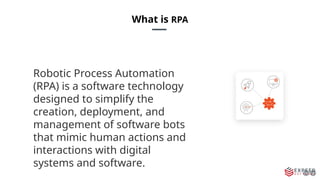
What is RPA
Robotic Process Automation
(RPA) is a software technology
designed to simplify the
creation, deployment, and
management of software bots
that mimic human actions and
interactions with digital
systems and software.
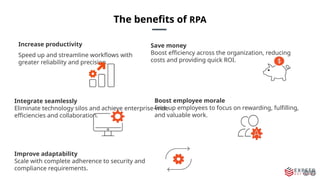
The benefits of RPA
Increase productivity
Speed up and streamline workflows with
greater reliability and precision.
Save money
Boost efficiency across the organization, reducing
costs and providing quick ROI.
Integrate seamlessly
Eliminate technology silos and achieve enterprise-wide
efficiencies and collaboration.
Boost employee morale
Free up employees to focus on rewarding, fulfilling,
and valuable work.
Improve adaptability
Scale with complete adherence to security and
compliance requirements.
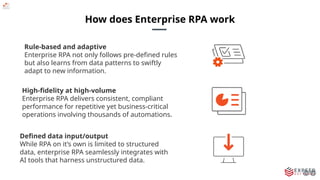
How does Enterprise RPA work
Rule-based and adaptive
Enterprise RPA not only follows pre-defined rules
but also learns from data patterns to swiftly
adapt to new information.
High-fidelity at high-volume
Enterprise RPA delivers consistent, compliant
performance for repetitive yet business-critical
operations involving thousands of automations.
Defined data input/output
While RPA on it’s own is limited to structured
data, enterprise RPA seamlessly integrates with
AI tools that harness unstructured data.
Features of Enterprise RPA Solution
Scale
Low-code/No-code
Interoperability and integration
Orchestration Audit and governance
Security
Cloud-native
Data privacy and compliance
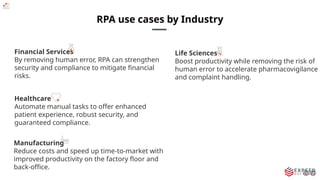
RPA use cases by Industry
Financial Services
By removing human error, RPA can strengthen
security and compliance to mitigate financial
risks.
Healthcare
Automate manual tasks to offer enhanced
patient experience, robust security, and
guaranteed compliance.
Manufacturing
Reduce costs and speed up time-to-market with
improved productivity on the factory floor and
back-office.
Life Sciences
Boost productivity while removing the risk of
human error to accelerate pharmacovigilance
and complaint handling.
The Evolution of RPA
Robotic process automation has
come a long way in a short time.
1.Automating repetitive tasks
2.Democratizing automation
3.Introducing AI
4.Expanding use cases
Let’s
Innovate
Together
www.expeed.com

Unlocking Efficiency with RPA: A Deep Dive into Automation Anywhere Task Bots

  • 1.
  • 2.
    Overview 1.What is RPA 2.TheBenefits of RPA 3.How does Enterprise RPA work 4.Features of Enterprise RPA Solution 5.RPA use cases by Industry 6.The Evolution of RPA
  • 3.
    What is RPA RoboticProcess Automation (RPA) is a software technology designed to simplify the creation, deployment, and management of software bots that mimic human actions and interactions with digital systems and software.
  • 4.
    The benefits ofRPA Increase productivity Speed up and streamline workflows with greater reliability and precision. Save money Boost efficiency across the organization, reducing costs and providing quick ROI. Integrate seamlessly Eliminate technology silos and achieve enterprise-wide efficiencies and collaboration. Boost employee morale Free up employees to focus on rewarding, fulfilling, and valuable work. Improve adaptability Scale with complete adherence to security and compliance requirements.
  • 5.
    How does EnterpriseRPA work Rule-based and adaptive Enterprise RPA not only follows pre-defined rules but also learns from data patterns to swiftly adapt to new information. High-fidelity at high-volume Enterprise RPA delivers consistent, compliant performance for repetitive yet business-critical operations involving thousands of automations. Defined data input/output While RPA on it’s own is limited to structured data, enterprise RPA seamlessly integrates with AI tools that harness unstructured data.
  • 6.
    Features of EnterpriseRPA Solution Scale Low-code/No-code Interoperability and integration Orchestration Audit and governance Security Cloud-native Data privacy and compliance
  • 7.
    RPA use casesby Industry Financial Services By removing human error, RPA can strengthen security and compliance to mitigate financial risks. Healthcare Automate manual tasks to offer enhanced patient experience, robust security, and guaranteed compliance. Manufacturing Reduce costs and speed up time-to-market with improved productivity on the factory floor and back-office. Life Sciences Boost productivity while removing the risk of human error to accelerate pharmacovigilance and complaint handling.
  • 8.
    The Evolution ofRPA Robotic process automation has come a long way in a short time. 1.Automating repetitive tasks 2.Democratizing automation 3.Introducing AI 4.Expanding use cases
  • 9.