FLUTTER
TheMostPopularCross–Platform
AppDevelopmentSDK
NATIVE APP AND HYBRID APP
• Native app is developed for a particular platform.
• Uses languages that are native to platform.
• They are generally faster and responsive than hybrid apps.
• Example:
i) App developed in iOS using swift.
ii) App developed in android using Kotlin.
NATIVE APP AND HYBRID APP
• Hybrid app combines the features of both native and web apps.
• Type of cross-platform app development
• It uses web technologies such as HTML,CSS and JavaScript.
• Hybrid apps are developed using frameworks such as React
Native,Xamarin etc.
• Allows developers to create apps that can run on both android and
iOS.
• Cross-platform development refers to the practice of creating software
applications that can run on multiple operating systems or platforms.
• This allows developers to write code once and deploy it across various
platforms.
• This saves time and reduce effort compared to building separate versions
for each operating system.
WHAT IS A CROSS-PLATFORM APP DEVELOPMENT ?
WHY FLUTTER ?
o Google's UI Toolkit: Flutter is an open-source UI
toolkit developed by Google for building natively
compiled applications for mobile, web, and
desktop from a single codebase.
o Cross-Platform Development: Flutter enables
developers to write code once and deploy it
across multiple platforms.
o Dart Programming Language
WHY FLUTTER ?
o Flutter’s widget-based system makes it simple to create great-looking
interfaces, and it works well on different platforms.
o . Hot Reload Feature: This allows developers to instantly see changes made to
the code reflected in the app's UI without restarting the application.
o Flutter aims to provide 60fps performance or 120fps performance on a device
capable of 120hz.
o This framework is popular for being flexible, easy to learn, and great for
making custom designs.
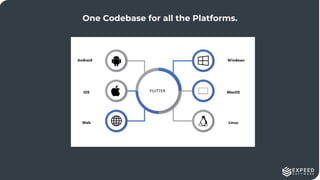
One Codebase for all the Platforms.
Dart Programming Language: The Backbone of Flutter
o Designed for Productivity and Performance: Dart is engineered
to strike a balance between developer productivity and application
performance.
o Familiar Syntax for JavaScript and Java Developers
o Supports Both JIT and AOT Compilation: Dart supports both Just-
In-Time (JIT) and Ahead-Of-Time (AOT) compilation, offering
flexibility in how Flutter applications are compiled and optimized
for performance.
.
FLUTTER SHOWCASE
WHAT ARE THE DOWNSIDES OF USING FLUTTER?
o Large apps : Flutter apps carry all the needed code to run the app, making
them bigger than other apps that rely on platform elements.
o Lack of third-party libraries : Flutter has a wide range of built-in widgets,
and its official package site offers thousands of choices. However, since
Flutter is still relatively new, there are fewer resources for third-party
libraries compared to other development tools.
o It may be better for Android than iOS : It’s not unexpected that Flutter’s
performance might lean more towards Android than iOS. Some instances
already show iOS features trailing behind as Flutter updates are rolled out.
Let’s
Innovate
Together
www.expeed.com

What makes Flutter the best cross platform sdk

  • 1.
  • 2.
    NATIVE APP ANDHYBRID APP • Native app is developed for a particular platform. • Uses languages that are native to platform. • They are generally faster and responsive than hybrid apps. • Example: i) App developed in iOS using swift. ii) App developed in android using Kotlin.
  • 3.
    NATIVE APP ANDHYBRID APP • Hybrid app combines the features of both native and web apps. • Type of cross-platform app development • It uses web technologies such as HTML,CSS and JavaScript. • Hybrid apps are developed using frameworks such as React Native,Xamarin etc. • Allows developers to create apps that can run on both android and iOS.
  • 4.
    • Cross-platform developmentrefers to the practice of creating software applications that can run on multiple operating systems or platforms. • This allows developers to write code once and deploy it across various platforms. • This saves time and reduce effort compared to building separate versions for each operating system. WHAT IS A CROSS-PLATFORM APP DEVELOPMENT ?
  • 6.
    WHY FLUTTER ? oGoogle's UI Toolkit: Flutter is an open-source UI toolkit developed by Google for building natively compiled applications for mobile, web, and desktop from a single codebase. o Cross-Platform Development: Flutter enables developers to write code once and deploy it across multiple platforms. o Dart Programming Language
  • 7.
    WHY FLUTTER ? oFlutter’s widget-based system makes it simple to create great-looking interfaces, and it works well on different platforms. o . Hot Reload Feature: This allows developers to instantly see changes made to the code reflected in the app's UI without restarting the application. o Flutter aims to provide 60fps performance or 120fps performance on a device capable of 120hz. o This framework is popular for being flexible, easy to learn, and great for making custom designs.
  • 8.
    One Codebase forall the Platforms.
  • 9.
    Dart Programming Language:The Backbone of Flutter o Designed for Productivity and Performance: Dart is engineered to strike a balance between developer productivity and application performance. o Familiar Syntax for JavaScript and Java Developers o Supports Both JIT and AOT Compilation: Dart supports both Just- In-Time (JIT) and Ahead-Of-Time (AOT) compilation, offering flexibility in how Flutter applications are compiled and optimized for performance. .
  • 10.
  • 11.
    WHAT ARE THEDOWNSIDES OF USING FLUTTER? o Large apps : Flutter apps carry all the needed code to run the app, making them bigger than other apps that rely on platform elements. o Lack of third-party libraries : Flutter has a wide range of built-in widgets, and its official package site offers thousands of choices. However, since Flutter is still relatively new, there are fewer resources for third-party libraries compared to other development tools. o It may be better for Android than iOS : It’s not unexpected that Flutter’s performance might lean more towards Android than iOS. Some instances already show iOS features trailing behind as Flutter updates are rolled out.
  • 12.