SOFTWARE PROJECT
MANAGEMENT
Submitted by
R. Girisakthi
II MSC CS
Nadar saraswathi college of arts
and science
Project Tracking
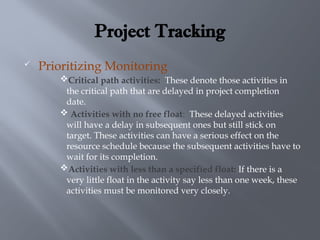
 Prioritizing Monitoring
Critical path activities: These denote those activities in
the critical path that are delayed in project completion
date.
 Activities with no free float: These delayed activities
will have a delay in subsequent ones but still stick on
target. These activities can have a serious effect on the
resource schedule because the subsequent activities have to
wait for its completion.
Activities with less than a specified float: If there is a
very little float in the activity say less than one week, these
activities must be monitored very closely.
 Getting back Project on Target:
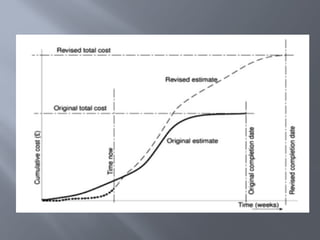
Projects are subjected to delays and unexpected
events.
The project manager must ensure that the
project scheduled end dates are unaffected at any
circumstances.
To maintain the project within the completed
time, duration of some activity of the project can
be delayed or shorten to fit into the time limit.
The strategies involved in getting back the
project to target are;
 Critical path shortening
 Reconsidering precedence requirements
Critical Path Shortening
 Delayed projects can often be brought back on
track by shortening activity times on the critical
path.
 Critical path is determined by the overall duration
of the project.
 By increasing the resources for the critical path
activities results in completion of the activity
before time.
 At the same time, the resources used must be
effectively allocated to all the activities so that no
resources are idle at any point of time.
 Swapping of critical and non- critical activities
can also be used to shorten the time limit and
bring the project back to target.
 One disadvantage of shortening critical path is
that, it produces many more paths while
shortening which can become critical.
Change Control
 Change control implies the authority to
approve and rank the changes. It combines the
automated tool with human to provide a
mechanism for control of change.
 Any changes or alteration done to a single
document often implies changes to other
documents as well.
 Change request is evaluated to assess the
technical aspect of configuration items and the
budget.
 Role of Change Control Manager
Identification of configuration items that are
subjected to change control.
All project documentation and software
products must be maintained in the central
repository.
A formal set of procedures have to be setup to
have control over changes.
 Maintenance of library items in the repository
 System Scope Changes
Any changes done leads to changes in the size
of the system which gradually increases.
 The changes can be either from the
management of from the user.
For every change that is implemented, the
scope of the developing project must be very
carefully monitored and controlled.
The changes made should not make the system
to be inconsistent by affecting the estimating
factors.
THANK YOU!!!

Project Tracking , Change Control in SPM

  • 1.
    SOFTWARE PROJECT MANAGEMENT Submitted by R.Girisakthi II MSC CS Nadar saraswathi college of arts and science
  • 2.
    Project Tracking  PrioritizingMonitoring Critical path activities: These denote those activities in the critical path that are delayed in project completion date.  Activities with no free float: These delayed activities will have a delay in subsequent ones but still stick on target. These activities can have a serious effect on the resource schedule because the subsequent activities have to wait for its completion. Activities with less than a specified float: If there is a very little float in the activity say less than one week, these activities must be monitored very closely.
  • 4.
     Getting backProject on Target: Projects are subjected to delays and unexpected events. The project manager must ensure that the project scheduled end dates are unaffected at any circumstances. To maintain the project within the completed time, duration of some activity of the project can be delayed or shorten to fit into the time limit. The strategies involved in getting back the project to target are;  Critical path shortening  Reconsidering precedence requirements
  • 5.
    Critical Path Shortening Delayed projects can often be brought back on track by shortening activity times on the critical path.  Critical path is determined by the overall duration of the project.  By increasing the resources for the critical path activities results in completion of the activity before time.  At the same time, the resources used must be effectively allocated to all the activities so that no resources are idle at any point of time.
  • 6.
     Swapping ofcritical and non- critical activities can also be used to shorten the time limit and bring the project back to target.  One disadvantage of shortening critical path is that, it produces many more paths while shortening which can become critical.
  • 7.
    Change Control  Changecontrol implies the authority to approve and rank the changes. It combines the automated tool with human to provide a mechanism for control of change.  Any changes or alteration done to a single document often implies changes to other documents as well.  Change request is evaluated to assess the technical aspect of configuration items and the budget.
  • 8.
     Role ofChange Control Manager Identification of configuration items that are subjected to change control. All project documentation and software products must be maintained in the central repository. A formal set of procedures have to be setup to have control over changes.  Maintenance of library items in the repository
  • 9.
     System ScopeChanges Any changes done leads to changes in the size of the system which gradually increases.  The changes can be either from the management of from the user. For every change that is implemented, the scope of the developing project must be very carefully monitored and controlled. The changes made should not make the system to be inconsistent by affecting the estimating factors.
  • 10.