Nature and Purpose of Planning
UNIT 2: PLANNING
1
Need for Planning?
1. Why and how do managers plan?
2. What types of plans do managers use?
3. What are the useful planning tools and
techniques?
4. How can plans be well implemented?
1. Why and How Managers Plan
1. Importance of planning
2. The planning process
3. Benefits of planning
2. Types of Plans Used by Managers
1. Long-range and short-range plans
2. Strategic and tactical plans
3. Operational plans
3. Planning Tools and Techniques
1. Forecasting
2. Contingency planning
3. Scenario planning
4. Benchmarking
5. Use of staff planners
4. Implementing Plans to Achieve Results
1. Goal setting
2. Goal alignment
3. Participation and involvement
Takeaway 1: Why and How Managers Plan
• Planning
• The process of setting objectives and determining how to
accomplish them
• Objectives and goals
• Identify the specific results or desired outcomes that one
intends to achieve
• Plan
• A statement of action steps to be taken in order to
accomplish the objectives
Definitions of Planning
• “Planning is the selecting and relating of facts and the making
and using of assumptions regarding the future in the visualization
to achieve desire results.”- George Terry
• “Planning is deciding advance what to do, how to do it, when to
do it, who is to do it. It bridges the gap between where we are,
where we want to go. It makes it possible for things to occur
which would not otherwise happen.” - Koontz and O’Donnel
• Based on futurity: “Planning is a trap laid down to capture the
future”-Allen.
• “Planning is informed anticipation of future”-Haimann.
• “Planning is ‘anticipatory’ decision-making”-R.L. Ackoff.
Planning
 Planning is an intellectual process which requires a
manager to think before acting.
 Planning is continuous process.
 Plan must be flexible.
 Change direction to adept to changing situation
 Technology (changing need)
 Market (Marketing Strategies)
 Finance (Obtain Fund)
 Personnel (Job Rotation)
 Organization (organizational structure )
Nature of Planning
Planning is goal-oriented
Primacy of Planning
Pervasiveness of Planning
Efficiency, Economy and Accuracy
Planning is an intellectual process
Limiting Factors
Flexibility
Co-ordination
8
Nature of Planning (Contd…)
i. Planning is goal-oriented: Every plan must contribute in some
positive way towards the accomplishment of group objectives.
Planning has no meaning without being related to goals.
ii. Primacy of Planning: Planning is the first of the managerial
functions. It precedes all other management functions.
iii. Pervasiveness of Planning: Planning is found at all levels of
management. Top management looks after strategic planning.
Middle management is in charge of administrative planning. Lower
management has to concentrate on operational planning.
iv. Efficiency, Economy and Accuracy: Efficiency of plan is measured
by its contribution to the objectives as economically as possible.
Planning also focuses on accurate forecasts. Contd…
9
Nature of Planning (Contd…)
v. Planning is an intellectual process: The quality of planning will
vary according to the quality of the mind of the manager.
vi. Limiting Factors: A planner must recognize the limiting factors
(money, manpower etc) and formulate plans in the light of these
critical factors.
vii. Flexibility: The process of planning should be adaptable to
changing environmental conditions.
viii. Co-ordination: Planning co-ordinates the what, who, how,
where and why of planning. Without co-ordination of all activities,
we cannot have united efforts.
10
Purposes/Importance of Planning
Planning seems to take a lot of effort. As a managerial function
planning is important due to the following reasons:-
i. To provide direction
ii. To reduce / offset uncertainty and change
iii. To minimize waste and redundancy
iv. To set the standards to make control effective
v. To manage by objectives
vi. To help in co-ordination
vii. To secure economy in operation
viii. To increase organizational effectiveness
11
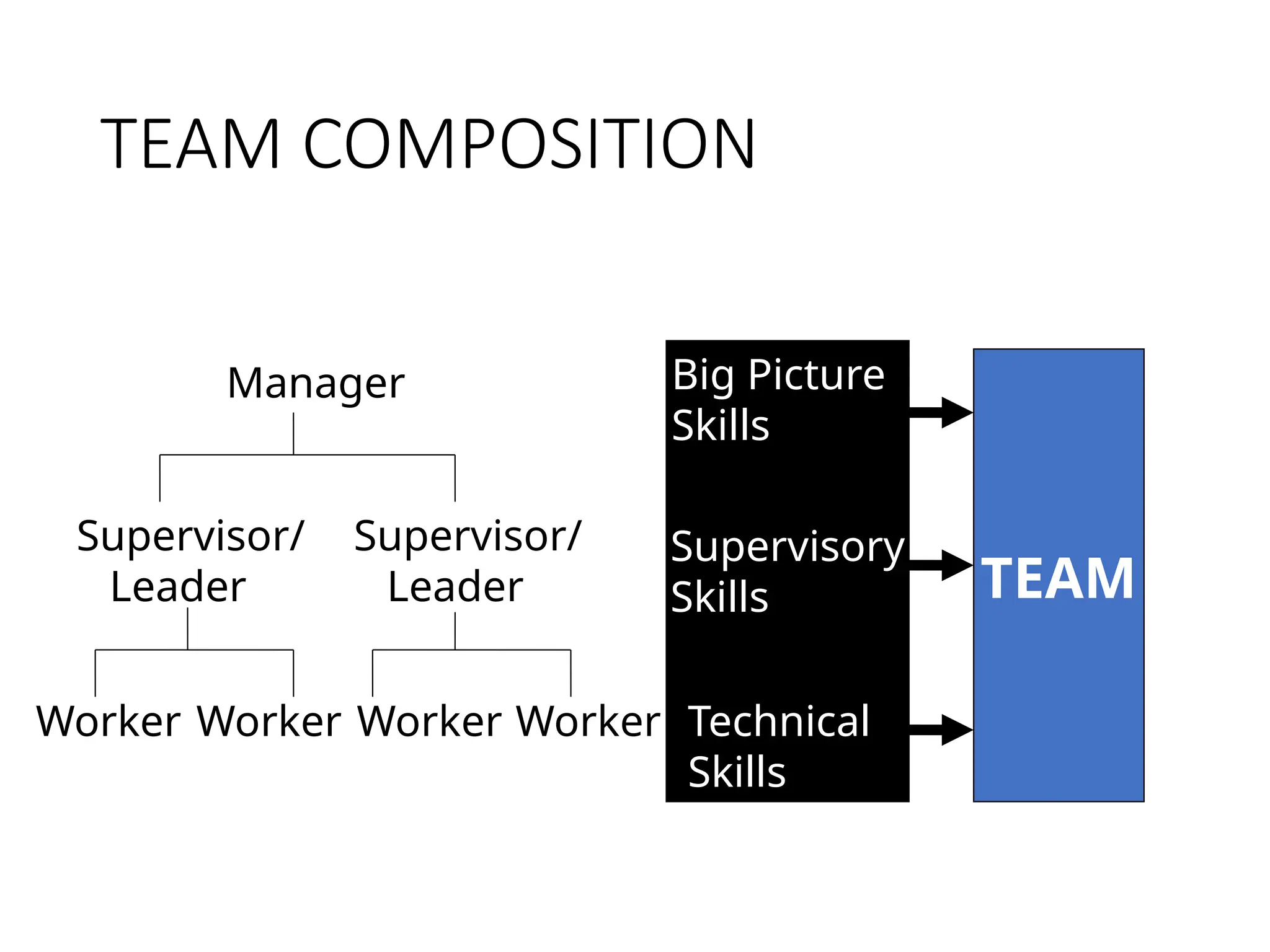
TEAM COMPOSITION
Manager
Supervisor/
Leader
Supervisor/
Leader
Worker
Worker
Worker
Worker
Big Picture
Skills
Supervisory
Skills
Technical
Skills
TEAM
Supervisor’s Job:
GET THE WORK DONE . . .
THROUGH OTHERS!
How does a supervisor do it?
•Plans work
•Allocates resources
•Makes decisions
•Provides direction to the team
•Solves problems
•Measures and reports results
PLANS WORK
•What needs to be done?
•What are the priorities?
•Who will do the work?
• When will it be done?
Types of Plans
•Daily
•Weekly
•Monthly
•Quarterly
•Fiscal Year (Budget)
•Strategic (Long-Range)
Other Plans
•Special Projects or Events
•Emergency Operational Plans
•Staffing Plans
Ready . . . Aim . . . Fire!
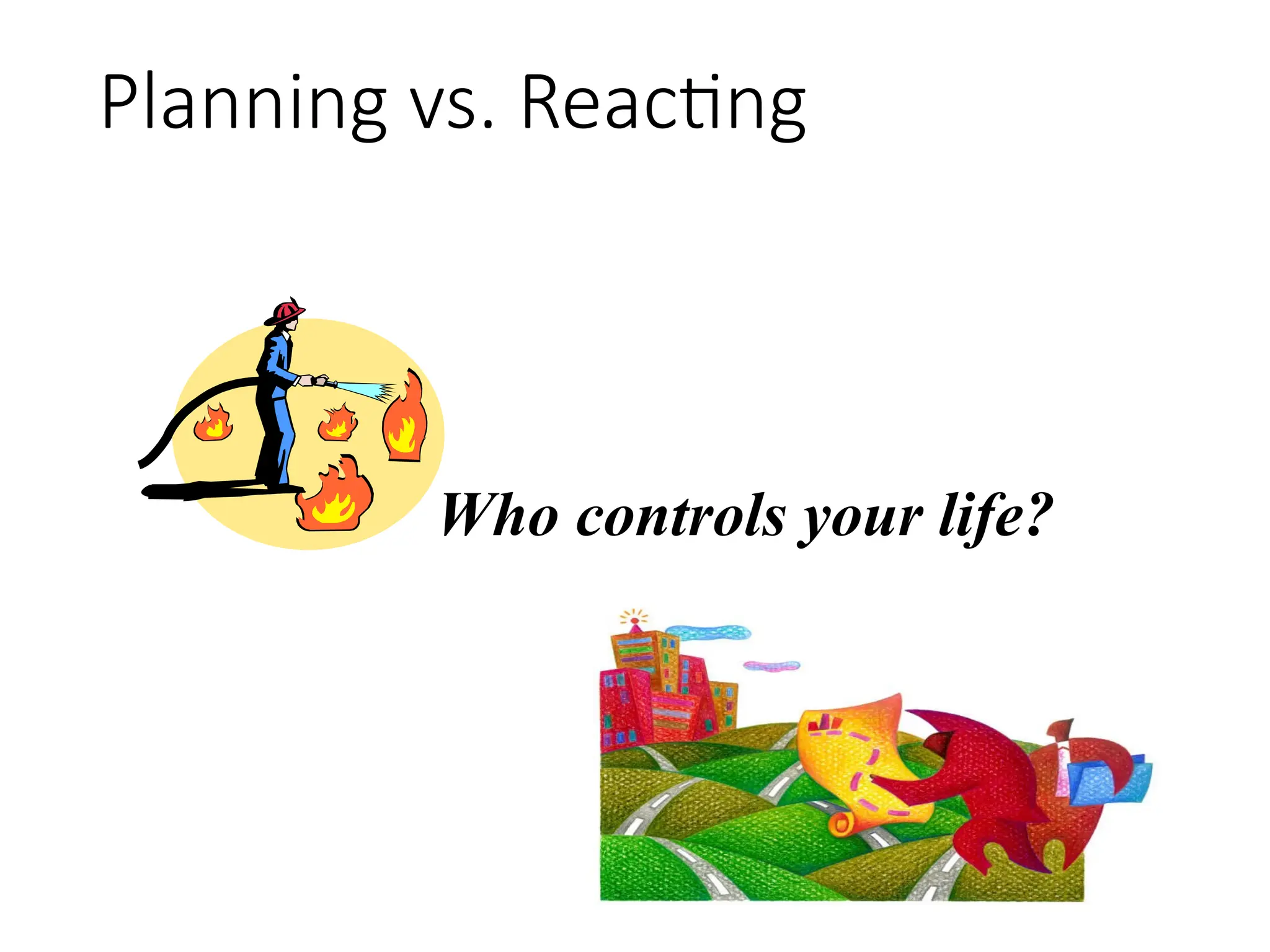
Planning vs. Reacting
Who controls your life?
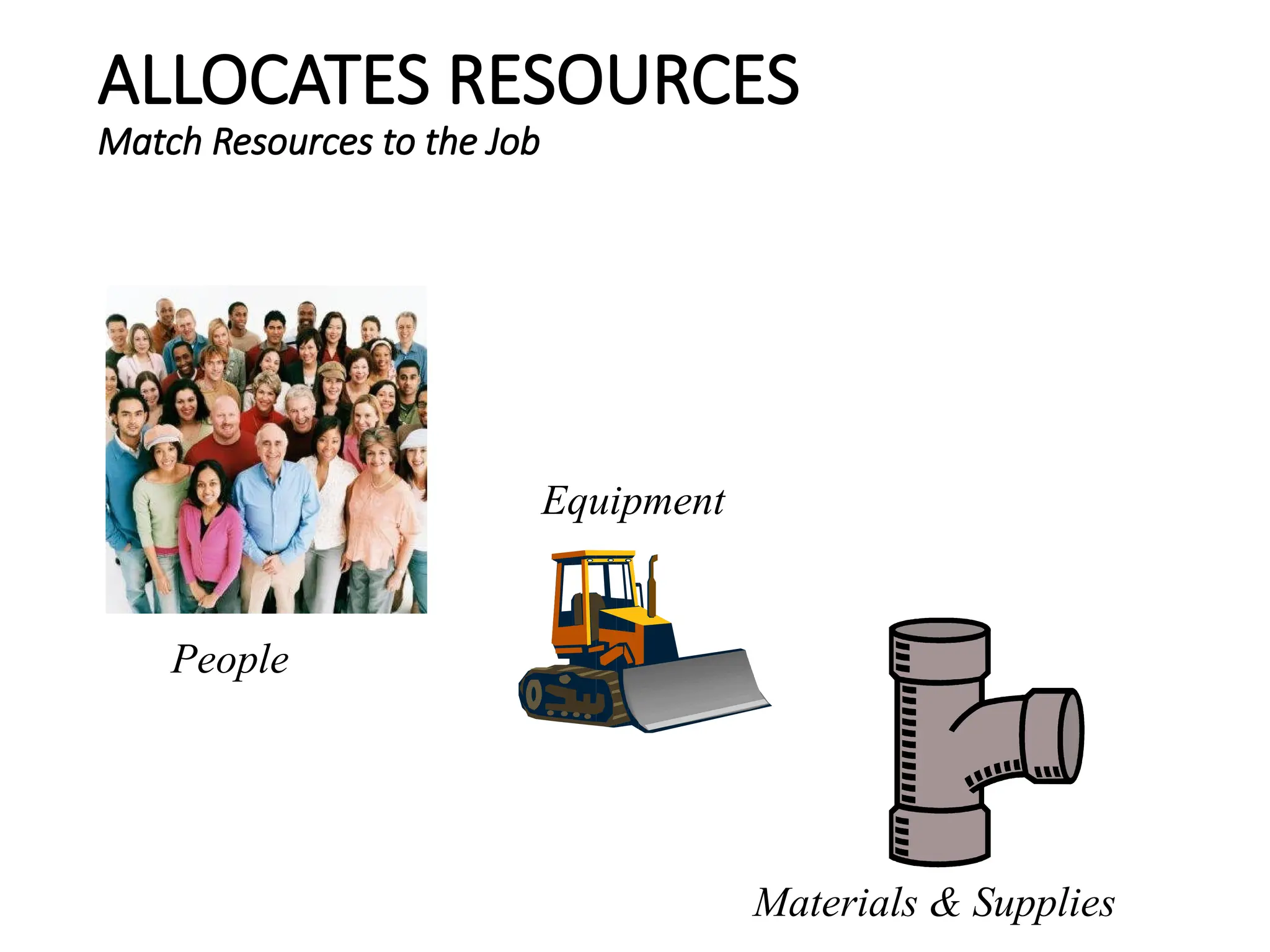
ALLOCATES RESOURCES
Match Resources to the Job
People
Equipment
Materials & Supplies
MAKES DECISIONS
1. Gather info
2. Confer with your team(s)
3. Decide
4. Inform
5. Implement
5a. Adjust???
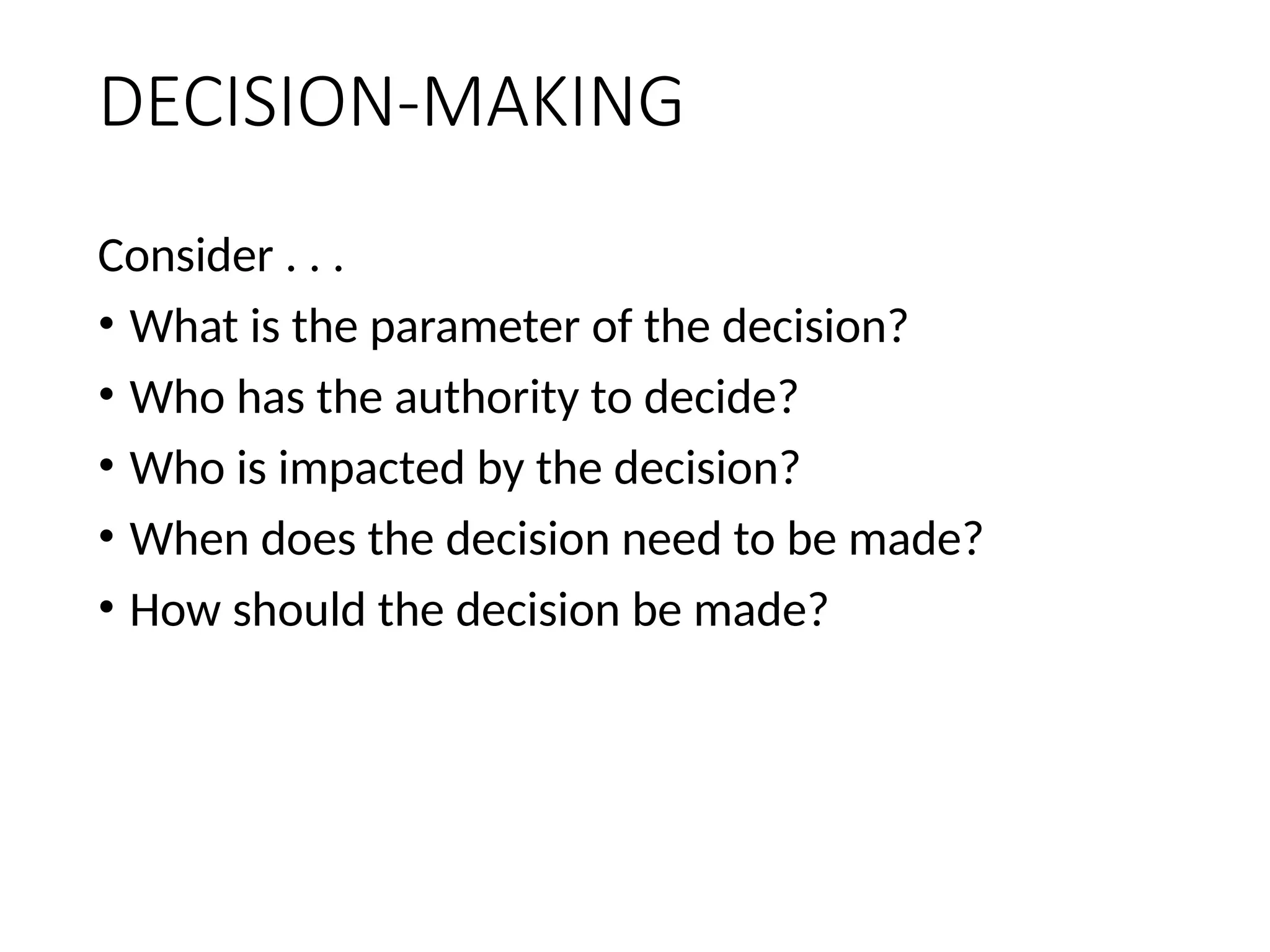
DECISION-MAKING
Consider . . .
• What is the parameter of the decision?
• Who has the authority to decide?
• Who is impacted by the decision?
• When does the decision need to be made?
• How should the decision be made?
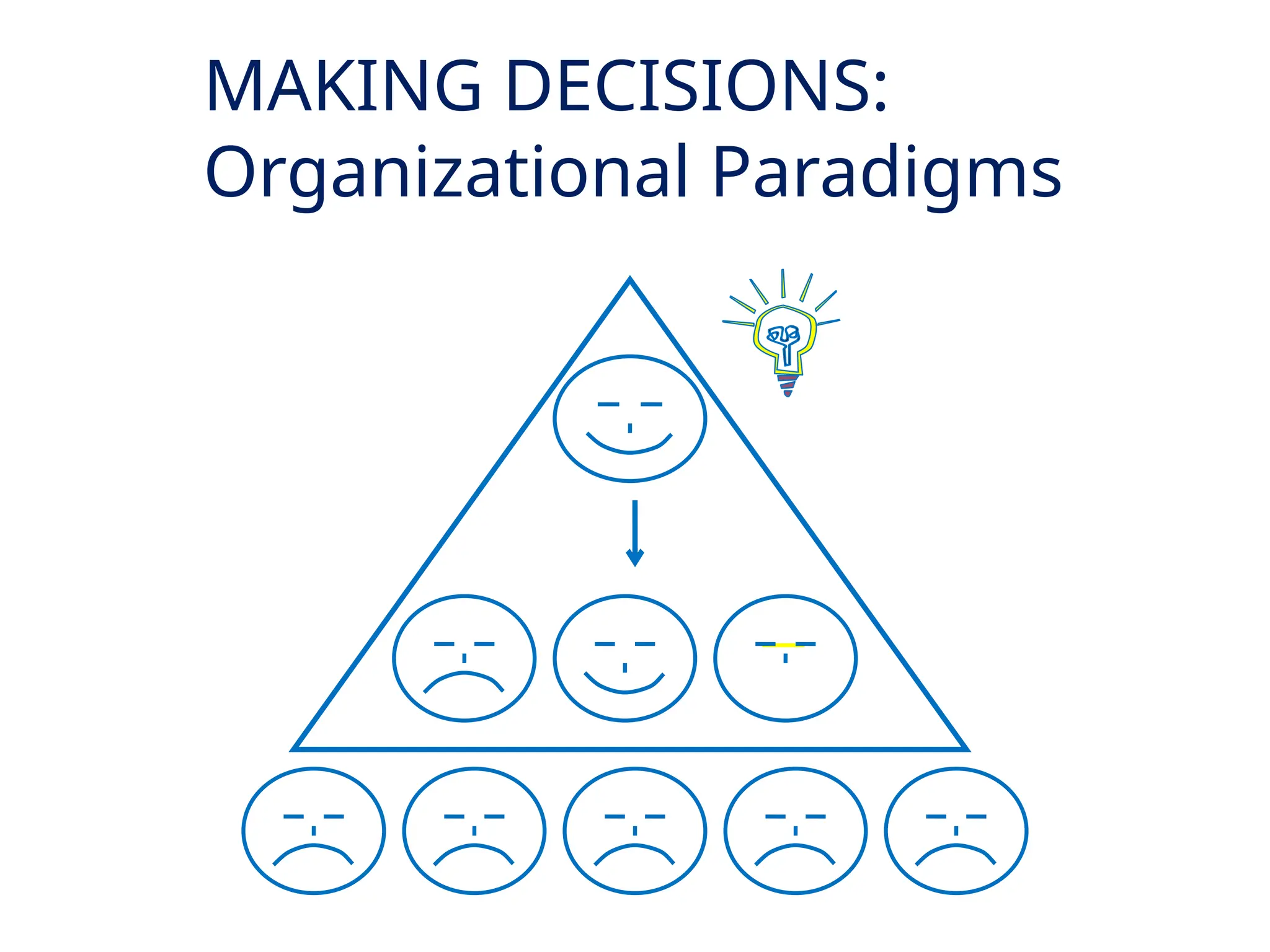
MAKING DECISIONS:
Organizational Paradigms
DECISION MAKING STYLES
• Make decision alone – tell others
• Ask for input – then decide
• Ask for recommendation – then decide
• Discuss – get consensus
• Delegate completely
The Indecisive Boss
•Recommend
•Allow time to ponder
•Follow-up (nag)
•What’s your tolerance for risk?
•Permission vs. forgiveness
•No decision is a decision
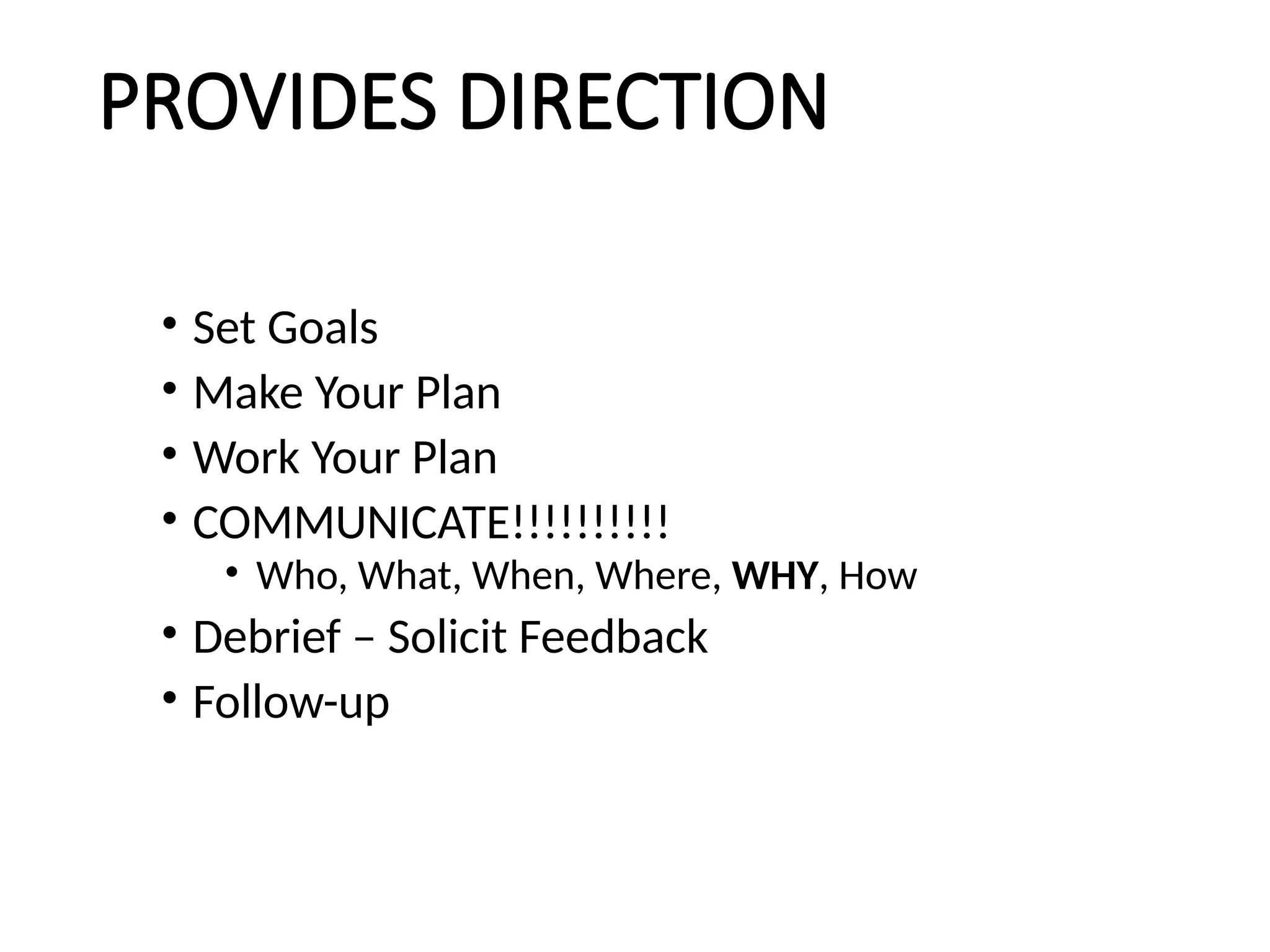
PROVIDES DIRECTION
• Set Goals
• Make Your Plan
• Work Your Plan
• COMMUNICATE!!!!!!!!!!
• Who, What, When, Where, WHY, How
• Debrief – Solicit Feedback
• Follow-up
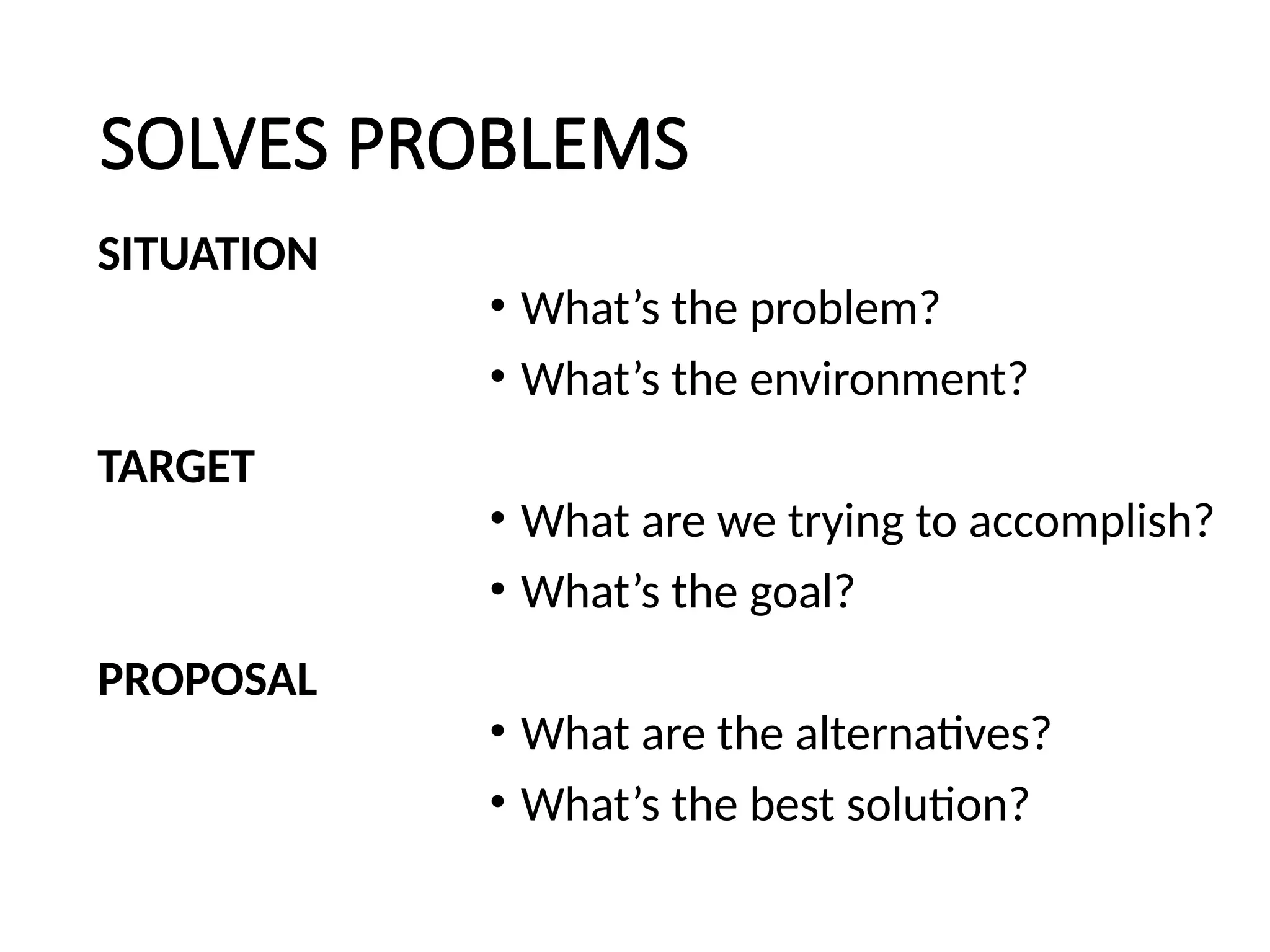
SOLVES PROBLEMS
SITUATION
TARGET
PROPOSAL
• What’s the problem?
• What’s the environment?
• What are we trying to accomplish?
• What’s the goal?
• What are the alternatives?
• What’s the best solution?
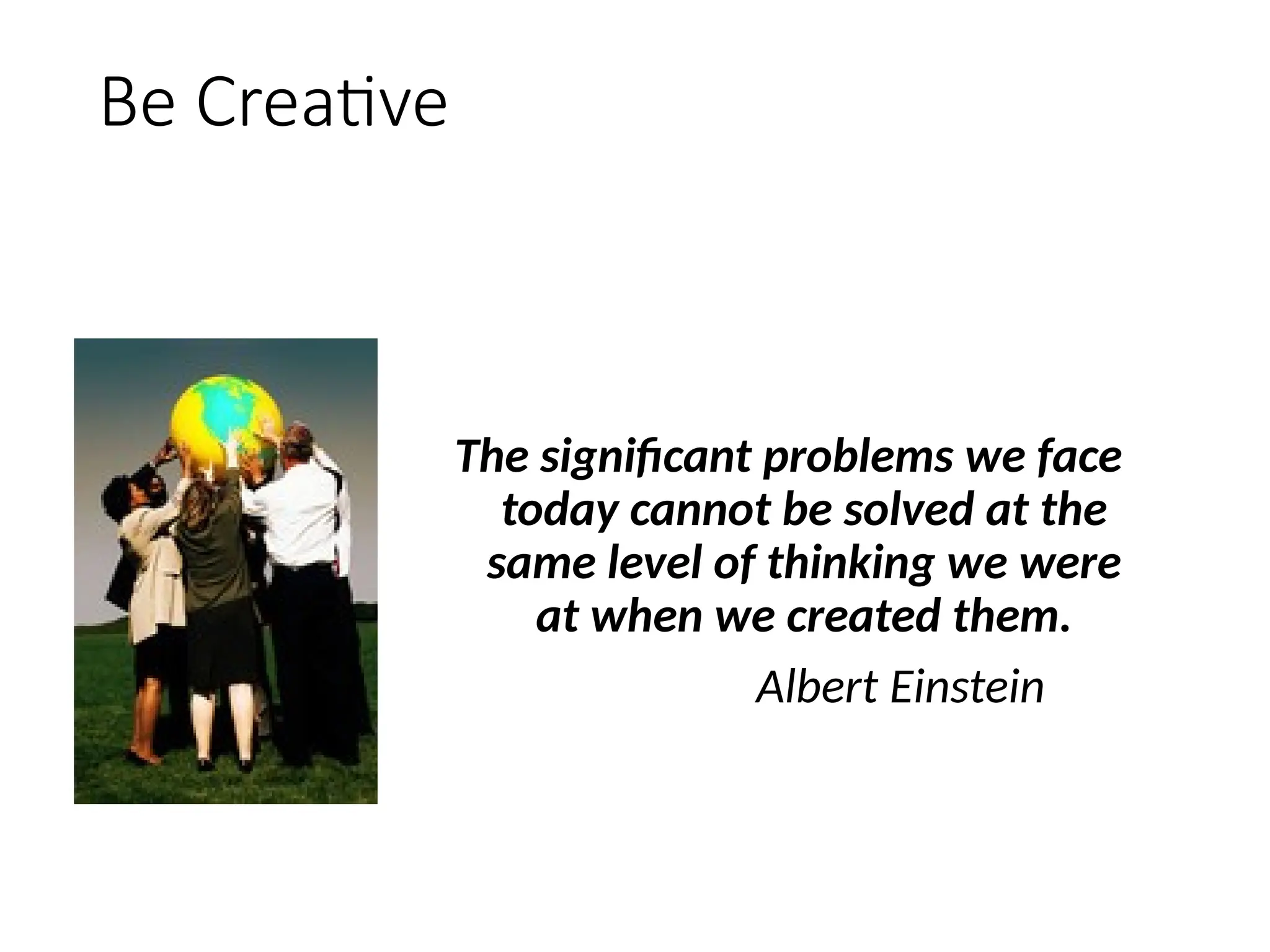
Be Creative
The significant problems we face
today cannot be solved at the
same level of thinking we were
at when we created them.
Albert Einstein
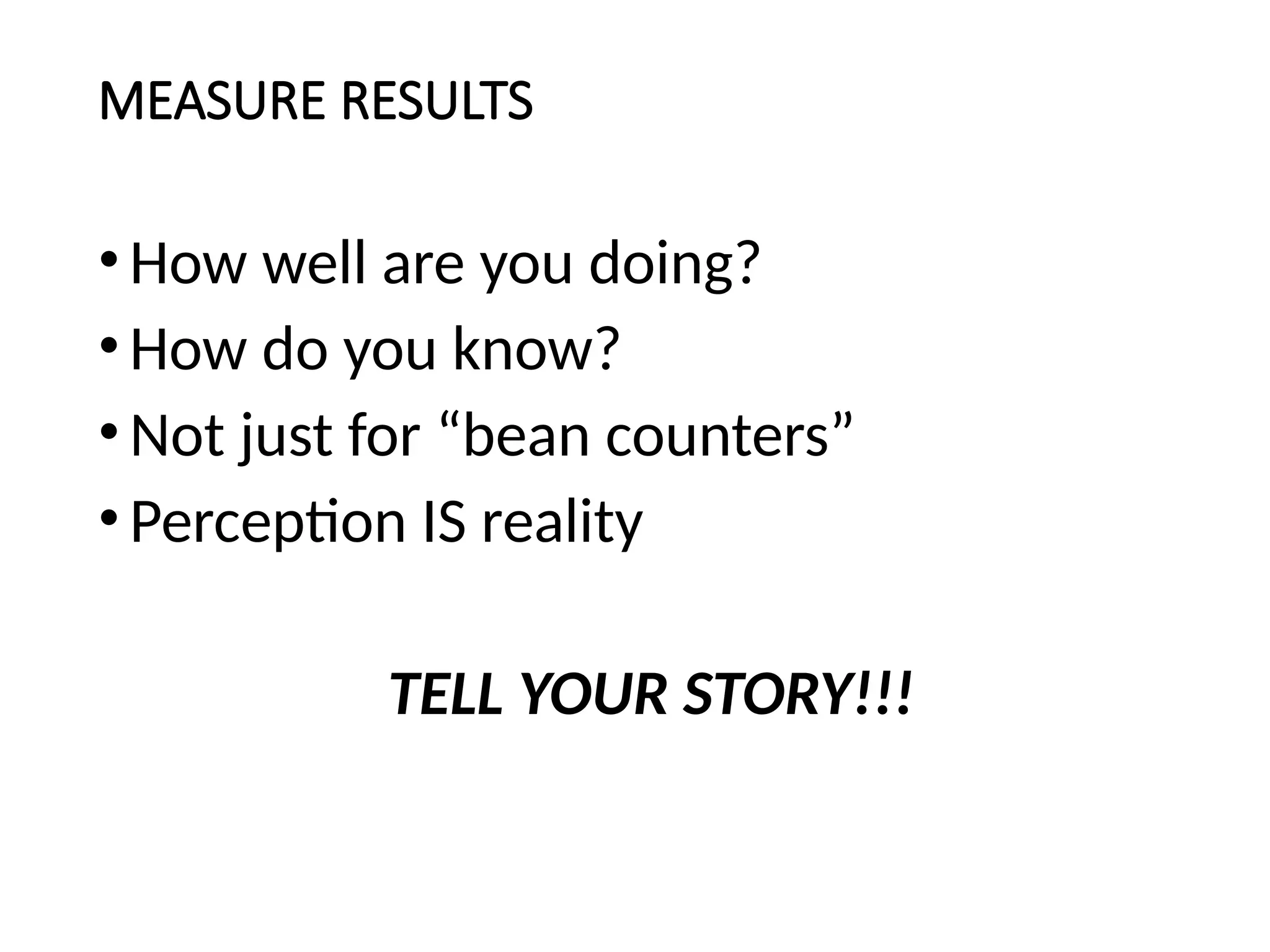
MEASURE RESULTS
•How well are you doing?
•How do you know?
•Not just for “bean counters”
•Perception IS reality
TELL YOUR STORY!!!
Report Results
•To Boss
•To Team
•To World
TELL YOUR STORY!!!
Attitude
•Handling success
•Handling failure
•Handling the ridiculous
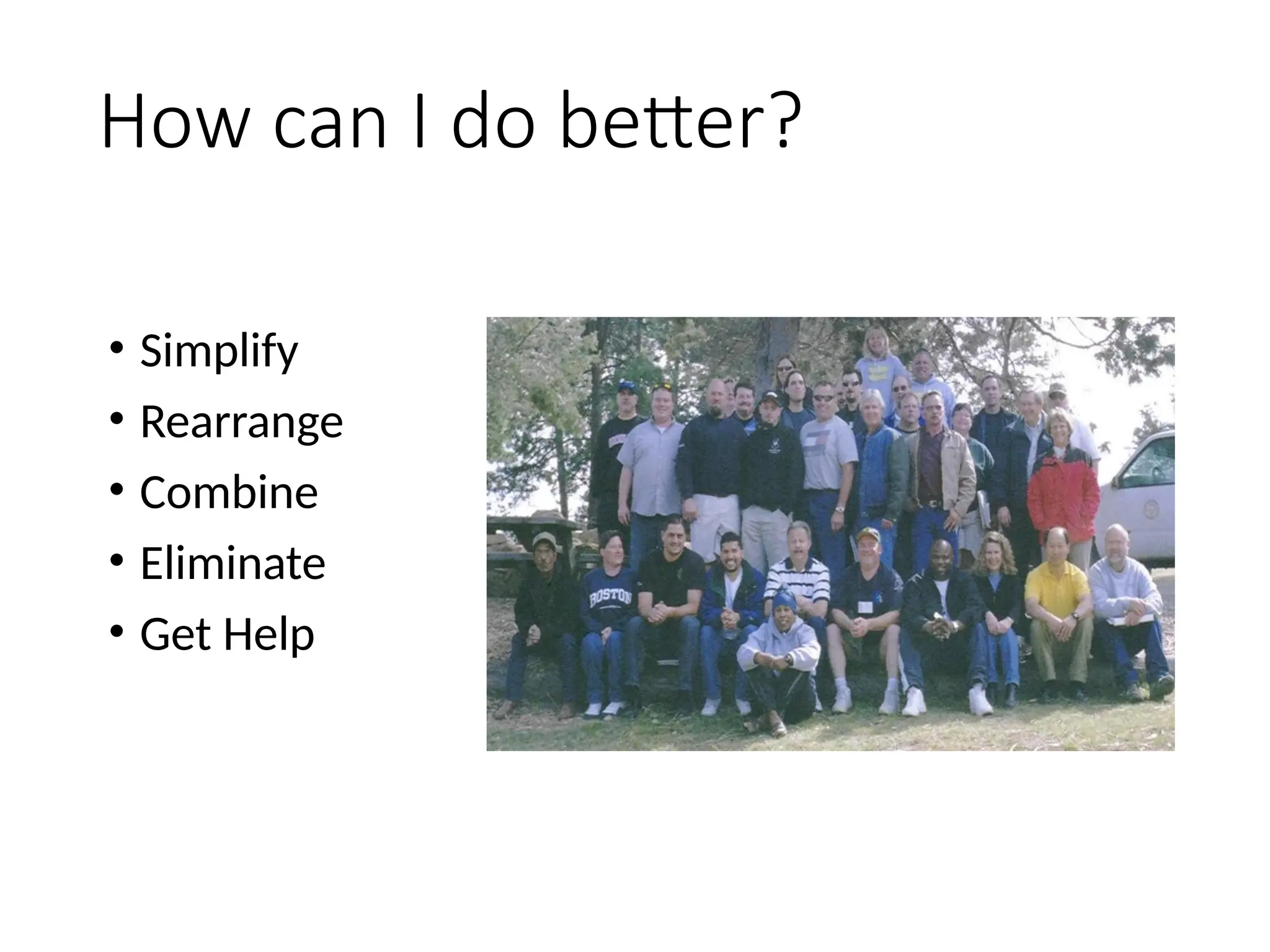
How can I do better?
• Simplify
• Rearrange
• Combine
• Eliminate
• Get Help
STEPS IN PLANNING (PROCESS)
UNIT 2: PLANNING
2
Takeaway 1: Why and How Managers Plan
• Steps in the planning process:
• Define your objectives
• Determine where you stand vis-à-vis objectives
• Develop premises regarding future conditions
• Analyze alternatives and make a plan
• Implement the plan and evaluate results
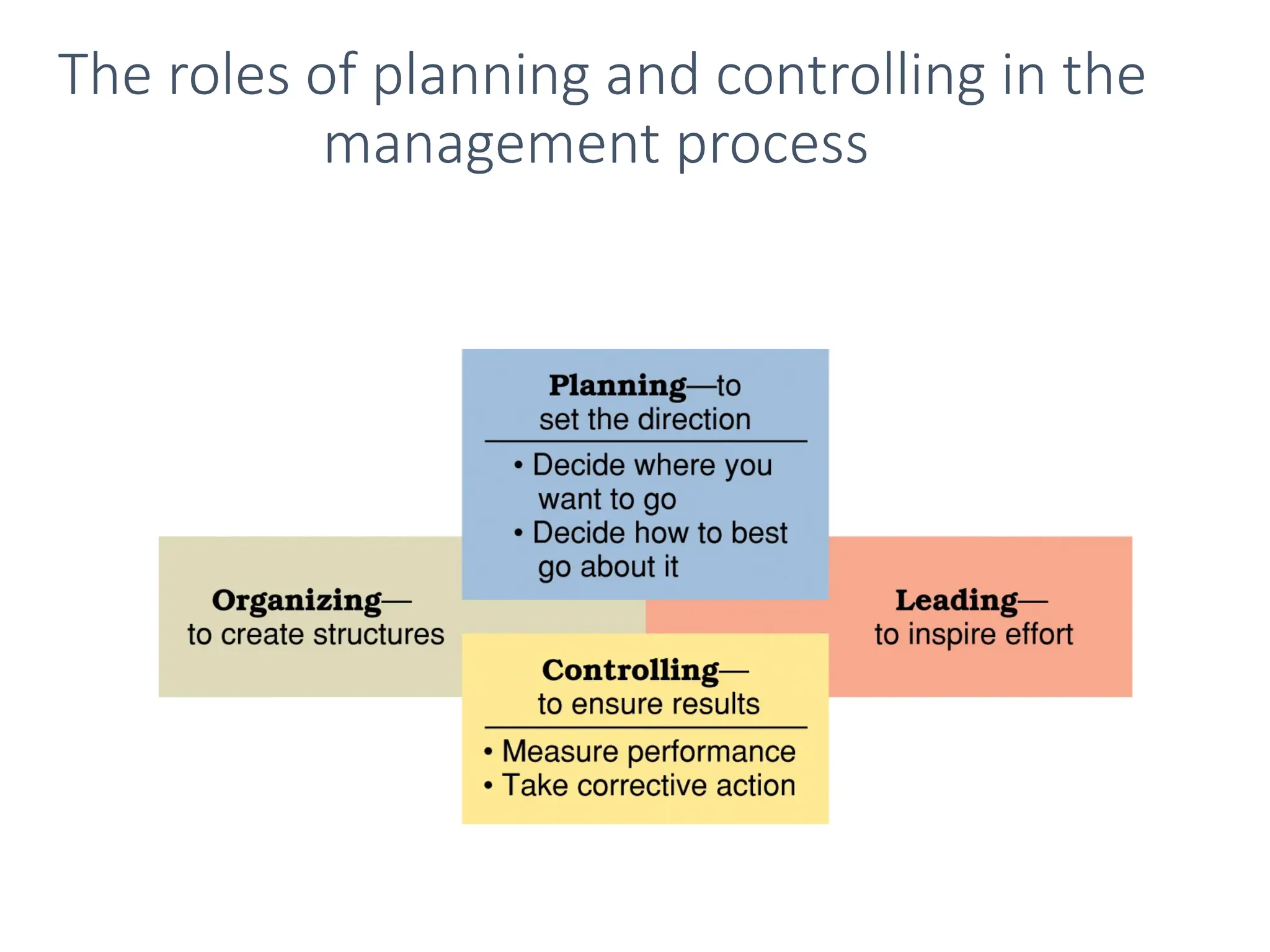
The roles of planning and controlling in the
management process
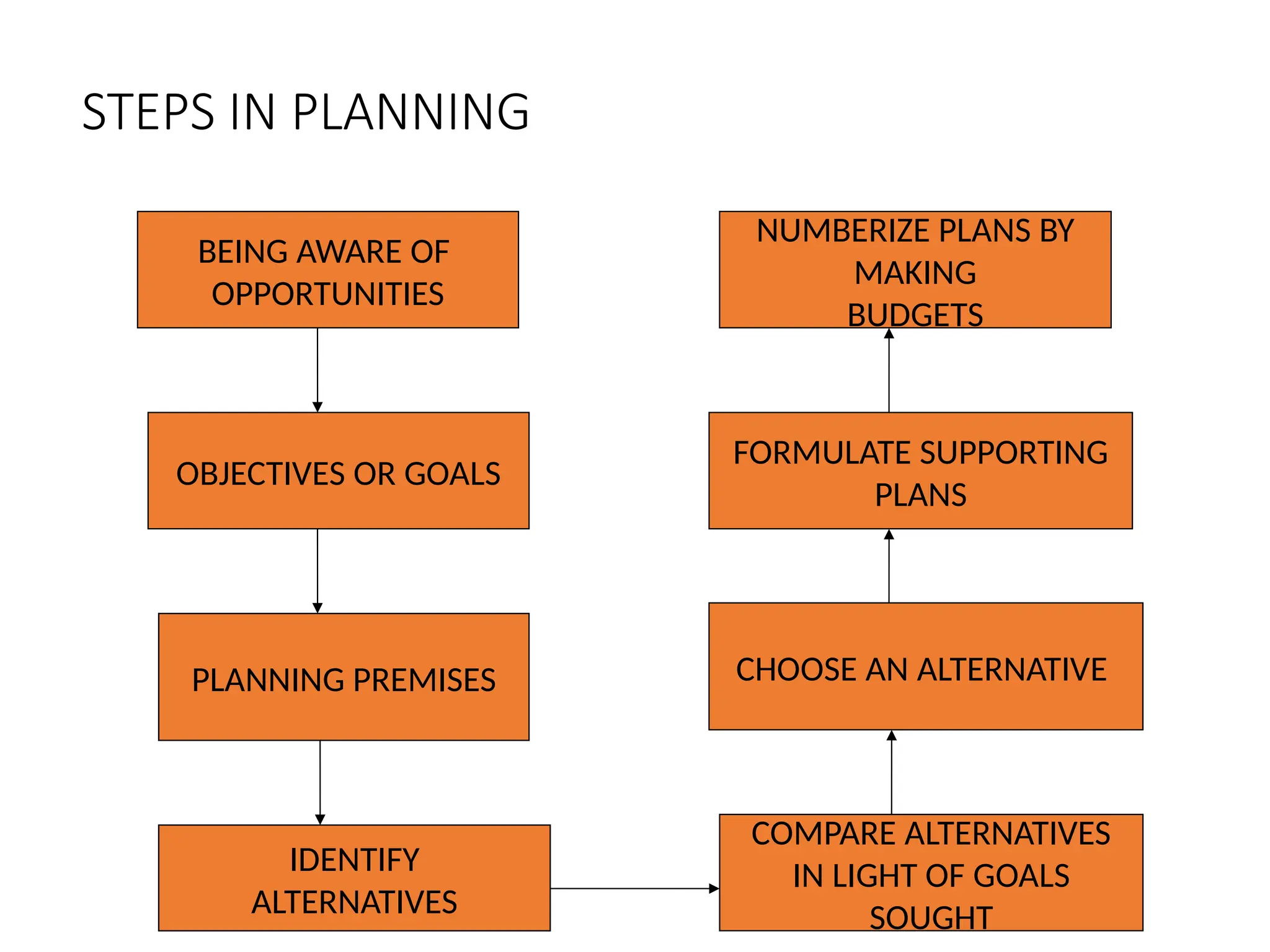
STEPS IN PLANNING
BEING AWARE OF
OPPORTUNITIES
OBJECTIVES OR GOALS
PLANNING PREMISES
IDENTIFY
ALTERNATIVES
NUMBERIZE PLANS BY
MAKING
BUDGETS
FORMULATE SUPPORTING
PLANS
CHOOSE AN ALTERNATIVE
COMPARE ALTERNATIVES
IN LIGHT OF GOALS
SOUGHT
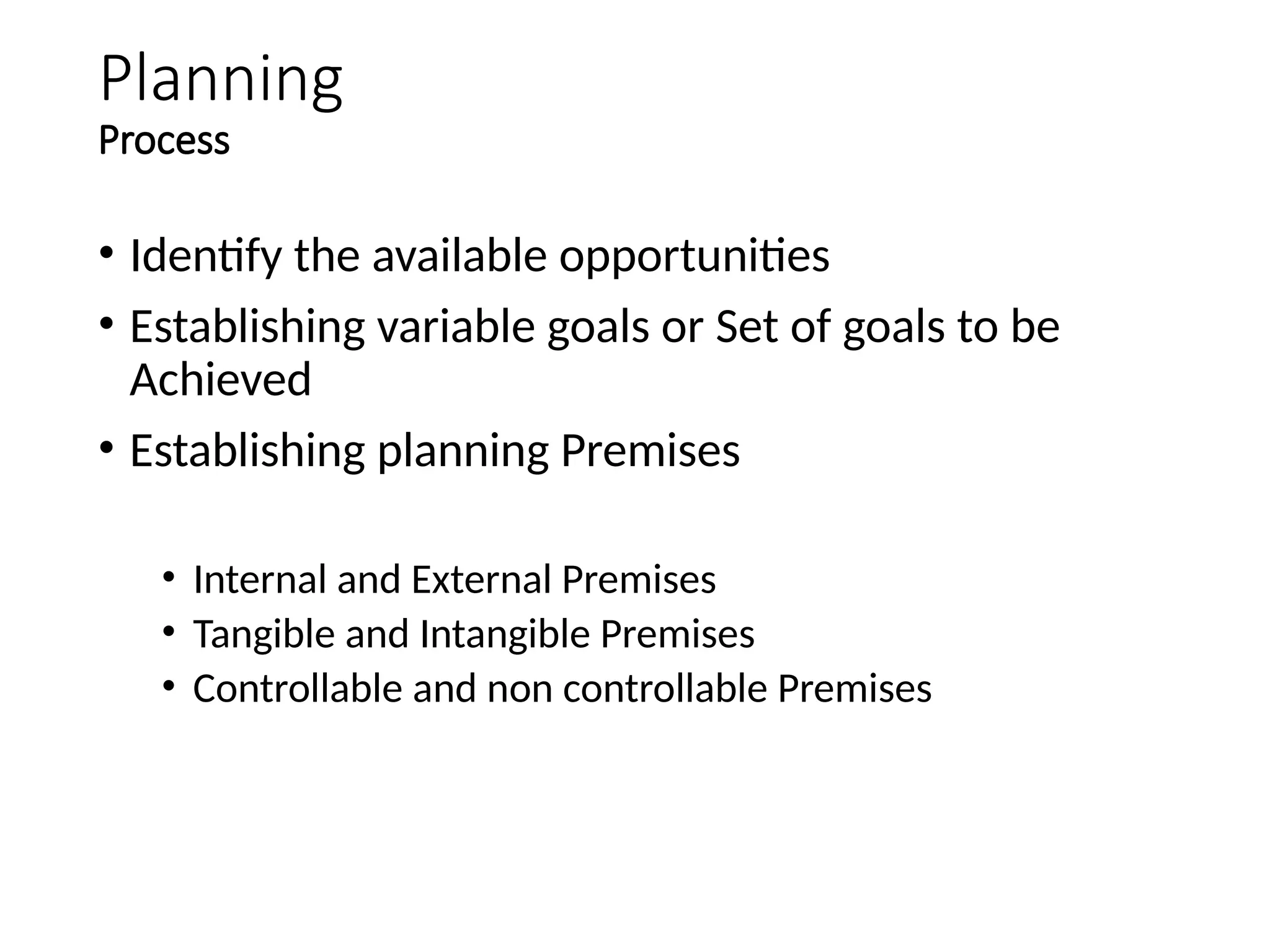
Planning
Process
• Identify the available opportunities
• Establishing variable goals or Set of goals to be
Achieved
• Establishing planning Premises
• Internal and External Premises
• Tangible and Intangible Premises
• Controllable and non controllable Premises
Planning
Process
• Deciding the planning Period
 Lead time in Product Development
 Capital Investment & Payback Period
• Finding Alternative course of Action
• Evaluating & Selecting a course of action
• Developing derivative Plan
• Establishing Action Plan
• Measuring and Controlling the Process
Types of plans
UNIT 2: PLANNING
3
Types of Plans Used by Managers
• Types of plans
• Long-term plans look three or more years into the future
• Short-term plans typically cover one
year or less
39
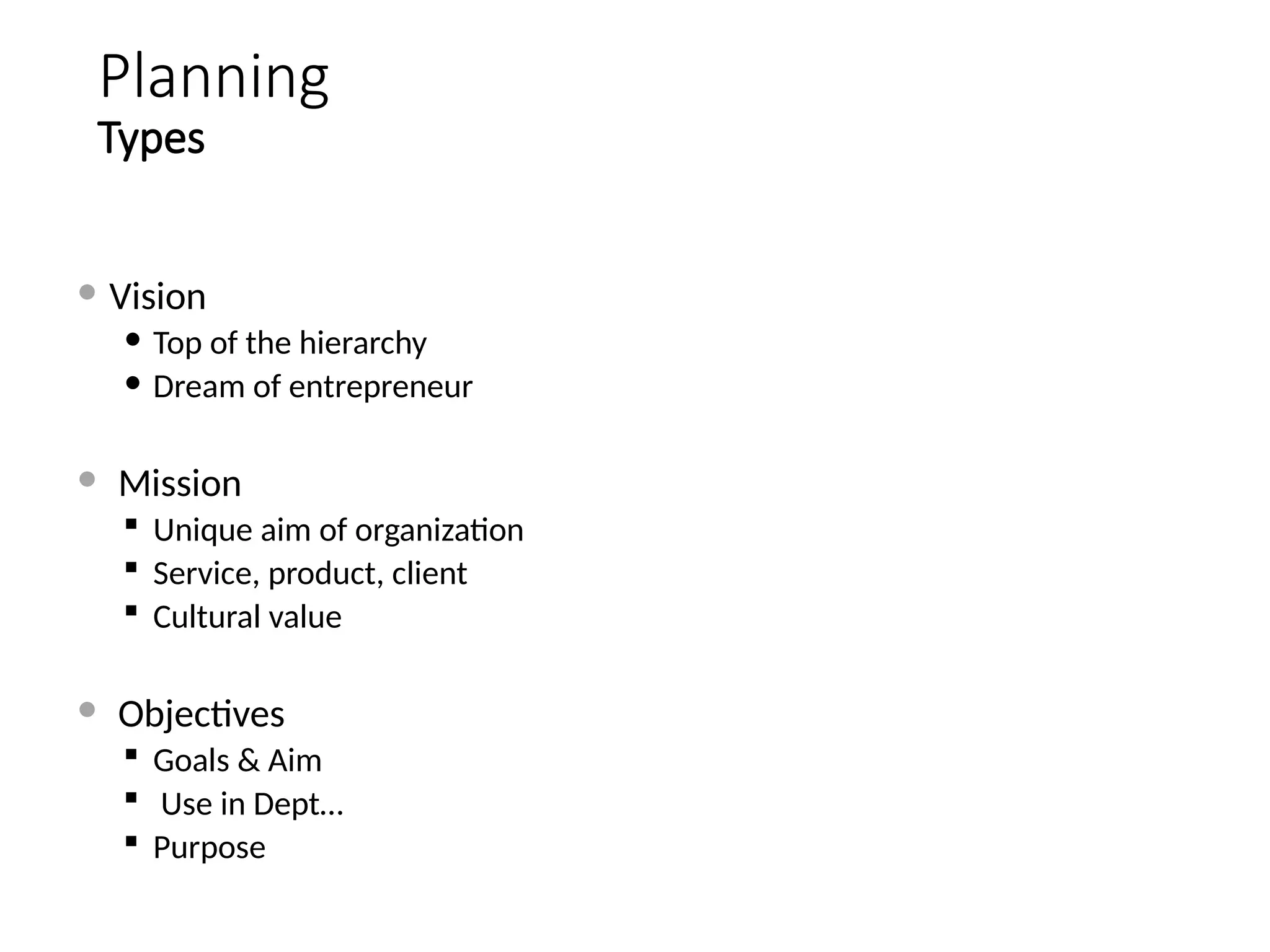
Planning
Types
 Vision
 Top of the hierarchy
 Dream of entrepreneur
 Mission
 Unique aim of organization
 Service, product, client
 Cultural value
 Objectives
 Goals & Aim
 Use in Dept…
 Purpose
Planning
Types
• Strategies
 Competitive Advantage
 SWOT Analysis
• Operational Plans
 Policies
 Procedures
 Methods
 Rules
Types of Plans Used by Managers
42
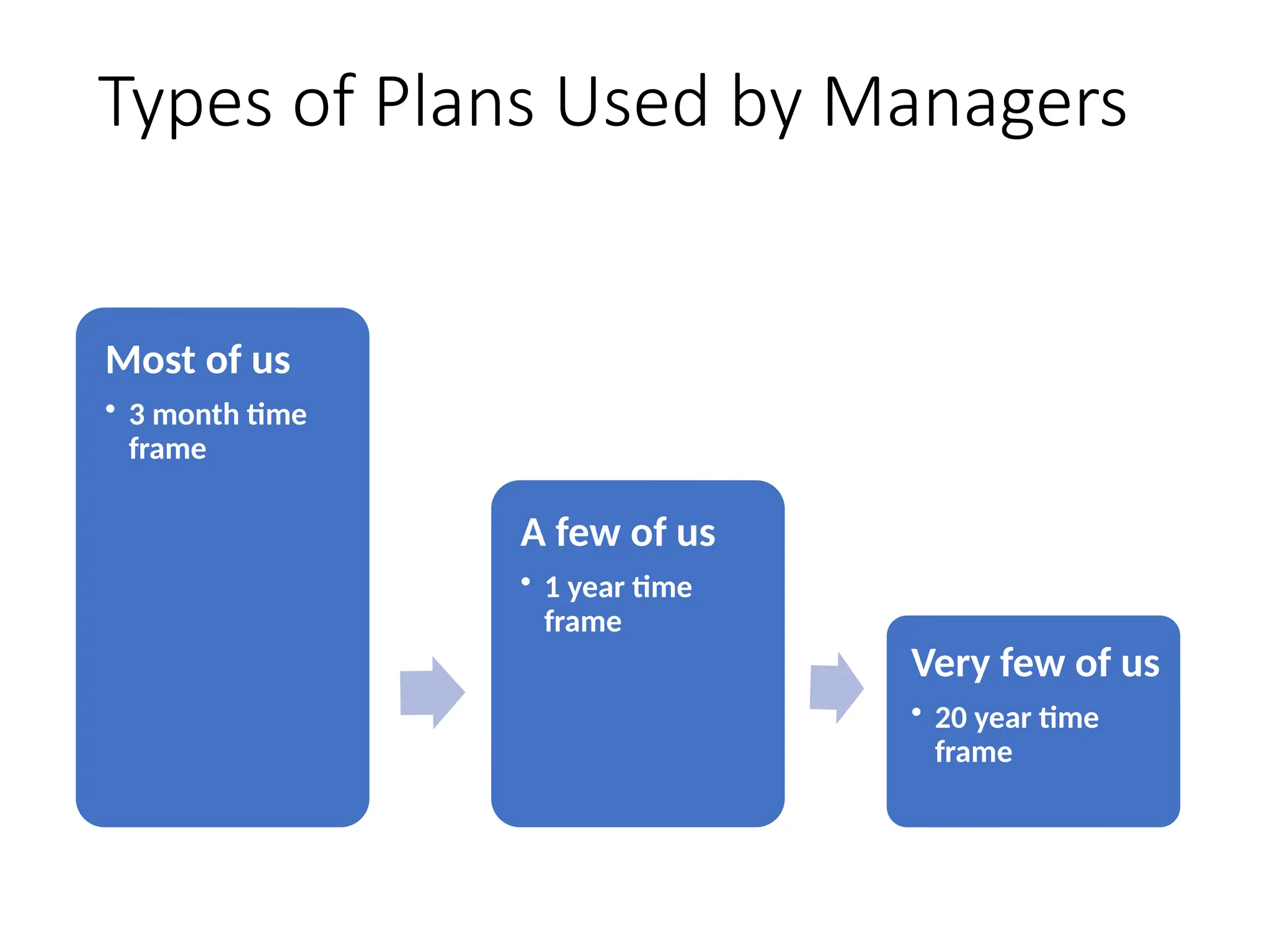
Most of us
• 3 month time
frame
A few of us
• 1 year time
frame
Very few of us
• 20 year time
frame
Types of Plans Used by Managers
• Strategic plans — set broad, comprehensive, and
longer-term action directions for the entire
organization
• Vision – clarifies purpose of the organization and
what it hopes to be in the future
43
Types of Plans Used by Managers
• Tactical plan – helps to implement all or parts of the
strategic plan
• Functional plans – indicate how different operations
within the organization will help accomplish the
overall strategy
• Production plans
• Financial plans
• Facilities plans
• Logistics plans
• Marketing plans
• Human resource plans
44
Types of Plans Used by Managers
• Operational plans — identify short-term activities to
implement strategic plans
• Policies are standing plans the communicate guidelines for
decisions
• Procedures are rules that describe actions to be taken in
specific situations
• Budgets are plans the commit resources to projects or
activities
• Zero based budgets allocate resources as if each budget were
brand new
45
Takeaway 3: Planning Tools and Techniques
• Forecasting
• Attempts to predict the future
• Qualitative forecasting uses expert opinions
• Quantitative forecasting uses mathematical models and
statistical analysis of historical data and surveys
Takeaway 3: Planning Tools and Techniques
• Contingency planning
• Identifying alternative courses of action to take when
things go wrong
• Contingency plans anticipate changing conditions
• Contingency plans contain trigger points
Takeaway 3: Planning Tools and Techniques
• Scenario planning
• A long-term version of contingency planning
• Identifying alternative future scenarios
• Plans made for each future scenario
• Increases organization’s flexibility and preparation for
future shocks
Takeaway 3: Planning Tools and Techniques
• Benchmarking
• Use of external and internal comparisons to plan for
future improvements
• Adopting best practices: things people and organizations
do that lead to superior performance
• Staff planners assist in all steps of the planning process

Unit2_Planning_Classnotes_Principles & Practice of Mgmt..pptx

  • 1.
    Nature and Purposeof Planning UNIT 2: PLANNING 1
  • 2.
    Need for Planning? 1.Why and how do managers plan? 2. What types of plans do managers use? 3. What are the useful planning tools and techniques? 4. How can plans be well implemented?
  • 3.
    1. Why andHow Managers Plan 1. Importance of planning 2. The planning process 3. Benefits of planning 2. Types of Plans Used by Managers 1. Long-range and short-range plans 2. Strategic and tactical plans 3. Operational plans
  • 4.
    3. Planning Toolsand Techniques 1. Forecasting 2. Contingency planning 3. Scenario planning 4. Benchmarking 5. Use of staff planners 4. Implementing Plans to Achieve Results 1. Goal setting 2. Goal alignment 3. Participation and involvement
  • 5.
    Takeaway 1: Whyand How Managers Plan • Planning • The process of setting objectives and determining how to accomplish them • Objectives and goals • Identify the specific results or desired outcomes that one intends to achieve • Plan • A statement of action steps to be taken in order to accomplish the objectives
  • 6.
    Definitions of Planning •“Planning is the selecting and relating of facts and the making and using of assumptions regarding the future in the visualization to achieve desire results.”- George Terry • “Planning is deciding advance what to do, how to do it, when to do it, who is to do it. It bridges the gap between where we are, where we want to go. It makes it possible for things to occur which would not otherwise happen.” - Koontz and O’Donnel • Based on futurity: “Planning is a trap laid down to capture the future”-Allen. • “Planning is informed anticipation of future”-Haimann. • “Planning is ‘anticipatory’ decision-making”-R.L. Ackoff.
  • 7.
    Planning  Planning isan intellectual process which requires a manager to think before acting.  Planning is continuous process.  Plan must be flexible.  Change direction to adept to changing situation  Technology (changing need)  Market (Marketing Strategies)  Finance (Obtain Fund)  Personnel (Job Rotation)  Organization (organizational structure )
  • 8.
    Nature of Planning Planningis goal-oriented Primacy of Planning Pervasiveness of Planning Efficiency, Economy and Accuracy Planning is an intellectual process Limiting Factors Flexibility Co-ordination 8
  • 9.
    Nature of Planning(Contd…) i. Planning is goal-oriented: Every plan must contribute in some positive way towards the accomplishment of group objectives. Planning has no meaning without being related to goals. ii. Primacy of Planning: Planning is the first of the managerial functions. It precedes all other management functions. iii. Pervasiveness of Planning: Planning is found at all levels of management. Top management looks after strategic planning. Middle management is in charge of administrative planning. Lower management has to concentrate on operational planning. iv. Efficiency, Economy and Accuracy: Efficiency of plan is measured by its contribution to the objectives as economically as possible. Planning also focuses on accurate forecasts. Contd… 9
  • 10.
    Nature of Planning(Contd…) v. Planning is an intellectual process: The quality of planning will vary according to the quality of the mind of the manager. vi. Limiting Factors: A planner must recognize the limiting factors (money, manpower etc) and formulate plans in the light of these critical factors. vii. Flexibility: The process of planning should be adaptable to changing environmental conditions. viii. Co-ordination: Planning co-ordinates the what, who, how, where and why of planning. Without co-ordination of all activities, we cannot have united efforts. 10
  • 11.
    Purposes/Importance of Planning Planningseems to take a lot of effort. As a managerial function planning is important due to the following reasons:- i. To provide direction ii. To reduce / offset uncertainty and change iii. To minimize waste and redundancy iv. To set the standards to make control effective v. To manage by objectives vi. To help in co-ordination vii. To secure economy in operation viii. To increase organizational effectiveness 11
  • 12.
  • 13.
    Supervisor’s Job: GET THEWORK DONE . . . THROUGH OTHERS!
  • 14.
    How does asupervisor do it? •Plans work •Allocates resources •Makes decisions •Provides direction to the team •Solves problems •Measures and reports results
  • 15.
    PLANS WORK •What needsto be done? •What are the priorities? •Who will do the work? • When will it be done?
  • 16.
  • 17.
    Other Plans •Special Projectsor Events •Emergency Operational Plans •Staffing Plans Ready . . . Aim . . . Fire!
  • 18.
    Planning vs. Reacting Whocontrols your life?
  • 19.
    ALLOCATES RESOURCES Match Resourcesto the Job People Equipment Materials & Supplies
  • 20.
    MAKES DECISIONS 1. Gatherinfo 2. Confer with your team(s) 3. Decide 4. Inform 5. Implement 5a. Adjust???
  • 21.
    DECISION-MAKING Consider . .. • What is the parameter of the decision? • Who has the authority to decide? • Who is impacted by the decision? • When does the decision need to be made? • How should the decision be made?
  • 22.
  • 23.
    DECISION MAKING STYLES •Make decision alone – tell others • Ask for input – then decide • Ask for recommendation – then decide • Discuss – get consensus • Delegate completely
  • 24.
    The Indecisive Boss •Recommend •Allowtime to ponder •Follow-up (nag) •What’s your tolerance for risk? •Permission vs. forgiveness •No decision is a decision
  • 25.
    PROVIDES DIRECTION • SetGoals • Make Your Plan • Work Your Plan • COMMUNICATE!!!!!!!!!! • Who, What, When, Where, WHY, How • Debrief – Solicit Feedback • Follow-up
  • 26.
    SOLVES PROBLEMS SITUATION TARGET PROPOSAL • What’sthe problem? • What’s the environment? • What are we trying to accomplish? • What’s the goal? • What are the alternatives? • What’s the best solution?
  • 27.
    Be Creative The significantproblems we face today cannot be solved at the same level of thinking we were at when we created them. Albert Einstein
  • 28.
    MEASURE RESULTS •How wellare you doing? •How do you know? •Not just for “bean counters” •Perception IS reality TELL YOUR STORY!!!
  • 29.
    Report Results •To Boss •ToTeam •To World TELL YOUR STORY!!!
  • 30.
  • 31.
    How can Ido better? • Simplify • Rearrange • Combine • Eliminate • Get Help
  • 32.
    STEPS IN PLANNING(PROCESS) UNIT 2: PLANNING 2
  • 33.
    Takeaway 1: Whyand How Managers Plan • Steps in the planning process: • Define your objectives • Determine where you stand vis-à-vis objectives • Develop premises regarding future conditions • Analyze alternatives and make a plan • Implement the plan and evaluate results
  • 34.
    The roles ofplanning and controlling in the management process
  • 35.
    STEPS IN PLANNING BEINGAWARE OF OPPORTUNITIES OBJECTIVES OR GOALS PLANNING PREMISES IDENTIFY ALTERNATIVES NUMBERIZE PLANS BY MAKING BUDGETS FORMULATE SUPPORTING PLANS CHOOSE AN ALTERNATIVE COMPARE ALTERNATIVES IN LIGHT OF GOALS SOUGHT
  • 36.
    Planning Process • Identify theavailable opportunities • Establishing variable goals or Set of goals to be Achieved • Establishing planning Premises • Internal and External Premises • Tangible and Intangible Premises • Controllable and non controllable Premises
  • 37.
    Planning Process • Deciding theplanning Period  Lead time in Product Development  Capital Investment & Payback Period • Finding Alternative course of Action • Evaluating & Selecting a course of action • Developing derivative Plan • Establishing Action Plan • Measuring and Controlling the Process
  • 38.
    Types of plans UNIT2: PLANNING 3
  • 39.
    Types of PlansUsed by Managers • Types of plans • Long-term plans look three or more years into the future • Short-term plans typically cover one year or less 39
  • 40.
    Planning Types  Vision  Topof the hierarchy  Dream of entrepreneur  Mission  Unique aim of organization  Service, product, client  Cultural value  Objectives  Goals & Aim  Use in Dept…  Purpose
  • 41.
    Planning Types • Strategies  CompetitiveAdvantage  SWOT Analysis • Operational Plans  Policies  Procedures  Methods  Rules
  • 42.
    Types of PlansUsed by Managers 42 Most of us • 3 month time frame A few of us • 1 year time frame Very few of us • 20 year time frame
  • 43.
    Types of PlansUsed by Managers • Strategic plans — set broad, comprehensive, and longer-term action directions for the entire organization • Vision – clarifies purpose of the organization and what it hopes to be in the future 43
  • 44.
    Types of PlansUsed by Managers • Tactical plan – helps to implement all or parts of the strategic plan • Functional plans – indicate how different operations within the organization will help accomplish the overall strategy • Production plans • Financial plans • Facilities plans • Logistics plans • Marketing plans • Human resource plans 44
  • 45.
    Types of PlansUsed by Managers • Operational plans — identify short-term activities to implement strategic plans • Policies are standing plans the communicate guidelines for decisions • Procedures are rules that describe actions to be taken in specific situations • Budgets are plans the commit resources to projects or activities • Zero based budgets allocate resources as if each budget were brand new 45
  • 46.
    Takeaway 3: PlanningTools and Techniques • Forecasting • Attempts to predict the future • Qualitative forecasting uses expert opinions • Quantitative forecasting uses mathematical models and statistical analysis of historical data and surveys
  • 47.
    Takeaway 3: PlanningTools and Techniques • Contingency planning • Identifying alternative courses of action to take when things go wrong • Contingency plans anticipate changing conditions • Contingency plans contain trigger points
  • 48.
    Takeaway 3: PlanningTools and Techniques • Scenario planning • A long-term version of contingency planning • Identifying alternative future scenarios • Plans made for each future scenario • Increases organization’s flexibility and preparation for future shocks
  • 49.
    Takeaway 3: PlanningTools and Techniques • Benchmarking • Use of external and internal comparisons to plan for future improvements • Adopting best practices: things people and organizations do that lead to superior performance • Staff planners assist in all steps of the planning process