Regulatory and professional bodies 
within the Creative Media Sector 
Name: Nicole Melia 
Unit 2 Task 1 Be able to extract information from written 
sources 
Unit 7 Task 3 Understanding the regulation of the media 
sector
Task 1: Be able to extract 
information from written sources 
Be able to extract information from written 
sources 
Written sources: e.g. books, journals, websites, 
magazines, newspapers, handouts 
Reading: with concentration; skim-reading: scanning; 
using index; using word search; using phrase search 
Extract information: e.g. write notes, summarise, 
highlight text, annotate document, underline 
passages,
British Board of Film 
Classification (BBFC) 
Source 1: http://www.bbfc.co.uk/education-resources/student-guide/legislation 
Source 2: http://www.legislation.gov.uk/ukpga/Eliz2/7-8/66/contents 
The British Board of Film Classification is an independent, non-governmental body which has classified 
cinema films since it was set up in 1912 and in 1984 videos and DVDs were classed as a certain 
classification. The British Board of Film was set up in 1912 by the film industry to bring a degree of 
uniformity to the classification of film nationally. These decide whether the films, DVDS and videos are 
suitable for people over a certain age otherwise they may begin to ban the films and even deleting cuts, 
instituting new ones or altering categories for films. BBFC's are in charge of the test of whether a work is 
suitable for viewing in the home (taking into account the potential for under-age viewing) They use the age 
ratings U, PG, 12, 12a, 15, 18. The BBFC has to consider the potential harm, whether to the viewer, or to 
society through the viewer's behaviour could effect people that watch these certain films. In particular 
anything involving criminal behaviour, illegal drugs, violent or horrific behaviour and human sexual activity 
are given special regard under the 'harm' test. Other legal considerations include indecent images of 
children, animal cruelty, obscenity, racial hatred and human rights. The examiners then have to analyse 
and make recommendations on the legality of a scene or work in the first instance. If then a work is found 
to contain material which falls foul of UK law, then it will be cut from the work. If the work as a whole is 
found to be in breach of the law, then it may be denied a certificate and rejected. An Act to amend the law 
relating to the publication of obscene matter is to provide the protection of others and to strengthen the law 
on pornography.
British Video Association 
Source 1: http://www.bva.org.uk/ 
Source 2: http://www.bva.org.uk/copyright-and-ip/ 
The BVA was established in 1980 to represent the interests of publishers and rights owners of pre-recorded video 
entertainment. 
They are here to make sure video entertainment is critical and cultural to everyone due to the fact the world is 
evolving technology and new opportunities day by day. 
There are hundreds of British video association's such as Warner's Brothers, Walt Disney, Sony pictures, 20th 
century fox, etc. 
Working with marking and work within the media the BVA makes sure it promotes the video entertainment on all 
formats through business and consumer-facing media activity, It coordinates and supports promotional activity for 
Blu-ray, Ultraviolet and legal digital services, The BVA Awards is the biggest fixture in industry’s calendar and is 
attended by over 1000 guests, BVA AGM & News Review, addresses the government and industry and highlights 
the BVA’s activities as well as raising concerns for the industry and that The BVA website with membership access, 
promotes members’ and partners’ news and information as well as keeping the sector up to date with the latest 
position on Government Policy. 
Copy write is one of the BVA’s laws that falls under the remit of the UK Intellectual Property Office. The BVA has 
extensive dealings with this government agency as it develops copyright policy. The BVA works closely with its 
members to share best practice in copyright protection measures, including certification of suppliers to verify their 
security systems, and in the promotion of legal services They have worked with many company's to make sure 
ensure the government is aware of the links between IP theft and serious and organised crime and the multi-million 
pound losses incurred by the video industry to physical and online copyright theft.
Film Distributors Association 
Source 1:http://www.launchingfilms.com/who-gains 
Source 2:https://www.google.co.uk/webhp?sourceid=chrome-instant& 
ion=1&espv=2&ie=UTF-8#q=what%20is%20priracy 
The FDA concentrates on Film Piracy In The UK. Piracy is the unauthorised permission to 
use or reproduce of others work, It has affected the film industry and wider society for many 
years - and in the digital age it remains as serious as it is. 
An example of Piracy is pirated copies being camcorder at early cinema screenings, with 
much ambient noise, shaky camera work and people walking in front of the lens. They may 
be downloaded on to discs from the Internet, or perhaps copied from a pre-release version 
of the film missing many of its final special effects or soundtrack. As much as this sounds 
like a good and easy idea to buy cheap films some of the discs do not play at all. In any 
event, people buying such copies are being ripped off. Worse still, the cash they pay lines 
the pockets of serious, organised criminals, who use the profits from film piracy to fuel their 
trade in human traffic, hard drugs or even terrorism.
Video Standards Council 
(VSC) 
Source 1:http://www.videostandards.org.uk/VSC/ 
Source 2: 
The VSC was established in 1989 and fulfils two basic roles: 
It is a standards body for the video and video games industries and has a Code of Practice designed to ensure that 
both industries show a duty of care in their dealings with customers and the public generally. It provides staff that 
are trained in dealing with age restricted videos, DVDs and video games. It acts as an administrator of the PEGI 
system of age rating for video games. PEGI is used in over 30 countries. It is the UK regulator responsible for the 
age rating of video games supplied in the UK (using the PEGI system). In fulfilling this role it uses the name Games 
Rating Authority (GRA). 
In 1993 we extended the Code to promote high standards within the video games industry. 
Since 2003 we have administered PEGI, a pan-European age rating system designed for video games and are 
responsible for applying the PEGI system to video games sold in the UK. 
In July 2012, the VSC was appointed as the designated authority for the rating of video games in the UK. The ratings 
arm of the VSC is called the Games Rating Authority (GRA).
Office for Communication 
(Ofcom) 
Ofcom is the communications regulator in the UK. 
They regulate the TV and radio sectors, fixed line telecoms, mobiles, postal services, plus the 
airwaves over which wireless devices operate and also, they make sure that people in the UK 
get the best from their communications services and are protected from scams and sharp 
practices, while ensuring that competition can thrive. 
Ofcom operates under a number of Acts of Parliament, including in particular 
the Communications Act 2003. Ofcom must act within the powers and duties set for it by 
Parliament in legislation. 
The Communications Act says that Ofcom’s principal duty is to further the interests of citizens 
and of consumers, where appropriate by promoting competition. Accountable to Parliament, 
they set and enforce regulatory rules for the sectors for which we have responsibility. We also 
have powers to enforce competition law in those sectors, alongside the Competition and 
Markets Authority. 
Ofcom is funded by fees from industry for regulating broadcasting and communications 
networks, and grant-in-aid from the Government. 
Ofcom.org.uk
Trading Standards Central 
This legislation was introduced to ensure that the standards of the item that you are trading has 
to be what you describe it as. Before exchanging money for goods, you should always allow 
yourself to consider what you’re buying and whether you trust the seller. For example, if the item 
someone is selling you is faulty, they must say that, by law, before exchanging the item for 
money. In the media industry, scenarios like this usually happen with DVDs and video games: 
You think someone is doing a fair trade without knowing the item you’ve bought is dodgy until 
you get home when you can’t do anything about it. 
It’s illegal to copy and sell on DVDs as it is an offence under the Trade Marks Act 1994 and the 
Copyright, Design and Patents Act 1988. A man named Mohammed Waheed was sentenced to 
9 months imprisonment after over 5000 discs of ‘fake DVDs’ were seized from his store and he 
pleaded guilty to selling them slyly behind the counter. The total cost he had to pay due to his 
actions was £8266. 
http://www.tradingstandards.gov.uk/extra/news-item.cfm/newsid/1391
Press Complaints 
Commission (PCC) 
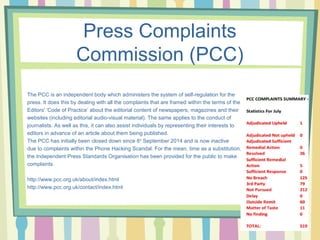
The PCC is an independent body which administers the system of self-regulation for the 
press. It does this by dealing with all the complaints that are framed within the terms of the 
Editors' ‘Code of Practice’ about the editorial content of newspapers, magazines and their 
websites (including editorial audio-visual material). The same applies to the conduct of 
journalists. As well as this, it can also assist individuals by representing their interests to 
editors in advance of an article about them being published. 
The PCC has initially been closed down since 8th September 2014 and is now inactive 
due to complaints within the Phone Hacking Scandal. For the mean, time as a substitution, 
the Independent Press Standards Organisation has been provided for the public to make 
complaints. 
http://www.pcc.org.uk/about/index.html 
http://www.pcc.org.uk/contact/index.html
Advertising Standards 
Authority(ASA). 
The Advertising Standards Authority is the UK’s independent regulator of 
advertising across all media. They apply the Advertising Codes, which are 
written by the Committees of Advertising Practice. There work includes acting on 
complaints and proactively checking the media to take action against 
misleading, harmful or offensive advertisements. ASA’s purpose is to make 
advertisements responsible and our ambition is to make every UK ad a 
responsible ad. 
Last year the ASA dealt with 31,136 complaints and thoroughly assessed every 
one of those concerns and investigated ads that seemed to breach the rules. As 
a result, nearly 4,161 ads were changed or withdrawn in 2013. 
http://www.asa.org.uk/About-ASA.aspx

Unit2 task1

  • 1.
    Regulatory and professionalbodies within the Creative Media Sector Name: Nicole Melia Unit 2 Task 1 Be able to extract information from written sources Unit 7 Task 3 Understanding the regulation of the media sector
  • 2.
    Task 1: Beable to extract information from written sources Be able to extract information from written sources Written sources: e.g. books, journals, websites, magazines, newspapers, handouts Reading: with concentration; skim-reading: scanning; using index; using word search; using phrase search Extract information: e.g. write notes, summarise, highlight text, annotate document, underline passages,
  • 3.
    British Board ofFilm Classification (BBFC) Source 1: http://www.bbfc.co.uk/education-resources/student-guide/legislation Source 2: http://www.legislation.gov.uk/ukpga/Eliz2/7-8/66/contents The British Board of Film Classification is an independent, non-governmental body which has classified cinema films since it was set up in 1912 and in 1984 videos and DVDs were classed as a certain classification. The British Board of Film was set up in 1912 by the film industry to bring a degree of uniformity to the classification of film nationally. These decide whether the films, DVDS and videos are suitable for people over a certain age otherwise they may begin to ban the films and even deleting cuts, instituting new ones or altering categories for films. BBFC's are in charge of the test of whether a work is suitable for viewing in the home (taking into account the potential for under-age viewing) They use the age ratings U, PG, 12, 12a, 15, 18. The BBFC has to consider the potential harm, whether to the viewer, or to society through the viewer's behaviour could effect people that watch these certain films. In particular anything involving criminal behaviour, illegal drugs, violent or horrific behaviour and human sexual activity are given special regard under the 'harm' test. Other legal considerations include indecent images of children, animal cruelty, obscenity, racial hatred and human rights. The examiners then have to analyse and make recommendations on the legality of a scene or work in the first instance. If then a work is found to contain material which falls foul of UK law, then it will be cut from the work. If the work as a whole is found to be in breach of the law, then it may be denied a certificate and rejected. An Act to amend the law relating to the publication of obscene matter is to provide the protection of others and to strengthen the law on pornography.
  • 4.
    British Video Association Source 1: http://www.bva.org.uk/ Source 2: http://www.bva.org.uk/copyright-and-ip/ The BVA was established in 1980 to represent the interests of publishers and rights owners of pre-recorded video entertainment. They are here to make sure video entertainment is critical and cultural to everyone due to the fact the world is evolving technology and new opportunities day by day. There are hundreds of British video association's such as Warner's Brothers, Walt Disney, Sony pictures, 20th century fox, etc. Working with marking and work within the media the BVA makes sure it promotes the video entertainment on all formats through business and consumer-facing media activity, It coordinates and supports promotional activity for Blu-ray, Ultraviolet and legal digital services, The BVA Awards is the biggest fixture in industry’s calendar and is attended by over 1000 guests, BVA AGM & News Review, addresses the government and industry and highlights the BVA’s activities as well as raising concerns for the industry and that The BVA website with membership access, promotes members’ and partners’ news and information as well as keeping the sector up to date with the latest position on Government Policy. Copy write is one of the BVA’s laws that falls under the remit of the UK Intellectual Property Office. The BVA has extensive dealings with this government agency as it develops copyright policy. The BVA works closely with its members to share best practice in copyright protection measures, including certification of suppliers to verify their security systems, and in the promotion of legal services They have worked with many company's to make sure ensure the government is aware of the links between IP theft and serious and organised crime and the multi-million pound losses incurred by the video industry to physical and online copyright theft.
  • 5.
    Film Distributors Association Source 1:http://www.launchingfilms.com/who-gains Source 2:https://www.google.co.uk/webhp?sourceid=chrome-instant& ion=1&espv=2&ie=UTF-8#q=what%20is%20priracy The FDA concentrates on Film Piracy In The UK. Piracy is the unauthorised permission to use or reproduce of others work, It has affected the film industry and wider society for many years - and in the digital age it remains as serious as it is. An example of Piracy is pirated copies being camcorder at early cinema screenings, with much ambient noise, shaky camera work and people walking in front of the lens. They may be downloaded on to discs from the Internet, or perhaps copied from a pre-release version of the film missing many of its final special effects or soundtrack. As much as this sounds like a good and easy idea to buy cheap films some of the discs do not play at all. In any event, people buying such copies are being ripped off. Worse still, the cash they pay lines the pockets of serious, organised criminals, who use the profits from film piracy to fuel their trade in human traffic, hard drugs or even terrorism.
  • 6.
    Video Standards Council (VSC) Source 1:http://www.videostandards.org.uk/VSC/ Source 2: The VSC was established in 1989 and fulfils two basic roles: It is a standards body for the video and video games industries and has a Code of Practice designed to ensure that both industries show a duty of care in their dealings with customers and the public generally. It provides staff that are trained in dealing with age restricted videos, DVDs and video games. It acts as an administrator of the PEGI system of age rating for video games. PEGI is used in over 30 countries. It is the UK regulator responsible for the age rating of video games supplied in the UK (using the PEGI system). In fulfilling this role it uses the name Games Rating Authority (GRA). In 1993 we extended the Code to promote high standards within the video games industry. Since 2003 we have administered PEGI, a pan-European age rating system designed for video games and are responsible for applying the PEGI system to video games sold in the UK. In July 2012, the VSC was appointed as the designated authority for the rating of video games in the UK. The ratings arm of the VSC is called the Games Rating Authority (GRA).
  • 7.
    Office for Communication (Ofcom) Ofcom is the communications regulator in the UK. They regulate the TV and radio sectors, fixed line telecoms, mobiles, postal services, plus the airwaves over which wireless devices operate and also, they make sure that people in the UK get the best from their communications services and are protected from scams and sharp practices, while ensuring that competition can thrive. Ofcom operates under a number of Acts of Parliament, including in particular the Communications Act 2003. Ofcom must act within the powers and duties set for it by Parliament in legislation. The Communications Act says that Ofcom’s principal duty is to further the interests of citizens and of consumers, where appropriate by promoting competition. Accountable to Parliament, they set and enforce regulatory rules for the sectors for which we have responsibility. We also have powers to enforce competition law in those sectors, alongside the Competition and Markets Authority. Ofcom is funded by fees from industry for regulating broadcasting and communications networks, and grant-in-aid from the Government. Ofcom.org.uk
  • 8.
    Trading Standards Central This legislation was introduced to ensure that the standards of the item that you are trading has to be what you describe it as. Before exchanging money for goods, you should always allow yourself to consider what you’re buying and whether you trust the seller. For example, if the item someone is selling you is faulty, they must say that, by law, before exchanging the item for money. In the media industry, scenarios like this usually happen with DVDs and video games: You think someone is doing a fair trade without knowing the item you’ve bought is dodgy until you get home when you can’t do anything about it. It’s illegal to copy and sell on DVDs as it is an offence under the Trade Marks Act 1994 and the Copyright, Design and Patents Act 1988. A man named Mohammed Waheed was sentenced to 9 months imprisonment after over 5000 discs of ‘fake DVDs’ were seized from his store and he pleaded guilty to selling them slyly behind the counter. The total cost he had to pay due to his actions was £8266. http://www.tradingstandards.gov.uk/extra/news-item.cfm/newsid/1391
  • 9.
    Press Complaints Commission(PCC) The PCC is an independent body which administers the system of self-regulation for the press. It does this by dealing with all the complaints that are framed within the terms of the Editors' ‘Code of Practice’ about the editorial content of newspapers, magazines and their websites (including editorial audio-visual material). The same applies to the conduct of journalists. As well as this, it can also assist individuals by representing their interests to editors in advance of an article about them being published. The PCC has initially been closed down since 8th September 2014 and is now inactive due to complaints within the Phone Hacking Scandal. For the mean, time as a substitution, the Independent Press Standards Organisation has been provided for the public to make complaints. http://www.pcc.org.uk/about/index.html http://www.pcc.org.uk/contact/index.html
  • 10.
    Advertising Standards Authority(ASA). The Advertising Standards Authority is the UK’s independent regulator of advertising across all media. They apply the Advertising Codes, which are written by the Committees of Advertising Practice. There work includes acting on complaints and proactively checking the media to take action against misleading, harmful or offensive advertisements. ASA’s purpose is to make advertisements responsible and our ambition is to make every UK ad a responsible ad. Last year the ASA dealt with 31,136 complaints and thoroughly assessed every one of those concerns and investigated ads that seemed to breach the rules. As a result, nearly 4,161 ads were changed or withdrawn in 2013. http://www.asa.org.uk/About-ASA.aspx