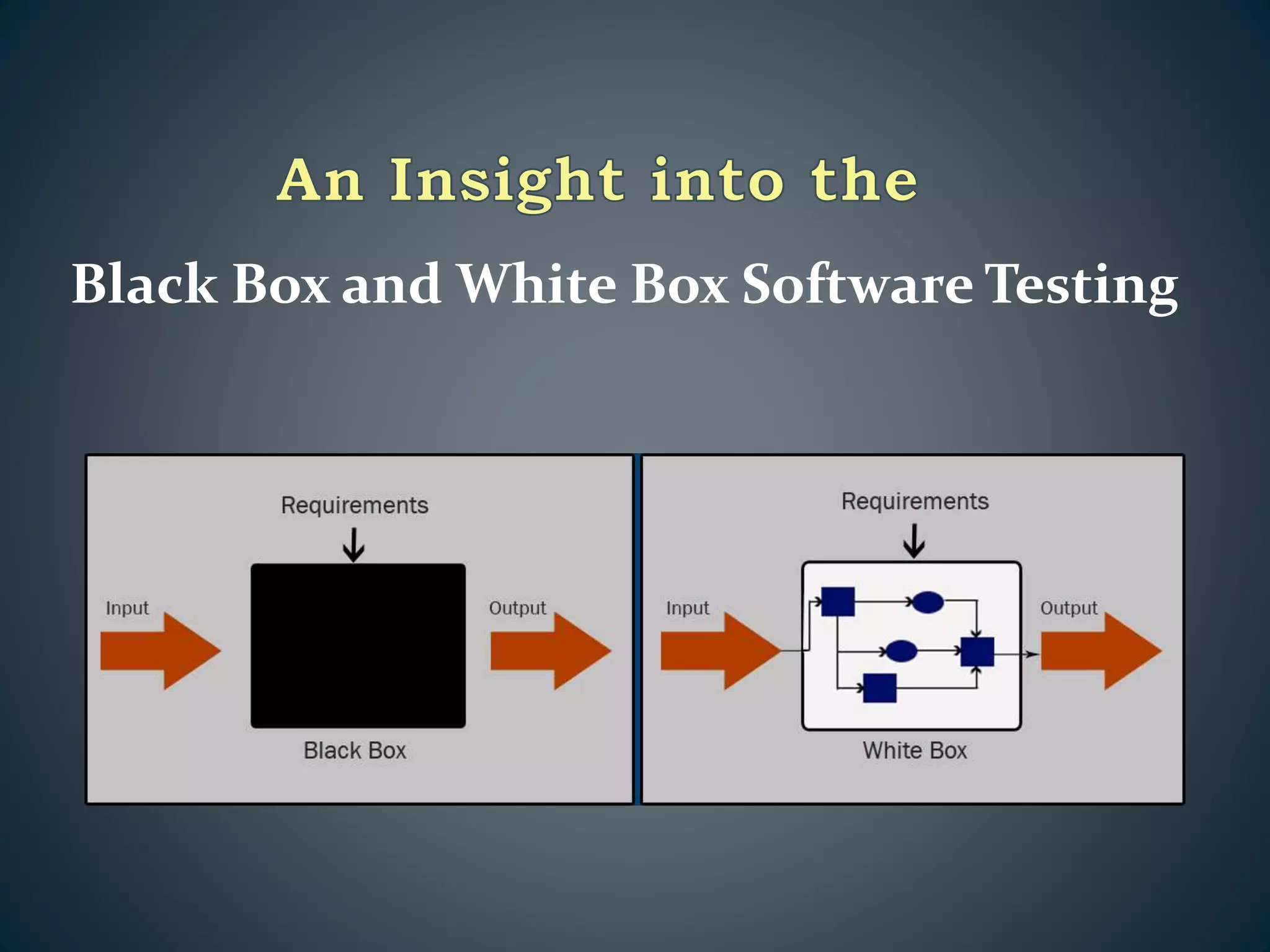


Black Box and White Box Software Testing
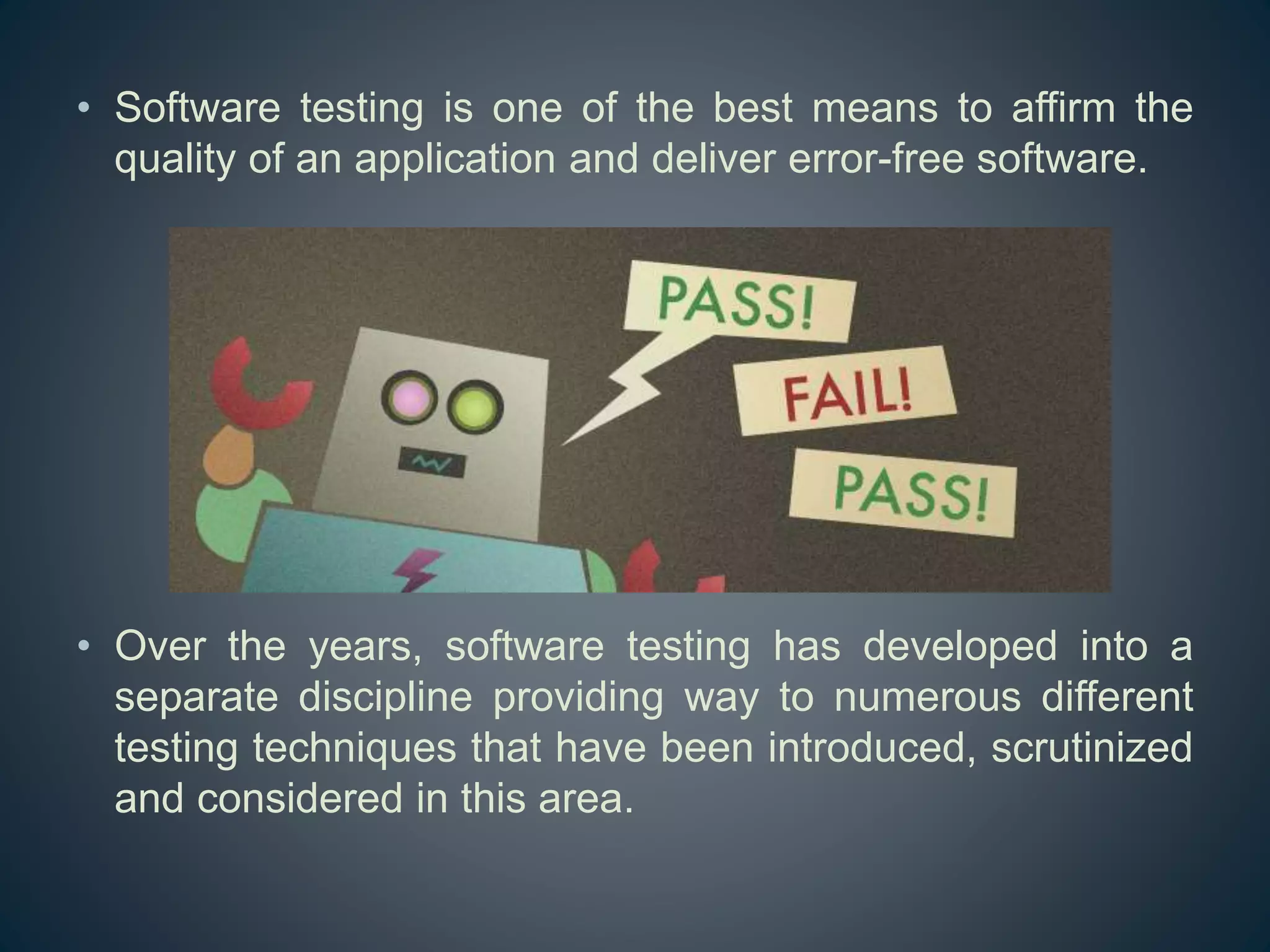
• Software testing is one of the best means to affirm the
quality of an application and deliver error-free software.
• Over the years, software testing has developed into a
separate discipline providing way to numerous different
testing techniques that have been introduced, scrutinized
and considered in this area.
However, the two commonly used testing approaches
include Black box and White box testing:
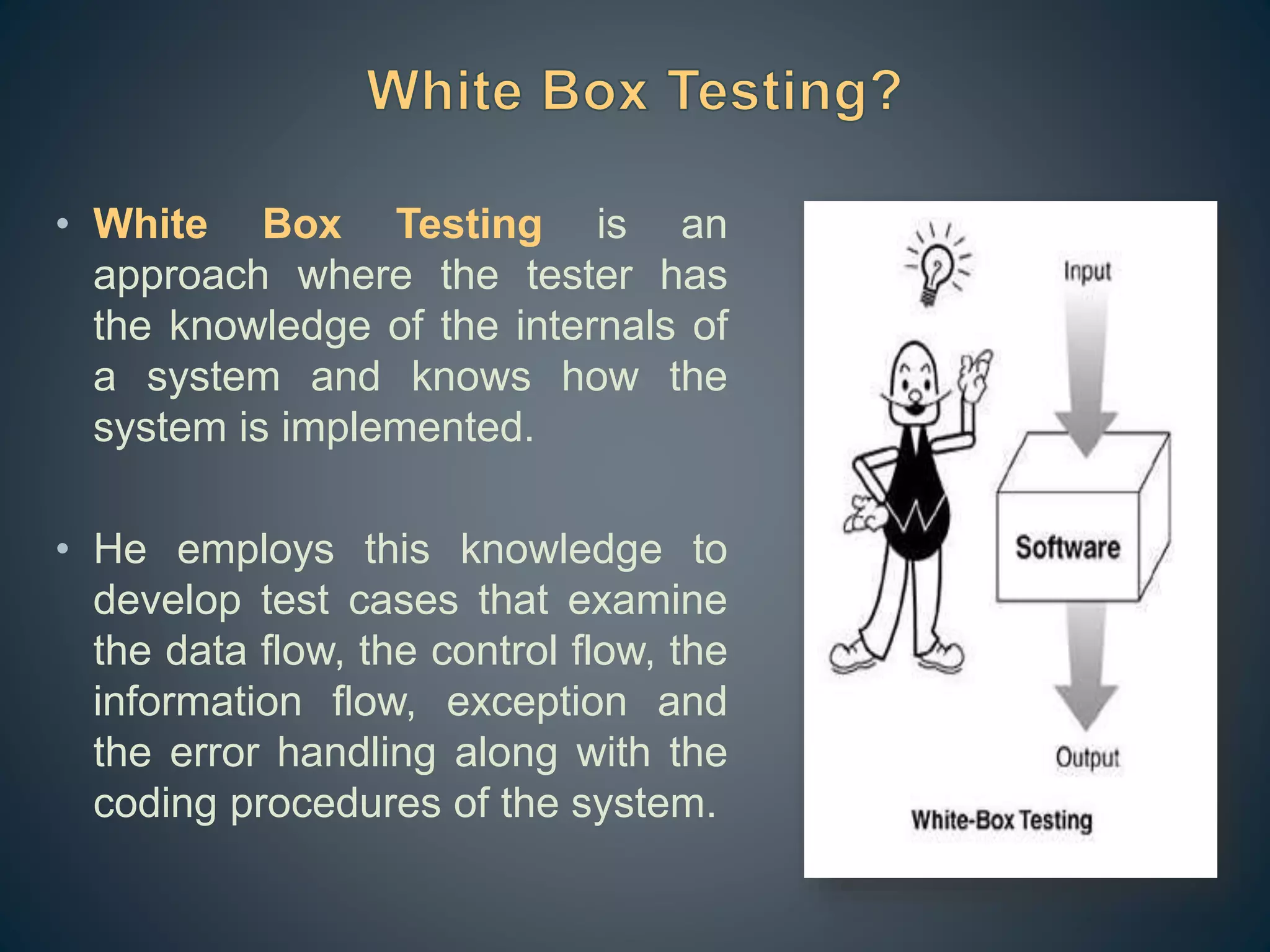
• White Box Testing is an
approach where the tester has
the knowledge of the internals of
a system and knows how the
system is implemented.
• He employs this knowledge to
develop test cases that examine
the data flow, the control flow, the
information flow, exception and
the error handling along with the
coding procedures of the system.
• The tester first analyzes and understands the structure of
the system by examining its code.
• He understands the weak points within the code that are
most prone to defects.
• He then develops the test cases to cover the individual
information/ data/ control flows within the code.
• The tester also develops the test cases to test the proper
working of all the functionalities and error handling of the
system.
• Decision Tests: All the decision directions must be
executed at least once during the software testing life cycle.
• Statement Tests: All the statements within the code must
have a test case associated with it so that each statement is
executed at least once during the testing cycle.
• Decision/Condition Tests: All the combinations of the
conceivable conditions within a specific set of decisions are
to be tested.
• Branch Condition Tests: All the conditions in a specific
decision are tested for proper working at least once.
• Multiple Condition Tests: This ensures that each point
of entry within the code is tested at least once during the
testing lifecycle.
• Data Flow Tests: This ensures that all the data and
variables used within the system are tested by passing
the specific variables through each probable calculation.
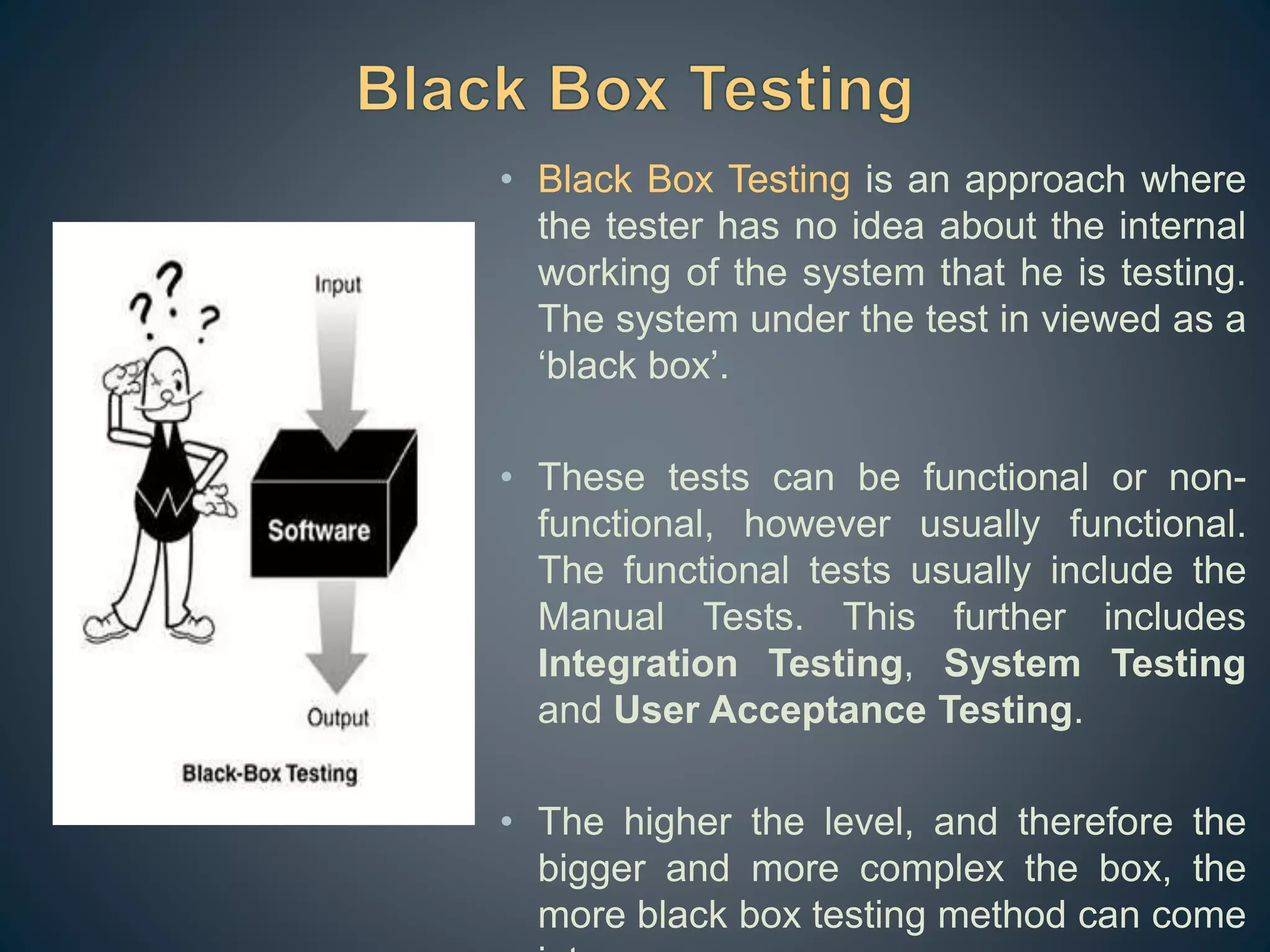
• Black Box Testing is an approach where
the tester has no idea about the internal
working of the system that he is testing.
The system under the test in viewed as a
‘black box’.
• These tests can be functional or non-
functional, however usually functional.
The functional tests usually include the
Manual Tests. This further includes
Integration Testing, System Testing
and User Acceptance Testing.
• The higher the level, and therefore the
bigger and more complex the box, the
more black box testing method can come
• The tester examines the requirements and the
specifications of the system.
• He explores the system’s User Interface and the
functionality to apprehend the working of the processes
in the system.
• He then designs the test cases with valid inputs and the
expected outputs.
• The tester also includes some of the negative test cases
with invalid inputs and the expected outputs, as
applicable.
• Equivalence Class Partitioning: Under this approach, a
set of functions is identified along with its corresponding
inputs (valid and invalid) and expected outcomes. This
technique aims at identifying classes of errors and therefore
reducing the total of test cases required.
• Boundary Value Analysis: This approach is focused on
testing the boundary values associated with the system. It
aims at testing the boundaries of the input domain that have
the highest probability of giving inaccurate outcomes.
• Error Guessing: This approach is often used by
experienced testers to identify the defects and then develop
the corresponding test cases.
• Want more insights on the Black Box- White Box
Testing concept? Get in contact with BugRaptors, a
CMMi5 certified quality assurance company with an
extensive experience in various software testing
techniques and services. Visit the website here.
An Insight into the Black Box and White Box Software Testing

An Insight into the Black Box and White Box Software Testing

  • 1.
    Black Box andWhite Box Software Testing
  • 2.
    • Software testingis one of the best means to affirm the quality of an application and deliver error-free software. • Over the years, software testing has developed into a separate discipline providing way to numerous different testing techniques that have been introduced, scrutinized and considered in this area.
  • 3.
    However, the twocommonly used testing approaches include Black box and White box testing:
  • 4.
    • White BoxTesting is an approach where the tester has the knowledge of the internals of a system and knows how the system is implemented. • He employs this knowledge to develop test cases that examine the data flow, the control flow, the information flow, exception and the error handling along with the coding procedures of the system.
  • 5.
    • The testerfirst analyzes and understands the structure of the system by examining its code. • He understands the weak points within the code that are most prone to defects. • He then develops the test cases to cover the individual information/ data/ control flows within the code. • The tester also develops the test cases to test the proper working of all the functionalities and error handling of the system.
  • 7.
    • Decision Tests:All the decision directions must be executed at least once during the software testing life cycle. • Statement Tests: All the statements within the code must have a test case associated with it so that each statement is executed at least once during the testing cycle. • Decision/Condition Tests: All the combinations of the conceivable conditions within a specific set of decisions are to be tested.
  • 9.
    • Branch ConditionTests: All the conditions in a specific decision are tested for proper working at least once. • Multiple Condition Tests: This ensures that each point of entry within the code is tested at least once during the testing lifecycle. • Data Flow Tests: This ensures that all the data and variables used within the system are tested by passing the specific variables through each probable calculation.
  • 10.
    • Black BoxTesting is an approach where the tester has no idea about the internal working of the system that he is testing. The system under the test in viewed as a ‘black box’. • These tests can be functional or non- functional, however usually functional. The functional tests usually include the Manual Tests. This further includes Integration Testing, System Testing and User Acceptance Testing. • The higher the level, and therefore the bigger and more complex the box, the more black box testing method can come
  • 11.
    • The testerexamines the requirements and the specifications of the system. • He explores the system’s User Interface and the functionality to apprehend the working of the processes in the system. • He then designs the test cases with valid inputs and the expected outputs. • The tester also includes some of the negative test cases with invalid inputs and the expected outputs, as applicable.
  • 13.
    • Equivalence ClassPartitioning: Under this approach, a set of functions is identified along with its corresponding inputs (valid and invalid) and expected outcomes. This technique aims at identifying classes of errors and therefore reducing the total of test cases required. • Boundary Value Analysis: This approach is focused on testing the boundary values associated with the system. It aims at testing the boundaries of the input domain that have the highest probability of giving inaccurate outcomes. • Error Guessing: This approach is often used by experienced testers to identify the defects and then develop the corresponding test cases.
  • 14.
    • Want moreinsights on the Black Box- White Box Testing concept? Get in contact with BugRaptors, a CMMi5 certified quality assurance company with an extensive experience in various software testing techniques and services. Visit the website here.