Unit III Introduction to IoT
Introduction of Internet of Things (IoT)
Definition:
The Internet of Things (IoT) describes the network of physical objects—“things”—that are embedded
with sensors, software, and other technologies for the purpose of connecting and exchanging data with
other devices and systems over the internet.
These devices range from ordinary household objects to sophisticated industrial tools. With more than 7
billion connected IoT devices today, experts are expecting this number to grow to 10 billion by 2020 and
22 billion by 2025.
What technologies have made IoT possible?
 Access to low-cost, low-power sensor technology
 Connectivity
 Cloud computing platforms
 Machine learning and analytics
 Conversational artificial intelligence (AI)
Characteristics of the Internet of Things
1.Connectivity
2. Intelligence and Identity
3. Scalability
4. Dynamic and Self-Adapting
5. Architecture
6. Safety
7. Self Configuring
8. Interoperability
9. Embedded Sensors and Actuators
10. Autonomous operation
Physical Design of Internet of Things (IOT)
The physical design of an IoT system is referred to as the Things/Devices and
protocols that are used to build an IoT system.
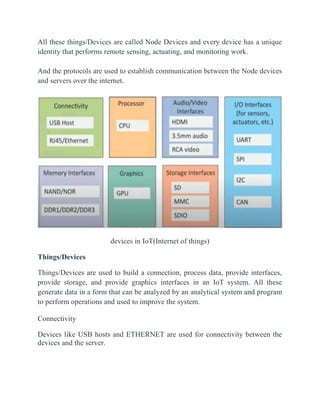
All these things/Devices are called Node Devices and every device has a unique
identity that performs remote sensing, actuating, and monitoring work.
And the protocols are used to establish communication between the Node devices
and servers over the internet.
devices in IoT(Internet of things)
Things/Devices
Things/Devices are used to build a connection, process data, provide interfaces,
provide storage, and provide graphics interfaces in an IoT system. All these
generate data in a form that can be analyzed by an analytical system and program
to perform operations and used to improve the system.
Connectivity
Devices like USB hosts and ETHERNET are used for connectivity between the
devices and the server.
Processor
A processor like a CPU and other units are used to process the data. these data are
further used to improve the decision quality of an IoT system.
Audio/Video Interfaces
An interface like HDMI and RCA devices is used to record audio and videos in a
system.
Input/Output interface
To give input and output signals to sensors, and actuators we use things like UART,
SPI, CAN, etc.
Storage Interfaces
Things like SD, MMC, and SDIO are used to store the data generated from an IoT
device.
Other things like DDR and GPU are used to control the activity of an IoT system.
IoT Protocols
These protocols are used to establish communication between a node device and a
server over the internet. it helps to send commands to an IoT device and receive
data from an IoT device over the internet
Physical Design of Internet of things(IoT) protocols
IoT(Internet of Things) protocols
Application Layer protocol
In this layer, protocols define how the data can be sent over the network using the
application interface. these protocols include HTTP, WebSocket, XMPP, MQTT,
DDS, and AMQP protocols.
Transport Layer
This layer is used to control the flow of data segments and handle error control.
also, these layer protocols provide end-to-end message transfer capability
independent of the underlying network. These protocols include TCP, UDP
Network Layer
This layer is used to send datagrams from the source network to the destination
network. we use IPv4 and IPv6 protocols as host identification that transfers data
in packets.
Link Layer
Link-layer protocols are used to send data over the network’s physical layer. it also
determines how the packets are coded and signaled by the devices. These protocols
include Ethernet, WiFi.
Logical Design of IoT
The logical design of an IoT system refers to an abstract representation of entities
and processes without going into the low-level specifies of implementation. it uses
Functional Blocks, Communication Models, and Communication APIs to
implement a system.
 IoT Functional Blocks
 IoT Communication Models
 IoT Communication APIs
IoT Functional blocks
An IoT system consists of a number of functional blocks like Devices, services,
communication, security, and application that provide the capability for sensing,
actuation, identification, communication, and management.
IoT functional blocks
Application
It is an interface that provides a control system that use by users to view the status
and analyze of system.
Management
This functional block provides various functions that are used to manage an IoT
system.
Services
This functional block provides some services like monitoring and controlling a
device and publishing and deleting the data and restoring the system.
Communication
This block handles the communication between the client and the cloud-based
server and sends/receives the data using protocols.
Security
This block is used to secure an IoT system using some functions like authorization,
data security, authentication, 2-step verification, etc.
Device
These devices are used to provide sensing and monitoring control functions that
collect data from the outer environment.
IoT Communication Models
There are several different types of models available in an IoT system that is used
to communicate between the system and server like the request-response model,
publish-subscribe model, push-pull model, exclusive pair model, etc.
Request-Response Communication Model
This model is a communication model in which a client sends the request for data
to the server and the server responds according to the request. when a server
receives a request it fetches the data, retrieves the resources and prepares the
response, and then sends the data back to the client.
logical design of iot communication models
Request response communication model
In simple terms, we can say that in the request-response model, the server sends
the response equivalent to the request of the client. in this model, HTTP works as
a request-response protocol between a client and server.
Example
When we search a query on a browser then the browser submits an HTTP request
to the server and then the server returns a response to the browser(client).
Publish-Subscribe Communication Model
In this communication model, we have a broker between the publisher and the
consumer. here publishers are the source of data but they are not aware of
consumers. they send the data managed by the brokers and when a consumer
subscribes to a topic that is managed by the broker and when the broker receives
data from the publisher it sends the data to all the subscribed consumers.
logical design of IoT publish subscribe model
Published-subscribe communication model
Example
On the website many times we subscribed to their newsletters using our email
address. these email addresses are managed by some third-party services and when
a new article is published on the website it is directly sent to the broker and then
the broker sends these new data or posts to all the subscribers.
Push-Pull Communication Model
It is a communication model in which the data push by the producers in a queue
and the consumers pull the data from the queues. here also producers are not aware
of the consumers.
logical design of iot push pull communication model
Push Pull Model
Example
When we visit a website we saw a number of posts that are published in a queue
and according to our requirements, we click on a post and start reading it.
Exclusive Pair Communication Model
It is a bidirectional fully duplex communication model that uses a persistent
connection between the client and server. here first set up a connection between
the client and the server and remain open until the client sends a close connection
request to the server.
logical design of iot exclusive pair model
Exclusive Pair communication model
IoT communication APIs
These APIs like REST and WebSocket are used to communicate between the server
and system in IoT.
REST-based communication APIs
Representational state transfer(REST) API uses a set of architectural principles that
are used to design web services. these APIs focus on the systems’ resources that
how resource states are transferred using the request-response communication
model. This API uses some architectural constraints.
Client-server
Here the client is not aware of the storage of data because it is concerned about the
server and similarly the server should not be concerned about the user interface
because it is a concern of the client. and this separation is needed for independent
development and updating of the server and client. no matter how the client is using
the response of the server and no matter how the server is using the request of the
client.
Stateless
It means each request from the client to the server must contain all the necessary
information to understand the server. because if the server can’t understand the
request of the client then it can’t fetch the requested data in a proper manner.
Cacheable
In response, if the cache constraints are given then a client can reuse that response
in a later request. it improves the efficiency and scalability of the system without
loading extra data.
A RESTful web API is implemented using HTTP and REST principles.
WebSocket-based communication API
This type of API allows bi-directional full-duplex communication between server
and client using the exclusive pair communication model. This API uses full-
duplex communication so it does not require a new connection setup every time
when it requests new data. WebSocket API begins with a connection setup between
the server and client and if the WebSocket is supported by the server then it
responds back to the client with a successful response after the setup of a
connection server and the client can send data to each other in full-duplex mode.
this type of API reduces the traffic and latency of data and makes sure that each
time when we request new data it cannot terminate the request.

Unit III.docx

  • 1.
    Unit III Introductionto IoT Introduction of Internet of Things (IoT) Definition: The Internet of Things (IoT) describes the network of physical objects—“things”—that are embedded with sensors, software, and other technologies for the purpose of connecting and exchanging data with other devices and systems over the internet. These devices range from ordinary household objects to sophisticated industrial tools. With more than 7 billion connected IoT devices today, experts are expecting this number to grow to 10 billion by 2020 and 22 billion by 2025. What technologies have made IoT possible?  Access to low-cost, low-power sensor technology  Connectivity  Cloud computing platforms  Machine learning and analytics  Conversational artificial intelligence (AI) Characteristics of the Internet of Things 1.Connectivity 2. Intelligence and Identity 3. Scalability 4. Dynamic and Self-Adapting 5. Architecture 6. Safety 7. Self Configuring 8. Interoperability 9. Embedded Sensors and Actuators 10. Autonomous operation Physical Design of Internet of Things (IOT) The physical design of an IoT system is referred to as the Things/Devices and protocols that are used to build an IoT system.
  • 2.
    All these things/Devicesare called Node Devices and every device has a unique identity that performs remote sensing, actuating, and monitoring work. And the protocols are used to establish communication between the Node devices and servers over the internet. devices in IoT(Internet of things) Things/Devices Things/Devices are used to build a connection, process data, provide interfaces, provide storage, and provide graphics interfaces in an IoT system. All these generate data in a form that can be analyzed by an analytical system and program to perform operations and used to improve the system. Connectivity Devices like USB hosts and ETHERNET are used for connectivity between the devices and the server.
  • 3.
    Processor A processor likea CPU and other units are used to process the data. these data are further used to improve the decision quality of an IoT system. Audio/Video Interfaces An interface like HDMI and RCA devices is used to record audio and videos in a system. Input/Output interface To give input and output signals to sensors, and actuators we use things like UART, SPI, CAN, etc. Storage Interfaces Things like SD, MMC, and SDIO are used to store the data generated from an IoT device. Other things like DDR and GPU are used to control the activity of an IoT system. IoT Protocols These protocols are used to establish communication between a node device and a server over the internet. it helps to send commands to an IoT device and receive data from an IoT device over the internet
  • 4.
    Physical Design ofInternet of things(IoT) protocols IoT(Internet of Things) protocols Application Layer protocol In this layer, protocols define how the data can be sent over the network using the application interface. these protocols include HTTP, WebSocket, XMPP, MQTT, DDS, and AMQP protocols. Transport Layer This layer is used to control the flow of data segments and handle error control. also, these layer protocols provide end-to-end message transfer capability independent of the underlying network. These protocols include TCP, UDP Network Layer This layer is used to send datagrams from the source network to the destination network. we use IPv4 and IPv6 protocols as host identification that transfers data in packets.
  • 5.
    Link Layer Link-layer protocolsare used to send data over the network’s physical layer. it also determines how the packets are coded and signaled by the devices. These protocols include Ethernet, WiFi. Logical Design of IoT The logical design of an IoT system refers to an abstract representation of entities and processes without going into the low-level specifies of implementation. it uses Functional Blocks, Communication Models, and Communication APIs to implement a system.  IoT Functional Blocks  IoT Communication Models  IoT Communication APIs IoT Functional blocks An IoT system consists of a number of functional blocks like Devices, services, communication, security, and application that provide the capability for sensing, actuation, identification, communication, and management.
  • 6.
    IoT functional blocks Application Itis an interface that provides a control system that use by users to view the status and analyze of system. Management This functional block provides various functions that are used to manage an IoT system. Services This functional block provides some services like monitoring and controlling a device and publishing and deleting the data and restoring the system. Communication This block handles the communication between the client and the cloud-based server and sends/receives the data using protocols.
  • 7.
    Security This block isused to secure an IoT system using some functions like authorization, data security, authentication, 2-step verification, etc. Device These devices are used to provide sensing and monitoring control functions that collect data from the outer environment. IoT Communication Models There are several different types of models available in an IoT system that is used to communicate between the system and server like the request-response model, publish-subscribe model, push-pull model, exclusive pair model, etc. Request-Response Communication Model This model is a communication model in which a client sends the request for data to the server and the server responds according to the request. when a server receives a request it fetches the data, retrieves the resources and prepares the response, and then sends the data back to the client. logical design of iot communication models Request response communication model In simple terms, we can say that in the request-response model, the server sends the response equivalent to the request of the client. in this model, HTTP works as a request-response protocol between a client and server. Example
  • 8.
    When we searcha query on a browser then the browser submits an HTTP request to the server and then the server returns a response to the browser(client). Publish-Subscribe Communication Model In this communication model, we have a broker between the publisher and the consumer. here publishers are the source of data but they are not aware of consumers. they send the data managed by the brokers and when a consumer subscribes to a topic that is managed by the broker and when the broker receives data from the publisher it sends the data to all the subscribed consumers. logical design of IoT publish subscribe model Published-subscribe communication model Example On the website many times we subscribed to their newsletters using our email address. these email addresses are managed by some third-party services and when a new article is published on the website it is directly sent to the broker and then the broker sends these new data or posts to all the subscribers. Push-Pull Communication Model It is a communication model in which the data push by the producers in a queue and the consumers pull the data from the queues. here also producers are not aware of the consumers. logical design of iot push pull communication model Push Pull Model Example
  • 9.
    When we visita website we saw a number of posts that are published in a queue and according to our requirements, we click on a post and start reading it. Exclusive Pair Communication Model It is a bidirectional fully duplex communication model that uses a persistent connection between the client and server. here first set up a connection between the client and the server and remain open until the client sends a close connection request to the server. logical design of iot exclusive pair model Exclusive Pair communication model IoT communication APIs These APIs like REST and WebSocket are used to communicate between the server and system in IoT. REST-based communication APIs Representational state transfer(REST) API uses a set of architectural principles that are used to design web services. these APIs focus on the systems’ resources that how resource states are transferred using the request-response communication model. This API uses some architectural constraints. Client-server Here the client is not aware of the storage of data because it is concerned about the server and similarly the server should not be concerned about the user interface because it is a concern of the client. and this separation is needed for independent development and updating of the server and client. no matter how the client is using the response of the server and no matter how the server is using the request of the client.
  • 10.
    Stateless It means eachrequest from the client to the server must contain all the necessary information to understand the server. because if the server can’t understand the request of the client then it can’t fetch the requested data in a proper manner. Cacheable In response, if the cache constraints are given then a client can reuse that response in a later request. it improves the efficiency and scalability of the system without loading extra data. A RESTful web API is implemented using HTTP and REST principles. WebSocket-based communication API This type of API allows bi-directional full-duplex communication between server and client using the exclusive pair communication model. This API uses full- duplex communication so it does not require a new connection setup every time when it requests new data. WebSocket API begins with a connection setup between the server and client and if the WebSocket is supported by the server then it responds back to the client with a successful response after the setup of a connection server and the client can send data to each other in full-duplex mode. this type of API reduces the traffic and latency of data and makes sure that each time when we request new data it cannot terminate the request.