DEFORESTATION
UNIT - II
INTRODUCTION
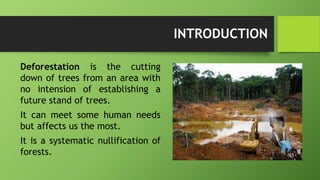
Deforestation is the cutting
down of trees from an area with
no intension of establishing a
future stand of trees.
It can meet some human needs
but affects us the most.
It is a systematic nullification of
forests.
INTRODUCTION
FORESTS are
• Dense habitat of flora and fauna
• Only place for wildlife
• Centres for biodiversity
• centres for ecosystem
• Areas to hold water responsible for continuous flow in rivers
• Hold soil together and control erosion
• Sinks of carbon dioxide
INTRODUCTION
Forests offer food, honey, fibre, medicinal plants, timber etc..
Forests generate soil and conserve water
They provide
• Employment
• Income
• Cultural heritage
• Aesthetic pleasure
• Scientific study
• Spiritual solace
CAUSES OF DEFORESTATION
 Because of increasing population forest lands had to be brought
under cultivation
 Construction of houses needs timber
 Furniture require wood
 Industries require large areas faraway from urban residential
areas
 Townships nearer to forests encroached in to them
 Dams constructed across valleys, resulting in submerged forests
CAUSES OF DEFORESTATION
 People with no emotions for the places where they settled
cutdown the trees for their benefits
 Roads through forests caused deforestation because of a easy
access for the tourists, plant collections and Hunters
EFFECTS OF DEFORESTATION
Heavy Soil Erosion
Extinction of flora and fauna
Relocation of wild life to urban areas
Global warming
EFFECTS OF DEFORESTATION
Flooding
Desertification
Danger of submersion of coastal areas and
glaciers
Heavy Soil Erosion
The roots of the trees hold the soil firmly
keeping it intact. With large scale
deforestation soil erosion and landslides
have become a normal phenomenon.
During heavy rains and typhoons soil is
washed away to lower regions.
This increases the risk for landslides
which can cause seriously threaten the
safety of the people and damage their
properties.
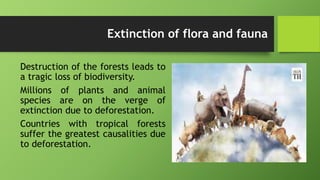
Extinction of flora and fauna
Destruction of the forests leads to
a tragic loss of biodiversity.
Millions of plants and animal
species are on the verge of
extinction due to deforestation.
Countries with tropical forests
suffer the greatest causalities due
to deforestation.
Relocation of wild life to urban areas
Many wild animals have started relocating
to urban areas as a result of massive
deforestation.
There have been many cases of various wild
animals like snakes, bats etc. causing
accidents in urban areas. Many times, wild
animals get killed in an effort to capture
them.
There have been instances of carnivorous
predators like lions, tigers and wolfs
preying on humans in villages surrounded by
forests.
Global warming
The trees absorb the harmful carbon
dioxide and release the life sustaining
oxygen, thus acting as natural friends of
humans.
Deforestation increases the amount of
carbon dioxide in the atmosphere leading
to global warming due to greenhouse
effect.
Silting of Rivers and Dams – Deforestation
causes large scale deposition of sediments
in the rivers. This leads to collection of
sediments in the dams, thus reducing their
lifespan.
Silting of Rivers and Dams
Deforestation causes large scale
deposition of sediments in the
rivers. This leads to collection of
sediments in the dams, thus
reducing their lifespan.
Flooding
Trees absorb water in large
quantities during heavy rains. But
due to large scale deforestation
there are very less trees to retain
water.
This again leads to heavy floods
causing heavy loss of life and
property.
Desertification
Deforestation is one of the causes
behind the conversion of many fertile
tracts of land to deserts. This
phenomenon is known as
desertification.
When mountain forest faces desertion,
watersheds are degraded and this leads
to the loss of sustained water supplies
for low land communities.
Danger of submersion of coastal areas and
glaciers
Due to massive deforestation, the
average temperature of the earth has
risen in the last century.
If this phenomenon continues then
the increased temperatures would
lead to melting of glaciers.
This would lead to a massive rise in
the sea levels leading to submersion
of coastal areas.
Keeping these dire consequences in mind, an honest
effort should be made by the human civilization to
conserve forests

UNIT II - DEFORESTATION.pptx

  • 1.
  • 2.
    INTRODUCTION Deforestation is thecutting down of trees from an area with no intension of establishing a future stand of trees. It can meet some human needs but affects us the most. It is a systematic nullification of forests.
  • 3.
    INTRODUCTION FORESTS are • Densehabitat of flora and fauna • Only place for wildlife • Centres for biodiversity • centres for ecosystem • Areas to hold water responsible for continuous flow in rivers • Hold soil together and control erosion • Sinks of carbon dioxide
  • 4.
    INTRODUCTION Forests offer food,honey, fibre, medicinal plants, timber etc.. Forests generate soil and conserve water They provide • Employment • Income • Cultural heritage • Aesthetic pleasure • Scientific study • Spiritual solace
  • 5.
    CAUSES OF DEFORESTATION Because of increasing population forest lands had to be brought under cultivation  Construction of houses needs timber  Furniture require wood  Industries require large areas faraway from urban residential areas  Townships nearer to forests encroached in to them  Dams constructed across valleys, resulting in submerged forests
  • 6.
    CAUSES OF DEFORESTATION People with no emotions for the places where they settled cutdown the trees for their benefits  Roads through forests caused deforestation because of a easy access for the tourists, plant collections and Hunters
  • 7.
    EFFECTS OF DEFORESTATION HeavySoil Erosion Extinction of flora and fauna Relocation of wild life to urban areas Global warming
  • 8.
    EFFECTS OF DEFORESTATION Flooding Desertification Dangerof submersion of coastal areas and glaciers
  • 9.
    Heavy Soil Erosion Theroots of the trees hold the soil firmly keeping it intact. With large scale deforestation soil erosion and landslides have become a normal phenomenon. During heavy rains and typhoons soil is washed away to lower regions. This increases the risk for landslides which can cause seriously threaten the safety of the people and damage their properties.
  • 10.
    Extinction of floraand fauna Destruction of the forests leads to a tragic loss of biodiversity. Millions of plants and animal species are on the verge of extinction due to deforestation. Countries with tropical forests suffer the greatest causalities due to deforestation.
  • 11.
    Relocation of wildlife to urban areas Many wild animals have started relocating to urban areas as a result of massive deforestation. There have been many cases of various wild animals like snakes, bats etc. causing accidents in urban areas. Many times, wild animals get killed in an effort to capture them. There have been instances of carnivorous predators like lions, tigers and wolfs preying on humans in villages surrounded by forests.
  • 12.
    Global warming The treesabsorb the harmful carbon dioxide and release the life sustaining oxygen, thus acting as natural friends of humans. Deforestation increases the amount of carbon dioxide in the atmosphere leading to global warming due to greenhouse effect. Silting of Rivers and Dams – Deforestation causes large scale deposition of sediments in the rivers. This leads to collection of sediments in the dams, thus reducing their lifespan.
  • 13.
    Silting of Riversand Dams Deforestation causes large scale deposition of sediments in the rivers. This leads to collection of sediments in the dams, thus reducing their lifespan.
  • 14.
    Flooding Trees absorb waterin large quantities during heavy rains. But due to large scale deforestation there are very less trees to retain water. This again leads to heavy floods causing heavy loss of life and property.
  • 15.
    Desertification Deforestation is oneof the causes behind the conversion of many fertile tracts of land to deserts. This phenomenon is known as desertification. When mountain forest faces desertion, watersheds are degraded and this leads to the loss of sustained water supplies for low land communities.
  • 16.
    Danger of submersionof coastal areas and glaciers Due to massive deforestation, the average temperature of the earth has risen in the last century. If this phenomenon continues then the increased temperatures would lead to melting of glaciers. This would lead to a massive rise in the sea levels leading to submersion of coastal areas.
  • 17.
    Keeping these direconsequences in mind, an honest effort should be made by the human civilization to conserve forests