


UNIT 6: ALLERGIES
FOR GRADE 11
BY Muhammed Loonat
201209626
INTRODUCTION
The immune system is really quite amazing. It is able to
identify and destroy many foreign invaders. The immune
system can also identify cells that are infected internally with
viruses. It does all of this work so the body remains healthy.
As amazing as the immune system is, it sometimes makes
mistakes…
Allergies are the result of these mistakes.
(Health.howstuffworks.com)
ALLERGY:
An allergy is a hypersensitivity disorder of the immune
system (Monroe, 2001).
WHY DOES THIS HAPPEN?
 The allergic immune system misidentifies an otherwise
harmless substance as harmful.
 It then attacks the substance with a fierceness far
greater than required.
 The problems this attack can cause range from mildly
inconvenient and uncomfortable to the total failure of
the organism the immune system is supposed to be
protecting (Health.howstuffworks.com).
ALLERGIES
 A substance that causes a reaction is called an
allergen(Campbell & Reece, 2010).
 Allergy reactions are acquired, predictable, and
rapid.
 Allergy is one of four forms of hypersensitivity and is
formally called type I (or immediate) hypersensitivity
(Health.howstuffworks.com).
CAUSES:
 Risk factors for allergy can be placed in two general categories,
namely 1.HOST and 2.ENVIRONMENTAL factors (Saban, 2011).
 1.HOST FACTORS include heredity, sex, race, and age, with heredity
being by far the most significant.
 2. ENVIRONMENTAL FACTORS –
Four major environmental candidates are:
1. Alterations in exposure to infectious disease during early childhood.
2. Environmental pollution.
3. Allergen levels.
4. Dietary changes.
THE ALLERGIC PROCESS:
 IgE antibodies are present in everyone.
 In a properly functioning immune system, the genetic code contains enough
information to enable the lymphocytes to distinguish between threatening and
non-threatening proteins.
 In an allergic person's immune system, for example the lymphocytes can't tell that
the protein ingested as part of a meal containing shellfish isn't invading the body.
 The B-cells of an allergic person -- "misinformed" at the genetic level -- cause the
production of large quantities of IgE antibodies that attach themselves to mast
cells and basophils throughout the body. This is known as the sensitizing exposure.
 A person who has an allergy is said to be ‘atopic’ – such people usually have
raised levels of IgE in their blood (Health.howstuffworks.com).
ALLERGIC REACTIONS
 Although mast cells are found in connective tissue and basophils are a
type of white blood cell, they have one thing in common to the allergy
sufferer - They contain histamine (Campbell & Reece, 2010).
 Histamine is an important weapon in the body for fighting infection.
 Unfortunately, when released into the body inappropriately or in too high a
quantity, histamine is a potentially devastating substance.
 In small amounts, histamine causes itching and reddening of the local
area.
 In large amounts, the nearby blood vessels become dilated and the area
swells with accumulated fluid (Health.howstuffworks.com).
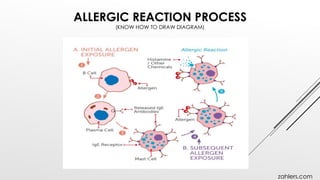
ALLERGIC REACTION PROCESS
(KNOW HOW TO DRAW DIAGRAM)
zahlers.com
THE ALLERGIC CASCADE
 It takes between a week and 10 days of warning exposure for the
mast cells and basophils to become aware with IgE antibodies.
 Then, if the allergen comes along again, it triggers a destructive
domino effect within the system called the allergic cascade
(Health.howstuffworks.com).
 Whether it's a protein molecule or a pollen particle that has been inhaled, or the injected protein in the
venom of a wasp, the same sequence of events takes place:
 The IgE antibodies bound to the surfaces of basophils and mast cells recognize the protein surface
markers of the allergen.
 The IgE antibodies react by binding to the protein surface markers while remaining attached to the mast
cells or basophils.
 This binding alerts a group of special proteins called the complement complex that circulates in the
blood.
 There are about 20 proteins in this family of proteins, at least nine of which are involved in the allergic-
response mechanism.
 After the IgE antibody (which is already attached to a mast cell or basophil) encounters and binds to its
specific allergen, the first complement protein attaches itself to the site.
 This alerts the next complement protein in the sequence, which joins and alerts the next, and so on.
 When the string is complete, the offending cell is destroyed (Health.howstuffworks.com).
 This is fine in a normal immune system, as Ig antibodies latch onto surface markers of disease
cells and cause their destruction. But in an allergic episode, the cells involved are mast cells
and basophils.
 When mast cells and basophils are destroyed, their stores of histamine and other allergy
mediators are released into the surrounding tissues and blood.
 This causes dilation of surface blood vessels and a subsequent drop in blood pressure.
 The spaces between surrounding cells fill with fluid. Depending on the allergen or the part of
the body involved, this brings on the various allergy symptoms (Health.howstuffworks.com).
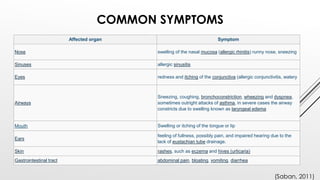
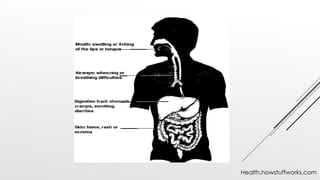
COMMON SYMPTOMS
Affected organ Symptom
Nose swelling of the nasal mucosa (allergic rhinitis) runny nose, sneezing
Sinuses allergic sinusitis
Eyes redness and itching of the conjunctiva (allergic conjunctivitis, watery
Airways
Sneezing, coughing, bronchoconstriction, wheezing and dyspnea,
sometimes outright attacks of asthma, in severe cases the airway
constricts due to swelling known as laryngeal edema
Mouth Swelling or itching of the tongue or lip
Ears
feeling of fullness, possibly pain, and impaired hearing due to the
lack of eustachian tube drainage.
Skin rashes, such as eczema and hives (urticaria)
Gastrointestinal tract abdominal pain, bloating, vomiting, diarrhea
(Saban, 2011)
Health.howstuffworks.com
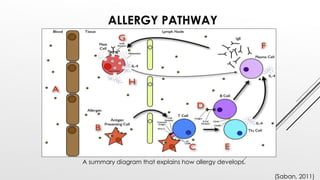
ALLERGY PATHWAY
A summary diagram that explains how allergy develops.
(Saban, 2011)
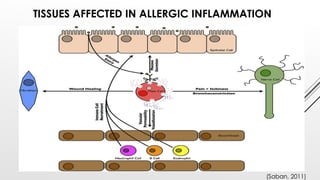
TISSUES AFFECTED IN ALLERGIC INFLAMMATION
(Saban, 2011)
CROSS REACTIVITY
 Allergy sufferers sometimes find that once they have become
sensitized to certain allergens, they also exhibit allergic symptoms
when exposed to related substances (Health.howstuffworks.com).
 For example, if you have an allergic reaction to honeybee venom,
you might also test positive for hypersensitivity to all other types of
bee venom.
SYSTEMIC REACTIONS
 Some allergic people become sensitized to proteins in such
things as ragweed pollen, latex, certain foods, and drugs like
penicillin.
 With these allergies, the reaction can involve the entire body. This
is called a systemic reaction (Health.howstuffworks.com).
 In a systemic reaction, the release of allergy mediators (chief
among them being histamine) causes capillaries all over the
body to dilate. If this proceeds to the point of danger, it is known
as anaphylaxis. If it proceeds even further, the victim passes
into anaphylactic shock (Monroe, 2001).
ANAPHYLACTIC SHOCK
 The exposure-reaction time can vary depending on your body and
the allergen you were exposed to.
 In a mild case, you may only have mild itching or swelling.
 In a severe reaction, after exposure to the triggering antigen, you
may suddenly develop hives over large areas of your body and begin
having breathing difficulties (this is accompanied by a rapid and
severe drop in blood pressure).
 Also, in a severe reaction, thinking becomes muddled as
the brain and other vital organs become oxygen-starved. The brain
and kidneys are especially vulnerable in this type of reaction and may
be permanently damaged even if the victim survives (Monroe, 2001).
 To make matters worse, cell fluids dumped into the tissues of the throat
can cause the throat to swell shut, leading to anaphylactic shock and
death in as little as three or four minutes after exposure to the antigen
or the onset of symptoms.
 Currently, the only effective treatment for anaphylaxis is an
intramuscular injection of epinephrine, a hormone the body produces
naturally in the adrenal glands.
 Epinephrine counteracts the symptoms of anaphylaxis by constricting
the blood vessels and opening the airways.
 The down side is that its effects last only 10 to 20 minutes per injection,
it has some potentially serious side effects, and it must be administered
correctly at or before the onset of symptoms to be effective (Monroe,
2001).
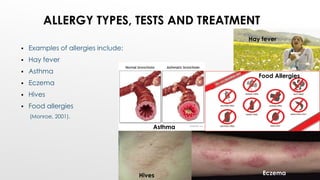
 Examples of allergies include:
 Hay fever
 Asthma
 Eczema
 Hives
 Food allergies
(Monroe, 2001).
ALLERGY TYPES, TESTS AND TREATMENT
Hives Eczema
Hay fever
Food Allergies
Asthma
 Food – such as crustaceans, eggs, fish, milk, peanuts, tree nuts (for
example, almonds, cashews, pecans and walnuts), sesame and soy
products
 Plants – pollen from grasses and plants
 Medicines from some prescription drugs (such as penicillin), over-the-
counter medicines (such as aspirin) and herbal preparations
 Insects – such as dust mites and the venom from bees, ticks and wasps
 Moulds – such as mushroom and mould spores
 Animal dander – such as the fur and skin flakes from domestic pets like
cats and dogs
 Chemicals – including industrial and household chemicals and chemical
products such as latex rubber (Monroe, 2001).
ALLERGY TYPES, TESTS AND TREATMENT
Common allergens:
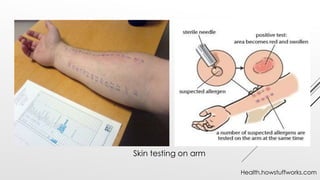
 Allergists use a variety of diagnostic techniques to determine if a person is allergic
 The most common test, the scratch test or also known as skin test, consists of applying a
diluted extract of the possible allergen to the back or arm, and then scratching the skin
with a needle. If the patient develops a certain degree of swelling or redness in the
scratched area, the existence of IgE antibodies to that allergen is indicated.
 Blood tests are another avenue of diagnostics, especially in small children. With small
children, the scratch test is used less often because the possible allergens used in the test
may actually trigger a reaction in a child who has not been exposed to that substance
before.
 Neither the scratch test nor the blood test is 100 percent accurate, but the results, taken
together with a patient's medical history, can help the doctor or allergist with a diagnosis
and treatment plan (Health.howstuffworks.com).
ALLERGY TYPES, TESTS AND TREATMENT
Skin testing on arm
Health.howstuffworks.com
 There are three techniques commonly offered by doctors to help
allergy sufferers:
 Avoidance
 Medication
 Immunotherapy
(Health.howstuffworks.com)
ALLERGY TYPES, TESTS AND TREATMENT
 Many allergens, once identified, can simply be avoided. If you know you're allergic to shellfish, you
don't eat it. Pet allergies can be handled sometimes by keeping the pet outside.
 Unfortunately, many allergens -- like pollen, mould and dust -- are very difficult, if not impossible, to
avoid. These can often be managed by using medications such as antihistamines, decongestants,
cromolyn sodium, corticosteroids and, in the case of anaphylaxis, epinephrine.
 Immunotherapy is expensive, time consuming and not without risk. But it is often the only hope a
person has for leading a normal life. It consists of a series of injections of the offending allergen,
beginning with a very weak dilution and gradually building in strength to a maintenance dose that
may be continued over time. The injections help the immune system to produce fewer IgE
antibodies, while also stimulating the production of a blocking antibody called IgG. This works to
varying degrees with many allergies, but some cannot be treated this way (Health.howstuffworks.com).
ALLERGY TYPES, TESTS AND TREATMENT
REFERENCES
 Campbell, A. & Reece, B. (2010).Biology, Eighth Edition.San Francisco: Pearson Benjamin
Cummings.
 Monroe, J. (2001). Allergies: Perspectives on Disease and Illness. USA: Capstone Press.
 Sabban, S. (2011). Development of an in vitro model system for studying the interaction of Equus
caballus IgE with its high-affinity receptor. University of Sheffield: PhD thesis.
 Beach, S. (2000). How Allergies Work. Available from: http://health.howstuffworks.com/diseases-
conditions/allergies/allergy-basics/allergy.htm
(Accessed September 2014)
 Allergic reaction process picture. Available from: http://zahlers.com/cms/wp-
content/uploads/2011/11/Allergies2.jpg
(Accessed 02 October 2014)

Unit 6 allergies

  • 1.
    UNIT 6: ALLERGIES FORGRADE 11 BY Muhammed Loonat 201209626
  • 2.
    INTRODUCTION The immune systemis really quite amazing. It is able to identify and destroy many foreign invaders. The immune system can also identify cells that are infected internally with viruses. It does all of this work so the body remains healthy. As amazing as the immune system is, it sometimes makes mistakes… Allergies are the result of these mistakes. (Health.howstuffworks.com)
  • 3.
    ALLERGY: An allergy isa hypersensitivity disorder of the immune system (Monroe, 2001).
  • 4.
    WHY DOES THISHAPPEN?  The allergic immune system misidentifies an otherwise harmless substance as harmful.  It then attacks the substance with a fierceness far greater than required.  The problems this attack can cause range from mildly inconvenient and uncomfortable to the total failure of the organism the immune system is supposed to be protecting (Health.howstuffworks.com).
  • 5.
    ALLERGIES  A substancethat causes a reaction is called an allergen(Campbell & Reece, 2010).  Allergy reactions are acquired, predictable, and rapid.  Allergy is one of four forms of hypersensitivity and is formally called type I (or immediate) hypersensitivity (Health.howstuffworks.com).
  • 6.
    CAUSES:  Risk factorsfor allergy can be placed in two general categories, namely 1.HOST and 2.ENVIRONMENTAL factors (Saban, 2011).  1.HOST FACTORS include heredity, sex, race, and age, with heredity being by far the most significant.  2. ENVIRONMENTAL FACTORS – Four major environmental candidates are: 1. Alterations in exposure to infectious disease during early childhood. 2. Environmental pollution. 3. Allergen levels. 4. Dietary changes.
  • 7.
    THE ALLERGIC PROCESS: IgE antibodies are present in everyone.  In a properly functioning immune system, the genetic code contains enough information to enable the lymphocytes to distinguish between threatening and non-threatening proteins.  In an allergic person's immune system, for example the lymphocytes can't tell that the protein ingested as part of a meal containing shellfish isn't invading the body.  The B-cells of an allergic person -- "misinformed" at the genetic level -- cause the production of large quantities of IgE antibodies that attach themselves to mast cells and basophils throughout the body. This is known as the sensitizing exposure.  A person who has an allergy is said to be ‘atopic’ – such people usually have raised levels of IgE in their blood (Health.howstuffworks.com).
  • 8.
    ALLERGIC REACTIONS  Althoughmast cells are found in connective tissue and basophils are a type of white blood cell, they have one thing in common to the allergy sufferer - They contain histamine (Campbell & Reece, 2010).  Histamine is an important weapon in the body for fighting infection.  Unfortunately, when released into the body inappropriately or in too high a quantity, histamine is a potentially devastating substance.  In small amounts, histamine causes itching and reddening of the local area.  In large amounts, the nearby blood vessels become dilated and the area swells with accumulated fluid (Health.howstuffworks.com).
  • 9.
    ALLERGIC REACTION PROCESS (KNOWHOW TO DRAW DIAGRAM) zahlers.com
  • 10.
    THE ALLERGIC CASCADE It takes between a week and 10 days of warning exposure for the mast cells and basophils to become aware with IgE antibodies.  Then, if the allergen comes along again, it triggers a destructive domino effect within the system called the allergic cascade (Health.howstuffworks.com).
  • 11.
     Whether it'sa protein molecule or a pollen particle that has been inhaled, or the injected protein in the venom of a wasp, the same sequence of events takes place:  The IgE antibodies bound to the surfaces of basophils and mast cells recognize the protein surface markers of the allergen.  The IgE antibodies react by binding to the protein surface markers while remaining attached to the mast cells or basophils.  This binding alerts a group of special proteins called the complement complex that circulates in the blood.  There are about 20 proteins in this family of proteins, at least nine of which are involved in the allergic- response mechanism.  After the IgE antibody (which is already attached to a mast cell or basophil) encounters and binds to its specific allergen, the first complement protein attaches itself to the site.  This alerts the next complement protein in the sequence, which joins and alerts the next, and so on.  When the string is complete, the offending cell is destroyed (Health.howstuffworks.com).
  • 12.
     This isfine in a normal immune system, as Ig antibodies latch onto surface markers of disease cells and cause their destruction. But in an allergic episode, the cells involved are mast cells and basophils.  When mast cells and basophils are destroyed, their stores of histamine and other allergy mediators are released into the surrounding tissues and blood.  This causes dilation of surface blood vessels and a subsequent drop in blood pressure.  The spaces between surrounding cells fill with fluid. Depending on the allergen or the part of the body involved, this brings on the various allergy symptoms (Health.howstuffworks.com).
  • 13.
    COMMON SYMPTOMS Affected organSymptom Nose swelling of the nasal mucosa (allergic rhinitis) runny nose, sneezing Sinuses allergic sinusitis Eyes redness and itching of the conjunctiva (allergic conjunctivitis, watery Airways Sneezing, coughing, bronchoconstriction, wheezing and dyspnea, sometimes outright attacks of asthma, in severe cases the airway constricts due to swelling known as laryngeal edema Mouth Swelling or itching of the tongue or lip Ears feeling of fullness, possibly pain, and impaired hearing due to the lack of eustachian tube drainage. Skin rashes, such as eczema and hives (urticaria) Gastrointestinal tract abdominal pain, bloating, vomiting, diarrhea (Saban, 2011)
  • 14.
  • 15.
    ALLERGY PATHWAY A summarydiagram that explains how allergy develops. (Saban, 2011)
  • 16.
    TISSUES AFFECTED INALLERGIC INFLAMMATION (Saban, 2011)
  • 17.
    CROSS REACTIVITY  Allergysufferers sometimes find that once they have become sensitized to certain allergens, they also exhibit allergic symptoms when exposed to related substances (Health.howstuffworks.com).  For example, if you have an allergic reaction to honeybee venom, you might also test positive for hypersensitivity to all other types of bee venom.
  • 18.
    SYSTEMIC REACTIONS  Someallergic people become sensitized to proteins in such things as ragweed pollen, latex, certain foods, and drugs like penicillin.  With these allergies, the reaction can involve the entire body. This is called a systemic reaction (Health.howstuffworks.com).  In a systemic reaction, the release of allergy mediators (chief among them being histamine) causes capillaries all over the body to dilate. If this proceeds to the point of danger, it is known as anaphylaxis. If it proceeds even further, the victim passes into anaphylactic shock (Monroe, 2001).
  • 19.
    ANAPHYLACTIC SHOCK  Theexposure-reaction time can vary depending on your body and the allergen you were exposed to.  In a mild case, you may only have mild itching or swelling.  In a severe reaction, after exposure to the triggering antigen, you may suddenly develop hives over large areas of your body and begin having breathing difficulties (this is accompanied by a rapid and severe drop in blood pressure).  Also, in a severe reaction, thinking becomes muddled as the brain and other vital organs become oxygen-starved. The brain and kidneys are especially vulnerable in this type of reaction and may be permanently damaged even if the victim survives (Monroe, 2001).
  • 20.
     To makematters worse, cell fluids dumped into the tissues of the throat can cause the throat to swell shut, leading to anaphylactic shock and death in as little as three or four minutes after exposure to the antigen or the onset of symptoms.  Currently, the only effective treatment for anaphylaxis is an intramuscular injection of epinephrine, a hormone the body produces naturally in the adrenal glands.  Epinephrine counteracts the symptoms of anaphylaxis by constricting the blood vessels and opening the airways.  The down side is that its effects last only 10 to 20 minutes per injection, it has some potentially serious side effects, and it must be administered correctly at or before the onset of symptoms to be effective (Monroe, 2001).
  • 21.
     Examples ofallergies include:  Hay fever  Asthma  Eczema  Hives  Food allergies (Monroe, 2001). ALLERGY TYPES, TESTS AND TREATMENT Hives Eczema Hay fever Food Allergies Asthma
  • 22.
     Food –such as crustaceans, eggs, fish, milk, peanuts, tree nuts (for example, almonds, cashews, pecans and walnuts), sesame and soy products  Plants – pollen from grasses and plants  Medicines from some prescription drugs (such as penicillin), over-the- counter medicines (such as aspirin) and herbal preparations  Insects – such as dust mites and the venom from bees, ticks and wasps  Moulds – such as mushroom and mould spores  Animal dander – such as the fur and skin flakes from domestic pets like cats and dogs  Chemicals – including industrial and household chemicals and chemical products such as latex rubber (Monroe, 2001). ALLERGY TYPES, TESTS AND TREATMENT Common allergens:
  • 23.
     Allergists usea variety of diagnostic techniques to determine if a person is allergic  The most common test, the scratch test or also known as skin test, consists of applying a diluted extract of the possible allergen to the back or arm, and then scratching the skin with a needle. If the patient develops a certain degree of swelling or redness in the scratched area, the existence of IgE antibodies to that allergen is indicated.  Blood tests are another avenue of diagnostics, especially in small children. With small children, the scratch test is used less often because the possible allergens used in the test may actually trigger a reaction in a child who has not been exposed to that substance before.  Neither the scratch test nor the blood test is 100 percent accurate, but the results, taken together with a patient's medical history, can help the doctor or allergist with a diagnosis and treatment plan (Health.howstuffworks.com). ALLERGY TYPES, TESTS AND TREATMENT
  • 24.
    Skin testing onarm Health.howstuffworks.com
  • 25.
     There arethree techniques commonly offered by doctors to help allergy sufferers:  Avoidance  Medication  Immunotherapy (Health.howstuffworks.com) ALLERGY TYPES, TESTS AND TREATMENT
  • 26.
     Many allergens,once identified, can simply be avoided. If you know you're allergic to shellfish, you don't eat it. Pet allergies can be handled sometimes by keeping the pet outside.  Unfortunately, many allergens -- like pollen, mould and dust -- are very difficult, if not impossible, to avoid. These can often be managed by using medications such as antihistamines, decongestants, cromolyn sodium, corticosteroids and, in the case of anaphylaxis, epinephrine.  Immunotherapy is expensive, time consuming and not without risk. But it is often the only hope a person has for leading a normal life. It consists of a series of injections of the offending allergen, beginning with a very weak dilution and gradually building in strength to a maintenance dose that may be continued over time. The injections help the immune system to produce fewer IgE antibodies, while also stimulating the production of a blocking antibody called IgG. This works to varying degrees with many allergies, but some cannot be treated this way (Health.howstuffworks.com). ALLERGY TYPES, TESTS AND TREATMENT
  • 28.
    REFERENCES  Campbell, A.& Reece, B. (2010).Biology, Eighth Edition.San Francisco: Pearson Benjamin Cummings.  Monroe, J. (2001). Allergies: Perspectives on Disease and Illness. USA: Capstone Press.  Sabban, S. (2011). Development of an in vitro model system for studying the interaction of Equus caballus IgE with its high-affinity receptor. University of Sheffield: PhD thesis.  Beach, S. (2000). How Allergies Work. Available from: http://health.howstuffworks.com/diseases- conditions/allergies/allergy-basics/allergy.htm (Accessed September 2014)  Allergic reaction process picture. Available from: http://zahlers.com/cms/wp- content/uploads/2011/11/Allergies2.jpg (Accessed 02 October 2014)