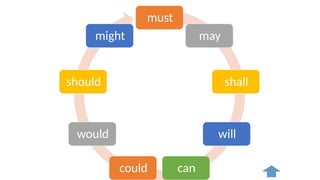
Modal
must
may
shall
will
can
could
would
should
might
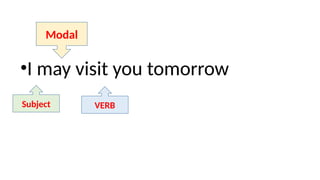
•I may visit you tomorrow
Subject VERB
Modal
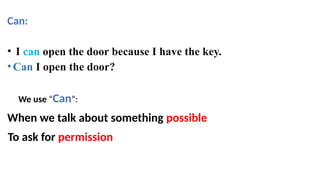
Can:
• I can open the door because I have the key.
•Can I open the door?
When we talk about something possible
We use “Can”:
To ask for permission
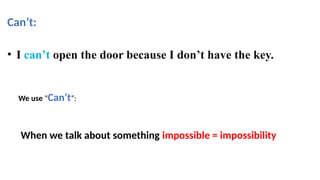
Can’t:
• I can’t open the door because I don’t have the key.
When we talk about something impossible = impossibility
We use “Can’t”:
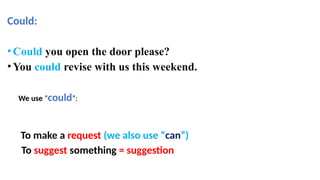
Could:
•Could you open the door please?
•You could revise with us this weekend.
To make a request (we also use “can”)
We use “could”:
To suggest something = suggestion
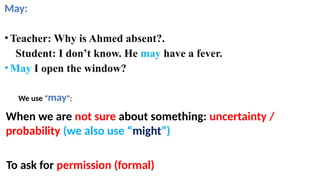
May:
•Teacher: Why is Ahmed absent?.
Student: I don’t know. He may have a fever.
•May I open the window?
When we are not sure about something: uncertainty /
probability (we also use “might”)
We use “may”:
To ask for permission (formal)
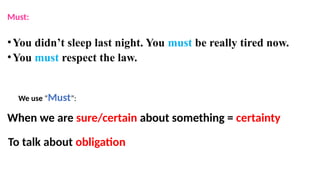
Must:
•You didn’t sleep last night. You must be really tired now.
•You must respect the law.
When we are sure/certain about something = certainty
We use “Must”:
To talk about obligation
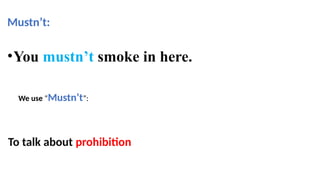
Mustn’t:
•You mustn’t smoke in here.
We use “Mustn’t”:
To talk about prohibition
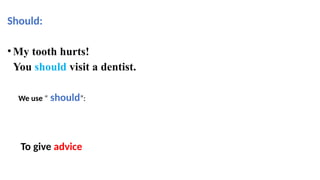
Should:
•My tooth hurts!
You should visit a dentist.
We use “ should”:
To give advice
Modal Verb Function
Can • Possibility – I can learn English.
• Permission – Can I go out please?
Can’t • Impossibility - I can’t see without my glasses
Could • Request – Could you bring me a cup of tea, please?
• Suggestion – You could revise with us this weekend
May • Permission (politeness) – May I open the window, please?
• Uncertainty –Ali may travel tomorrow.
Might • Probability – It might rain.
Shall • Suggestion – Shall we go to the cinema?
Should • Advice – You should eat more vegetables.
Must • Obligation – You must do your homework, whether you want to or not.
• Certainty – He has a great car. He must earn a lot of money.
Mustn’t • Prohibition – You mustn’t cross the road when the red light is on.
Form:
You must be tired:
Subject + Modal + Verb (infinitive) + …
Modals
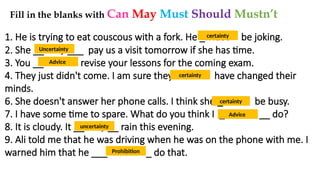
1. He is trying to eat couscous with a fork. He _must be joking.
2. She __ may ___ pay us a visit tomorrow if she has time.
3. You __ should revise your lessons for the coming exam.
4. They just didn't come. I am sure they must have changed their
minds.
6. She doesn't answer her phone calls. I think she _ must be busy.
7. I have some time to spare. What do you think I _ should __ do?
8. It is cloudy. It __ may __ rain this evening.
9. Ali told me that he was driving when he was on the phone with me. I
warned him that he ___ mustn't _ do that.
Fill in the blanks with Can May Must Should Mustn’t
certainty
certainty
certainty
Uncertainty
Advice
uncertainty
Advice
Prohibition
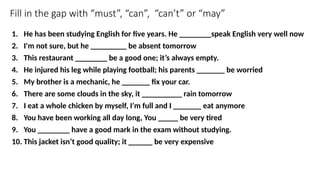
Fill in the gap with “must”, “can”, “can’t” or “may”
1. He has been studying English for five years. He ________speak English very well now
2. I'm not sure, but he _________ be absent tomorrow
3. This restaurant ________ be a good one; it’s always empty.
4. He injured his leg while playing football; his parents _______ be worried
5. My brother is a mechanic, he _______ fix your car.
6. There are some clouds in the sky, it __________ rain tomorrow
7. I eat a whole chicken by myself, I’m full and I _______ eat anymore
8. You have been working all day long, You _____ be very tired
9. You ________ have a good mark in the exam without studying.
10. This jacket isn’t good quality; it ______ be very expensive

modals english 0000000000000000 ppt.pptx

  • 1.
  • 2.
  • 3.
    •I may visityou tomorrow Subject VERB Modal
  • 4.
    Can: • I canopen the door because I have the key. •Can I open the door? When we talk about something possible We use “Can”: To ask for permission
  • 5.
    Can’t: • I can’topen the door because I don’t have the key. When we talk about something impossible = impossibility We use “Can’t”:
  • 6.
    Could: •Could you openthe door please? •You could revise with us this weekend. To make a request (we also use “can”) We use “could”: To suggest something = suggestion
  • 7.
    May: •Teacher: Why isAhmed absent?. Student: I don’t know. He may have a fever. •May I open the window? When we are not sure about something: uncertainty / probability (we also use “might”) We use “may”: To ask for permission (formal)
  • 8.
    Must: •You didn’t sleeplast night. You must be really tired now. •You must respect the law. When we are sure/certain about something = certainty We use “Must”: To talk about obligation
  • 9.
    Mustn’t: •You mustn’t smokein here. We use “Mustn’t”: To talk about prohibition
  • 10.
    Should: •My tooth hurts! Youshould visit a dentist. We use “ should”: To give advice
  • 11.
    Modal Verb Function Can• Possibility – I can learn English. • Permission – Can I go out please? Can’t • Impossibility - I can’t see without my glasses Could • Request – Could you bring me a cup of tea, please? • Suggestion – You could revise with us this weekend May • Permission (politeness) – May I open the window, please? • Uncertainty –Ali may travel tomorrow. Might • Probability – It might rain. Shall • Suggestion – Shall we go to the cinema? Should • Advice – You should eat more vegetables. Must • Obligation – You must do your homework, whether you want to or not. • Certainty – He has a great car. He must earn a lot of money. Mustn’t • Prohibition – You mustn’t cross the road when the red light is on. Form: You must be tired: Subject + Modal + Verb (infinitive) + … Modals
  • 12.
    1. He istrying to eat couscous with a fork. He _must be joking. 2. She __ may ___ pay us a visit tomorrow if she has time. 3. You __ should revise your lessons for the coming exam. 4. They just didn't come. I am sure they must have changed their minds. 6. She doesn't answer her phone calls. I think she _ must be busy. 7. I have some time to spare. What do you think I _ should __ do? 8. It is cloudy. It __ may __ rain this evening. 9. Ali told me that he was driving when he was on the phone with me. I warned him that he ___ mustn't _ do that. Fill in the blanks with Can May Must Should Mustn’t certainty certainty certainty Uncertainty Advice uncertainty Advice Prohibition
  • 13.
    Fill in thegap with “must”, “can”, “can’t” or “may” 1. He has been studying English for five years. He ________speak English very well now 2. I'm not sure, but he _________ be absent tomorrow 3. This restaurant ________ be a good one; it’s always empty. 4. He injured his leg while playing football; his parents _______ be worried 5. My brother is a mechanic, he _______ fix your car. 6. There are some clouds in the sky, it __________ rain tomorrow 7. I eat a whole chicken by myself, I’m full and I _______ eat anymore 8. You have been working all day long, You _____ be very tired 9. You ________ have a good mark in the exam without studying. 10. This jacket isn’t good quality; it ______ be very expensive