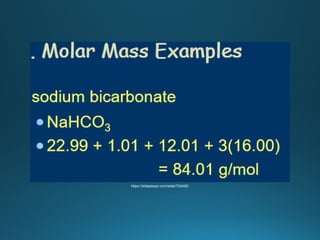
Copyright © Pearson Education, Inc., or its affiliates. All Rights Reserved.
.
Chemical Quantities
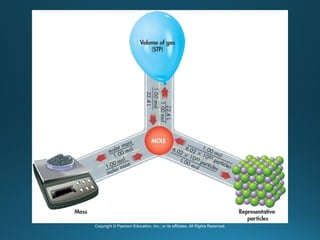
The Mole
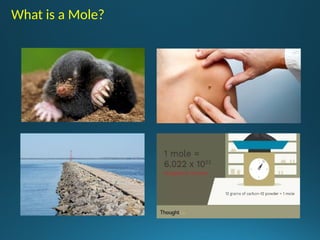
What is a Mole?
Copyright © Pearson Education, Inc., or its affiliates. All Rights Reserved.
.
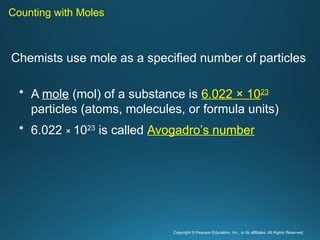
Counting with Moles
Chemists use mole as a specified number of particles
• A mole (mol) of a substance is 6.022 × 10²³
particles (atoms, molecules, or formula units)
• 6.022 × 10²³
is called Avogadro’s number
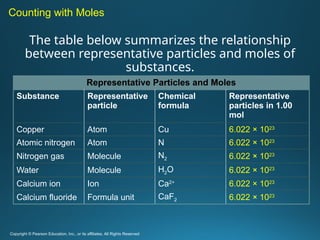
The table below summarizes the relationship
between representative particles and moles of
substances.
Representative Particles and Moles
Substance Representative
particle
Chemical
formula
Representative
particles in 1.00
mol
Copper Atom Cu 6.022 × 10²³
Atomic nitrogen Atom N 6.022 × 10²³
Nitrogen gas Molecule N2 6.022 × 10²³
Water Molecule H2O 6.022 × 10²³
Calcium ion Ion Ca2+
6.022 × 10²³
Calcium fluoride Formula unit CaF2 6.022 × 10²³
Copyright © Pearson Education, Inc., or its affiliates. All Rights Reserved
Counting with Moles
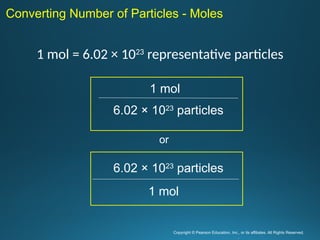
1 mol = 6.02 × 10²³
representative particles
Copyright © Pearson Education, Inc., or its affiliates. All Rights Reserved.
.
Converting Number of Particles - Moles
1 mol
6.02 × 10²³
particles
6.02 × 10²³
particles
1 mol
or
https://www.jokejive.com/topic/chemistry+mole
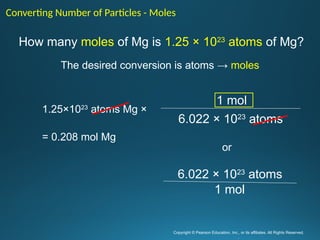
How many moles of Mg is 1.25 × 10²³
atoms of Mg?
Copyright © Pearson Education, Inc., or its affiliates. All Rights Reserved.
.
Converting Number of Particles - Moles
1 mol
6.022 × 10²³
atoms
6.022 × 10²³
atoms
1 mol
or
1.25×10²³
atoms Mg ×
= 0.208 mol Mg
The desired conversion is atoms → moles
Copyright © Pearson Education, Inc., or its affiliates. All Rights Reserved.
.
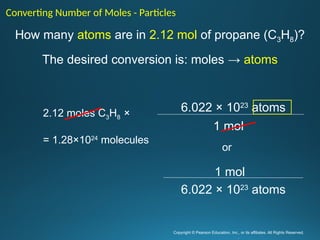
How many atoms are in 2.12 mol of propane (C3H8)?
The desired conversion is: moles → atoms
Converting Number of Moles - Particles
1 mol
6.022 × 10²³
atoms
6.022 × 10²³
atoms
1 mol
or
2.12 moles C3H8 ×
= 1.28×1024
molecules
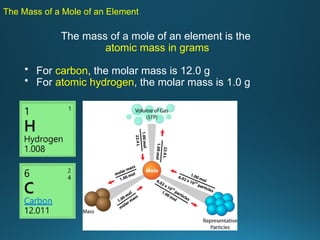
The Mass of a Mole of an Element
The mass of a mole of an element is the
atomic mass in grams
• For carbon, the molar mass is 12.0 g
• For atomic hydrogen, the molar mass is 1.0 g
Copyright © Pearson Education, Inc., or its affiliates. All Rights Reserved.
.
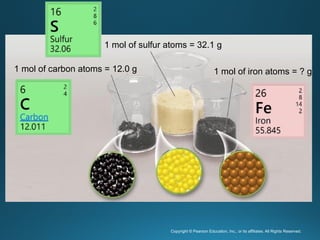
1 mol of carbon atoms = 12.0 g
1 mol of sulfur atoms = 32.1 g
1 mol of iron atoms = ? g
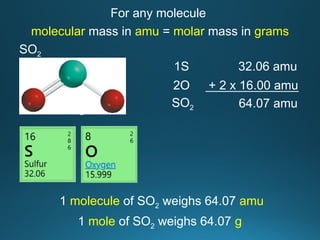
SO2
1S 32.06 amu
2O + 2 x 16.00 amu
SO2 64.07 amu
1 molecule of SO2 weighs 64.07 amu
1 mole of SO2 weighs 64.07 g
For any molecule
molecular mass in amu = molar mass in grams
SO2
Copyright © Pearson Education, Inc., or its affiliates. All Rights Reserved.
.
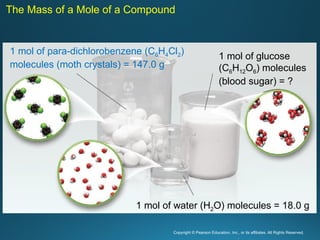
The Mass of a Mole of a Compound
1 mol of para-dichlorobenzene (C6H4Cl2)
molecules (moth crystals) = 147.0 g
1 mol of water (H2O) molecules = 18.0 g
1 mol of glucose
(C6H12O6) molecules
(blood sugar) = ?
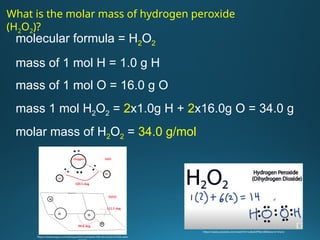
What is the molar mass of hydrogen peroxide
(H2O2)?
molecular formula = H2O2
mass of 1 mol H = 1.0 g H
mass of 1 mol O = 16.0 g O
mass 1 mol H2O2 = 2x1.0g H + 2x16.0g O = 34.0 g
molar mass of H2O2 = 34.0 g/mol
https://www.youtube.com/watch?v=ca6aKZPBonI&feature=share
https://www.toppr.com/ask/question/compare-the-structure-of-h2o-and-
https://www.pinterest.com/pin/chemistry-mole-problems-square-sticker--669488300872526383/
Copyright © Pearson Education, Inc., or its affiliates. All Rights Reserved.
.
Chemical Quantities
Mole-Mass and Mole-Volume
Relationships
Copyright © Pearson Education, Inc., or its affiliates. All Rights Reserved.
.
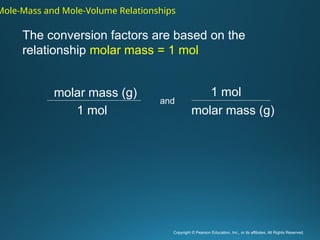
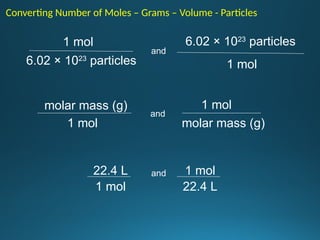
molar mass (g)
1 mol
1 mol
molar mass (g)
and
The conversion factors are based on the
relationship molar mass = 1 mol
Mole-Mass and Mole-Volume Relationships
Copyright © Pearson Education, Inc., or its affiliates. All Rights Reserved.
.
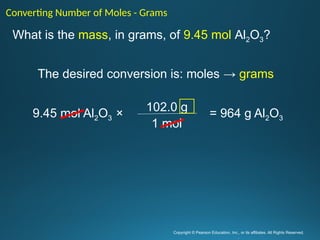
What is the mass, in grams, of 9.45 mol Al2O3?
The desired conversion is: moles → grams
Converting Number of Moles - Grams
102.0 g
1 mol
9.45 mol Al2O3 × = 964 g Al2O3
Copyright © Pearson Education, Inc., or its affiliates. All Rights Reserved.
.
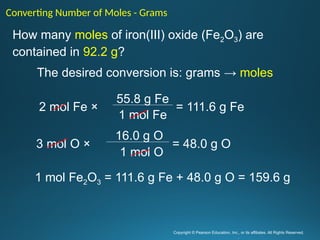
How many moles of iron(III) oxide (Fe2O3) are
contained in 92.2 g?
The desired conversion is: grams → moles
Converting Number of Moles - Grams
1 mol Fe2O3 = 111.6 g Fe + 48.0 g O = 159.6 g
2 mol Fe × = 111.6 g Fe
55.8 g Fe
1 mol Fe
3 mol O × = 48.0 g O
16.0 g O
1 mol O
Copyright © Pearson Education, Inc., or its affiliates. All Rights Reserved.
.
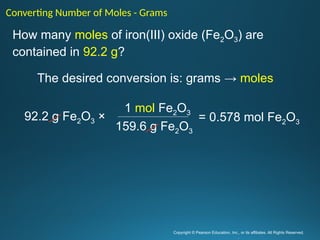
How many moles of iron(III) oxide (Fe2O3) are
contained in 92.2 g?
The desired conversion is: grams → moles
Converting Number of Moles - Grams
92.2 g Fe2O3 ×
1 mol Fe2O3
159.6 g Fe2O3
= 0.578 mol Fe2O3
Copyright © Pearson Education, Inc., or its affiliates. All Rights Reserved.
.
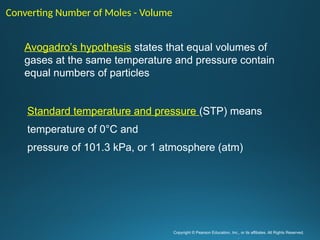
Converting Number of Moles - Volume
Avogadro’s hypothesis states that equal volumes of
gases at the same temperature and pressure contain
equal numbers of particles
Standard temperature and pressure (STP) means
temperature of 0°C and
pressure of 101.3 kPa, or 1 atmosphere (atm)
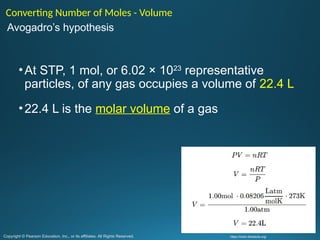
Avogadro’s hypothesis
https://chem.libretexts.org/
Copyright © Pearson Education, Inc., or its affiliates. All Rights Reserved.
•At STP, 1 mol, or 6.02 × 10²³
representative
particles, of any gas occupies a volume of 22.4 L
•22.4 L is the molar volume of a gas
Converting Number of Moles - Volume
Copyright © Pearson Education, Inc., or its affiliates. All Rights Reserved.
.
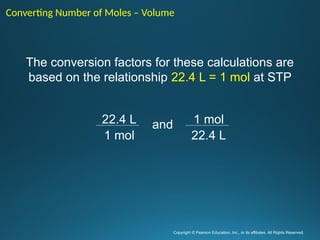
22.4 L
1 mol
1 mol
22.4 L
and
The conversion factors for these calculations are
based on the relationship 22.4 L = 1 mol at STP
Converting Number of Moles – Volume
Copyright © Pearson Education, Inc., or its affiliates. All Rights Reserved.
.
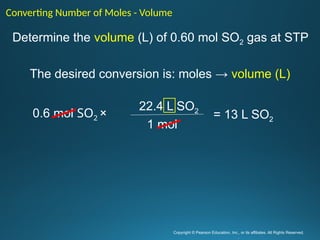
Determine the volume (L) of 0.60 mol SO2 gas at STP
The desired conversion is: moles → volume (L)
Converting Number of Moles - Volume
22.4 L SO2
1 mol
0.6 mol SO2 × = 13 L SO2
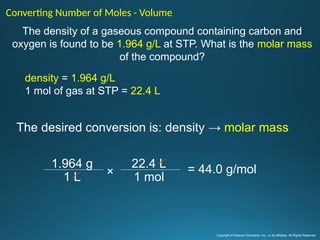
The density of a gaseous compound containing carbon and
oxygen is found to be 1.964 g/L at STP. What is the molar mass
of the compound?
The desired conversion is: density → molar mass
Converting Number of Moles - Volume
density = 1.964 g/L
1 mol of gas at STP = 22.4 L
Copyright © Pearson Education, Inc., or its affiliates. All Rights Reserved
= 44.0 g/mol
1.964 g
1 L
22.4 L
1 mol
×
Copyright © Pearson Education, Inc., or its affiliates. All Rights Reserved.
.
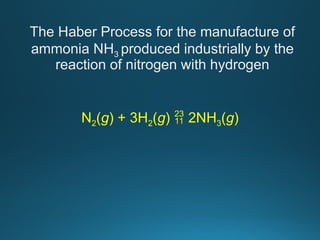
N2(g) + 3H2(g)  2NH3(g)
The Haber Process for the manufacture of
ammonia NH3 produced industrially by the
reaction of nitrogen with hydrogen
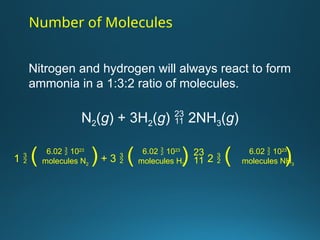
Number of Molecules
Nitrogen and hydrogen will always react to form
ammonia in a 1:3:2 ratio of molecules.
1  ( )+ 3  ( )  2  ( )
6.02  1023
molecules N2
6.02  1023
molecules H2
6.02  1023
molecules NH3
N2(g) + 3H2(g)  2NH3(g)
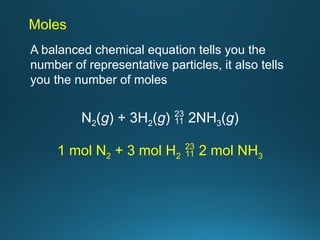
A balanced chemical equation tells you the
number of representative particles, it also tells
you the number of moles
1 mol N2 + 3 mol H2  2 mol NH3
Moles
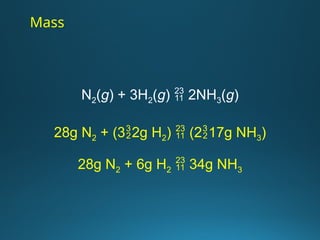
N2(g) + 3H2(g)  2NH3(g)
Mass
28g N2 + (32g H2)  (217g NH3)
28g N2 + 6g H2  34g NH3
N2(g) + 3H2(g)  2NH3(g)
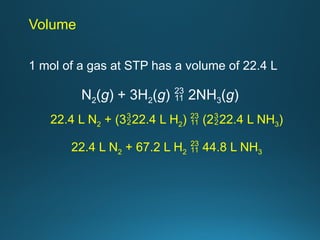
1 mol of a gas at STP has a volume of 22.4 L
22.4 L N2 + 67.2 L H2  44.8 L NH3
22.4 L N2 + (322.4 L H2)  (222.4 L NH3)
Volume
N2(g) + 3H2(g)  2NH3(g)
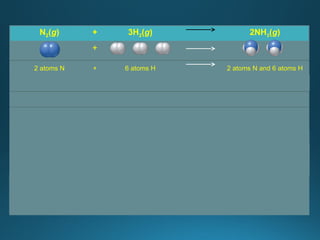
N2(g) + 3H2(g) 2NH3(g)
+
2 atoms N + 6 atoms H 2 atoms N and 6 atoms H
1 molecule N2 + 3 molecules H2 2 molecules NH3
1  + 3  2 
1 mol N2 + 3 mol H2 2 mol NH3
28 g N2 + 3  2 g H2 2  17 g NH3
34 g reactants 34 g products
Assume
STP
22.4 L N2
+
67.2 L H2 44.8 L NH3
6.02  1023
molecules N2
( ) 6.02  1023
molecules H2
( ) 6.02  1023
molecules NH2
( )
22.4
L
22.4
L
22.4
L
22.4
L
22.4
L
22.4
L
22.4 L
1 mol
1 mol
22.4 L
and
molar mass (g)
1 mol
1 mol
molar mass (g)
and
1 mol
6.02 × 10²³
particles
6.02 × 10²³
particles
1 mol
and
Converting Number of Moles – Grams – Volume - Particles
Copyright © Pearson Education, Inc., or its affiliates. All Rights Reserved.
https://slideplayer.com/slide/724492/
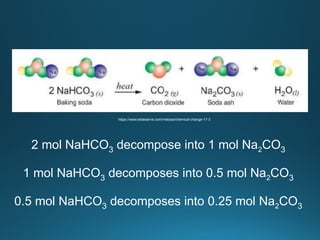
https://www.slideserve.com/melosa/chemical-change-17-3
2 mol NaHCO3 decompose into 1 mol Na2CO3
1 mol NaHCO3 decomposes into 0.5 mol Na2CO3
0.5 mol NaHCO3 decomposes into 0.25 mol Na2CO3
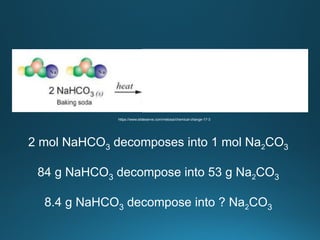
https://www.slideserve.com/melosa/chemical-change-17-3
84 g NaHCO3 decompose into 53 g Na2CO3
2 mol NaHCO3 decomposes into 1 mol Na2CO3
8.4 g NaHCO3 decompose into ? Na2CO3
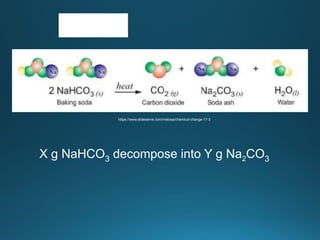
https://www.slideserve.com/melosa/chemical-change-17-3
X g NaHCO3 decompose into Y g Na2CO3
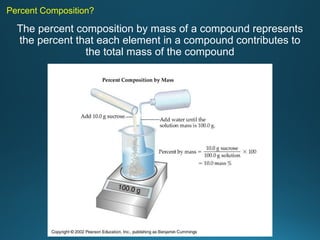
Percent Composition?
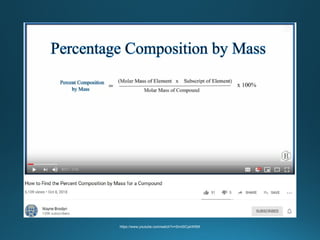
The percent composition by mass of a compound represents
the percent that each element in a compound contributes to
the total mass of the compound
https://www.youtube.com/watch?v=Snnt0CpkWSM
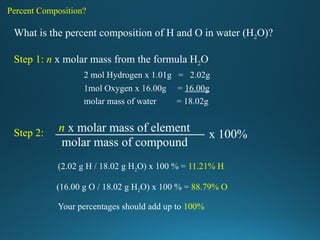
What is the percent composition of H and O in water (H2O)?
Step 1: n x molar mass from the formula H2O
2 mol Hydrogen x 1.01g = 2.02g
1mol Oxygen x 16.00g = 16.00g
molar mass of water = 18.02g
Percent Composition?
Step 2:
(2.02 g H / 18.02 g H2O) x 100 % = 11.21% H
(16.00 g O / 18.02 g H2O) x 100 % = 88.79% O
Your percentages should add up to 100%
n x molar mass of element
molar mass of compound
x 100%
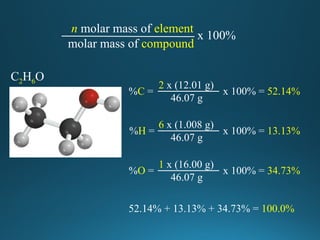
n molar mass of element
molar mass of compound
x 100%
C2H6O
%C =
2 x (12.01 g)
46.07 g
x 100% = 52.14%
%H =
6 x (1.008 g)
46.07 g
x 100% = 13.13%
%O =
1 x (16.00 g)
46.07 g
x 100% = 34.73%
52.14% + 13.13% + 34.73% = 100.0%
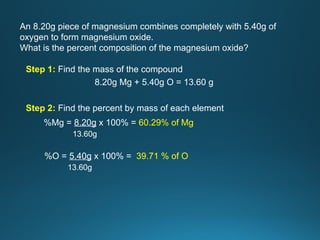
An 8.20g piece of magnesium combines completely with 5.40g of
oxygen to form magnesium oxide.
What is the percent composition of the magnesium oxide?
Step 1: Find the mass of the compound
8.20g Mg + 5.40g O = 13.60 g
Step 2: Find the percent by mass of each element
%Mg = 8.20g x 100% = 60.29% of Mg
%O = 5.40g x 100% = 39.71 % of O
13.60g
13.60g
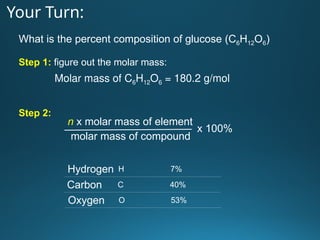
Your Turn:
What is the percent composition of glucose (C6H12O6)
Step 1: figure out the molar mass:
Step 2:
Molar mass of C6H12O6 = 180.2 g/mol
n x molar mass of element
molar mass of compound
x 100%
Hydrogen H 7%
Carbon C 40%
Oxygen O 53%
Copyright © Pearson Education, Inc., or its affiliates. All Rights Reserved.
.
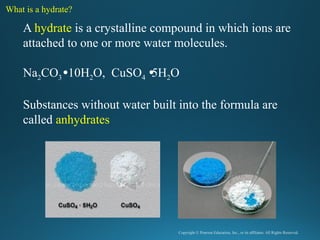
A hydrate is a crystalline compound in which ions are
attached to one or more water molecules.
Na2CO3 10H2O, CuSO4 5H2O
Substances without water built into the formula are
called anhydrates
What is a hydrate?
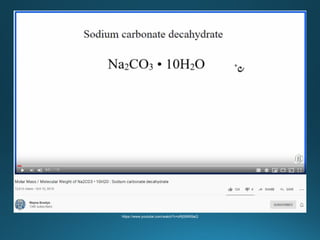
https://www.youtube.com/watch?v=zRjS6f6I9aQ
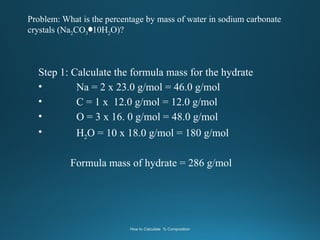
Step 1: Calculate the formula mass for the hydrate
• Na = 2 x 23.0 g/mol = 46.0 g/mol
• C = 1 x 12.0 g/mol = 12.0 g/mol
• O = 3 x 16. 0 g/mol = 48.0 g/mol
• H2O = 10 x 18.0 g/mol = 180 g/mol
Formula mass of hydrate = 286 g/mol
How to Calculate % Composition
Problem: What is the percentage by mass of water in sodium carbonate
crystals (Na2CO3 10H2O)?
Copyright © Pearson Education, Inc., or its affiliates. All Rights Reserved.
.
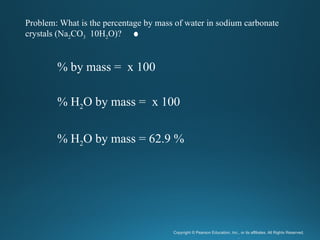
% by mass = x 100
% H2O by mass = x 100
% H2O by mass = 62.9 %
Problem: What is the percentage by mass of water in sodium carbonate
crystals (Na2CO3 10H2O)?
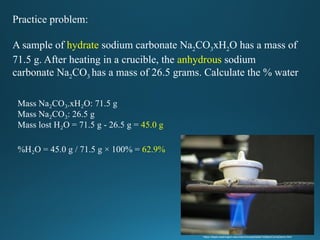
https://depts.washington.edu/chem/courses/labs/142labs/CompDemo.html
Practice problem:
A sample of hydrate sodium carbonate Na2CO3xH2O has a mass of
71.5 g. After heating in a crucible, the anhydrous sodium
carbonate Na2CO3 has a mass of 26.5 grams. Calculate the % water
Mass Na CO .xH O: 71.5 g
₂ ₃ ₂
Mass Na CO : 26.5 g
₂ ₃
Mass lost H O = 71.5 g - 26.5 g =
₂ 45.0 g
%H O = 45.0 g / 71.5 g × 100% =
₂ 62.9%
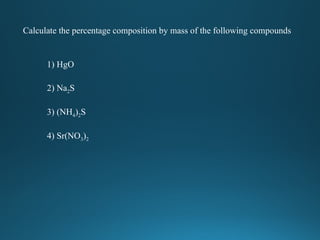
Calculate the percentage composition by mass of the following compounds
1) HgO
2) Na2S
3) (NH4)2S
4) Sr(NO3)2

Unit 5 - Chemical Quantities Part I.pptx

  • 1.
    Copyright © PearsonEducation, Inc., or its affiliates. All Rights Reserved. . Chemical Quantities The Mole
  • 2.
    What is aMole?
  • 3.
    Copyright © PearsonEducation, Inc., or its affiliates. All Rights Reserved. . Counting with Moles Chemists use mole as a specified number of particles • A mole (mol) of a substance is 6.022 × 10²³ particles (atoms, molecules, or formula units) • 6.022 × 10²³ is called Avogadro’s number
  • 4.
    The table belowsummarizes the relationship between representative particles and moles of substances. Representative Particles and Moles Substance Representative particle Chemical formula Representative particles in 1.00 mol Copper Atom Cu 6.022 × 10²³ Atomic nitrogen Atom N 6.022 × 10²³ Nitrogen gas Molecule N2 6.022 × 10²³ Water Molecule H2O 6.022 × 10²³ Calcium ion Ion Ca2+ 6.022 × 10²³ Calcium fluoride Formula unit CaF2 6.022 × 10²³ Copyright © Pearson Education, Inc., or its affiliates. All Rights Reserved Counting with Moles
  • 5.
    1 mol =6.02 × 10²³ representative particles Copyright © Pearson Education, Inc., or its affiliates. All Rights Reserved. . Converting Number of Particles - Moles 1 mol 6.02 × 10²³ particles 6.02 × 10²³ particles 1 mol or
  • 6.
  • 7.
    How many molesof Mg is 1.25 × 10²³ atoms of Mg? Copyright © Pearson Education, Inc., or its affiliates. All Rights Reserved. . Converting Number of Particles - Moles 1 mol 6.022 × 10²³ atoms 6.022 × 10²³ atoms 1 mol or 1.25×10²³ atoms Mg × = 0.208 mol Mg The desired conversion is atoms → moles
  • 8.
    Copyright © PearsonEducation, Inc., or its affiliates. All Rights Reserved. . How many atoms are in 2.12 mol of propane (C3H8)? The desired conversion is: moles → atoms Converting Number of Moles - Particles 1 mol 6.022 × 10²³ atoms 6.022 × 10²³ atoms 1 mol or 2.12 moles C3H8 × = 1.28×1024 molecules
  • 9.
    The Mass ofa Mole of an Element The mass of a mole of an element is the atomic mass in grams • For carbon, the molar mass is 12.0 g • For atomic hydrogen, the molar mass is 1.0 g
  • 10.
    Copyright © PearsonEducation, Inc., or its affiliates. All Rights Reserved. . 1 mol of carbon atoms = 12.0 g 1 mol of sulfur atoms = 32.1 g 1 mol of iron atoms = ? g
  • 11.
    SO2 1S 32.06 amu 2O+ 2 x 16.00 amu SO2 64.07 amu 1 molecule of SO2 weighs 64.07 amu 1 mole of SO2 weighs 64.07 g For any molecule molecular mass in amu = molar mass in grams SO2
  • 12.
    Copyright © PearsonEducation, Inc., or its affiliates. All Rights Reserved. . The Mass of a Mole of a Compound 1 mol of para-dichlorobenzene (C6H4Cl2) molecules (moth crystals) = 147.0 g 1 mol of water (H2O) molecules = 18.0 g 1 mol of glucose (C6H12O6) molecules (blood sugar) = ?
  • 13.
    What is themolar mass of hydrogen peroxide (H2O2)? molecular formula = H2O2 mass of 1 mol H = 1.0 g H mass of 1 mol O = 16.0 g O mass 1 mol H2O2 = 2x1.0g H + 2x16.0g O = 34.0 g molar mass of H2O2 = 34.0 g/mol https://www.youtube.com/watch?v=ca6aKZPBonI&feature=share https://www.toppr.com/ask/question/compare-the-structure-of-h2o-and-
  • 14.
  • 15.
    Copyright © PearsonEducation, Inc., or its affiliates. All Rights Reserved. . Chemical Quantities Mole-Mass and Mole-Volume Relationships
  • 16.
    Copyright © PearsonEducation, Inc., or its affiliates. All Rights Reserved. . molar mass (g) 1 mol 1 mol molar mass (g) and The conversion factors are based on the relationship molar mass = 1 mol Mole-Mass and Mole-Volume Relationships
  • 17.
    Copyright © PearsonEducation, Inc., or its affiliates. All Rights Reserved. . What is the mass, in grams, of 9.45 mol Al2O3? The desired conversion is: moles → grams Converting Number of Moles - Grams 102.0 g 1 mol 9.45 mol Al2O3 × = 964 g Al2O3
  • 18.
    Copyright © PearsonEducation, Inc., or its affiliates. All Rights Reserved. . How many moles of iron(III) oxide (Fe2O3) are contained in 92.2 g? The desired conversion is: grams → moles Converting Number of Moles - Grams 1 mol Fe2O3 = 111.6 g Fe + 48.0 g O = 159.6 g 2 mol Fe × = 111.6 g Fe 55.8 g Fe 1 mol Fe 3 mol O × = 48.0 g O 16.0 g O 1 mol O
  • 19.
    Copyright © PearsonEducation, Inc., or its affiliates. All Rights Reserved. . How many moles of iron(III) oxide (Fe2O3) are contained in 92.2 g? The desired conversion is: grams → moles Converting Number of Moles - Grams 92.2 g Fe2O3 × 1 mol Fe2O3 159.6 g Fe2O3 = 0.578 mol Fe2O3
  • 20.
    Copyright © PearsonEducation, Inc., or its affiliates. All Rights Reserved. . Converting Number of Moles - Volume Avogadro’s hypothesis states that equal volumes of gases at the same temperature and pressure contain equal numbers of particles Standard temperature and pressure (STP) means temperature of 0°C and pressure of 101.3 kPa, or 1 atmosphere (atm)
  • 21.
    Avogadro’s hypothesis https://chem.libretexts.org/ Copyright ©Pearson Education, Inc., or its affiliates. All Rights Reserved. •At STP, 1 mol, or 6.02 × 10²³ representative particles, of any gas occupies a volume of 22.4 L •22.4 L is the molar volume of a gas Converting Number of Moles - Volume
  • 22.
    Copyright © PearsonEducation, Inc., or its affiliates. All Rights Reserved. . 22.4 L 1 mol 1 mol 22.4 L and The conversion factors for these calculations are based on the relationship 22.4 L = 1 mol at STP Converting Number of Moles – Volume
  • 23.
    Copyright © PearsonEducation, Inc., or its affiliates. All Rights Reserved. . Determine the volume (L) of 0.60 mol SO2 gas at STP The desired conversion is: moles → volume (L) Converting Number of Moles - Volume 22.4 L SO2 1 mol 0.6 mol SO2 × = 13 L SO2
  • 24.
    The density ofa gaseous compound containing carbon and oxygen is found to be 1.964 g/L at STP. What is the molar mass of the compound? The desired conversion is: density → molar mass Converting Number of Moles - Volume density = 1.964 g/L 1 mol of gas at STP = 22.4 L Copyright © Pearson Education, Inc., or its affiliates. All Rights Reserved = 44.0 g/mol 1.964 g 1 L 22.4 L 1 mol ×
  • 25.
    Copyright © PearsonEducation, Inc., or its affiliates. All Rights Reserved. .
  • 26.
    N2(g) + 3H2(g) 2NH3(g) The Haber Process for the manufacture of ammonia NH3 produced industrially by the reaction of nitrogen with hydrogen
  • 27.
    Number of Molecules Nitrogenand hydrogen will always react to form ammonia in a 1:3:2 ratio of molecules. 1  ( )+ 3  ( )  2  ( ) 6.02  1023 molecules N2 6.02  1023 molecules H2 6.02  1023 molecules NH3 N2(g) + 3H2(g)  2NH3(g)
  • 28.
    A balanced chemicalequation tells you the number of representative particles, it also tells you the number of moles 1 mol N2 + 3 mol H2  2 mol NH3 Moles N2(g) + 3H2(g)  2NH3(g)
  • 29.
    Mass 28g N2 +(32g H2)  (217g NH3) 28g N2 + 6g H2  34g NH3 N2(g) + 3H2(g)  2NH3(g)
  • 30.
    1 mol ofa gas at STP has a volume of 22.4 L 22.4 L N2 + 67.2 L H2  44.8 L NH3 22.4 L N2 + (322.4 L H2)  (222.4 L NH3) Volume N2(g) + 3H2(g)  2NH3(g)
  • 31.
    N2(g) + 3H2(g)2NH3(g) + 2 atoms N + 6 atoms H 2 atoms N and 6 atoms H 1 molecule N2 + 3 molecules H2 2 molecules NH3 1  + 3  2  1 mol N2 + 3 mol H2 2 mol NH3 28 g N2 + 3  2 g H2 2  17 g NH3 34 g reactants 34 g products Assume STP 22.4 L N2 + 67.2 L H2 44.8 L NH3 6.02  1023 molecules N2 ( ) 6.02  1023 molecules H2 ( ) 6.02  1023 molecules NH2 ( ) 22.4 L 22.4 L 22.4 L 22.4 L 22.4 L 22.4 L
  • 32.
    22.4 L 1 mol 1mol 22.4 L and molar mass (g) 1 mol 1 mol molar mass (g) and 1 mol 6.02 × 10²³ particles 6.02 × 10²³ particles 1 mol and Converting Number of Moles – Grams – Volume - Particles
  • 33.
    Copyright © PearsonEducation, Inc., or its affiliates. All Rights Reserved.
  • 34.
  • 35.
    https://www.slideserve.com/melosa/chemical-change-17-3 2 mol NaHCO3decompose into 1 mol Na2CO3 1 mol NaHCO3 decomposes into 0.5 mol Na2CO3 0.5 mol NaHCO3 decomposes into 0.25 mol Na2CO3
  • 36.
    https://www.slideserve.com/melosa/chemical-change-17-3 84 g NaHCO3decompose into 53 g Na2CO3 2 mol NaHCO3 decomposes into 1 mol Na2CO3 8.4 g NaHCO3 decompose into ? Na2CO3
  • 37.
  • 38.
    Percent Composition? The percentcomposition by mass of a compound represents the percent that each element in a compound contributes to the total mass of the compound
  • 39.
  • 40.
    What is thepercent composition of H and O in water (H2O)? Step 1: n x molar mass from the formula H2O 2 mol Hydrogen x 1.01g = 2.02g 1mol Oxygen x 16.00g = 16.00g molar mass of water = 18.02g Percent Composition? Step 2: (2.02 g H / 18.02 g H2O) x 100 % = 11.21% H (16.00 g O / 18.02 g H2O) x 100 % = 88.79% O Your percentages should add up to 100% n x molar mass of element molar mass of compound x 100%
  • 41.
    n molar massof element molar mass of compound x 100% C2H6O %C = 2 x (12.01 g) 46.07 g x 100% = 52.14% %H = 6 x (1.008 g) 46.07 g x 100% = 13.13% %O = 1 x (16.00 g) 46.07 g x 100% = 34.73% 52.14% + 13.13% + 34.73% = 100.0%
  • 42.
    An 8.20g pieceof magnesium combines completely with 5.40g of oxygen to form magnesium oxide. What is the percent composition of the magnesium oxide? Step 1: Find the mass of the compound 8.20g Mg + 5.40g O = 13.60 g Step 2: Find the percent by mass of each element %Mg = 8.20g x 100% = 60.29% of Mg %O = 5.40g x 100% = 39.71 % of O 13.60g 13.60g
  • 43.
    Your Turn: What isthe percent composition of glucose (C6H12O6) Step 1: figure out the molar mass: Step 2: Molar mass of C6H12O6 = 180.2 g/mol n x molar mass of element molar mass of compound x 100% Hydrogen H 7% Carbon C 40% Oxygen O 53%
  • 44.
    Copyright © PearsonEducation, Inc., or its affiliates. All Rights Reserved. . A hydrate is a crystalline compound in which ions are attached to one or more water molecules. Na2CO3 10H2O, CuSO4 5H2O Substances without water built into the formula are called anhydrates What is a hydrate?
  • 46.
  • 47.
    Step 1: Calculatethe formula mass for the hydrate • Na = 2 x 23.0 g/mol = 46.0 g/mol • C = 1 x 12.0 g/mol = 12.0 g/mol • O = 3 x 16. 0 g/mol = 48.0 g/mol • H2O = 10 x 18.0 g/mol = 180 g/mol Formula mass of hydrate = 286 g/mol How to Calculate % Composition Problem: What is the percentage by mass of water in sodium carbonate crystals (Na2CO3 10H2O)?
  • 48.
    Copyright © PearsonEducation, Inc., or its affiliates. All Rights Reserved. . % by mass = x 100 % H2O by mass = x 100 % H2O by mass = 62.9 % Problem: What is the percentage by mass of water in sodium carbonate crystals (Na2CO3 10H2O)?
  • 49.
    https://depts.washington.edu/chem/courses/labs/142labs/CompDemo.html Practice problem: A sampleof hydrate sodium carbonate Na2CO3xH2O has a mass of 71.5 g. After heating in a crucible, the anhydrous sodium carbonate Na2CO3 has a mass of 26.5 grams. Calculate the % water Mass Na CO .xH O: 71.5 g ₂ ₃ ₂ Mass Na CO : 26.5 g ₂ ₃ Mass lost H O = 71.5 g - 26.5 g = ₂ 45.0 g %H O = 45.0 g / 71.5 g × 100% = ₂ 62.9%
  • 50.
    Calculate the percentagecomposition by mass of the following compounds 1) HgO 2) Na2S 3) (NH4)2S 4) Sr(NO3)2