Stress measurement:
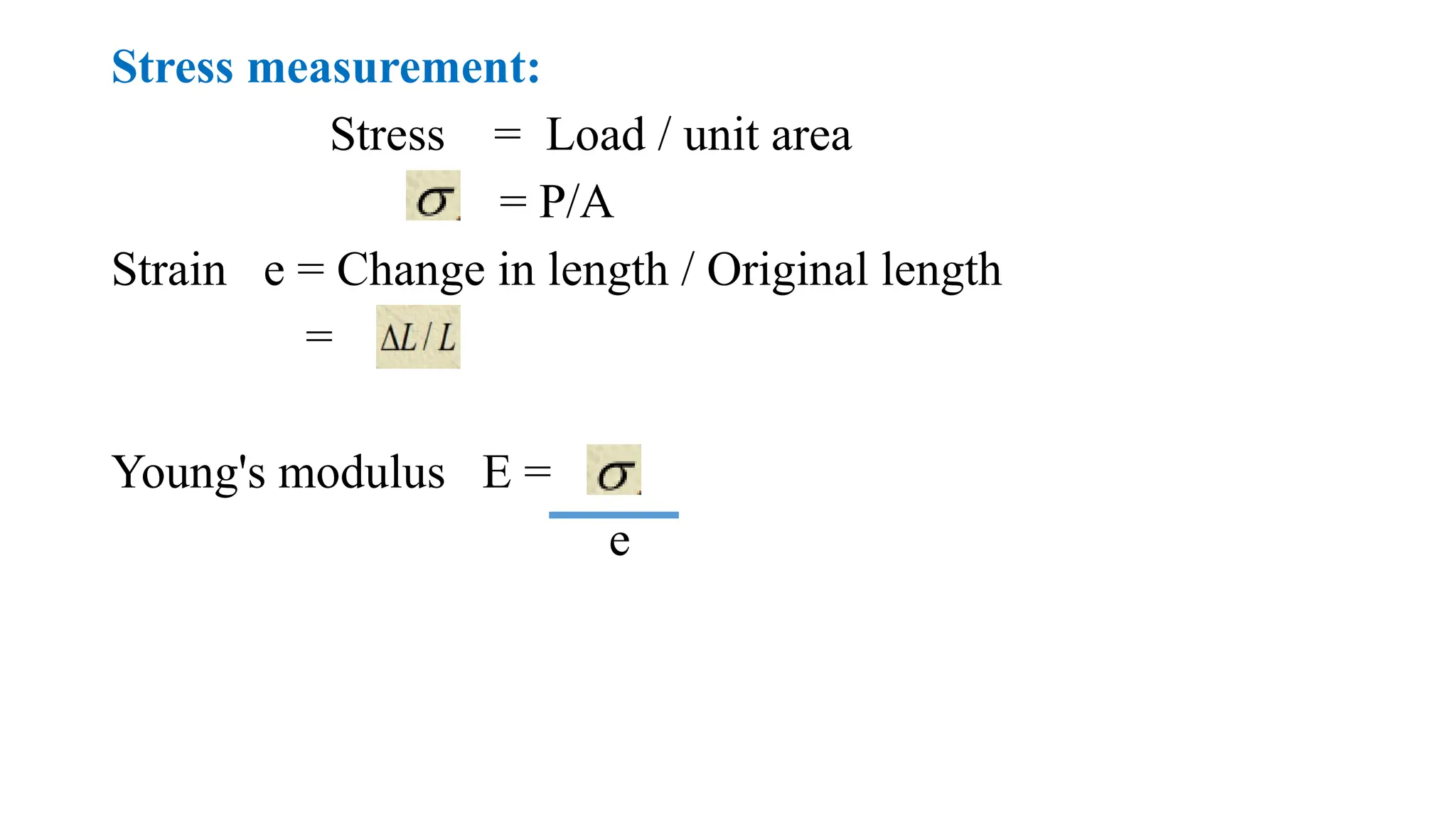
Stress =Load / unit area
= P/A
Strain e = Change in length / Original length
=
Young's modulus E =
e
3.
Strain gauges:
Ametallic conductor is stretched or compressed, its resistance
changes due to the change in length and diameter of the conductor.
Strain gauge is a measurement transducer used to measure strain
( change in dimensions).
Converts information about relative change in dimension to a
change resistance.
4.
Positive strain:
Straingauge(Metallic conductor) is subjected to tension, it is said to be
Positively strained.
Length increases and its area of the cross-section decreases.
Resistance of the conductor is proportional to its length and inversely
proportional to its area of cross-section the resistance of the gauge increases
with positive strain.
Negative strain:
Strain gauge(Metallic conductor) is subjected to compression it is said to
be Negative strain.
Length decreases and its area of the cross-section increases.
Resistance of the conductor is proportional to its length and inversely
proportional to its area of cross-section the resistance of the gauge decreases
with negative strain.
5.
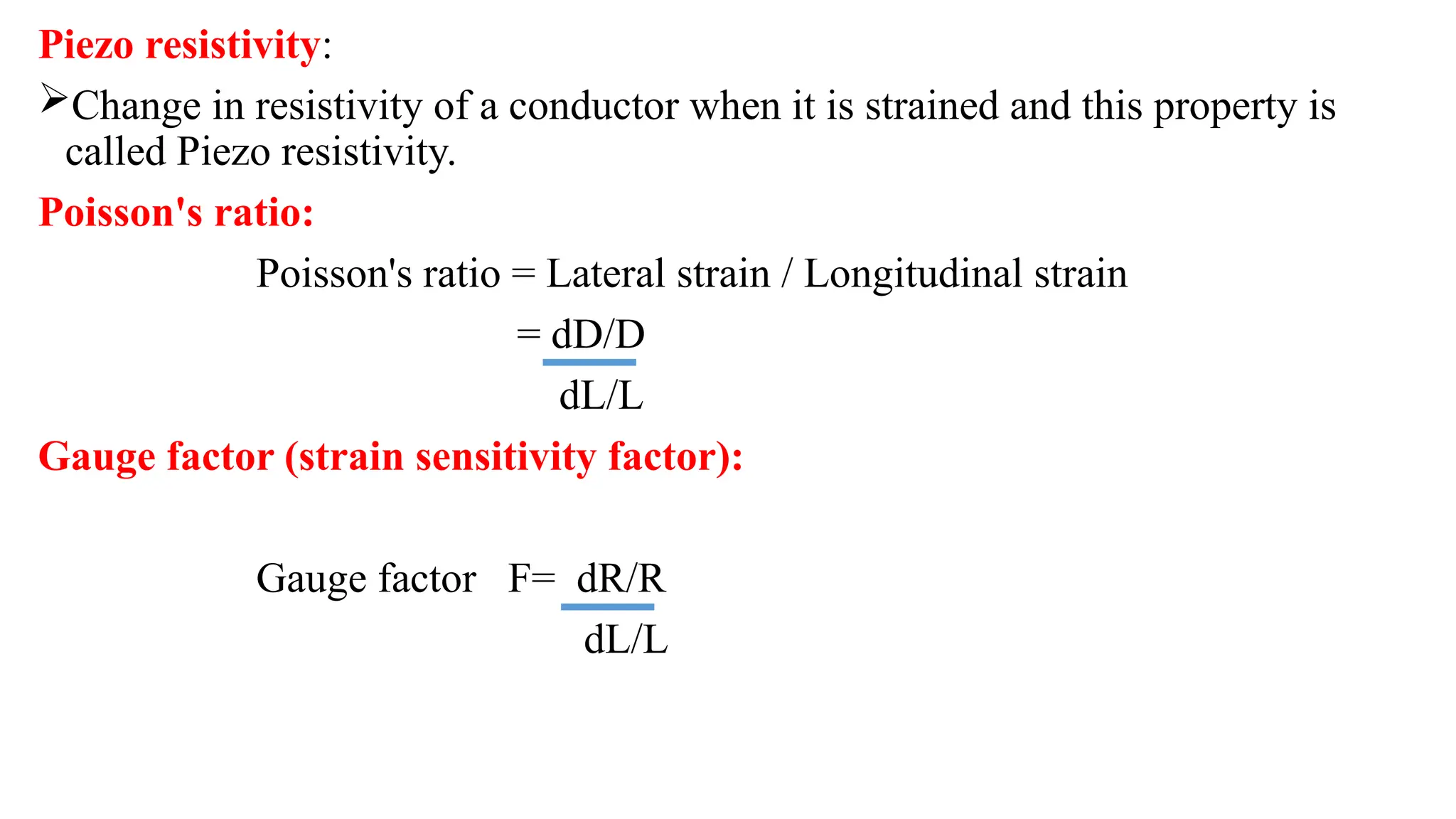
Piezo resistivity:
Change inresistivity of a conductor when it is strained and this property is
called Piezo resistivity.
Poisson's ratio:
Poisson's ratio = Lateral strain / Longitudinal strain
= dD/D
dL/L
Gauge factor (strain sensitivity factor):
Gauge factor F= dR/R
dL/L
6.
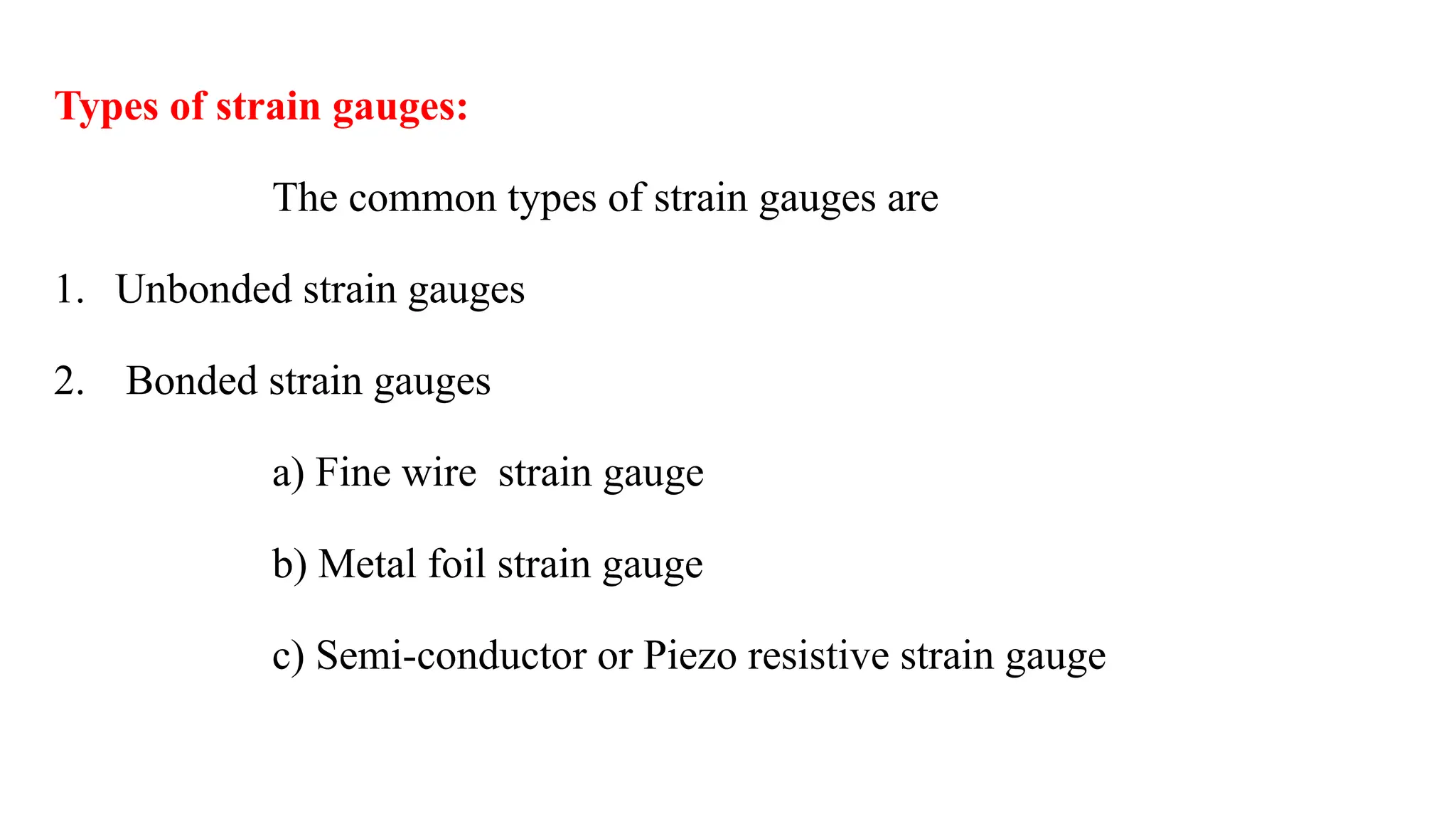
Types of straingauges:
The common types of strain gauges are
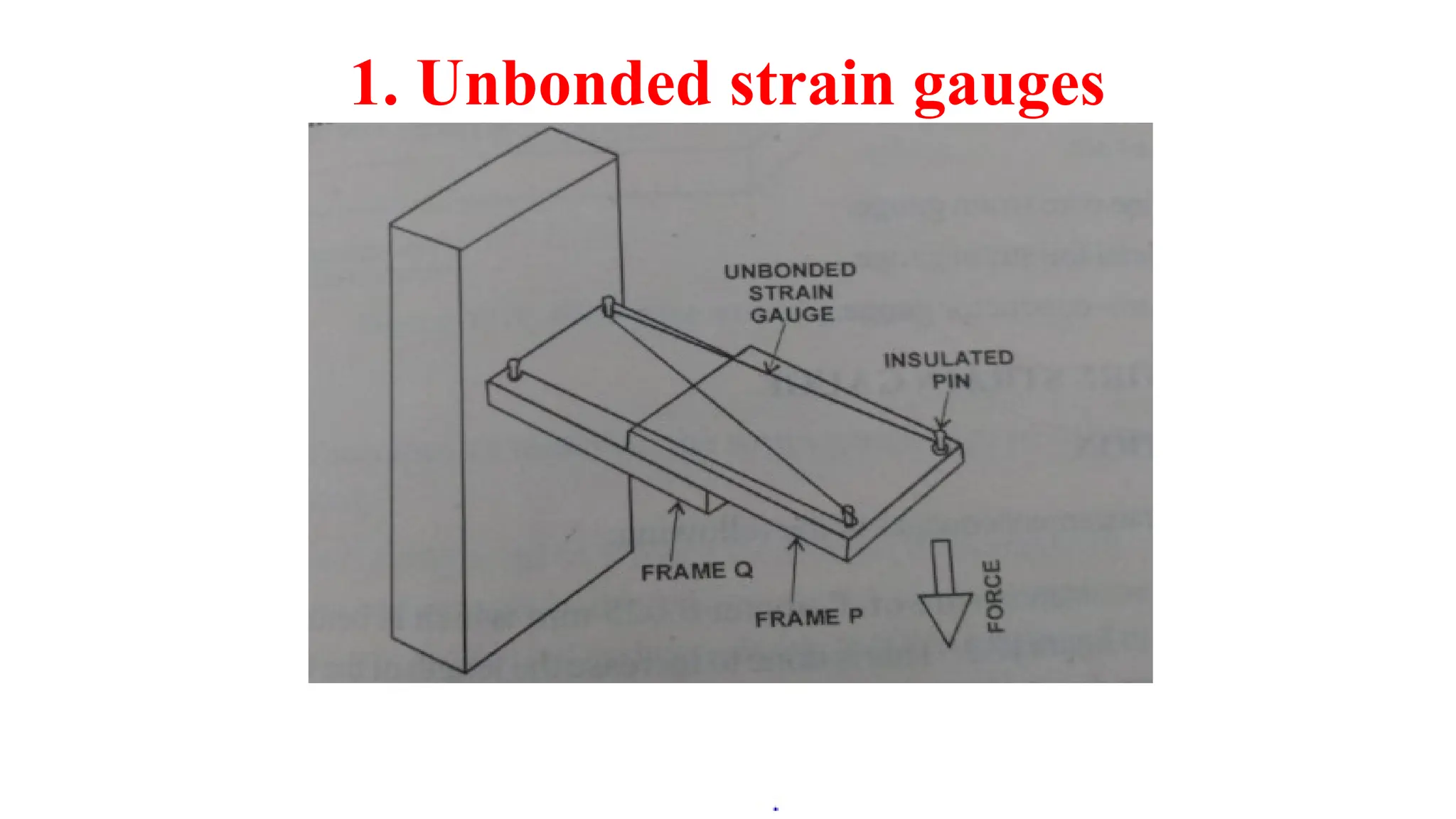
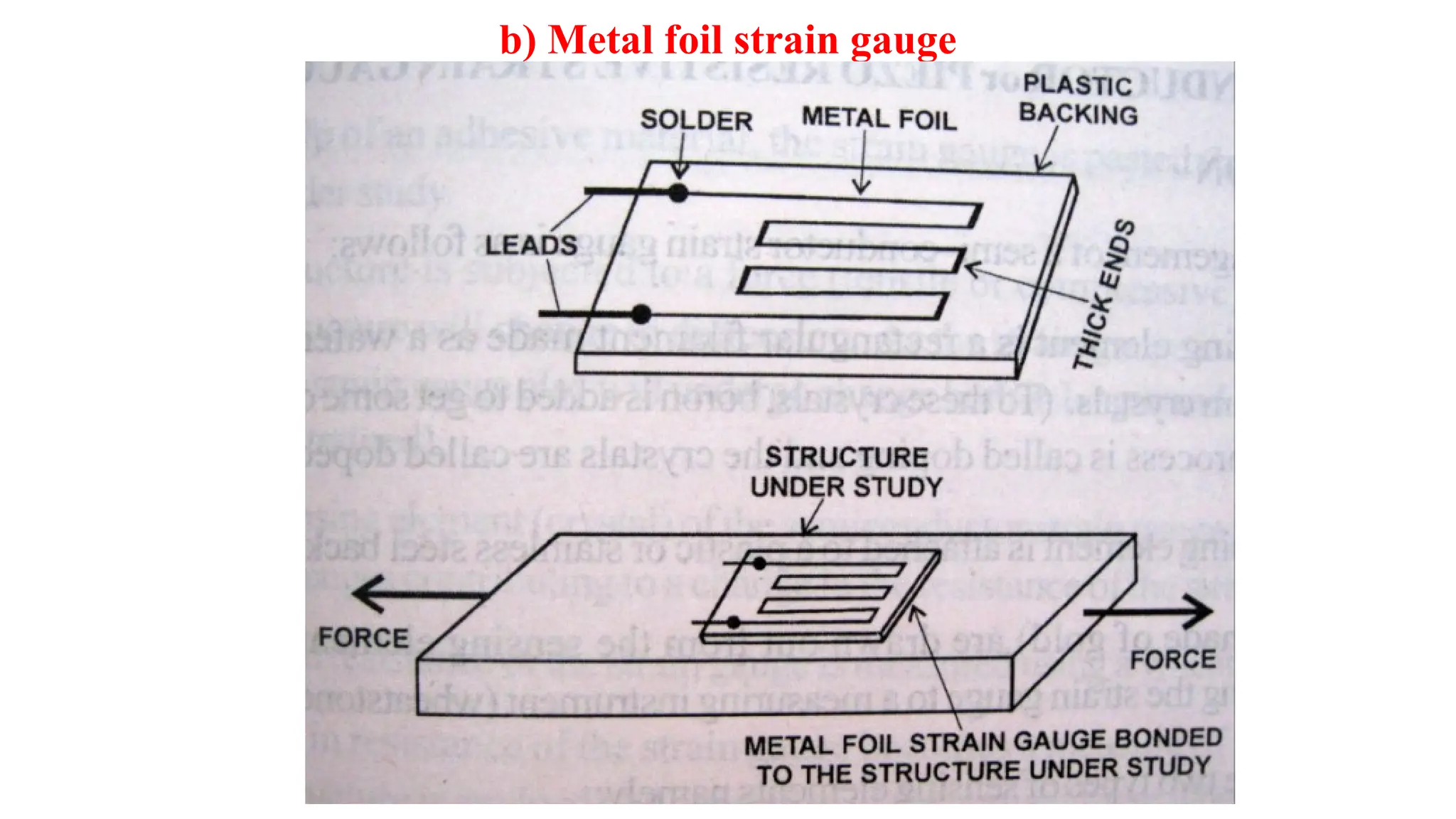
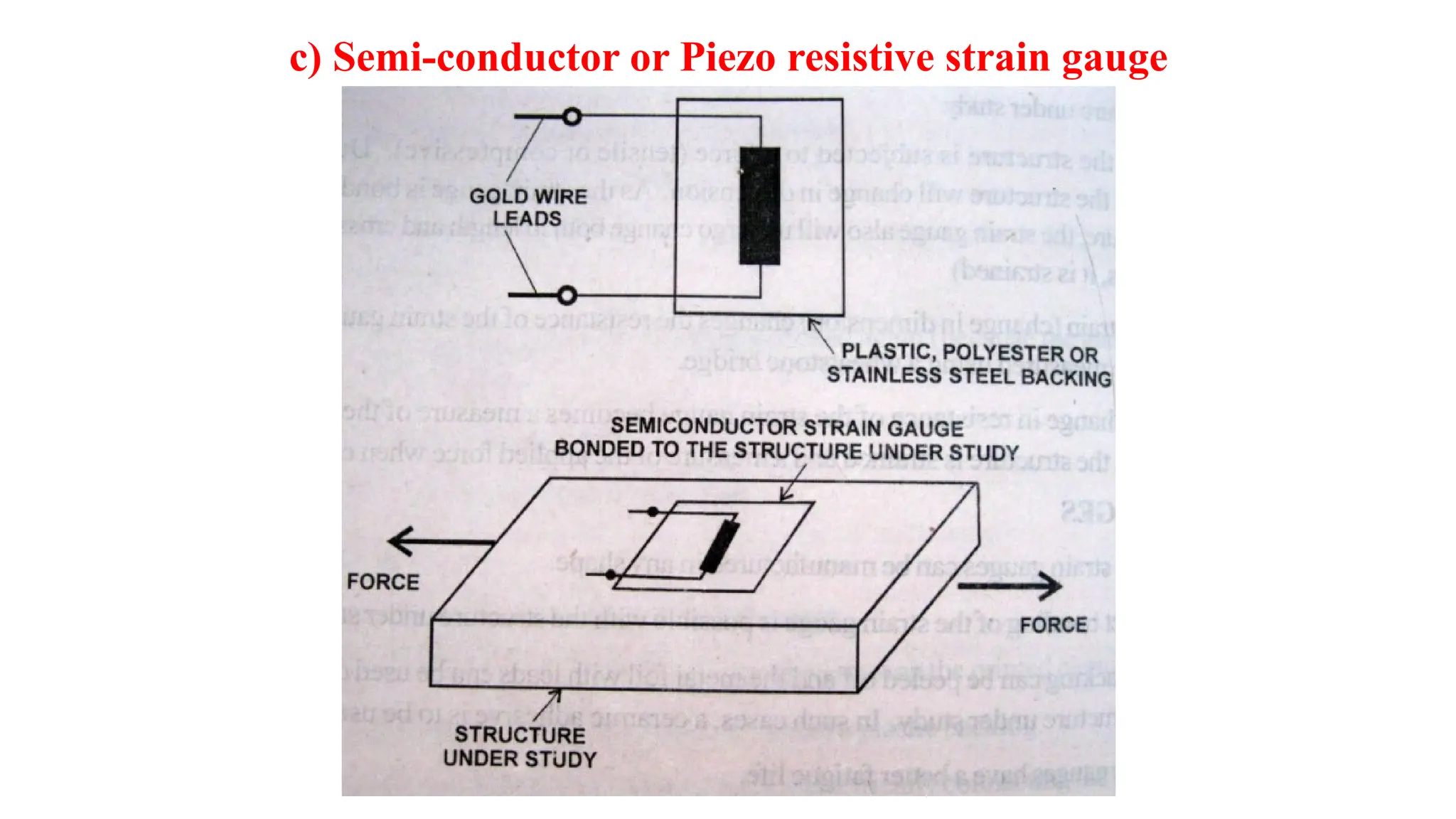
1. Unbonded strain gauges
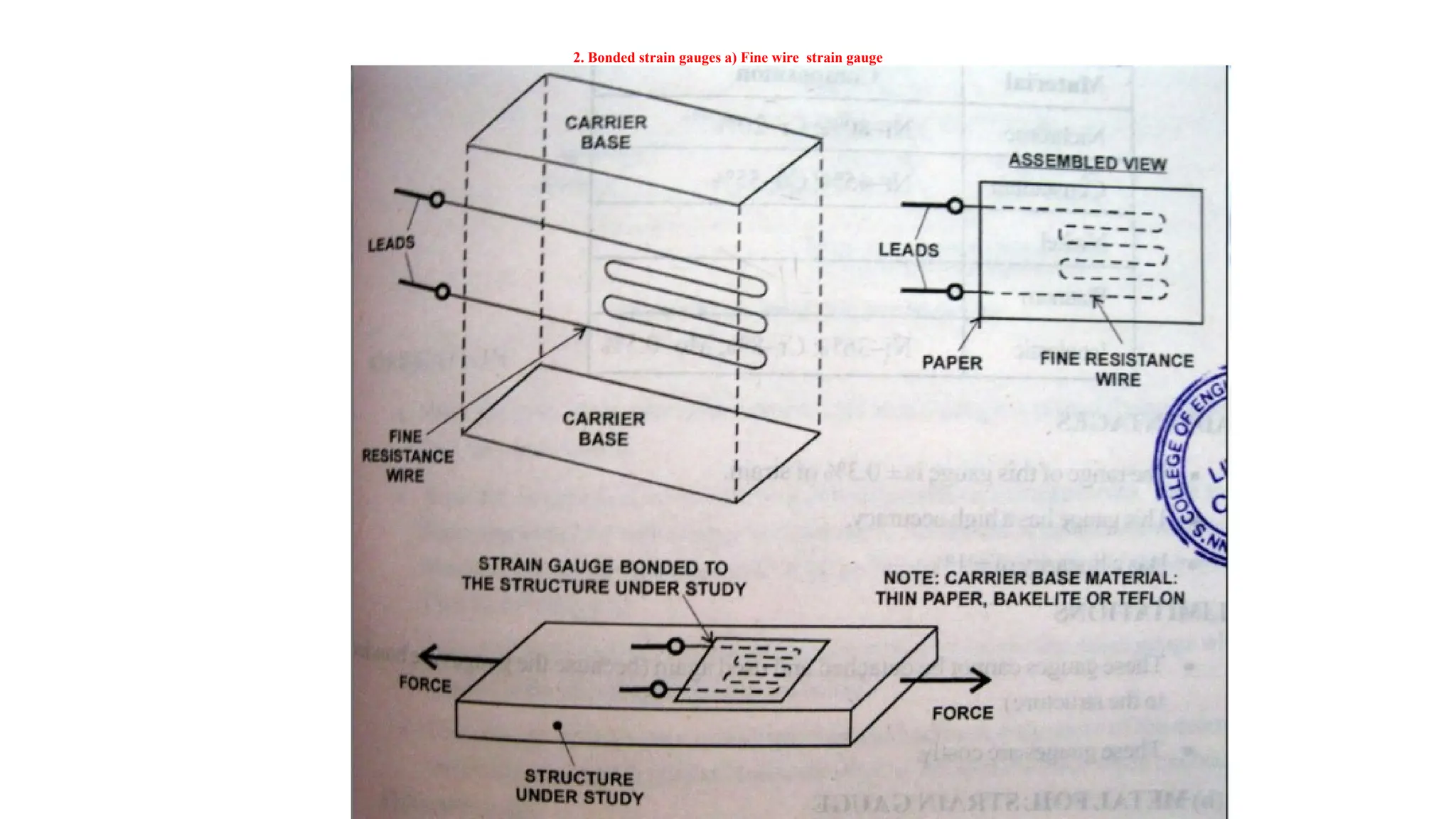
2. Bonded strain gauges
a) Fine wire strain gauge
b) Metal foil strain gauge
c) Semi-conductor or Piezo resistive strain gauge
Surface preparation andBonding techniques
Surface preparation and bonding techniques are mainly
three types
1. Backing, Base or Carrier material
2. Bonding material or Cement
3. Surface preparation and mounting of strain gauges
12.
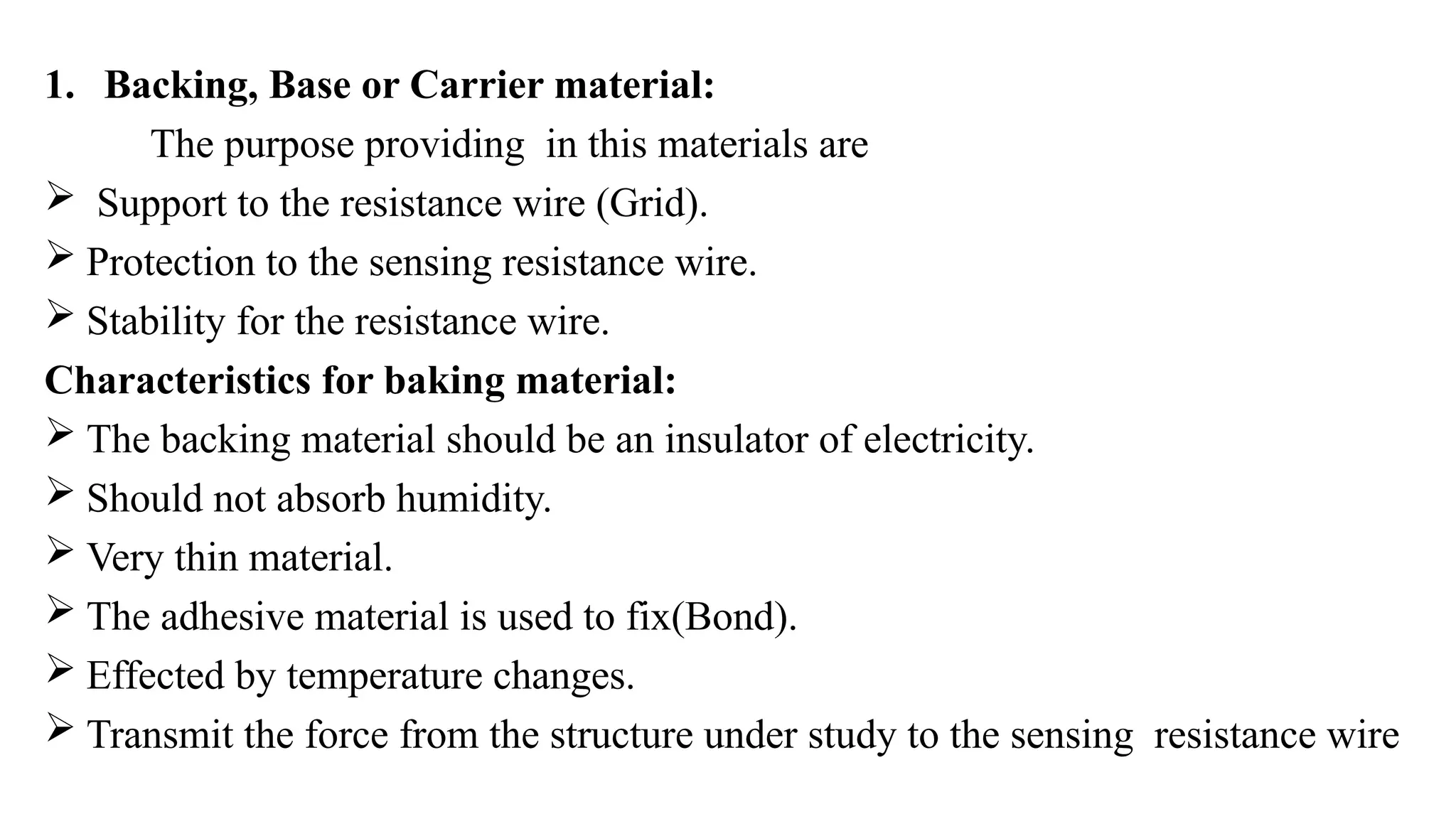
1. Backing, Baseor Carrier material:
The purpose providing in this materials are
Support to the resistance wire (Grid).
Protection to the sensing resistance wire.
Stability for the resistance wire.
Characteristics for baking material:
The backing material should be an insulator of electricity.
Should not absorb humidity.
Very thin material.
The adhesive material is used to fix(Bond).
Effected by temperature changes.
Transmit the force from the structure under study to the sensing resistance wire
13.
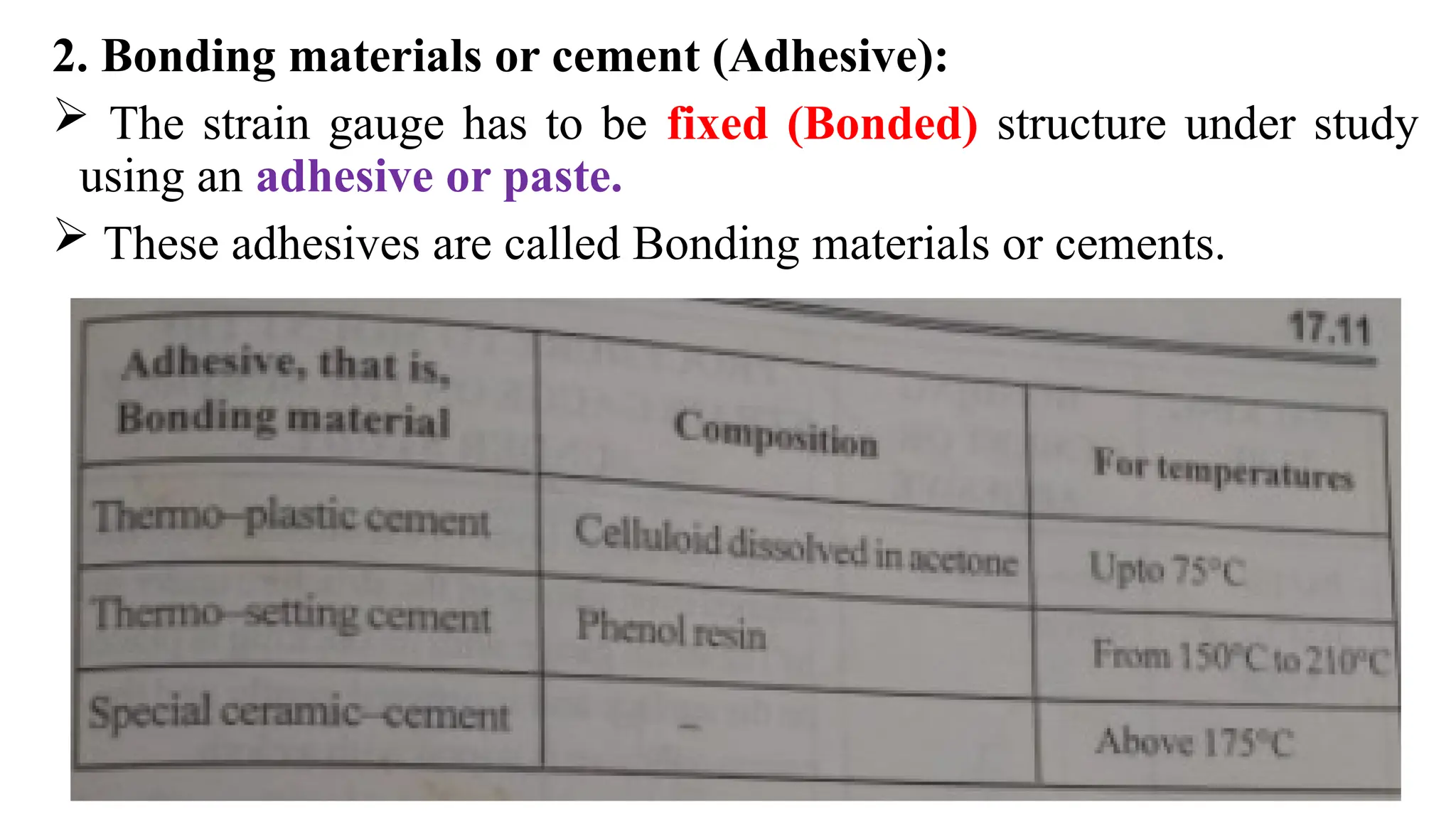
2. Bonding materialsor cement (Adhesive):
The strain gauge has to be fixed (Bonded) structure under study
using an adhesive or paste.
These adhesives are called Bonding materials or cements.
14.
Characteristics:
The bondingmaterial should be an insulator of electricity.
Should not absorb humidity.
The backing material is fixed (Bonded) rigidly on the structure under study.
Should not effected by temperature changes.
Should have good shear strength to transmit the force.
Should be easy to apply, spread easily.
The bonding material should have high creep resistance.
15.
3. Surface Preparationand Mounting of Strain Gauges:
The structure under study is made Even and Free from Dust and dirt by
rubbing with an emery sheet or by sand blasting.
The even surface is then cleaned by Volatile solution (Acetone) using a
cloth to remove oil/grease.
The Bottom side of the backing is also cleaned by a solvent using a cloth.
TEMPERATURE COMPENSSTION
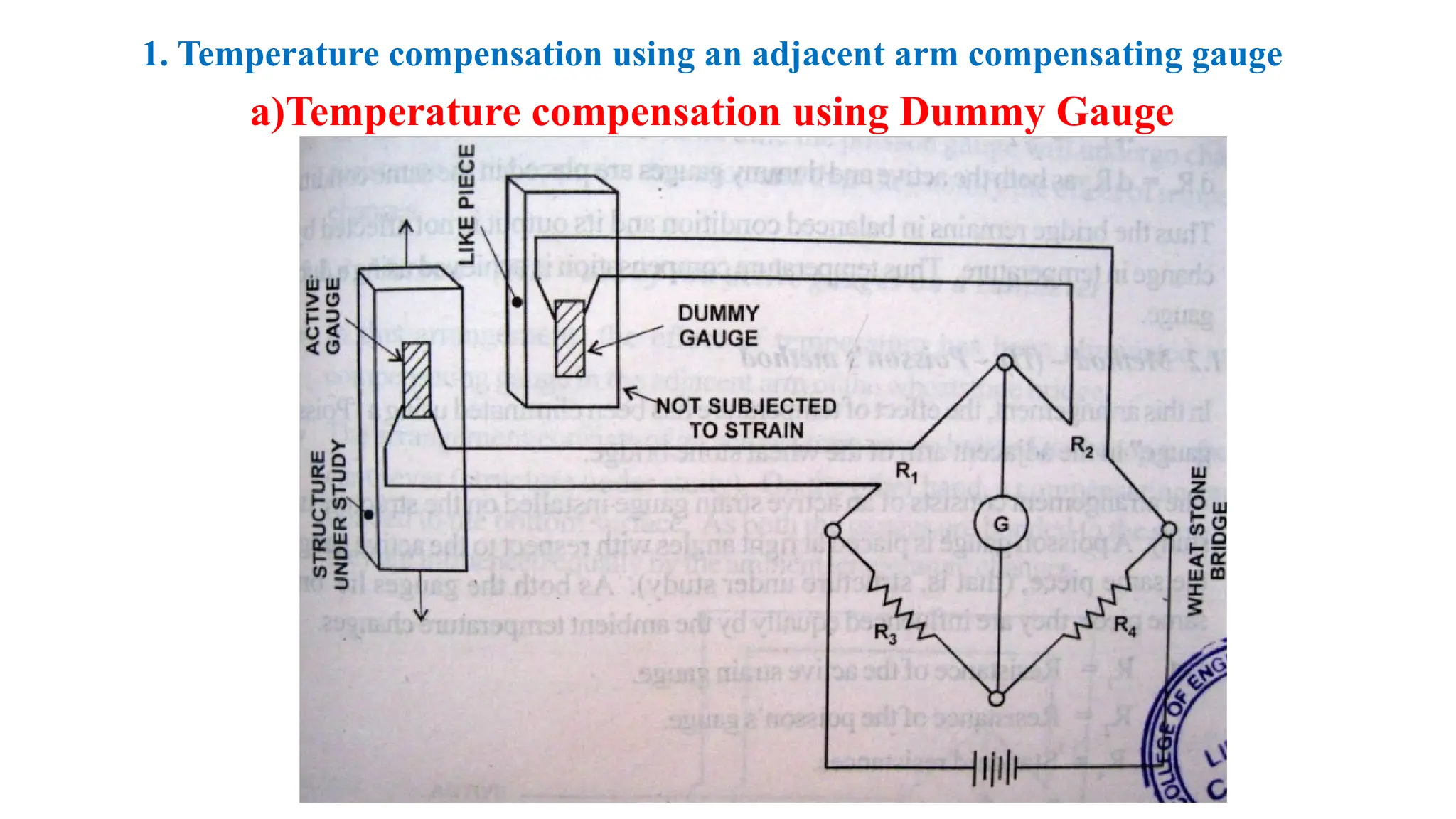
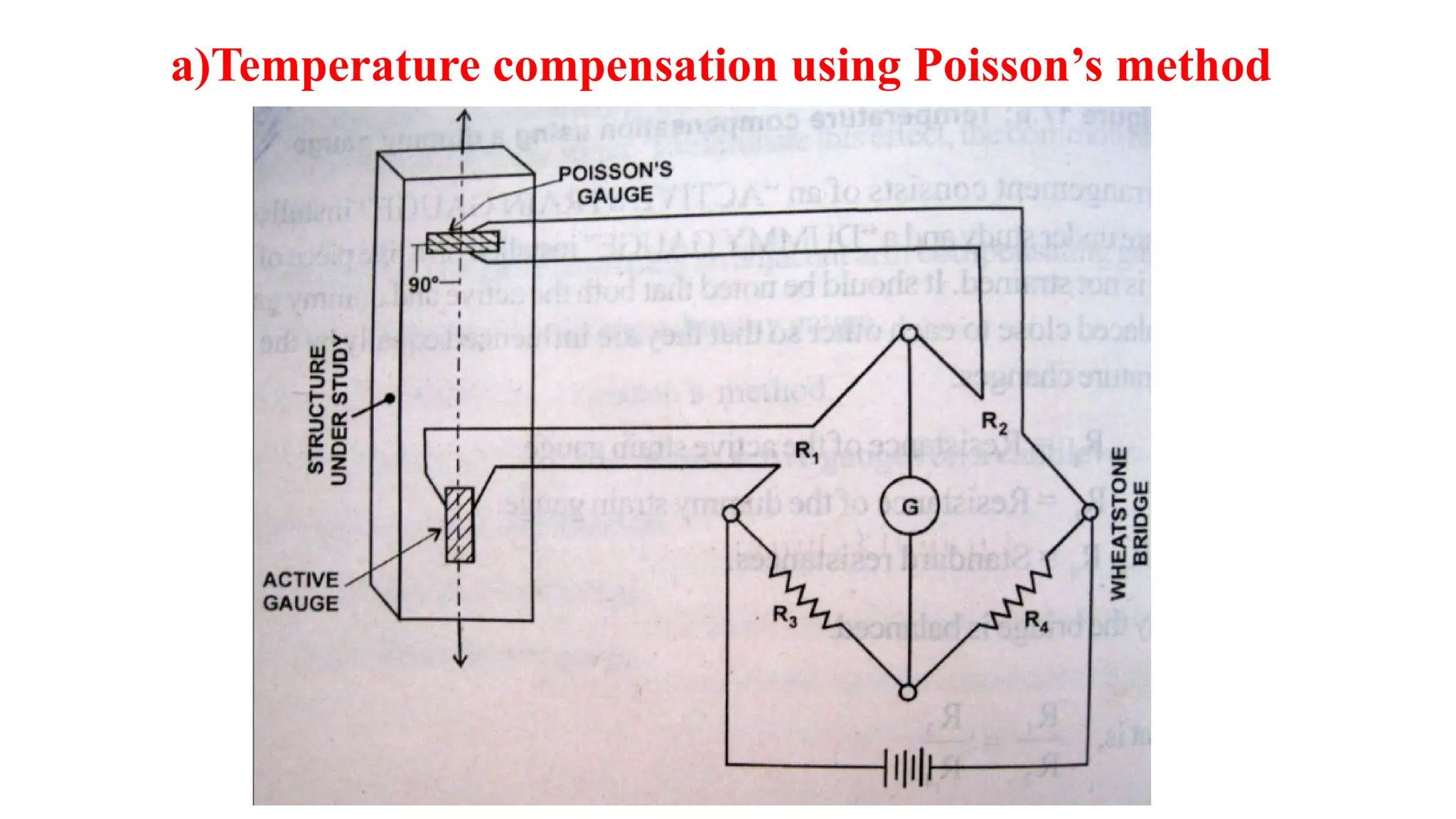
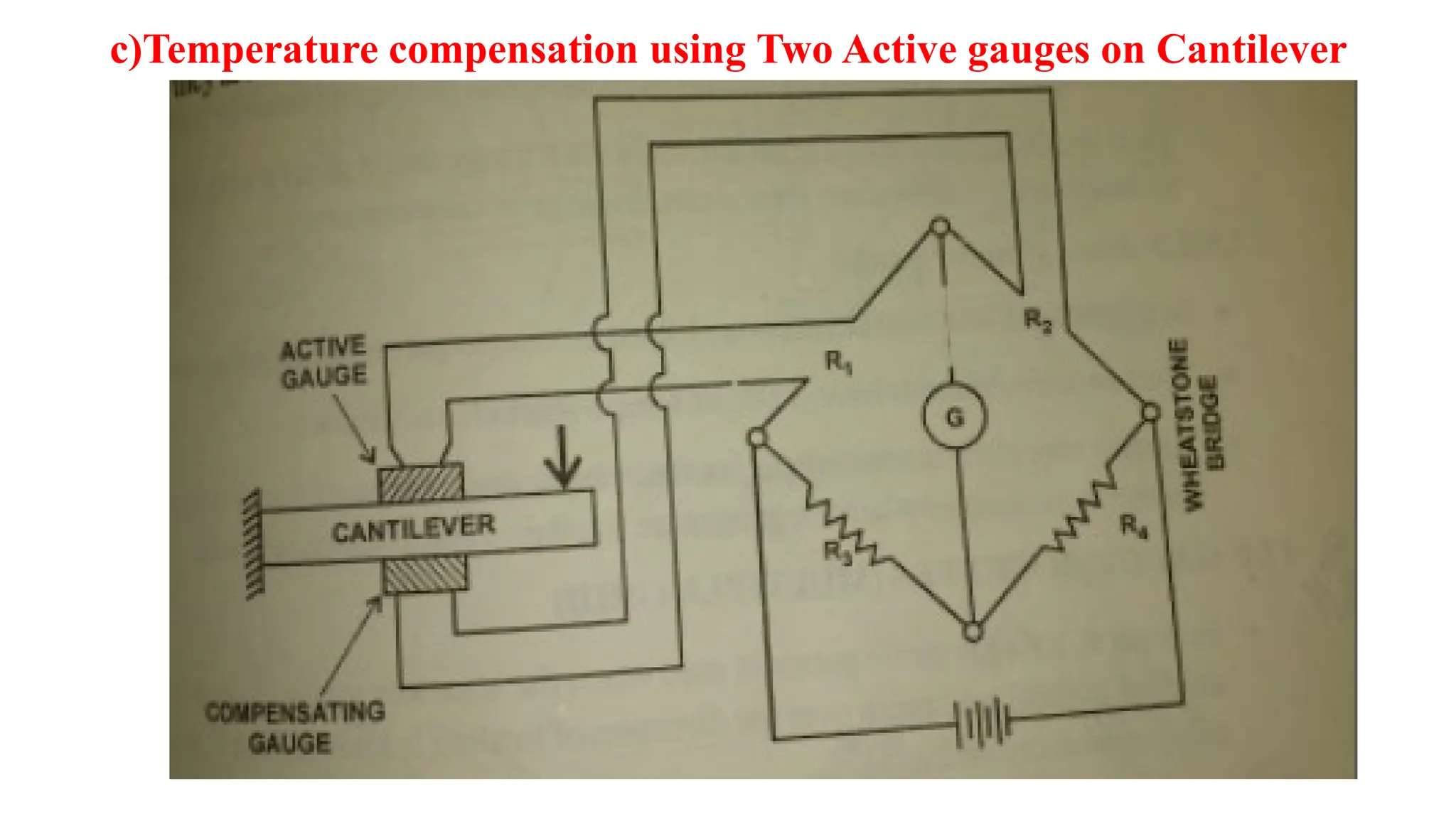
1. Temperaturecompensation using an adjacent arm compensating gauge
a) Method-I --- Using Dummy Gauge
b) Method-II --- Poisson’s method
c) Method-III --- Use of Two Active gauges on Cantilever
2. Self Temperature Compensation
a) Selected melt gauge
b) Dual element gauge
18.
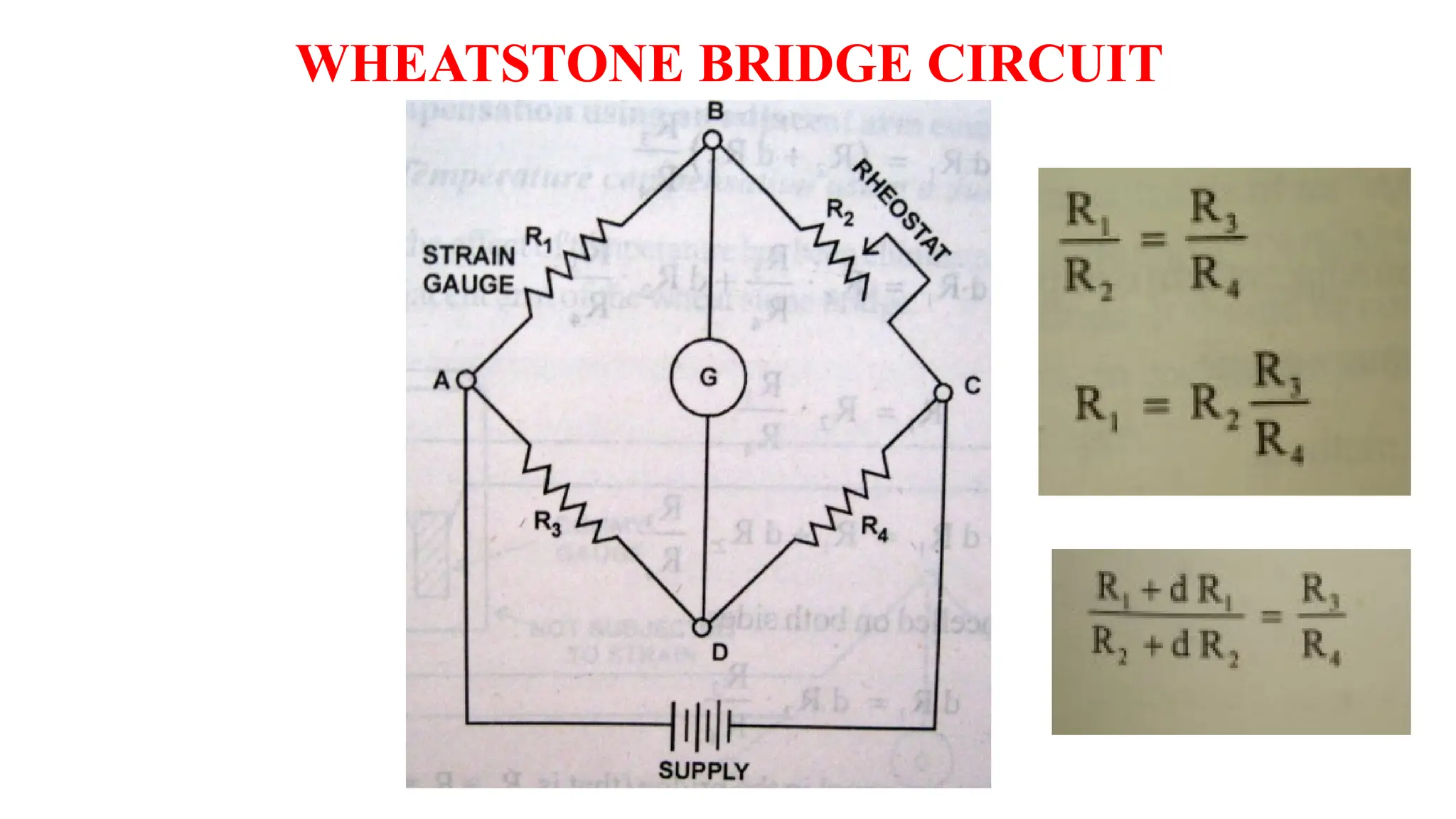
1. Temperature compensationusing an adjacent arm compensating gauge
a)Temperature compensation using Dummy Gauge


![[DSC Europe 25] Uros Pesic - The Reality of AI in Marketing.pdf](https://cdn.slidesharecdn.com/ss_thumbnails/rtkodnmtycovsllvzsyn-9-251215095918-b0c6bfe3-thumbnail.jpg?width=640&height=640&fit=bounds)

![[DSC Europe 25] Kaja Kandare - LLM as a judge.pptx](https://cdn.slidesharecdn.com/ss_thumbnails/arxyccaxsdsd1ba99wjw-7-251212104007-2b4e3f64-thumbnail.jpg?width=640&height=640&fit=bounds)


![[DSC Europe 25] Katherine Forrest - AI NOW: Understanding the Velocity of Cha...](https://cdn.slidesharecdn.com/ss_thumbnails/wvvbruqfrci0sfq9xwgb-4-251212104007-e5ad1987-thumbnail.jpg?width=640&height=640&fit=bounds)
![[DSC Europe 25] Djordje Hirs - Revolutionizing Telco Customer Experience with...](https://cdn.slidesharecdn.com/ss_thumbnails/zif75aur3qscnckv6tnc-djordje-hirs-cc-dsc2025-1-251219145617-679178aa-thumbnail.jpg?width=640&height=640&fit=bounds)
![[DSC Europe 25] Velibor Ilic - Autonomous Driving - How AI Shapes Technical ...](https://cdn.slidesharecdn.com/ss_thumbnails/gwu9aqths9ovngsrhidc-3-velibor-ilic-autonomous-driving-how-ai-shapes-technical-challenges-251219150035-7436923a-thumbnail.jpg?width=640&height=640&fit=bounds)


![[DSC Europe 25] Francisco Prado Moreno - Model Validation in the Age of AI: T...](https://cdn.slidesharecdn.com/ss_thumbnails/2igqvkir1yd2yzlhoylg-3-251215095918-6676c4e6-thumbnail.jpg?width=640&height=640&fit=bounds)
![[DSC Europe 25] Miodrag Pesovic & Vladislav Radonjic - Federated Data Archite...](https://cdn.slidesharecdn.com/ss_thumbnails/gsbe3y5it5uhndi4e08e-1-251212103249-f1008e0c-thumbnail.jpg?width=640&height=640&fit=bounds)
![[DSC Europe 25] Nikolay Burlutskiy - Best Practices for Building Enterprise M...](https://cdn.slidesharecdn.com/ss_thumbnails/uirvaiuvq8y1w8hzd9tx-7-251212103249-2619edb4-thumbnail.jpg?width=640&height=640&fit=bounds)


