Unit 4: Theory of Production and Cost
Concept of Production Function, Fixed and Variable Inputs and Short and Long
Run, Total, Average and Marginal Products, Total, Average and Marginal Curves,
The Law of Variable Proportions: Returns to a Factor, What Are Isoquants?,
Characteristics or Properties of Isoquants, Returns to Scale, Economies and
Diseconomies of Scale Theory of Costs- Basic Concepts, Short-run Total Cost
Curves, Fixed and Variable, Short-run Average and Marginal Cost Curves,
Relationship between Average and Marginal Cost Curve, Average and Marginal
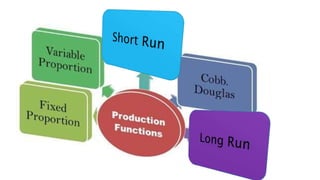
Production Function
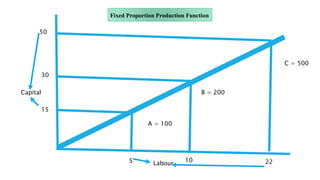
Fixed Proportion Production Function
Capital
Labour
15
5
30
50
10 22
A = 100
B = 200
C = 500
Variable Proportion Production Function
Short-run Production
Law of variable proportion
No change in scale of production.
Factor ratio changes
There are barriers to entry and the firms can shut down but cannot
fully exist.
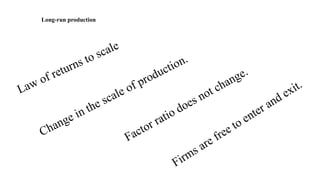
Long-run production
use of the available capital can be made only in periods of full
employment
considers only two inputs
shows constant returns to scale
neglects the complementarity of factors
perfect competition in the factor market
function is the aggregation problem
Criticisms of C-D Production Function
The Cobb-Douglas Production Function
Q = ALα Cβ
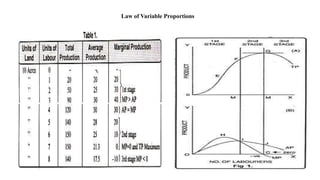
Law of Variable Proportions
Assumptions
Constant Technology Factor Proportions are Variable Homogeneous Factor Units Short-Run
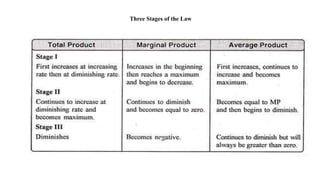
Three Stages of the Law
Condition or Causes of Applicability
Under Utilization of Fixed Factor
Fixed Factors of Production
Optimum Production
Imperfect Substitutes
Applicability of the Law of Variable Proportions
Application to Agriculture
Application to Industries
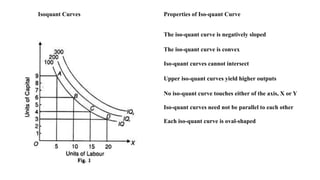
Isoquant Curves Properties of Iso-quant Curve
The iso-quant curve is negatively sloped
The iso-quant curve is convex
Iso-quant curves cannot intersect
Upper iso-quant curves yield higher outputs
No iso-quant curve touches either of the axis, X or Y
Iso-quant curves need not be parallel to each other
Each iso-quant curve is oval-shaped
Iso-cost Lines
The Choice of Optimal Expansion Path
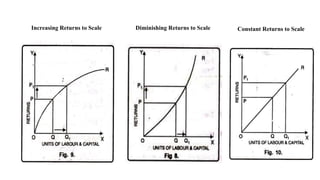
Law of returns to scale
1. Increasing Returns to scale.
2. Constant Returns to Scale
3. Diminishing Returns to Scale
Increasing Returns to Scale Diminishing Returns to Scale Constant Returns to Scale
). Nature of the Industry
). Analysis of Cost of Production
Diseconomies of Scale of Production
Internal Diseconomies
(a) Inefficient Management
(b) Technical Difficulties
(c) Production Diseconomies
(d) Marketing Diseconomies
(e) Financial Diseconomies
(f) Marketing Diseconomies
External Diseconomies
(a). Diseconomies of Pollution
(b). Diseconomies of Strains on Infrastructure
(c). Diseconomies of High Factor
“Cost is the expense incurred in producing a commodity”
Cost Determinants
1. Level of output
2. Price of input factors
3. Productivities of factors of production
4. Size of plant
5. Output stability
6. Lot size
7. Laws of returns
8. Levels of capacity utilization
9. Time period
10. Technology
Cost-Output Relationship
C= f (S, O, P, T ….)
Cost-Output Relationship in the Short-Run
Units of
Output Q
Total fixed
cost TFC
Total
variable
cost TVC
Total cost
(TFC + TVC)
TC
Average
variable
cost (TVC /
Q) AVC
Average
fixed cost
(TFC / Q)
AFC
Average
cost (TC/Q)
AC
Marginal
cost MC
0 – – 60 – – – –
1 60 20 80 20 60 80 20
2 60 36 96 18 30 48 16
3 60 48 108 16 20 36 12
4 60 64 124 16 15 31 16
5 60 90 150 18 12 30 26
short-run cost-output relationship
Cost-output Relationship in the Long-Run

Unit - 4 Topic - 1.pptx

  • 1.
    Unit 4: Theoryof Production and Cost Concept of Production Function, Fixed and Variable Inputs and Short and Long Run, Total, Average and Marginal Products, Total, Average and Marginal Curves, The Law of Variable Proportions: Returns to a Factor, What Are Isoquants?, Characteristics or Properties of Isoquants, Returns to Scale, Economies and Diseconomies of Scale Theory of Costs- Basic Concepts, Short-run Total Cost Curves, Fixed and Variable, Short-run Average and Marginal Cost Curves, Relationship between Average and Marginal Cost Curve, Average and Marginal
  • 2.
  • 4.
    Fixed Proportion ProductionFunction Capital Labour 15 5 30 50 10 22 A = 100 B = 200 C = 500
  • 5.
  • 6.
    Short-run Production Law ofvariable proportion No change in scale of production. Factor ratio changes There are barriers to entry and the firms can shut down but cannot fully exist.
  • 7.
  • 8.
    use of theavailable capital can be made only in periods of full employment considers only two inputs shows constant returns to scale neglects the complementarity of factors perfect competition in the factor market function is the aggregation problem Criticisms of C-D Production Function The Cobb-Douglas Production Function Q = ALα Cβ
  • 9.
    Law of VariableProportions
  • 10.
    Assumptions Constant Technology FactorProportions are Variable Homogeneous Factor Units Short-Run
  • 11.
  • 12.
    Condition or Causesof Applicability Under Utilization of Fixed Factor Fixed Factors of Production Optimum Production Imperfect Substitutes Applicability of the Law of Variable Proportions Application to Agriculture Application to Industries
  • 13.
    Isoquant Curves Propertiesof Iso-quant Curve The iso-quant curve is negatively sloped The iso-quant curve is convex Iso-quant curves cannot intersect Upper iso-quant curves yield higher outputs No iso-quant curve touches either of the axis, X or Y Iso-quant curves need not be parallel to each other Each iso-quant curve is oval-shaped
  • 14.
  • 15.
    The Choice ofOptimal Expansion Path
  • 16.
    Law of returnsto scale 1. Increasing Returns to scale. 2. Constant Returns to Scale 3. Diminishing Returns to Scale
  • 17.
    Increasing Returns toScale Diminishing Returns to Scale Constant Returns to Scale
  • 18.
    ). Nature ofthe Industry ). Analysis of Cost of Production
  • 19.
    Diseconomies of Scaleof Production Internal Diseconomies (a) Inefficient Management (b) Technical Difficulties (c) Production Diseconomies (d) Marketing Diseconomies (e) Financial Diseconomies (f) Marketing Diseconomies External Diseconomies (a). Diseconomies of Pollution (b). Diseconomies of Strains on Infrastructure (c). Diseconomies of High Factor
  • 20.
    “Cost is theexpense incurred in producing a commodity” Cost Determinants 1. Level of output 2. Price of input factors 3. Productivities of factors of production 4. Size of plant 5. Output stability 6. Lot size 7. Laws of returns 8. Levels of capacity utilization 9. Time period 10. Technology
  • 22.
    Cost-Output Relationship C= f(S, O, P, T ….) Cost-Output Relationship in the Short-Run Units of Output Q Total fixed cost TFC Total variable cost TVC Total cost (TFC + TVC) TC Average variable cost (TVC / Q) AVC Average fixed cost (TFC / Q) AFC Average cost (TC/Q) AC Marginal cost MC 0 – – 60 – – – – 1 60 20 80 20 60 80 20 2 60 36 96 18 30 48 16 3 60 48 108 16 20 36 12 4 60 64 124 16 15 31 16 5 60 90 150 18 12 30 26
  • 23.
  • 24.