MODAL VERBS
MODAL VERBS
• Modal verbs are special verbs which transmit
different communicative intentions
• They are special because they have special
grammar rules… Look
MODAL VERBS
• Modal verbs do not have –s in third person singular when
used in present
– I can do it! He can do it
• They don’t negate with the auxiliary “do”. They negate
with “not”
– I don’t drink alcohol I cannot drink alcohol
• They ask questions with no auxiliary, but with “inversion”
– Does he play board games? Can he play board games?
MODAL VERBS
• Depending on the modal verb that we use, we
will transmit different communicative
intentions… Look:
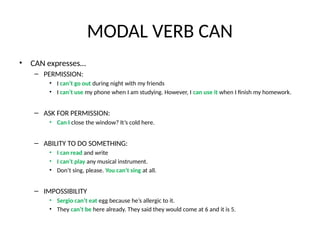
MODAL VERB CAN
• CAN expresses…
– PERMISSION:
• I can’t go out during night with my friends
• I can’t use my phone when I am studying. However, I can use it when I finish my homework.
– ASK FOR PERMISSION:
• Can I close the window? It’s cold here.
– ABILITY TO DO SOMETHING:
• I can read and write
• I can’t play any musical instrument.
• Don’t sing, please. You can’t sing at all.
– IMPOSSIBILITY
• Sergio can’t eat egg because he’s allergic to it.
• They can’t be here already. They said they would come at 6 and it is 5.
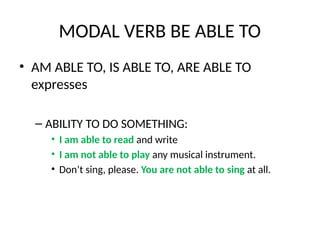
MODAL VERB BE ABLE TO
• AM ABLE TO, IS ABLE TO, ARE ABLE TO
expresses
– ABILITY TO DO SOMETHING:
• I am able to read and write
• I am not able to play any musical instrument.
• Don’t sing, please. You are not able to sing at all.
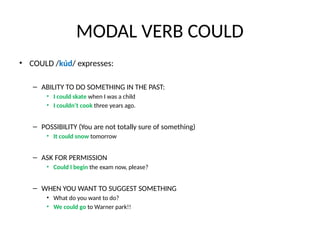
MODAL VERB COULD
• COULD /kúd/ expresses:
– ABILITY TO DO SOMETHING IN THE PAST:
• I could skate when I was a child
• I couldn’t cook three years ago.
– POSSIBILITY (You are not totally sure of something)
• It could snow tomorrow
– ASK FOR PERMISSION
• Could I begin the exam now, please?
– WHEN YOU WANT TO SUGGEST SOMETHING
• What do you want to do?
• We could go to Warner park!!
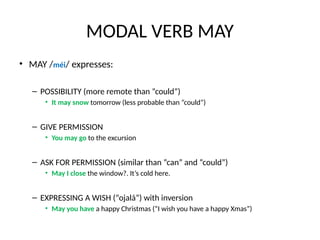
MODAL VERB MAY
• MAY /méi/ expresses:
– POSSIBILITY (more remote than “could”)
• It may snow tomorrow (less probable than “could”)
– GIVE PERMISSION
• You may go to the excursion
– ASK FOR PERMISSION (similar than “can” and “could”)
• May I close the window?. It’s cold here.
– EXPRESSING A WISH (“ojalá”) with inversion
• May you have a happy Christmas (“I wish you have a happy Xmas”)
MODAL VERB MIGHT
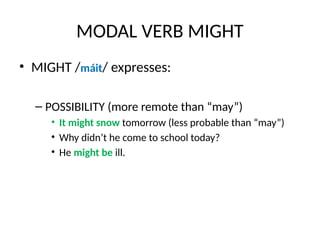
• MIGHT /máit/ expresses:
– POSSIBILITY (more remote than “may”)
• It might snow tomorrow (less probable than “may”)
• Why didn’t he come to school today?
• He might be ill.
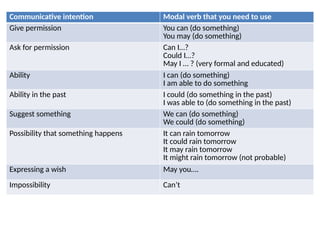
Communicative intention Modal verb that you need to use
Give permission You can (do something)
You may (do something)
Ask for permission Can I…?
Could I…?
May I … ? (very formal and educated)
Ability I can (do something)
I am able to do something
Ability in the past I could (do something in the past)
I was able to (do something in the past)
Suggest something We can (do something)
We could (do something)
Possibility that something happens It can rain tomorrow
It could rain tomorrow
It may rain tomorrow
It might rain tomorrow (not probable)
Expressing a wish May you….
Impossibility Can’t
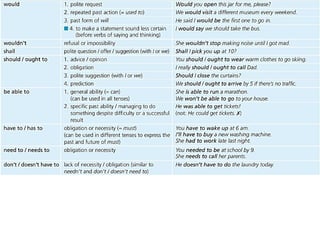
MODAL VERB WOULD
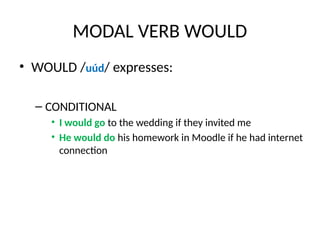
• WOULD /uúd/ expresses:
– CONDITIONAL
• I would go to the wedding if they invited me
• He would do his homework in Moodle if he had internet
connection
MODAL VERBS SHOULD and OUGHT TO
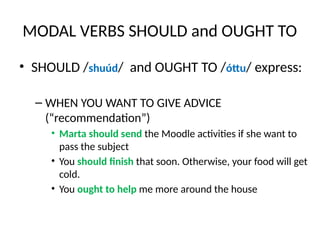
• SHOULD /shuúd/ and OUGHT TO /óttu/ express:
– WHEN YOU WANT TO GIVE ADVICE
(“recommendation”)
• Marta should send the Moodle activities if she want to
pass the subject
• You should finish that soon. Otherwise, your food will get
cold.
• You ought to help me more around the house
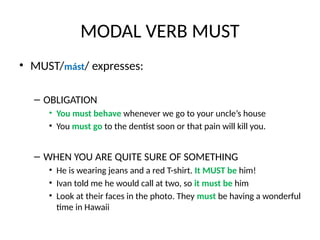
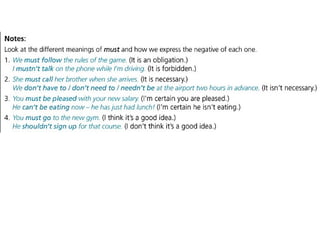
MODAL VERB MUST
• MUST/mást/ expresses:
– OBLIGATION
• You must behave whenever we go to your uncle’s house
• You must go to the dentist soon or that pain will kill you.
– WHEN YOU ARE QUITE SURE OF SOMETHING
• He is wearing jeans and a red T-shirt. It MUST be him!
• Ivan told me he would call at two, so it must be him
• Look at their faces in the photo. They must be having a wonderful
time in Hawaii
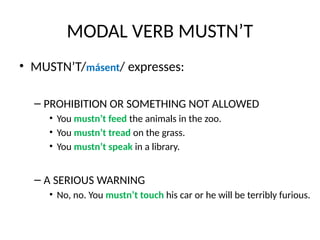
MODAL VERB MUSTN’T
• MUSTN’T/másent/ expresses:
– PROHIBITION OR SOMETHING NOT ALLOWED
• You mustn’t feed the animals in the zoo.
• You mustn’t tread on the grass.
• You mustn’t speak in a library.
– A SERIOUS WARNING
• No, no. You mustn’t touch his car or he will be terribly furious.
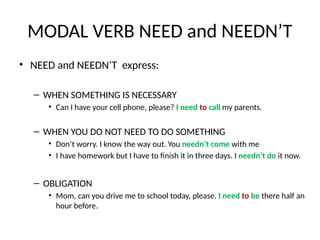
MODAL VERB NEED and NEEDN’T
• NEED and NEEDN’T express:
– WHEN SOMETHING IS NECESSARY
• Can I have your cell phone, please? I need to call my parents.
– WHEN YOU DO NOT NEED TO DO SOMETHING
• Don’t worry. I know the way out. You needn’t come with me
• I have homework but I have to finish it in three days. I needn’t do it now.
– OBLIGATION
• Mom, can you drive me to school today, please. I need to be there half an
hour before.
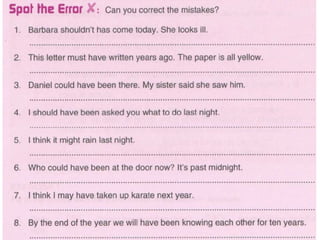
MODAL PERFECTS
• SOMETIMES YOU NEED TO EXPRESS THINGS
WITH MODAL VERBS BUT IN THE PAST.
– USE A MODAL PERFECT
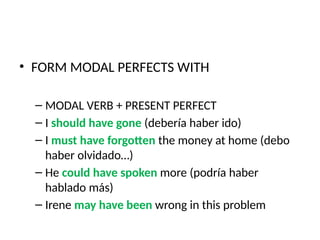
• FORM MODAL PERFECTS WITH
– MODAL VERB + PRESENT PERFECT
– I should have gone (debería haber ido)
– I must have forgotten the money at home (debo
haber olvidado…)
– He could have spoken more (podría haber
hablado más)
– Irene may have been wrong in this problem
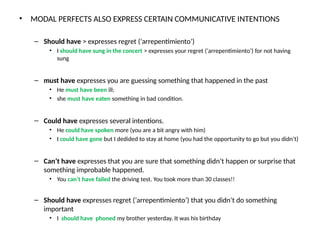
• MODAL PERFECTS ALSO EXPRESS CERTAIN COMMUNICATIVE INTENTIONS
– Should have > expresses regret (‘arrepentimiento’)
• I should have sung in the concert > expresses your regret (‘arrepentimiento’) for not having
sung
– must have expresses you are guessing something that happened in the past
• He must have been ill;
• she must have eaten something in bad condition.
– Could have expresses several intentions.
• He could have spoken more (you are a bit angry with him)
• I could have gone but I dedided to stay at home (you had the opportunity to go but you didn’t)
– Can’t have expresses that you are sure that something didn’t happen or surprise that
something improbable happened.
• You can’t have failed the driving test. You took more than 30 classes!!
– Should have expresses regret (‘arrepentimiento’) that you didn’t do something
important
• I should have phoned my brother yesterday. It was his birthday
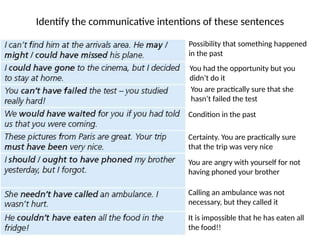
Identify the communicative intentions of these sentences
Possibility that something happened
in the past
You had the opportunity but you
didn’t do it
You are practically sure that she
hasn’t failed the test
Condition in the past
Certainty. You are practically sure
that the trip was very nice
You are angry with yourself for not
having phoned your brother
Calling an ambulance was not
necessary, but they called it
It is impossible that he has eaten all
the food!!
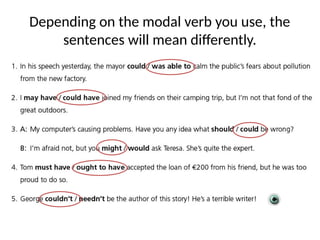
Depending on the modal verb you use, the
sentences will mean differently.
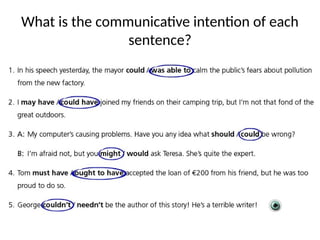
What is the communicative intention of each
sentence?
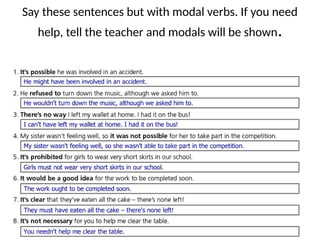
Say these sentences but with modal verbs. If you need
help, tell the teacher and modals will be shown.
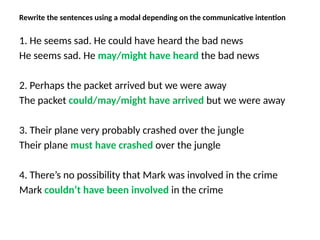
Rewrite the sentences using a modal depending on the communicative intention
1. He seems sad. He could have heard the bad news
He seems sad. He may/might have heard the bad news
2. Perhaps the packet arrived but we were away
The packet could/may/might have arrived but we were away
3. Their plane very probably crashed over the jungle
Their plane must have crashed over the jungle
4. There’s no possibility that Mark was involved in the crime
Mark couldn’t have been involved in the crime
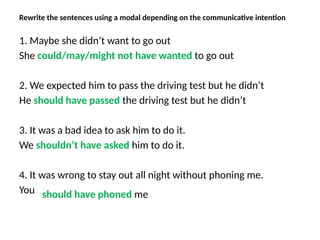
Rewrite the sentences using a modal depending on the communicative intention
1. Maybe she didn’t want to go out
She could/may/might not have wanted to go out
2. We expected him to pass the driving test but he didn’t
He should have passed the driving test but he didn’t
3. It was a bad idea to ask him to do it.
We shouldn’t have asked him to do it.
4. It was wrong to stay out all night without phoning me.
You should have phoned me
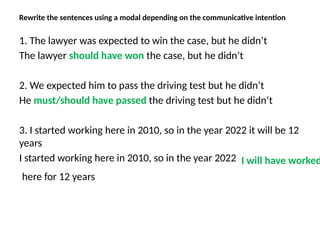
Rewrite the sentences using a modal depending on the communicative intention
1. The lawyer was expected to win the case, but he didn’t
The lawyer should have won the case, but he didn’t
2. We expected him to pass the driving test but he didn’t
He must/should have passed the driving test but he didn’t
3. I started working here in 2010, so in the year 2022 it will be 12
years
I started working here in 2010, so in the year 2022 I will have worked
here for 12 years
Unit 4 MODAL VERBS y MODAL PERFECTS.pptx

Unit 4 MODAL VERBS y MODAL PERFECTS.pptx

  • 1.
  • 2.
    MODAL VERBS • Modalverbs are special verbs which transmit different communicative intentions • They are special because they have special grammar rules… Look
  • 3.
    MODAL VERBS • Modalverbs do not have –s in third person singular when used in present – I can do it! He can do it • They don’t negate with the auxiliary “do”. They negate with “not” – I don’t drink alcohol I cannot drink alcohol • They ask questions with no auxiliary, but with “inversion” – Does he play board games? Can he play board games?
  • 4.
    MODAL VERBS • Dependingon the modal verb that we use, we will transmit different communicative intentions… Look:
  • 5.
    MODAL VERB CAN •CAN expresses… – PERMISSION: • I can’t go out during night with my friends • I can’t use my phone when I am studying. However, I can use it when I finish my homework. – ASK FOR PERMISSION: • Can I close the window? It’s cold here. – ABILITY TO DO SOMETHING: • I can read and write • I can’t play any musical instrument. • Don’t sing, please. You can’t sing at all. – IMPOSSIBILITY • Sergio can’t eat egg because he’s allergic to it. • They can’t be here already. They said they would come at 6 and it is 5.
  • 6.
    MODAL VERB BEABLE TO • AM ABLE TO, IS ABLE TO, ARE ABLE TO expresses – ABILITY TO DO SOMETHING: • I am able to read and write • I am not able to play any musical instrument. • Don’t sing, please. You are not able to sing at all.
  • 7.
    MODAL VERB COULD •COULD /kúd/ expresses: – ABILITY TO DO SOMETHING IN THE PAST: • I could skate when I was a child • I couldn’t cook three years ago. – POSSIBILITY (You are not totally sure of something) • It could snow tomorrow – ASK FOR PERMISSION • Could I begin the exam now, please? – WHEN YOU WANT TO SUGGEST SOMETHING • What do you want to do? • We could go to Warner park!!
  • 8.
    MODAL VERB MAY •MAY /méi/ expresses: – POSSIBILITY (more remote than “could”) • It may snow tomorrow (less probable than “could”) – GIVE PERMISSION • You may go to the excursion – ASK FOR PERMISSION (similar than “can” and “could”) • May I close the window?. It’s cold here. – EXPRESSING A WISH (“ojalá”) with inversion • May you have a happy Christmas (“I wish you have a happy Xmas”)
  • 9.
    MODAL VERB MIGHT •MIGHT /máit/ expresses: – POSSIBILITY (more remote than “may”) • It might snow tomorrow (less probable than “may”) • Why didn’t he come to school today? • He might be ill.
  • 10.
    Communicative intention Modalverb that you need to use Give permission You can (do something) You may (do something) Ask for permission Can I…? Could I…? May I … ? (very formal and educated) Ability I can (do something) I am able to do something Ability in the past I could (do something in the past) I was able to (do something in the past) Suggest something We can (do something) We could (do something) Possibility that something happens It can rain tomorrow It could rain tomorrow It may rain tomorrow It might rain tomorrow (not probable) Expressing a wish May you…. Impossibility Can’t
  • 11.
    MODAL VERB WOULD •WOULD /uúd/ expresses: – CONDITIONAL • I would go to the wedding if they invited me • He would do his homework in Moodle if he had internet connection
  • 12.
    MODAL VERBS SHOULDand OUGHT TO • SHOULD /shuúd/ and OUGHT TO /óttu/ express: – WHEN YOU WANT TO GIVE ADVICE (“recommendation”) • Marta should send the Moodle activities if she want to pass the subject • You should finish that soon. Otherwise, your food will get cold. • You ought to help me more around the house
  • 13.
    MODAL VERB MUST •MUST/mást/ expresses: – OBLIGATION • You must behave whenever we go to your uncle’s house • You must go to the dentist soon or that pain will kill you. – WHEN YOU ARE QUITE SURE OF SOMETHING • He is wearing jeans and a red T-shirt. It MUST be him! • Ivan told me he would call at two, so it must be him • Look at their faces in the photo. They must be having a wonderful time in Hawaii
  • 14.
    MODAL VERB MUSTN’T •MUSTN’T/másent/ expresses: – PROHIBITION OR SOMETHING NOT ALLOWED • You mustn’t feed the animals in the zoo. • You mustn’t tread on the grass. • You mustn’t speak in a library. – A SERIOUS WARNING • No, no. You mustn’t touch his car or he will be terribly furious.
  • 15.
    MODAL VERB NEEDand NEEDN’T • NEED and NEEDN’T express: – WHEN SOMETHING IS NECESSARY • Can I have your cell phone, please? I need to call my parents. – WHEN YOU DO NOT NEED TO DO SOMETHING • Don’t worry. I know the way out. You needn’t come with me • I have homework but I have to finish it in three days. I needn’t do it now. – OBLIGATION • Mom, can you drive me to school today, please. I need to be there half an hour before.
  • 19.
    MODAL PERFECTS • SOMETIMESYOU NEED TO EXPRESS THINGS WITH MODAL VERBS BUT IN THE PAST. – USE A MODAL PERFECT
  • 20.
    • FORM MODALPERFECTS WITH – MODAL VERB + PRESENT PERFECT – I should have gone (debería haber ido) – I must have forgotten the money at home (debo haber olvidado…) – He could have spoken more (podría haber hablado más) – Irene may have been wrong in this problem
  • 21.
    • MODAL PERFECTSALSO EXPRESS CERTAIN COMMUNICATIVE INTENTIONS – Should have > expresses regret (‘arrepentimiento’) • I should have sung in the concert > expresses your regret (‘arrepentimiento’) for not having sung – must have expresses you are guessing something that happened in the past • He must have been ill; • she must have eaten something in bad condition. – Could have expresses several intentions. • He could have spoken more (you are a bit angry with him) • I could have gone but I dedided to stay at home (you had the opportunity to go but you didn’t) – Can’t have expresses that you are sure that something didn’t happen or surprise that something improbable happened. • You can’t have failed the driving test. You took more than 30 classes!! – Should have expresses regret (‘arrepentimiento’) that you didn’t do something important • I should have phoned my brother yesterday. It was his birthday
  • 22.
    Identify the communicativeintentions of these sentences Possibility that something happened in the past You had the opportunity but you didn’t do it You are practically sure that she hasn’t failed the test Condition in the past Certainty. You are practically sure that the trip was very nice You are angry with yourself for not having phoned your brother Calling an ambulance was not necessary, but they called it It is impossible that he has eaten all the food!!
  • 23.
    Depending on themodal verb you use, the sentences will mean differently.
  • 24.
    What is thecommunicative intention of each sentence?
  • 25.
    Say these sentencesbut with modal verbs. If you need help, tell the teacher and modals will be shown.
  • 26.
    Rewrite the sentencesusing a modal depending on the communicative intention 1. He seems sad. He could have heard the bad news He seems sad. He may/might have heard the bad news 2. Perhaps the packet arrived but we were away The packet could/may/might have arrived but we were away 3. Their plane very probably crashed over the jungle Their plane must have crashed over the jungle 4. There’s no possibility that Mark was involved in the crime Mark couldn’t have been involved in the crime
  • 27.
    Rewrite the sentencesusing a modal depending on the communicative intention 1. Maybe she didn’t want to go out She could/may/might not have wanted to go out 2. We expected him to pass the driving test but he didn’t He should have passed the driving test but he didn’t 3. It was a bad idea to ask him to do it. We shouldn’t have asked him to do it. 4. It was wrong to stay out all night without phoning me. You should have phoned me
  • 28.
    Rewrite the sentencesusing a modal depending on the communicative intention 1. The lawyer was expected to win the case, but he didn’t The lawyer should have won the case, but he didn’t 2. We expected him to pass the driving test but he didn’t He must/should have passed the driving test but he didn’t 3. I started working here in 2010, so in the year 2022 it will be 12 years I started working here in 2010, so in the year 2022 I will have worked here for 12 years