Unit - 2
Operations Strategy and Competi
tiveness
Overview
 Competitiveness
 Operations strategy
 Operations Strategy in manufacturing
operations
 Operations Strategy in Service operati
ons
2
2.1 Introduction-Competitiveness
 Competitiveness refers to how effectively an organization m
eets the wants and needs of customers relative to others th
at offer similar goods or services
 How Organization Compete against each other?
organizations can compete against each other
- price - flexibility
- quality - time
- product differentiation
 The ability of a Company to compete in the marketplace de
pends on its operations strategy that is properly aligned
with its mission of serving customers.
3
Introduction
 Operational effectiveness is the ability to perform similar o
perations activities better than competitors
 It is very difficult for a company to compete successfully in
the long run based just on operational effectiveness
 A firm must also determine how operational effectiveness c
an be used to achieve a sustainable competitive advantage
.
 An effective competitive strategy is critical.
 Competitive strategy is about being different. It means deli
berately choosing a different set of activities to deliver a u
nique mix of values.
4
Introduction
Strategy ?
- total pattern of the decisions and actions that
influence the long-term direction of the business
(indicates of the actual strategic behavior even not explicitly stated)
- the direction and scope of an organization over
the long-term
5
Introduction
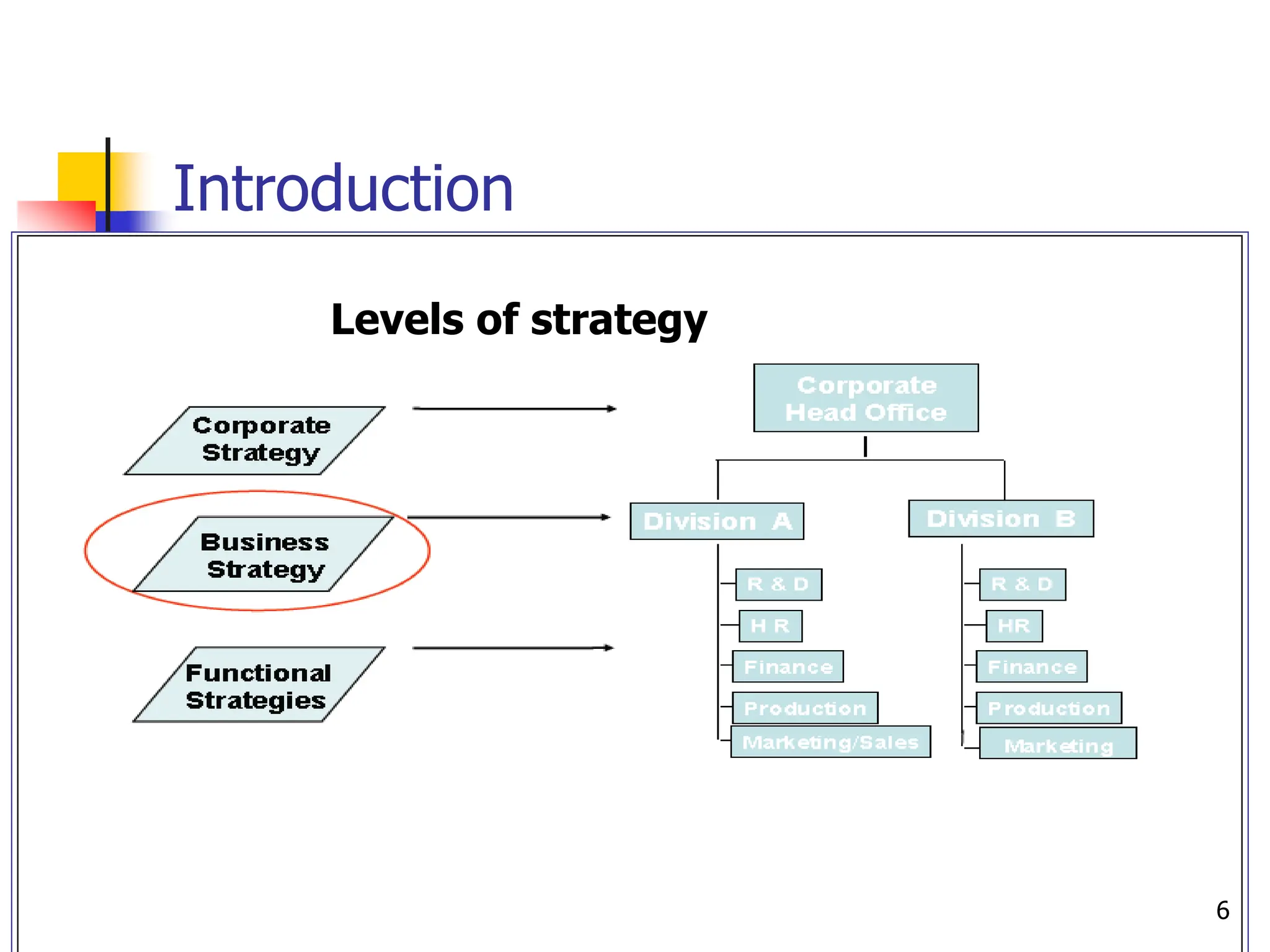
Levels of strategy
6
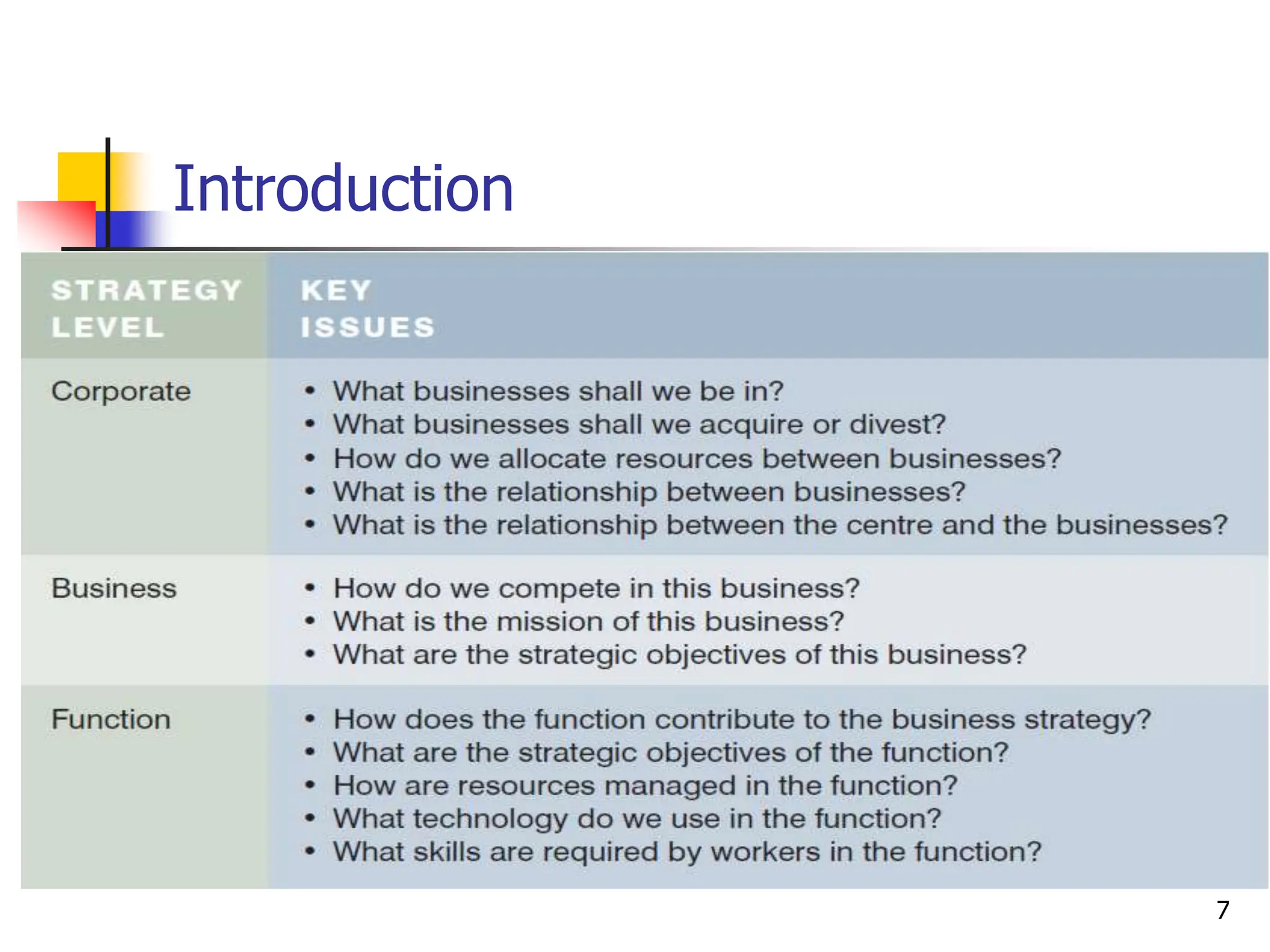
Introduction
7
2.2 Operations Strategy
Operations Strategy
- The approach, consistent with organization strategy, that is
used to guide the operations function
- Policies and plans for using the organization’s resources to
support its long-term competitive strategy
- Must aligned with the company’s business strategy and
enable the company to achieve its long-term plan
8
Operations Strategy
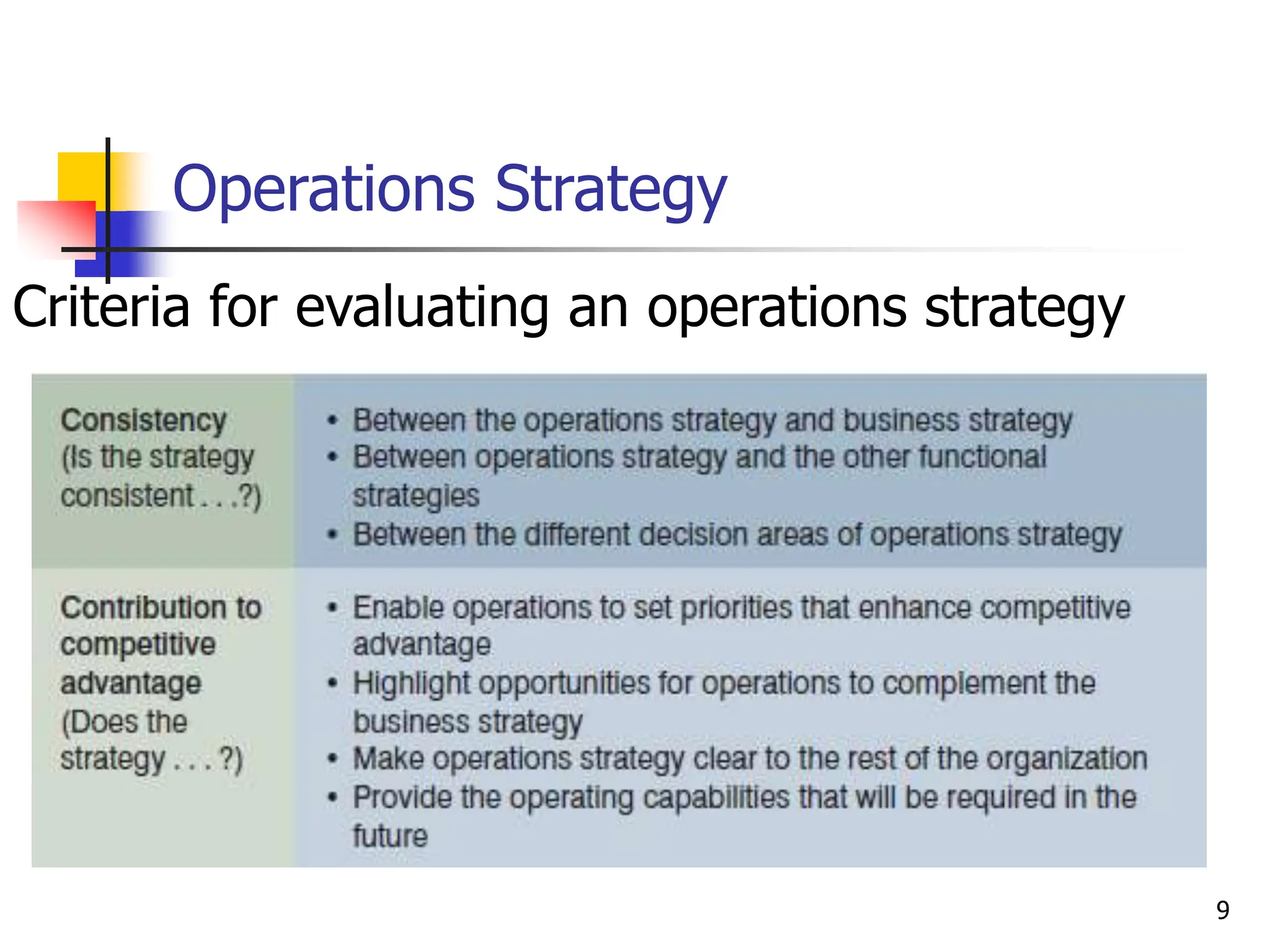
Criteria for evaluating an operations strategy
9
Developing Operations Strategy
10
Corporate Mission
 A corporate mission is a set of long-range goals and i
ncluding statements about:
 the kind of business the company wants to be in
 who its customers are
 its basic beliefs about business
 its goals of survival, growth, and profitability
⇒ Mission statements tell an organization where it is going
11
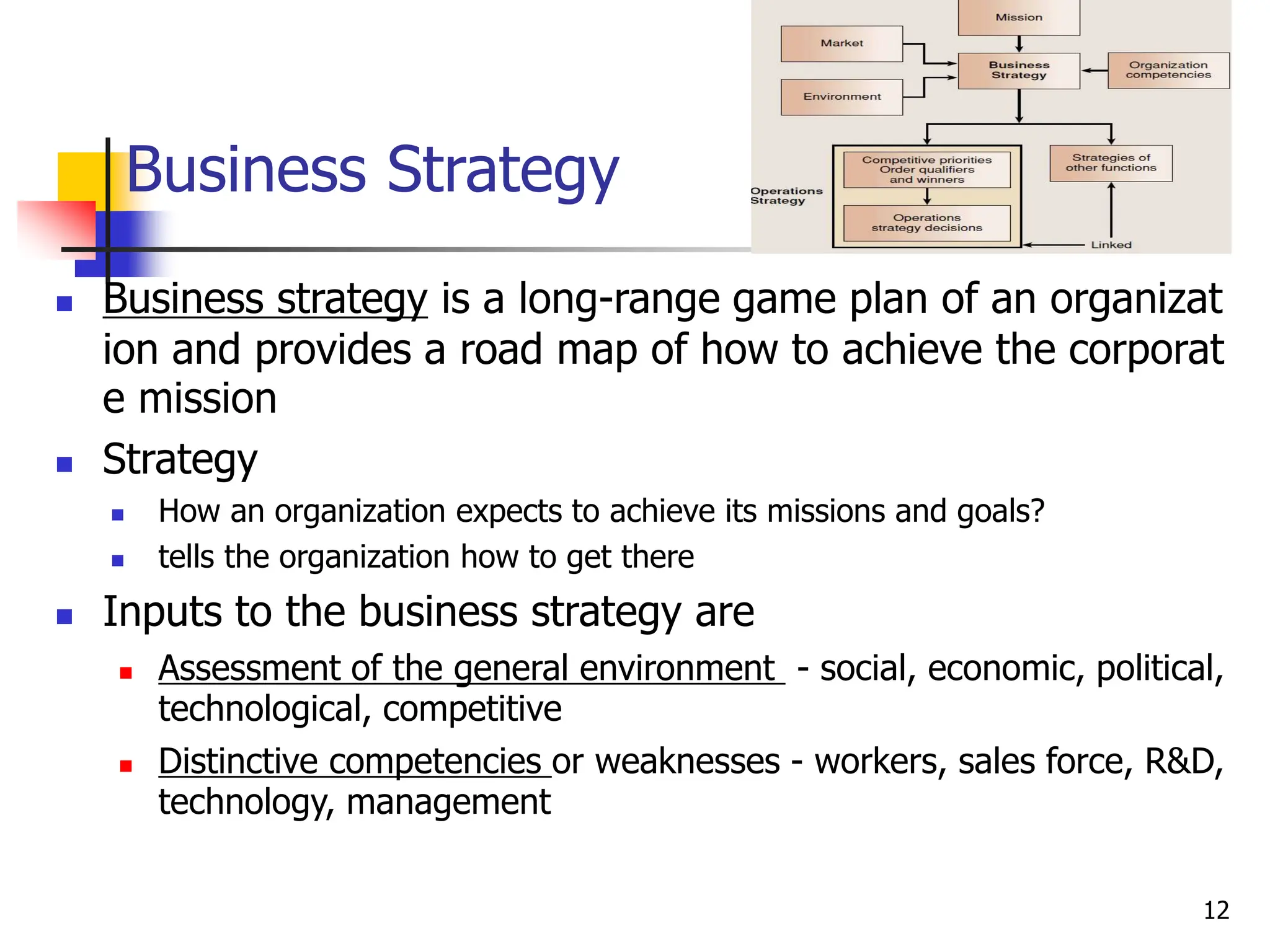
Business Strategy
 Business strategy is a long-range game plan of an organizat
ion and provides a road map of how to achieve the corporat
e mission
 Strategy
 How an organization expects to achieve its missions and goals?
 tells the organization how to get there
 Inputs to the business strategy are
 Assessment of the general environment - social, economic, political,
technological, competitive
 Distinctive competencies or weaknesses - workers, sales force, R&D,
technology, management
12
Competitive Priorities/Dimmensions
 Cost or Price: “ Make the Product or Deliver the Service Cheap”
 Quality: “ Make a Great Product or Deliver a Great Service”
 design quality and process quality
 Delivery Speed: “Make the Product or Deliver the Service Quickly”
 Delivery Reliability: “ Deliver It When Promised”
 Flexibility
 Coping with Changes in Demand: “Change Its Volume”
 Customer Service, Flexibility & New-Product Introduction Speed “Change It”- resp
onsiveness to customer needs and ability to quickly change production/service volu
mes, configurations, etc.
13
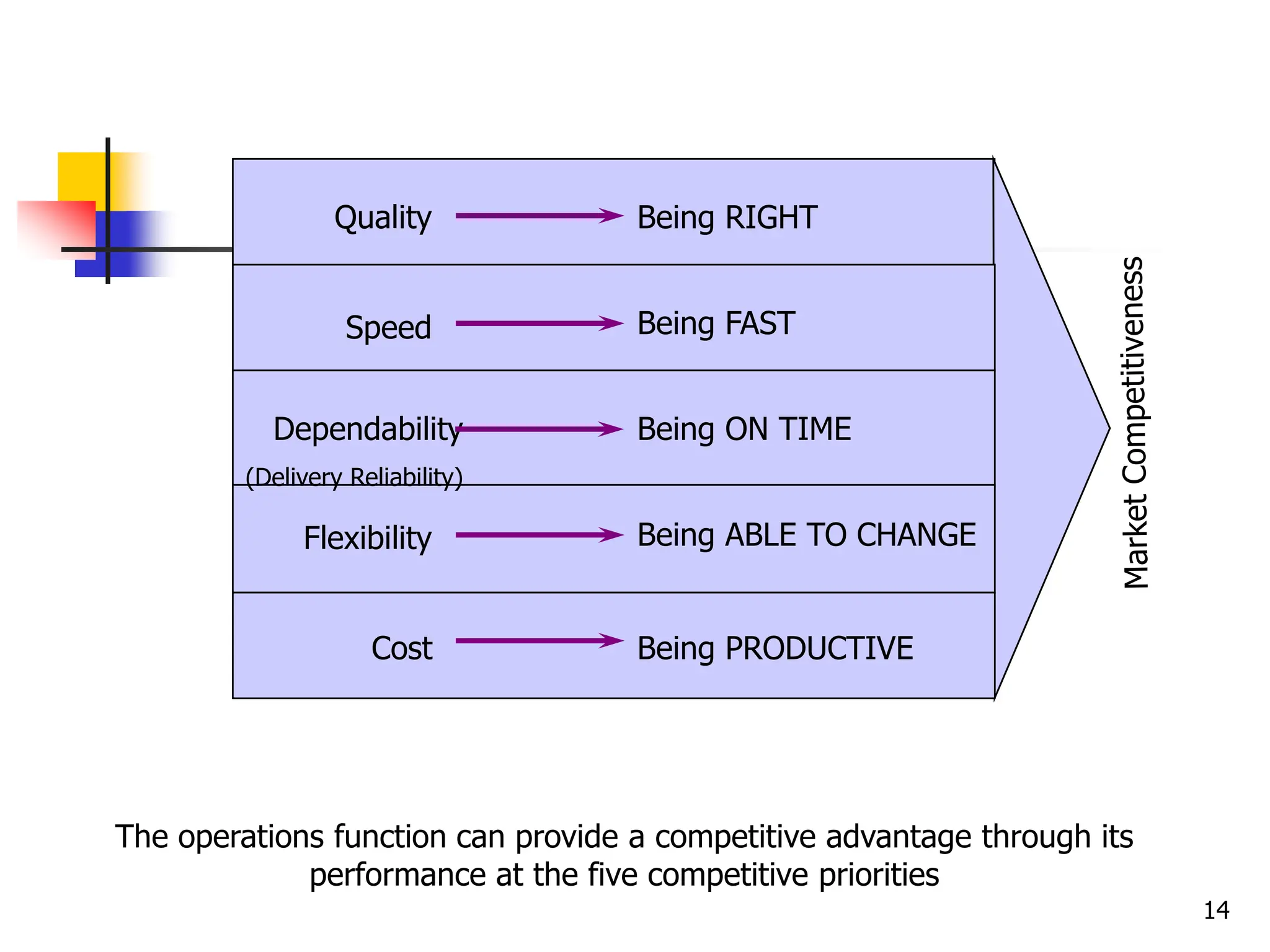
Speed
Flexibility
Cost
Dependability
(Delivery Reliability)
Quality
The operations function can provide a competitive advantage through its
performance at the five competitive priorities
Being RIGHT
Being FAST
Being ON TIME
Being ABLE TO CHANGE
Being PRODUCTIVE
14
Operations Strategy
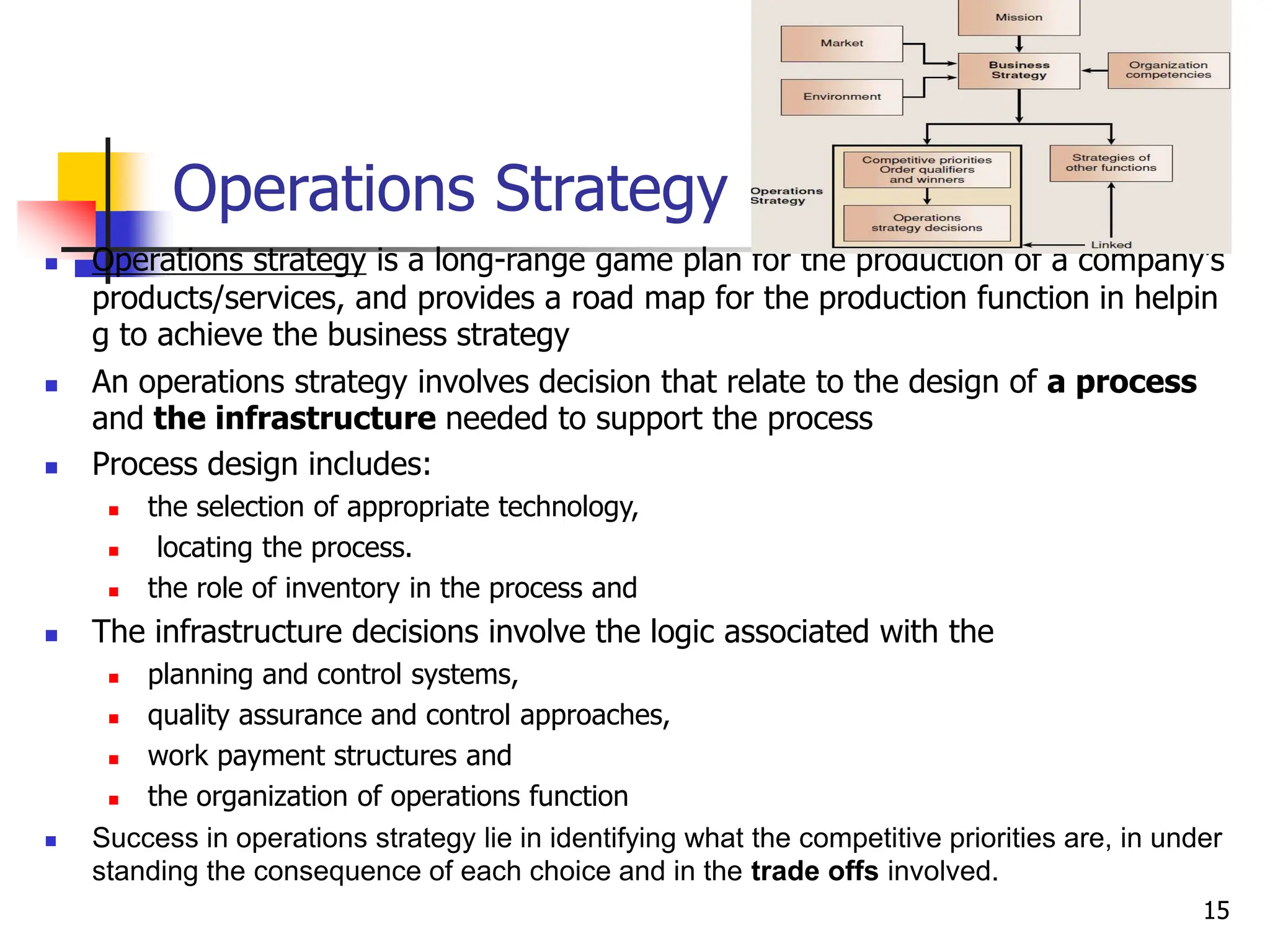
 Operations strategy is a long-range game plan for the production of a company’s
products/services, and provides a road map for the production function in helpin
g to achieve the business strategy
 An operations strategy involves decision that relate to the design of a process
and the infrastructure needed to support the process
 Process design includes:
 the selection of appropriate technology,
 locating the process.
 the role of inventory in the process and
 The infrastructure decisions involve the logic associated with the
 planning and control systems,
 quality assurance and control approaches,
 work payment structures and
 the organization of operations function
 Success in operations strategy lie in identifying what the competitive priorities are, in under
standing the consequence of each choice and in the trade offs involved.
15
Competitive priorities
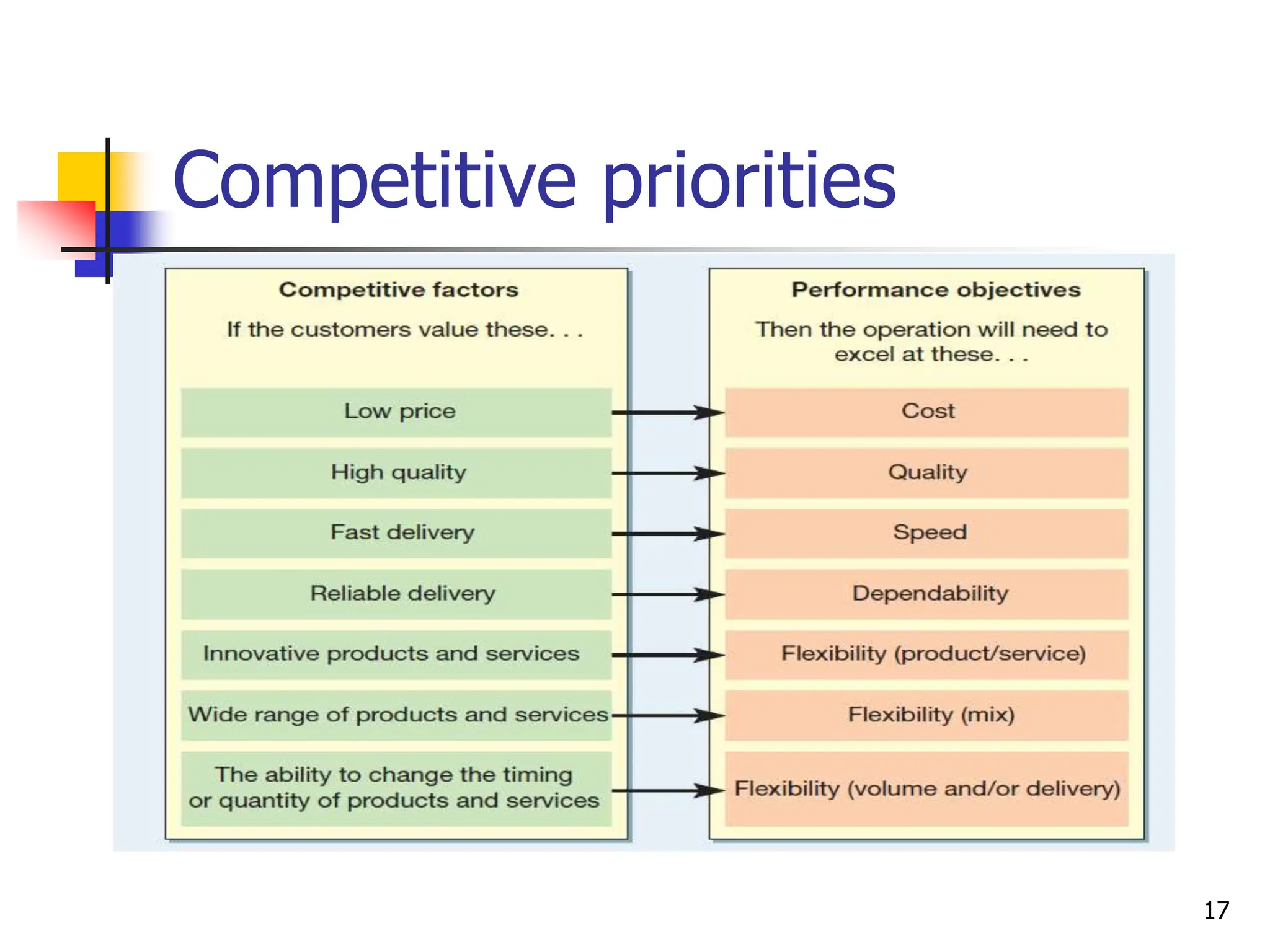
 the market requirements for the product or service are analyzed
in terms of various competitive priorities/ criteria such as cost, q
uality, reliability , speed , flexibility
 The performance of the organization’s operations against those
competitive priorities/ criteria are then assessed
 An operations strategy should be developed which will enable o
perations to match the level of performance required by custom
ers in each of the competitive priorities/ criteria
 The operations function can provide a competitive advantage th
rough its performance at the five competitive priorities
16
Competitive priorities
17
Trade-off
Why Not Focus on All Priorities?
why the operations function needs to give special focus to som
e priorities and not all?
 Aren’t all the priorities important?
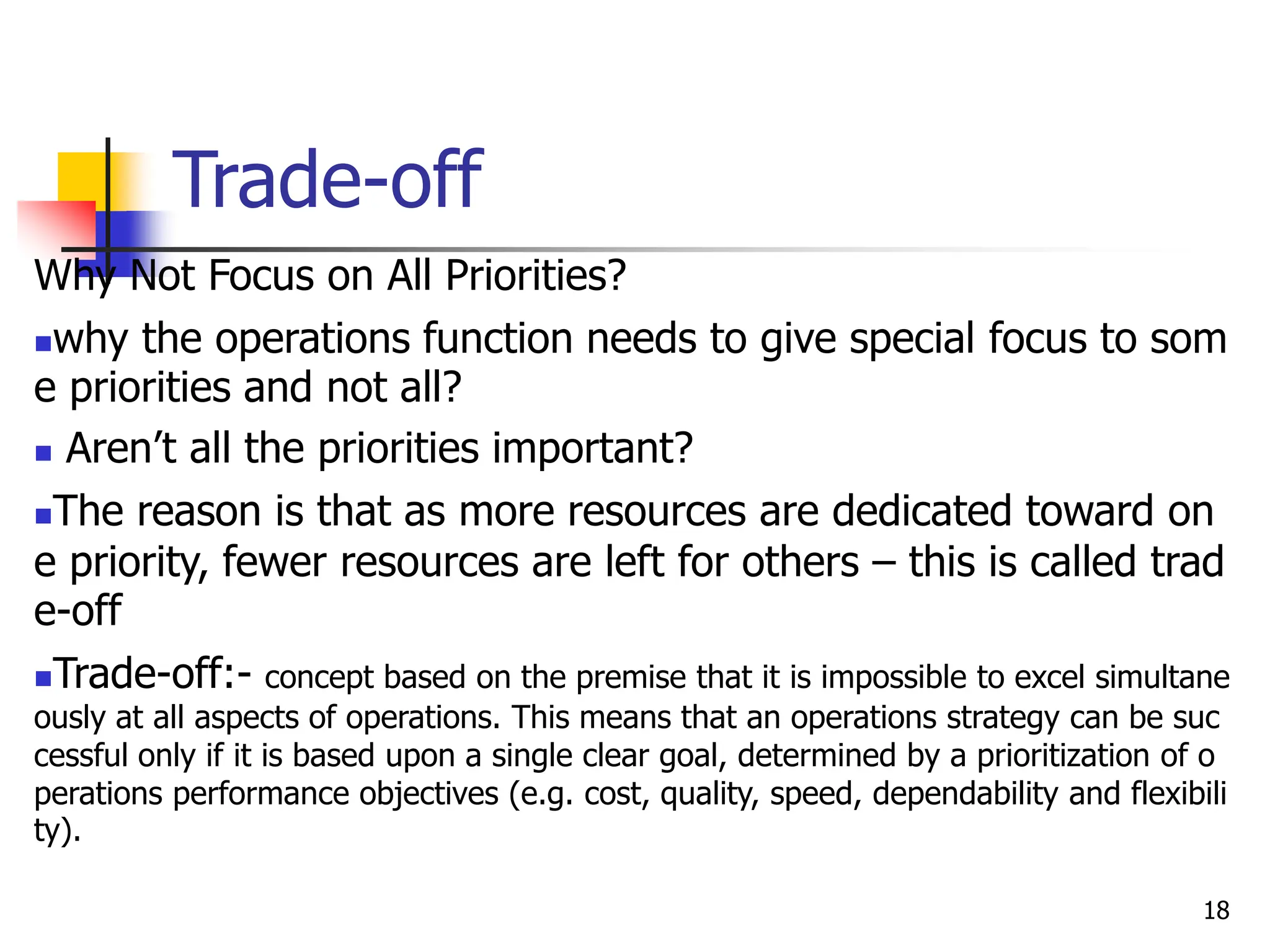
The reason is that as more resources are dedicated toward on
e priority, fewer resources are left for others – this is called trad
e-off
Trade-off:- concept based on the premise that it is impossible to excel simultane
ously at all aspects of operations. This means that an operations strategy can be suc
cessful only if it is based upon a single clear goal, determined by a prioritization of o
perations performance objectives (e.g. cost, quality, speed, dependability and flexibili
ty).
18
Trade-off
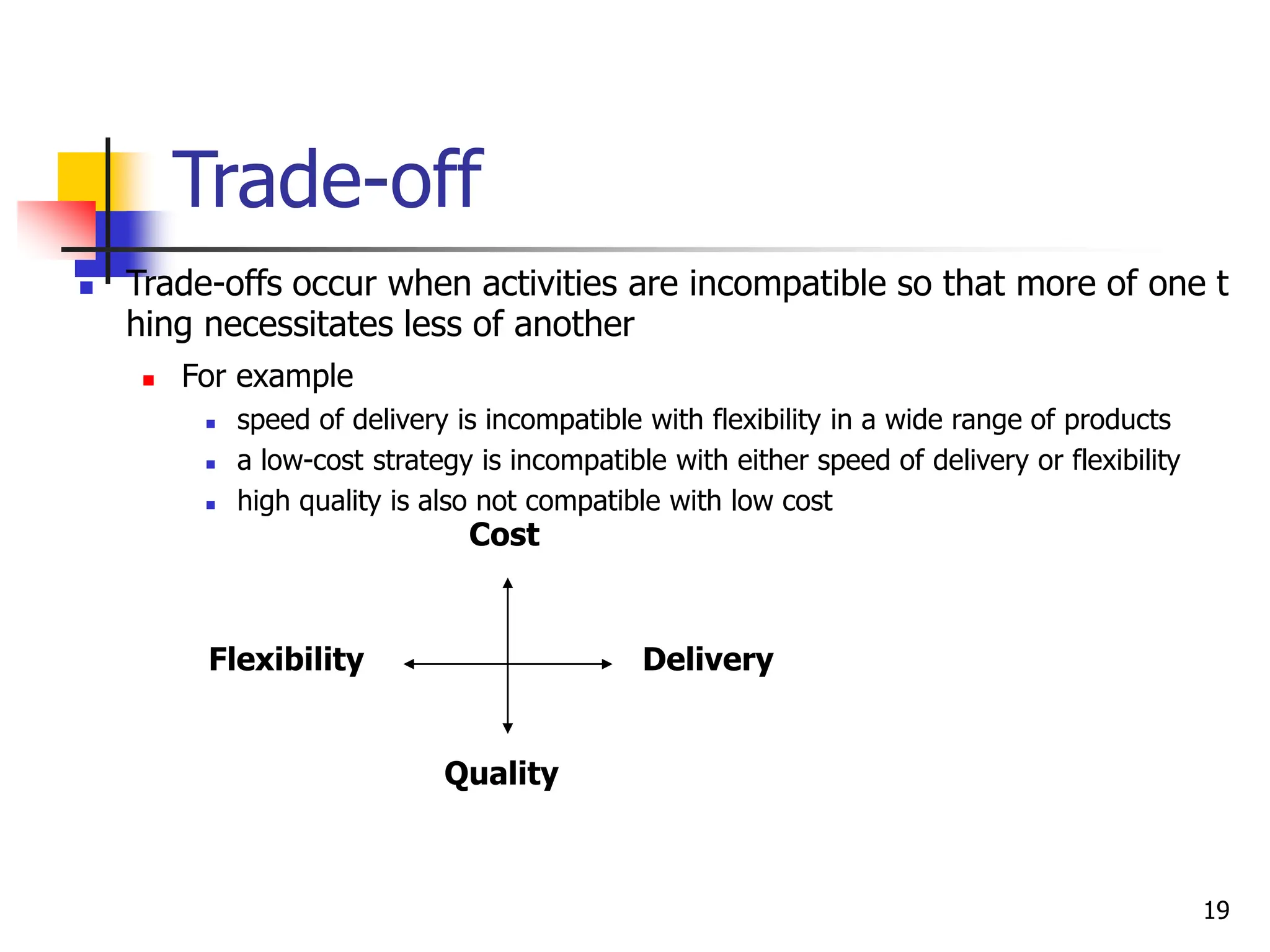
 Trade-offs occur when activities are incompatible so that more of one t
hing necessitates less of another
 For example
 speed of delivery is incompatible with flexibility in a wide range of products
 a low-cost strategy is incompatible with either speed of delivery or flexibility
 high quality is also not compatible with low cost
Cost
Quality
Delivery
Flexibility
19
Dealing with Trade-offs
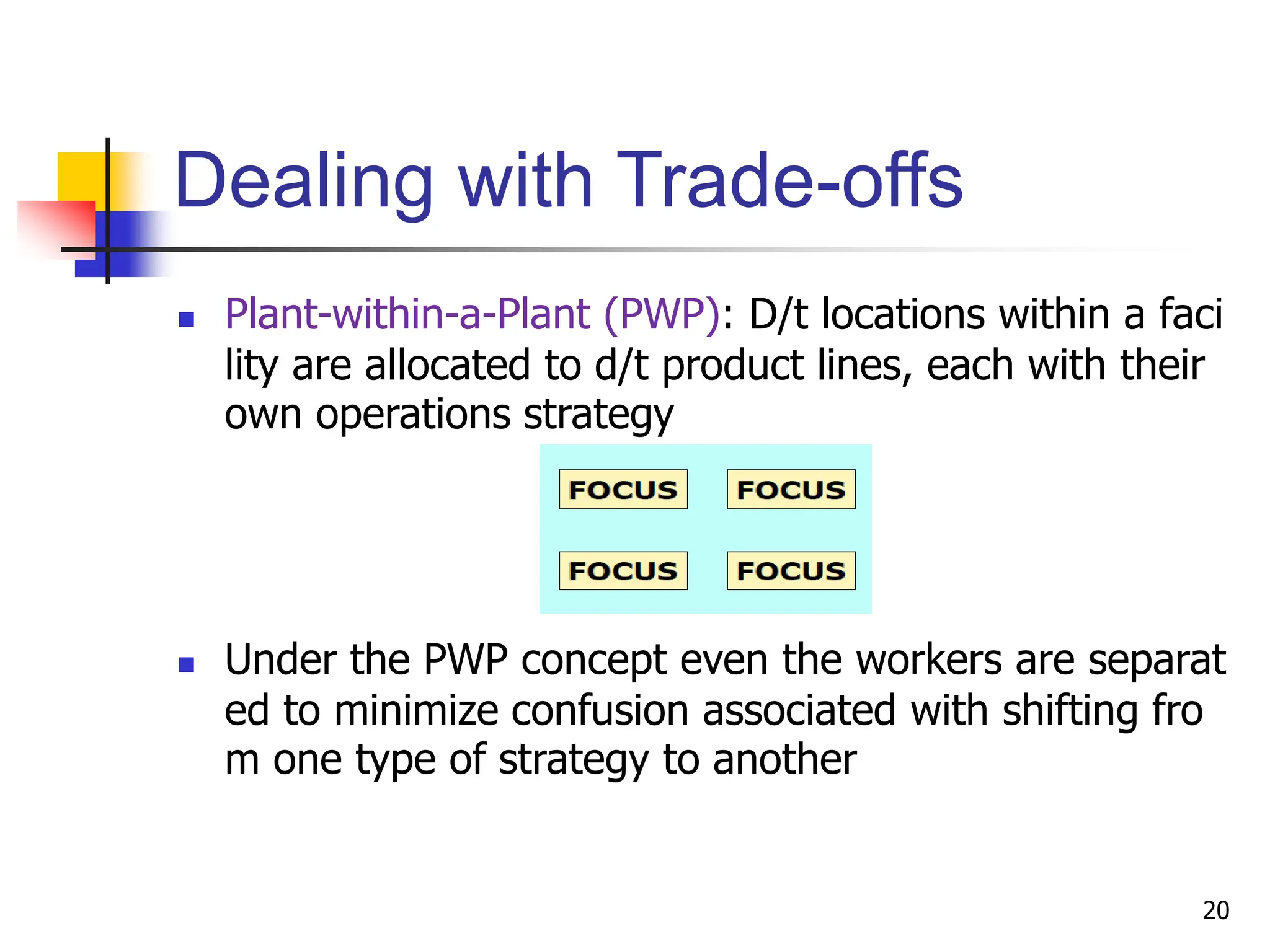
 Plant-within-a-Plant (PWP): D/t locations within a faci
lity are allocated to d/t product lines, each with their
own operations strategy
 Under the PWP concept even the workers are separat
ed to minimize confusion associated with shifting fro
m one type of strategy to another
20
Dealing with Trade-offs
Example
 a business that manufactures paint may serve two quite distinct markets.
Some of its products are intended for domestic customers who are price se
nsitive but demand only a limited variety of colors and sizes. The other mar
ket is professional interior decorators who demand a wide variety of colors
and sizes but are less price sensitive.
 The business may choose to move from a position where all types of paint
are made on the same processes to one where it has two separate sets of p
rocesses:
 one that makes paint only for the domestic market; and
 the other that makes paint only for the professional market.
In effect, the business has segmented its operations processes to match the
segmentation of the market
21
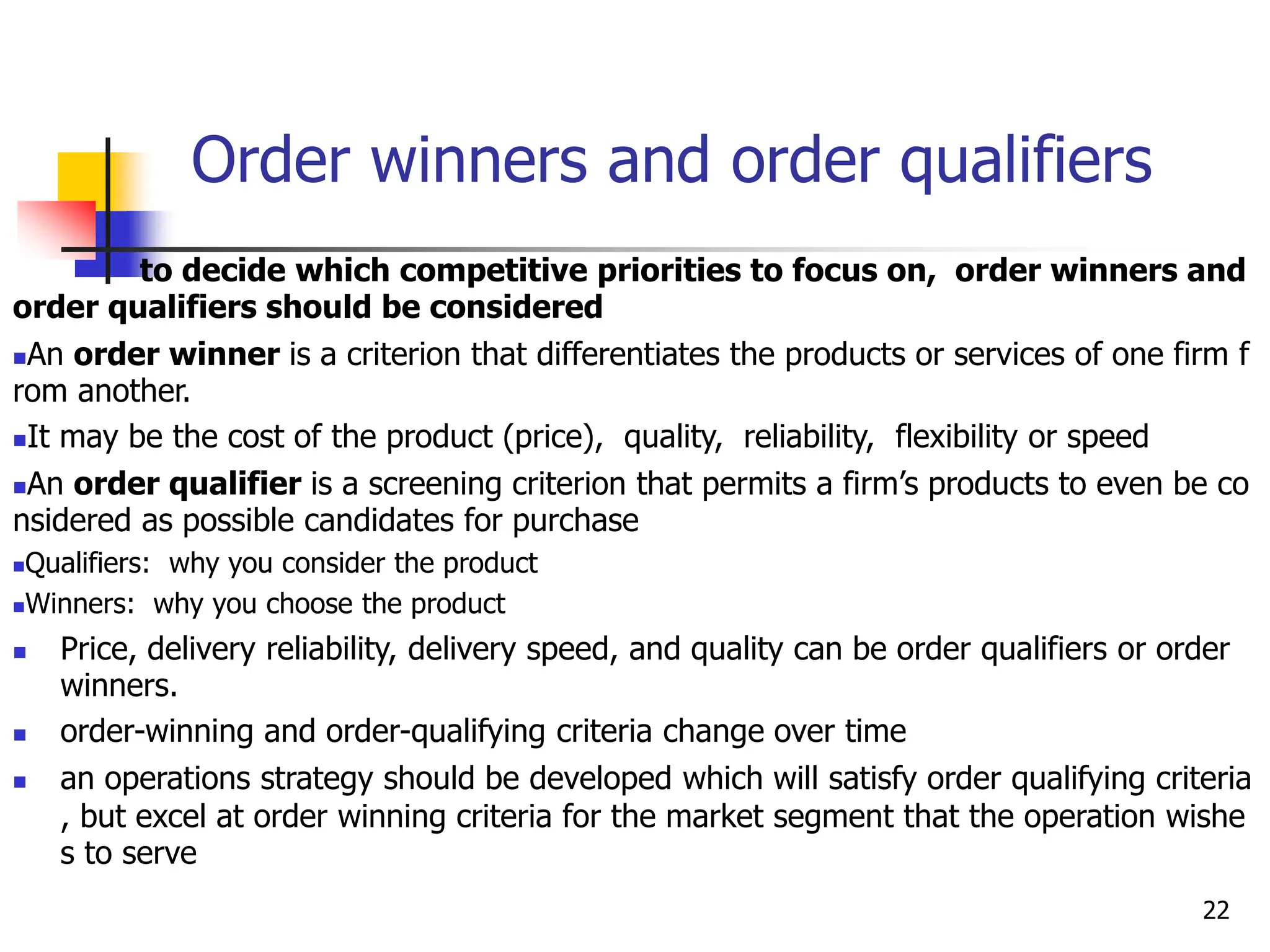
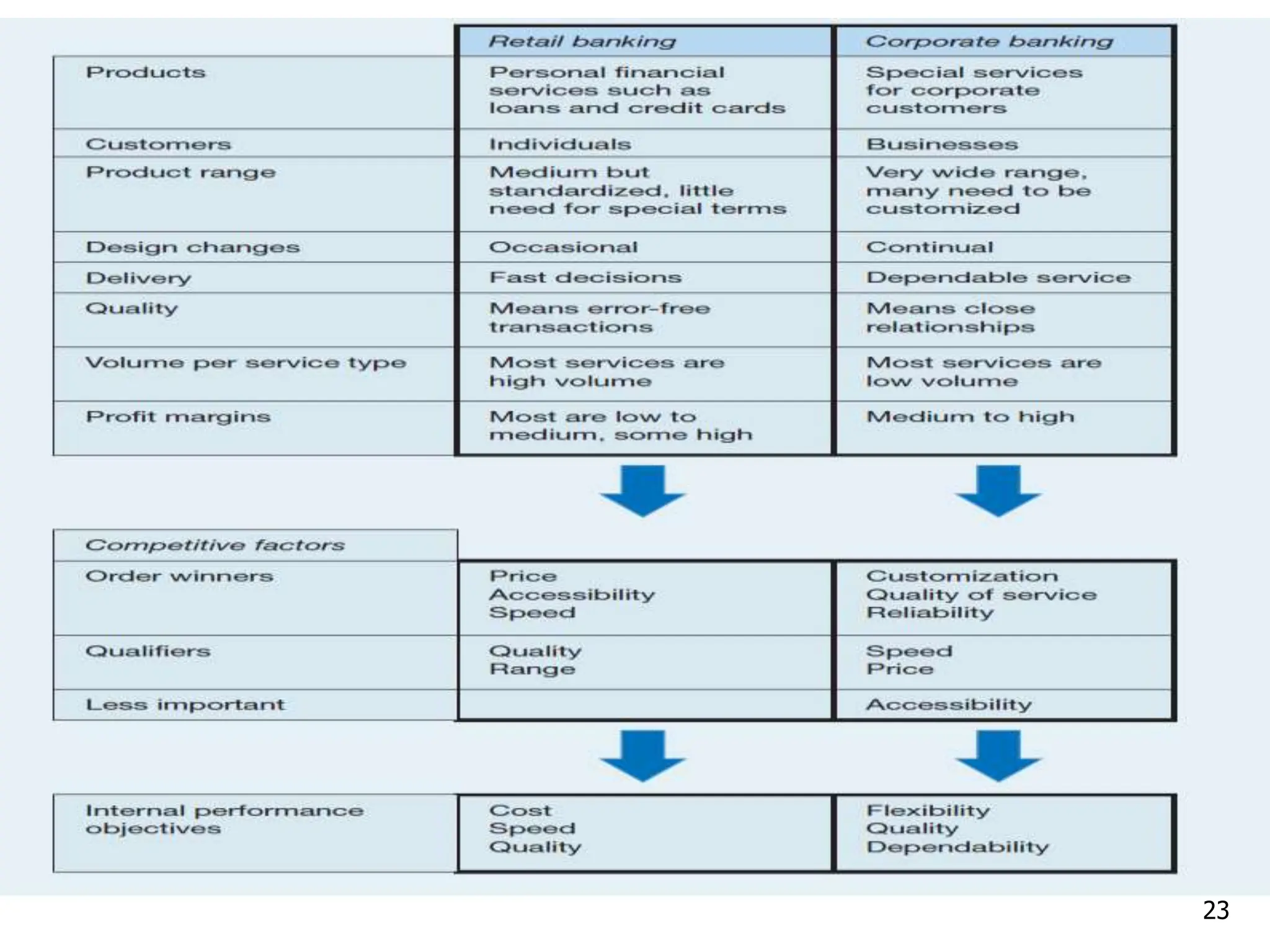
Order winners and order qualifiers
to decide which competitive priorities to focus on, order winners and
order qualifiers should be considered
An order winner is a criterion that differentiates the products or services of one firm f
rom another.
It may be the cost of the product (price), quality, reliability, flexibility or speed
An order qualifier is a screening criterion that permits a firm’s products to even be co
nsidered as possible candidates for purchase
Qualifiers: why you consider the product
Winners: why you choose the product
 Price, delivery reliability, delivery speed, and quality can be order qualifiers or order
winners.
 order-winning and order-qualifying criteria change over time
 an operations strategy should be developed which will satisfy order qualifying criteria
, but excel at order winning criteria for the market segment that the operation wishe
s to serve
22
23
Product/service life cycle
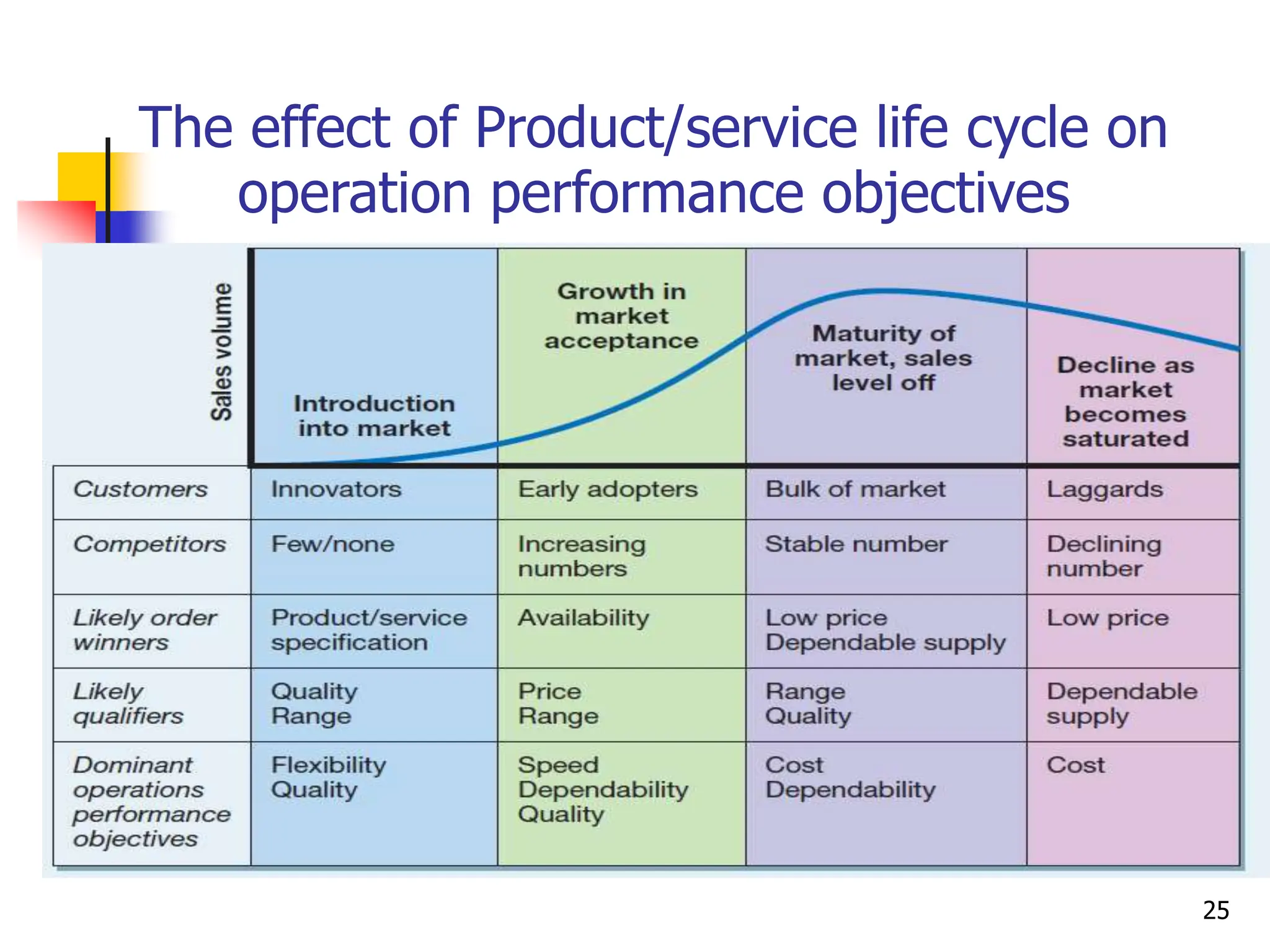
 The exact form of product/ service life cycles will
vary, but generally they are shown as the sales volum
e passing through four stages – introduction, growth,
maturity and decline
 Products and services will require operations strategie
s in each stage of their life cycle
24
The effect of Product/service life cycle on
operation performance objectives
25
Operations Strategy
 Excellence in operations is used to drive the organizat
ion’s strategy
 The process of strategy development should be base
d on a sound understanding of current operational ca
pabilities and an analysis of how these could be devel
oped in the future
 This provide the basis for decisions about which markets are
likely to be the best in which to deploy current and future ca
pabilities, which competitors are likely to be most vulnerable
and how attacks from competitors might best be countered
26
2.3 Operations strategy in Manufacturing
and service operations
 Developing A Manufacturing Operations Strategy
Steps
1. Segment the market according to the product group
2. Identify the product requirements, DD patterns, & profit ma
rgins of each group
3. Determine the order winners & order qualifiers for each gro
up
4. Convert order winners into specific performance requireme
nts
27
28
Manufacturing Strategy
Dimensions of Manufacturing Strategy
• Core Competencies
•Customer Markets and Distribution
•Vertical Integration
•Level of Flexibility
29
Manufacturing Strategy
core Competencies – what a company thinks or strives to be good at.
characteristics of core competencies:
 Facilitate access to markets
 Be perceived by customers as adding significant value to products
 Be difficult to imitate, thus providing a barrier to competitors
Possible core competencies:
-Product development (new features or technology)
-Manufacturing
-Quality
-Customer relations
-Time to delivery
-Cost
-Consistency of product
30
Manufacturing Strategy
Customer Markets and Distribution
 Geographic location
 Market segment
31
Manufacturing Strategy
Vertical Integration
– company owns two or more stages of production
Level of Flexibility
– the ease and extent to which a facility can adapt to change
 volume flexibility
expansion flexibility
Product flexibility
32
Manufacturing Strategy
 Make –vs- Buy
 Make parts internally or outsource?
 Do parts give you a competitive advantage from a design, cost, quality,
or other factor?
33
Manufacturing Strategy
 Make–to-Stock versus Make-to-Order:
 In general, high volume products are made to stock
 Customized products are made to order (current trend towar
ds mass customization)
 Decision highly related to corporate strateg
y
 Do customers only buy what they can see?
 Is order-to-delivery time a competitive advantage?
 Is inventory reduction desirable?
 Is the product life-cycle short?
 Will mass-customization sell products?
34
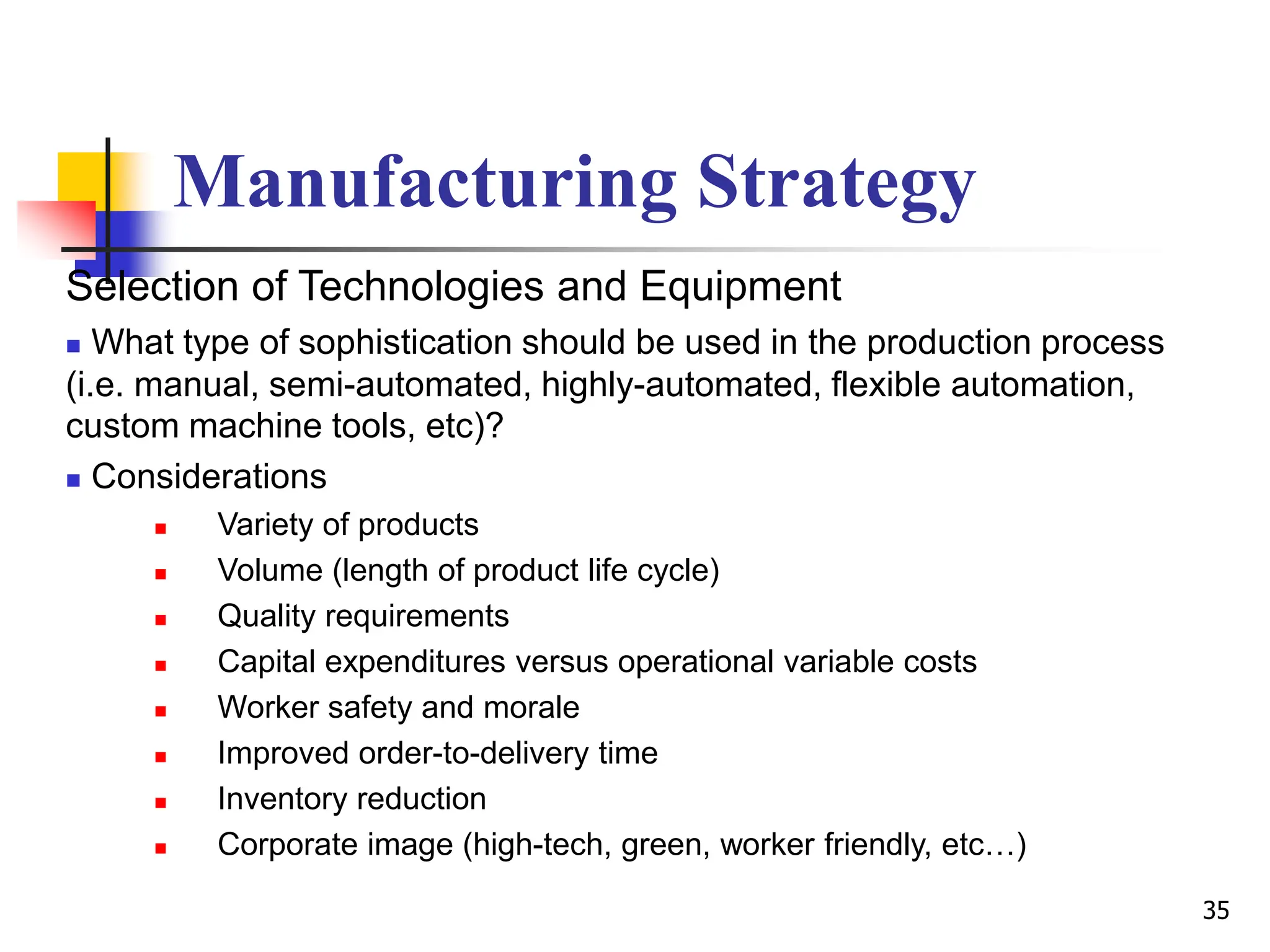
Manufacturing Strategy
Selection of Technologies and Equipment
 What type of sophistication should be used in the production process
(i.e. manual, semi-automated, highly-automated, flexible automation,
custom machine tools, etc)?
 Considerations
 Variety of products
 Volume (length of product life cycle)
 Quality requirements
 Capital expenditures versus operational variable costs
 Worker safety and morale
 Improved order-to-delivery time
 Inventory reduction
 Corporate image (high-tech, green, worker friendly, etc…)
35
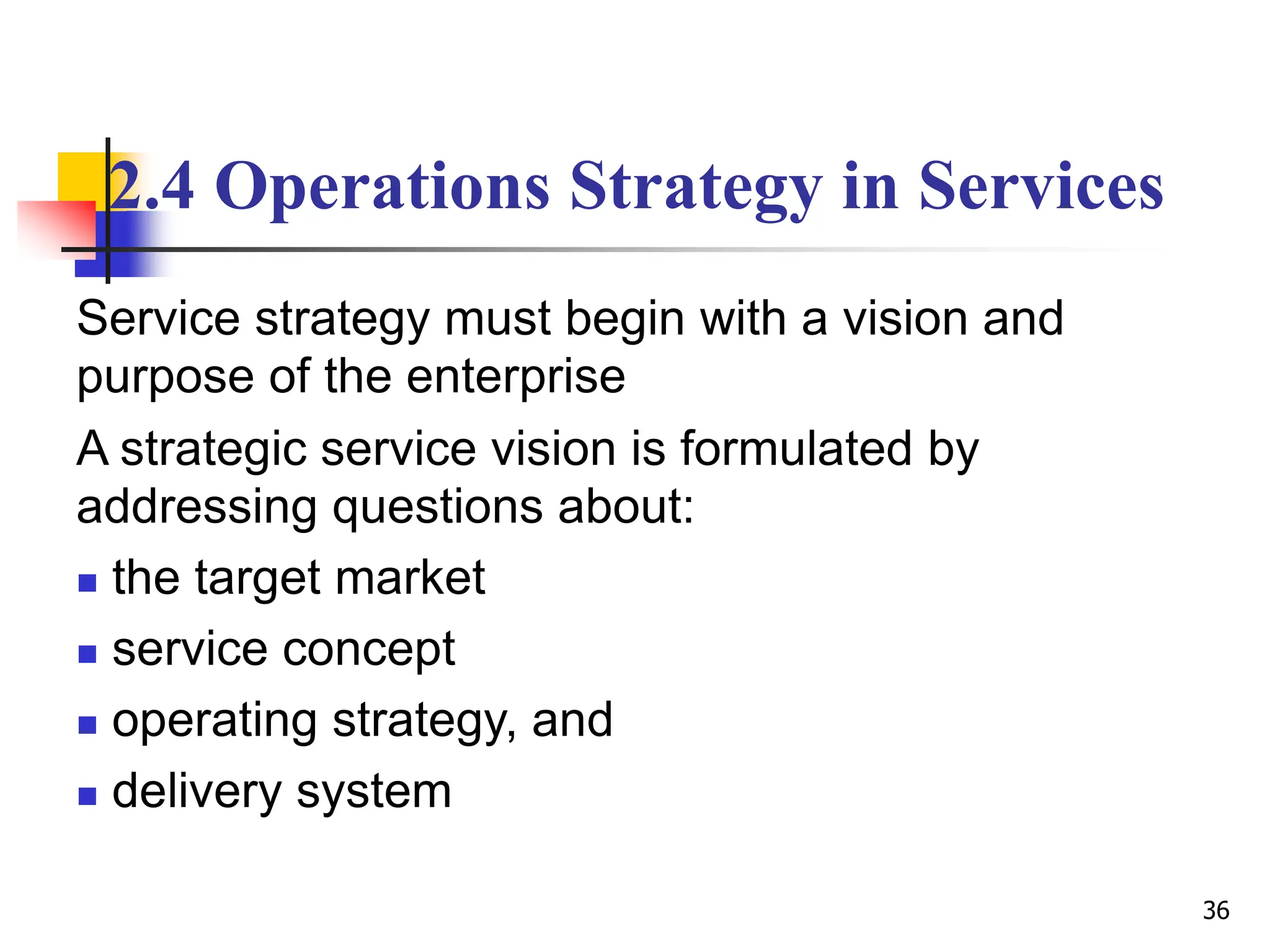
2.4 Operations Strategy in Services
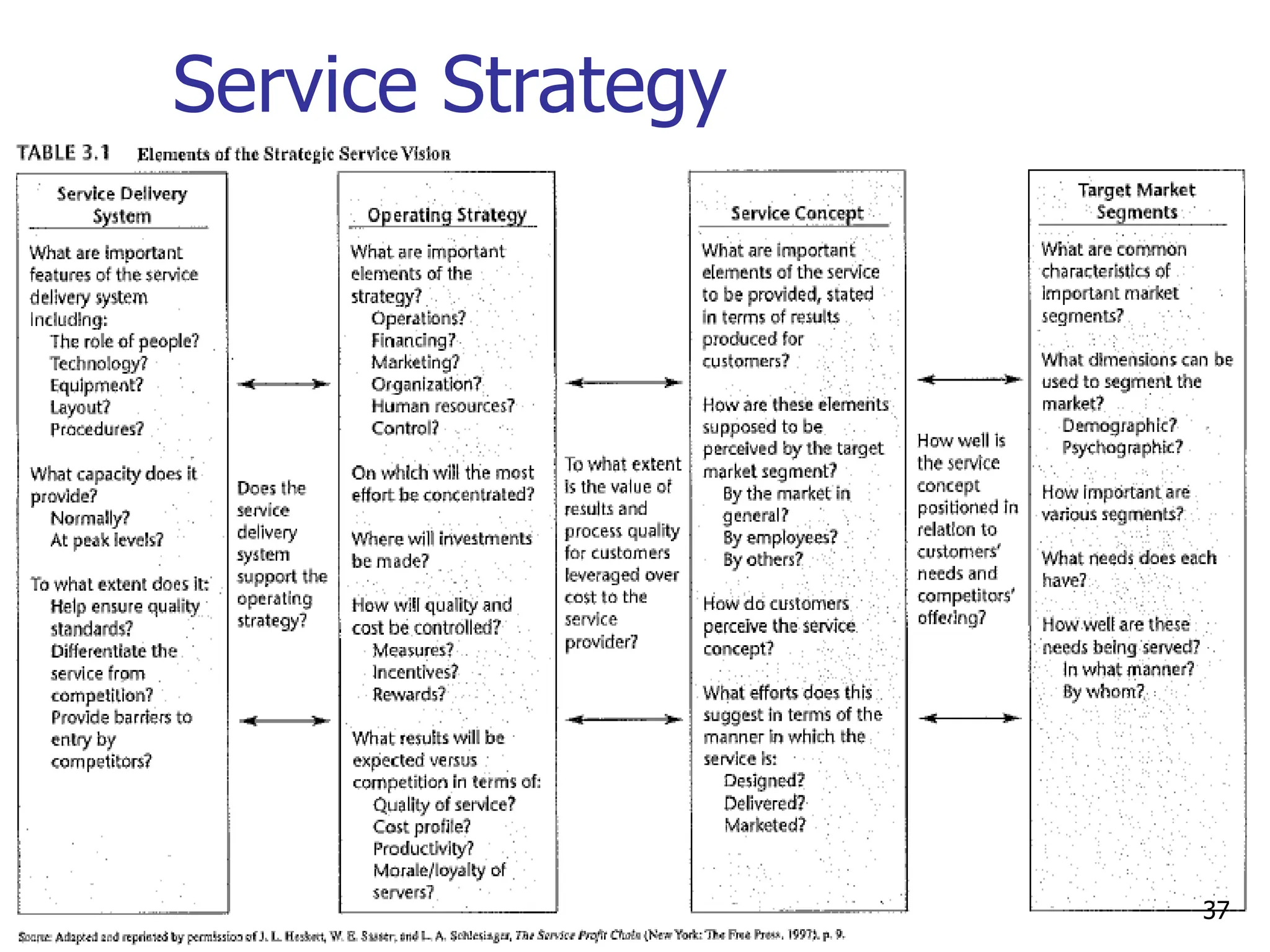
Service strategy must begin with a vision and
purpose of the enterprise
A strategic service vision is formulated by
addressing questions about:
 the target market
 service concept
 operating strategy, and
 delivery system
36
Service Strategy
37
Service Strategy Capabilities
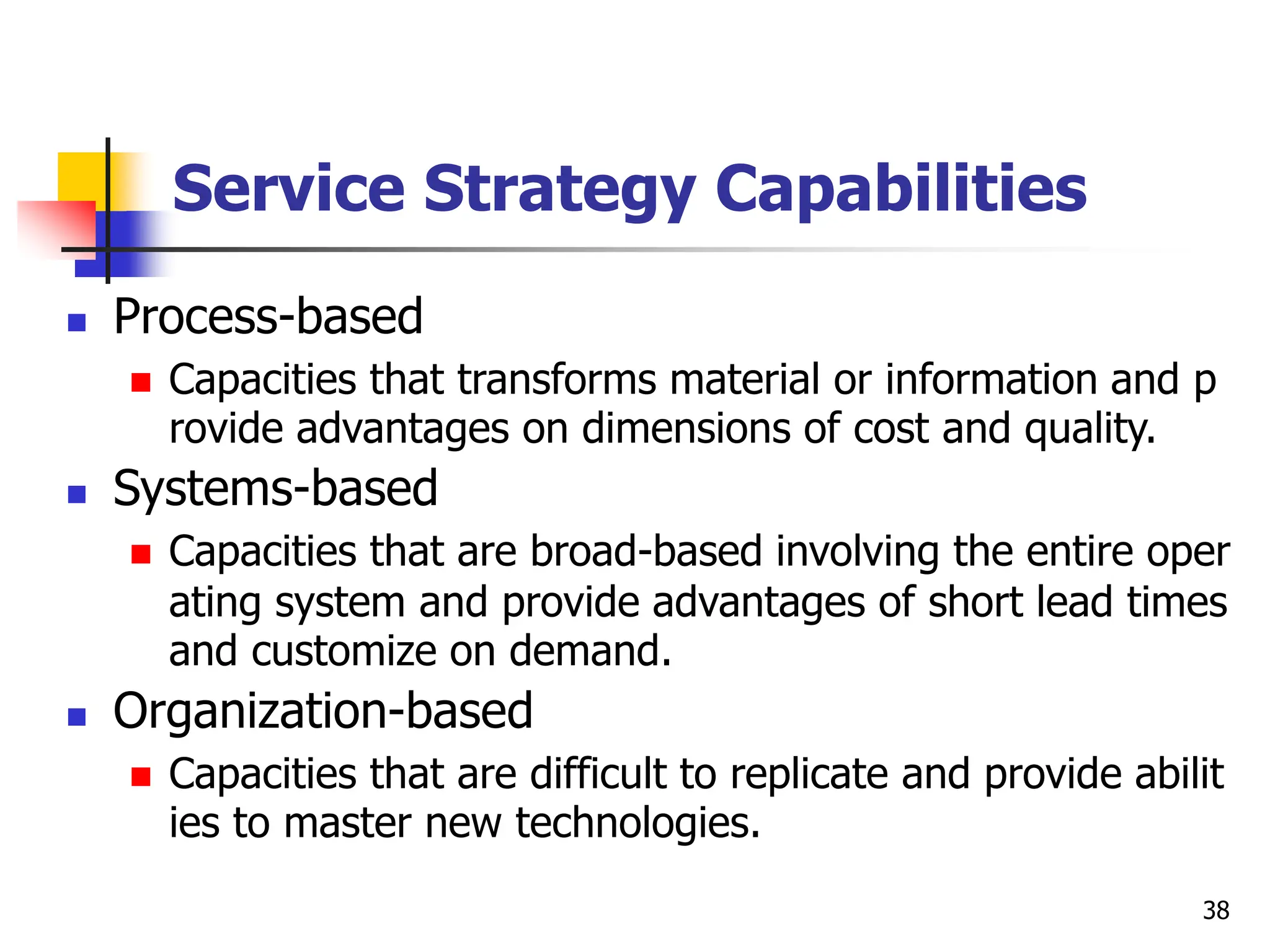
 Process-based
 Capacities that transforms material or information and p
rovide advantages on dimensions of cost and quality.
 Systems-based
 Capacities that are broad-based involving the entire oper
ating system and provide advantages of short lead times
and customize on demand.
 Organization-based
 Capacities that are difficult to replicate and provide abilit
ies to master new technologies.
38
Competitive Environment of Services
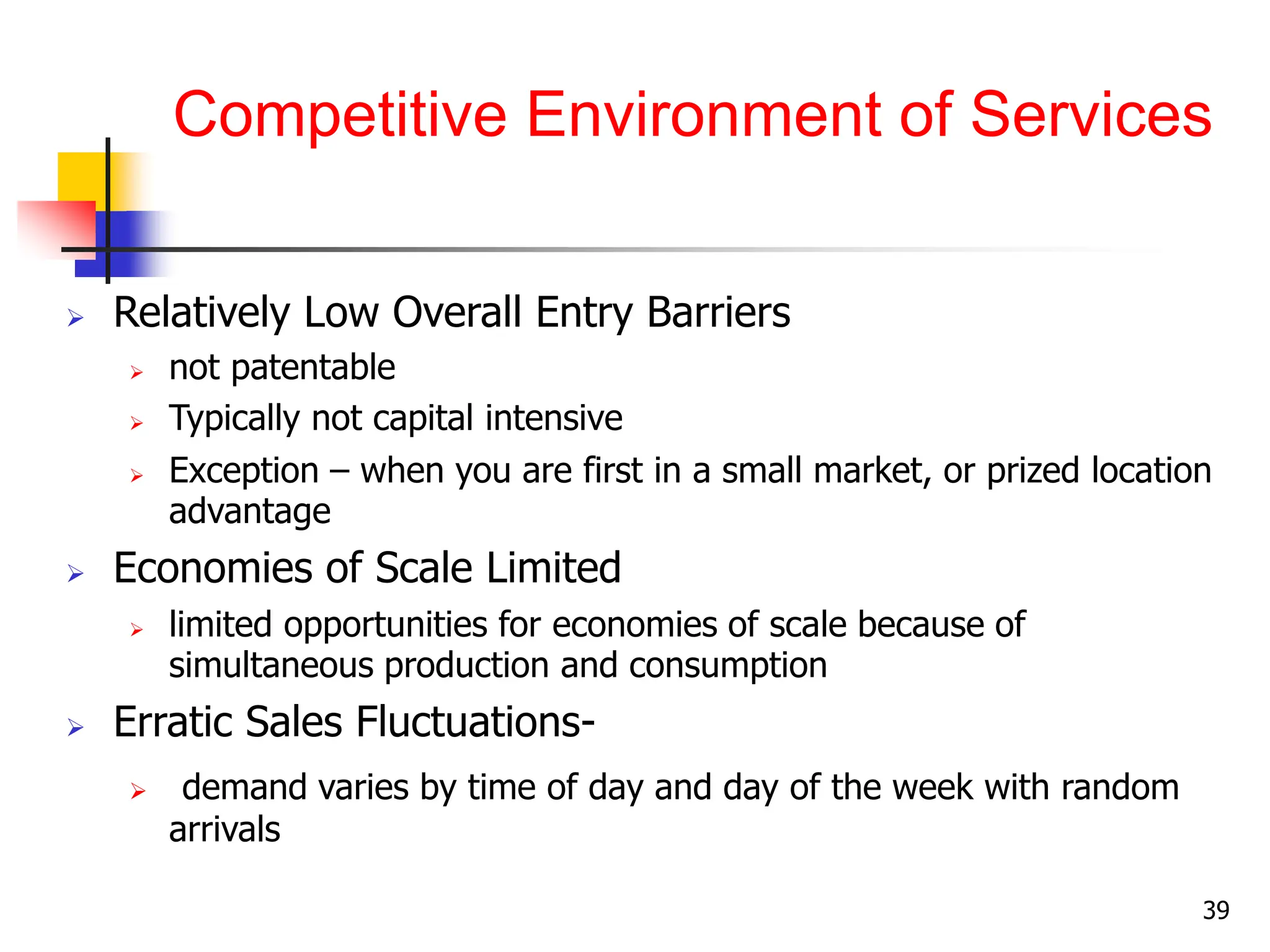
 Relatively Low Overall Entry Barriers
 not patentable
 Typically not capital intensive
 Exception – when you are first in a small market, or prized location
advantage
 Economies of Scale Limited
 limited opportunities for economies of scale because of
simultaneous production and consumption
 Erratic Sales Fluctuations-
 demand varies by time of day and day of the week with random
arrivals
39
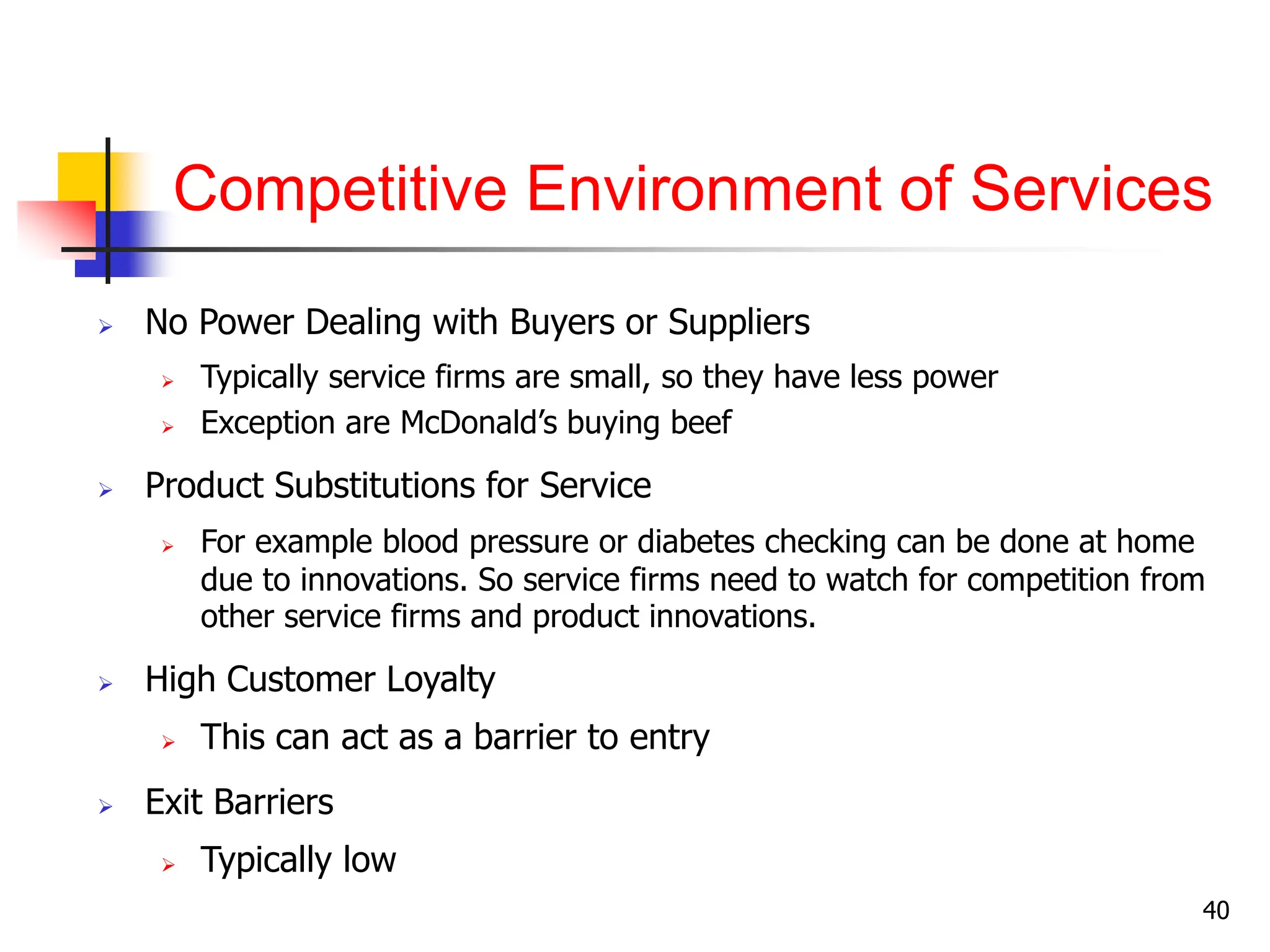
Competitive Environment of Services
 No Power Dealing with Buyers or Suppliers
 Typically service firms are small, so they have less power
 Exception are McDonald’s buying beef
 Product Substitutions for Service
 For example blood pressure or diabetes checking can be done at home
due to innovations. So service firms need to watch for competition from
other service firms and product innovations.
 High Customer Loyalty
 This can act as a barrier to entry
 Exit Barriers
 Typically low
40
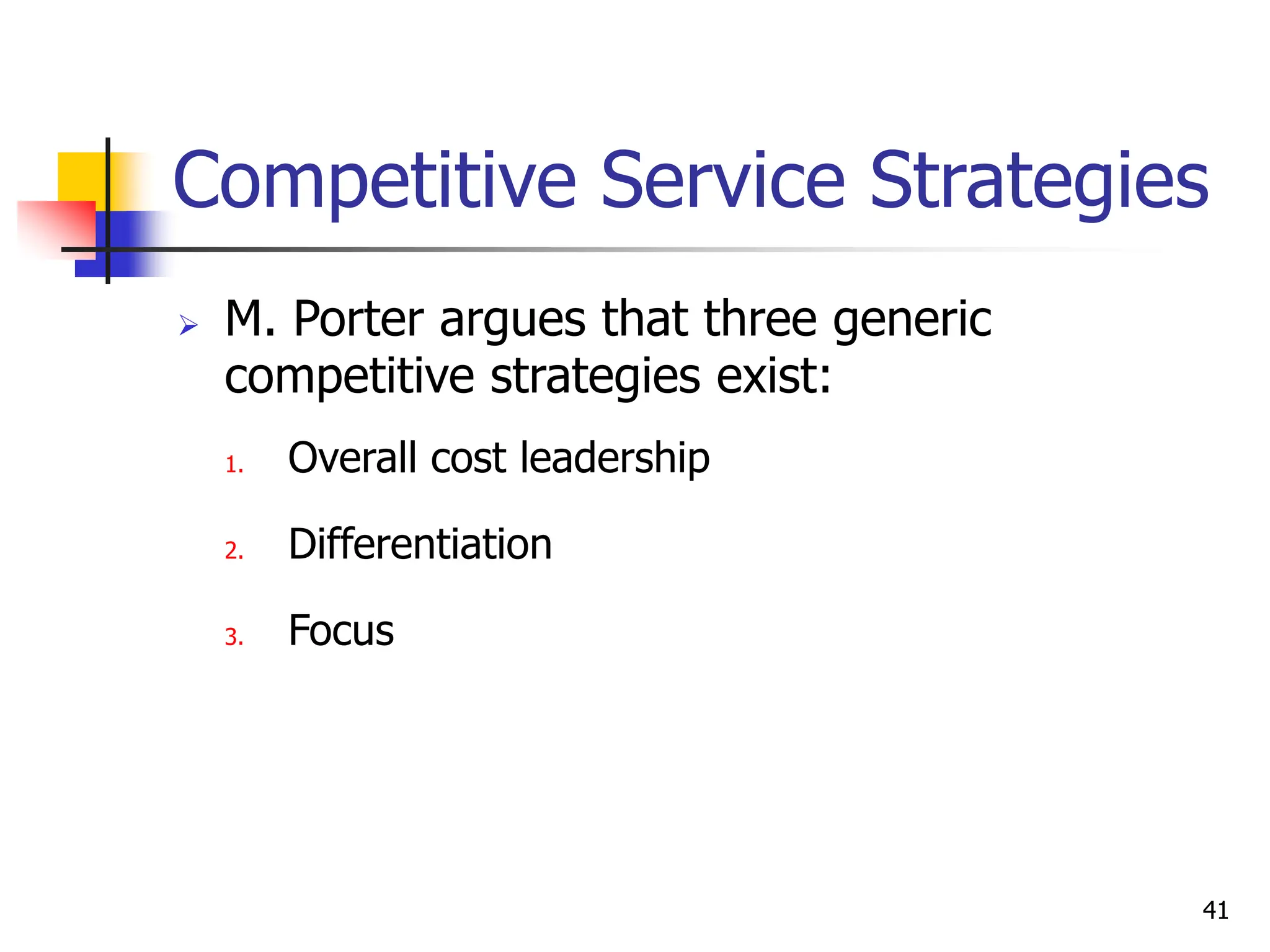
Competitive Service Strategies
 M. Porter argues that three generic
competitive strategies exist:
1. Overall cost leadership
2. Differentiation
3. Focus
41
1. Overall Cost Leadership
 Requires efficient scale facilities, tight cost
and overhead control, and use of innovative
technology
 Implementation of this strategy typically
requires high capital investment in state of
the art equipment, and aggressive pricing
(even when it may lead to start up losses).
 Examples, Wal-Mart, McDonald’s
42
How to attain cost leadership?
 Seeking Out Low-cost Customers
 Some customers cost less to serve than others
 Sam’s club and Costco serve customers who buy bulk and ask for little to no service
 Standardizing a Custom Service
 Example H&R block has taken only routine preparation though tax forms can be
customized
 Reducing the Personal Element in Service Delivery (promote self-service)
 Technology use has allowed banks to provide access to ATMs and reduce human
interface
 Reducing Network Costs (hub and spoke) air line operators
 Taking Service Operations Off-line when customer is not required to be
present – ex. drop off/ pick up for laundry or repair services
43
2. Differentiation
Differentiation in service means being unique in brand image, technology use,
features, or reputation for customer service.
HOW?
 Making the Intangible Tangible (memorable)
 For example giving toiletries in hotels to remind of the comfortable stay
 Customizing the Standard Product
 For example addressing a customer by the name can give an impression of customization of
otherwise a standardized service
 Reducing Perceived Risk
 By providing guarantee, example pest control
 Giving Attention to Personnel Training
 Service providers will ultimately make the difference
 Delivering consistent level of high Quality at multiple sites
44
3. Focus
 This strategy is built around providing a
target market with very specific need.
 Works on the assumption that the firm
can serve its narrow market more
effectively and efficiently.
45
Customer Criteria for Selecting
a Service Provider
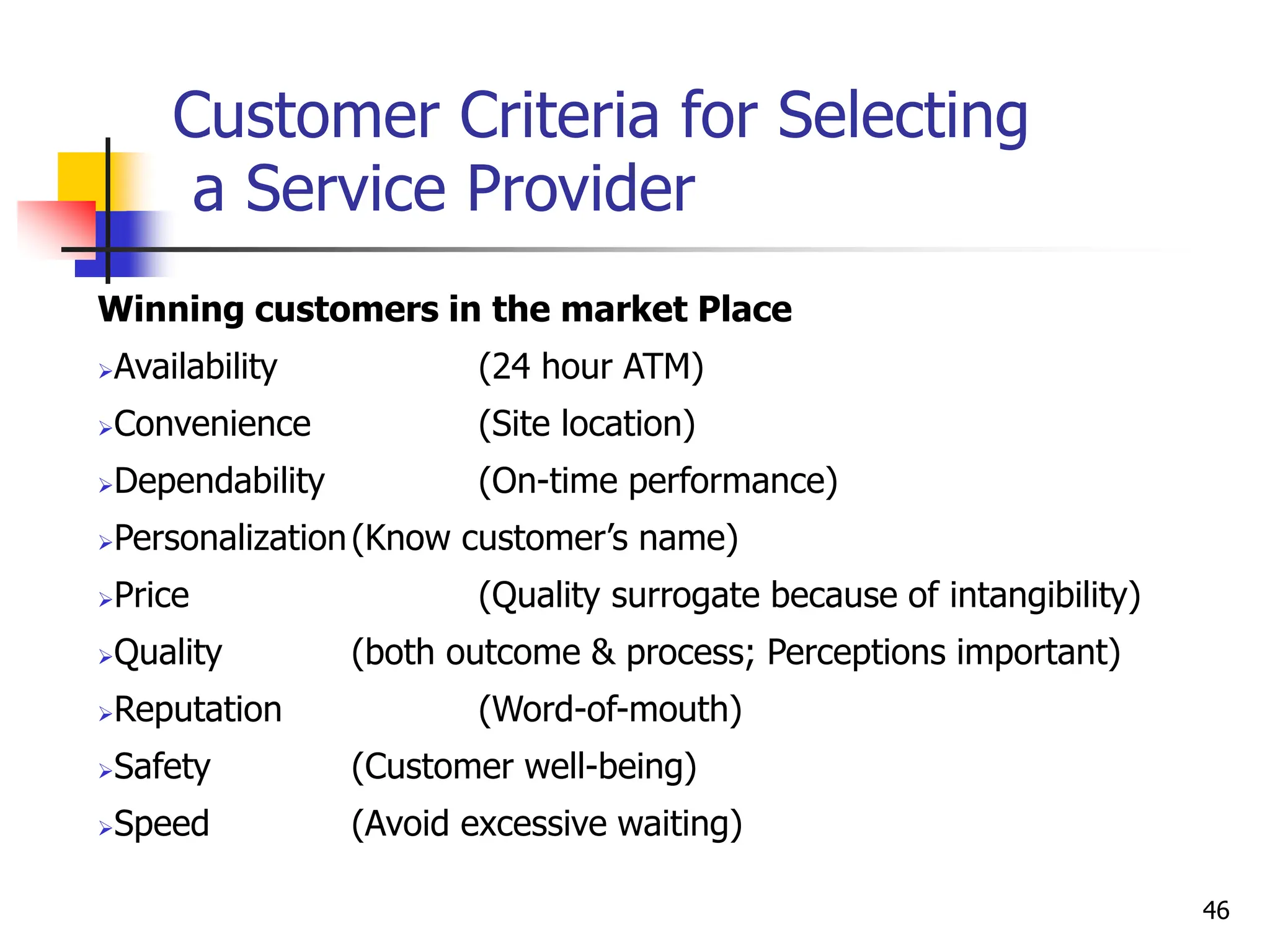
Winning customers in the market Place
Availability (24 hour ATM)
Convenience (Site location)
Dependability (On-time performance)
Personalization(Know customer’s name)
Price (Quality surrogate because of intangibility)
Quality (both outcome & process; Perceptions important)
Reputation (Word-of-mouth)
Safety (Customer well-being)
Speed (Avoid excessive waiting)
46
47
END

unit -2 Operations Strategy and Competitiveness.ppt

  • 1.
    Unit - 2 OperationsStrategy and Competi tiveness
  • 2.
    Overview  Competitiveness  Operationsstrategy  Operations Strategy in manufacturing operations  Operations Strategy in Service operati ons 2
  • 3.
    2.1 Introduction-Competitiveness  Competitivenessrefers to how effectively an organization m eets the wants and needs of customers relative to others th at offer similar goods or services  How Organization Compete against each other? organizations can compete against each other - price - flexibility - quality - time - product differentiation  The ability of a Company to compete in the marketplace de pends on its operations strategy that is properly aligned with its mission of serving customers. 3
  • 4.
    Introduction  Operational effectivenessis the ability to perform similar o perations activities better than competitors  It is very difficult for a company to compete successfully in the long run based just on operational effectiveness  A firm must also determine how operational effectiveness c an be used to achieve a sustainable competitive advantage .  An effective competitive strategy is critical.  Competitive strategy is about being different. It means deli berately choosing a different set of activities to deliver a u nique mix of values. 4
  • 5.
    Introduction Strategy ? - totalpattern of the decisions and actions that influence the long-term direction of the business (indicates of the actual strategic behavior even not explicitly stated) - the direction and scope of an organization over the long-term 5
  • 6.
  • 7.
  • 8.
    2.2 Operations Strategy OperationsStrategy - The approach, consistent with organization strategy, that is used to guide the operations function - Policies and plans for using the organization’s resources to support its long-term competitive strategy - Must aligned with the company’s business strategy and enable the company to achieve its long-term plan 8
  • 9.
    Operations Strategy Criteria forevaluating an operations strategy 9
  • 10.
  • 11.
    Corporate Mission  Acorporate mission is a set of long-range goals and i ncluding statements about:  the kind of business the company wants to be in  who its customers are  its basic beliefs about business  its goals of survival, growth, and profitability ⇒ Mission statements tell an organization where it is going 11
  • 12.
    Business Strategy  Businessstrategy is a long-range game plan of an organizat ion and provides a road map of how to achieve the corporat e mission  Strategy  How an organization expects to achieve its missions and goals?  tells the organization how to get there  Inputs to the business strategy are  Assessment of the general environment - social, economic, political, technological, competitive  Distinctive competencies or weaknesses - workers, sales force, R&D, technology, management 12
  • 13.
    Competitive Priorities/Dimmensions  Costor Price: “ Make the Product or Deliver the Service Cheap”  Quality: “ Make a Great Product or Deliver a Great Service”  design quality and process quality  Delivery Speed: “Make the Product or Deliver the Service Quickly”  Delivery Reliability: “ Deliver It When Promised”  Flexibility  Coping with Changes in Demand: “Change Its Volume”  Customer Service, Flexibility & New-Product Introduction Speed “Change It”- resp onsiveness to customer needs and ability to quickly change production/service volu mes, configurations, etc. 13
  • 14.
    Speed Flexibility Cost Dependability (Delivery Reliability) Quality The operationsfunction can provide a competitive advantage through its performance at the five competitive priorities Being RIGHT Being FAST Being ON TIME Being ABLE TO CHANGE Being PRODUCTIVE 14
  • 15.
    Operations Strategy  Operationsstrategy is a long-range game plan for the production of a company’s products/services, and provides a road map for the production function in helpin g to achieve the business strategy  An operations strategy involves decision that relate to the design of a process and the infrastructure needed to support the process  Process design includes:  the selection of appropriate technology,  locating the process.  the role of inventory in the process and  The infrastructure decisions involve the logic associated with the  planning and control systems,  quality assurance and control approaches,  work payment structures and  the organization of operations function  Success in operations strategy lie in identifying what the competitive priorities are, in under standing the consequence of each choice and in the trade offs involved. 15
  • 16.
    Competitive priorities  themarket requirements for the product or service are analyzed in terms of various competitive priorities/ criteria such as cost, q uality, reliability , speed , flexibility  The performance of the organization’s operations against those competitive priorities/ criteria are then assessed  An operations strategy should be developed which will enable o perations to match the level of performance required by custom ers in each of the competitive priorities/ criteria  The operations function can provide a competitive advantage th rough its performance at the five competitive priorities 16
  • 17.
  • 18.
    Trade-off Why Not Focuson All Priorities? why the operations function needs to give special focus to som e priorities and not all?  Aren’t all the priorities important? The reason is that as more resources are dedicated toward on e priority, fewer resources are left for others – this is called trad e-off Trade-off:- concept based on the premise that it is impossible to excel simultane ously at all aspects of operations. This means that an operations strategy can be suc cessful only if it is based upon a single clear goal, determined by a prioritization of o perations performance objectives (e.g. cost, quality, speed, dependability and flexibili ty). 18
  • 19.
    Trade-off  Trade-offs occurwhen activities are incompatible so that more of one t hing necessitates less of another  For example  speed of delivery is incompatible with flexibility in a wide range of products  a low-cost strategy is incompatible with either speed of delivery or flexibility  high quality is also not compatible with low cost Cost Quality Delivery Flexibility 19
  • 20.
    Dealing with Trade-offs Plant-within-a-Plant (PWP): D/t locations within a faci lity are allocated to d/t product lines, each with their own operations strategy  Under the PWP concept even the workers are separat ed to minimize confusion associated with shifting fro m one type of strategy to another 20
  • 21.
    Dealing with Trade-offs Example a business that manufactures paint may serve two quite distinct markets. Some of its products are intended for domestic customers who are price se nsitive but demand only a limited variety of colors and sizes. The other mar ket is professional interior decorators who demand a wide variety of colors and sizes but are less price sensitive.  The business may choose to move from a position where all types of paint are made on the same processes to one where it has two separate sets of p rocesses:  one that makes paint only for the domestic market; and  the other that makes paint only for the professional market. In effect, the business has segmented its operations processes to match the segmentation of the market 21
  • 22.
    Order winners andorder qualifiers to decide which competitive priorities to focus on, order winners and order qualifiers should be considered An order winner is a criterion that differentiates the products or services of one firm f rom another. It may be the cost of the product (price), quality, reliability, flexibility or speed An order qualifier is a screening criterion that permits a firm’s products to even be co nsidered as possible candidates for purchase Qualifiers: why you consider the product Winners: why you choose the product  Price, delivery reliability, delivery speed, and quality can be order qualifiers or order winners.  order-winning and order-qualifying criteria change over time  an operations strategy should be developed which will satisfy order qualifying criteria , but excel at order winning criteria for the market segment that the operation wishe s to serve 22
  • 23.
  • 24.
    Product/service life cycle The exact form of product/ service life cycles will vary, but generally they are shown as the sales volum e passing through four stages – introduction, growth, maturity and decline  Products and services will require operations strategie s in each stage of their life cycle 24
  • 25.
    The effect ofProduct/service life cycle on operation performance objectives 25
  • 26.
    Operations Strategy  Excellencein operations is used to drive the organizat ion’s strategy  The process of strategy development should be base d on a sound understanding of current operational ca pabilities and an analysis of how these could be devel oped in the future  This provide the basis for decisions about which markets are likely to be the best in which to deploy current and future ca pabilities, which competitors are likely to be most vulnerable and how attacks from competitors might best be countered 26
  • 27.
    2.3 Operations strategyin Manufacturing and service operations  Developing A Manufacturing Operations Strategy Steps 1. Segment the market according to the product group 2. Identify the product requirements, DD patterns, & profit ma rgins of each group 3. Determine the order winners & order qualifiers for each gro up 4. Convert order winners into specific performance requireme nts 27
  • 28.
  • 29.
    Manufacturing Strategy Dimensions ofManufacturing Strategy • Core Competencies •Customer Markets and Distribution •Vertical Integration •Level of Flexibility 29
  • 30.
    Manufacturing Strategy core Competencies– what a company thinks or strives to be good at. characteristics of core competencies:  Facilitate access to markets  Be perceived by customers as adding significant value to products  Be difficult to imitate, thus providing a barrier to competitors Possible core competencies: -Product development (new features or technology) -Manufacturing -Quality -Customer relations -Time to delivery -Cost -Consistency of product 30
  • 31.
    Manufacturing Strategy Customer Marketsand Distribution  Geographic location  Market segment 31
  • 32.
    Manufacturing Strategy Vertical Integration –company owns two or more stages of production Level of Flexibility – the ease and extent to which a facility can adapt to change  volume flexibility expansion flexibility Product flexibility 32
  • 33.
    Manufacturing Strategy  Make–vs- Buy  Make parts internally or outsource?  Do parts give you a competitive advantage from a design, cost, quality, or other factor? 33
  • 34.
    Manufacturing Strategy  Make–to-Stockversus Make-to-Order:  In general, high volume products are made to stock  Customized products are made to order (current trend towar ds mass customization)  Decision highly related to corporate strateg y  Do customers only buy what they can see?  Is order-to-delivery time a competitive advantage?  Is inventory reduction desirable?  Is the product life-cycle short?  Will mass-customization sell products? 34
  • 35.
    Manufacturing Strategy Selection ofTechnologies and Equipment  What type of sophistication should be used in the production process (i.e. manual, semi-automated, highly-automated, flexible automation, custom machine tools, etc)?  Considerations  Variety of products  Volume (length of product life cycle)  Quality requirements  Capital expenditures versus operational variable costs  Worker safety and morale  Improved order-to-delivery time  Inventory reduction  Corporate image (high-tech, green, worker friendly, etc…) 35
  • 36.
    2.4 Operations Strategyin Services Service strategy must begin with a vision and purpose of the enterprise A strategic service vision is formulated by addressing questions about:  the target market  service concept  operating strategy, and  delivery system 36
  • 37.
  • 38.
    Service Strategy Capabilities Process-based  Capacities that transforms material or information and p rovide advantages on dimensions of cost and quality.  Systems-based  Capacities that are broad-based involving the entire oper ating system and provide advantages of short lead times and customize on demand.  Organization-based  Capacities that are difficult to replicate and provide abilit ies to master new technologies. 38
  • 39.
    Competitive Environment ofServices  Relatively Low Overall Entry Barriers  not patentable  Typically not capital intensive  Exception – when you are first in a small market, or prized location advantage  Economies of Scale Limited  limited opportunities for economies of scale because of simultaneous production and consumption  Erratic Sales Fluctuations-  demand varies by time of day and day of the week with random arrivals 39
  • 40.
    Competitive Environment ofServices  No Power Dealing with Buyers or Suppliers  Typically service firms are small, so they have less power  Exception are McDonald’s buying beef  Product Substitutions for Service  For example blood pressure or diabetes checking can be done at home due to innovations. So service firms need to watch for competition from other service firms and product innovations.  High Customer Loyalty  This can act as a barrier to entry  Exit Barriers  Typically low 40
  • 41.
    Competitive Service Strategies M. Porter argues that three generic competitive strategies exist: 1. Overall cost leadership 2. Differentiation 3. Focus 41
  • 42.
    1. Overall CostLeadership  Requires efficient scale facilities, tight cost and overhead control, and use of innovative technology  Implementation of this strategy typically requires high capital investment in state of the art equipment, and aggressive pricing (even when it may lead to start up losses).  Examples, Wal-Mart, McDonald’s 42
  • 43.
    How to attaincost leadership?  Seeking Out Low-cost Customers  Some customers cost less to serve than others  Sam’s club and Costco serve customers who buy bulk and ask for little to no service  Standardizing a Custom Service  Example H&R block has taken only routine preparation though tax forms can be customized  Reducing the Personal Element in Service Delivery (promote self-service)  Technology use has allowed banks to provide access to ATMs and reduce human interface  Reducing Network Costs (hub and spoke) air line operators  Taking Service Operations Off-line when customer is not required to be present – ex. drop off/ pick up for laundry or repair services 43
  • 44.
    2. Differentiation Differentiation inservice means being unique in brand image, technology use, features, or reputation for customer service. HOW?  Making the Intangible Tangible (memorable)  For example giving toiletries in hotels to remind of the comfortable stay  Customizing the Standard Product  For example addressing a customer by the name can give an impression of customization of otherwise a standardized service  Reducing Perceived Risk  By providing guarantee, example pest control  Giving Attention to Personnel Training  Service providers will ultimately make the difference  Delivering consistent level of high Quality at multiple sites 44
  • 45.
    3. Focus  Thisstrategy is built around providing a target market with very specific need.  Works on the assumption that the firm can serve its narrow market more effectively and efficiently. 45
  • 46.
    Customer Criteria forSelecting a Service Provider Winning customers in the market Place Availability (24 hour ATM) Convenience (Site location) Dependability (On-time performance) Personalization(Know customer’s name) Price (Quality surrogate because of intangibility) Quality (both outcome & process; Perceptions important) Reputation (Word-of-mouth) Safety (Customer well-being) Speed (Avoid excessive waiting) 46
  • 47.