1
I M POSSIBLE
2
I M POSSIBLE
Bibek Prajapti
(FCMA, CS , MBA, M COM, ).
Please like , subscribe and comment and don’t forget to share
Pray to God for the success Life
Thank You
 Strategy and operations are inextricably connected:
strategy is a plan to reach an objective and operations
is the means of getting there.
 The word operations stems from the Latin verb operari
and noun opus,which mean (to) work.
3
The Role of Operations Strategy
 Provide a plan that makes best use of resources which;
 Specifies the policies and plans for using organizational
resources
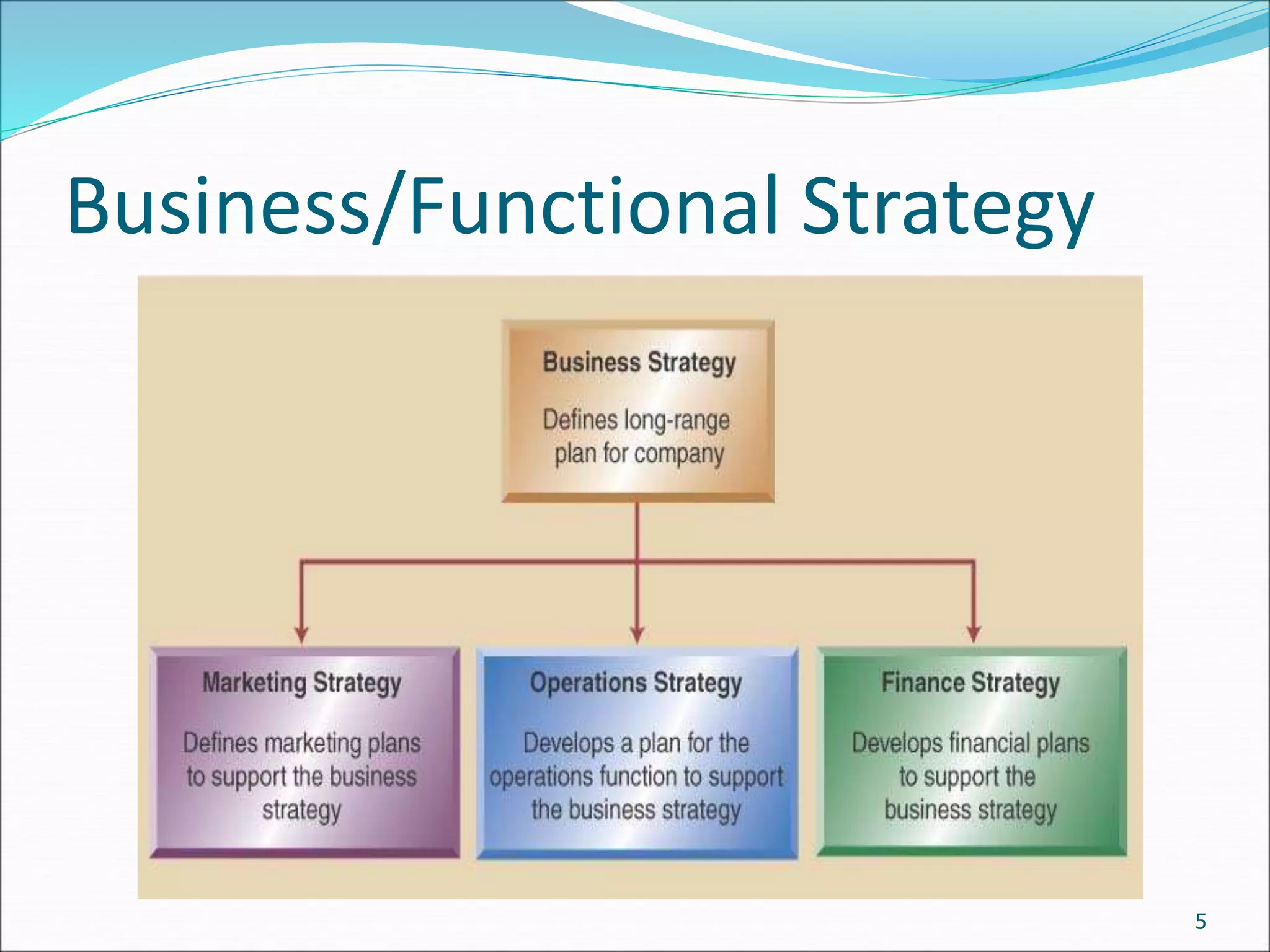
 Supports Business Strategy as shown on next slide
4
Business/Functional Strategy
5
Importance of Operations Strategy
 Companies often do not understand the differences
between operational efficiency and strategy
 Operational efficiency is performing tasks well, even
better than competitors
 Strategy is a plan for competing in the marketplace
 Operations strategy is to ensure all tasks performed
are the right tasks
6
Developing a Business Strategy
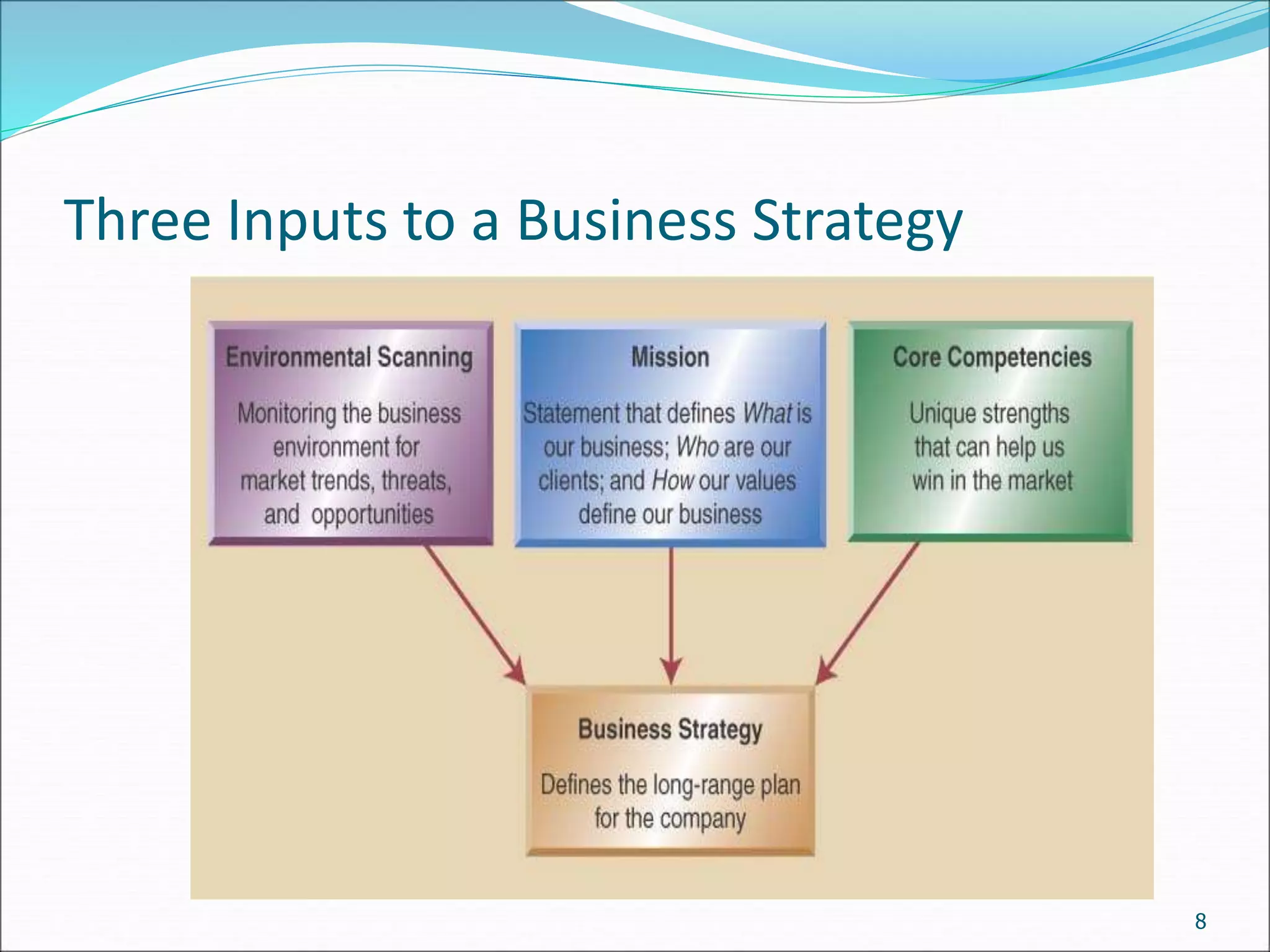
 A business strategy is developed after taking into many
factors and following some strategic decisions such as;
 What business is the company in (mission)
 Analyzing and understanding the market
(environmental scanning)
 Identifying the companies strengths (core
competencies)
7
Three Inputs to a Business Strategy
8
Developing an Operations Strategy
 Operations Strategy is a plan for the design and
management of operations functions
 Operation Strategy developed after the business
strategy
 Operations Strategy focuses on specific capabilities
which give it a competitive edge – competitive
priorities
9
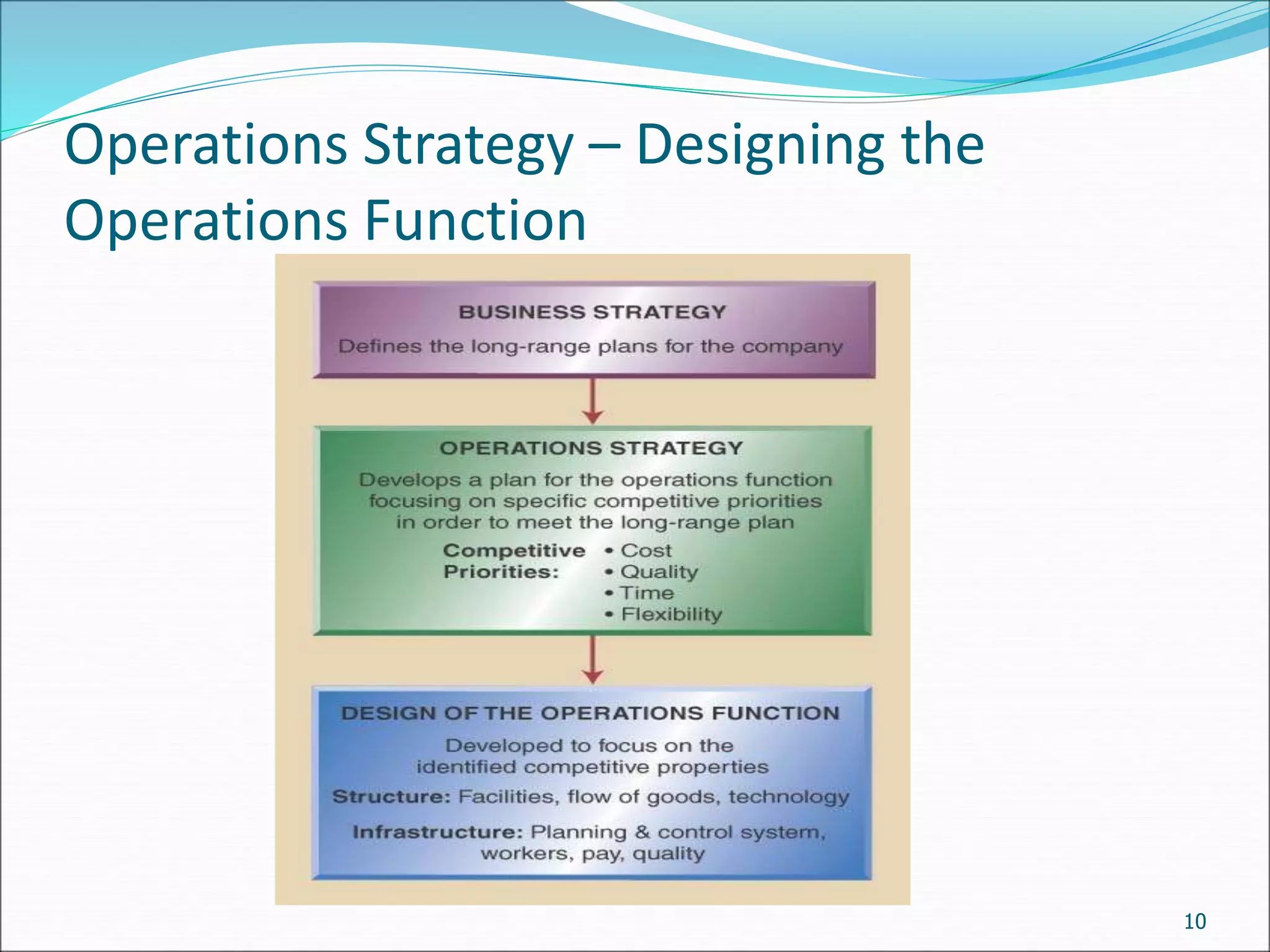
Operations Strategy – Designing the
Operations Function
10
Competitive Priorities- The Edge
 Four Important Operations Questions: Will you
compete on –
Cost?
Quality?
Time?
Flexibility?
 All of the above? Some? Tradeoffs?
11
Competing on Cost?
 Offering product at a low price relative to competition
 Typically high volume products
 Often limit product range & offer little customization
 May invest in automation to reduce unit costs
 Can use lower skill labor
 Probably use product focused layouts
 Low cost does not mean low quality
12
Competing on Quality?
 Quality is often subjective
 Quality is defined differently depending on who is defining it
 Two major quality dimensions include
 High performance design:
 Superior features, high durability, & excellent customer service
 Product & service consistency:
 Meets design specifications
 Close tolerances
 Error free delivery
 Quality needs to address
 Product design quality – product/service meets requirements
 Process quality – error free products
13
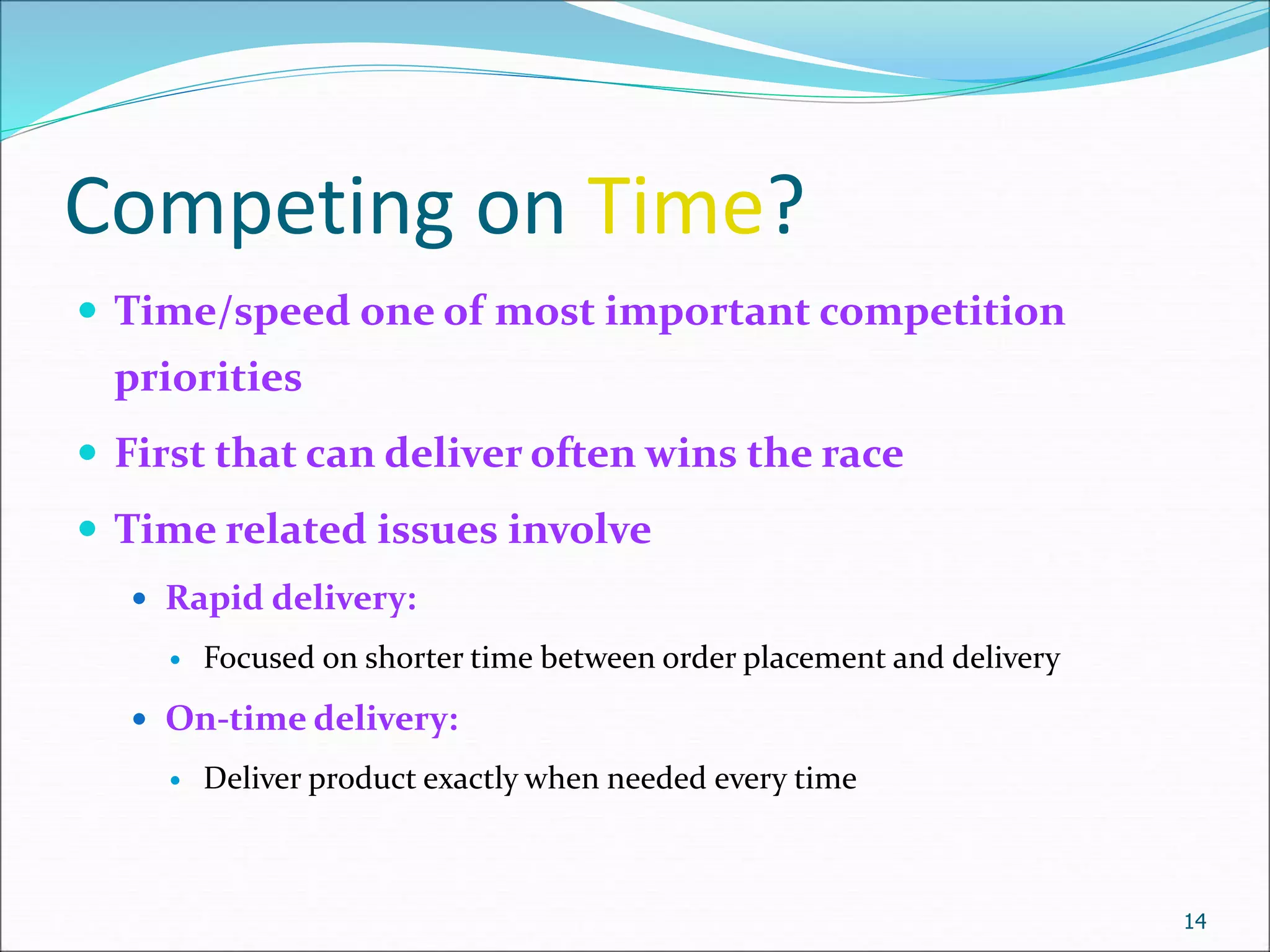
Competing on Time?
 Time/speed one of most important competition
priorities
 First that can deliver often wins the race
 Time related issues involve
 Rapid delivery:
 Focused on shorter time between order placement and delivery
 On-time delivery:
 Deliver product exactly when needed every time
14
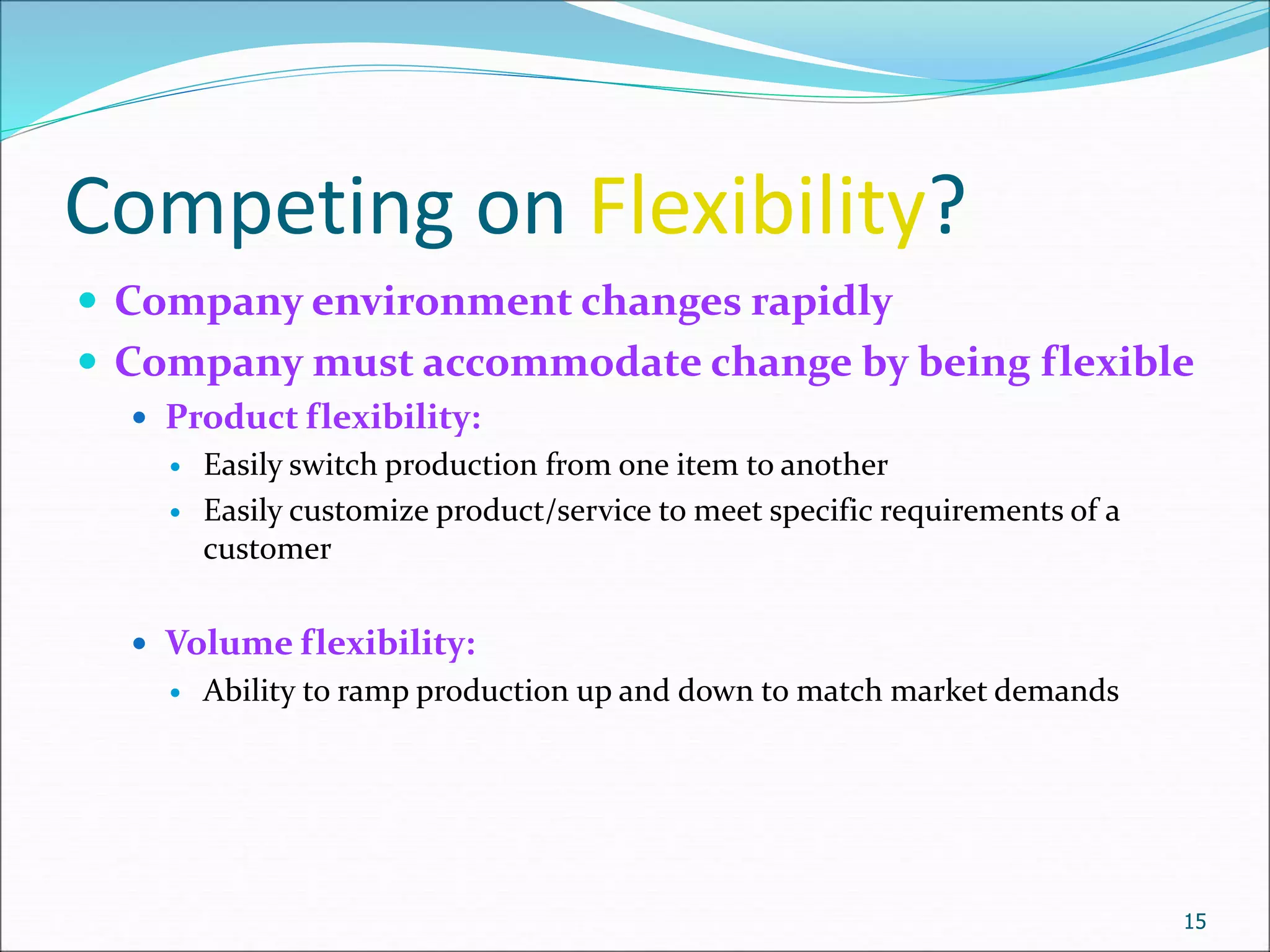
Competing on Flexibility?
 Company environment changes rapidly
 Company must accommodate change by being flexible
 Product flexibility:
 Easily switch production from one item to another
 Easily customize product/service to meet specific requirements of a
customer
 Volume flexibility:
 Ability to ramp production up and down to match market demands
15
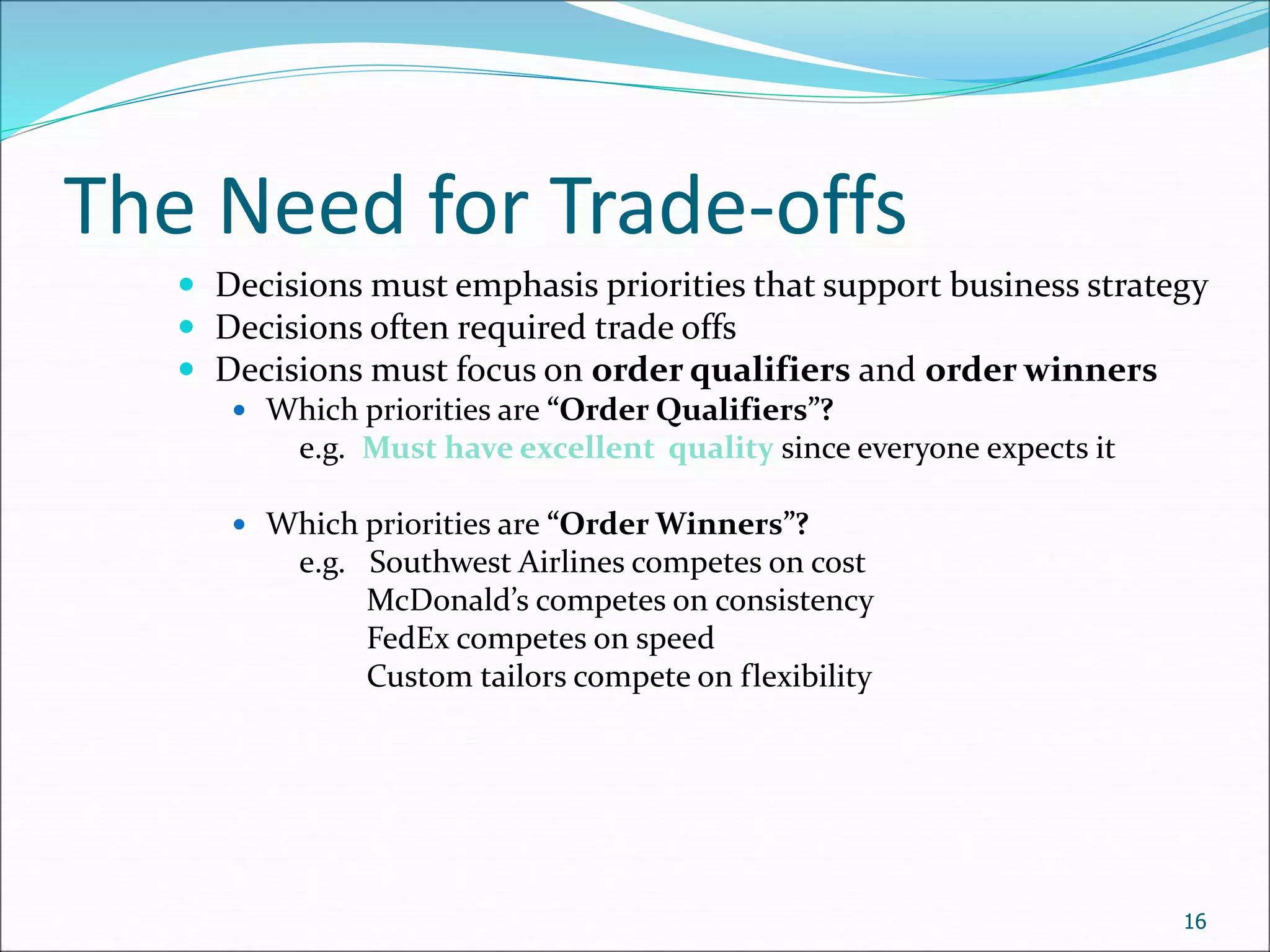
The Need for Trade-offs
 Decisions must emphasis priorities that support business strategy
 Decisions often required trade offs
 Decisions must focus on order qualifiers and order winners
 Which priorities are “Order Qualifiers”?
e.g. Must have excellent quality since everyone expects it
 Which priorities are “Order Winners”?
e.g. Southwest Airlines competes on cost
McDonald’s competes on consistency
FedEx competes on speed
Custom tailors compete on flexibility
16
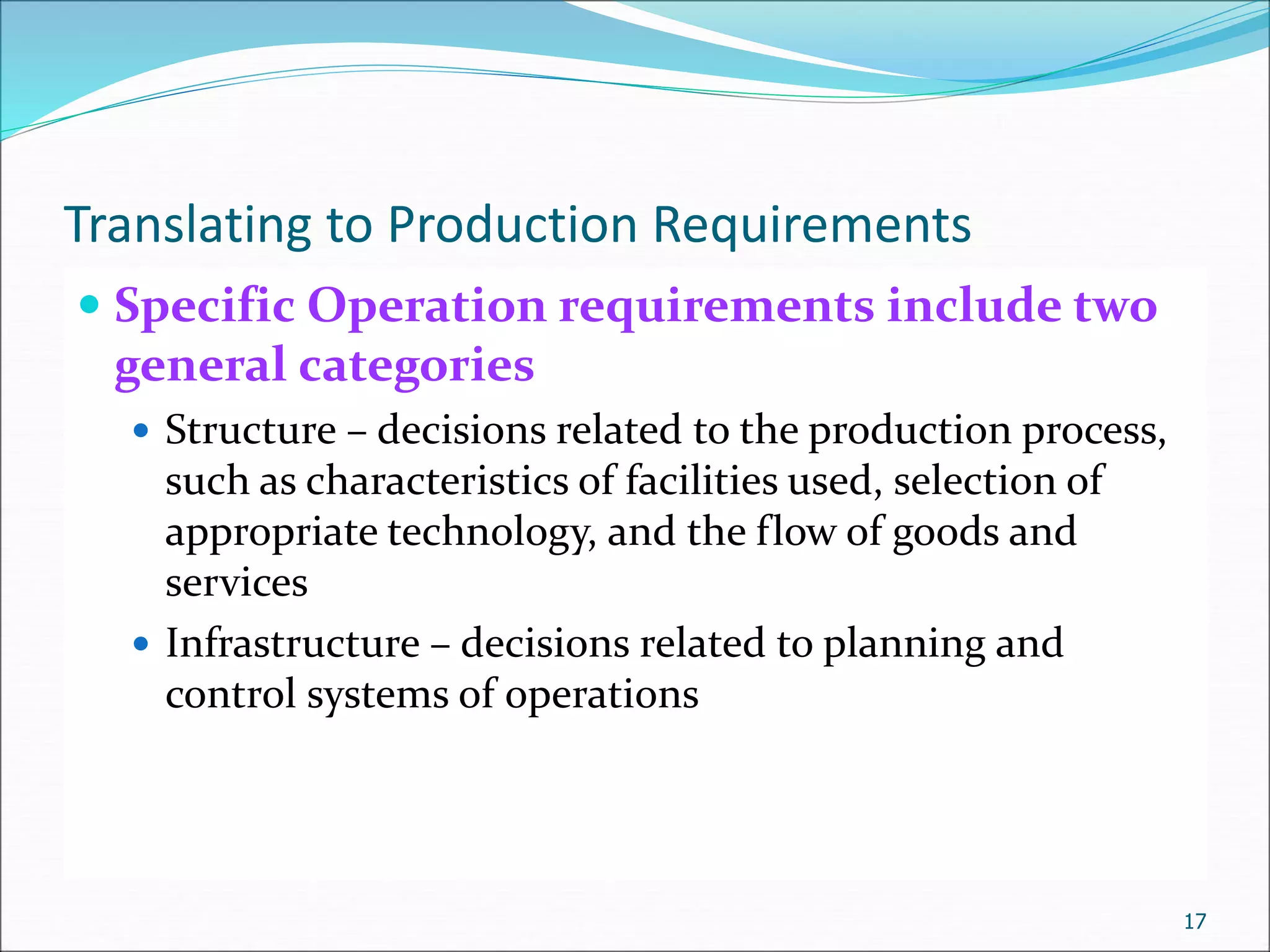
Translating to Production Requirements
 Specific Operation requirements include two
general categories
 Structure – decisions related to the production process,
such as characteristics of facilities used, selection of
appropriate technology, and the flow of goods and
services
 Infrastructure – decisions related to planning and
control systems of operations
17
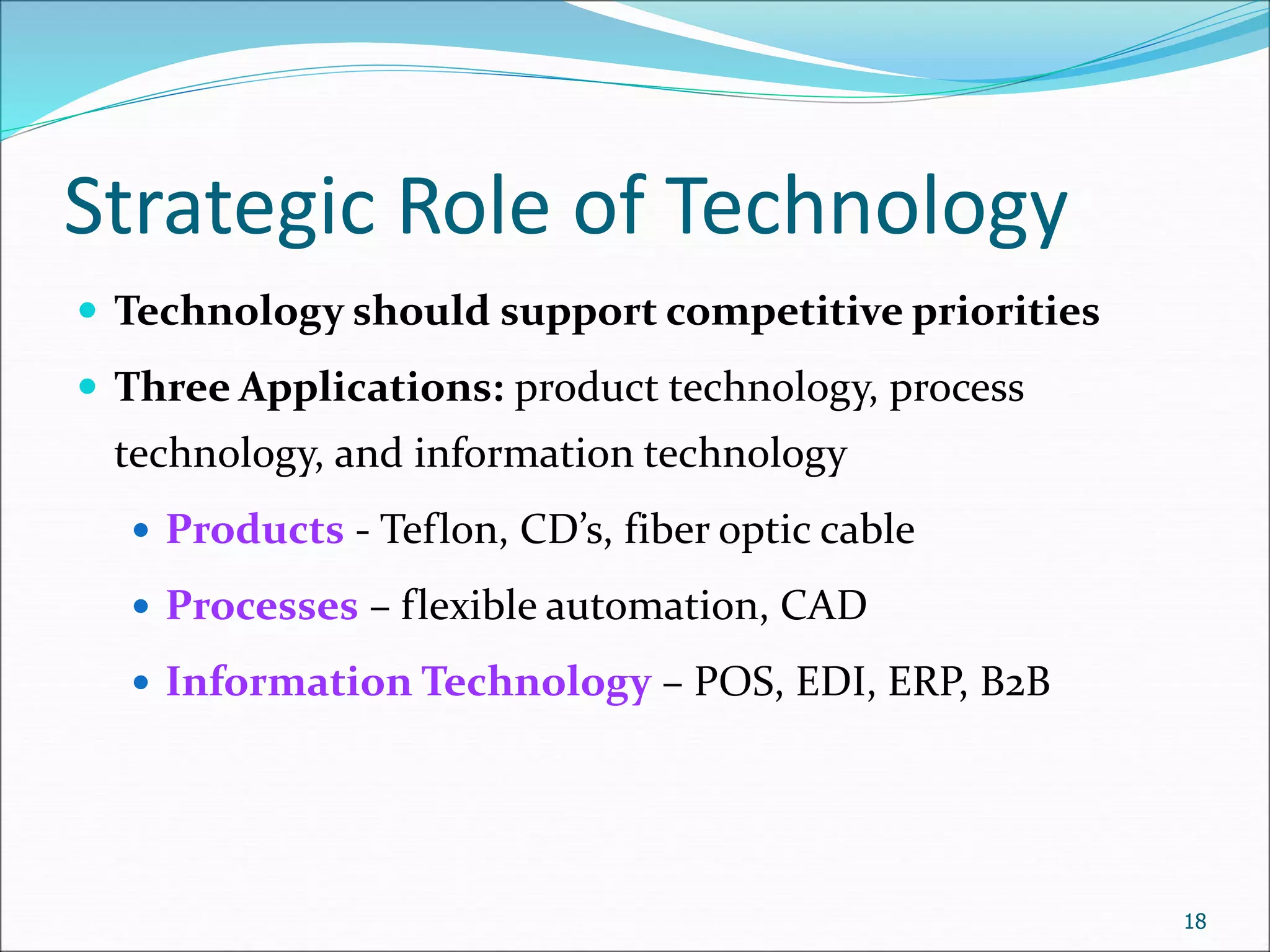
Strategic Role of Technology
 Technology should support competitive priorities
 Three Applications: product technology, process
technology, and information technology
 Products - Teflon, CD’s, fiber optic cable
 Processes – flexible automation, CAD
 Information Technology – POS, EDI, ERP, B2B
18
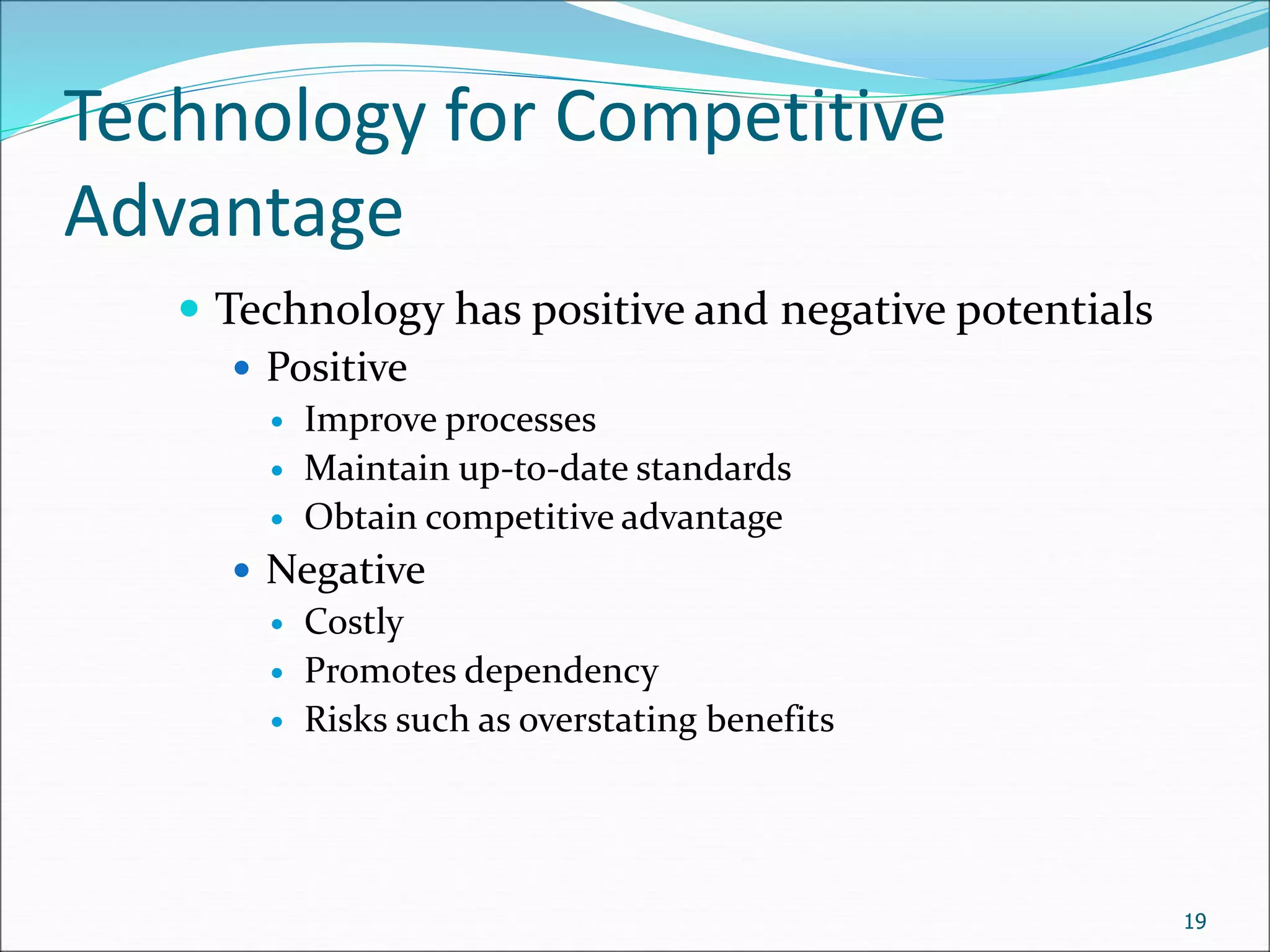
Technology for Competitive
Advantage
 Technology has positive and negative potentials
 Positive
 Improve processes
 Maintain up-to-date standards
 Obtain competitive advantage
 Negative
 Costly
 Promotes dependency
 Risks such as overstating benefits
19
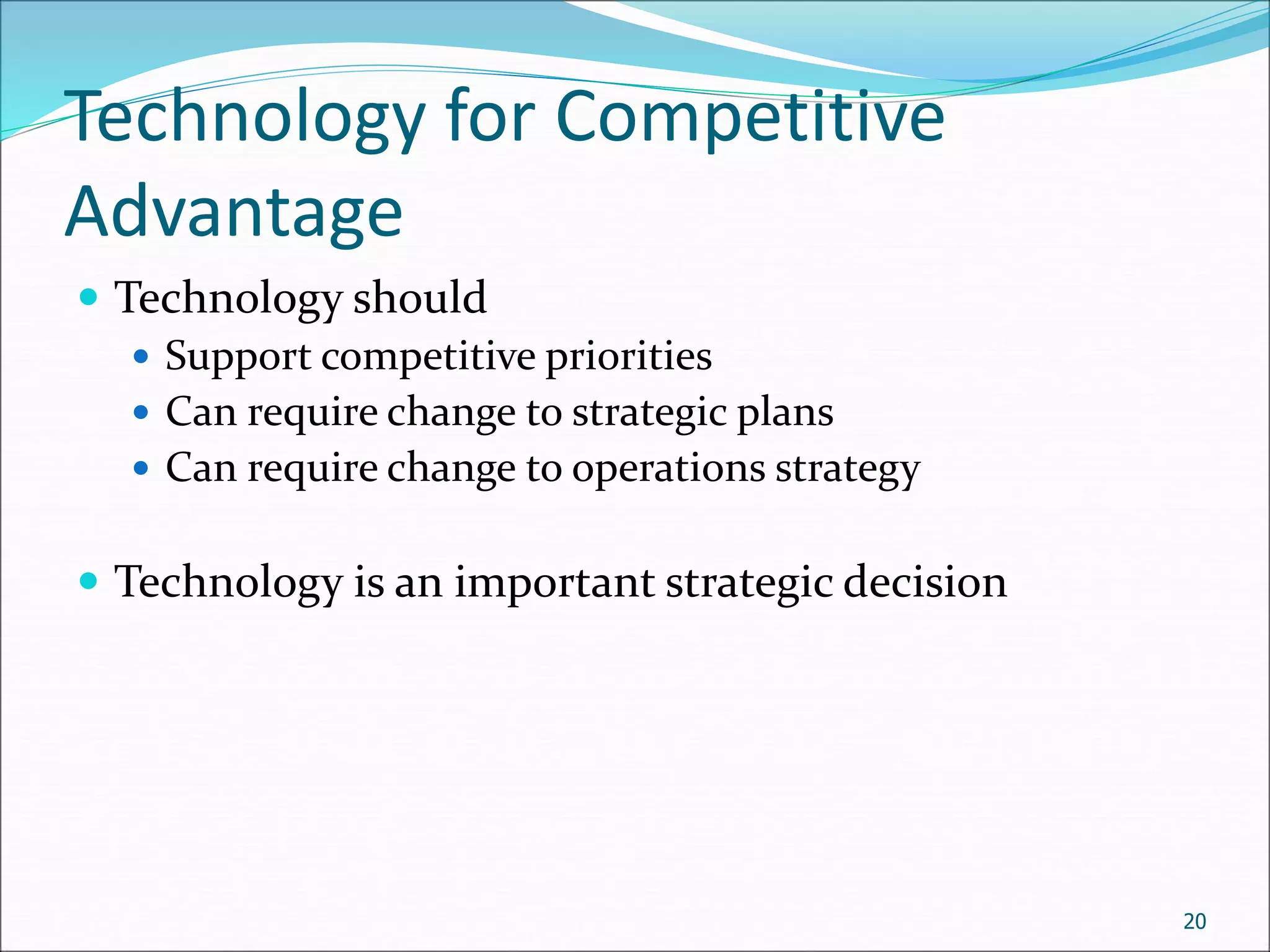
Technology for Competitive
Advantage
 Technology should
 Support competitive priorities
 Can require change to strategic plans
 Can require change to operations strategy
 Technology is an important strategic decision
20
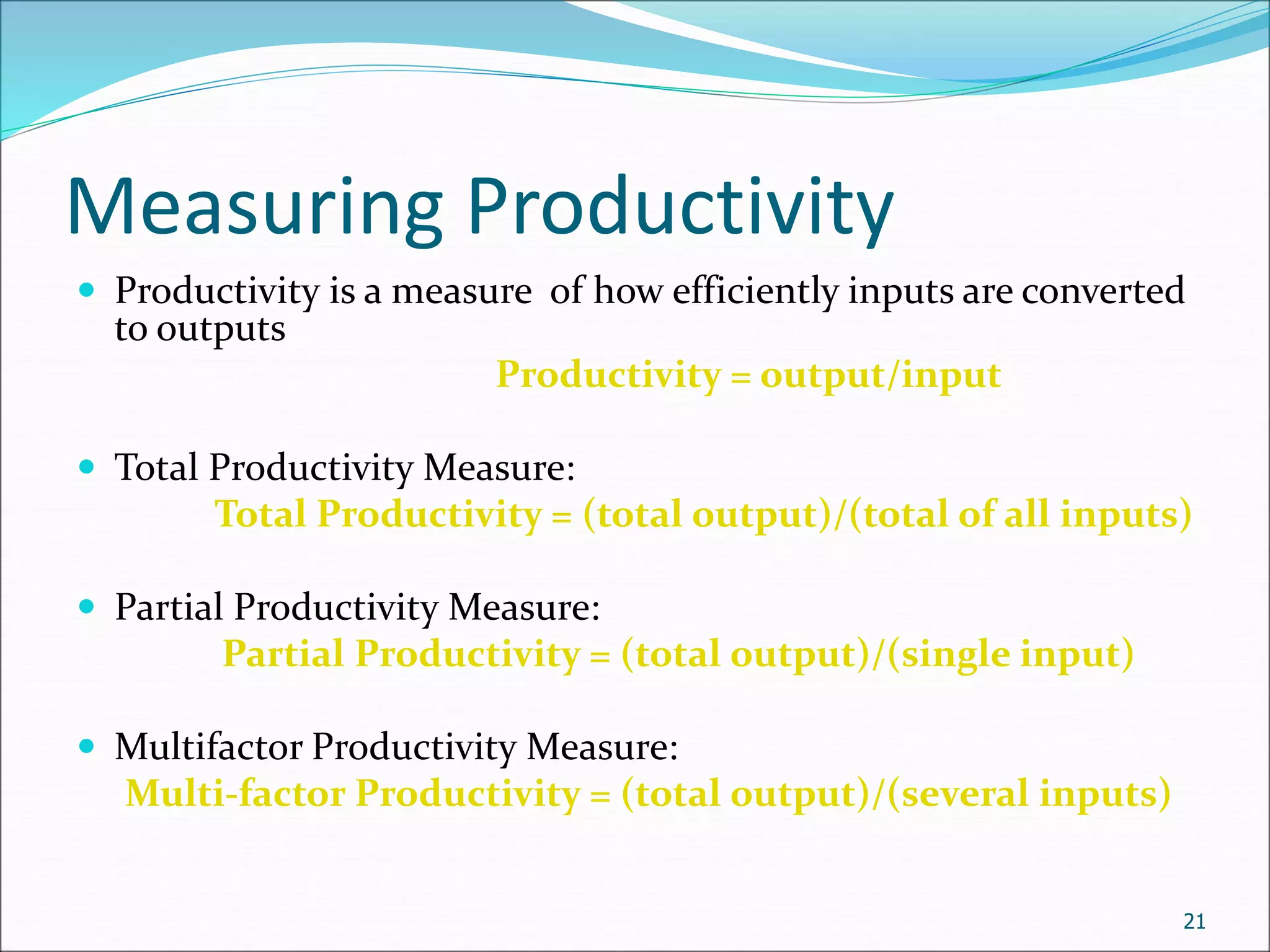
Measuring Productivity
 Productivity is a measure of how efficiently inputs are converted
to outputs
Productivity = output/input
 Total Productivity Measure:
Total Productivity = (total output)/(total of all inputs)
 Partial Productivity Measure:
Partial Productivity = (total output)/(single input)
 Multifactor Productivity Measure:
Multi-factor Productivity = (total output)/(several inputs)
21
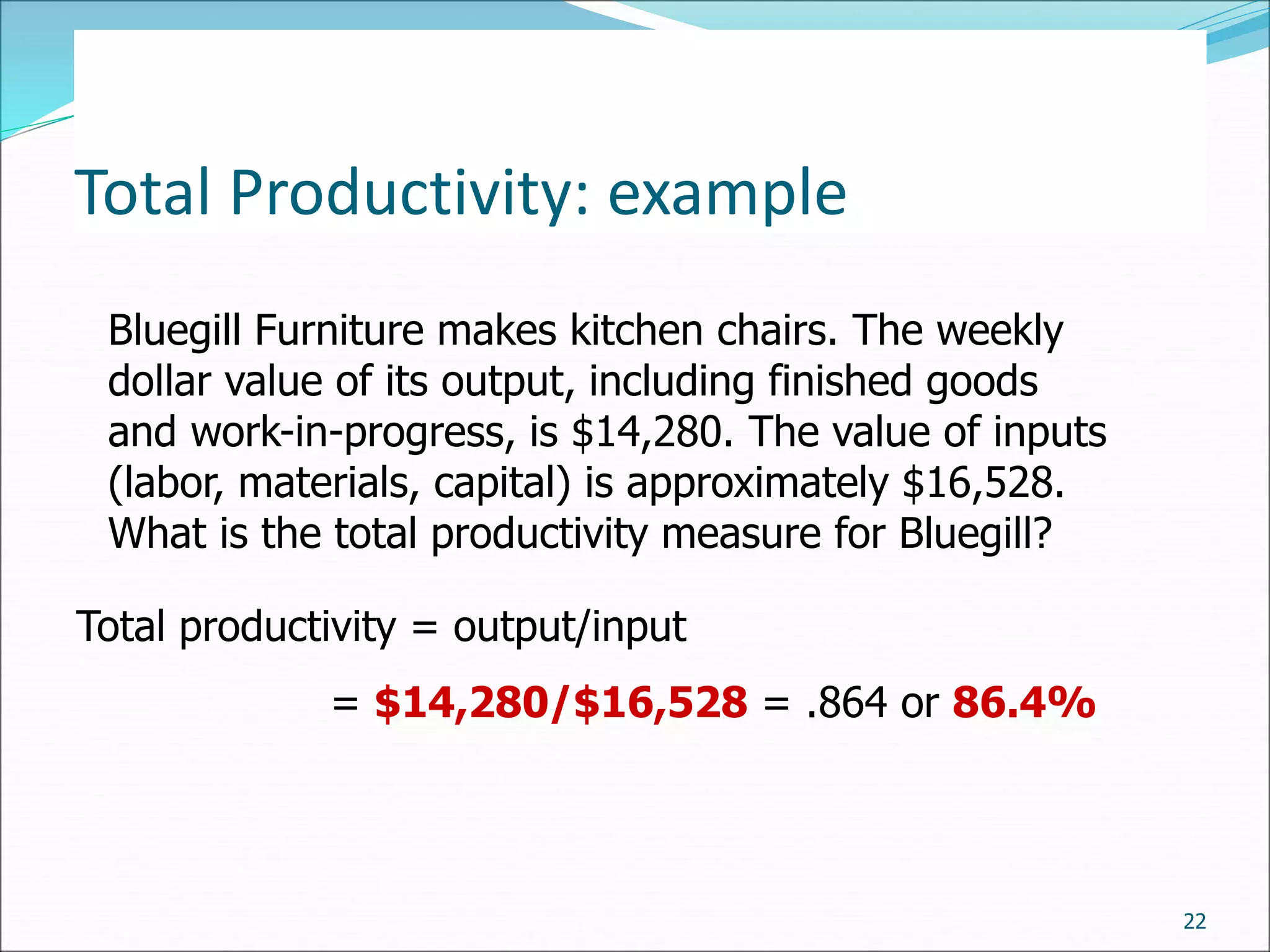
Total Productivity: example
22
Bluegill Furniture makes kitchen chairs. The weekly
dollar value of its output, including finished goods
and work-in-progress, is $14,280. The value of inputs
(labor, materials, capital) is approximately $16,528.
What is the total productivity measure for Bluegill?
Total productivity = output/input
= $14,280/$16,528 = .864 or 86.4%
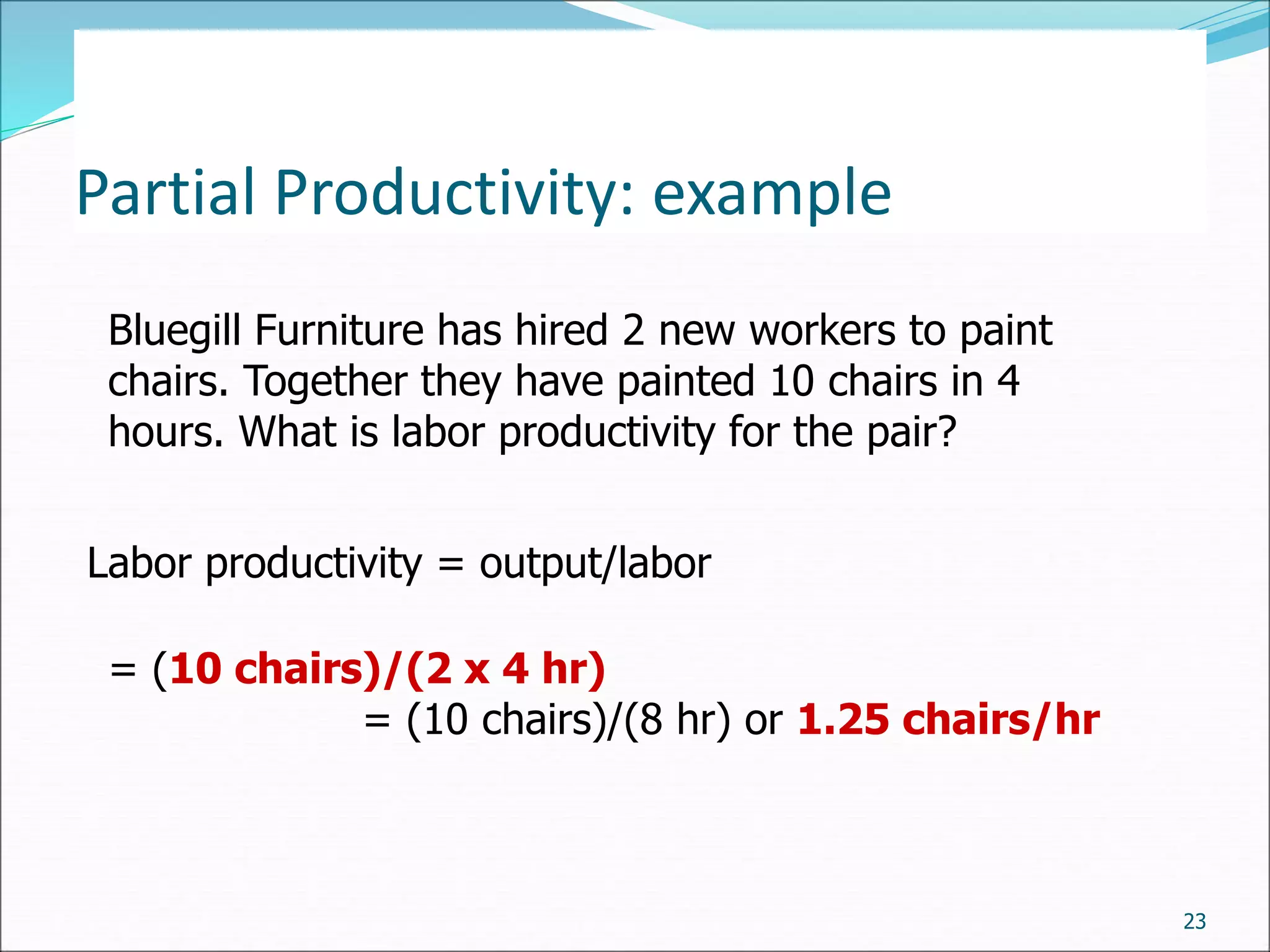
Partial Productivity: example
23
Bluegill Furniture has hired 2 new workers to paint
chairs. Together they have painted 10 chairs in 4
hours. What is labor productivity for the pair?
Labor productivity = output/labor
= (10 chairs)/(2 x 4 hr)
= (10 chairs)/(8 hr) or 1.25 chairs/hr
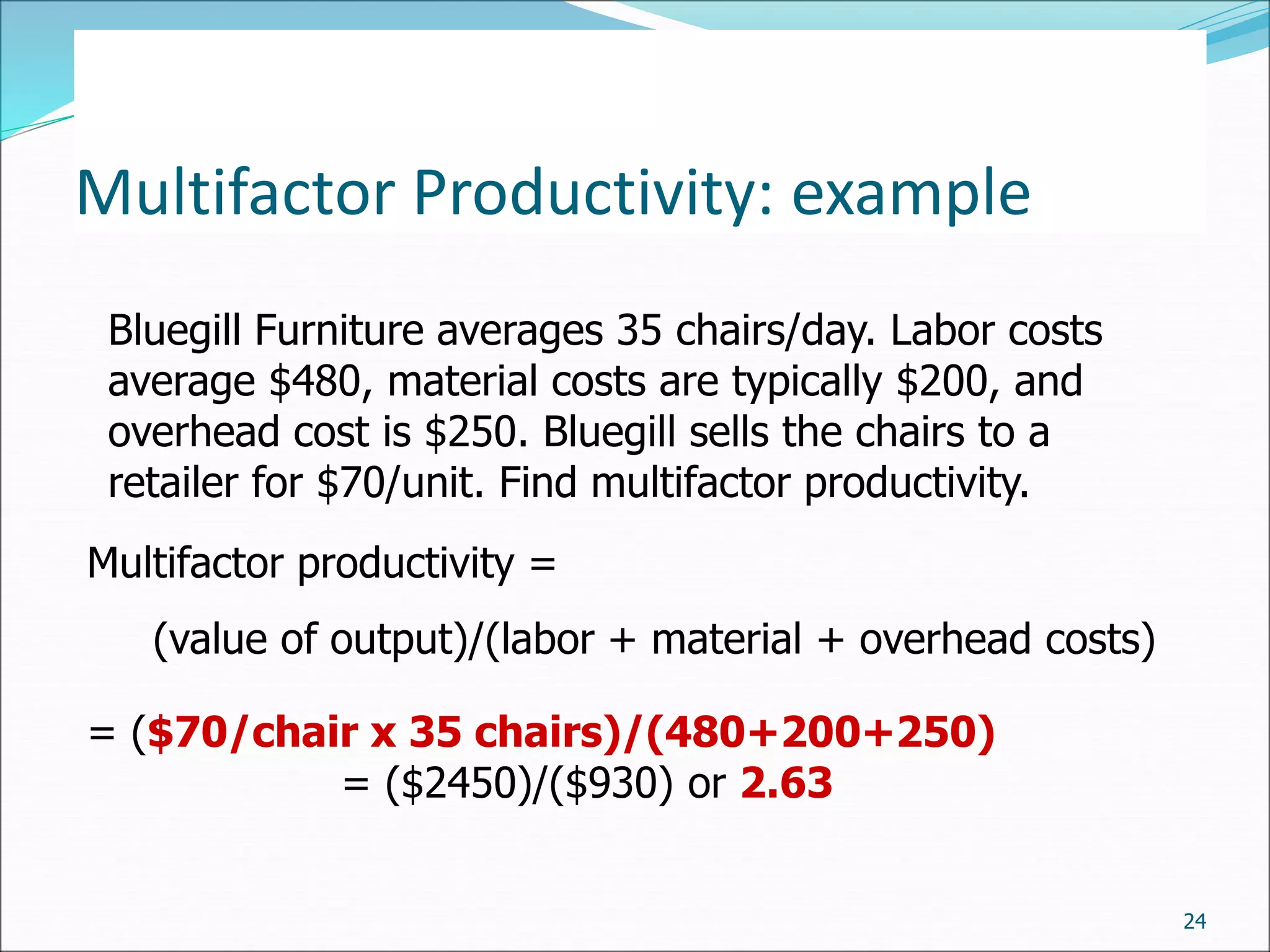
Multifactor Productivity: example
24
Bluegill Furniture averages 35 chairs/day. Labor costs
average $480, material costs are typically $200, and
overhead cost is $250. Bluegill sells the chairs to a
retailer for $70/unit. Find multifactor productivity.
Multifactor productivity =
(value of output)/(labor + material + overhead costs)
= ($70/chair x 35 chairs)/(480+200+250)
= ($2450)/($930) or 2.63
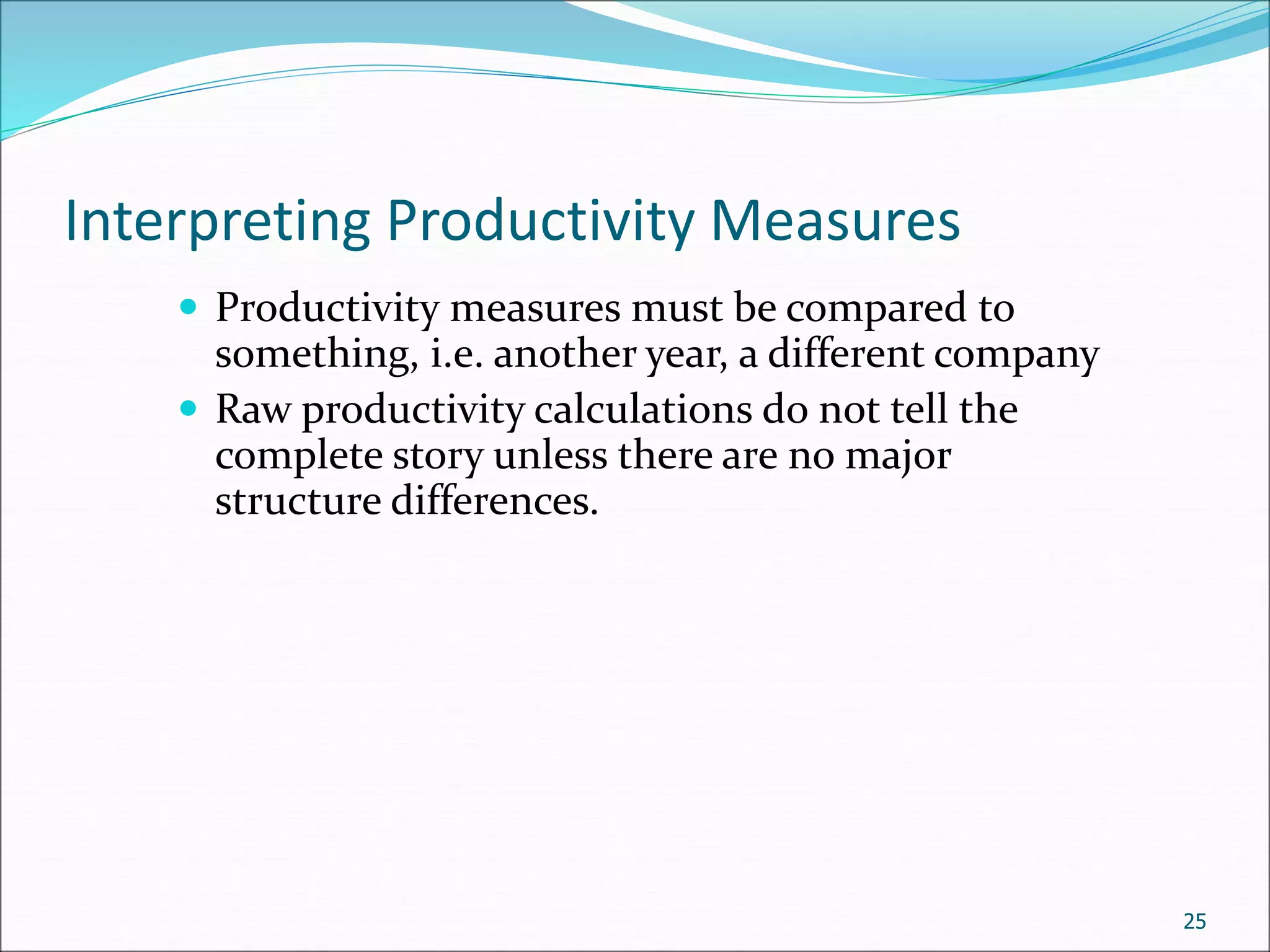
Interpreting Productivity Measures
 Productivity measures must be compared to
something, i.e. another year, a different company
 Raw productivity calculations do not tell the
complete story unless there are no major
structure differences.
25
Interpreting Productivity Measures
 Other productivity measure questions;
 Is this partial productivity measurement enough
to make an investment decision?
 Should you also look at productivity measures
for the two major competitors for comparison?
 Productivity measure provides information
on how the firm is doing relative to what is
critical to the firm
26
Productivity, Competitiveness, and the
Service Sector
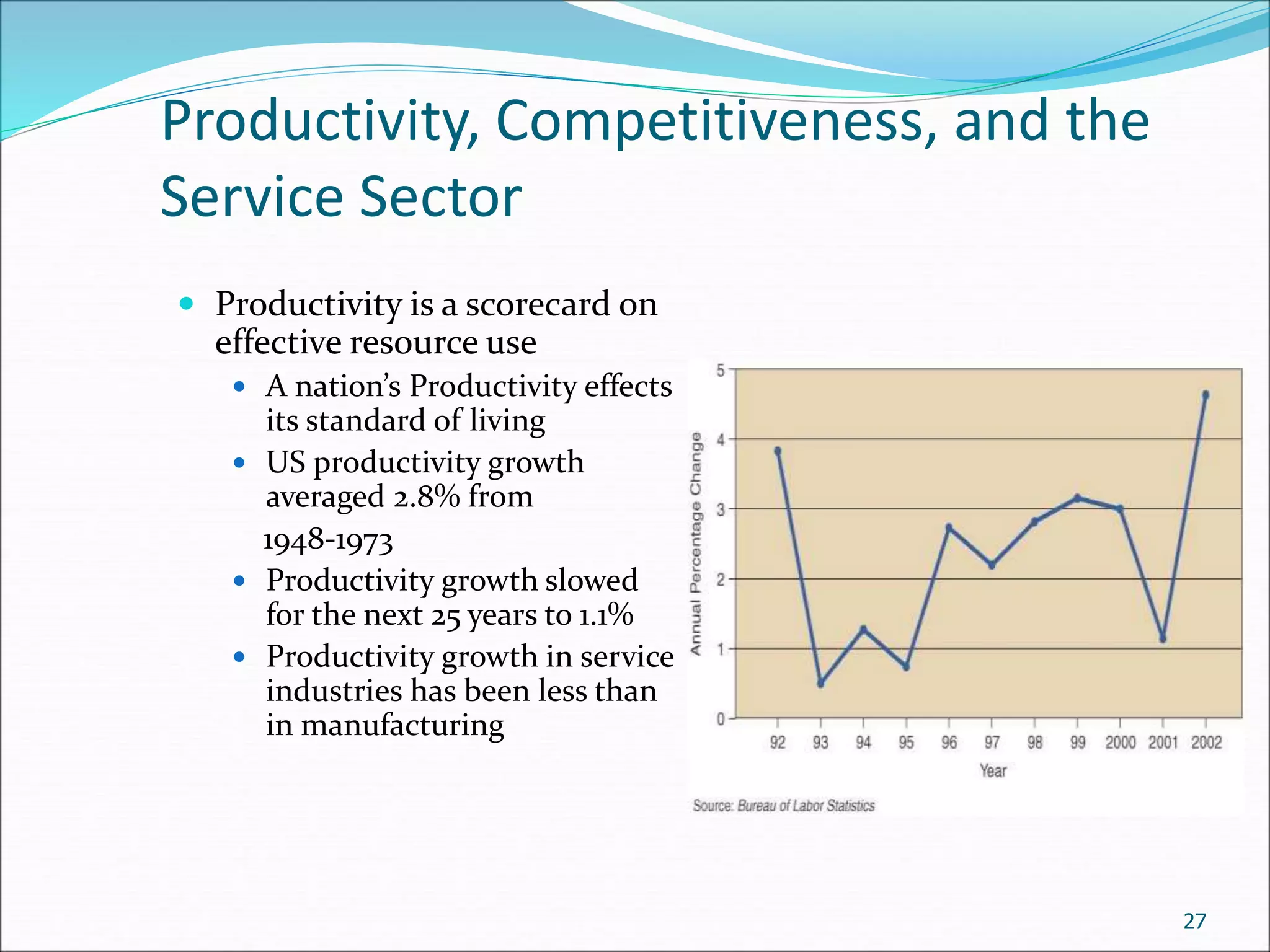
 Productivity is a scorecard on
effective resource use
 A nation’s Productivity effects
its standard of living
 US productivity growth
averaged 2.8% from
1948-1973
 Productivity growth slowed
for the next 25 years to 1.1%
 Productivity growth in service
industries has been less than
in manufacturing
27
Productivity and the Service Sector
 Measuring service sector productivity is a unique
challenge
 Traditional measures focus on tangible outcomes
 Service industries primarily produce intangible
outcomes
 Measuring intangibles is challenging
28
Operations Strategy Across the
Organization
 Business strategy defines long-term plan
 Operations strategy support the business strategy
 Marketing strategy needs to fully understand
operations capability
 Financial plans in effect support operations activities.
29
Review of Learning Objectives
 Define the role of Business Strategy
 Explain how a Business strategy is developed
 Explain the role of Operations Strategy in the
organization
 Explain the relationship between business strategy
and operations strategy
 Describe how an operations strategy is developed
30
Review of Learning Objectives
 Identify competitive priorities for of the operations
function
 Explain the strategic role of technology
 Define productivity and identify productivity
measures
 Compute productivity measures
31
Highlights
 Business Strategy is a long range plan and vision. Each
individual business function develop needs to support the
business strategy
 An organization develops its business strategy by doing
environmental scanning and considering its mission and
its core competencies.
 The role of operations strategy is to provide a long-range
plan for the use of the company’s resources in producing
the company’s primary goods and services.
 The role of business strategy is to serve as an overall guide
for the development of the organization’s operations
strategy.
32
Highlights
 The operations strategy focuses on developing specific
capabilities called competitive priorities.
 There are four categories of competitive priorities: cost,
quality, time, and flexibility
 Technology can be sued by companies to gain a competitive
advantage and should be acquired to support the company’s
chosen competitive priorities
 Productivity is a measure that indicates how efficiently an
organization is using its resources
 Productivity is computed as the ratio or organizational
outputs divided by inputs
33
I M POSSIBLE
34
I M POSSIBLE
Bibek Prajapti
(FCMA, CS , MBA, M COM, ).
Please like , subscribe and comment and don’t forget to share
Pray to God for the success Life
Thank You

Operations strategy for MBA, CA, CMA, B COM, M COM

  • 1.
  • 2.
    I M POSSIBLE 2 IM POSSIBLE Bibek Prajapti (FCMA, CS , MBA, M COM, ). Please like , subscribe and comment and don’t forget to share Pray to God for the success Life Thank You
  • 3.
     Strategy andoperations are inextricably connected: strategy is a plan to reach an objective and operations is the means of getting there.  The word operations stems from the Latin verb operari and noun opus,which mean (to) work. 3
  • 4.
    The Role ofOperations Strategy  Provide a plan that makes best use of resources which;  Specifies the policies and plans for using organizational resources  Supports Business Strategy as shown on next slide 4
  • 5.
  • 6.
    Importance of OperationsStrategy  Companies often do not understand the differences between operational efficiency and strategy  Operational efficiency is performing tasks well, even better than competitors  Strategy is a plan for competing in the marketplace  Operations strategy is to ensure all tasks performed are the right tasks 6
  • 7.
    Developing a BusinessStrategy  A business strategy is developed after taking into many factors and following some strategic decisions such as;  What business is the company in (mission)  Analyzing and understanding the market (environmental scanning)  Identifying the companies strengths (core competencies) 7
  • 8.
    Three Inputs toa Business Strategy 8
  • 9.
    Developing an OperationsStrategy  Operations Strategy is a plan for the design and management of operations functions  Operation Strategy developed after the business strategy  Operations Strategy focuses on specific capabilities which give it a competitive edge – competitive priorities 9
  • 10.
    Operations Strategy –Designing the Operations Function 10
  • 11.
    Competitive Priorities- TheEdge  Four Important Operations Questions: Will you compete on – Cost? Quality? Time? Flexibility?  All of the above? Some? Tradeoffs? 11
  • 12.
    Competing on Cost? Offering product at a low price relative to competition  Typically high volume products  Often limit product range & offer little customization  May invest in automation to reduce unit costs  Can use lower skill labor  Probably use product focused layouts  Low cost does not mean low quality 12
  • 13.
    Competing on Quality? Quality is often subjective  Quality is defined differently depending on who is defining it  Two major quality dimensions include  High performance design:  Superior features, high durability, & excellent customer service  Product & service consistency:  Meets design specifications  Close tolerances  Error free delivery  Quality needs to address  Product design quality – product/service meets requirements  Process quality – error free products 13
  • 14.
    Competing on Time? Time/speed one of most important competition priorities  First that can deliver often wins the race  Time related issues involve  Rapid delivery:  Focused on shorter time between order placement and delivery  On-time delivery:  Deliver product exactly when needed every time 14
  • 15.
    Competing on Flexibility? Company environment changes rapidly  Company must accommodate change by being flexible  Product flexibility:  Easily switch production from one item to another  Easily customize product/service to meet specific requirements of a customer  Volume flexibility:  Ability to ramp production up and down to match market demands 15
  • 16.
    The Need forTrade-offs  Decisions must emphasis priorities that support business strategy  Decisions often required trade offs  Decisions must focus on order qualifiers and order winners  Which priorities are “Order Qualifiers”? e.g. Must have excellent quality since everyone expects it  Which priorities are “Order Winners”? e.g. Southwest Airlines competes on cost McDonald’s competes on consistency FedEx competes on speed Custom tailors compete on flexibility 16
  • 17.
    Translating to ProductionRequirements  Specific Operation requirements include two general categories  Structure – decisions related to the production process, such as characteristics of facilities used, selection of appropriate technology, and the flow of goods and services  Infrastructure – decisions related to planning and control systems of operations 17
  • 18.
    Strategic Role ofTechnology  Technology should support competitive priorities  Three Applications: product technology, process technology, and information technology  Products - Teflon, CD’s, fiber optic cable  Processes – flexible automation, CAD  Information Technology – POS, EDI, ERP, B2B 18
  • 19.
    Technology for Competitive Advantage Technology has positive and negative potentials  Positive  Improve processes  Maintain up-to-date standards  Obtain competitive advantage  Negative  Costly  Promotes dependency  Risks such as overstating benefits 19
  • 20.
    Technology for Competitive Advantage Technology should  Support competitive priorities  Can require change to strategic plans  Can require change to operations strategy  Technology is an important strategic decision 20
  • 21.
    Measuring Productivity  Productivityis a measure of how efficiently inputs are converted to outputs Productivity = output/input  Total Productivity Measure: Total Productivity = (total output)/(total of all inputs)  Partial Productivity Measure: Partial Productivity = (total output)/(single input)  Multifactor Productivity Measure: Multi-factor Productivity = (total output)/(several inputs) 21
  • 22.
    Total Productivity: example 22 BluegillFurniture makes kitchen chairs. The weekly dollar value of its output, including finished goods and work-in-progress, is $14,280. The value of inputs (labor, materials, capital) is approximately $16,528. What is the total productivity measure for Bluegill? Total productivity = output/input = $14,280/$16,528 = .864 or 86.4%
  • 23.
    Partial Productivity: example 23 BluegillFurniture has hired 2 new workers to paint chairs. Together they have painted 10 chairs in 4 hours. What is labor productivity for the pair? Labor productivity = output/labor = (10 chairs)/(2 x 4 hr) = (10 chairs)/(8 hr) or 1.25 chairs/hr
  • 24.
    Multifactor Productivity: example 24 BluegillFurniture averages 35 chairs/day. Labor costs average $480, material costs are typically $200, and overhead cost is $250. Bluegill sells the chairs to a retailer for $70/unit. Find multifactor productivity. Multifactor productivity = (value of output)/(labor + material + overhead costs) = ($70/chair x 35 chairs)/(480+200+250) = ($2450)/($930) or 2.63
  • 25.
    Interpreting Productivity Measures Productivity measures must be compared to something, i.e. another year, a different company  Raw productivity calculations do not tell the complete story unless there are no major structure differences. 25
  • 26.
    Interpreting Productivity Measures Other productivity measure questions;  Is this partial productivity measurement enough to make an investment decision?  Should you also look at productivity measures for the two major competitors for comparison?  Productivity measure provides information on how the firm is doing relative to what is critical to the firm 26
  • 27.
    Productivity, Competitiveness, andthe Service Sector  Productivity is a scorecard on effective resource use  A nation’s Productivity effects its standard of living  US productivity growth averaged 2.8% from 1948-1973  Productivity growth slowed for the next 25 years to 1.1%  Productivity growth in service industries has been less than in manufacturing 27
  • 28.
    Productivity and theService Sector  Measuring service sector productivity is a unique challenge  Traditional measures focus on tangible outcomes  Service industries primarily produce intangible outcomes  Measuring intangibles is challenging 28
  • 29.
    Operations Strategy Acrossthe Organization  Business strategy defines long-term plan  Operations strategy support the business strategy  Marketing strategy needs to fully understand operations capability  Financial plans in effect support operations activities. 29
  • 30.
    Review of LearningObjectives  Define the role of Business Strategy  Explain how a Business strategy is developed  Explain the role of Operations Strategy in the organization  Explain the relationship between business strategy and operations strategy  Describe how an operations strategy is developed 30
  • 31.
    Review of LearningObjectives  Identify competitive priorities for of the operations function  Explain the strategic role of technology  Define productivity and identify productivity measures  Compute productivity measures 31
  • 32.
    Highlights  Business Strategyis a long range plan and vision. Each individual business function develop needs to support the business strategy  An organization develops its business strategy by doing environmental scanning and considering its mission and its core competencies.  The role of operations strategy is to provide a long-range plan for the use of the company’s resources in producing the company’s primary goods and services.  The role of business strategy is to serve as an overall guide for the development of the organization’s operations strategy. 32
  • 33.
    Highlights  The operationsstrategy focuses on developing specific capabilities called competitive priorities.  There are four categories of competitive priorities: cost, quality, time, and flexibility  Technology can be sued by companies to gain a competitive advantage and should be acquired to support the company’s chosen competitive priorities  Productivity is a measure that indicates how efficiently an organization is using its resources  Productivity is computed as the ratio or organizational outputs divided by inputs 33
  • 34.
    I M POSSIBLE 34 IM POSSIBLE Bibek Prajapti (FCMA, CS , MBA, M COM, ). Please like , subscribe and comment and don’t forget to share Pray to God for the success Life Thank You