Local Asynchronous
Communications
Asynchronous Transmission
• One definition of asynchronous: transmitter and receiver do not
explicitly coordinate each data transmission
Transmitter can wait arbitrarily long between transmissions
for example, when transmitter such as a keyboard may not always
have data ready to send
• Asynchronous may also mean no explicit information about where
data bits begin and end
E.g. when we send individual ASCII characters
Bitwise Data Transmission
Transmission requires:
– Encoding bits as energy
– Transmitting energy through medium
– Decoding energy back into bits
• Energy can be electric current, radio, infrared, light, smell, etc.
• Transmitter and receiver must agree on encoding scheme and
transmission timing.
Using Electric Current to Send Bits
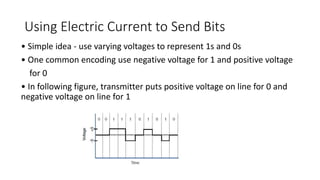
• Simple idea ‐ use varying voltages to represent 1s and 0s
• One common encoding use negative voltage for 1 and positive voltage
for 0
• In following figure, transmitter puts positive voltage on line for 0 and
negative voltage on line for 1
Transmission Timing Problems
• Encoding scheme leaves several questions unanswered:
– How long will voltage last for each bit?
– How soon will next bit start?
– How will the transmitter and receiver agree on timing?
• Later : Self‐clocking codes (e.g. Manchester Encoding)
• Standards specify operation of communication systems
• Devices from different vendors that adhere to the standard can
interoperate
• Example organizations:
– International Telecommunications Union (ITU)
– Electronic Industries Association (EIA)
– Institute for Electrical and Electronics Engineers (IEEE)
RS‐232
• Standard for transfer of characters across copper wire
• Produced by EIA
• Full name is RS‐232‐C
• RS‐232 defines serial, asynchronous communication
– Serial ‐ bits are encoded and transmitted one at a time (as
opposed to parallel transmission)
– Asynchronous ‐ characters can be sent at any time and bits
are not individually synchronized
Transmission Rates
• Baud rate measures number of signal changes per second
• Bits per second measures number of bits transmitted per second
• In RS‐232, each signal change represents one bit, so baud rate and
bits per second are equal
• If each signal change represents more than one bit, bits per second
may be greater than baud rate
– This is the case with modems nowadays
– More on this when we look at modulation
Framing
• Start and stop bits represent framing of each character
• If transmitter and receiver are using different speeds, stop bit will
not be received at the expected time – framing error occurs
• Framing error also occurs transmitter’s and receiver’s voltage do
not agree
• RS‐232 devices may send an intentional framing error called a
BREAK – reset wire to zero state
Duplex asynchronous communication
• Two endpoints may send data simultaneously
‐ full duplex communication
– Requires an electrical path in each direction
• If only one endpoint may send data half‐duplex communications
only one direction - simplex
– Pin 2 ‐ Receive (RxD)
– Pin 3 ‐ Transmit (TxD)
– Pin 4 ‐ Ready to send (RTS)
– Pin 5 ‐ Clear to send (CTS)
– Pin 7 ‐ Ground
Effect of Noise
• In practice, noise (interference) limits maximum data
transmission rate to less than maximum allowed by Nyquist
sampling theorem
• Claude Shannon Max data rate (taking noise into consideration):
C= Blog 2 (1 +S/N);
B : Bandwidth;
S: Average Signal power;
N: Average Noise power
less interference (noise) means a higher data transmission rate
higher capacity (C) if signal-to-noise ratio
(S/N) is higher Sometime expressed as 10log 10 (S/N);
Nyquist - absolute limitation

unit 1 section 5.pptx

  • 1.
  • 2.
    Asynchronous Transmission • Onedefinition of asynchronous: transmitter and receiver do not explicitly coordinate each data transmission Transmitter can wait arbitrarily long between transmissions for example, when transmitter such as a keyboard may not always have data ready to send • Asynchronous may also mean no explicit information about where data bits begin and end E.g. when we send individual ASCII characters
  • 3.
    Bitwise Data Transmission Transmissionrequires: – Encoding bits as energy – Transmitting energy through medium – Decoding energy back into bits • Energy can be electric current, radio, infrared, light, smell, etc. • Transmitter and receiver must agree on encoding scheme and transmission timing.
  • 4.
    Using Electric Currentto Send Bits • Simple idea ‐ use varying voltages to represent 1s and 0s • One common encoding use negative voltage for 1 and positive voltage for 0 • In following figure, transmitter puts positive voltage on line for 0 and negative voltage on line for 1
  • 5.
    Transmission Timing Problems •Encoding scheme leaves several questions unanswered: – How long will voltage last for each bit? – How soon will next bit start? – How will the transmitter and receiver agree on timing? • Later : Self‐clocking codes (e.g. Manchester Encoding) • Standards specify operation of communication systems • Devices from different vendors that adhere to the standard can interoperate • Example organizations: – International Telecommunications Union (ITU) – Electronic Industries Association (EIA) – Institute for Electrical and Electronics Engineers (IEEE)
  • 6.
    RS‐232 • Standard fortransfer of characters across copper wire • Produced by EIA • Full name is RS‐232‐C • RS‐232 defines serial, asynchronous communication – Serial ‐ bits are encoded and transmitted one at a time (as opposed to parallel transmission) – Asynchronous ‐ characters can be sent at any time and bits are not individually synchronized
  • 7.
    Transmission Rates • Baudrate measures number of signal changes per second • Bits per second measures number of bits transmitted per second • In RS‐232, each signal change represents one bit, so baud rate and bits per second are equal • If each signal change represents more than one bit, bits per second may be greater than baud rate – This is the case with modems nowadays – More on this when we look at modulation
  • 8.
    Framing • Start andstop bits represent framing of each character • If transmitter and receiver are using different speeds, stop bit will not be received at the expected time – framing error occurs • Framing error also occurs transmitter’s and receiver’s voltage do not agree • RS‐232 devices may send an intentional framing error called a BREAK – reset wire to zero state
  • 9.
    Duplex asynchronous communication •Two endpoints may send data simultaneously ‐ full duplex communication – Requires an electrical path in each direction • If only one endpoint may send data half‐duplex communications only one direction - simplex – Pin 2 ‐ Receive (RxD) – Pin 3 ‐ Transmit (TxD) – Pin 4 ‐ Ready to send (RTS) – Pin 5 ‐ Clear to send (CTS) – Pin 7 ‐ Ground
  • 10.
    Effect of Noise •In practice, noise (interference) limits maximum data transmission rate to less than maximum allowed by Nyquist sampling theorem • Claude Shannon Max data rate (taking noise into consideration): C= Blog 2 (1 +S/N); B : Bandwidth; S: Average Signal power; N: Average Noise power less interference (noise) means a higher data transmission rate higher capacity (C) if signal-to-noise ratio (S/N) is higher Sometime expressed as 10log 10 (S/N); Nyquist - absolute limitation