UNIT-1
Introduction
• Mobile Computing is a technology that provides
an environment which allow users to transmit
data from one device to another device without
the use of any physical link or cables.
• It is a human–computer interaction in which a
computer is transported during normal use and
allow for transfer of data, which include voice and
video transmissions.
• It facilitates the users to move from one physical
location to another during communication.
:
Mobile communication can be divided in the following four types
1.Fixed and Wired: In Fixed and Wired configuration, the devices are fixed at a
position, and they are connected through a physical link to communicate with other
devices.
Example, Desktop Computer.
2.Fixed and Wireless: In Fixed and Wireless configuration, the devices are fixed at a
position, and they are connected through a wireless link to make communication
with other devices.
Example, Communication Towers, WiFi router
3.Mobile and Wired: In Mobile and Wired configuration, some devices are wired, and
some are mobile. They altogether make communication with other devices.
Example, Laptops.
4.Mobile and Wireless: In Mobile and Wireless configuration, the devices can
communicate with each other irrespective of their position. They can also connect to
any network without the use of any wired device.
Example, WiFi Dongle.
Three major elements of mobile computing are mobile
communication, mobile hardware, and mobile software.
•Mobile Communication: It refers to the communication infrastructure set in
place, including wireless network infrastructure, protocols, data formats,
bandwidths, and portals necessary to ensure seamless connectivity and
communication.
•Mobile Hardware: The hardware is the mobile computing devices and
supporting devices, with the capabilities required to perform their required
operations and connect to networks.
• Mobile Software: The most important software component is the operating
system, which is the brain of any computing system. For a laptop, this may be
Windows, Linux or macOS, and for a smartphone, it may be Android or iOS.
Issues in Mobile Computing
Hardware Challenges
1.Limited Battery Life and Power Management:
The battery life of a mobile device can be one of the biggest challenges for users.
Users often need to charge their devices multiple times per day, which is inconvenient
and reduces productivity.
Mobile devices use different applications that run in the background, which can drain
the battery quickly.
2.Small Form Factor and Limited Processing Power
Mobile devices are typically smaller than desktop computers or laptops, which limits
their processing power.
3.Compatibility Issues with Different Devices and Operating Systems
Compatibility issues between different devices and operating systems is
another important hardware challenge in mobile computing.
Software Challenges
1.Security Concerns and Data Protection
Mobile devices store large amounts of critical personal information such as
banking details, passwords, emails, contacts and other sensitive data. This
makes them prime targets for hackers who exploit security vulnerabilities in
mobile operating systems to gain unauthorized access to this valuable data.
2.Network Connectivity Issues
Mobile devices rely on wireless networks for internet connectivity. However,
these networks are susceptible to interference from other wireless signals
causing connection stability issues.
3.Small Screen Size and Touch Screen Limitations
The small screen size of mobile devices can limit the amount of information
that can be displayed at any given time.
4.Limited Input Options such as Keyboard or Mouse
Mobile devices typically have limited physical input options such as a
keyboard or mouse. This can be challenging for applications that require
precise input or complex interactions
Overview of Wireless Telephony
Wireless telephony refers to technology which operates
on transmission of information through space; there is no
physical or fixed connection between sender and receiver
devices.
By using wireless
telephony people can be transceivers information from
driving cars, and walking in garden. Wireless telephony
come in two basic varieties:
1.Cordless phones
2.Mobile phones (cell phones).
Most modern mobile telephone services use a cellular
network architecture, and therefore mobile telephones
are also called cellular telephones or cell phones.
Cellular Concept Mobile Computing Technology
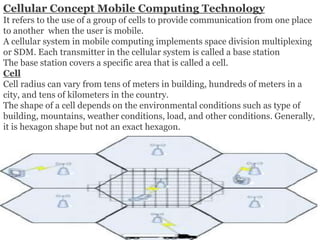
It refers to the use of a group of cells to provide communication from one place
to another when the user is mobile.
A cellular system in mobile computing implements space division multiplexing
or SDM. Each transmitter in the cellular system is called a base station
The base station covers a specific area that is called a cell.
Cell
Cell radius can vary from tens of meters in building, hundreds of meters in a
city, and tens of kilometers in the country.
The shape of a cell depends on the environmental conditions such as type of
building, mountains, weather conditions, load, and other conditions. Generally,
it is hexagon shape but not an exact hexagon.
Mobile computing used cellular system and it has the following
advantages:
1.Higher Capacity
Cellular system uses SDM. SDM allows frequency reuse. If one transmitter is
far away from another transmitter particularly out of the range of the
interference area then another transmitter can use the same frequency.
2.Less Transmission Power
Keeping cell size small facilitate mobile receivers because as they move far from the
base station their receiving capacity reduces and due to small cells after a few
distances they can again access receiving power from the cell nearby them and the
problem of the mobile receiver is solved.
3.Local Interference
. There is only local interference when cells are small and that is easy to handle by the
base station and the mobile station.
4.Robustness
If any component fails only that specific area affected and the rest of the part remains
unaffected and works efficiently.
Cellular System or having small cells have the following
disadvantages.
1.Infrastructure Requirement
Cellular system establishment needs complex infrastructure, storage registers
to locate mobile users in local areas and roaming, antennas, transmitters,
receivers, and amplifiers, etc. that are expensive.
2.Handover Needed
The mobile system needs handovers when they change cells. This is quite
often which further incur a cost.
3.Frequency Planning
To avoid the interference between transmitters frequencies are planned
carefully. Frequency is a limited resource therefore they are distributed
intelligently so that they can be reused without any kind of interference.
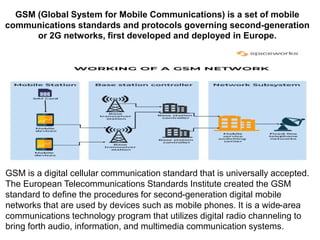
GSM (Global System for Mobile Communications) is a set of mobile
communications standards and protocols governing second-generation
or 2G networks, first developed and deployed in Europe.
GSM is a digital cellular communication standard that is universally accepted.
The European Telecommunications Standards Institute created the GSM
standard to define the procedures for second-generation digital mobile
networks that are used by devices such as mobile phones. It is a wide-area
communications technology program that utilizes digital radio channeling to
bring forth audio, information, and multimedia communication systems.
Three subsystem BSS, NSS and OSS are connected with each other via some
interfaces. Total three interfaces are there:
Air Interface : Air interface is also known as UM interface. Interface between
MS and BTS is called as UM interface because it is mobile analog to the U
interface of ISDN.
Abis Interface : It is a BSS internal interface linking with BTS and BSC.
A interface : It provides communication between BSS and MSC.
.
Location Management
Location management is a two-stage process:
The first stage is to discover the current attachment point of the
mobile user for call delivery
The second one is call delivery.
The associated protocol deals with querying and storing
information in location databases and sending paging signals to
locate the user within the network. Key research areas are the
design of database architecture to reduce query traffic,
streamlining location update signaling, and terminal paging
scheme .
Home Location Register (HLR)
The HLR is a database used for storage and management of
subscriptions. It is considered the most important database, as it
stores permanent data about subscribers, including a subscriber's
service profile, location information, and activity status. When an
individual buys a subscription in the form of SIM, then all the
information about this subscription is registered in the HLR of that
operator.
Mobile Services Switching Center (MSC)
The MSC performs the switching of calls between the mobile and
other fixed or mobile network users, as well as the management of
mobile services such as registration, authentication, location
updating, handovers, and call routing to a roaming subscriber.
Visitor Location Register (VLR)
The VLR is a database that contains temporary information about
subscribers that is needed by the MSC in order to service visiting
subscribers.. When a mobile station roams into a new MSC area, the
VLR connected to that MSC will request data about the mobile station
from the HLR. Later, if the mobile station makes a call, the VLR will
have the information needed for call setup without having to
How are the HLR and VLR used?
Each mobile network has its own HLRs and VLRs. When a MSC detects
a mobile user’s presence in the area covered by its network, it first
checks a database to determine if the user is in his/her home area or is
roaming, i.e., the user is a visitor. o User in Home Area: HLR has the
necessary information for initiating, terminating, or receiving a call.
o User is Roaming: VLR contacts the user’s HLR to get the necessary
information to set up a temporary user profile. The user’s location is
recorded in the HLR, and in case the user roaming, it is also recorded in
the VLR.
Suppose that the user wants to make a call: o User in Home Area: MSC
contacts the HLR prior to setting up the call. o User is Roaming: MSC
contacts the VLR prior to setting up the call. Suppose that there is a call
for the user (call goes to the home MSC): o User in Home Area: Home
MSC delivers the call immediately. o User is Roaming: Home MSC
contacts the VLR to determine the appropriate switch in the roaming
area to handle the arriving call and then transfers the call to the
roaming area MSC.
Hand-off
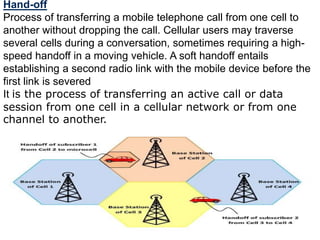
Process of transferring a mobile telephone call from one cell to
another without dropping the call. Cellular users may traverse
several cells during a conversation, sometimes requiring a high-
speed handoff in a moving vehicle. A soft handoff entails
establishing a second radio link with the mobile device before the
first link is severed
It is the process of transferring an active call or data
session from one cell in a cellular network or from one
channel to another.
Hard Handoff − In a hard handoff, an actual break in the
connection occurs while switching from one cell to another. The
radio links from the mobile station to the existing cell is broken
before establishing a link with the next cell. It is generally an inter-
frequency handoff. It is a “break before make” policy.
Soft Handoff − In soft handoff, at least one of the links is kept
when radio links are added and removed to the mobile station.
This ensures that during the handoff, no break occurs. This is
generally adopted in co-located sites. It is a “make before break”
policy.
Channel Allocation in Cellular System
Channel allocation deals with the allocation of channels to cells in a cellular
network. Once the channels are allocated, cells may then allow users within the
cell to communicate via the available channels.
Channels in a wireless communication system typically consist of time slots,
frequency bands and/or CDMA pseudo noise sequences
There are three major categories for assigning these channels to cells (or base-
stations). They are
Fixed Channel Allocation,
Dynamic Channel Allocation
Hybrid Channel Allocation (which is a combination of the first two
methods).
Fixed Channel Allocation
(FCA) systems allocate specific channels to specific cells. This allocation is
static and can not be changed. For efficient operation, FCA systems typically
allocate channels in a manner that maximizes frequency reuse
Dynamic Channel Allocation
In DCA systems, no set relationship exists between channels and cells. Instead,
channels are part of a pool of resources. Whenever a channel is needed by a
cell, the channel is allocated
Hybrid Channel Allocation Schemes
This category of channel allocation methods includes all systems
that are hybrids of fixed and dynamic channel allocation systems.
Channel Borrowing is one of the
most straightforward hybrid allocation schemes. Here, channels
are assigned to cells just as in fixed allocation schemes. If a cell
needs a channel in excess of the channels previously assigned to
it, that cell may borrow a channel from one of its neighboring
cells given that a channel is available and use of this channel
won't violate frequency reuse requirements.
CDMA - Technology
Code Division Multiple Access (CDMA) is a form of multiplexing that
facilitates various signals to occupy a single transmission channel. It
optimizes the use of available bandwidth. The technology is
commonly used in ultra-high-frequency (UHF) cellular telephone
systems, bands ranging between the 800-MHz and 1.9-GHz.
A CDMA network assigns every user a code that encodes and
decodes wireless signals sent to and from their device. Multiple
users can communicate with the network's transmission towers
using the entire width of the frequency spectrum.
Each device decodes only the signals
that use their personal code, with signals meant for other users
appearing as noise that the receiver can safely discard. By not
limiting each user's frequency range, CDMA provides
more bandwidth when compared to the TDMA method used by
GSM networks.
CDMA also allows more
simultaneous users to use the same frequency spectrum without
Advantages of CDMA :
1.CDMA channel is not easily decodable hence it offers
increases cellular communication securities
2.Call quality is better with more consistent sound as
compared to GSM
3.Less interference due to hand off features reduces
call dropping
4 .Gives better coverage and needs few antenna sites
and also consumes less power
Disadvantages of CDMA :
1.Time synchronization is required
2.It can't offer international roaming, a large GSM advantage
3.The CDMA system performance degrades with an increase in
the number of users
General Packet Radio Service (GPRS) is the packet and data
transfer service on the 2G and 3G wireless networks used for the
global communications in the mobile systems.
It allows the continuous connections of the Internet to mobile
phones and handheld devices. It is based on the GSM services which
used existing services such as the SMS and circuit-switched phone
networks and connections.
Features of GPRS
GPRS operates at an extremely slow speed. It downloads the data at the
deficient range and even uploads the data at the range lower than the
download range. Its features are as follows:
• Short messaging service: it is the communication protocol which
specially designed for text messaging. So, it is a special-purpose
communication protocol.
• Multimedia messaging service: It has done an extension to SMS, i.e.,
now we can transmit videos along with the text also.
• Wireless application protocol: it is a special-purpose communication
protocol which used for mobile browsers.
Advantages of GPRS are as follows:
• High-speed: GPRS offers us the speed which is 3 times quicker
than the data transfer speed of fixed telecommunication networks.
Also, the speed of GPRS is 10 times faster than the GSM
services. GPRS gives the speed of 171.2 kbps.
• Instant connection and immediate data transfer: GPRS provide
us the instant connections. It can send data wherever and
whenever the data is required.
• Cost-effective solution: The cost of using GPRS is less. That’s
why there is an increase in the penetration of data services.
The disadvantages of GPRS are as follows:
• The data rate supported by GPRS is slower than the data rate of
the latest wireless standards like LTE, LTE-advanced, etc.,
• We cannot troubleshoot the error in case any issue appears in
front of us.
• The problem of congestion also occurs , which means that if
multiple users of GPRS are utilizing the services of GPRS in the
same area at the same time, then slower data connection there.

UNIT-1 Mobile computing (2).pptx for notes

  • 1.
    UNIT-1 Introduction • Mobile Computingis a technology that provides an environment which allow users to transmit data from one device to another device without the use of any physical link or cables. • It is a human–computer interaction in which a computer is transported during normal use and allow for transfer of data, which include voice and video transmissions. • It facilitates the users to move from one physical location to another during communication.
  • 2.
    : Mobile communication canbe divided in the following four types
  • 3.
    1.Fixed and Wired:In Fixed and Wired configuration, the devices are fixed at a position, and they are connected through a physical link to communicate with other devices. Example, Desktop Computer. 2.Fixed and Wireless: In Fixed and Wireless configuration, the devices are fixed at a position, and they are connected through a wireless link to make communication with other devices. Example, Communication Towers, WiFi router 3.Mobile and Wired: In Mobile and Wired configuration, some devices are wired, and some are mobile. They altogether make communication with other devices. Example, Laptops. 4.Mobile and Wireless: In Mobile and Wireless configuration, the devices can communicate with each other irrespective of their position. They can also connect to any network without the use of any wired device. Example, WiFi Dongle.
  • 4.
    Three major elementsof mobile computing are mobile communication, mobile hardware, and mobile software. •Mobile Communication: It refers to the communication infrastructure set in place, including wireless network infrastructure, protocols, data formats, bandwidths, and portals necessary to ensure seamless connectivity and communication. •Mobile Hardware: The hardware is the mobile computing devices and supporting devices, with the capabilities required to perform their required operations and connect to networks. • Mobile Software: The most important software component is the operating system, which is the brain of any computing system. For a laptop, this may be Windows, Linux or macOS, and for a smartphone, it may be Android or iOS.
  • 5.
    Issues in MobileComputing Hardware Challenges 1.Limited Battery Life and Power Management: The battery life of a mobile device can be one of the biggest challenges for users. Users often need to charge their devices multiple times per day, which is inconvenient and reduces productivity. Mobile devices use different applications that run in the background, which can drain the battery quickly. 2.Small Form Factor and Limited Processing Power Mobile devices are typically smaller than desktop computers or laptops, which limits their processing power. 3.Compatibility Issues with Different Devices and Operating Systems Compatibility issues between different devices and operating systems is another important hardware challenge in mobile computing.
  • 6.
    Software Challenges 1.Security Concernsand Data Protection Mobile devices store large amounts of critical personal information such as banking details, passwords, emails, contacts and other sensitive data. This makes them prime targets for hackers who exploit security vulnerabilities in mobile operating systems to gain unauthorized access to this valuable data. 2.Network Connectivity Issues Mobile devices rely on wireless networks for internet connectivity. However, these networks are susceptible to interference from other wireless signals causing connection stability issues. 3.Small Screen Size and Touch Screen Limitations The small screen size of mobile devices can limit the amount of information that can be displayed at any given time. 4.Limited Input Options such as Keyboard or Mouse Mobile devices typically have limited physical input options such as a keyboard or mouse. This can be challenging for applications that require precise input or complex interactions
  • 7.
    Overview of WirelessTelephony Wireless telephony refers to technology which operates on transmission of information through space; there is no physical or fixed connection between sender and receiver devices. By using wireless telephony people can be transceivers information from driving cars, and walking in garden. Wireless telephony come in two basic varieties: 1.Cordless phones 2.Mobile phones (cell phones). Most modern mobile telephone services use a cellular network architecture, and therefore mobile telephones are also called cellular telephones or cell phones.
  • 8.
    Cellular Concept MobileComputing Technology It refers to the use of a group of cells to provide communication from one place to another when the user is mobile. A cellular system in mobile computing implements space division multiplexing or SDM. Each transmitter in the cellular system is called a base station The base station covers a specific area that is called a cell. Cell Cell radius can vary from tens of meters in building, hundreds of meters in a city, and tens of kilometers in the country. The shape of a cell depends on the environmental conditions such as type of building, mountains, weather conditions, load, and other conditions. Generally, it is hexagon shape but not an exact hexagon.
  • 9.
    Mobile computing usedcellular system and it has the following advantages: 1.Higher Capacity Cellular system uses SDM. SDM allows frequency reuse. If one transmitter is far away from another transmitter particularly out of the range of the interference area then another transmitter can use the same frequency. 2.Less Transmission Power Keeping cell size small facilitate mobile receivers because as they move far from the base station their receiving capacity reduces and due to small cells after a few distances they can again access receiving power from the cell nearby them and the problem of the mobile receiver is solved. 3.Local Interference . There is only local interference when cells are small and that is easy to handle by the base station and the mobile station. 4.Robustness If any component fails only that specific area affected and the rest of the part remains unaffected and works efficiently.
  • 10.
    Cellular System orhaving small cells have the following disadvantages. 1.Infrastructure Requirement Cellular system establishment needs complex infrastructure, storage registers to locate mobile users in local areas and roaming, antennas, transmitters, receivers, and amplifiers, etc. that are expensive. 2.Handover Needed The mobile system needs handovers when they change cells. This is quite often which further incur a cost. 3.Frequency Planning To avoid the interference between transmitters frequencies are planned carefully. Frequency is a limited resource therefore they are distributed intelligently so that they can be reused without any kind of interference.
  • 11.
    GSM (Global Systemfor Mobile Communications) is a set of mobile communications standards and protocols governing second-generation or 2G networks, first developed and deployed in Europe. GSM is a digital cellular communication standard that is universally accepted. The European Telecommunications Standards Institute created the GSM standard to define the procedures for second-generation digital mobile networks that are used by devices such as mobile phones. It is a wide-area communications technology program that utilizes digital radio channeling to bring forth audio, information, and multimedia communication systems.
  • 12.
    Three subsystem BSS,NSS and OSS are connected with each other via some interfaces. Total three interfaces are there: Air Interface : Air interface is also known as UM interface. Interface between MS and BTS is called as UM interface because it is mobile analog to the U interface of ISDN. Abis Interface : It is a BSS internal interface linking with BTS and BSC. A interface : It provides communication between BSS and MSC. .
  • 13.
    Location Management Location managementis a two-stage process: The first stage is to discover the current attachment point of the mobile user for call delivery The second one is call delivery. The associated protocol deals with querying and storing information in location databases and sending paging signals to locate the user within the network. Key research areas are the design of database architecture to reduce query traffic, streamlining location update signaling, and terminal paging scheme .
  • 14.
    Home Location Register(HLR) The HLR is a database used for storage and management of subscriptions. It is considered the most important database, as it stores permanent data about subscribers, including a subscriber's service profile, location information, and activity status. When an individual buys a subscription in the form of SIM, then all the information about this subscription is registered in the HLR of that operator. Mobile Services Switching Center (MSC) The MSC performs the switching of calls between the mobile and other fixed or mobile network users, as well as the management of mobile services such as registration, authentication, location updating, handovers, and call routing to a roaming subscriber. Visitor Location Register (VLR) The VLR is a database that contains temporary information about subscribers that is needed by the MSC in order to service visiting subscribers.. When a mobile station roams into a new MSC area, the VLR connected to that MSC will request data about the mobile station from the HLR. Later, if the mobile station makes a call, the VLR will have the information needed for call setup without having to
  • 15.
    How are theHLR and VLR used? Each mobile network has its own HLRs and VLRs. When a MSC detects a mobile user’s presence in the area covered by its network, it first checks a database to determine if the user is in his/her home area or is roaming, i.e., the user is a visitor. o User in Home Area: HLR has the necessary information for initiating, terminating, or receiving a call. o User is Roaming: VLR contacts the user’s HLR to get the necessary information to set up a temporary user profile. The user’s location is recorded in the HLR, and in case the user roaming, it is also recorded in the VLR. Suppose that the user wants to make a call: o User in Home Area: MSC contacts the HLR prior to setting up the call. o User is Roaming: MSC contacts the VLR prior to setting up the call. Suppose that there is a call for the user (call goes to the home MSC): o User in Home Area: Home MSC delivers the call immediately. o User is Roaming: Home MSC contacts the VLR to determine the appropriate switch in the roaming area to handle the arriving call and then transfers the call to the roaming area MSC.
  • 16.
    Hand-off Process of transferringa mobile telephone call from one cell to another without dropping the call. Cellular users may traverse several cells during a conversation, sometimes requiring a high- speed handoff in a moving vehicle. A soft handoff entails establishing a second radio link with the mobile device before the first link is severed It is the process of transferring an active call or data session from one cell in a cellular network or from one channel to another.
  • 17.
    Hard Handoff −In a hard handoff, an actual break in the connection occurs while switching from one cell to another. The radio links from the mobile station to the existing cell is broken before establishing a link with the next cell. It is generally an inter- frequency handoff. It is a “break before make” policy. Soft Handoff − In soft handoff, at least one of the links is kept when radio links are added and removed to the mobile station. This ensures that during the handoff, no break occurs. This is generally adopted in co-located sites. It is a “make before break” policy.
  • 18.
    Channel Allocation inCellular System Channel allocation deals with the allocation of channels to cells in a cellular network. Once the channels are allocated, cells may then allow users within the cell to communicate via the available channels. Channels in a wireless communication system typically consist of time slots, frequency bands and/or CDMA pseudo noise sequences There are three major categories for assigning these channels to cells (or base- stations). They are Fixed Channel Allocation, Dynamic Channel Allocation Hybrid Channel Allocation (which is a combination of the first two methods). Fixed Channel Allocation (FCA) systems allocate specific channels to specific cells. This allocation is static and can not be changed. For efficient operation, FCA systems typically allocate channels in a manner that maximizes frequency reuse Dynamic Channel Allocation In DCA systems, no set relationship exists between channels and cells. Instead, channels are part of a pool of resources. Whenever a channel is needed by a cell, the channel is allocated
  • 19.
    Hybrid Channel AllocationSchemes This category of channel allocation methods includes all systems that are hybrids of fixed and dynamic channel allocation systems. Channel Borrowing is one of the most straightforward hybrid allocation schemes. Here, channels are assigned to cells just as in fixed allocation schemes. If a cell needs a channel in excess of the channels previously assigned to it, that cell may borrow a channel from one of its neighboring cells given that a channel is available and use of this channel won't violate frequency reuse requirements.
  • 20.
    CDMA - Technology CodeDivision Multiple Access (CDMA) is a form of multiplexing that facilitates various signals to occupy a single transmission channel. It optimizes the use of available bandwidth. The technology is commonly used in ultra-high-frequency (UHF) cellular telephone systems, bands ranging between the 800-MHz and 1.9-GHz. A CDMA network assigns every user a code that encodes and decodes wireless signals sent to and from their device. Multiple users can communicate with the network's transmission towers using the entire width of the frequency spectrum. Each device decodes only the signals that use their personal code, with signals meant for other users appearing as noise that the receiver can safely discard. By not limiting each user's frequency range, CDMA provides more bandwidth when compared to the TDMA method used by GSM networks. CDMA also allows more simultaneous users to use the same frequency spectrum without
  • 21.
    Advantages of CDMA: 1.CDMA channel is not easily decodable hence it offers increases cellular communication securities 2.Call quality is better with more consistent sound as compared to GSM 3.Less interference due to hand off features reduces call dropping 4 .Gives better coverage and needs few antenna sites and also consumes less power Disadvantages of CDMA : 1.Time synchronization is required 2.It can't offer international roaming, a large GSM advantage 3.The CDMA system performance degrades with an increase in the number of users
  • 22.
    General Packet RadioService (GPRS) is the packet and data transfer service on the 2G and 3G wireless networks used for the global communications in the mobile systems. It allows the continuous connections of the Internet to mobile phones and handheld devices. It is based on the GSM services which used existing services such as the SMS and circuit-switched phone networks and connections. Features of GPRS GPRS operates at an extremely slow speed. It downloads the data at the deficient range and even uploads the data at the range lower than the download range. Its features are as follows: • Short messaging service: it is the communication protocol which specially designed for text messaging. So, it is a special-purpose communication protocol. • Multimedia messaging service: It has done an extension to SMS, i.e., now we can transmit videos along with the text also. • Wireless application protocol: it is a special-purpose communication protocol which used for mobile browsers.
  • 23.
    Advantages of GPRSare as follows: • High-speed: GPRS offers us the speed which is 3 times quicker than the data transfer speed of fixed telecommunication networks. Also, the speed of GPRS is 10 times faster than the GSM services. GPRS gives the speed of 171.2 kbps. • Instant connection and immediate data transfer: GPRS provide us the instant connections. It can send data wherever and whenever the data is required. • Cost-effective solution: The cost of using GPRS is less. That’s why there is an increase in the penetration of data services. The disadvantages of GPRS are as follows: • The data rate supported by GPRS is slower than the data rate of the latest wireless standards like LTE, LTE-advanced, etc., • We cannot troubleshoot the error in case any issue appears in front of us. • The problem of congestion also occurs , which means that if multiple users of GPRS are utilizing the services of GPRS in the same area at the same time, then slower data connection there.