First Semester, S.Y. 2020-2021
MODULE in SCIENCE (Teaching Science in the Primary Grade (BIOLOGY and CHEMISTRY)
Course: SCIENCE
Course Title: Teaching Science in the Primary Grade
Course Credits: Units
Contact Hours/week: 3 hours
Prerequisite: BIOLOGY and CHEMISTRY
Course Description: this course deals with the study on introduction to the unifying principles of biology with
emphasis on biological chemistry, energetics and homeostasis, cell structure and function, gene expression,
and patterns of inheritance. Laboratory is designed to reinforce lecture topics and develop analytical skills
essential to the practice of biology and chemistry.
Course Outcomes:
At the end of the course, the students will be able to:
1. Explain the scope of biology and molecular basis of life
2. Describe life activities from the cellular point of view
3. Manipulate basic biological tool, record data and draw conclusions
4. Develop scientific attitude, skill and conduct biological experiments using scientific
procedures
5. Outline basic processes of energy transduction and synthesis of intermediate or final
products in living cells
6. Understand the basic concepts of genetics and inheritance
7. Understand the concepts of infection and immunity
8. Classify organisms based on their cellular organization and complexity
9. Explain components, processes and interrelationships within a given ecosystem
10. Know the general features of invertebrate and vertebrate animals
11. Appreciate the practical uses of biological knowledge and its application in the wider
society
Learning Objectives: After completing this chapter you will be expected to:
 define the term biology
 explain scientific methods
 know the origin and the nature of life
1.1. The meaning and scope of biology
Biological Sciences is the study of life and living organisms. It is also called as “Biology”.
The Greek word „bio‟ means life and „logos‟ means study of. In the late 1700s Pierre-Antoine de
Monet and Jean-Baptiste de Lamarck coined the term biology. Earlier study of living things was
restricted to the pure Science like Botany and Zoology that together comprise the Biology. But as the
time passed new branches evolved. New technologies developed in pure subjects as well as in applied
fields, which gave rise to a very broad concept of science called Biological Sciences. Biological
Sciences is an extensive study covering the minute workings of chemical substances inside living cells
to the broad scale concepts of ecosystems and global environmental changes.
It is also concerned with the physical characteristics and behaviors of organisms living today and long
ago.
The life sciences can be defined as “a systematic study of living beings or study of nature”. Teaching
of life Science basically deals with providing information about the latest developments in the field of
Biological sciences all over the world.
1.2. The origin and nature of life
One of the biggest and most important of emergent phenomena is that of the origin or emergence
of life. The mystery of life's origin is still a big debating issue in science. The question “what is life?”
is so hard to answer; we really want to know much more than what it is, we want to know why it is,
“we are really asking, in physical terms, why a specific material system is an organism and not
something else”. To answer this why question we need to understand how life might have originated.
There are a number of theories about the origin of life. The next few sections give emphasis on these
different theories about the origin of life.
Theories on Origin of life
Several attempts have been made from time to time to explain the origin of life on earth. As a result,
there are several theories which offer their own explanation on the possible mechanism of origin of
life. Following are some of them:
1. Theory of Special Creation: according to this theory, all the different forms of life that occur today
on planet earth have been created by God, the almighty.
2.Theory of Catastrophism: It is simply a modification of the theory of Special Creation. It states that
there have been several creations of life by God, each preceded by a catastrophe resulting from some
kind of geological disturbance. According to this theory, since each catastrophe completely destroyed
the existing life, each new creation consisted of life form different from that of previous ones.
3. Cosmozoic Theory (Theory of Panspermia): according to this theory, life has reached this
planet Earth from other heavenly bodies such as meteorites, in the form of highly resistance spores of
some organisms. This idea was proposed by Richter in 1865 and supported by Arrhenius (1908) and
other contemporary scientists. The theory did not gain any support. This theory lacks evidence, hence
it was discarded.
4. Theory of Chemical Evolution: this theory is also known as Materialistic Theory or Physico-
chemical Theory. According this theory, Origin of life on earth is the result of a slow and gradual
process of chemical evolution that probably occurred about 3.8 billion years ago. This theory was
proposed independently by two scientists - A.I.Oparin, a Russian scientist in 1923 and J.B.S Haldane,
an English scientist, in 1928.
1.3. Scientific methods
The scientific method is a process for experimentation that is used to explore observations and answer
questions. It is an empirical method of acquiring knowledge. It is also the technique used in the construction
and testing of a scientific hypothesis.
The scientific method has five basic steps, plus one feedback step:
 Make an observation.
 Ask a question.
 Form a hypothesis, or testable explanation.
 Make a prediction based on the hypothesis.
 Test the prediction.
 Iterate: use the results to make new hypotheses or predictions.
Observation - Quantitative and qualitative measurements of the world.
Inference - Deriving new knowledge based upon old knowledge.
Hypotheses –A suggested explanation.
Rejected Hypothesis - An explanation that has been ruled out through experimentation. Accepted
Hypothesis - An explanation that has not been ruled out through excessive experimentation and makes
verifiable predictions that are true.
Experiment - A test that is used to rule out a hypothesis or validate something already known.
Scientific Method - The process of scientific investigation.
Theory - A widely accepted hypothesis that stands the test of time. Often tested, and usually never
rejected.
The scientific method is based primarily on the testing of hypotheses by experimentation. This involves
a control, or subject that does not undergo the process in question. A scientist will also seek to limit
variables to one or another very small number, single or minimum number of variables. The
procedure is to form a hypothesis or prediction about what you believe or expect to see and then do
everything you can to violate that, or falsify the hypotheses. Although this may seem unintuitive, the
process serves to establish more firmly what is and what is not true.
the scientific method
Step 1: Observe behavior or other phenomena
Step 2: Form a tentative answer or explanation (a hypothesis (guess a reason)
Step 3: Use your hypothesis to generate a testable prediction
Step 4: Make systematic, planned observations (data collection)
Step 5: Results and Discussion , Use the observations to evaluate (support, refute, or
refine) the original hypothesis
Step 6: Conclusion
Step 7: Recommendation
Chapter questions
1. List dawn all the steps used in scientific methods
2. Propose a hypothesis in an attempt to find explanations for this curiosity
3. Explain the differences between control and variable group
4. List down the characteristics common to all living things
5. What is a controlled experiment? Why is it essential to have a control group in scientific
experiment?
Chapter Two
2. BiologicalMolecules
Biological molecules are often referred to as the molecules of life (bio-molecules) that are basically
found in a living cell and categorized as organic and inorganic molecules in general. Each member of
the groups is vital for every single organism on Earth. The organic biomolecules are proteins,
carbohydrates, lipids and nucleic acids. Without any of these four molecules, a cell and organism
would not be able to live. They are important either structurally or functionally for cells and, in most
cases, they are important in both ways. the most commonly known inorganic molecules are water and
minerals, which are still important for the normal functioning of the cell.
Learning Objectives: After completing this chapter you will be expected to:
 define the term biomolecules
 describe list of organic and inorganic molecules and their biological importance
 identify the basic structures of biomolecules
 explain the precursors of each macromolecules with their respective polymerization process
 state the physical and chemical nature of water and their relevance to the existence
of life
2.1. Carbohydrates
A carbohydrate molecule is made of atoms of carbon, hydrogen and oxygen. They are an important
source of energy and they also provide structural support for cells and help with communication
between cells (cell-cell recognition). They are found in the form of either a sugar or many sugars
linked together, called saccharides.
Fig: 2.1. Structure of monosaccharides (glucose and fructose)
Monosaccharides
Monosaccharides containing the aldehyde group are classified as aldoses, and those with a ketone
group are classified as ketoses. Aldoses are reducing sugars; ketoses are non-reducing sugars. This is
important in understanding the reaction of sugars with Benedict's reagent. However, in water pentoses
and hexoses exist mainly in the cyclic form, and it is in this form that they combine to form larger
saccharide molecules.
Glucose
Glucose is the most important carbohydrate fuel in human cells. Its concentration in the blood is about
1 gdm-3. The small size and solubility in water of glucose molecules allows them to pass through the
cell membrane into the cell. Energy is released when the molecules are metabolized.
Two glucose molecules react to form the dissacharide maltose. Starch and cellulose are
polysaccharides made up of glucose units.
Galactose
Galactose molecules look very similar to glucose molecules. They can also exist in α and β forms.
Galactose reacts with glucose to make the dissacharide lactose. However, glucose and galactose
cannot be easily converted into one another. Galactose cannot play the same part in respiration as
glucose. This comparison of glucose and galactose shows why the precise arrangement of atoms in a
molecule (shown by the displayed formula) is so important.
Fructose
Fructose, glucose and galactose are all hexoses. However, whereas glucose and galactose are aldoses
(reducing sugars), fructose is a ketose (a non-reducing sugar). It also has a five-atom ring rather than a
six-atom ring. Fructose reacts with glucose to make the dissacharide sucrose.
Ribose and deoxyribose
Ribose and deoxyribose are pentoses. The ribose unit forms part of a nucleotide of RNA. The
deoxyribose unit forms part of the nucleotide of DNA.
Disaccharides
Monosaccharides are rare in nature. Most sugars found in nature are disaccharides. These form when
two monosaccharides react. Disaccharides are soluble in water, but they are too big to pass through the
cell membrane by diffusion. They are broken down in the small intestine during digestion to give the
smaller monosaccharides that pass into the blood and through cell membranes into cells.
This is a hydrolysis reaction and is the reverse of a condensation reaction and it releases energy.
A condensation reaction takes place by releasing water. This process requires energy. A glycosidic
bond forms and holds the two monosaccharide units together. The three most important disaccharides
are sucrose, lactose and maltose.
Polysaccharides
Monosaccharides can undergo a series of condensation reactions, adding one unit after another to the
chain until very large molecules (polysaccharides) are formed. This is called condensation
polymerisation, and the building blocks are called monomers.
Starch
Starch is often produced in plants as a way of storing energy. It exists in two forms: amylose and
amylopectin. Both are made from α-glucose. Amylose is an unbranched polymer of αglucose. The
molecules coil into a helical structure. It forms a colloidal suspension in hot water. Amylopectin is a
branched polymer of α-glucose. It is completely insoluble in water.
Glycogen
Glycogen is amylopectin with very short distances between the branching side-chains. Starch from
plants is hydrolysed in the body to produce glucose. Glucose passes into the cell and is used in
metabolism. Inside the cell, glucose can be polymerised to make glycogen which acts as a
carbohydrate energy store.
Cellulose
Cellulose is a third polymer made from glucose. But this time it's made from β-glucose molecules and
the polymer molecules are 'straight'. Cellulose serves a very different purpose in nature to starch and
glycogen. It makes up the cell walls in plant cells. These are much tougher than cell membranes. This
toughness is due to the arrangement of glucose units in the polymer chain and the hydrogen-bonding
between neighboring chains. Cellulose is not hydrolysed easily and, therefore, cannot be digested so it
is not a source of energy for humans. The stomachs of Herbivores contain a specific enzyme called
cellulase which enables them to digest cellulose.
2.2. Lipids
Lipids are a highly variable group of molecules that include fats, oils, waxes and some
steroids. They are esters of fatty acids and alcohol (glycerol or chains of alcohols). Fatty acids are
made mostly from chains of carbon and hydrogen and they bond to a range of other types of atoms to
form many different lipids. The primary function of lipids is to store energy.
A lipid called a triglyceride is a fat if it is solid at room temperature and an oil if it is liquid at
room temperature. In addition, triglycerides are stored in the fat cells , also called adipocytes or
lipocytes, and are responsible in storing fats and lipids which will facilitate energy store in animal‟s
body. Fat cells are categorized in white fat cells and brown fat cells. The different is made from their
ways of storing lipids. White fat cells store one large lipid drop while brown fat cells store smaller and
multiple droplets of lipids spreading in the whole body of the cell. Various types of lipids occur in the
human body, namely 1) triacylglycerol, 2) cholesterol, and 3) polar lipids, which include
phospholipids, glycolipids and sphingolipids. Plant leaves are coated with lipids called waxes to
prevent water loss, and the honeycomb in a beehive is made of beeswax.
The basic structure of a lipid includes fatty acid tails as shown in Lipids that have at least one double
bond between carbon atoms in the tail chain can accommodate at least one more hydrogen and are
called unsaturated fats. Fats with more than one double bond in the tail are called polyunsaturated
fats.
Properties of lipids
• Insoluble in water
• Longer chains
 More hydrophobic, less soluble • Double bonds increase solubility
• Melting points:
 Depend on chain length and saturation
Importance of lipids
 As the main component of cell membranes (phospholipids)
 Insulation of heat and water,
 Storing energy, protection and cellular communication.
Activity
1. What are the elemental compositions of lipids?
2. Why lipids act as major source of energy?
3. What are the major classes of lipids?
4. Jot down the importance of cholesterol?
2.3. Proteins
A protein is a compound made of small carbon compounds called amino acids. Amino acids
are small compounds that are made of carbon, nitrogen, oxygen, hydrogen, and sometimes sulfur. All
amino acids share the same general structure.
2.4. Nucleic acids
Nucleic acids are complex macromolecules that store and transmit genetic information.
Nucleic acids are made of smaller repeating subunits called nucleotides. Nucleotides are composed of
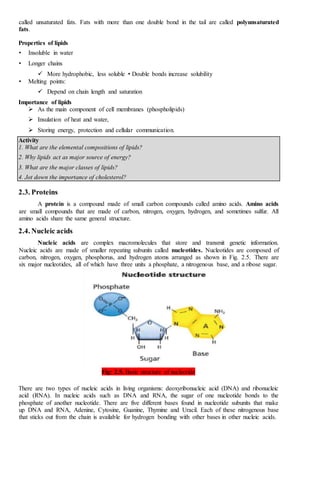
carbon, nitrogen, oxygen, phosphorus, and hydrogen atoms arranged as shown in Fig. 2.5. There are
six major nucleotides, all of which have three units a phosphate, a nitrogenous base, and a ribose sugar.
Fig: 2.5. Basic structure of nucleotide
There are two types of nucleic acids in living organisms: deoxyribonucleic acid (DNA) and ribonucleic
acid (RNA). In nucleic acids such as DNA and RNA, the sugar of one nucleotide bonds to the
phosphate of another nucleotide. There are five different bases found in nucleotide subunits that make
up DNA and RNA, Adenine, Cytosine, Guanine, Thymine and Uracil. Each of these nitrogenous base
that sticks out from the chain is available for hydrogen bonding with other bases in other nucleic acids.
Fig: 2.6. Nitrogenous bases
A nucleotide with three phosphate groups is adenosine triphosphate (ATP). ATP is a storehouse of
chemical energy that can be used by cells in a variety of reactions. It releases energy when the bond between the
second and third phosphate group is broken.
2.5. Vitamins
Vitamins are organic compounds that are needed in small amounts for metabolic activities.
Many vitamins help enzymes function well. Vitamin D is made by cells in your skin. Some B vitamins
and vitamin K are produced by bacteria living in the large intestine. Sufficient quantities of most
vitamins cannot be made by the body, but a well-balanced diet can provide the vitamins that are
needed. Some vitamins that are fat-soluble can be stored in small quantities in the liver and fatty
tissues of the body.
2.6 Water
Water molecules are formed by covalent bonds that link two hydrogen (H) atoms to one oxygen
(O) atom, and each water molecule has the same structure. It is one of the most plentiful and essential of
compounds, which is a tasteless and odorless, existing in gaseous, liquid, and solid states. It has the
important ability to dissolve and as a media for transportation of many other substances. In reality, the
versatility of water as a solvent is essential to living organisms, as well.
Water molecules have an unequal distribution of charges and are called polar molecules, meaning
that they have oppositely charged regions.
Activity (Think Scientifically)
1. What would have happened to the living things if the color of water was black or red?
2. Even if water exists on other planets but it couldn't support life but what is the mystery behind this
for the existence of life on earth?
2.7. Minerals
Minerals are inorganic compounds used by the body as building material, and they are involved
with metabolic functions. For example, the mineral iron is needed to make hemoglobin and it binds to
hemoglobin in red blood cells and is delivered to body cells as blood circulates in the body. Calcium,
and other minerals, is an important component of bones and is involved with muscle and nerve
functions and they serve as cofactors for enzymes. Magnesium is an important component of the
green pigment, chlorophyll, involved in photosynthesis.
Activity
1. Explain why raw edible oil is added on dishes of raw vegetables before consumption?
Summary of unit two
 Carbon compounds are the basic building blocks of living organisms.
 Biological macromolecules are formed by joining of small carbon compounds into polymers.
 There are four types of biological macromolecules; carbohydrates, proteins, lipids and nucleic
acids
 Monosaccharides undergo condensation to form disaccharides and poly saccharides through
the glycosidic linkages
 Peptide bonds join amino acids in proteins.
 Lipids are esters of fatty acids and alcohols  Chains of nucleotides form nucleic acids.
Chapter Review Questions
Explain if an unknown substance found on a meteorite is determined to contain no trace of
carbon, can scientists conclude that there is life at the meteorite's origin?
1. ist and compare the four types of biological macromolecules.
2. Identify the components of carbohydrates and proteins.
3. Discuss the importance of amino acid order to a protein‟s function.
4. Given the large number of proteins in the body, explain why the shape of an enzyme is
important to its function.
5. Compare and contrast the functions of carbohydrates, lipids, proteins, and nucleic acids.
6. State why the polarity of water molecules makes water a good solvent.
7. Given the large number of proteins in the body, explain why the shape of an enzyme is
important to its function?
Chapter Three
3. The cellular basis of life (4hrs)
In the late 1600‟s, an English scientist named Robert Hook was the first to observe plant cells
with a crude microscope. Then, almost a century and a half later, in the 1830‟s two German scientists
proposed that all living things are composed of cells (their names were Mathias Schleiden and
Theodore Schwann). A German pathologist, Rudolph Virchow extended this idea by contending that
cells arise only from other cells.
3.1. The cell theory
A cell is the basic structural and functional unit of living organisms. The activity of an organism
depends on both the individual and the collective activities of its cells. According to the principle of
complementarity of structure and function, the biochemical activities of cells are dictated by their
shapes or forms, and by the relative number of their specific sub-cellular structures. All cells arise
from pre-existing cells (continuity of life from one generation to another has a cellular basis).
A typical eukaryotic cell has 3 major parts:
 The plasma membrane: the outer boundary of the cell.
 The cytoplasm: the intracellular fluid packed with organelles, small structures that perform
specific cell functions.
 The nucleus: an organelle that controls cellular activities. Typically the nucleus resides near
the cell‟s center.
Fig: 3.1. Animal cell
3.2. Cell organelles
An organelle is a specialized subunit within a cell that has a specific function. In eukaryotes an
organelle is a membrane bound structure found within a cell.
3.3. Structure and function of organelles
The nucleus: This is distinctly oval or spherically shaped largest central structure surrounded
by a double-layered membrane. In the nucleus, DNA directs protein synthesis and serves as a genetic
blueprint during cell replication.
• .
The nucleus is surrounded by a nuclear envelope and contains chromatin and one or more nucleoli.
The Nuclear envelope
 surrounds nuclear material
 consists of outer and inner membrane
 perforated at intervals by nuclear pores
 through this pores most ions and water soluble molecules to transfer b/n nucleus and
cytoplasm.
Chromatin: The term chromatin means "colored material" and refers to the fact that this material is
easily stained for viewing with microscope, and it is composed mainly of coils DNA bound to basic
protein called his tones. The DNA is so long that it has to be packed in an organization manner or it
would get entangled like unraveled ball of string.
Nucleoli: The nuclei of most cells contain one or more lightly stained structures called nucleoli that
actively engage in synthesizing of ribosomes. The nucleolus, unlike most of the organelles, does not
have a limiting membrane. Instead, it is simply a structure that contains large amounts of RNA and
protein of the type found in ribosomes. The nucleolus becomes considerably enlarged when a cell is
actively synthesizing proteins.
The Cytoplasm: The cytosol is the material of cell interior not occupied by the nucleus, containing a
number of distinct, highly organized membrane-enclosed structures- the organelles- dispersed within a
complex jelly – like marrow called the „cytosol‟. All cells contain six main types of Organelles- the
endoplasmic reticulum, Golgi complex, lysosomes, peroxisomes, mitochondria, and vacules.
Fig:3.2. Endoplasmic reticulum
Endoplasmic reticulum (ER)
The endoplasmic reticulum is a fluid-filled membrane system extensively present throughout the
cytosol. The ER is one continuous organelle with many communicating channels. The two different
types are smooth endoplasmic reticulum and the rough ER.. The smooth ER is a meshwork of
interconnected tubules, whereas the rough ER projects outwards from the reticulum as stacks of
flattened sacs. Though different in structure and function, they are continuous with each other.
The rough Endoplasmic Reticulum: The outer surface of the rough ER contains dark particles called
ribosomes, which are ribosomal RNA protein complexes that produce protein under the direction of
nuclear DNA. Messenger-RNA carries the genetic message from the nucleus to the ribosomes
“workshop” where proteins are synthesized
Smooth Endoplasmic Reticulum: Since it does not have ribosomes, it looks „smooth‟ and does not
produce proteins. It serves a variety of other functions that differ in cell types. In most cells, the
smooth ER is sparse and serves in packaging and discharging site for protein molecules that are to be
transported from the ER.
Fig:3.3. Golgi apparatus
The Golgi Complex: The Golgi complex is elaborately associated with the ER and contains
sets of flattened, curved, membrane- enclosed sacs, or cisternae, stacked in layers. Number of stacks
vary in cells; cells specialized for protein secretion have hundreds of stacks, whereas some have only
one.
Lysosomes:
A lysosome fuses with the membrane of the internalized vesicle and releases its contents of
hydrolytic enzymes into the vesicle. These enzymes safely attack the microbes or other trapped
material within the enclosed confines of the vesicle without
damaging the remainder of the cell.
Lysosomes can take up old organelles such as mitochondria and break down into their component
molecules. Those molecules that can be released are reabsorbed into the cytosol, and the rest are
dumped out of the cell. The process by which worn-out organelles are digested is called autophagy a
human liver cell recycles about half its content every week. In the inherited condition known as
lysosomal storage disease (Tay-Sachs disease) lysosomes are not effective because they lack specific
enzymes. As a result, harmful waste products accumulate disrupting the normal function of cells, often
with fatal results
Peroxisome:
Peroxisome Is membrane-enclosed sacs containing oxidative enzymes and catalase that
detoxify various wastes. Oxidative enzymes need oxygen to remove hydrogen from specific
substance/molecule; such reactions are important in detoxifying various waste products within the cell
or foreign compounds that have entered in, such as ethanol consumed in alcoholic drinks (in liver and
kidneys). The major product generated is hydrogen peroxide; hydrogen peroxide itself is a powerful
oxidant. It also contains catalase, and antioxidant enzyme decomposing hydrogen peroxide into
harmless water and oxygen. This reaction is an important safety reaction that destroys deadly hydrogen
peroxide, at the site of production, thereby preventing possible devastating escape into the cytosol. It is
shorter and smoother than lysosome and several hundreds may present in one cell.
Mitochondria
Mitochondria are the “power houses” of a cell; they extract energy from nutrients in food and
transform it into usable form to energize cell activity. Their number varies depending on the energy
needs of each particular cell types. A single cell may have few hundreds or thousands. Mitochondria
are rod or oval shaped about the size of a bacterium. Each is enclosed by a double membrane - a
smooth outer that surrounds the mitochondria, and an inner membrane that forms a series of enfolding
or shelves called cristae, which project into an inner cavity filled with a jelly-like matrix
Fig. 3.5. Mitochondrial structure
Mitochondria are unusual organelles in two ways:
• In the matrix they have their own unique DNA called mitochondrial DNA.
• Mitochondria have the ability to replicate themselves even when the cell to which they belong
is not undergoing cell division.
Chloroplasts
Chloroplasts are useful organelles among plastids as they highly participate in the process of
photosynthesis which is a process by which plants synthesize their own food. They are located in outer
surface of the cell to receive enough light. Chloroplasts are green colored due to the chlorophyll
pigments found in its internal parts. Some of important characteristics of plant is its ability to carry out
photosynthesis as the way they use in making their own food and pass through converting light energy
in chemical energy.
Fig: 3.6. Structure of plant cell
Vesicles are membrane bound sacs that are used to store or transport substances around the cell.
Lysosomes are actually Vesicles.
Vacuoles are essentially larger Vesicles, and they are formed by the joining together of many Vesicles.
They are membrane bound organelles that have no specific shape and contain water with a number of
different compounds within it. Their function varies greatly depending on the type of cell they are part
of. In plant cells they are important in maintaining Turgor Pressure.
Cytoskeleton
The cytoskeleton is a complex protein network that act as the “bone and muscle” of the cell. This
necessary intracellular scaffoldings supports and organizes cellular components arrangements and to
control their movements; this provides distinct shape, size to the cell.
Plasma/cell membrane
The plasma membrane is extremely thin layer of lipids and proteins forming outermost boundary of
living cell and enclosing the intracellular fluid (ICF). It serves as a mechanical barrier that traps needed
molecules within the cell; plasma membrane plays an active role in determining the composition of
cell by selective permeability of substances to pass between the cell and its ECF environment.
Fig: 3.7. Structure of cell membrane
All plasma membrane are made up of lipids and proteins plus small amount of carbohydrates.
Phospholipids are most abundant with a lesser amount of cholesterol. Phospholipids have a polar
charged head having a negatively charged phosphate group and two non-polar (electrically neutral)
fatty acid tails. The polar end is hydrophilic (water loving) because it can interact with water molecule,
which is also polar; the non-polar end is hydrophobic (water fearing) and will not mix with water.
Such two-sided molecule self assemble into a lipid bilayer, a double layer of lipid molecules when in
contact with water.
Lipid bilayer forms the basic structure of the membrane, is a barrier to passage of watersoluble
substances between the ICF and ECF; and is responsible for the fluidity of the membrane.
Membrane proteins are variety of different proteins within the plasma membrane;
Fig: 3.8. Membrane protein
Membrane Carbohydrate: Short-chain carbohydrate on the outer membrane surface serves as self-
identity marker enabling cells to identify and interact with each other in the following ways:
• Recognition of “self” and cell-to-cell interactions. Cells recognize each other and form tissues;
complex carbohydrates act as a “trademark” of a particular cell type, for recognition.
• Carbohydrate-containing surface markers are important in growth. Cells do not overgrow their
own territory. Abnormal surface markers present in tumor cells, and abnormality may underline
uncontrolled growth.
• Some CAMS have carbohydrate, on the outermost tip where they participate in cell adhesion
activity.
Functions of biological membranes
The phospholipid bilayers provides the basic structure of the membrane and they also restrict entry and
exit of polar molecules and ion. The other molecules in the membrane have a variety of function:
• Channel protein and carrier protein: these proteins are involved in the selective transport of
polar molecule and ion across the membrane
• Enzymes: membrane proteins sometimes act as enzymes, For example, the microvilli on
epithelial cells lining some part of the gut contain digestive enzymes in their cell surface
membrane
• Receptor molecules: proteins have very specific shapes and this makes them ideal as receptor
molecules for chemical signaling between cells.
o For example, hormones are chemical messengers, which circulate in the blood but, only
bind to specific target cells, which have the correct receptors sites. Neurotransmitters,
the chemicals that enable nerve impules from one nerve cell to the next, also fit into
specific receptor proteins in nerve cells.
• Antigens: these act as cell identity markers or ''name tag''. They are glycoproteins that is
proteins with branching carbohydrates side chains like antennae. There is an enormous number
of possible shapes to these side chains, so each type of cell can have its own specific markers.
• Glycolipids- also have branching carbohydrate side chain and are involved in cell-cell
recognition. They may act as a receptor sites for chemical signals. With glycoproteins they
also involved in sticking the correct cell together in tissues. Eg. sperm recognition of ova
• Energy Transfer in photosynthesis and respiration proteins take part in the energy transfer
systems that exist in the membranes of chloroplast and mitochondria respectively.
• Cholosterole: acts like a plug, reducing even further the escape or entry of polar molecules
through the membrane.
3.4. Cellular diversity
Cells are found in different organisms, and are very diverse in their size, shape and their
internal structure and this also applies to cells found in the same organism. This diversity is influenced
by their roles and function within organism‟s body.
3.4.1. Cell Shape
Cells have different shapes due to appropriate function. It is possible to find other cells which
are flat, most of these cells are body cells and their function is protecting and covering body surface.
Nerve cells have long extensions. Skin cells have a shape which is flat. Egg cells have shape which is
like sphere, and some bacteria are rod in shape. Some plant cells are rectangular.
Fig: 3.9. Various types of animal cells (shape)
3.4.2 Cell Size
Some cell can be seen without using magnification instruments as they are enough to be seen by the
naked eye.
Example, egg of birds/reptiles and a neuron cell of giraffe, which is 2 meters in length.
3.5. Transport across the cell membranes
The plasma membrane is selectively permeable. Lipid-soluble substances and small ions can
passively diffuse through the plasma membrane down their electro-chemical gradients. Highly lipid-
soluble particles are able to dissolve in the lipid bilayer and pass through the membrane.
Uncharged/non-polar molecules oxygen, carbon dioxide and fatty acids are highly lipid-soluble and
readily permeate the membrane. There are 4 basic mechanisms:
1. Diffusion and facilitated diffusion
2. osmosis
3. active transport
4. bulk transport
Two forces are involved in facilitating movement across the plasma membrane:
1. Forces that do not require the cell to expend energy for movement – passive force
2. Forces requiring energy (as ATP) to be expended to transport across the membrane - active force
Diffusion
Diffusion is the net movement of molecules (or ions) from a region of their high concentration
to a region of their lower concentration. The molecules move down a concentration gradient.
Molecules have kinetic energy, which makes them move about randomly. All molecules in liquid and
gases are in continuous random motion in any direction as they have more room to move before
colliding with another. As a result of this haphazard movement, the molecules frequently collide
bouncing off each other in different directions.
The greater the concentration, the greater the likelihood of collision. Such a difference in concentration
in molecules between two adjacent areas is chemical /concentration gradient. The net movement of the
molecule by diffusion will be from the higher area of concentration to the area of lower concentration.
Certain additional factors that influence the rate of net diffusion across a membrane are:
1. permeability of the membrane
2. surface area of the membrane
3. molecular weight of the substance (lighter one diffuses rapidly)
4. distance through which diffusion must take place
N.B:- Increasing all the factors increases rate of net diffusion, except distance - thickness, that if
increased, decreases the rate of diffusion; and molecular weight if increased, decreases rate of
diffusion.
Fig: 3.10. Diffusion of liqiud
As a result of diffusion molecules reach an equilibrium where they are evenly spread out. This is when
there is no net movement of molecules from either side.
Movement along electrical gradient
Movement of charged particles is also affected by their electrical gradient. If a relative difference in
charges exist between two adjacent areas, the captions tend to move towards more negatively charged
area, whereas the anions tend to move toward the more positively charged areas. The simultaneous
existence of an electrical and concentration (chemical) gradient for a particular ion is referred to as an
electro-chemical gradient.
Fig: 3.11. Concentration difference (A) and difussion (B)
Fig:3.12. Diffusion of lipid molecules
Carrier- Mediated Transport
All carrier proteins span the thickness of the plasma membrane and are able to undergo reversible
changes in shape so that specific binding site can alternately be exposed at either side of the
membrane. As the molecule to be transported attaches to a binding site on the carrier on one side of the
membrane, it triggers a change in the carrier shape that causes the same site to be exposed to the other
side of the membrane. Their having movement in this way, the bound molecule detaches from the
carrier. This transport displays three characteristics:
1. Specificity: each cell possesses protein specified to transport a specific substance or few
closely-related chemical compounds amino acid cannot bind to glucose carrier, but similar
amino acids may use the same carrier. Type of carriers vary in cells. A number of inherited
disorders involve defects in transport system for a particular substance.
2. Saturation: in a given time only a limited amount of a substance can be transported via a
carrier; limited number of carrier site are available within a particular plasma membrane for a
specific molecule. This limit is known as transport maximum (Tm).
The substance‟s rate of transport across the membrane are directly related to its concentration.
When the Tm is reached, the carrier is saturated, and the rate of transport is maximum.
3. Competition: Several closely related compounds may compete for ride across the plasma
membrane on the same carrier.
Facilitated Diffusion
Facilitated diffusion uses a carrier protein to facilitate the transfer of a particular substance
across the membrane ''downhill'' from higher to lower concentration. This process is passive and does
not require energy because movement occurs naturally down a concentration gradient.
Phosphorylation and binding of particle on the low concentration side induces a conformational change
in the carrier protein so that passenger is now exposed to the high concentration side of the membrane.
Osmosis
Osmosis is the net diffusion of water down its own concentration gradient. Water can readily
permeate the plasma membrane. The driving force for diffusion of water is its concentration gradient
from area of higher water concentration (low solute) to the area of lower water (high solute)
concentration. This net diffusion of water is known as osmosis. Special mechanisms are used to
transport selected molecules unable to cross the plasma membrane on their own.
Fig:3.13. diffusion of water molecules
Fig. 3.14. diffusion of water molecules
Active transport
Active transport is energy consuming transport of molecules or ions across a membrane against its
natural tendency to diffuse in the opposite direction. The movement of molecules in active transport is
in one direction only; unlike diffusion that is reversible the energy is supplied by the broke down of
ATP, which energy carrier is made in respiration
Exocytocis and Endocytisis
Vesicular Transport The special cell membrane transport system selectively transports ions and small
polar molecules. But large polar molecules and even multimolecular material may leave or enter the
cell, such as hormone secretion or ingestion of invading microbe by leukocytes. These materials
cannot cross the plasma membrane but are to be transferred between the ICF and ECF not by usual
crossing but by wrapped in membrane. This process of transport into or out of the cell in a membrane-
enclosed vesicle is - vesicular transport. Vesicles formed are extremely small , in which case the
process is known as micropinocytosis and the vesicles as micropinocytic vesicles. Pinocytosis is used
by the human egg cell to take up nutrients from the surrounding follicle cells.
Fig: 3.16. Exocytosis
Exocytosis. is the reverse process of endocytosis. Waste materials such as solid and undigested
remains from phagocytic vacuoles may be removed from cells or useful materials may be secreted.
Secretion of enzymes from the pancreas is achieved in this way. Plant cells use exocytosis to export
the materials needed to form cell wall.
Activity
1. What is autophagy?
2. Describe the change in domination of types of plastids when a banana fruit gets ripened.
3. Describe the different sizes and shapes of cells? Why are so varied?
4. Compare and contrast respiration and biosynthesis.
5. write down roles of different components of cell membrane
6. How is osmotic condition of the body kept constant?
7. Which of the means of transport of materials in cells are active and which are passive?
What is the difference?
8. Differentiate endocytosis from exocytosis?
9. Explain the development of cell theory
10. What are the factors affecting the rate of diffusion?
Chapter Four Cellular Metabolismand Metabolic Disorders
4.1. Cellular metabolism
Living cells are in a constant activity. Macromolecules are assembled and broken down,
substances are transported across cell membranes, and genetic instructions are transmitted. All of these
cellular activities require energy.
Living organisms are unique in that they can extract energy from their environments and use it
to carry out activities such as movement, growth and development, and reproduction. But the basic
question is how living organisms or, their cells extract energy from their environments, and how cells
use this energy to synthesize and assemble the components from which the cells are made
Metabolism is thus the sum of chemical reactions that takes place within each cell of a living
organism and that provides energy for vital processes and synthesizing of new organic materials.
Broadly, these reactions can be divided into catabolic reactions that convert nutrients to energy and
anabolic reactions that lead to the synthesis of larger biomolecules.
Enzymes and their role in metabolism
Most chemical reactions within cells do not occur spontaneously. Instead, they need a catalyst to
get them started.
Why do you think this is so?
What are enzymes and why they are needed?
How do enzymes speed up chemical reactions?
What is activation energy?
Chemical nature and classification of enzymes
All known enzymes are proteins with the exception of recently discovered RNA enzymes. Some
enzymes may additionally contain a non-protein group. Enzymes are high molecular weight
compounds made up principally of chains of amino acids linked together by peptide bonds.
Many enzymes require the presence of other compounds (cofactors) before their catalytic activity can
be exerted. This entire active complex is referred to as the holoenzyme; i.e., apoenzyme (protein
portion) plus the cofactor (coenzyme, prosthetic group or metal-ionactivator). Thus, on the basis of
differences in chemical nature, the enzymes may be described as follows:
 Simple enzymes: Simple enzymes are made up of only protein (polypeptide). They contain no
chemical groups other than amino acid residues. Digestive enzymes such as pepsin, and trypsin
are of this nature.
 Conjugate Enzymes: It is an enzyme which is formed of two parts – a protein part called
apoenzyme (e.g., flavoprotein) and a non-protein part named cofactor. The complete conjugate
enzyme, consisting of an apoenzyme and a cofactor, is called holoenzyme.
 Metallo-enzymes: The metal cofactors involved in enzymic reactions are monovalent (K+) and
divalent cations (Mg++, Mn++ and Cu++). These may be loosely held by the enzyme, or as in
some cases, go into the composition of the molecule itself. If the metal forms part of the
molecule, as iron of haemoglobin or cytochrome is, the enzymes are called metallo-enzymes.
 Isoenzymes (Isozymes): At one time it was believed that an organism has only a single
enzyme for a given step of a metabolic reaction. It was later discovered that a substrate may be
acted upon by a number of variants of an enzyme producing the same product.
Classes of enzymes based on the substrate they act up on
Enzymes can be classified based on different criteria of which classification based on the substrate they
acted up on is the most common (Table 4.1).
Table4.1. Major classes of Enzymes
Mechanisms of enzyme action
Mechanisms of enzyme catalysis vary, but are all similar in principle to other types of chemical
catalysis in that the crucial factor is a reduction of energy barrier(s) separating the reactants from the
products.
An enzyme attracts substrates to its active site, catalyzes the chemical reaction by which products are
formed, and then allows the products to dissociate (separate from the enzyme surface). The
combination formed by an enzyme and its substrates is called the enzyme– substrate complex. The
substrates are attracted to the active site by electrostatic and hydrophobic forces, which are called
noncovalent bonds because they are physical attractions and not chemical bonds.
Do you recall enzyme models? Discuss on it in detail.
Activity
1. Graphically, show the relationship between enzyme activity and temperature.
2. What is the optimum temperature for most enzymes in the human body?
3. What do you know about a buffer and its importance in the body of organisms?
Substrate and enzyme concentration
Changing the enzyme and substrate concentrations affect the rate of reaction of an enzymecatalysed
reaction. Controlling these factors in a cell is one way that an organism regulates its enzyme activity
and so its metabolism. Changing the concentration of a substance only affects the rate of reaction if it
is the limiting factor. If it is the limiting factor, increasing concentration will increase the rate of
reaction up to a point, after which any increase will not affect the rate of reaction. This is because it
will no longer be the limiting factor and another factor will be limiting the maximum rate of reaction.
As a reaction proceeds, the rate of reaction will decrease, since the substrate will get used up.
Substrate concentration
Increasing substrate concentration increases the rate of reaction. This is because more substrate
molecules will be colliding with enzyme molecules, so more product will be formed.
However, after a certain concentration, any increase will have no effect on the rate of reaction, since
substrate concentration will no longer be the limiting factor. The enzymes will effectively become
saturated, and will be working at their maximum possible rate.
Enzyme concentration
Increasing enzyme concentration will increase the rate of reaction, as more enzymes will be colliding
with substrate molecules. However, this too will only have an effect up to a certain concentration,
where the enzyme concentration is no longer the limiting factor.
Enzyme inhibitors
Enzyme activity can be inhibited in various ways. Inhibition could be reversible or irreversible.
Reversible inhibition
Competitive inhibition: occurs when molecules very similar to the substrate molecules bind to the
active site and prevent binding of the actual substrate. Penicillin, for example, is a competitive
inhibitor that blocks the active site of an enzyme that many bacteria use to construct their cell walls.
Noncompetitive inhibition: occurs when an inhibitor binds to the enzyme at a location other than the
active site. In some cases of noncompetitive inhibition, the inhibitor is thought to bind to the enzyme in
such a way as to physically block the normal active site. In other instances, the binding of the inhibitor
is believed to change the shape of the enzyme molecule, thereby deforming its active site and
preventing it from reacting with its substrate. This latter type of noncompetitive inhibition is called
allosteric inhibition; This inhibition of an enzyme by a product of its pathway is a form of negative
feedback.
Irreversible inhibition
Irreversible inhibitors usually covalently modify an enzyme, and inhibition can therefore not be
reversed. Irreversible inhibitors often contain reactive functional groups. Irreversible inhibition is
different from reversible enzyme inactivation. Irreversible inhibitors are generally specific for one
class of enzyme and do not inactivate all proteins; they do not function by destroying protein structure
but by specifically altering the active site of their target
Activity
1.Describe other types of inhibition.
2.Relate the concept of irreversible enzyme inhibition to drug discovery and food poisoning.
3.Explain how painkillers like ibuprofen relieved you from pain.
4.What is the difference between endothermic and exothermic reaction?
5.What is meant by a catalyst?
6. Why are several enzymes needed in a typical metabolic path ways?
7. Which of the three ( coenzyme, cofactor, apoenzyme) is a protein?
8.Descibe three factors that that influence enzymatic activity.
Bioenergetics and biosynthesis
Cellular respiration
Most living organisms obtain energy by breaking down organic molecules (catabolism) during cellular
respiration. The function of cellular respiration is to harvest electrons from carbon compounds, such as
glucose, and use that energy to make Adenosine Tri Phosphate (ATP). ATP is used to provide
immediate energy for cells to do work. This catabolic process can be divided into 3 phases.
Phase I - Breakdown of large complex biomolecules like polysaccharides, proteins and lipids
into their respective building blocks (hydrolysis). The chemical reactions occurring during this
stage do not release much energy.
Phase II - These building blocks are usually oxidized to a common intermediate, acetyl - CoA.
Additionally, pyruvate or other citric acid cycle intermediates may also be formed (in
glycolysis and other pathways).
Phase III – This consists of the citric acid cycle (i.e. oxidation of acetyl - CoA to CO2,
formation of NADH and FADH2) followed by electron transport and oxidative
phosphorylation. Energy released by electron transport to O2 is coupled to ATP synthesis. This
cycle is responsible for the release of much energy ( TCA cycle and ETC).
Cellular respiration occurs in two main parts: glycolysis and aerobic respiration. The first stage,
glycolysis, is an anaerobic process. Anaerobic metabolic processes do not require oxygen. Aerobic
respiration includes the Krebs cycle and electron transport chain and is an aerobic process. Aerobic
metabolic processes require oxygen.
.
The Tricarboxylic Acid (TCA) Cycle (Phase III)
The TCA cycle also called Krebs or Citric acid cycle, is considered as central pathway of aerobic
metabolism, as it serves two purposes-bioenergetics and biosynthesis:
1. Bioenergetic - The cycle carries out complex degradation of acetyl group in acetyl - CoA to
CO2, resulting in release of energy (ATP or GTP) and reducing power (NADH and FADH2).
 TCA oxidizes two-carbon units, producing two molecules of CO2, one molecule of GP, and
high-energy electrons in the form of NADH and FADH2.
Steps of the Krebs cycle
Prior to the Krebs cycle, pyruvate first reacts with coenzymeA (CoA) to form a 2-carbon intermediate
called acetyl CoA. At the same time, carbon dioxide is released and NAD is converted to NADH.
Acetyl CoA then moves to the mitochondrial matrix. The reaction results in the production of two
carbon dioxide molecules and two NADH.
 The Krebs cycle begins with acetyl CoA combining with a 4-carbon compound to form a 6-
carbon compound known as citric acid.
 Citric acid is then broken down in the next series of steps, releasing two molecules of
carbon dioxide and generating one ATP, three NADH, and one FADH . FAD is another
electron carrier similar to NADH and NADPH.
 Finally, acetyl CoA and citric acid are generated and the cycle continues.
Fig: 4.2. The TCA cycle
Recall that two molecules of pyruvate are formed during glycolysis, resulting in two “turns” of the
Krebs cycle for each glucose molecule. The net yield from the Krebs cycle is six carbon dioxide
molecules, two ATP, eight NADH, and two FADH2 . NADH and FADH2 move on to play a
significant role in the next stage of aerobic respiration.
2. Biosynthesis - It supplies precursors for several biosynthetic pathways of amino acids,
pyrimidines, purines etc.
 As already mentioned, the TCA cycle is also an important source of biosynthetic precursors
 e.g. α-ketoglutarate and oxaloacetate are used for synthesis of a number of amino
acids like glutamic acid, asparatic acid etc.
 Succinyl - CoA is used to form porphyrin ring of cytochromes, chlorophyll etc.
 Oxaloacetate can also be converted to phosphoenolpyruvate, which is a precursor of
glucose.
 Acetyl - CoA is the starting material for fatty acid biosynthesis.
4.3.1.3.Electron Transport Chain
In aerobic respiration, electron transport is the final step in the break-down of glucose. It also is the
point at which most of the ATP is produced. High-energy electrons and hydrogen ions from NADH
and FADH2 produced in the Krebs cycle are used to convert ADP to ATP.
Fig:4.3. Electron Transport Chain
Activity
1.What is the overall chemical reaction of aerobic reparation?
2. How many ATP molecules are collected during electron transport chain and chemiosmosis from a single
glucose?
Biosynthesis
Biosynthesis is a multi-step, enzyme-catalyzed process where substrates are converted into more
complex products in living organisms. In biosynthesis, simple compounds are modified, converted into
other compounds, or joined together to form macromolecules. This process often consists of metabolic
pathways. Some of these biosynthetic pathways are located within a single cellular organelle, while
others involve enzymes that are located within multiple cellular organelles. Examples of these
biosynthetic pathways include the production of lipid membrane components and nucleotides.
Biosynthesis is usually synonymous with anabolism.
The prerequisite elements for biosynthesis include: precursor compounds, chemical energy (e.g. ATP),
and catalytic enzymes which may require coenzymes (e.g.NADH, NADPH). These elements create
monomers, the building blocks for macromolecules. Some important biological macromolecules
include: proteins, which are composed of amino acid monomers joined via peptide bonds, and DNA
molecules, which are composed of nucleotides joined via phosphodiester bonds.
Requirements of Biosynthesis
Sometimes all that is required for biosynthesis is for two substances to physically join together to make
a new physical substance, which is called a macromolecule.
A very simplified equation for biosynthesis of one form of macromolecule: two substances join
together to form a new, more complex substance.
i. Photosynthesis
Energy is transformed all around us every day. Batteries convert chemical energy into electric
energy, and radios convert electric energy into the energy carried by sound waves. Similarly, some
autotrophs convert light energy into chemical energy through photosynthesis.
The importance of photosynthesis
The processes of all organisms, from bacteria to humans require energy. To get this energy, many
organisms access stored energy by eating food. Carnivores eat other animals and herbivores eat plants.
But where does the stored energy in food originate? All of this energy can be traced back to the
process of photosynthesis and light energy from the sun. Photosynthesis is essential to all life on earth.
It is the only biological process that captures energy from outer space (sunlight) and converts it into
chemical energy in the form of Glyceraldehyde3-phosphate (G3P), which in turn can be made into
sugars and other organic compounds such as proteins, lipids, and nucleic acids. Plants use these
compounds in all of their metabolic processes; plants do not need to consume other organisms for food
because they build all the molecules they need. Unlike plants, animals need to consume other
organisms to consume the molecules they need for their metabolic processes.
The process of photosynthesis
During photosynthesis, molecules in leaves capture sunlight and energize electrons, which are then
stored in the covalent bonds of carbohydrate molecules. That energy within those covalent bonds will
be released when they are broken during cell respiration. How long lasting and stable are those
covalent bonds? The energy extracted today by the burning of coal and petroleum products represents
sunlight energy captured and stored by photosynthesis almost 200 million years ago.
The photosynthetic apparatus
Plastids
Photosynthetic eukaryotic organisms contain organelles called plastids in their cytoplasm. Plastids
generally contain pigments or can store nutrients. Colorless and
nonpigmented leucoplasts store fats and starch, while chromoplasts contain carotenoids and
chloroplasts contain chlorophyll.
Photosynthesis occurs in the chloroplasts; specifically, in the grana and stroma regions. The grana is
the innermost portion of the organelle; a collection of disc-shaped membranes, stacked into columns
like plates. The individual discs are called thylakoids. It is here that the transfer of electrons takes
place. The empty spaces between columns of grana constitute the stroma.
Chloroplasts are similar to mitochondria, the energy centers of cells, in that they have their own
genome, or collection of genes, contained within circular DNA. These genes encode proteins essential
to the organelle and to photosynthesis. Like mitochondria, chloroplasts are also thought to have
originated from primitive bacterial cells through the process of endosymbiosis.
Fig: 4.4. structure of chloroplast
Pigments
Pigments are molecules that bestow color on plants, algae and bacteria, but they are also responsible
for effectively trapping sunlight. Pigments of different colors absorb different wavelengths of light.
Below are the three main groups.
• Chlorophylls: These green-colored pigments are capable of trapping blue and red light.
Chlorophylls have three subtypes, dubbed chlorophyll a, chlorophyll b and chlorophyll c. There
is also a bacterial variant aptly named bacteriochlorophyll, which absorbs infrared light. This
pigment is mainly seen in purple and green bacteria, which perform anoxygenic
photosynthesis.
Fig: 4.5. basic structure of major photosynthetic pigments
• Carotenoids: These red, orange or yellow-colored pigments absorb bluish-green light.
Examples of carotenoids are xanthophyll (yellow) and carotene (orange) from which carrots get
their color.
• Phycobilins: These red or blue pigments absorb wavelengths of light that are not as well
absorbed by chlorophylls and carotenoids. They are seen in cyanobacteria and red algae.
Antennae
Pigment molecules are associated with proteins, which allow them the flexibility to move toward light
and toward one another. A large collection of 100 to 5,000 pigment molecules constitutes antennae.
These structures effectively capture light energy from the sun, in the form of photons.
Ultimately, light energy must be transferred to a pigment-protein complex that can convert it to
chemical energy, in the form of electrons. In plants, for example, light energy is transferred to
chlorophyll pigments. The conversion to chemical energy is accomplished when a chlorophyll pigment
expels an electron, which can then move on to an appropriate recipient.
Reaction centers
The pigments and proteins, which convert light energy to chemical energy and begin the process of
electron transfer, are known as reaction centers.
The photosynthetic process
The reactions of plant photosynthesis are divided into those that require the presence of sunlight and
those that do not. Both types of reactions take place in chloroplasts: lightdependent reactions in the
thylakoid and light-independent reactions in the stroma.
Light-dependent reactions (also called light reactions): When a photon of light hits the reaction
center, a pigment molecule such as chlorophyll releases an electron.
How does this generate energy?
The released electron manages to escape by traveling through an electron transport chain, which
generates the energy needed to produce ATP (adenosine triphosphate, a source of chemical energy for
cells) and NADPH. The "electron hole" in the original chlorophyll pigment is filled by taking an
electron from water. As a result, oxygen is released into the atmosphere.
Light-independent reactions (also called dark reactions and known as the Calvin cycle): Light
reactions produce ATP and NADPH, which are the rich energy sources that drive dark reactions.
Although NADPH and ATP provide cells with large amounts of energy, these molecules are not stable
enough to store chemical energy for long periods of time. Thus, there is a second phase of
photosynthesis called the Calvin cycle in which energy is stored in organic molecules such as glucose.
Three chemical reaction steps make up the Calvin cycle: carbon fixation, reduction and regeneration.
These reactions use water and catalysts. The carbon atoms from carbon dioxide are ''fixed,'' when they
are built into organic molecules that ultimately form three-carbon sugars. These sugars are then used to
make glucose or are recycled to initiate the Calvin cycle again.
Fig:4.6. Calvin cycle
Because rubisco converts inorganic carbon dioxide molecules into organic molecules that can be used
by the cell, it is considered one of the most important biological enzymes. Plants use the sugars formed
during the Calvin cycle both as a source of energy and as building blocks for complex carbohydrates,
including cellulose, which provides structural support for the plant.
Scientific Tips!!
Photosynthesis in the future
Photosynthetic organisms are a possible means to generate clean-burning fuels such as hydrogen or even methane.
Recently, a research group at the University of Turku in Finland, tapped into the ability of green algae to produce
hydrogen. Green algae can produce hydrogen for a few seconds if they are first exposed to dark, anaerobic (oxygen-free)
conditions and then exposed to light. The team devised a way to extend green algae's hydrogen production for up to three
days, as reported in their 2018 study published in the journal Energy and Environmental Science.
Scientists have also made advances in the field of artificial photosynthesis. A group of researchers from the University of
California, Berkeley, developed an artificial system to capture carbon dioxide using nanowires, or wires that are a few
billionths of a meter in diameter. The wires feed into a system of microbes that reduce carbon dioxide into fuels or
polymers by using energy from sunlight. The team published its design in 2015 in the journal Nano Letters.
In 2016, members of this same group published a study in the journal Science that described another artificial
photosynthetic system in which specially engineered bacteria were used to create liquid fuels using sunlight, water and
carbon dioxide. In general, plants are only able to harness about one percent of solar energy and use it to produce organic
compounds during photosynthesis. In contrast, the researchers' artificial system was able to harness 10 percent of solar
energy to produce organic compounds.
Continued research of natural processes, such as photosynthesis, aids scientists in developing new ways to utilize various
sources of renewable energy. Seeing as sunlight, plants and bacteria are all ubiquitous, tapping into the power of
photosynthesis is a logical step for creating clean-burning and carbon-neutral fuels.
4.4. Metabolic disorders, diagnosis and treatments
Metabolism is the breaking down of food to its simpler components: proteins, carbohydrates
(or sugars), and fats. Metabolic disorders occur when these normal processes become disrupted.
Disorders in metabolism can be inherited, in which case they are also known as inborn errors of
metabolism, or they may be acquired during your lifetime.
Inherited metabolic disorders
Inherited metabolic disorders are one cause of metabolic disorders, and occur when a defective gene
causes an enzyme deficiency. These diseases, of which there are many subtypes, are known as inborn
errors of metabolism. Metabolic diseases can also occur when the liver or pancreas do not function
properly.
There are numerous examples of inherited metabolic disorders, which can be classified based on the
type of food-related building block that they affect, including amino acids (the building block for
proteins), carbohydrates, and fatty acids (the building block for fats). Inherited causes of metabolic
disorders include:
• Carbohydrate disorders; examples include Diabetes insipidus, hereditary fructose
intolerance, galactosemia, pyruvate metabolism disorders, von Gierke‟s disease, McArdle
disease, Pompe‟s disease, and Forbes‟ disease
• Fatty acid oxidation defects; examples include Gaucher‟s disease, Niemann-Pick disease,
Fabry‟s disease, and medium-chain acyl-coenzyme A dehydrogenase (MCAD) deficiency
• Amino acid disorders; examples include Tay-Sachs disease, phenylketonuria, tyrosinemia,
maple syrup urine disease, and homocysteine Acid-base imbalance, Disorders of calcium
metabolism, DNA repair-deficiency disorders, Iron metabolism disorders, Mitochondrial diseases,
Phosphorus metabolism disorders, Malabsorption syndromes, Water-electrolyte imbalance are
some of the disorders associated with metabolism.
Activity
1. What are the risk factors of metabolic disorders?
2. How are metabolic disorders treated?
3. Write down the common metabolic disorders and their symptoms.
CHAPTER FIVE
Control of Gene expression
Genes are switched on by "transcription factors"- are proteins that bind to a regulatory
sequence of DNA near to the gene they influence. They operate in the following way: The
transcription factors bind to a promoter sequence of DNA near the gene to be activated. RNA
polymerase binds to the DNA/ transcription factor complex. The RNA polymerase activated and
moves away from the DNA along the gene. They don‟t act on the gene itself, but interfere/silence the
mRNA once it has been transcribed from DNA.
Mutations
Mutation is the alteration of the nucleotide sequence of the genome of an organism, virus, or
extrachromosomal DNA.
 Mutation could occur spontaneously (accidentally) during duplication.
 They are rare events.
 Each cell contains 6x10⁹/billion/ base parts occurrence
 Each new cell has an average 120 mutations. But
 Most mutations detected & repaired
 95% of our DNA is non-coding, most mutation unlikely to affect coding gens.
 Rate of mutations can be increased by:-  Carcinogenic - chemical in tobacco smoke
 High energy radiation- ultraviolet radiation, x- ray
There are many different ways that DNA can be changed, resulting in different types of mutiation as
described below:
1. Point mutations- changes that involves a single base. There are several types of point mutations,
some of these are:
 Substitution- one base is replaced by other base  Addition-a base is missed
out during DNA replication.
 Deletions – an extra base is added.
2. Chromosomal Mutations- situation where part /segment/ of a chromosome sequence of DNA is
disturbed/ a chromosome is missed/added. Types of chromosomal mutations:
 Euploidy/polyploidy/-is a condition where an organism/ a cell has one complete set of extra
chromosomes/an exact multiple of a complete set.
 Aneuploidy – is a condition where an organism/a cell lost from or added to one or more
chromosomes to/the normal set of chromosome
Gidu syndrome = mental retardation – caused by part of deletion of chromosome number 5 of
man.
Consequence of gene-mutations
Mutations on body cell (non- sex cell) cannot be inherited but may result in one of the following:
 harmless
 damage the cell
 kill the cell
 make cell cancerous- which might kill the person.
Mutations in different genes will obviously produce different effects but two types of gene are
important in regulating cell division and preventing the formation of a tumor.
a. Proto-oncogenes-when proto-oncogenes mutate,they often become active oncogeneswhich
stimulate cell to divide in an uncontrolled manner.
b. Tumor-suppressor genes- recognize this uncontrolled cell division and act to suppress cell division.
 If these genes mutate and become inactive, a tumor will form as uncontrolled cell division
continues.
 Tumor-is a mass of cells created when cell replication gets out of control and cause cancer.
CHAPTER SIX
Infection and Disease
The terms "infection" and "disease" are not synonymous. An infection results when a infectious agent
(pathogen) enters and begins growing within a host.
Disease occurs when the cells in host body are damaged, tissue function is impaired as a result of the
infection and signs and symptoms of an illness appear.
Sign, symptom and syndrome
 Symptom: A change in body function that is felt by a patient as a result of disease  Sign: A
change in a body that can be measured or observed as a result of disease.
Signs (objective) Symptoms (subjective)
 Syndrome: A specific group of signs and symptoms that accompany a disease
Classifying infectious diseases
• Communicable disease: A disease that is spread from one host to another
• Contagious disease: A disease that is easily spread from one host to another
• Non-communicable disease: A disease that is not transmitted from one host to another
Classifying infectious diseases by occurrence of diseases
• Incidence: fraction of a population that contracts a disease during a specific time
• Prevalence: fraction of a population having a specific disease at a given time
• Sporadic disease: disease that occurs occasionally in a population
• Endemic disease: disease constantly present in a population
• Epidemic disease: disease acquired by many hosts in a given area in a short time
• Pandemic disease: worldwide epidemic
Severity or duration of infectious disease
Scope of infectious disease can be defined as :-
• Acute: disease develops rapidly
• Chronic: disease develops slowly
• Subacute: symptoms appear between acute and chronic
• Latent: disease with a period of no symptoms when the causative agent is inactive
Extent of host involvement:
An Infection of Infectious diseases can be
• Local infection: Pathogens are limited to a small area of the body
• abscesses
• Systemic infection: an infection throughout the body by blood and/or lymph
• Bacteremia: bacteria in the blood
• Sepsis: toxic inflammatory condition arising from the spread of microbes, especially
bacteria or their toxins, from a focus of infection
• Septicemia: growth of bacteria in the blood
• Toxemia: toxins in the blood
• Viremia: viruses in the blood
• Focal infection: systemic infection that began as a local infection
• local tooth infection can moves via blood or lymph to set up a new infection at another
site - rheumatoid arthritis
• Primary: acute infection causing initial illness
• Secondary: occurs after host is weakened from primary infection
• Subclinical (inapparent): no noticeable signs and symptoms
Disease development and stages
• Incubation period: time interval between initial infection and first appearance of
signs and symptoms.
• Prodromal period: characterized by appearance of first mild signs and symptoms.
• Period of illness: disease at its height: all disease signs and symptoms apparent.
• Period of decline: signs and symptoms subside.
 Period of convalescence: body returns to prediseased state, health is restored.
Fig: 6.1 Disease development and stages
Pathogenicity
Vast majority generate no ill effects and relatively few are pathogens that cause damage. These
microorganisms are classified based on their pathogenicity:-
Primary pathogen is microbe or virus that causes disease in otherwise healthy individual .
Diseases such as plague, malaria, measles, influenza, diphtheria, tetanus, tuberculosis, etc. These
pathogenic organisms are called virulent because of their virulence factor. Virulence refers to a degree
of pathogenicity, which is caused by virulence factors are traits that allow microorganism to cause
disease.
Opportunistic pathogen (opportunist) causes disease only when body‟s innate or adaptive
defenses are compromised or when introduced into unusual location. It can be members of normal
microbiota or common in environment (e.g., Pseudomonas).
Normal microbiota (normal flora) are organisms that routinely reside on body‟s surfaces and
the relationship is delicate balance and some can cause disease if opportunity arise. This is due to the
fact that weaknesses or defects in innate or adaptive defenses can leave individuals vulnerable to
invasion.
• These individuals are said to be immune-compromised
• Factors include malnutrition, cancer, AIDS or other disease, surgery, wounds, genetic defects,
alcohol or drug abuse, and immunosuppressive therapy following procedures such as organ
transplants.
Activity: -
1. Discuss the differences between:- • Infection and diseases
• Sign and Symptom
• Incidence and prevalence
• Endemic and epidemic
• Acute and Chronic
• Primary and secondary infection
Types of infectious disease and their causative agent
Bacteria, viruses, fungi, protozoa, parasites, and prions are different types of pathogen. They vary in
their size, shape, function, genetic content, and how they act on the body. For example, viruses are
smaller than bacteria, and they can enter a host and take over cells. However, bacteria can survive
without a host.
The common pathogens known as causative agents for different types of infectious diseases are:-
Bacteria
Bacteria are unicellular prokaryotic organisms; they have circular genomes, double-stranded
DNA that is associated with much less protein than eukaryotic genomes. Most bacteria reproduce by
growing and dividing into two cells in a process known as binary fission. The energy sources for
bacteria also vary. Some bacteria are photosynthetic and obtain their energy directly from the sun.
Others oxidize inorganic compounds to supply their energy needs. Still other bacteria generate energy
by breaking down organic compounds such as amino acids and sugars in a respiratory process. Some
bacteria require oxygen (aerobes), while others are unable to tolerate it (anaerobes). Some bacteria can
grow either with or without oxygen (facultative anaerobes).
Bacteria are frequently divided into two broad classes based on their cell wall structures,
which influences their Gram stain reaction. Gram-negative bacteria appear pink after the staining
procedure. Familiar pathogenic gram-negative organisms are Salmonella typhi, which causes typhoid
fever, and Yersinia pestis, which causes plague. Gram-positive bacteria appear purple after the Gram
staining procedure.
Viruses
Viruses can infect all organisms, from plants and animals to fungi and bacteria. Viruses,
however, are not organisms themselves because, apart from a host cell, they have no metabolism and
cannot reproduce. A virus particle is composed of a viral genome of nucleic acid that is surrounded by
a protein coat called a capsid.
Viruses cause disease by disrupting normal cell function. They do this in a variety of ways.
Some viruses make repressor proteins that stop the synthesis of the host cell's proteins, RNA, and
DNA. Viruses are classified using a variety of criteria, including shape, size, and type of genome.
Among the DNA viruses are the herpes viruses that cause chicken pox, cold sores, and painful genital
lesions, and the poxvirus that causes smallpox.
Antibiotics are not effective against viruses. Using antibiotics against a virus will not stop the
virus, and it increases the risk of antibiotic resistance. Most treatment aims to relieve symptoms
while the immune system combats the virus without assistance from medicine.
Fungi
Fungi are eukaryotic, heterotrophic organisms that have rigid cellulose- or chitin-based cell
walls and reproduce primarily by forming spores. Most fungi are multicellular, although some, such as
yeasts, are unicellular. Together with bacteria, fungi fulfill the indispensable role of decomposers in
the environment. Many fungal infections will appear in the upper layers of the skin, and some progress
to the deeper layers. Inhaled fungal spores can lead to systemic fungal infections, such as thrush, or
candidiasis. Systemic diseases affect the whole body.
Those with a higher risk of developing a fungal infection include people who:
• use strong antibiotics for a long time
• have a weakened immune system, due, for example, to HIV or AIDS, diabetes, chemotherapy
treatment, and those who have undergone a transplant, as they take medications to prevent their
body from rejecting the new organ
Protozoa
Protozoa are unicellular, heterotrophic eukaryotes that include the familiar amoeba and
paramecium. Because protozoa do not have cell walls, they are capable of a variety of rapid and
flexible movements. Protozoa can be acquired through contaminated food or water or by the bite of an
infected arthropod such as a mosquito. Diarrheal disease can be caused by two common protozoan
parasites, Giardia lamblia and Cryptosporidium parvum. Malaria, a tropical illness that causes 300
million to 500 million cases of disease annually, is caused by different species of the protozoan
Plasmodium.
Helminths
Helminths are simple, invertebrate animals, some of which are infectious parasites. They are
multicellular and have differentiated tissues. Because they are animals, their physiology is similar in
some ways to ours. This makes parasitic helminth infections difficult to treat because drugs that kill
helminths are frequently very toxic to human cells.
Many helminths have complex reproductive cycles that include multiple stages, many or all of
which require a host. The common helminthes are Ascaries, tape worm, hook worm Schistosoma etc.
Summary
The Innate immune system is the first line of defense’ which is present at birth and changes
little throughout the life of the individual. The cells and molecules of this innate system are
mainly responsible for the first stages of expulsion of the microbe .
Some of the most important cells in the innate immune system are phagocytes, since they are
able to ingest and kill microbes. In general the innate immunity includes:-
• Anatomical and physiological barriers
• Cellular defense (phagocytosis and extracellular killing)
• Inflammation
• The complement system
• Normal flora
Specific mechanisms of host resistance (Adaptive defense)
When these nonspecific mechanisms fail, the body initiates a second, specific line of defense.
Adaptive immune system is brought into action even as the innate immune system is dealing with the
microbe, and especially if it is unable to remove the invading microbe.
This specific immune response enables the body to target particular pathogens and pathogen
infected cells for destruction. It depends on specialized white blood cells called lymphocytes and
includes T-cells (produced from lymphocytes that matured in the thymus gland) and Bcells (produced
from lymphocytes that matured in the bone marrow).
The two complementary components of the specific immune response are the cell-mediated
response and the antibody-mediated response:
1. The cell-mediated response involves T-cells and is responsible for directly destroying
body cells that are infected with a virus or have become cancerous, or for activating
other immune cells to be more efficient microbe killers.
2. The antibody-mediated response involves both T-cells and B-cells and is critical for
the destruction of invading pathogens as well as the elimination of toxins.
The cell-mediated response occurs when the lymphokines released from the helper T-cells
stimulate other cell types to participate in the immune response. Lymphokine-stimulated killer T-cells
attach to the pathogen-infected cells and destroy them, whereas lymphokine-activated phagocytic cells
produce more toxic molecules that can kill the pathogen directly.
The antibody-mediated response occurs when the lymphokines activate specific B-cells to
produce antibodies (proteins that specifically recognize and bind to antigens). These antibodies attach
to antigens on the surface of the pathogens and signal attack by phagocytic cells and complement
system. Other B-cells go on to become memory B-cells, which respond quickly by producing more
antibodies upon subsequent infection.
The branches of acquired immunity :-
I. Humoral or Antibody-mediated immunity
• Consists of antibodies circulating in the fluids of the body
• Targets are mainly extracellular microbes and parasites
• Produced by B-lymphocytes
II. Cellular or Cell-mediated immunity
• Mediated by lymphocytes (T-cells) themselves
• Targets – virus or parasite-infected cells, cancer cells, foreign graft cells
• Can act directly by lysing foreign cells or indirectly by releasing chemicals that enhance the
inflammatory response or activate other lymphocytes or macrophages.
Fig: 6.2 overview of cell-mediated and antibody-mediated immune responses
Interaction between innate and adaptive immunity
The innate and adaptive immune system have different types of cells and molecules, which
are responsible for the two different types of immune systems. In addition they have different
characteristics as it is explained above:-
The cells, molecules and characteristics of innate and adaptive immune systems are summarized in the
table below.
Table 6.1. The innate and adaptive immunity
Characteristics Cells Molecules
Innate immunity
Responds rapidly
Present at birth
Has no specificity
No memory Mast cells
Phagocytes (PMNs and macrophages)
Dendritic cells
Natural killer cells
Cytokines
Complement
Acute phase
proteins
Adaptive immunity
Highly specific
Slow to start
Has Memory
Adaptiveness
T and B cells Antibodies
Cytokines
Autoimmunity and autoimmune disease
Self test
1. What are the factors responsible for autoimmune diseases?
2. What do we mean by self tolerance
Autoimmunity is an acquired immune reactivity to self antigens which lead to tissue damage.
Normally, the immune system can tell the difference between foreign cells and your own cells. In the
case of an autoimmune disease, the immune system mistakes part of your body, like joints or skin, as
foreign. It releases proteins called auto-antibodies that attack healthy cells.
There are more than 80 different autoimmune diseases but here are 14 of the most common ones.
Type 1 diabetes:-The pancreas produces the hormone insulin, which helps regulate blood
sugar levels. In type 1 diabetes mellitus, the immune system attacks and destroys insulinproducing
cells in the pancreas. High blood sugar results can lead to damage in the blood vessels, as well as
organs like the heart, kidneys, eyes, and nerves.
Rheumatoid arthritis (RA):-In rheumatoid arthritis (RA), the immune system attacks the
joints. This attack causes redness, warmth, soreness, and stiffness in the joints. Unlike osteoarthritis,
which commonly affects people as they get older, RA can start as early as your 30s or sooner.
Psoriasis/psoriatic arthritis:- Skin cells normally grow and then shed when they‟re no longer
needed. Psoriasis causes skin cells to multiply too quickly. The extra cells build up and form inflamed
red patches, commonly with silver-white scales of plaque on the skin. Some people with psoriasis also
develop swelling, stiffness, and pain in their joints. This form of the disease is called psoriatic arthritis.
Multiple sclerosis:-Multiple sclerosis (MS) damages the myelin sheath, the protective coating
that surrounds nerve cells, in your central nervous system. Damage to the myelin sheath slows the
transmission speed of messages between your brain and spinal cord to and from the rest of your body.
Systemic lupus erythematosus (SLE):-Although doctors in the 1800s first described lupus as a
skin disease because of the rash it commonly produces, the systemic form, which is most the common,
actually affects many organs, including the joints, kidneys, brain, and heart. Joint pain, fatigue, and
rashes are among the most common symptoms.
Inflammatory bowel disease:-Inflammatory bowel disease (IBD) is a term used to describe
conditions that cause inflammation in the lining of the intestinal wall.
Addison’s disease:-Addison‟s disease affects the adrenal glands, which produce the hormones
cortisol and aldosterone as well as androgen hormones. Having too little of cortisol can affect the way
the body uses and stores carbohydrates and sugar (glucose). Deficiency of aldosterone will lead to
sodium loss and excess potassium in the bloodstream. Symptoms include weakness, fatigue, weight
loss, and low blood sugar.
Graves’ disease:-Graves‟ disease attacks the thyroid gland in the neck, causing it to produce
too much of its hormones. Thyroid hormones control the body‟s energy usage, known as metabolism.
Having too much of these hormones revs up your body‟s activities, causing symptoms like
nervousness, a fast heartbeat, heat intolerance, and weight loss.
Sjogren’s syndrome:-This condition attacks the glands that provide lubrication to the eyes and
mouth. The hallmark symptoms of Sjogren‟s syndrome are dry eyes and dry mouth, but it may also
affect the joints or skin.
Hashimoto’s thyroiditis:-In Hashimoto‟s thyroiditis, thyroid hormone production slows to a
deficiency. Symptoms include weight gain, sensitivity to cold, fatigue, hair loss, and swelling of the
thyroid (goiter).
Myasthenia gravis:- affects nerve impulses that help the brain control the muscles. When the
communication from nerves to muscles is impaired, signals can‟t direct the muscles to contract. The
most common symptom is muscle weakness that gets worse with activity and improves with rest.
Often muscles that control eye movements, eyelid opening, swallowing, and facial movements are
involved.
Autoimmune vasculitis:-Autoimmune vasculitis happens when the immune system attacks
blood vessels. The inflammation that results narrows the arteries and veins, allowing less blood to flow
through them.
Pernicious anemia:- This condition causes deficiency of a protein, made by stomach lining
cells, known as intrinsic factor that is needed in order for the small intestine to absorb vitamin
B-12 from food. Pernicious anemia is more common in older adults. According to a 2012 study, it
affects 0.1 percent of people in general, but nearly 2 percent of people over age 60.
Celiac disease People with celiac disease can‟t eat foods containing gluten, a protein found in
wheat, rye, and other grain products. When gluten is in the small intestine, the immune system attacks
this part of the gastrointestinal tract and causes inflammation.
Factors contributing for autoimmune diseases:
• Age, Auto-antibodies are more prevalent in older people and
• Gender women have a greater risk than men for developing an autoimmune disease.
• Genetic factor Antigen-specific autoimmune phenomena cluster in certain families.
– Particular HLA genes are associated with certain autoimmune diseases
• Infections
– Many infectious agents (EBV, mycoplasma, streptococci, klebsiella, malaria, etc.)
– have been linked to particular autoimmune diseases and may be important in their
etiology.
• Nature of the auto antigen.
– Target antigens are often highly conserved proteins such as heat shock proteins
(HSPs), stress proteins, enzymes, or their substrates.
Immune Deficiencies
The immunological disorders can be caused by the deficiency of immune response of the host
body or the excessive production of the host immune system. Immune deficiencies occur when one or
more components of the immune system is defective. It is classified as primary or secondary.
Primary immunodeficiency
It is congenital because of genetic disorder, which caused by mutations affecting any of a large
number of genes that control the expression and activities of immune responses. Most present in clinic
as a recurrent or overwhelming infections in very young children. May affect either the acquired or
innate immune system. In other way this defect can affect in either the lymphoid or the myeloid
lineages.
Defects in lymphoid lineage: - May involve B-cell, T-cell or both.
The severity depends on the number and type of immune components involved.
• B- cell immunodeficiency: associated with recurrent bacterial infections but may be normal
immunity to viruses and fungi.
• T-cell deficiencies: can affect both cell and humoral immunity. Do not response to various
types of pathogens.
Defects in myeloid linage: Affect innate immunity, especially phagocytic activity.
• Chronic granulomatos disease (CGD). It Leads to recurrent or persistent intracellular infections
and granuloma formation. Genetically heterogeneous deficiency disorder resulting from the
inability of phagocytes to kill microbes they have ingested. Have a higher prevalence of
mucosal inflammatory disorders such as colitis, enteritis, etc.
• Complement deficiencies, this one associated with increased susceptibility to bacterial or
fungal infection and/or immune complex disease.
Secondary immunodeficiency
This type is acquired secondary to some agents after birth, more common in malnutrition,
infection, cancer, etc. Patients treated by immunosuppressive drugs. The good example is HIV that
cause AIDS.
Activity
1. What is the main difference between hypersensitivity and autoimmunity?
2. Give example for each of the four types of hypersensitivity
3. Give at least four examples of common systemic autoimmune diseases
4. Explain about how HIV/AIDs results in immune-deficiency
Tumor Immunology
A tumor is a mass of tissue that's formed by an accumulation of abnormal cells. Tumor cells grow,
even though the body does not need them, and unlike normal old cells, they don't die.
Cancer is a disease in which cells, almost anywhere in the body, begin to divide uncontrollably. A
tumor is when this uncontrolled growth occurs in solid tissue such as an organ, muscle, or bone.
Tumors may spread to surrounding tissues through the blood and lymph systems.
Most cancers form a lump called a tumor or a growth. Lumps that are not cancer are called benign.
Lumps that are cancer are called malignant. There are some cancers, like leukemia (cancer of the
blood), that don't form tumors.
Tumor associated antigens
In order for the immune system to react against a tumor, the latter must have antigens that are
recognized as a foreign. A number of alterations in gene expression occur in cells during
tumorigenesis. Tumorigenesis may lead to expression of new antigens (neoantigens) or alteration in
existin/g antigens that are found on normal cells. These antigens may include membrane receptors,
regulators of cell cycle and apoptosis, or molecules involved in signal transduction pathways.
There are 2 main types of tumor antigens:
• Tumor-specific transplantation antigens (TSTA) which are unique to tumor cells and not
expressed on normal cells. They are responsible for rejection of the tumor.
• Tumor associated transplantation antigens (TATA) that are expressed by tumor cells and
normal cells.
Energy flow through ecosystems
The transfer of energy from the source in plants through a series of organisms by eating and being
eaten constitutes food chains. At each transfer, a large proportion of energy is lost in the form of heat.
These food chains are not isolated sequences, but are interconnected with each other. This interlocking
pattern is known as the food web. Each step of the food web is called a trophic level. Hence green
plants occupy the first level, herbivores the second level, carnivores the third level and secondary
carnivores the fourth level. These trophic levels together form the ecological pyramid.
1. The food chains
The transfer of food - energy from plants to animals and then to other animals by successive
stage of feeding is called a food chain. The cyclic interdependence of one trophic level over the others
forms a food chain. A food chain is also defined as "the sequence of organisms that are related to each
other for their source of food." In an ecosystem, energy is transferred through a series of organisms,
each feeding on the preceding organisms and providing raw materials and energy for the next
organisms. Each stage of the food chain is known as trophic level. The first trophic level is occupied
by the autotrophic organisms, so they are called producers.
In nature, basically two types of food chains are recognized: They are:
1. grazing food chain
2. detritus food chain.
The food web
Self test
1. What does food web mean? How it is different from food chain?
a. Grazing food chain: starts from the living green plants and goes to grazing herbivores and
on to the carnivores. Ecosystems with such type of food chain are directly dependent on an influx of
solar radiation. Thus, this type of food chain depends on autotrophic energy capture and the movement
of this energy to herbivores. Most of the ecosystems in nature follow this type of food chain. These
chains are very significant from energy standpoint.
The following are examples of grazing food chain:
1. Aquatic food chain: Phytoplanktons zooplanktonsfish
2. Terrestrial food chain :GrassesRabbitfox
b. Detritus food chain The organic wastes, exudates and dead matter derived from the grazing
food chain are generally termed as detritus. The energy contained in this detritus is not lost to the
ecosystem as a whole; rather it serves as the source of energy for a group of organisms (detritivores)
that are separated from the grazing food chain. The detritus food chain represents an exceedingly
important component in the energy flow of an ecosystem. The organisms of the detritus food chain are
many and include algae, bacteria, slime molds, actinomycetes, fungi, protozoa, insects, mites,
crustacea, centipedes, mollusks, rotifers, annelid worms, and nematodes.
In an ecosystem there are a very large number of interlinked chains and forms a food web. Stability of
the ecosystem is maintained by food web. If the linkages in the chains that make up the web of life are
disrupted due to human activities that lead to the extinction of species, the web will breaks down.
Fig: 8.3. Food web
Ecosystem productivity
Productivity in land ecosystems generally rises with temperature about 30oC, after which it
declines, and is positively correlated with moisture. On land primary productivity is highest in warm,
wet zones in the tropics where tropical forest biomes are located. In contrast, desert scrub ecosystems
have the lowest productivity because their climates are extremely hot and dry.
A. Primary production
The flow of energy through a terrestrial ecosystem starts with the harnessing of sunlight by green
plants, a process that in itself demands the expenditure of energy. A plant gets its start by living on the
food energy stored in the seed until it produces leaves. Energy accumulated by plants is called primary
production, because it is the first and basic form of energy stored. The energy left over from
maintenance and respiration goes into production, including both the growth of new tissues and the
production of young. This net energy of production is called secondary production.
Activities:
1. How does energy flow occur from one organism to another?
2. How many trophic levels can an ecosystem support?
3. Why do primary consumers get more energy than secondary consumers?
4. How much energy does a consumer obtain from producer?
Ecological pyramid
Ecological pyramid is the graphic representation of the number, biomass and energy of the
successive trophic levels of an ecosystem. The concept of ecological pyramid was first described by
Charles Elton. Ecological pyramids represent the trophic structure (feeding relationships) and trophic
function (efficiency of energy transfer through biotic components) of an ecosystem.
Types of ecological pyramid
I) Pyramid of number depicts the number of individual organisms at different trophic levels of
food chain.
II) Pyramid of biomass depicts the amount of biomass at different trophic levels of food chain or
the total weight of living matter per unit area present in the ecosystem.
III) Pyramid of energy depicts the amount of energy at different trophic levels of food chain. It
shows how energy moves throughout an ecosystem. As you move up the pyramid levels,
approximately 90% of the food‟s original energy is lost from level to level because animals must use
their own energy to consume and digest food
Ecological pyramids are always upright, This type of pyramid is called inverted pyramid.
Inverted pyramid of numbers is found in parasitic food chain. Inverted pyramid of biomass occur in
pond and lake ecosystems. However, the pyramid of energy is always upright (never inverted).
Fig: 8.4. Pyramid of Energy
Activity. Why the pyramid of numbers is inverted in parasitic food chain?
Chapter SEVEN
Introduction to Botany and Zoology
Learning objectives
After completion of this unit, students will be expected to:
 describe features of algae
 explain different characteristics of algae
 describe the major features of bryophytes and pteridophytes
 what are the major features and groups of seed plants
 Define invertebrates and vertebrates
 Identify and use key features to differentiate between invertebrate groups
 Differentiate the characteristics of vertebrates
 Classify invertebrates and vertebrates animals
 Services provided by invertebrates
7.1. Introduction to Botany
Botany is one of the main branches of Biology concerned with the scientific study of plants. Botany
has several branches. Like algology, bryology, pteridology, plant physiology, plant ecology, plant
anatomy, plant nutrition, plant pathology, dendrology, phytochemistry, cell biology, histology,
phytopathology, phytogeography, geobotany, paleobotany, cell phytopathology, phytogeography,
geobotany and paleobotany are some of the major branches.
7.1.1. Algology
Algology (phycology) is a branch of botany deals with algae. It is derived from two Greek words:
Phycos=algae; Logos=study. This discipline deals with the morphology, phylogeny (tree of Life),
biology, reproduction and ecology of algae in all ecosystems. Algae can be defined as:simple,
eukaryotic, autotrophic, have a various range of cell morphologies and diversified life cycle organisms.
They differ widely in their distribution, structure, biochemical traits and eproduction(sexual and
asexual). They lack the roots, stems, leaves & vascular tissues.Algae show the following major
morphological variations:
 Unicellular:single celled algae.
 Colonial: An assemblage of individual cells together.
 Filamentous:a morphology in which daughter cells remain attached after cell division.
 Siphonaceaous: a morphology in which one large, multi-nucleate cell without cross walls.
Algae reproduce both asexually and sexually. The common methods of asexual reproductions are:
binary fission, fragmentation, hormogonia and spore production. Isogamy and heterogamy are the two
common sexual reproduction methods.
Ecology and Distribution of Algae
Generally, algae can be found everywhere in nature. They are found from marine to fresh water,
terrestrial land, shaded areas, etc. Various terminologies are applied for microhabitats of algae. For
example, Epipelic: algae live on clay; Epipamic:algae live onsand; Epilithic: algae live onrocks;
Epiphytic:algae live/grow on other plants; Endozoic/epizoic: Live in or on animals
Currently, there are different divisions of algae. The most common are listed below.
 Cyanophyta:a group of blue green algae includes Nostoc, Anabaena, Spirullin,
Oscilatotia, etc.
 Chlorophyta: a group of green algae includes Spirogyra, Volvox, Oedogonium, Chlorella, and
others.
 Phaeophyta: a group of brown algae includes Fucus, Laminaria, Sargassum, Ectocarpus 
Rhodophyta: a group of red algae includes Polysiphonia, Coralline, etc.
 Charophyta: Commonly known as stoneworts, usually preferred less oxygenated & hard water
(Ca and Mg carbonates) areas.Example Chara, Vaucheria, etc.
 Euglenophyta: Unicellular fresh water algae, plant-animal feature. Example Euglena.
 Bacillariophyta: Especial group of algae, abundant in sediments in marine and freshwater
ecosystems. Example Diatoms.
Economical uses of Algae
Algae have various economical uses like:
 Primary Producers
 As Fertilizers
 Sources of Iodine
 In biological research
 Pharmaceutical, cosmetic, and industrial applications
 Source of different compounds, like: agar, carrageenansand alginates
 Applications in Pisciculture
 Biofuel production
 Carbon sequestration
 Bioremediation
7.1.2. Bryology and Pteridology
Bryology is a science mosses and liverworts (Bryophyta). Pteridology is the science of ferns and their
relatives. Division Bryophyta is divided in to 3 classes. These are:
• Class Hepaticopsida (Liverworts)
• Class Anthocertopsida (Hornworts)
• Class Bryopsida (Mosses)
Liverworts are given their name because the lobes of their gametophyte plant resemble to the liver of
human, wort - means "plant". Most species are leafy resemble mosses while others are thaloid
superficially resembling lichens. Their thallus is attached to the substrate by unicellular rhizoids. There
are about 8500 species of liverworts. Liverworts range in size from tiny, leafy filaments less than 0.5
mm in diameter to a thallus more than 20 cm wide.
Fig: 7.1.Marchantia (Liverwort)
Hornworts are a group of small, inconspicuous thaloid plants that often grow on moist soils. They
consist of only about 400 named species. They are different from all other embryophytesin having a
single large chloroplast (occasionally two to four) per cell and chloroplasts have a pyrenoid, both algal
feature and absent in all other embryophytes.
Mosses are perennial & remarkably successful plants. Although the mosses are small plants, they are
conspicuous (their wide range of habitats, soft texture and pleasant green appearance). About 12,000
species of mosses are known. They are the largest and most familiar group of bryophytes.
The division Pteridophytes also categorized in to four main groups. Namely Psilophyta,
Lycopsida(containing lycopodiales, selaginellales, isoetes), Sphenopsida and Pteropsida.Psilophyta are
characterized by aerial stem, bear small scale like leaves that are epidermal in origin. This scale like
leaves (Prophylls) do not have vascular tissues which resemble the leaves of bryophyte in having no
vascular strand and regarded as appendages rather than true leaves. Like all other vascular plants,
Psilotales possess stomata, but unlike other vascular plants the stomata are found in the epidermis of
the stem.
Lycophyta are also characterized or distinguished form members of Psilotals by having true leaves and
roots; by association of their sporangia with fertile leaves-sporophylls. They are known as club mosses
because of their small size and their moss like leaves. Dear students, please read about different
divisions of Pteridophytes from various books.
7.1.3. Seed plants
Another important and dominant group of plants are called seed plants. Seed is the product of the
fertilized ovule. Seed is a culmination of the activities of one plant generation and the start of a new
one that contains embryo for survival value. The plant world is dominated by gymnosperms and
angiosperms, which are collectively known as seed plants orspermatophytes. They are the most
important plants on Earth unlike other seedless plants (mosses, liverworts, horsetails), which are
overlooked because of their size or inconspicuous appearance. Life on land as we know it is shaped
largely by the activities of seed plants. Soil, forest, and food are some of the most apparent products of
this group.
The angiosperms or flowering plants are the most advanced one now a day.Most land plants familiar to
us belong to this groupincludes from grasses to cactuses, tiny herbs to large trees. This huge and
diverse group is divided again into two subgroups; monocotyledons (grasses, crops, lilies and palms)
and dicotyledons(Olea, Ficus, beans, peas, chickpea, etc…).
Seeds contain: embryo, food, endosperm, seed coat or testa and sporophyte. The embryo within the
seed is dormant; it can survive for long periods without additional food or water. When conditions
become favorable, the embryo resumes growth as the seed germinates i. e upon germination the seeds
produce the sporophyte. Seeds have freedom from external water for transfer of the male gamete or
spermatozoids to the female gamete or egg cells. They produce pollen and pollen tube. Endosperm
provides nourishment or food supply for the growing embryo (young sporophyte).
Seed plants have distinct features. They producetwo major features that distinctly distinguish them
from other plants. The first is the seed. The production of seed is a very advanced stage in plant life.
The second is wood. The possession of wood is also another very important feature. Therefore, the
production of seed and wood, which other non-seed plants cannot produce are unique features.
Seed plants have also haveother many features in common, like:
 The dominant phase is represented by the sporophyte, which is differentiated into roots, stems
and leaves or shoot.
 The leaves of seed plants are megaphyllous.
 The gametophytes (male and female) are protected from desiccation and injury by the
protective covering of the ovules called integuments and later embryo is protected by the seed
coat ortesta.
The generalized life cycle of seed plants, which have separate male and female gametophytes produced
by different sized spores is indicated below the Figure.
Fig:7.2. Generalized life cycle of seed plants
Seed plants are broadly divided in to two. These are Gymnosperms and angiosperms. The following
are common characteristics of gymnosperms.
Gymnospermsare distinguished from angiosperms recently. At one time, they were considered to be a
single class of seed plants. The term gymnosperm derived from two Greek words (gymnos- naked,
sperma-seed=naked seed plants). Plants with seeds that are not enclosed within a fruit- seeds are
produced on the open surface of the cones or cups. They do not form true flowers and fruits. They
were the first true seed plants. Most are tall evergreen trees with roots, wood and stems. They are
needle shaped leaves. Have vascular tissues for transport and reproductive structures are found on
cones. Seeds are found in female cones.
Angiosperms are the largest group of seed plants with about 90% of all plant species. Their name
Angiosperm derived from Greek words, Angio-container/vessel and sperma- seed= seed enclosed in
vessel or fruits. They are the most abundant and recognized plants. These plants are a gain divided into
two main groups (monocots & dicots) based on cotyledons. They produce seeds in flowers they do
have fruits and advanced vascular tissues.
7.2. Introduction to Zoology
7.2.1. Invertebrates
There are over a million described species of animals. Of this number about 5% possess a backbone
and are known as vertebrates. All others, constituting the greater part of the animal kingdom, are
invertebrates. The Invertebrates therefore include 95% of all species in the animal kingdom plus more
than half of the animal-like members of the kingdom protista.
7.2.1 General Characteristics of Invertebrates
→ Invertebrates are animals without backbones.
→ Invertebrates are by far the most numerous animals on earth and heterogeneous assemblage of
groups that do not hold a single positive characteristic in common.
→ Invertebrates are multicellular, heterotrophs and motile animals but the adult forms of some
lower invertebrate species are sessile, belonging to a group of filter feeders.
→ Invertebrates are varying in size, in structural diversity, and in adaptations to different modes of
existence.
→ Invertebrates able to exhibit all types of reproduction.
→ Invertebrates can be categorized as acoelomates, pseudocoelomates or coelomates.
→ Invertebrates show radial symmetry, bilateral symmetry or they may be assymetric.
→ Invertebrates are with different stages of organization.
→ Some invertebrates have common phylogenetic origin; others are only remotely related. Some
are much more closely related to the vertebrates than to other invertebrate groups.
7.2.2 Classification of Invertebrates
Zoologists classify invertebrates into different major groups, known as phyla. These phyla vary
enormously in the number of species they contain. The major phyla are described as following:
A. Phylum Porifera (Sponges)
The word Porifera has been adopted from the Latin porus for pore and Ferre to bear, hence sponges are
called “pore bearing animals” since their body wall is perforated by numerous tiny pores. The phylum
comprises the most primitive and simple multicellular animals that lack organs. Compared with other
metazoans, sponges‟s cells show a high degree of interdependence that the sponge body resembles a
protozoan colony in some respects.
General characteristics
• Sponges are the most primitive metazoans.
• They are mostly marine; all aquatic in habitat.
• Radial symmetry or asymmetrical.
• They are diploblastic animals (Having two germ layers ectoderm (pinacoderm) and endoderm
(chanoderm)).
• The bodies of the sponges are supported by spicules made up of calcium, silica or sponging
fibres.
• All adults sessile and attached to substratum.
• Sponges can vary in size from one-millimeter to one meter.
• They are filter-feeders (the separation of suspended food particles from water by passing them
through a mesh that strains out the food).
• The body wall has numerous pores called ostia. The body encloses large cavity called
spongocoel
• Gas exchange: As water passes through the sponge, each cell is responsible for exchanging O2
and CO2 across the cell membrane by simple diffusion.
• Reproduction is both by sexual or asexual reproduction by budding or by specialized cell called
gemmules. Gemmules develop into new sponges during favourable conditions.
• Sponges show greater power of regeneration.
• Classes of Porifera: Class Calcarea (calcispongiae), Class Hexactinellida
(Hyalospongiae) or 'Glass sponges', and Class Demospongiae
B. Phylum Radiata
The first groups of true Metazoa (Eumetazoa) are called radiates. The Eumetazoa can be divided
into the Radiata, which are characterized by a primary radial or biradial symmetry, and the
Bilateria, which have a bilateral symmetry. The Radiata are the most primitive of the Eumetazoa.
The radiate animals are made up of two phyla, namely Cnidaria and Ctenophora, which have got
their common name from the type of symmetry they have.
General Characteristic of Radiate Animals
 Both phyla Cnidaria and Ctenophora make up the radiate animals.
 Other eumetazoans have bilateral symmetry or radial symmetry.
 Neither Cnidaria nor Ctenophora have advanced beyond tissue level of organization.
 Both phyla have two well-defined germ layers: ectoderm and endoderm; mesoderm may be
derived from ectoderm.
 There is an internal body cavity: the gastrovascular cavity.
 Extracellular digestion occurs in the gastrovascular cavity; gastrodermal cells accomplish
cellular digestion.
 Most have tentacles, which are extensible projections for food capture.
 Radiates are the simplest animals with nerve cells; there is no central nervous system.
 Radiates are the simplest animals with sense organs: statocysts and ocelli.
 Locomotion is by muscular contraction or ciliary comb plates.
 The polyp and medusa forms allow wider ecological possibilities.
 Unique features include nematocysts- defense, prey capture, and temporary anchorage of the
body to a substrate in cnidarian, colloblasts and ciliary comb plates in ctenophores.
 Cnidaria have two basic body plans.: polyp and medussa
A polyp is a hydroid form.
Polyps are an adaptation to a sedentary life.
The body is tubular with the mouth directed upward and surrounded by tentacles.
The aboral end is attached to a substrate by a pedal disc.
Only have a small amount of mesoglea.
In colonial forms, the polyps may be specialized for feeding, reproduction or defense.
e.g. Sea anemones and corals are all polyps with no medusa stage Medusa
form
• Bell or umbrella shaped body, with the mouth is directed downward.
• Small tentacles, directed downward.
• Possess a large amount of mesoglea.
• Motile, move by weak contractions of body.
Fig:7.3: a) Polypoid body form. b) Medusoid body form
 Classification of the Phylum Cnidaria: There are approx 9200 species classified into four
classes: Hydrozoa (freshwater hydra, fire coral) 3000 spp; Scyphozoa (true jellyfish) 200 spp;
Cubozoa (box jellyfish) 20 spp; and Anthozoa (true coral, sea anemones, sea pens) 6000 spp.
 Phylum Ctenophora (Comb-jellies). E.g . Class Nuda and Class Tentaculata
C. Acoelomate Bilateria
Common features of Acoelomates
 Have no coelom (body cavity).
 The space between the body wall and the digestive tract is filled with muscle fibers and loose
tissue called parenchyma.
 They have bilateral symmetry.
 They have defined tissues organized into functional organs.
 They have a highly organized nervous system with concentration of nervous tissue and sense
organs in the anterior end (cephalization).
 They have an excretory system of specialized flame cells and tubules for elimination of
nitrogenous wastes.
 Platyhelminthes have a gastrovascular system, but ribbon worms have separated the two
functions and have a complete mouth-to-anus digestive tract and a circulatory system.
 Flatworms have a tissue-organ level of organization.
 Acoelomates include:
-flatworms, phylum Platyhelminthes (Gr. platys, flat, + helmins, worm) -ribbon worms,
phylum Nemertea (Gr. Nemertes, one of the Nereids, mermaids of Greek mythology)
and
-Jaw worms, phylum Gnathostomulida (Gr. gnathos, jaw, + stoma, mouth).
 Flatworms (phylum Platyhelminthes) are divided into four classes:
1. Class Turbellaria – Free living Flatworms
2. Class Trematodes - parasitic flukes
3. Class Monogenea – parasitic monogenetic flukes
4. Class Cestoda – tapeworms
Fig: 7.3. Flat worm
i)Class Turbellaria
Contains mostly free-living forms ranging in size from a few mm to 60 cm. Most species are bottom
dwellers in marine and freshwater environments that crawl over rocks, sand or vegetation. Smaller
forms can swim by means of ventral cilia. Larger forms use powerful muscle contractions to crawl or
swim.
Unique to turbellarians are rod-shaped epidermal bodies called rhabdites, found among the ventral
epidermal cells of the body surface. o They are produced by epidermal gland cells
o These rhabdites secrete thick mucus that coats the animal's body, possibly for protection
against predators or to prevent drying.
Epidermal duo-gland adhesive organs produce secretions that anchor the organism to the substrate.
In terms of nutrition, most turbellarians are predators and scavengers.
Epidermal mucous secretions trap and kill prey items (dual-gland adhesive organ may help anchor
animal while struggling to subdue prey).
In terms of gas exchange, internal transport and excretion, flatworms have a high enough surface area
to volume ratio to accomplish these tasks by simple diffusion.
Excretion and Osmoregulation - a network of water collecting tubules adjacent to flame cells or a
protonephridia o When cilia beat they move water into the tubules and out the body through pores
called nephridiopores
Example: Planarians are also known for their tremendous powers of regeneration, and a
planarian that has been cut into three pieces will give rise to three new complete individuals!
Fig:7.4 Regeneration in Planaria ii) Class Monogenea

Classification
I. Subphylum Trilobita II. Subphylum Chelicerata
Class Merostomata (horse-shoe crab)
Class Arachnida(spiders, scorpions, mites and ticks)
III. Subphylum Crustacea (shrimp, lobsters, Crayfish, water fleas, copepod & sow bugs)
1. Class Malacostraca
– Order Decapoda
– Order Isopoda
2. Class Branchiopoda
3. Class Osracoda
4. Class Maxillopoda
– Subclass Copepoda
– Subclass Thecostraca
Infraclass Cirripoda
IV. Subphylum Myriapoda
– Class Diplopoda (eg millipedes)
– Class Chilopoda (eg centipedes)
V. Subphylum Hexapoda
–Class Insecta (insects)
Classification of class insecta
I. Subclass Aperygota (No wings)
Order Thysanura – silverfish (no metamorphosis (Ametabolous))
II. Subclass Perygota (with wings)
1. Superorder Exopterygota (incomplete metamorphosis)
1. Order Isoptera (termites)
2. Order Odonata (dragonfly)
3. Order Blattaria (cockroach)
4. Order Orthoptera (grasshopper,crickets)
5. Order Mantodea (praying mantis)
6. Order Hemiptera – true bugs
7. Order Homoptera – plant lice, lacewings
2. Superorder Endopterygota (complete metamorphosis)
1. Order Lepidoptera (butterfly) - Scaly wings
2. Order Diptera (house fly, mosquito)
3. Order Coleoptera (beetle)
4. Order Hymenoptera (ants, bees, wasps)
Activities
1. Compare and contrast the polyp and medusa forms of cnidarians
2. Describe the structure and function of the stinging cells for which cnidarians are
named.
7.1.3 Services Provided by Invertebrates
Ecosystem Services provided by Invertebrates
• Pollination- many cross pollinated plants depend on insects for pollination and fruit set. Eg
Honey bees, aid in pollination of crops.
• Seed dispersal
• Natural enemies of other pests
• Decomposition
• Soil formation: Soil invertebrates include ecosystem engineers that are powerful drivers of soil
physical functions (water dynamics, aeration and protection from erosion hazards). They play
an important role in carbon cycling, as they control the carbon sequestration process and
influence greenhouse gas emission. Example, soil insects such as ants, beetles, larval of
cutworms, crickets, collumbola, make tunnels in soil and facilitate aeration in soil. They
become good manure after death and enrich soil.
Invertebrates as a Resource Example
• Source of food for humans
• Bait for fishing
• Sponges for bathing
• Corals, Conchs, Oysters and others for jewelry
• Bees as pollinators of crops: Honey bees are mass produced and transported to farms during
flowering periods to insure adequate pollination of crop plants, without pollination fruits and
vegetables from insect pollinated crops will not be produced.
• Wasps, beetles, mantids, spiders, for biocontrol
• Medicinal use of leeches: Medicinal leeches are still used to reduce bruising and scarring after
surgery
Fig: 7.5. Medicinal uses of leech
• Target of bio-prospecting: Invertebrates could serve as a source of biochemicals useful in
medicine and other applications
• Cloth production (silk from- silkworm)
Fig: 7.6. Silk production from silk worm
Pharmacologically active Compounds from Invertebrates
• Ecteinascidin – from tunicates – tested for treatment of breast and ovarian cancers
• Topsentin – from sponges – anti-inflammatory
• Lasonolide – from sponge (Forcepia sp). – anti-tumor
• Discodermalide – from sponges (Discomermia) – anti-tumor Bryostatin – from Bryozoan (Bugula
neritina) – anti cancer
• Pseudopterosins – from octocoral (Pseudoterogorgia elisabethae) – anti-infammatory and
analgesic agents that reduce swelling and skin irritation
• Omega Conotoxin MVIIA – extracted from cone snails (Conus magnus) – potent pain killer
Invertebrates as Food Examples,
• Mollusca (squid, mussels, clams, oysters, scallops, snails, abalone)
• Crustacea (shrimp, lobsters, crabs, spider crabs)
• Insecta (beetles, ants, termites, grasshoppers, bees)
• Echinodermata (sea cucumbers, sea urchins)
• Cnidaria (jellyfish)
• Annelida (palolo worms)
Bait for Fishing
• Earthworms (Oligochaeta)
• Insect larvae (Neuroptera – night crawlers)
• Shrimp, etc.
Invertebrate used in Jewelry:
• Morpho butterflies
• Scarab beetles
• Rare corals
• Oysters and Conchs for pearl and mother of pear
7.2 Subphylum Vertebrates
.2.1 Characteristics of vertebrates
i) Head with brain and skull ii) Vertebral column – during development in most (all but Myxini),
surrounding and ultimate replacement of notochord by bony or bone-like, hollow vertebrae; also,
encase brain in protective box (skull or cranium) of bone or cartilage iii). Neural crest ectoderm – a
unique set of stem cells that form near neural tube and migrate during development, involved in
forming a variety of structures.
iv) Highly developed internal organs:
• unique kidney and excretory system
• endocrine glands (make many hormones)
• specialized heart; closed circulatory system
v) Endoskeleton made of cartilage and/or bone:
 cartilage and bone are tissues with compacted collagen protein fibers
 collagen matrix laid down first (provides flexibility)
 for bone, calcium phosphate is then deposited (provides rigidity)
 better than chitin – strong but not brittle (if you get enough calcium)
7.2.2 Classification of Vertebrates
Vertebrates are diverse, there are about 53, 000 living vertebrates. They are divided into two super
classes and 9 classes.
Subphylum vertebrata Superclass Agnatha (jawless fish)
Class Myxini – hagfish
Class Pteraspidomorphi – lampreys
Superclass Gnathostomata (jawed vertebrates)
Class Chondrichthyes: cartilaginous fishes
Class Sarcopterygii:sarcopterygians or fleshy-finned fishes
Class Actinopterygii: ray-finned fishes
Class Amphibia – frogs, salamanders, caecilians
Class Reptilia – turtles, tuatara, lizard. Snake, crocodiles
Class Aves – birds
Class- Mammalia
1. Superclass Agnatha (grade) – jawless fishes A. Class
Myxini (clade) – hagfishes:
• the hagfishes alive today are of uncertain origin, may not be properly classified
• temperate oceans
• cannot regulate body salts
• slime glands, no vertebrae (so, craniates but not really vertebrates)
B. Class Cephalaspidomorphi: Lampreys
- Occur in both marine and fresh waters
-About half of all species are ectoparasites of fish (the others are non-feeding as adults and live only a
few months). Parasitic lampreys have a sucker-like mouth with which they attach to fish and rasp away
at them with their keratinized teeth.
The lamprey produces an anticoagulant as it feeds to maintain blood flow.
-Has only one heart , pairs of gills each with a gill opening, one kidney only and eyes moderately
developed
- Separate sexes with long larval stage and radical metamorphosis.Lampreys spawn in streams and the
larvae (ammocoetes) live and grow as filter feeders in the stream for 3-7 years before maturing into
an adult.
Fig: 7.9. Lamp ray
2. Superclass Gnathostomata - Jawed vertebrates
There are two groups of living jawed fish
a. Class Chondrichthyes (cartilaginous fish), such as sharks, skates, rays and ratfish.
b. Class Osteichthyes (bony fish), grouped in to two: the Sarcopterygi (lob-finned fish) and the
Actinopterygi (ray-finned fish).
a) Characteristics of Class Chondrichthyes
 may have evolved from a placoderm (or form a clade with placoderms)
 They were the first to evolve jaws (derived from first pair of gills) that greatly enhanced their
ability to feed on potential food sources.
 They also evolved paired fins – pectoral up front, pelvic behind – that allowed greater
swimming ability.
 Uses large, oily liver-for buoyancy
 have lost bone and have calcified cartilage instead
 jaw improved over that of placoderms, opens wider
 shark teeth developed from rough scales; as part of skin, are continually replaced
 built better for swimming than placoderms: more streamlined body, better fins
 sharks became dominant predators after the Devonian, have remained as such through today.
 Scale-Rough, sand-paper like placoid scales
 Reproduction - Internal fertilization
b) Characteristics of Class Osteichthyes (bony fishes): grouped in to two: the Sarcopterygi (lob-
finned fish-eg. coelacanth and lungfishes) and the Actinopterygi (ray-finned fish). This group includes
the vast majority of freshwater and marine fish. These fish retain a bony skeleton. Bony fish has the
following structures:
i) Swim bladder
 internal structure filled with air (usually via gases released from blood) -used to
maintain
buoyancy
 amount of air can be adjusted, used to regulate body density and thus depth in water
 derived from lung, a primitive structure used to breathe air ii) Lateral line system
 found in other jawed fishes, but most prominent in bony fishes
 system of pores along body
 used to sense vibrations in water; both moving and still objects can be detected iii)
Operculum or gill cover
• allows greater diversity in food capture and preparation
• increases breathing effectiveness (throat muscles aid in breathing) can breathe
without swimming, unlike sharks.
Amphibians (Class Amphibia)
Amphibians are cold blooded animal with moist, hairless skin through which water can pass in and
out. Nearly all amphibians live the first part of their lives in water and the second part on land-a
double life reflected in the name amphibian, which comes from the Greek words amphi, meaning
“both,” and bios, meaning “life.” Amphibians were the first animals with backbone to adapt to life
on land. They are the ancestors of reptiles, which in turn gave rise to mammals and birds.
Scientists recognize more than 5,000 species of amphibians, all of which are members of one of three
main groups: frogs and toads, salamanders, or caecilians. Frogs and toads are the most abundant of
all amphibians, numbering more than 4,000 species. Frogs have smooth skin and long limbs. Toads,
in contrast, have warty skin and short limbs.
Amphibians’ adaptations to live on land:
• Legs. Some ancestral fish undoubtedly lived in shallow freshwater marshes and lagoons where
they could find more food and deposit eggs “out of reach” of larger aquatic predators. For a
fish even partially out of water, buoyancy would be diminished and more muscular and leg like
fins would have been an enormous advantage.
• Cutaneous respiration and lungs. Extended visits to land would have been problematic for
fish that extract oxygen from water moving through gill slits, and this selected for fish that
could absorb more oxygen directly through their skin. Gulping air into pouches in the gut was
another solution and these pouches eventually evolved into lungs.
• Improved vascular system. Larger muscles require more oxygen, and the heart and
circulatory system allowed greater oxygen transport between the respiratory tissue and the
body.
Activities
1. State at least three major characteristic features of Gnathostomes.
2. What is the distinguishing feature of each of the fish classes?
3. Why are you not likely to see members of the super class Agnathans around
your area?
4. Collect a fish from the aquarium or lake and attempt to classify as either
cartilaginous or bony fish.
There are three orders of amphibians:
a) Salamanders and newts (Order Caudata-Urodela)
This group includes salamanders, newts and mudpuppies. The term caudata is derived from the Latin
for tail, making this group (roughly) the “tailed-amphibians”. They typically have slender bodies with
long tails, and arms and legs of equal size. Urodelas are usually found in or near water and often reside
in moist soil under rocks or logs. The adults usually spend most of their time on land and have a diet
consisting of insects and worms and burrow in mud at the bottom of marshes.
Fig: 7.10. Mud puppies (unusual type of salamander)
b) Frogs and toads (Order Anura)
These members of this order have the following characteristics: "Anura" comes from the Greek words
meaning no tail, making these the “tail-less amphibians”. Since their skin absorbs oxygen most
efficiently when damp and tends to lose water rapidly, remaining near water is necessary for most
frogs (and salamanders). As a defense mechanism some frogs (e.g., poison arrow frogs) secrete potent
toxins into the mucus layer of their skin. Their hind legs are longer than front limbs; and by this they
are well adapted for hopping, jumping and swimming. They live in aquatic environment, although
some are well adapted to drier habitats. Their larval also forms are called tadpoles lacking true teeth,
are usually herbivorous, and develop hind limbs before front limbs (which is the opposite of Urodela
larvae). Larvae also lack external gills, having opercular chambers that allow water to flow over
internal gills, before exiting through a spiracle.
c) Order Gymnophiona (Caecilians). They have the following features:
-Lack legs (dig by ramming its bony head through the soft dirt)
-Members of this order are blind and legless amphibians that are shaped like worms. They burrow
in moist soil in tropical habitats of Africa and South America, feeding on soil invertebrates such as
worms and insects. Some caecilians live in moist soil that is rich in decayed plant matter. 4.
Reptiles (Class Reptilia)
There are about 6,550 living species of reptiles worldwide. Reptiles live in a wide range of habitats,
including forests, swamps, grasslands, deserts, oceans, and mountains. The name
"reptile" is generally applied to any of a group of ectodermic (cold-blooded i.e. need an
"outside" source of heat to generate adequate body heat) vertebrates in the Class Reptilian. Reptiles
must regulate their body temperature by behavior, either by basking in the sun to keep warm or by
hiding under cover to keep cool. Reptiles have dry and not slimy skin. They are covered in scales or a
shell. If they have legs, they have claws on their toes. Reptiles can be far from water sources because
their skins retain water better than that of amphibians. Reptiles lay amniotic eggs that have a leathery
shell preventing rapid water loss. Reptiles were the first animals to fully escape a dependence upon the
availability of an open body of water.
What adaptations were required for this transition?
 Thick, dry skin with scales, which was less prone to desiccation (water loss).
Activity: What adaptations allowed amphibians to move out of water?
 Amniotic eggs were one of the most important evolutionary innovations.
Structures of amniotic egg:
• Air cell: located in the large end of the egg.
• Yolk: the principal nutritional source for the embryo.
• Albumen: clear, cushioning protein surrounding the yolk.
• Chalazae: whitish cord-like proteins that support the yolk in the center of the albumen.
• Shell membranes: there are two of these surrounding the albumin.
• Shell: is composed mainly of protein embedded with calcium carbonate. If the hen lays brown eggs,
the brown pigments are added to the shell in the last hours of shell formation. The shell contains
several thousand pores that permit the egg to "breathe
Fig: 7. 11. Amniotic egg
 Internal fertilization. A shelled egg layed on dry land can no longer be fertilized by sperm
swimming freely in water. Internal fertilization allows sperm to swim to the eggs in the moist
interior of the female‟s body, and for fertilization to occur before the hard shell is added around
the egg.
 Breathing. Muscles of the rib cage expand and contract to pump larger quantities of air into
larger, more advanced lungs.
Classification of reptiles is still being resolved, and zoologists have been revising the various
classifications of reptiles. There are three important groups that we will consider here:
Turtles and Tortoises (Order Chelonia): among which the body is surrounded by a
protective shell.
Lizards and Snakes (Order Squamata): Snakes evolved from a legged lizard, and some still
possess vestigial leg bones.
Crocodiles and Alligators (Order Crocodylia): In several ways crocodiles more closely
resemble birds than other reptiles, such as in building nests and caring for their young. Possibly
there was a close relationship among the dinosaur ancestors from which crocodiles and birds
descended.
5. Birds (Class Aves)
Birds are the direct descendents of theropod type dinosaurs, and certain key traits of birds can be
linked to anatomical features of these dinosaurs:
Activity: Explain how the adaptations of early reptiles enabled these animals to live
on land?
• Feathers are composed of the same material (keratin protein) as the scales of reptiles. They
provide efficient insulation to both hot and cold environments and form an aerodynamic surface
necessary for flight.
• Bones and skeletonadapted for flight. If you have ever carved a turkey, you have
encountered the fused collarbone called the furcula (or the „wish bone‟) and a large sternum bone
called the ‘keel’ to which the large flight muscles are attached. The bones are said to be pneumatic
(filled with air spaces) to reduce weight, and these air spaces participate in respiratory oxygen storage.
• Endothermy or being „warm-blooded‟. Unlike modern reptiles, birds can generate enough
heat internally to regulate and maintain a constant body temperature, thus allowing birds to inhabit
habitats (think of penguins) unacceptably cold for reptiles. There is some evidence that this trait
evolved among the theropod ancestors of birds.
For terrestrial vertebrates the greatest numbers of species are found among the birds. Some familiar
birds are representatives of the major Orders, such as: Eagles and hawks,
Hummingbirds, Owls, Penguins, Pigeons, Parrots, Songbirds (robins, warblers, orioles, etc),
Woodpecker.
6. Mammals (Class Mammalia)
Although mammals appear to have evolved early during the Mesozoic (even before birds), they did not
rise to predominance until the ecological niches become vacant with the demise of the dinosaurs.
Activities
1.Describe the characteristic features of mammals
2.Distinguish mammals from other vertebrates
Activity. Why do you think that some birds are not able to fly even if they
have wings ? Describe it.

General biology module

  • 1.
    First Semester, S.Y.2020-2021 MODULE in SCIENCE (Teaching Science in the Primary Grade (BIOLOGY and CHEMISTRY) Course: SCIENCE Course Title: Teaching Science in the Primary Grade Course Credits: Units Contact Hours/week: 3 hours Prerequisite: BIOLOGY and CHEMISTRY Course Description: this course deals with the study on introduction to the unifying principles of biology with emphasis on biological chemistry, energetics and homeostasis, cell structure and function, gene expression, and patterns of inheritance. Laboratory is designed to reinforce lecture topics and develop analytical skills essential to the practice of biology and chemistry. Course Outcomes: At the end of the course, the students will be able to: 1. Explain the scope of biology and molecular basis of life 2. Describe life activities from the cellular point of view 3. Manipulate basic biological tool, record data and draw conclusions 4. Develop scientific attitude, skill and conduct biological experiments using scientific procedures 5. Outline basic processes of energy transduction and synthesis of intermediate or final products in living cells 6. Understand the basic concepts of genetics and inheritance 7. Understand the concepts of infection and immunity 8. Classify organisms based on their cellular organization and complexity 9. Explain components, processes and interrelationships within a given ecosystem 10. Know the general features of invertebrate and vertebrate animals 11. Appreciate the practical uses of biological knowledge and its application in the wider society Learning Objectives: After completing this chapter you will be expected to:  define the term biology  explain scientific methods  know the origin and the nature of life 1.1. The meaning and scope of biology Biological Sciences is the study of life and living organisms. It is also called as “Biology”. The Greek word „bio‟ means life and „logos‟ means study of. In the late 1700s Pierre-Antoine de Monet and Jean-Baptiste de Lamarck coined the term biology. Earlier study of living things was restricted to the pure Science like Botany and Zoology that together comprise the Biology. But as the time passed new branches evolved. New technologies developed in pure subjects as well as in applied fields, which gave rise to a very broad concept of science called Biological Sciences. Biological Sciences is an extensive study covering the minute workings of chemical substances inside living cells to the broad scale concepts of ecosystems and global environmental changes. It is also concerned with the physical characteristics and behaviors of organisms living today and long ago. The life sciences can be defined as “a systematic study of living beings or study of nature”. Teaching of life Science basically deals with providing information about the latest developments in the field of Biological sciences all over the world.
  • 2.
    1.2. The originand nature of life One of the biggest and most important of emergent phenomena is that of the origin or emergence of life. The mystery of life's origin is still a big debating issue in science. The question “what is life?” is so hard to answer; we really want to know much more than what it is, we want to know why it is, “we are really asking, in physical terms, why a specific material system is an organism and not something else”. To answer this why question we need to understand how life might have originated. There are a number of theories about the origin of life. The next few sections give emphasis on these different theories about the origin of life. Theories on Origin of life Several attempts have been made from time to time to explain the origin of life on earth. As a result, there are several theories which offer their own explanation on the possible mechanism of origin of life. Following are some of them: 1. Theory of Special Creation: according to this theory, all the different forms of life that occur today on planet earth have been created by God, the almighty. 2.Theory of Catastrophism: It is simply a modification of the theory of Special Creation. It states that there have been several creations of life by God, each preceded by a catastrophe resulting from some kind of geological disturbance. According to this theory, since each catastrophe completely destroyed the existing life, each new creation consisted of life form different from that of previous ones. 3. Cosmozoic Theory (Theory of Panspermia): according to this theory, life has reached this planet Earth from other heavenly bodies such as meteorites, in the form of highly resistance spores of some organisms. This idea was proposed by Richter in 1865 and supported by Arrhenius (1908) and other contemporary scientists. The theory did not gain any support. This theory lacks evidence, hence it was discarded. 4. Theory of Chemical Evolution: this theory is also known as Materialistic Theory or Physico- chemical Theory. According this theory, Origin of life on earth is the result of a slow and gradual process of chemical evolution that probably occurred about 3.8 billion years ago. This theory was proposed independently by two scientists - A.I.Oparin, a Russian scientist in 1923 and J.B.S Haldane, an English scientist, in 1928. 1.3. Scientific methods The scientific method is a process for experimentation that is used to explore observations and answer questions. It is an empirical method of acquiring knowledge. It is also the technique used in the construction and testing of a scientific hypothesis. The scientific method has five basic steps, plus one feedback step:  Make an observation.  Ask a question.  Form a hypothesis, or testable explanation.  Make a prediction based on the hypothesis.  Test the prediction.  Iterate: use the results to make new hypotheses or predictions. Observation - Quantitative and qualitative measurements of the world.
  • 3.
    Inference - Derivingnew knowledge based upon old knowledge. Hypotheses –A suggested explanation. Rejected Hypothesis - An explanation that has been ruled out through experimentation. Accepted Hypothesis - An explanation that has not been ruled out through excessive experimentation and makes verifiable predictions that are true. Experiment - A test that is used to rule out a hypothesis or validate something already known. Scientific Method - The process of scientific investigation. Theory - A widely accepted hypothesis that stands the test of time. Often tested, and usually never rejected. The scientific method is based primarily on the testing of hypotheses by experimentation. This involves a control, or subject that does not undergo the process in question. A scientist will also seek to limit variables to one or another very small number, single or minimum number of variables. The procedure is to form a hypothesis or prediction about what you believe or expect to see and then do everything you can to violate that, or falsify the hypotheses. Although this may seem unintuitive, the process serves to establish more firmly what is and what is not true. the scientific method Step 1: Observe behavior or other phenomena Step 2: Form a tentative answer or explanation (a hypothesis (guess a reason) Step 3: Use your hypothesis to generate a testable prediction Step 4: Make systematic, planned observations (data collection) Step 5: Results and Discussion , Use the observations to evaluate (support, refute, or refine) the original hypothesis Step 6: Conclusion Step 7: Recommendation Chapter questions 1. List dawn all the steps used in scientific methods 2. Propose a hypothesis in an attempt to find explanations for this curiosity 3. Explain the differences between control and variable group 4. List down the characteristics common to all living things 5. What is a controlled experiment? Why is it essential to have a control group in scientific experiment? Chapter Two 2. BiologicalMolecules Biological molecules are often referred to as the molecules of life (bio-molecules) that are basically found in a living cell and categorized as organic and inorganic molecules in general. Each member of the groups is vital for every single organism on Earth. The organic biomolecules are proteins, carbohydrates, lipids and nucleic acids. Without any of these four molecules, a cell and organism would not be able to live. They are important either structurally or functionally for cells and, in most cases, they are important in both ways. the most commonly known inorganic molecules are water and minerals, which are still important for the normal functioning of the cell. Learning Objectives: After completing this chapter you will be expected to:  define the term biomolecules  describe list of organic and inorganic molecules and their biological importance  identify the basic structures of biomolecules
  • 4.
     explain theprecursors of each macromolecules with their respective polymerization process  state the physical and chemical nature of water and their relevance to the existence of life 2.1. Carbohydrates A carbohydrate molecule is made of atoms of carbon, hydrogen and oxygen. They are an important source of energy and they also provide structural support for cells and help with communication between cells (cell-cell recognition). They are found in the form of either a sugar or many sugars linked together, called saccharides. Fig: 2.1. Structure of monosaccharides (glucose and fructose) Monosaccharides Monosaccharides containing the aldehyde group are classified as aldoses, and those with a ketone group are classified as ketoses. Aldoses are reducing sugars; ketoses are non-reducing sugars. This is important in understanding the reaction of sugars with Benedict's reagent. However, in water pentoses and hexoses exist mainly in the cyclic form, and it is in this form that they combine to form larger saccharide molecules. Glucose Glucose is the most important carbohydrate fuel in human cells. Its concentration in the blood is about 1 gdm-3. The small size and solubility in water of glucose molecules allows them to pass through the cell membrane into the cell. Energy is released when the molecules are metabolized. Two glucose molecules react to form the dissacharide maltose. Starch and cellulose are polysaccharides made up of glucose units. Galactose Galactose molecules look very similar to glucose molecules. They can also exist in α and β forms. Galactose reacts with glucose to make the dissacharide lactose. However, glucose and galactose cannot be easily converted into one another. Galactose cannot play the same part in respiration as glucose. This comparison of glucose and galactose shows why the precise arrangement of atoms in a molecule (shown by the displayed formula) is so important. Fructose Fructose, glucose and galactose are all hexoses. However, whereas glucose and galactose are aldoses (reducing sugars), fructose is a ketose (a non-reducing sugar). It also has a five-atom ring rather than a six-atom ring. Fructose reacts with glucose to make the dissacharide sucrose. Ribose and deoxyribose Ribose and deoxyribose are pentoses. The ribose unit forms part of a nucleotide of RNA. The deoxyribose unit forms part of the nucleotide of DNA.
  • 5.
    Disaccharides Monosaccharides are rarein nature. Most sugars found in nature are disaccharides. These form when two monosaccharides react. Disaccharides are soluble in water, but they are too big to pass through the cell membrane by diffusion. They are broken down in the small intestine during digestion to give the smaller monosaccharides that pass into the blood and through cell membranes into cells. This is a hydrolysis reaction and is the reverse of a condensation reaction and it releases energy. A condensation reaction takes place by releasing water. This process requires energy. A glycosidic bond forms and holds the two monosaccharide units together. The three most important disaccharides are sucrose, lactose and maltose. Polysaccharides Monosaccharides can undergo a series of condensation reactions, adding one unit after another to the chain until very large molecules (polysaccharides) are formed. This is called condensation polymerisation, and the building blocks are called monomers. Starch Starch is often produced in plants as a way of storing energy. It exists in two forms: amylose and amylopectin. Both are made from α-glucose. Amylose is an unbranched polymer of αglucose. The molecules coil into a helical structure. It forms a colloidal suspension in hot water. Amylopectin is a branched polymer of α-glucose. It is completely insoluble in water. Glycogen Glycogen is amylopectin with very short distances between the branching side-chains. Starch from plants is hydrolysed in the body to produce glucose. Glucose passes into the cell and is used in metabolism. Inside the cell, glucose can be polymerised to make glycogen which acts as a carbohydrate energy store. Cellulose Cellulose is a third polymer made from glucose. But this time it's made from β-glucose molecules and the polymer molecules are 'straight'. Cellulose serves a very different purpose in nature to starch and glycogen. It makes up the cell walls in plant cells. These are much tougher than cell membranes. This toughness is due to the arrangement of glucose units in the polymer chain and the hydrogen-bonding between neighboring chains. Cellulose is not hydrolysed easily and, therefore, cannot be digested so it is not a source of energy for humans. The stomachs of Herbivores contain a specific enzyme called cellulase which enables them to digest cellulose. 2.2. Lipids Lipids are a highly variable group of molecules that include fats, oils, waxes and some steroids. They are esters of fatty acids and alcohol (glycerol or chains of alcohols). Fatty acids are made mostly from chains of carbon and hydrogen and they bond to a range of other types of atoms to form many different lipids. The primary function of lipids is to store energy. A lipid called a triglyceride is a fat if it is solid at room temperature and an oil if it is liquid at room temperature. In addition, triglycerides are stored in the fat cells , also called adipocytes or lipocytes, and are responsible in storing fats and lipids which will facilitate energy store in animal‟s body. Fat cells are categorized in white fat cells and brown fat cells. The different is made from their ways of storing lipids. White fat cells store one large lipid drop while brown fat cells store smaller and multiple droplets of lipids spreading in the whole body of the cell. Various types of lipids occur in the human body, namely 1) triacylglycerol, 2) cholesterol, and 3) polar lipids, which include phospholipids, glycolipids and sphingolipids. Plant leaves are coated with lipids called waxes to prevent water loss, and the honeycomb in a beehive is made of beeswax. The basic structure of a lipid includes fatty acid tails as shown in Lipids that have at least one double bond between carbon atoms in the tail chain can accommodate at least one more hydrogen and are
  • 6.
    called unsaturated fats.Fats with more than one double bond in the tail are called polyunsaturated fats. Properties of lipids • Insoluble in water • Longer chains  More hydrophobic, less soluble • Double bonds increase solubility • Melting points:  Depend on chain length and saturation Importance of lipids  As the main component of cell membranes (phospholipids)  Insulation of heat and water,  Storing energy, protection and cellular communication. Activity 1. What are the elemental compositions of lipids? 2. Why lipids act as major source of energy? 3. What are the major classes of lipids? 4. Jot down the importance of cholesterol? 2.3. Proteins A protein is a compound made of small carbon compounds called amino acids. Amino acids are small compounds that are made of carbon, nitrogen, oxygen, hydrogen, and sometimes sulfur. All amino acids share the same general structure. 2.4. Nucleic acids Nucleic acids are complex macromolecules that store and transmit genetic information. Nucleic acids are made of smaller repeating subunits called nucleotides. Nucleotides are composed of carbon, nitrogen, oxygen, phosphorus, and hydrogen atoms arranged as shown in Fig. 2.5. There are six major nucleotides, all of which have three units a phosphate, a nitrogenous base, and a ribose sugar. Fig: 2.5. Basic structure of nucleotide There are two types of nucleic acids in living organisms: deoxyribonucleic acid (DNA) and ribonucleic acid (RNA). In nucleic acids such as DNA and RNA, the sugar of one nucleotide bonds to the phosphate of another nucleotide. There are five different bases found in nucleotide subunits that make up DNA and RNA, Adenine, Cytosine, Guanine, Thymine and Uracil. Each of these nitrogenous base that sticks out from the chain is available for hydrogen bonding with other bases in other nucleic acids.
  • 7.
    Fig: 2.6. Nitrogenousbases A nucleotide with three phosphate groups is adenosine triphosphate (ATP). ATP is a storehouse of chemical energy that can be used by cells in a variety of reactions. It releases energy when the bond between the second and third phosphate group is broken. 2.5. Vitamins Vitamins are organic compounds that are needed in small amounts for metabolic activities. Many vitamins help enzymes function well. Vitamin D is made by cells in your skin. Some B vitamins and vitamin K are produced by bacteria living in the large intestine. Sufficient quantities of most vitamins cannot be made by the body, but a well-balanced diet can provide the vitamins that are needed. Some vitamins that are fat-soluble can be stored in small quantities in the liver and fatty tissues of the body. 2.6 Water Water molecules are formed by covalent bonds that link two hydrogen (H) atoms to one oxygen (O) atom, and each water molecule has the same structure. It is one of the most plentiful and essential of compounds, which is a tasteless and odorless, existing in gaseous, liquid, and solid states. It has the important ability to dissolve and as a media for transportation of many other substances. In reality, the versatility of water as a solvent is essential to living organisms, as well. Water molecules have an unequal distribution of charges and are called polar molecules, meaning that they have oppositely charged regions. Activity (Think Scientifically) 1. What would have happened to the living things if the color of water was black or red? 2. Even if water exists on other planets but it couldn't support life but what is the mystery behind this for the existence of life on earth? 2.7. Minerals Minerals are inorganic compounds used by the body as building material, and they are involved with metabolic functions. For example, the mineral iron is needed to make hemoglobin and it binds to hemoglobin in red blood cells and is delivered to body cells as blood circulates in the body. Calcium, and other minerals, is an important component of bones and is involved with muscle and nerve functions and they serve as cofactors for enzymes. Magnesium is an important component of the green pigment, chlorophyll, involved in photosynthesis. Activity 1. Explain why raw edible oil is added on dishes of raw vegetables before consumption? Summary of unit two  Carbon compounds are the basic building blocks of living organisms.  Biological macromolecules are formed by joining of small carbon compounds into polymers.
  • 8.
     There arefour types of biological macromolecules; carbohydrates, proteins, lipids and nucleic acids  Monosaccharides undergo condensation to form disaccharides and poly saccharides through the glycosidic linkages  Peptide bonds join amino acids in proteins.  Lipids are esters of fatty acids and alcohols  Chains of nucleotides form nucleic acids. Chapter Review Questions Explain if an unknown substance found on a meteorite is determined to contain no trace of carbon, can scientists conclude that there is life at the meteorite's origin? 1. ist and compare the four types of biological macromolecules. 2. Identify the components of carbohydrates and proteins. 3. Discuss the importance of amino acid order to a protein‟s function. 4. Given the large number of proteins in the body, explain why the shape of an enzyme is important to its function. 5. Compare and contrast the functions of carbohydrates, lipids, proteins, and nucleic acids. 6. State why the polarity of water molecules makes water a good solvent. 7. Given the large number of proteins in the body, explain why the shape of an enzyme is important to its function? Chapter Three 3. The cellular basis of life (4hrs) In the late 1600‟s, an English scientist named Robert Hook was the first to observe plant cells with a crude microscope. Then, almost a century and a half later, in the 1830‟s two German scientists proposed that all living things are composed of cells (their names were Mathias Schleiden and Theodore Schwann). A German pathologist, Rudolph Virchow extended this idea by contending that cells arise only from other cells. 3.1. The cell theory A cell is the basic structural and functional unit of living organisms. The activity of an organism depends on both the individual and the collective activities of its cells. According to the principle of complementarity of structure and function, the biochemical activities of cells are dictated by their shapes or forms, and by the relative number of their specific sub-cellular structures. All cells arise from pre-existing cells (continuity of life from one generation to another has a cellular basis). A typical eukaryotic cell has 3 major parts:  The plasma membrane: the outer boundary of the cell.  The cytoplasm: the intracellular fluid packed with organelles, small structures that perform specific cell functions.  The nucleus: an organelle that controls cellular activities. Typically the nucleus resides near the cell‟s center.
  • 9.
    Fig: 3.1. Animalcell 3.2. Cell organelles An organelle is a specialized subunit within a cell that has a specific function. In eukaryotes an organelle is a membrane bound structure found within a cell. 3.3. Structure and function of organelles The nucleus: This is distinctly oval or spherically shaped largest central structure surrounded by a double-layered membrane. In the nucleus, DNA directs protein synthesis and serves as a genetic blueprint during cell replication. • . The nucleus is surrounded by a nuclear envelope and contains chromatin and one or more nucleoli. The Nuclear envelope  surrounds nuclear material  consists of outer and inner membrane  perforated at intervals by nuclear pores  through this pores most ions and water soluble molecules to transfer b/n nucleus and cytoplasm. Chromatin: The term chromatin means "colored material" and refers to the fact that this material is easily stained for viewing with microscope, and it is composed mainly of coils DNA bound to basic protein called his tones. The DNA is so long that it has to be packed in an organization manner or it would get entangled like unraveled ball of string. Nucleoli: The nuclei of most cells contain one or more lightly stained structures called nucleoli that actively engage in synthesizing of ribosomes. The nucleolus, unlike most of the organelles, does not have a limiting membrane. Instead, it is simply a structure that contains large amounts of RNA and protein of the type found in ribosomes. The nucleolus becomes considerably enlarged when a cell is actively synthesizing proteins. The Cytoplasm: The cytosol is the material of cell interior not occupied by the nucleus, containing a number of distinct, highly organized membrane-enclosed structures- the organelles- dispersed within a complex jelly – like marrow called the „cytosol‟. All cells contain six main types of Organelles- the
  • 10.
    endoplasmic reticulum, Golgicomplex, lysosomes, peroxisomes, mitochondria, and vacules. Fig:3.2. Endoplasmic reticulum Endoplasmic reticulum (ER) The endoplasmic reticulum is a fluid-filled membrane system extensively present throughout the cytosol. The ER is one continuous organelle with many communicating channels. The two different types are smooth endoplasmic reticulum and the rough ER.. The smooth ER is a meshwork of interconnected tubules, whereas the rough ER projects outwards from the reticulum as stacks of flattened sacs. Though different in structure and function, they are continuous with each other. The rough Endoplasmic Reticulum: The outer surface of the rough ER contains dark particles called ribosomes, which are ribosomal RNA protein complexes that produce protein under the direction of nuclear DNA. Messenger-RNA carries the genetic message from the nucleus to the ribosomes “workshop” where proteins are synthesized Smooth Endoplasmic Reticulum: Since it does not have ribosomes, it looks „smooth‟ and does not produce proteins. It serves a variety of other functions that differ in cell types. In most cells, the smooth ER is sparse and serves in packaging and discharging site for protein molecules that are to be transported from the ER.
  • 11.
    Fig:3.3. Golgi apparatus TheGolgi Complex: The Golgi complex is elaborately associated with the ER and contains sets of flattened, curved, membrane- enclosed sacs, or cisternae, stacked in layers. Number of stacks vary in cells; cells specialized for protein secretion have hundreds of stacks, whereas some have only one. Lysosomes: A lysosome fuses with the membrane of the internalized vesicle and releases its contents of hydrolytic enzymes into the vesicle. These enzymes safely attack the microbes or other trapped material within the enclosed confines of the vesicle without damaging the remainder of the cell. Lysosomes can take up old organelles such as mitochondria and break down into their component molecules. Those molecules that can be released are reabsorbed into the cytosol, and the rest are dumped out of the cell. The process by which worn-out organelles are digested is called autophagy a human liver cell recycles about half its content every week. In the inherited condition known as lysosomal storage disease (Tay-Sachs disease) lysosomes are not effective because they lack specific enzymes. As a result, harmful waste products accumulate disrupting the normal function of cells, often with fatal results Peroxisome: Peroxisome Is membrane-enclosed sacs containing oxidative enzymes and catalase that detoxify various wastes. Oxidative enzymes need oxygen to remove hydrogen from specific substance/molecule; such reactions are important in detoxifying various waste products within the cell or foreign compounds that have entered in, such as ethanol consumed in alcoholic drinks (in liver and kidneys). The major product generated is hydrogen peroxide; hydrogen peroxide itself is a powerful oxidant. It also contains catalase, and antioxidant enzyme decomposing hydrogen peroxide into harmless water and oxygen. This reaction is an important safety reaction that destroys deadly hydrogen peroxide, at the site of production, thereby preventing possible devastating escape into the cytosol. It is shorter and smoother than lysosome and several hundreds may present in one cell. Mitochondria Mitochondria are the “power houses” of a cell; they extract energy from nutrients in food and transform it into usable form to energize cell activity. Their number varies depending on the energy needs of each particular cell types. A single cell may have few hundreds or thousands. Mitochondria are rod or oval shaped about the size of a bacterium. Each is enclosed by a double membrane - a smooth outer that surrounds the mitochondria, and an inner membrane that forms a series of enfolding or shelves called cristae, which project into an inner cavity filled with a jelly-like matrix Fig. 3.5. Mitochondrial structure Mitochondria are unusual organelles in two ways: • In the matrix they have their own unique DNA called mitochondrial DNA. • Mitochondria have the ability to replicate themselves even when the cell to which they belong is not undergoing cell division.
  • 12.
    Chloroplasts Chloroplasts are usefulorganelles among plastids as they highly participate in the process of photosynthesis which is a process by which plants synthesize their own food. They are located in outer surface of the cell to receive enough light. Chloroplasts are green colored due to the chlorophyll pigments found in its internal parts. Some of important characteristics of plant is its ability to carry out photosynthesis as the way they use in making their own food and pass through converting light energy in chemical energy. Fig: 3.6. Structure of plant cell Vesicles are membrane bound sacs that are used to store or transport substances around the cell. Lysosomes are actually Vesicles. Vacuoles are essentially larger Vesicles, and they are formed by the joining together of many Vesicles. They are membrane bound organelles that have no specific shape and contain water with a number of different compounds within it. Their function varies greatly depending on the type of cell they are part of. In plant cells they are important in maintaining Turgor Pressure. Cytoskeleton The cytoskeleton is a complex protein network that act as the “bone and muscle” of the cell. This necessary intracellular scaffoldings supports and organizes cellular components arrangements and to control their movements; this provides distinct shape, size to the cell. Plasma/cell membrane The plasma membrane is extremely thin layer of lipids and proteins forming outermost boundary of living cell and enclosing the intracellular fluid (ICF). It serves as a mechanical barrier that traps needed molecules within the cell; plasma membrane plays an active role in determining the composition of cell by selective permeability of substances to pass between the cell and its ECF environment. Fig: 3.7. Structure of cell membrane
  • 13.
    All plasma membraneare made up of lipids and proteins plus small amount of carbohydrates. Phospholipids are most abundant with a lesser amount of cholesterol. Phospholipids have a polar charged head having a negatively charged phosphate group and two non-polar (electrically neutral) fatty acid tails. The polar end is hydrophilic (water loving) because it can interact with water molecule, which is also polar; the non-polar end is hydrophobic (water fearing) and will not mix with water. Such two-sided molecule self assemble into a lipid bilayer, a double layer of lipid molecules when in contact with water. Lipid bilayer forms the basic structure of the membrane, is a barrier to passage of watersoluble substances between the ICF and ECF; and is responsible for the fluidity of the membrane. Membrane proteins are variety of different proteins within the plasma membrane; Fig: 3.8. Membrane protein Membrane Carbohydrate: Short-chain carbohydrate on the outer membrane surface serves as self- identity marker enabling cells to identify and interact with each other in the following ways: • Recognition of “self” and cell-to-cell interactions. Cells recognize each other and form tissues; complex carbohydrates act as a “trademark” of a particular cell type, for recognition. • Carbohydrate-containing surface markers are important in growth. Cells do not overgrow their own territory. Abnormal surface markers present in tumor cells, and abnormality may underline uncontrolled growth. • Some CAMS have carbohydrate, on the outermost tip where they participate in cell adhesion activity. Functions of biological membranes The phospholipid bilayers provides the basic structure of the membrane and they also restrict entry and exit of polar molecules and ion. The other molecules in the membrane have a variety of function: • Channel protein and carrier protein: these proteins are involved in the selective transport of polar molecule and ion across the membrane • Enzymes: membrane proteins sometimes act as enzymes, For example, the microvilli on epithelial cells lining some part of the gut contain digestive enzymes in their cell surface membrane • Receptor molecules: proteins have very specific shapes and this makes them ideal as receptor molecules for chemical signaling between cells. o For example, hormones are chemical messengers, which circulate in the blood but, only bind to specific target cells, which have the correct receptors sites. Neurotransmitters, the chemicals that enable nerve impules from one nerve cell to the next, also fit into specific receptor proteins in nerve cells.
  • 14.
    • Antigens: theseact as cell identity markers or ''name tag''. They are glycoproteins that is proteins with branching carbohydrates side chains like antennae. There is an enormous number of possible shapes to these side chains, so each type of cell can have its own specific markers. • Glycolipids- also have branching carbohydrate side chain and are involved in cell-cell recognition. They may act as a receptor sites for chemical signals. With glycoproteins they also involved in sticking the correct cell together in tissues. Eg. sperm recognition of ova • Energy Transfer in photosynthesis and respiration proteins take part in the energy transfer systems that exist in the membranes of chloroplast and mitochondria respectively. • Cholosterole: acts like a plug, reducing even further the escape or entry of polar molecules through the membrane. 3.4. Cellular diversity Cells are found in different organisms, and are very diverse in their size, shape and their internal structure and this also applies to cells found in the same organism. This diversity is influenced by their roles and function within organism‟s body. 3.4.1. Cell Shape Cells have different shapes due to appropriate function. It is possible to find other cells which are flat, most of these cells are body cells and their function is protecting and covering body surface. Nerve cells have long extensions. Skin cells have a shape which is flat. Egg cells have shape which is like sphere, and some bacteria are rod in shape. Some plant cells are rectangular. Fig: 3.9. Various types of animal cells (shape) 3.4.2 Cell Size Some cell can be seen without using magnification instruments as they are enough to be seen by the naked eye. Example, egg of birds/reptiles and a neuron cell of giraffe, which is 2 meters in length. 3.5. Transport across the cell membranes The plasma membrane is selectively permeable. Lipid-soluble substances and small ions can passively diffuse through the plasma membrane down their electro-chemical gradients. Highly lipid- soluble particles are able to dissolve in the lipid bilayer and pass through the membrane. Uncharged/non-polar molecules oxygen, carbon dioxide and fatty acids are highly lipid-soluble and readily permeate the membrane. There are 4 basic mechanisms: 1. Diffusion and facilitated diffusion 2. osmosis 3. active transport
  • 15.
    4. bulk transport Twoforces are involved in facilitating movement across the plasma membrane: 1. Forces that do not require the cell to expend energy for movement – passive force 2. Forces requiring energy (as ATP) to be expended to transport across the membrane - active force Diffusion Diffusion is the net movement of molecules (or ions) from a region of their high concentration to a region of their lower concentration. The molecules move down a concentration gradient. Molecules have kinetic energy, which makes them move about randomly. All molecules in liquid and gases are in continuous random motion in any direction as they have more room to move before colliding with another. As a result of this haphazard movement, the molecules frequently collide bouncing off each other in different directions. The greater the concentration, the greater the likelihood of collision. Such a difference in concentration in molecules between two adjacent areas is chemical /concentration gradient. The net movement of the molecule by diffusion will be from the higher area of concentration to the area of lower concentration. Certain additional factors that influence the rate of net diffusion across a membrane are: 1. permeability of the membrane 2. surface area of the membrane 3. molecular weight of the substance (lighter one diffuses rapidly) 4. distance through which diffusion must take place N.B:- Increasing all the factors increases rate of net diffusion, except distance - thickness, that if increased, decreases the rate of diffusion; and molecular weight if increased, decreases rate of diffusion. Fig: 3.10. Diffusion of liqiud As a result of diffusion molecules reach an equilibrium where they are evenly spread out. This is when there is no net movement of molecules from either side. Movement along electrical gradient Movement of charged particles is also affected by their electrical gradient. If a relative difference in charges exist between two adjacent areas, the captions tend to move towards more negatively charged area, whereas the anions tend to move toward the more positively charged areas. The simultaneous existence of an electrical and concentration (chemical) gradient for a particular ion is referred to as an electro-chemical gradient. Fig: 3.11. Concentration difference (A) and difussion (B)
  • 16.
    Fig:3.12. Diffusion oflipid molecules Carrier- Mediated Transport All carrier proteins span the thickness of the plasma membrane and are able to undergo reversible changes in shape so that specific binding site can alternately be exposed at either side of the membrane. As the molecule to be transported attaches to a binding site on the carrier on one side of the membrane, it triggers a change in the carrier shape that causes the same site to be exposed to the other side of the membrane. Their having movement in this way, the bound molecule detaches from the carrier. This transport displays three characteristics: 1. Specificity: each cell possesses protein specified to transport a specific substance or few closely-related chemical compounds amino acid cannot bind to glucose carrier, but similar amino acids may use the same carrier. Type of carriers vary in cells. A number of inherited disorders involve defects in transport system for a particular substance. 2. Saturation: in a given time only a limited amount of a substance can be transported via a carrier; limited number of carrier site are available within a particular plasma membrane for a specific molecule. This limit is known as transport maximum (Tm). The substance‟s rate of transport across the membrane are directly related to its concentration. When the Tm is reached, the carrier is saturated, and the rate of transport is maximum. 3. Competition: Several closely related compounds may compete for ride across the plasma membrane on the same carrier. Facilitated Diffusion Facilitated diffusion uses a carrier protein to facilitate the transfer of a particular substance across the membrane ''downhill'' from higher to lower concentration. This process is passive and does not require energy because movement occurs naturally down a concentration gradient. Phosphorylation and binding of particle on the low concentration side induces a conformational change in the carrier protein so that passenger is now exposed to the high concentration side of the membrane. Osmosis Osmosis is the net diffusion of water down its own concentration gradient. Water can readily permeate the plasma membrane. The driving force for diffusion of water is its concentration gradient from area of higher water concentration (low solute) to the area of lower water (high solute) concentration. This net diffusion of water is known as osmosis. Special mechanisms are used to transport selected molecules unable to cross the plasma membrane on their own.
  • 17.
    Fig:3.13. diffusion ofwater molecules Fig. 3.14. diffusion of water molecules Active transport Active transport is energy consuming transport of molecules or ions across a membrane against its natural tendency to diffuse in the opposite direction. The movement of molecules in active transport is in one direction only; unlike diffusion that is reversible the energy is supplied by the broke down of ATP, which energy carrier is made in respiration
  • 18.
    Exocytocis and Endocytisis VesicularTransport The special cell membrane transport system selectively transports ions and small polar molecules. But large polar molecules and even multimolecular material may leave or enter the cell, such as hormone secretion or ingestion of invading microbe by leukocytes. These materials cannot cross the plasma membrane but are to be transferred between the ICF and ECF not by usual crossing but by wrapped in membrane. This process of transport into or out of the cell in a membrane- enclosed vesicle is - vesicular transport. Vesicles formed are extremely small , in which case the process is known as micropinocytosis and the vesicles as micropinocytic vesicles. Pinocytosis is used by the human egg cell to take up nutrients from the surrounding follicle cells. Fig: 3.16. Exocytosis Exocytosis. is the reverse process of endocytosis. Waste materials such as solid and undigested remains from phagocytic vacuoles may be removed from cells or useful materials may be secreted. Secretion of enzymes from the pancreas is achieved in this way. Plant cells use exocytosis to export the materials needed to form cell wall. Activity 1. What is autophagy? 2. Describe the change in domination of types of plastids when a banana fruit gets ripened. 3. Describe the different sizes and shapes of cells? Why are so varied?
  • 19.
    4. Compare andcontrast respiration and biosynthesis. 5. write down roles of different components of cell membrane 6. How is osmotic condition of the body kept constant? 7. Which of the means of transport of materials in cells are active and which are passive? What is the difference? 8. Differentiate endocytosis from exocytosis? 9. Explain the development of cell theory 10. What are the factors affecting the rate of diffusion? Chapter Four Cellular Metabolismand Metabolic Disorders 4.1. Cellular metabolism Living cells are in a constant activity. Macromolecules are assembled and broken down, substances are transported across cell membranes, and genetic instructions are transmitted. All of these cellular activities require energy. Living organisms are unique in that they can extract energy from their environments and use it to carry out activities such as movement, growth and development, and reproduction. But the basic question is how living organisms or, their cells extract energy from their environments, and how cells use this energy to synthesize and assemble the components from which the cells are made Metabolism is thus the sum of chemical reactions that takes place within each cell of a living organism and that provides energy for vital processes and synthesizing of new organic materials. Broadly, these reactions can be divided into catabolic reactions that convert nutrients to energy and anabolic reactions that lead to the synthesis of larger biomolecules. Enzymes and their role in metabolism Most chemical reactions within cells do not occur spontaneously. Instead, they need a catalyst to get them started. Why do you think this is so? What are enzymes and why they are needed? How do enzymes speed up chemical reactions? What is activation energy? Chemical nature and classification of enzymes All known enzymes are proteins with the exception of recently discovered RNA enzymes. Some enzymes may additionally contain a non-protein group. Enzymes are high molecular weight compounds made up principally of chains of amino acids linked together by peptide bonds. Many enzymes require the presence of other compounds (cofactors) before their catalytic activity can be exerted. This entire active complex is referred to as the holoenzyme; i.e., apoenzyme (protein portion) plus the cofactor (coenzyme, prosthetic group or metal-ionactivator). Thus, on the basis of differences in chemical nature, the enzymes may be described as follows:  Simple enzymes: Simple enzymes are made up of only protein (polypeptide). They contain no chemical groups other than amino acid residues. Digestive enzymes such as pepsin, and trypsin are of this nature.
  • 20.
     Conjugate Enzymes:It is an enzyme which is formed of two parts – a protein part called apoenzyme (e.g., flavoprotein) and a non-protein part named cofactor. The complete conjugate enzyme, consisting of an apoenzyme and a cofactor, is called holoenzyme.  Metallo-enzymes: The metal cofactors involved in enzymic reactions are monovalent (K+) and divalent cations (Mg++, Mn++ and Cu++). These may be loosely held by the enzyme, or as in some cases, go into the composition of the molecule itself. If the metal forms part of the molecule, as iron of haemoglobin or cytochrome is, the enzymes are called metallo-enzymes.  Isoenzymes (Isozymes): At one time it was believed that an organism has only a single enzyme for a given step of a metabolic reaction. It was later discovered that a substrate may be acted upon by a number of variants of an enzyme producing the same product. Classes of enzymes based on the substrate they act up on Enzymes can be classified based on different criteria of which classification based on the substrate they acted up on is the most common (Table 4.1). Table4.1. Major classes of Enzymes Mechanisms of enzyme action Mechanisms of enzyme catalysis vary, but are all similar in principle to other types of chemical catalysis in that the crucial factor is a reduction of energy barrier(s) separating the reactants from the products. An enzyme attracts substrates to its active site, catalyzes the chemical reaction by which products are formed, and then allows the products to dissociate (separate from the enzyme surface). The combination formed by an enzyme and its substrates is called the enzyme– substrate complex. The substrates are attracted to the active site by electrostatic and hydrophobic forces, which are called noncovalent bonds because they are physical attractions and not chemical bonds. Do you recall enzyme models? Discuss on it in detail. Activity 1. Graphically, show the relationship between enzyme activity and temperature. 2. What is the optimum temperature for most enzymes in the human body? 3. What do you know about a buffer and its importance in the body of organisms? Substrate and enzyme concentration Changing the enzyme and substrate concentrations affect the rate of reaction of an enzymecatalysed reaction. Controlling these factors in a cell is one way that an organism regulates its enzyme activity and so its metabolism. Changing the concentration of a substance only affects the rate of reaction if it is the limiting factor. If it is the limiting factor, increasing concentration will increase the rate of reaction up to a point, after which any increase will not affect the rate of reaction. This is because it will no longer be the limiting factor and another factor will be limiting the maximum rate of reaction. As a reaction proceeds, the rate of reaction will decrease, since the substrate will get used up.
  • 21.
    Substrate concentration Increasing substrateconcentration increases the rate of reaction. This is because more substrate molecules will be colliding with enzyme molecules, so more product will be formed. However, after a certain concentration, any increase will have no effect on the rate of reaction, since substrate concentration will no longer be the limiting factor. The enzymes will effectively become saturated, and will be working at their maximum possible rate. Enzyme concentration Increasing enzyme concentration will increase the rate of reaction, as more enzymes will be colliding with substrate molecules. However, this too will only have an effect up to a certain concentration, where the enzyme concentration is no longer the limiting factor. Enzyme inhibitors Enzyme activity can be inhibited in various ways. Inhibition could be reversible or irreversible. Reversible inhibition Competitive inhibition: occurs when molecules very similar to the substrate molecules bind to the active site and prevent binding of the actual substrate. Penicillin, for example, is a competitive inhibitor that blocks the active site of an enzyme that many bacteria use to construct their cell walls. Noncompetitive inhibition: occurs when an inhibitor binds to the enzyme at a location other than the active site. In some cases of noncompetitive inhibition, the inhibitor is thought to bind to the enzyme in such a way as to physically block the normal active site. In other instances, the binding of the inhibitor is believed to change the shape of the enzyme molecule, thereby deforming its active site and preventing it from reacting with its substrate. This latter type of noncompetitive inhibition is called allosteric inhibition; This inhibition of an enzyme by a product of its pathway is a form of negative feedback. Irreversible inhibition Irreversible inhibitors usually covalently modify an enzyme, and inhibition can therefore not be reversed. Irreversible inhibitors often contain reactive functional groups. Irreversible inhibition is different from reversible enzyme inactivation. Irreversible inhibitors are generally specific for one class of enzyme and do not inactivate all proteins; they do not function by destroying protein structure but by specifically altering the active site of their target Activity 1.Describe other types of inhibition. 2.Relate the concept of irreversible enzyme inhibition to drug discovery and food poisoning. 3.Explain how painkillers like ibuprofen relieved you from pain. 4.What is the difference between endothermic and exothermic reaction? 5.What is meant by a catalyst? 6. Why are several enzymes needed in a typical metabolic path ways? 7. Which of the three ( coenzyme, cofactor, apoenzyme) is a protein? 8.Descibe three factors that that influence enzymatic activity. Bioenergetics and biosynthesis Cellular respiration Most living organisms obtain energy by breaking down organic molecules (catabolism) during cellular respiration. The function of cellular respiration is to harvest electrons from carbon compounds, such as glucose, and use that energy to make Adenosine Tri Phosphate (ATP). ATP is used to provide immediate energy for cells to do work. This catabolic process can be divided into 3 phases. Phase I - Breakdown of large complex biomolecules like polysaccharides, proteins and lipids into their respective building blocks (hydrolysis). The chemical reactions occurring during this stage do not release much energy.
  • 22.
    Phase II -These building blocks are usually oxidized to a common intermediate, acetyl - CoA. Additionally, pyruvate or other citric acid cycle intermediates may also be formed (in glycolysis and other pathways). Phase III – This consists of the citric acid cycle (i.e. oxidation of acetyl - CoA to CO2, formation of NADH and FADH2) followed by electron transport and oxidative phosphorylation. Energy released by electron transport to O2 is coupled to ATP synthesis. This cycle is responsible for the release of much energy ( TCA cycle and ETC). Cellular respiration occurs in two main parts: glycolysis and aerobic respiration. The first stage, glycolysis, is an anaerobic process. Anaerobic metabolic processes do not require oxygen. Aerobic respiration includes the Krebs cycle and electron transport chain and is an aerobic process. Aerobic metabolic processes require oxygen. . The Tricarboxylic Acid (TCA) Cycle (Phase III) The TCA cycle also called Krebs or Citric acid cycle, is considered as central pathway of aerobic metabolism, as it serves two purposes-bioenergetics and biosynthesis: 1. Bioenergetic - The cycle carries out complex degradation of acetyl group in acetyl - CoA to CO2, resulting in release of energy (ATP or GTP) and reducing power (NADH and FADH2).  TCA oxidizes two-carbon units, producing two molecules of CO2, one molecule of GP, and high-energy electrons in the form of NADH and FADH2. Steps of the Krebs cycle Prior to the Krebs cycle, pyruvate first reacts with coenzymeA (CoA) to form a 2-carbon intermediate called acetyl CoA. At the same time, carbon dioxide is released and NAD is converted to NADH. Acetyl CoA then moves to the mitochondrial matrix. The reaction results in the production of two carbon dioxide molecules and two NADH.  The Krebs cycle begins with acetyl CoA combining with a 4-carbon compound to form a 6- carbon compound known as citric acid.  Citric acid is then broken down in the next series of steps, releasing two molecules of carbon dioxide and generating one ATP, three NADH, and one FADH . FAD is another electron carrier similar to NADH and NADPH.  Finally, acetyl CoA and citric acid are generated and the cycle continues.
  • 23.
    Fig: 4.2. TheTCA cycle Recall that two molecules of pyruvate are formed during glycolysis, resulting in two “turns” of the Krebs cycle for each glucose molecule. The net yield from the Krebs cycle is six carbon dioxide molecules, two ATP, eight NADH, and two FADH2 . NADH and FADH2 move on to play a significant role in the next stage of aerobic respiration. 2. Biosynthesis - It supplies precursors for several biosynthetic pathways of amino acids, pyrimidines, purines etc.  As already mentioned, the TCA cycle is also an important source of biosynthetic precursors  e.g. α-ketoglutarate and oxaloacetate are used for synthesis of a number of amino acids like glutamic acid, asparatic acid etc.  Succinyl - CoA is used to form porphyrin ring of cytochromes, chlorophyll etc.  Oxaloacetate can also be converted to phosphoenolpyruvate, which is a precursor of glucose.  Acetyl - CoA is the starting material for fatty acid biosynthesis. 4.3.1.3.Electron Transport Chain In aerobic respiration, electron transport is the final step in the break-down of glucose. It also is the point at which most of the ATP is produced. High-energy electrons and hydrogen ions from NADH and FADH2 produced in the Krebs cycle are used to convert ADP to ATP. Fig:4.3. Electron Transport Chain Activity 1.What is the overall chemical reaction of aerobic reparation? 2. How many ATP molecules are collected during electron transport chain and chemiosmosis from a single glucose? Biosynthesis Biosynthesis is a multi-step, enzyme-catalyzed process where substrates are converted into more complex products in living organisms. In biosynthesis, simple compounds are modified, converted into other compounds, or joined together to form macromolecules. This process often consists of metabolic pathways. Some of these biosynthetic pathways are located within a single cellular organelle, while others involve enzymes that are located within multiple cellular organelles. Examples of these biosynthetic pathways include the production of lipid membrane components and nucleotides. Biosynthesis is usually synonymous with anabolism. The prerequisite elements for biosynthesis include: precursor compounds, chemical energy (e.g. ATP), and catalytic enzymes which may require coenzymes (e.g.NADH, NADPH). These elements create monomers, the building blocks for macromolecules. Some important biological macromolecules include: proteins, which are composed of amino acid monomers joined via peptide bonds, and DNA molecules, which are composed of nucleotides joined via phosphodiester bonds.
  • 24.
    Requirements of Biosynthesis Sometimesall that is required for biosynthesis is for two substances to physically join together to make a new physical substance, which is called a macromolecule. A very simplified equation for biosynthesis of one form of macromolecule: two substances join together to form a new, more complex substance. i. Photosynthesis Energy is transformed all around us every day. Batteries convert chemical energy into electric energy, and radios convert electric energy into the energy carried by sound waves. Similarly, some autotrophs convert light energy into chemical energy through photosynthesis. The importance of photosynthesis The processes of all organisms, from bacteria to humans require energy. To get this energy, many organisms access stored energy by eating food. Carnivores eat other animals and herbivores eat plants. But where does the stored energy in food originate? All of this energy can be traced back to the process of photosynthesis and light energy from the sun. Photosynthesis is essential to all life on earth. It is the only biological process that captures energy from outer space (sunlight) and converts it into chemical energy in the form of Glyceraldehyde3-phosphate (G3P), which in turn can be made into sugars and other organic compounds such as proteins, lipids, and nucleic acids. Plants use these compounds in all of their metabolic processes; plants do not need to consume other organisms for food because they build all the molecules they need. Unlike plants, animals need to consume other organisms to consume the molecules they need for their metabolic processes. The process of photosynthesis During photosynthesis, molecules in leaves capture sunlight and energize electrons, which are then stored in the covalent bonds of carbohydrate molecules. That energy within those covalent bonds will be released when they are broken during cell respiration. How long lasting and stable are those covalent bonds? The energy extracted today by the burning of coal and petroleum products represents sunlight energy captured and stored by photosynthesis almost 200 million years ago. The photosynthetic apparatus Plastids Photosynthetic eukaryotic organisms contain organelles called plastids in their cytoplasm. Plastids generally contain pigments or can store nutrients. Colorless and nonpigmented leucoplasts store fats and starch, while chromoplasts contain carotenoids and chloroplasts contain chlorophyll. Photosynthesis occurs in the chloroplasts; specifically, in the grana and stroma regions. The grana is the innermost portion of the organelle; a collection of disc-shaped membranes, stacked into columns like plates. The individual discs are called thylakoids. It is here that the transfer of electrons takes place. The empty spaces between columns of grana constitute the stroma. Chloroplasts are similar to mitochondria, the energy centers of cells, in that they have their own genome, or collection of genes, contained within circular DNA. These genes encode proteins essential to the organelle and to photosynthesis. Like mitochondria, chloroplasts are also thought to have originated from primitive bacterial cells through the process of endosymbiosis.
  • 25.
    Fig: 4.4. structureof chloroplast Pigments Pigments are molecules that bestow color on plants, algae and bacteria, but they are also responsible for effectively trapping sunlight. Pigments of different colors absorb different wavelengths of light. Below are the three main groups. • Chlorophylls: These green-colored pigments are capable of trapping blue and red light. Chlorophylls have three subtypes, dubbed chlorophyll a, chlorophyll b and chlorophyll c. There is also a bacterial variant aptly named bacteriochlorophyll, which absorbs infrared light. This pigment is mainly seen in purple and green bacteria, which perform anoxygenic photosynthesis.
  • 26.
    Fig: 4.5. basicstructure of major photosynthetic pigments • Carotenoids: These red, orange or yellow-colored pigments absorb bluish-green light. Examples of carotenoids are xanthophyll (yellow) and carotene (orange) from which carrots get their color. • Phycobilins: These red or blue pigments absorb wavelengths of light that are not as well absorbed by chlorophylls and carotenoids. They are seen in cyanobacteria and red algae. Antennae Pigment molecules are associated with proteins, which allow them the flexibility to move toward light and toward one another. A large collection of 100 to 5,000 pigment molecules constitutes antennae. These structures effectively capture light energy from the sun, in the form of photons. Ultimately, light energy must be transferred to a pigment-protein complex that can convert it to chemical energy, in the form of electrons. In plants, for example, light energy is transferred to chlorophyll pigments. The conversion to chemical energy is accomplished when a chlorophyll pigment expels an electron, which can then move on to an appropriate recipient. Reaction centers The pigments and proteins, which convert light energy to chemical energy and begin the process of electron transfer, are known as reaction centers. The photosynthetic process The reactions of plant photosynthesis are divided into those that require the presence of sunlight and those that do not. Both types of reactions take place in chloroplasts: lightdependent reactions in the thylakoid and light-independent reactions in the stroma. Light-dependent reactions (also called light reactions): When a photon of light hits the reaction center, a pigment molecule such as chlorophyll releases an electron. How does this generate energy? The released electron manages to escape by traveling through an electron transport chain, which generates the energy needed to produce ATP (adenosine triphosphate, a source of chemical energy for
  • 27.
    cells) and NADPH.The "electron hole" in the original chlorophyll pigment is filled by taking an electron from water. As a result, oxygen is released into the atmosphere. Light-independent reactions (also called dark reactions and known as the Calvin cycle): Light reactions produce ATP and NADPH, which are the rich energy sources that drive dark reactions. Although NADPH and ATP provide cells with large amounts of energy, these molecules are not stable enough to store chemical energy for long periods of time. Thus, there is a second phase of photosynthesis called the Calvin cycle in which energy is stored in organic molecules such as glucose. Three chemical reaction steps make up the Calvin cycle: carbon fixation, reduction and regeneration. These reactions use water and catalysts. The carbon atoms from carbon dioxide are ''fixed,'' when they are built into organic molecules that ultimately form three-carbon sugars. These sugars are then used to make glucose or are recycled to initiate the Calvin cycle again. Fig:4.6. Calvin cycle Because rubisco converts inorganic carbon dioxide molecules into organic molecules that can be used by the cell, it is considered one of the most important biological enzymes. Plants use the sugars formed during the Calvin cycle both as a source of energy and as building blocks for complex carbohydrates, including cellulose, which provides structural support for the plant. Scientific Tips!! Photosynthesis in the future Photosynthetic organisms are a possible means to generate clean-burning fuels such as hydrogen or even methane. Recently, a research group at the University of Turku in Finland, tapped into the ability of green algae to produce hydrogen. Green algae can produce hydrogen for a few seconds if they are first exposed to dark, anaerobic (oxygen-free) conditions and then exposed to light. The team devised a way to extend green algae's hydrogen production for up to three days, as reported in their 2018 study published in the journal Energy and Environmental Science. Scientists have also made advances in the field of artificial photosynthesis. A group of researchers from the University of California, Berkeley, developed an artificial system to capture carbon dioxide using nanowires, or wires that are a few billionths of a meter in diameter. The wires feed into a system of microbes that reduce carbon dioxide into fuels or polymers by using energy from sunlight. The team published its design in 2015 in the journal Nano Letters. In 2016, members of this same group published a study in the journal Science that described another artificial photosynthetic system in which specially engineered bacteria were used to create liquid fuels using sunlight, water and carbon dioxide. In general, plants are only able to harness about one percent of solar energy and use it to produce organic compounds during photosynthesis. In contrast, the researchers' artificial system was able to harness 10 percent of solar energy to produce organic compounds. Continued research of natural processes, such as photosynthesis, aids scientists in developing new ways to utilize various sources of renewable energy. Seeing as sunlight, plants and bacteria are all ubiquitous, tapping into the power of photosynthesis is a logical step for creating clean-burning and carbon-neutral fuels.
  • 28.
    4.4. Metabolic disorders,diagnosis and treatments Metabolism is the breaking down of food to its simpler components: proteins, carbohydrates (or sugars), and fats. Metabolic disorders occur when these normal processes become disrupted. Disorders in metabolism can be inherited, in which case they are also known as inborn errors of metabolism, or they may be acquired during your lifetime. Inherited metabolic disorders Inherited metabolic disorders are one cause of metabolic disorders, and occur when a defective gene causes an enzyme deficiency. These diseases, of which there are many subtypes, are known as inborn errors of metabolism. Metabolic diseases can also occur when the liver or pancreas do not function properly. There are numerous examples of inherited metabolic disorders, which can be classified based on the type of food-related building block that they affect, including amino acids (the building block for proteins), carbohydrates, and fatty acids (the building block for fats). Inherited causes of metabolic disorders include: • Carbohydrate disorders; examples include Diabetes insipidus, hereditary fructose intolerance, galactosemia, pyruvate metabolism disorders, von Gierke‟s disease, McArdle disease, Pompe‟s disease, and Forbes‟ disease • Fatty acid oxidation defects; examples include Gaucher‟s disease, Niemann-Pick disease, Fabry‟s disease, and medium-chain acyl-coenzyme A dehydrogenase (MCAD) deficiency • Amino acid disorders; examples include Tay-Sachs disease, phenylketonuria, tyrosinemia, maple syrup urine disease, and homocysteine Acid-base imbalance, Disorders of calcium metabolism, DNA repair-deficiency disorders, Iron metabolism disorders, Mitochondrial diseases, Phosphorus metabolism disorders, Malabsorption syndromes, Water-electrolyte imbalance are some of the disorders associated with metabolism. Activity 1. What are the risk factors of metabolic disorders? 2. How are metabolic disorders treated? 3. Write down the common metabolic disorders and their symptoms. CHAPTER FIVE Control of Gene expression Genes are switched on by "transcription factors"- are proteins that bind to a regulatory sequence of DNA near to the gene they influence. They operate in the following way: The transcription factors bind to a promoter sequence of DNA near the gene to be activated. RNA polymerase binds to the DNA/ transcription factor complex. The RNA polymerase activated and moves away from the DNA along the gene. They don‟t act on the gene itself, but interfere/silence the mRNA once it has been transcribed from DNA. Mutations Mutation is the alteration of the nucleotide sequence of the genome of an organism, virus, or extrachromosomal DNA.  Mutation could occur spontaneously (accidentally) during duplication.  They are rare events.  Each cell contains 6x10⁹/billion/ base parts occurrence  Each new cell has an average 120 mutations. But  Most mutations detected & repaired  95% of our DNA is non-coding, most mutation unlikely to affect coding gens.  Rate of mutations can be increased by:-  Carcinogenic - chemical in tobacco smoke
  • 29.
     High energyradiation- ultraviolet radiation, x- ray There are many different ways that DNA can be changed, resulting in different types of mutiation as described below: 1. Point mutations- changes that involves a single base. There are several types of point mutations, some of these are:  Substitution- one base is replaced by other base  Addition-a base is missed out during DNA replication.  Deletions – an extra base is added. 2. Chromosomal Mutations- situation where part /segment/ of a chromosome sequence of DNA is disturbed/ a chromosome is missed/added. Types of chromosomal mutations:  Euploidy/polyploidy/-is a condition where an organism/ a cell has one complete set of extra chromosomes/an exact multiple of a complete set.  Aneuploidy – is a condition where an organism/a cell lost from or added to one or more chromosomes to/the normal set of chromosome Gidu syndrome = mental retardation – caused by part of deletion of chromosome number 5 of man. Consequence of gene-mutations Mutations on body cell (non- sex cell) cannot be inherited but may result in one of the following:  harmless  damage the cell  kill the cell  make cell cancerous- which might kill the person. Mutations in different genes will obviously produce different effects but two types of gene are important in regulating cell division and preventing the formation of a tumor. a. Proto-oncogenes-when proto-oncogenes mutate,they often become active oncogeneswhich stimulate cell to divide in an uncontrolled manner. b. Tumor-suppressor genes- recognize this uncontrolled cell division and act to suppress cell division.  If these genes mutate and become inactive, a tumor will form as uncontrolled cell division continues.  Tumor-is a mass of cells created when cell replication gets out of control and cause cancer. CHAPTER SIX Infection and Disease The terms "infection" and "disease" are not synonymous. An infection results when a infectious agent (pathogen) enters and begins growing within a host. Disease occurs when the cells in host body are damaged, tissue function is impaired as a result of the infection and signs and symptoms of an illness appear. Sign, symptom and syndrome  Symptom: A change in body function that is felt by a patient as a result of disease  Sign: A change in a body that can be measured or observed as a result of disease. Signs (objective) Symptoms (subjective)  Syndrome: A specific group of signs and symptoms that accompany a disease Classifying infectious diseases • Communicable disease: A disease that is spread from one host to another • Contagious disease: A disease that is easily spread from one host to another
  • 30.
    • Non-communicable disease:A disease that is not transmitted from one host to another Classifying infectious diseases by occurrence of diseases • Incidence: fraction of a population that contracts a disease during a specific time • Prevalence: fraction of a population having a specific disease at a given time • Sporadic disease: disease that occurs occasionally in a population • Endemic disease: disease constantly present in a population • Epidemic disease: disease acquired by many hosts in a given area in a short time • Pandemic disease: worldwide epidemic Severity or duration of infectious disease Scope of infectious disease can be defined as :- • Acute: disease develops rapidly • Chronic: disease develops slowly • Subacute: symptoms appear between acute and chronic • Latent: disease with a period of no symptoms when the causative agent is inactive Extent of host involvement: An Infection of Infectious diseases can be • Local infection: Pathogens are limited to a small area of the body • abscesses • Systemic infection: an infection throughout the body by blood and/or lymph • Bacteremia: bacteria in the blood • Sepsis: toxic inflammatory condition arising from the spread of microbes, especially bacteria or their toxins, from a focus of infection • Septicemia: growth of bacteria in the blood • Toxemia: toxins in the blood • Viremia: viruses in the blood • Focal infection: systemic infection that began as a local infection • local tooth infection can moves via blood or lymph to set up a new infection at another site - rheumatoid arthritis • Primary: acute infection causing initial illness • Secondary: occurs after host is weakened from primary infection • Subclinical (inapparent): no noticeable signs and symptoms Disease development and stages • Incubation period: time interval between initial infection and first appearance of signs and symptoms. • Prodromal period: characterized by appearance of first mild signs and symptoms. • Period of illness: disease at its height: all disease signs and symptoms apparent. • Period of decline: signs and symptoms subside.  Period of convalescence: body returns to prediseased state, health is restored.
  • 31.
    Fig: 6.1 Diseasedevelopment and stages Pathogenicity Vast majority generate no ill effects and relatively few are pathogens that cause damage. These microorganisms are classified based on their pathogenicity:- Primary pathogen is microbe or virus that causes disease in otherwise healthy individual . Diseases such as plague, malaria, measles, influenza, diphtheria, tetanus, tuberculosis, etc. These pathogenic organisms are called virulent because of their virulence factor. Virulence refers to a degree of pathogenicity, which is caused by virulence factors are traits that allow microorganism to cause disease. Opportunistic pathogen (opportunist) causes disease only when body‟s innate or adaptive defenses are compromised or when introduced into unusual location. It can be members of normal microbiota or common in environment (e.g., Pseudomonas). Normal microbiota (normal flora) are organisms that routinely reside on body‟s surfaces and the relationship is delicate balance and some can cause disease if opportunity arise. This is due to the fact that weaknesses or defects in innate or adaptive defenses can leave individuals vulnerable to invasion. • These individuals are said to be immune-compromised • Factors include malnutrition, cancer, AIDS or other disease, surgery, wounds, genetic defects, alcohol or drug abuse, and immunosuppressive therapy following procedures such as organ transplants. Activity: - 1. Discuss the differences between:- • Infection and diseases • Sign and Symptom • Incidence and prevalence • Endemic and epidemic • Acute and Chronic • Primary and secondary infection Types of infectious disease and their causative agent Bacteria, viruses, fungi, protozoa, parasites, and prions are different types of pathogen. They vary in their size, shape, function, genetic content, and how they act on the body. For example, viruses are smaller than bacteria, and they can enter a host and take over cells. However, bacteria can survive without a host. The common pathogens known as causative agents for different types of infectious diseases are:-
  • 32.
    Bacteria Bacteria are unicellularprokaryotic organisms; they have circular genomes, double-stranded DNA that is associated with much less protein than eukaryotic genomes. Most bacteria reproduce by growing and dividing into two cells in a process known as binary fission. The energy sources for bacteria also vary. Some bacteria are photosynthetic and obtain their energy directly from the sun. Others oxidize inorganic compounds to supply their energy needs. Still other bacteria generate energy by breaking down organic compounds such as amino acids and sugars in a respiratory process. Some bacteria require oxygen (aerobes), while others are unable to tolerate it (anaerobes). Some bacteria can grow either with or without oxygen (facultative anaerobes). Bacteria are frequently divided into two broad classes based on their cell wall structures, which influences their Gram stain reaction. Gram-negative bacteria appear pink after the staining procedure. Familiar pathogenic gram-negative organisms are Salmonella typhi, which causes typhoid fever, and Yersinia pestis, which causes plague. Gram-positive bacteria appear purple after the Gram staining procedure. Viruses Viruses can infect all organisms, from plants and animals to fungi and bacteria. Viruses, however, are not organisms themselves because, apart from a host cell, they have no metabolism and cannot reproduce. A virus particle is composed of a viral genome of nucleic acid that is surrounded by a protein coat called a capsid. Viruses cause disease by disrupting normal cell function. They do this in a variety of ways. Some viruses make repressor proteins that stop the synthesis of the host cell's proteins, RNA, and DNA. Viruses are classified using a variety of criteria, including shape, size, and type of genome. Among the DNA viruses are the herpes viruses that cause chicken pox, cold sores, and painful genital lesions, and the poxvirus that causes smallpox. Antibiotics are not effective against viruses. Using antibiotics against a virus will not stop the virus, and it increases the risk of antibiotic resistance. Most treatment aims to relieve symptoms while the immune system combats the virus without assistance from medicine. Fungi Fungi are eukaryotic, heterotrophic organisms that have rigid cellulose- or chitin-based cell walls and reproduce primarily by forming spores. Most fungi are multicellular, although some, such as yeasts, are unicellular. Together with bacteria, fungi fulfill the indispensable role of decomposers in the environment. Many fungal infections will appear in the upper layers of the skin, and some progress to the deeper layers. Inhaled fungal spores can lead to systemic fungal infections, such as thrush, or candidiasis. Systemic diseases affect the whole body. Those with a higher risk of developing a fungal infection include people who: • use strong antibiotics for a long time • have a weakened immune system, due, for example, to HIV or AIDS, diabetes, chemotherapy treatment, and those who have undergone a transplant, as they take medications to prevent their body from rejecting the new organ Protozoa Protozoa are unicellular, heterotrophic eukaryotes that include the familiar amoeba and paramecium. Because protozoa do not have cell walls, they are capable of a variety of rapid and flexible movements. Protozoa can be acquired through contaminated food or water or by the bite of an infected arthropod such as a mosquito. Diarrheal disease can be caused by two common protozoan parasites, Giardia lamblia and Cryptosporidium parvum. Malaria, a tropical illness that causes 300 million to 500 million cases of disease annually, is caused by different species of the protozoan Plasmodium. Helminths Helminths are simple, invertebrate animals, some of which are infectious parasites. They are multicellular and have differentiated tissues. Because they are animals, their physiology is similar in
  • 33.
    some ways toours. This makes parasitic helminth infections difficult to treat because drugs that kill helminths are frequently very toxic to human cells. Many helminths have complex reproductive cycles that include multiple stages, many or all of which require a host. The common helminthes are Ascaries, tape worm, hook worm Schistosoma etc. Summary The Innate immune system is the first line of defense’ which is present at birth and changes little throughout the life of the individual. The cells and molecules of this innate system are mainly responsible for the first stages of expulsion of the microbe . Some of the most important cells in the innate immune system are phagocytes, since they are able to ingest and kill microbes. In general the innate immunity includes:- • Anatomical and physiological barriers • Cellular defense (phagocytosis and extracellular killing) • Inflammation • The complement system • Normal flora Specific mechanisms of host resistance (Adaptive defense) When these nonspecific mechanisms fail, the body initiates a second, specific line of defense. Adaptive immune system is brought into action even as the innate immune system is dealing with the microbe, and especially if it is unable to remove the invading microbe. This specific immune response enables the body to target particular pathogens and pathogen infected cells for destruction. It depends on specialized white blood cells called lymphocytes and includes T-cells (produced from lymphocytes that matured in the thymus gland) and Bcells (produced from lymphocytes that matured in the bone marrow). The two complementary components of the specific immune response are the cell-mediated response and the antibody-mediated response: 1. The cell-mediated response involves T-cells and is responsible for directly destroying body cells that are infected with a virus or have become cancerous, or for activating other immune cells to be more efficient microbe killers. 2. The antibody-mediated response involves both T-cells and B-cells and is critical for the destruction of invading pathogens as well as the elimination of toxins. The cell-mediated response occurs when the lymphokines released from the helper T-cells stimulate other cell types to participate in the immune response. Lymphokine-stimulated killer T-cells attach to the pathogen-infected cells and destroy them, whereas lymphokine-activated phagocytic cells produce more toxic molecules that can kill the pathogen directly. The antibody-mediated response occurs when the lymphokines activate specific B-cells to produce antibodies (proteins that specifically recognize and bind to antigens). These antibodies attach to antigens on the surface of the pathogens and signal attack by phagocytic cells and complement system. Other B-cells go on to become memory B-cells, which respond quickly by producing more antibodies upon subsequent infection. The branches of acquired immunity :- I. Humoral or Antibody-mediated immunity • Consists of antibodies circulating in the fluids of the body • Targets are mainly extracellular microbes and parasites • Produced by B-lymphocytes II. Cellular or Cell-mediated immunity
  • 34.
    • Mediated bylymphocytes (T-cells) themselves • Targets – virus or parasite-infected cells, cancer cells, foreign graft cells • Can act directly by lysing foreign cells or indirectly by releasing chemicals that enhance the inflammatory response or activate other lymphocytes or macrophages. Fig: 6.2 overview of cell-mediated and antibody-mediated immune responses Interaction between innate and adaptive immunity The innate and adaptive immune system have different types of cells and molecules, which are responsible for the two different types of immune systems. In addition they have different characteristics as it is explained above:- The cells, molecules and characteristics of innate and adaptive immune systems are summarized in the table below. Table 6.1. The innate and adaptive immunity Characteristics Cells Molecules Innate immunity Responds rapidly Present at birth Has no specificity No memory Mast cells Phagocytes (PMNs and macrophages) Dendritic cells Natural killer cells Cytokines Complement Acute phase proteins Adaptive immunity
  • 35.
    Highly specific Slow tostart Has Memory Adaptiveness T and B cells Antibodies Cytokines Autoimmunity and autoimmune disease Self test 1. What are the factors responsible for autoimmune diseases? 2. What do we mean by self tolerance Autoimmunity is an acquired immune reactivity to self antigens which lead to tissue damage. Normally, the immune system can tell the difference between foreign cells and your own cells. In the case of an autoimmune disease, the immune system mistakes part of your body, like joints or skin, as foreign. It releases proteins called auto-antibodies that attack healthy cells. There are more than 80 different autoimmune diseases but here are 14 of the most common ones. Type 1 diabetes:-The pancreas produces the hormone insulin, which helps regulate blood sugar levels. In type 1 diabetes mellitus, the immune system attacks and destroys insulinproducing cells in the pancreas. High blood sugar results can lead to damage in the blood vessels, as well as organs like the heart, kidneys, eyes, and nerves. Rheumatoid arthritis (RA):-In rheumatoid arthritis (RA), the immune system attacks the joints. This attack causes redness, warmth, soreness, and stiffness in the joints. Unlike osteoarthritis, which commonly affects people as they get older, RA can start as early as your 30s or sooner. Psoriasis/psoriatic arthritis:- Skin cells normally grow and then shed when they‟re no longer needed. Psoriasis causes skin cells to multiply too quickly. The extra cells build up and form inflamed red patches, commonly with silver-white scales of plaque on the skin. Some people with psoriasis also develop swelling, stiffness, and pain in their joints. This form of the disease is called psoriatic arthritis. Multiple sclerosis:-Multiple sclerosis (MS) damages the myelin sheath, the protective coating that surrounds nerve cells, in your central nervous system. Damage to the myelin sheath slows the transmission speed of messages between your brain and spinal cord to and from the rest of your body. Systemic lupus erythematosus (SLE):-Although doctors in the 1800s first described lupus as a skin disease because of the rash it commonly produces, the systemic form, which is most the common, actually affects many organs, including the joints, kidneys, brain, and heart. Joint pain, fatigue, and rashes are among the most common symptoms. Inflammatory bowel disease:-Inflammatory bowel disease (IBD) is a term used to describe conditions that cause inflammation in the lining of the intestinal wall. Addison’s disease:-Addison‟s disease affects the adrenal glands, which produce the hormones cortisol and aldosterone as well as androgen hormones. Having too little of cortisol can affect the way the body uses and stores carbohydrates and sugar (glucose). Deficiency of aldosterone will lead to sodium loss and excess potassium in the bloodstream. Symptoms include weakness, fatigue, weight loss, and low blood sugar. Graves’ disease:-Graves‟ disease attacks the thyroid gland in the neck, causing it to produce too much of its hormones. Thyroid hormones control the body‟s energy usage, known as metabolism. Having too much of these hormones revs up your body‟s activities, causing symptoms like nervousness, a fast heartbeat, heat intolerance, and weight loss.
  • 36.
    Sjogren’s syndrome:-This conditionattacks the glands that provide lubrication to the eyes and mouth. The hallmark symptoms of Sjogren‟s syndrome are dry eyes and dry mouth, but it may also affect the joints or skin. Hashimoto’s thyroiditis:-In Hashimoto‟s thyroiditis, thyroid hormone production slows to a deficiency. Symptoms include weight gain, sensitivity to cold, fatigue, hair loss, and swelling of the thyroid (goiter). Myasthenia gravis:- affects nerve impulses that help the brain control the muscles. When the communication from nerves to muscles is impaired, signals can‟t direct the muscles to contract. The most common symptom is muscle weakness that gets worse with activity and improves with rest. Often muscles that control eye movements, eyelid opening, swallowing, and facial movements are involved. Autoimmune vasculitis:-Autoimmune vasculitis happens when the immune system attacks blood vessels. The inflammation that results narrows the arteries and veins, allowing less blood to flow through them. Pernicious anemia:- This condition causes deficiency of a protein, made by stomach lining cells, known as intrinsic factor that is needed in order for the small intestine to absorb vitamin B-12 from food. Pernicious anemia is more common in older adults. According to a 2012 study, it affects 0.1 percent of people in general, but nearly 2 percent of people over age 60. Celiac disease People with celiac disease can‟t eat foods containing gluten, a protein found in wheat, rye, and other grain products. When gluten is in the small intestine, the immune system attacks this part of the gastrointestinal tract and causes inflammation. Factors contributing for autoimmune diseases: • Age, Auto-antibodies are more prevalent in older people and • Gender women have a greater risk than men for developing an autoimmune disease. • Genetic factor Antigen-specific autoimmune phenomena cluster in certain families. – Particular HLA genes are associated with certain autoimmune diseases • Infections – Many infectious agents (EBV, mycoplasma, streptococci, klebsiella, malaria, etc.) – have been linked to particular autoimmune diseases and may be important in their etiology. • Nature of the auto antigen. – Target antigens are often highly conserved proteins such as heat shock proteins (HSPs), stress proteins, enzymes, or their substrates. Immune Deficiencies The immunological disorders can be caused by the deficiency of immune response of the host body or the excessive production of the host immune system. Immune deficiencies occur when one or more components of the immune system is defective. It is classified as primary or secondary. Primary immunodeficiency It is congenital because of genetic disorder, which caused by mutations affecting any of a large number of genes that control the expression and activities of immune responses. Most present in clinic as a recurrent or overwhelming infections in very young children. May affect either the acquired or innate immune system. In other way this defect can affect in either the lymphoid or the myeloid lineages. Defects in lymphoid lineage: - May involve B-cell, T-cell or both. The severity depends on the number and type of immune components involved. • B- cell immunodeficiency: associated with recurrent bacterial infections but may be normal immunity to viruses and fungi. • T-cell deficiencies: can affect both cell and humoral immunity. Do not response to various types of pathogens. Defects in myeloid linage: Affect innate immunity, especially phagocytic activity. • Chronic granulomatos disease (CGD). It Leads to recurrent or persistent intracellular infections and granuloma formation. Genetically heterogeneous deficiency disorder resulting from the inability of phagocytes to kill microbes they have ingested. Have a higher prevalence of mucosal inflammatory disorders such as colitis, enteritis, etc.
  • 37.
    • Complement deficiencies,this one associated with increased susceptibility to bacterial or fungal infection and/or immune complex disease. Secondary immunodeficiency This type is acquired secondary to some agents after birth, more common in malnutrition, infection, cancer, etc. Patients treated by immunosuppressive drugs. The good example is HIV that cause AIDS. Activity 1. What is the main difference between hypersensitivity and autoimmunity? 2. Give example for each of the four types of hypersensitivity 3. Give at least four examples of common systemic autoimmune diseases 4. Explain about how HIV/AIDs results in immune-deficiency Tumor Immunology A tumor is a mass of tissue that's formed by an accumulation of abnormal cells. Tumor cells grow, even though the body does not need them, and unlike normal old cells, they don't die. Cancer is a disease in which cells, almost anywhere in the body, begin to divide uncontrollably. A tumor is when this uncontrolled growth occurs in solid tissue such as an organ, muscle, or bone. Tumors may spread to surrounding tissues through the blood and lymph systems. Most cancers form a lump called a tumor or a growth. Lumps that are not cancer are called benign. Lumps that are cancer are called malignant. There are some cancers, like leukemia (cancer of the blood), that don't form tumors. Tumor associated antigens In order for the immune system to react against a tumor, the latter must have antigens that are recognized as a foreign. A number of alterations in gene expression occur in cells during tumorigenesis. Tumorigenesis may lead to expression of new antigens (neoantigens) or alteration in existin/g antigens that are found on normal cells. These antigens may include membrane receptors, regulators of cell cycle and apoptosis, or molecules involved in signal transduction pathways. There are 2 main types of tumor antigens: • Tumor-specific transplantation antigens (TSTA) which are unique to tumor cells and not expressed on normal cells. They are responsible for rejection of the tumor. • Tumor associated transplantation antigens (TATA) that are expressed by tumor cells and normal cells. Energy flow through ecosystems The transfer of energy from the source in plants through a series of organisms by eating and being eaten constitutes food chains. At each transfer, a large proportion of energy is lost in the form of heat. These food chains are not isolated sequences, but are interconnected with each other. This interlocking pattern is known as the food web. Each step of the food web is called a trophic level. Hence green plants occupy the first level, herbivores the second level, carnivores the third level and secondary carnivores the fourth level. These trophic levels together form the ecological pyramid. 1. The food chains The transfer of food - energy from plants to animals and then to other animals by successive stage of feeding is called a food chain. The cyclic interdependence of one trophic level over the others forms a food chain. A food chain is also defined as "the sequence of organisms that are related to each other for their source of food." In an ecosystem, energy is transferred through a series of organisms, each feeding on the preceding organisms and providing raw materials and energy for the next organisms. Each stage of the food chain is known as trophic level. The first trophic level is occupied by the autotrophic organisms, so they are called producers. In nature, basically two types of food chains are recognized: They are: 1. grazing food chain 2. detritus food chain.
  • 38.
    The food web Selftest 1. What does food web mean? How it is different from food chain? a. Grazing food chain: starts from the living green plants and goes to grazing herbivores and on to the carnivores. Ecosystems with such type of food chain are directly dependent on an influx of solar radiation. Thus, this type of food chain depends on autotrophic energy capture and the movement of this energy to herbivores. Most of the ecosystems in nature follow this type of food chain. These chains are very significant from energy standpoint. The following are examples of grazing food chain: 1. Aquatic food chain: Phytoplanktons zooplanktonsfish 2. Terrestrial food chain :GrassesRabbitfox b. Detritus food chain The organic wastes, exudates and dead matter derived from the grazing food chain are generally termed as detritus. The energy contained in this detritus is not lost to the ecosystem as a whole; rather it serves as the source of energy for a group of organisms (detritivores) that are separated from the grazing food chain. The detritus food chain represents an exceedingly important component in the energy flow of an ecosystem. The organisms of the detritus food chain are many and include algae, bacteria, slime molds, actinomycetes, fungi, protozoa, insects, mites, crustacea, centipedes, mollusks, rotifers, annelid worms, and nematodes. In an ecosystem there are a very large number of interlinked chains and forms a food web. Stability of the ecosystem is maintained by food web. If the linkages in the chains that make up the web of life are disrupted due to human activities that lead to the extinction of species, the web will breaks down. Fig: 8.3. Food web Ecosystem productivity Productivity in land ecosystems generally rises with temperature about 30oC, after which it declines, and is positively correlated with moisture. On land primary productivity is highest in warm, wet zones in the tropics where tropical forest biomes are located. In contrast, desert scrub ecosystems have the lowest productivity because their climates are extremely hot and dry.
  • 39.
    A. Primary production Theflow of energy through a terrestrial ecosystem starts with the harnessing of sunlight by green plants, a process that in itself demands the expenditure of energy. A plant gets its start by living on the food energy stored in the seed until it produces leaves. Energy accumulated by plants is called primary production, because it is the first and basic form of energy stored. The energy left over from maintenance and respiration goes into production, including both the growth of new tissues and the production of young. This net energy of production is called secondary production. Activities: 1. How does energy flow occur from one organism to another? 2. How many trophic levels can an ecosystem support? 3. Why do primary consumers get more energy than secondary consumers? 4. How much energy does a consumer obtain from producer? Ecological pyramid Ecological pyramid is the graphic representation of the number, biomass and energy of the successive trophic levels of an ecosystem. The concept of ecological pyramid was first described by Charles Elton. Ecological pyramids represent the trophic structure (feeding relationships) and trophic function (efficiency of energy transfer through biotic components) of an ecosystem. Types of ecological pyramid I) Pyramid of number depicts the number of individual organisms at different trophic levels of food chain. II) Pyramid of biomass depicts the amount of biomass at different trophic levels of food chain or the total weight of living matter per unit area present in the ecosystem. III) Pyramid of energy depicts the amount of energy at different trophic levels of food chain. It shows how energy moves throughout an ecosystem. As you move up the pyramid levels, approximately 90% of the food‟s original energy is lost from level to level because animals must use their own energy to consume and digest food Ecological pyramids are always upright, This type of pyramid is called inverted pyramid. Inverted pyramid of numbers is found in parasitic food chain. Inverted pyramid of biomass occur in pond and lake ecosystems. However, the pyramid of energy is always upright (never inverted). Fig: 8.4. Pyramid of Energy Activity. Why the pyramid of numbers is inverted in parasitic food chain?
  • 40.
    Chapter SEVEN Introduction toBotany and Zoology Learning objectives After completion of this unit, students will be expected to:  describe features of algae  explain different characteristics of algae  describe the major features of bryophytes and pteridophytes  what are the major features and groups of seed plants  Define invertebrates and vertebrates  Identify and use key features to differentiate between invertebrate groups  Differentiate the characteristics of vertebrates  Classify invertebrates and vertebrates animals  Services provided by invertebrates 7.1. Introduction to Botany Botany is one of the main branches of Biology concerned with the scientific study of plants. Botany has several branches. Like algology, bryology, pteridology, plant physiology, plant ecology, plant anatomy, plant nutrition, plant pathology, dendrology, phytochemistry, cell biology, histology, phytopathology, phytogeography, geobotany, paleobotany, cell phytopathology, phytogeography, geobotany and paleobotany are some of the major branches. 7.1.1. Algology Algology (phycology) is a branch of botany deals with algae. It is derived from two Greek words: Phycos=algae; Logos=study. This discipline deals with the morphology, phylogeny (tree of Life), biology, reproduction and ecology of algae in all ecosystems. Algae can be defined as:simple, eukaryotic, autotrophic, have a various range of cell morphologies and diversified life cycle organisms. They differ widely in their distribution, structure, biochemical traits and eproduction(sexual and asexual). They lack the roots, stems, leaves & vascular tissues.Algae show the following major morphological variations:  Unicellular:single celled algae.  Colonial: An assemblage of individual cells together.  Filamentous:a morphology in which daughter cells remain attached after cell division.  Siphonaceaous: a morphology in which one large, multi-nucleate cell without cross walls. Algae reproduce both asexually and sexually. The common methods of asexual reproductions are: binary fission, fragmentation, hormogonia and spore production. Isogamy and heterogamy are the two common sexual reproduction methods. Ecology and Distribution of Algae Generally, algae can be found everywhere in nature. They are found from marine to fresh water, terrestrial land, shaded areas, etc. Various terminologies are applied for microhabitats of algae. For example, Epipelic: algae live on clay; Epipamic:algae live onsand; Epilithic: algae live onrocks; Epiphytic:algae live/grow on other plants; Endozoic/epizoic: Live in or on animals Currently, there are different divisions of algae. The most common are listed below.  Cyanophyta:a group of blue green algae includes Nostoc, Anabaena, Spirullin, Oscilatotia, etc.  Chlorophyta: a group of green algae includes Spirogyra, Volvox, Oedogonium, Chlorella, and others.  Phaeophyta: a group of brown algae includes Fucus, Laminaria, Sargassum, Ectocarpus  Rhodophyta: a group of red algae includes Polysiphonia, Coralline, etc.  Charophyta: Commonly known as stoneworts, usually preferred less oxygenated & hard water (Ca and Mg carbonates) areas.Example Chara, Vaucheria, etc.
  • 41.
     Euglenophyta: Unicellularfresh water algae, plant-animal feature. Example Euglena.  Bacillariophyta: Especial group of algae, abundant in sediments in marine and freshwater ecosystems. Example Diatoms. Economical uses of Algae Algae have various economical uses like:  Primary Producers  As Fertilizers  Sources of Iodine  In biological research  Pharmaceutical, cosmetic, and industrial applications  Source of different compounds, like: agar, carrageenansand alginates  Applications in Pisciculture  Biofuel production  Carbon sequestration  Bioremediation 7.1.2. Bryology and Pteridology Bryology is a science mosses and liverworts (Bryophyta). Pteridology is the science of ferns and their relatives. Division Bryophyta is divided in to 3 classes. These are: • Class Hepaticopsida (Liverworts) • Class Anthocertopsida (Hornworts) • Class Bryopsida (Mosses) Liverworts are given their name because the lobes of their gametophyte plant resemble to the liver of human, wort - means "plant". Most species are leafy resemble mosses while others are thaloid superficially resembling lichens. Their thallus is attached to the substrate by unicellular rhizoids. There are about 8500 species of liverworts. Liverworts range in size from tiny, leafy filaments less than 0.5 mm in diameter to a thallus more than 20 cm wide. Fig: 7.1.Marchantia (Liverwort) Hornworts are a group of small, inconspicuous thaloid plants that often grow on moist soils. They consist of only about 400 named species. They are different from all other embryophytesin having a single large chloroplast (occasionally two to four) per cell and chloroplasts have a pyrenoid, both algal feature and absent in all other embryophytes.
  • 42.
    Mosses are perennial& remarkably successful plants. Although the mosses are small plants, they are conspicuous (their wide range of habitats, soft texture and pleasant green appearance). About 12,000 species of mosses are known. They are the largest and most familiar group of bryophytes. The division Pteridophytes also categorized in to four main groups. Namely Psilophyta, Lycopsida(containing lycopodiales, selaginellales, isoetes), Sphenopsida and Pteropsida.Psilophyta are characterized by aerial stem, bear small scale like leaves that are epidermal in origin. This scale like leaves (Prophylls) do not have vascular tissues which resemble the leaves of bryophyte in having no vascular strand and regarded as appendages rather than true leaves. Like all other vascular plants, Psilotales possess stomata, but unlike other vascular plants the stomata are found in the epidermis of the stem. Lycophyta are also characterized or distinguished form members of Psilotals by having true leaves and roots; by association of their sporangia with fertile leaves-sporophylls. They are known as club mosses because of their small size and their moss like leaves. Dear students, please read about different divisions of Pteridophytes from various books. 7.1.3. Seed plants Another important and dominant group of plants are called seed plants. Seed is the product of the fertilized ovule. Seed is a culmination of the activities of one plant generation and the start of a new one that contains embryo for survival value. The plant world is dominated by gymnosperms and angiosperms, which are collectively known as seed plants orspermatophytes. They are the most important plants on Earth unlike other seedless plants (mosses, liverworts, horsetails), which are overlooked because of their size or inconspicuous appearance. Life on land as we know it is shaped largely by the activities of seed plants. Soil, forest, and food are some of the most apparent products of this group. The angiosperms or flowering plants are the most advanced one now a day.Most land plants familiar to us belong to this groupincludes from grasses to cactuses, tiny herbs to large trees. This huge and diverse group is divided again into two subgroups; monocotyledons (grasses, crops, lilies and palms) and dicotyledons(Olea, Ficus, beans, peas, chickpea, etc…). Seeds contain: embryo, food, endosperm, seed coat or testa and sporophyte. The embryo within the seed is dormant; it can survive for long periods without additional food or water. When conditions become favorable, the embryo resumes growth as the seed germinates i. e upon germination the seeds produce the sporophyte. Seeds have freedom from external water for transfer of the male gamete or spermatozoids to the female gamete or egg cells. They produce pollen and pollen tube. Endosperm provides nourishment or food supply for the growing embryo (young sporophyte). Seed plants have distinct features. They producetwo major features that distinctly distinguish them from other plants. The first is the seed. The production of seed is a very advanced stage in plant life. The second is wood. The possession of wood is also another very important feature. Therefore, the production of seed and wood, which other non-seed plants cannot produce are unique features. Seed plants have also haveother many features in common, like:  The dominant phase is represented by the sporophyte, which is differentiated into roots, stems and leaves or shoot.  The leaves of seed plants are megaphyllous.  The gametophytes (male and female) are protected from desiccation and injury by the protective covering of the ovules called integuments and later embryo is protected by the seed coat ortesta. The generalized life cycle of seed plants, which have separate male and female gametophytes produced by different sized spores is indicated below the Figure.
  • 43.
    Fig:7.2. Generalized lifecycle of seed plants Seed plants are broadly divided in to two. These are Gymnosperms and angiosperms. The following are common characteristics of gymnosperms. Gymnospermsare distinguished from angiosperms recently. At one time, they were considered to be a single class of seed plants. The term gymnosperm derived from two Greek words (gymnos- naked, sperma-seed=naked seed plants). Plants with seeds that are not enclosed within a fruit- seeds are produced on the open surface of the cones or cups. They do not form true flowers and fruits. They were the first true seed plants. Most are tall evergreen trees with roots, wood and stems. They are needle shaped leaves. Have vascular tissues for transport and reproductive structures are found on cones. Seeds are found in female cones. Angiosperms are the largest group of seed plants with about 90% of all plant species. Their name Angiosperm derived from Greek words, Angio-container/vessel and sperma- seed= seed enclosed in vessel or fruits. They are the most abundant and recognized plants. These plants are a gain divided into two main groups (monocots & dicots) based on cotyledons. They produce seeds in flowers they do have fruits and advanced vascular tissues. 7.2. Introduction to Zoology 7.2.1. Invertebrates There are over a million described species of animals. Of this number about 5% possess a backbone and are known as vertebrates. All others, constituting the greater part of the animal kingdom, are invertebrates. The Invertebrates therefore include 95% of all species in the animal kingdom plus more than half of the animal-like members of the kingdom protista. 7.2.1 General Characteristics of Invertebrates → Invertebrates are animals without backbones. → Invertebrates are by far the most numerous animals on earth and heterogeneous assemblage of groups that do not hold a single positive characteristic in common. → Invertebrates are multicellular, heterotrophs and motile animals but the adult forms of some lower invertebrate species are sessile, belonging to a group of filter feeders. → Invertebrates are varying in size, in structural diversity, and in adaptations to different modes of existence. → Invertebrates able to exhibit all types of reproduction. → Invertebrates can be categorized as acoelomates, pseudocoelomates or coelomates. → Invertebrates show radial symmetry, bilateral symmetry or they may be assymetric.
  • 44.
    → Invertebrates arewith different stages of organization. → Some invertebrates have common phylogenetic origin; others are only remotely related. Some are much more closely related to the vertebrates than to other invertebrate groups. 7.2.2 Classification of Invertebrates Zoologists classify invertebrates into different major groups, known as phyla. These phyla vary enormously in the number of species they contain. The major phyla are described as following: A. Phylum Porifera (Sponges) The word Porifera has been adopted from the Latin porus for pore and Ferre to bear, hence sponges are called “pore bearing animals” since their body wall is perforated by numerous tiny pores. The phylum comprises the most primitive and simple multicellular animals that lack organs. Compared with other metazoans, sponges‟s cells show a high degree of interdependence that the sponge body resembles a protozoan colony in some respects. General characteristics • Sponges are the most primitive metazoans. • They are mostly marine; all aquatic in habitat. • Radial symmetry or asymmetrical. • They are diploblastic animals (Having two germ layers ectoderm (pinacoderm) and endoderm (chanoderm)). • The bodies of the sponges are supported by spicules made up of calcium, silica or sponging fibres. • All adults sessile and attached to substratum. • Sponges can vary in size from one-millimeter to one meter. • They are filter-feeders (the separation of suspended food particles from water by passing them through a mesh that strains out the food). • The body wall has numerous pores called ostia. The body encloses large cavity called spongocoel • Gas exchange: As water passes through the sponge, each cell is responsible for exchanging O2 and CO2 across the cell membrane by simple diffusion. • Reproduction is both by sexual or asexual reproduction by budding or by specialized cell called gemmules. Gemmules develop into new sponges during favourable conditions. • Sponges show greater power of regeneration. • Classes of Porifera: Class Calcarea (calcispongiae), Class Hexactinellida (Hyalospongiae) or 'Glass sponges', and Class Demospongiae B. Phylum Radiata The first groups of true Metazoa (Eumetazoa) are called radiates. The Eumetazoa can be divided into the Radiata, which are characterized by a primary radial or biradial symmetry, and the Bilateria, which have a bilateral symmetry. The Radiata are the most primitive of the Eumetazoa. The radiate animals are made up of two phyla, namely Cnidaria and Ctenophora, which have got their common name from the type of symmetry they have. General Characteristic of Radiate Animals  Both phyla Cnidaria and Ctenophora make up the radiate animals.  Other eumetazoans have bilateral symmetry or radial symmetry.  Neither Cnidaria nor Ctenophora have advanced beyond tissue level of organization.  Both phyla have two well-defined germ layers: ectoderm and endoderm; mesoderm may be derived from ectoderm.  There is an internal body cavity: the gastrovascular cavity.  Extracellular digestion occurs in the gastrovascular cavity; gastrodermal cells accomplish cellular digestion.
  • 45.
     Most havetentacles, which are extensible projections for food capture.  Radiates are the simplest animals with nerve cells; there is no central nervous system.  Radiates are the simplest animals with sense organs: statocysts and ocelli.  Locomotion is by muscular contraction or ciliary comb plates.  The polyp and medusa forms allow wider ecological possibilities.  Unique features include nematocysts- defense, prey capture, and temporary anchorage of the body to a substrate in cnidarian, colloblasts and ciliary comb plates in ctenophores.  Cnidaria have two basic body plans.: polyp and medussa A polyp is a hydroid form. Polyps are an adaptation to a sedentary life. The body is tubular with the mouth directed upward and surrounded by tentacles. The aboral end is attached to a substrate by a pedal disc. Only have a small amount of mesoglea. In colonial forms, the polyps may be specialized for feeding, reproduction or defense. e.g. Sea anemones and corals are all polyps with no medusa stage Medusa form • Bell or umbrella shaped body, with the mouth is directed downward. • Small tentacles, directed downward. • Possess a large amount of mesoglea. • Motile, move by weak contractions of body. Fig:7.3: a) Polypoid body form. b) Medusoid body form  Classification of the Phylum Cnidaria: There are approx 9200 species classified into four classes: Hydrozoa (freshwater hydra, fire coral) 3000 spp; Scyphozoa (true jellyfish) 200 spp; Cubozoa (box jellyfish) 20 spp; and Anthozoa (true coral, sea anemones, sea pens) 6000 spp.  Phylum Ctenophora (Comb-jellies). E.g . Class Nuda and Class Tentaculata C. Acoelomate Bilateria Common features of Acoelomates  Have no coelom (body cavity).  The space between the body wall and the digestive tract is filled with muscle fibers and loose tissue called parenchyma.  They have bilateral symmetry.  They have defined tissues organized into functional organs.  They have a highly organized nervous system with concentration of nervous tissue and sense organs in the anterior end (cephalization).
  • 46.
     They havean excretory system of specialized flame cells and tubules for elimination of nitrogenous wastes.  Platyhelminthes have a gastrovascular system, but ribbon worms have separated the two functions and have a complete mouth-to-anus digestive tract and a circulatory system.  Flatworms have a tissue-organ level of organization.  Acoelomates include: -flatworms, phylum Platyhelminthes (Gr. platys, flat, + helmins, worm) -ribbon worms, phylum Nemertea (Gr. Nemertes, one of the Nereids, mermaids of Greek mythology) and -Jaw worms, phylum Gnathostomulida (Gr. gnathos, jaw, + stoma, mouth).  Flatworms (phylum Platyhelminthes) are divided into four classes: 1. Class Turbellaria – Free living Flatworms 2. Class Trematodes - parasitic flukes 3. Class Monogenea – parasitic monogenetic flukes 4. Class Cestoda – tapeworms Fig: 7.3. Flat worm i)Class Turbellaria Contains mostly free-living forms ranging in size from a few mm to 60 cm. Most species are bottom dwellers in marine and freshwater environments that crawl over rocks, sand or vegetation. Smaller forms can swim by means of ventral cilia. Larger forms use powerful muscle contractions to crawl or swim. Unique to turbellarians are rod-shaped epidermal bodies called rhabdites, found among the ventral epidermal cells of the body surface. o They are produced by epidermal gland cells o These rhabdites secrete thick mucus that coats the animal's body, possibly for protection against predators or to prevent drying. Epidermal duo-gland adhesive organs produce secretions that anchor the organism to the substrate. In terms of nutrition, most turbellarians are predators and scavengers. Epidermal mucous secretions trap and kill prey items (dual-gland adhesive organ may help anchor animal while struggling to subdue prey). In terms of gas exchange, internal transport and excretion, flatworms have a high enough surface area to volume ratio to accomplish these tasks by simple diffusion. Excretion and Osmoregulation - a network of water collecting tubules adjacent to flame cells or a protonephridia o When cilia beat they move water into the tubules and out the body through pores called nephridiopores Example: Planarians are also known for their tremendous powers of regeneration, and a planarian that has been cut into three pieces will give rise to three new complete individuals!
  • 47.
    Fig:7.4 Regeneration inPlanaria ii) Class Monogenea  Classification I. Subphylum Trilobita II. Subphylum Chelicerata Class Merostomata (horse-shoe crab) Class Arachnida(spiders, scorpions, mites and ticks) III. Subphylum Crustacea (shrimp, lobsters, Crayfish, water fleas, copepod & sow bugs) 1. Class Malacostraca – Order Decapoda – Order Isopoda 2. Class Branchiopoda 3. Class Osracoda 4. Class Maxillopoda – Subclass Copepoda – Subclass Thecostraca Infraclass Cirripoda IV. Subphylum Myriapoda – Class Diplopoda (eg millipedes) – Class Chilopoda (eg centipedes) V. Subphylum Hexapoda –Class Insecta (insects) Classification of class insecta I. Subclass Aperygota (No wings) Order Thysanura – silverfish (no metamorphosis (Ametabolous)) II. Subclass Perygota (with wings) 1. Superorder Exopterygota (incomplete metamorphosis) 1. Order Isoptera (termites) 2. Order Odonata (dragonfly) 3. Order Blattaria (cockroach) 4. Order Orthoptera (grasshopper,crickets) 5. Order Mantodea (praying mantis) 6. Order Hemiptera – true bugs 7. Order Homoptera – plant lice, lacewings 2. Superorder Endopterygota (complete metamorphosis) 1. Order Lepidoptera (butterfly) - Scaly wings
  • 48.
    2. Order Diptera(house fly, mosquito) 3. Order Coleoptera (beetle) 4. Order Hymenoptera (ants, bees, wasps) Activities 1. Compare and contrast the polyp and medusa forms of cnidarians 2. Describe the structure and function of the stinging cells for which cnidarians are named. 7.1.3 Services Provided by Invertebrates Ecosystem Services provided by Invertebrates • Pollination- many cross pollinated plants depend on insects for pollination and fruit set. Eg Honey bees, aid in pollination of crops. • Seed dispersal • Natural enemies of other pests • Decomposition • Soil formation: Soil invertebrates include ecosystem engineers that are powerful drivers of soil physical functions (water dynamics, aeration and protection from erosion hazards). They play an important role in carbon cycling, as they control the carbon sequestration process and influence greenhouse gas emission. Example, soil insects such as ants, beetles, larval of cutworms, crickets, collumbola, make tunnels in soil and facilitate aeration in soil. They become good manure after death and enrich soil. Invertebrates as a Resource Example • Source of food for humans • Bait for fishing • Sponges for bathing • Corals, Conchs, Oysters and others for jewelry • Bees as pollinators of crops: Honey bees are mass produced and transported to farms during flowering periods to insure adequate pollination of crop plants, without pollination fruits and vegetables from insect pollinated crops will not be produced. • Wasps, beetles, mantids, spiders, for biocontrol • Medicinal use of leeches: Medicinal leeches are still used to reduce bruising and scarring after surgery
  • 49.
    Fig: 7.5. Medicinaluses of leech • Target of bio-prospecting: Invertebrates could serve as a source of biochemicals useful in medicine and other applications • Cloth production (silk from- silkworm) Fig: 7.6. Silk production from silk worm Pharmacologically active Compounds from Invertebrates • Ecteinascidin – from tunicates – tested for treatment of breast and ovarian cancers • Topsentin – from sponges – anti-inflammatory • Lasonolide – from sponge (Forcepia sp). – anti-tumor • Discodermalide – from sponges (Discomermia) – anti-tumor Bryostatin – from Bryozoan (Bugula neritina) – anti cancer • Pseudopterosins – from octocoral (Pseudoterogorgia elisabethae) – anti-infammatory and analgesic agents that reduce swelling and skin irritation • Omega Conotoxin MVIIA – extracted from cone snails (Conus magnus) – potent pain killer Invertebrates as Food Examples, • Mollusca (squid, mussels, clams, oysters, scallops, snails, abalone) • Crustacea (shrimp, lobsters, crabs, spider crabs) • Insecta (beetles, ants, termites, grasshoppers, bees)
  • 50.
    • Echinodermata (seacucumbers, sea urchins) • Cnidaria (jellyfish) • Annelida (palolo worms) Bait for Fishing • Earthworms (Oligochaeta) • Insect larvae (Neuroptera – night crawlers) • Shrimp, etc. Invertebrate used in Jewelry: • Morpho butterflies • Scarab beetles • Rare corals • Oysters and Conchs for pearl and mother of pear 7.2 Subphylum Vertebrates .2.1 Characteristics of vertebrates i) Head with brain and skull ii) Vertebral column – during development in most (all but Myxini), surrounding and ultimate replacement of notochord by bony or bone-like, hollow vertebrae; also, encase brain in protective box (skull or cranium) of bone or cartilage iii). Neural crest ectoderm – a unique set of stem cells that form near neural tube and migrate during development, involved in forming a variety of structures. iv) Highly developed internal organs: • unique kidney and excretory system • endocrine glands (make many hormones) • specialized heart; closed circulatory system v) Endoskeleton made of cartilage and/or bone:  cartilage and bone are tissues with compacted collagen protein fibers  collagen matrix laid down first (provides flexibility)  for bone, calcium phosphate is then deposited (provides rigidity)  better than chitin – strong but not brittle (if you get enough calcium) 7.2.2 Classification of Vertebrates Vertebrates are diverse, there are about 53, 000 living vertebrates. They are divided into two super classes and 9 classes. Subphylum vertebrata Superclass Agnatha (jawless fish) Class Myxini – hagfish Class Pteraspidomorphi – lampreys Superclass Gnathostomata (jawed vertebrates) Class Chondrichthyes: cartilaginous fishes Class Sarcopterygii:sarcopterygians or fleshy-finned fishes Class Actinopterygii: ray-finned fishes Class Amphibia – frogs, salamanders, caecilians Class Reptilia – turtles, tuatara, lizard. Snake, crocodiles Class Aves – birds Class- Mammalia 1. Superclass Agnatha (grade) – jawless fishes A. Class Myxini (clade) – hagfishes:
  • 51.
    • the hagfishesalive today are of uncertain origin, may not be properly classified • temperate oceans • cannot regulate body salts • slime glands, no vertebrae (so, craniates but not really vertebrates) B. Class Cephalaspidomorphi: Lampreys - Occur in both marine and fresh waters -About half of all species are ectoparasites of fish (the others are non-feeding as adults and live only a few months). Parasitic lampreys have a sucker-like mouth with which they attach to fish and rasp away at them with their keratinized teeth. The lamprey produces an anticoagulant as it feeds to maintain blood flow. -Has only one heart , pairs of gills each with a gill opening, one kidney only and eyes moderately developed - Separate sexes with long larval stage and radical metamorphosis.Lampreys spawn in streams and the larvae (ammocoetes) live and grow as filter feeders in the stream for 3-7 years before maturing into an adult. Fig: 7.9. Lamp ray 2. Superclass Gnathostomata - Jawed vertebrates There are two groups of living jawed fish a. Class Chondrichthyes (cartilaginous fish), such as sharks, skates, rays and ratfish. b. Class Osteichthyes (bony fish), grouped in to two: the Sarcopterygi (lob-finned fish) and the Actinopterygi (ray-finned fish). a) Characteristics of Class Chondrichthyes  may have evolved from a placoderm (or form a clade with placoderms)  They were the first to evolve jaws (derived from first pair of gills) that greatly enhanced their ability to feed on potential food sources.  They also evolved paired fins – pectoral up front, pelvic behind – that allowed greater swimming ability.  Uses large, oily liver-for buoyancy  have lost bone and have calcified cartilage instead  jaw improved over that of placoderms, opens wider  shark teeth developed from rough scales; as part of skin, are continually replaced  built better for swimming than placoderms: more streamlined body, better fins  sharks became dominant predators after the Devonian, have remained as such through today.  Scale-Rough, sand-paper like placoid scales  Reproduction - Internal fertilization b) Characteristics of Class Osteichthyes (bony fishes): grouped in to two: the Sarcopterygi (lob- finned fish-eg. coelacanth and lungfishes) and the Actinopterygi (ray-finned fish). This group includes
  • 52.
    the vast majorityof freshwater and marine fish. These fish retain a bony skeleton. Bony fish has the following structures: i) Swim bladder  internal structure filled with air (usually via gases released from blood) -used to maintain buoyancy  amount of air can be adjusted, used to regulate body density and thus depth in water  derived from lung, a primitive structure used to breathe air ii) Lateral line system  found in other jawed fishes, but most prominent in bony fishes  system of pores along body  used to sense vibrations in water; both moving and still objects can be detected iii) Operculum or gill cover • allows greater diversity in food capture and preparation • increases breathing effectiveness (throat muscles aid in breathing) can breathe without swimming, unlike sharks. Amphibians (Class Amphibia) Amphibians are cold blooded animal with moist, hairless skin through which water can pass in and out. Nearly all amphibians live the first part of their lives in water and the second part on land-a double life reflected in the name amphibian, which comes from the Greek words amphi, meaning “both,” and bios, meaning “life.” Amphibians were the first animals with backbone to adapt to life on land. They are the ancestors of reptiles, which in turn gave rise to mammals and birds. Scientists recognize more than 5,000 species of amphibians, all of which are members of one of three main groups: frogs and toads, salamanders, or caecilians. Frogs and toads are the most abundant of all amphibians, numbering more than 4,000 species. Frogs have smooth skin and long limbs. Toads, in contrast, have warty skin and short limbs. Amphibians’ adaptations to live on land: • Legs. Some ancestral fish undoubtedly lived in shallow freshwater marshes and lagoons where they could find more food and deposit eggs “out of reach” of larger aquatic predators. For a fish even partially out of water, buoyancy would be diminished and more muscular and leg like fins would have been an enormous advantage. • Cutaneous respiration and lungs. Extended visits to land would have been problematic for fish that extract oxygen from water moving through gill slits, and this selected for fish that could absorb more oxygen directly through their skin. Gulping air into pouches in the gut was another solution and these pouches eventually evolved into lungs. • Improved vascular system. Larger muscles require more oxygen, and the heart and circulatory system allowed greater oxygen transport between the respiratory tissue and the body. Activities 1. State at least three major characteristic features of Gnathostomes. 2. What is the distinguishing feature of each of the fish classes? 3. Why are you not likely to see members of the super class Agnathans around your area? 4. Collect a fish from the aquarium or lake and attempt to classify as either cartilaginous or bony fish.
  • 53.
    There are threeorders of amphibians: a) Salamanders and newts (Order Caudata-Urodela) This group includes salamanders, newts and mudpuppies. The term caudata is derived from the Latin for tail, making this group (roughly) the “tailed-amphibians”. They typically have slender bodies with long tails, and arms and legs of equal size. Urodelas are usually found in or near water and often reside in moist soil under rocks or logs. The adults usually spend most of their time on land and have a diet consisting of insects and worms and burrow in mud at the bottom of marshes. Fig: 7.10. Mud puppies (unusual type of salamander) b) Frogs and toads (Order Anura) These members of this order have the following characteristics: "Anura" comes from the Greek words meaning no tail, making these the “tail-less amphibians”. Since their skin absorbs oxygen most efficiently when damp and tends to lose water rapidly, remaining near water is necessary for most frogs (and salamanders). As a defense mechanism some frogs (e.g., poison arrow frogs) secrete potent toxins into the mucus layer of their skin. Their hind legs are longer than front limbs; and by this they are well adapted for hopping, jumping and swimming. They live in aquatic environment, although some are well adapted to drier habitats. Their larval also forms are called tadpoles lacking true teeth, are usually herbivorous, and develop hind limbs before front limbs (which is the opposite of Urodela larvae). Larvae also lack external gills, having opercular chambers that allow water to flow over internal gills, before exiting through a spiracle. c) Order Gymnophiona (Caecilians). They have the following features: -Lack legs (dig by ramming its bony head through the soft dirt) -Members of this order are blind and legless amphibians that are shaped like worms. They burrow in moist soil in tropical habitats of Africa and South America, feeding on soil invertebrates such as worms and insects. Some caecilians live in moist soil that is rich in decayed plant matter. 4. Reptiles (Class Reptilia) There are about 6,550 living species of reptiles worldwide. Reptiles live in a wide range of habitats, including forests, swamps, grasslands, deserts, oceans, and mountains. The name "reptile" is generally applied to any of a group of ectodermic (cold-blooded i.e. need an "outside" source of heat to generate adequate body heat) vertebrates in the Class Reptilian. Reptiles must regulate their body temperature by behavior, either by basking in the sun to keep warm or by hiding under cover to keep cool. Reptiles have dry and not slimy skin. They are covered in scales or a shell. If they have legs, they have claws on their toes. Reptiles can be far from water sources because their skins retain water better than that of amphibians. Reptiles lay amniotic eggs that have a leathery shell preventing rapid water loss. Reptiles were the first animals to fully escape a dependence upon the availability of an open body of water. What adaptations were required for this transition?  Thick, dry skin with scales, which was less prone to desiccation (water loss). Activity: What adaptations allowed amphibians to move out of water?
  • 54.
     Amniotic eggswere one of the most important evolutionary innovations. Structures of amniotic egg: • Air cell: located in the large end of the egg. • Yolk: the principal nutritional source for the embryo. • Albumen: clear, cushioning protein surrounding the yolk. • Chalazae: whitish cord-like proteins that support the yolk in the center of the albumen. • Shell membranes: there are two of these surrounding the albumin. • Shell: is composed mainly of protein embedded with calcium carbonate. If the hen lays brown eggs, the brown pigments are added to the shell in the last hours of shell formation. The shell contains several thousand pores that permit the egg to "breathe Fig: 7. 11. Amniotic egg  Internal fertilization. A shelled egg layed on dry land can no longer be fertilized by sperm swimming freely in water. Internal fertilization allows sperm to swim to the eggs in the moist interior of the female‟s body, and for fertilization to occur before the hard shell is added around the egg.  Breathing. Muscles of the rib cage expand and contract to pump larger quantities of air into larger, more advanced lungs. Classification of reptiles is still being resolved, and zoologists have been revising the various classifications of reptiles. There are three important groups that we will consider here: Turtles and Tortoises (Order Chelonia): among which the body is surrounded by a protective shell. Lizards and Snakes (Order Squamata): Snakes evolved from a legged lizard, and some still possess vestigial leg bones. Crocodiles and Alligators (Order Crocodylia): In several ways crocodiles more closely resemble birds than other reptiles, such as in building nests and caring for their young. Possibly there was a close relationship among the dinosaur ancestors from which crocodiles and birds descended. 5. Birds (Class Aves) Birds are the direct descendents of theropod type dinosaurs, and certain key traits of birds can be linked to anatomical features of these dinosaurs: Activity: Explain how the adaptations of early reptiles enabled these animals to live on land?
  • 55.
    • Feathers arecomposed of the same material (keratin protein) as the scales of reptiles. They provide efficient insulation to both hot and cold environments and form an aerodynamic surface necessary for flight. • Bones and skeletonadapted for flight. If you have ever carved a turkey, you have encountered the fused collarbone called the furcula (or the „wish bone‟) and a large sternum bone called the ‘keel’ to which the large flight muscles are attached. The bones are said to be pneumatic (filled with air spaces) to reduce weight, and these air spaces participate in respiratory oxygen storage. • Endothermy or being „warm-blooded‟. Unlike modern reptiles, birds can generate enough heat internally to regulate and maintain a constant body temperature, thus allowing birds to inhabit habitats (think of penguins) unacceptably cold for reptiles. There is some evidence that this trait evolved among the theropod ancestors of birds. For terrestrial vertebrates the greatest numbers of species are found among the birds. Some familiar birds are representatives of the major Orders, such as: Eagles and hawks, Hummingbirds, Owls, Penguins, Pigeons, Parrots, Songbirds (robins, warblers, orioles, etc), Woodpecker. 6. Mammals (Class Mammalia) Although mammals appear to have evolved early during the Mesozoic (even before birds), they did not rise to predominance until the ecological niches become vacant with the demise of the dinosaurs. Activities 1.Describe the characteristic features of mammals 2.Distinguish mammals from other vertebrates Activity. Why do you think that some birds are not able to fly even if they have wings ? Describe it.