By the word Industry, we mean the
economic activity which creates forms utility.
In other words, it creates economic value
through the transformation of raw materials
into finished products. In fact one of the
dictionary meaning of the word „ INDUSTRY‟
is diligence or assiduous activity at any work
or task.
Industrialization is a system of
economic development in which the major part
of the national resources are used to develop a
technically up-to-date, diversified national
capable of assuring a high rate of growth for
the economy as a whole and overcoming
economic and social backwardness.
1. Mining
2. Manufacturing
3. Electricity, gas and water supply.
“ The ideal location is that which permits the
lowest cost in production and distribution of a
product or a service.”
John A. Shubin
“ Considers it an ideal location where all type
of costs of business activities are the minimum.”
Shri F.G.Moore
 The aim of any industry is primarily to earn profits.
 Profit depends largely on cost of production.
 Cost of production depends largely on manufacturing
and distribution costs.
 An ideal location of industry can economize on these
costs.
 A wrong or improper location would adversely affect
the cost structure and profit.
 From national point of view, a balanced growth is
essential hence proper location of the industry.
 For future expansion of industry, location is equally
important where sufficient land and infrastructure
would be available.
According to Weber the aim behind
establishing an industrial unit in a particular area is
to minimize the overall cost and maximize the
profits.
 ASSUMPTIONS OF THE THEORY
a) Sources of raw material availability are known.
b) Situation of market or consumption centre is also
known.
c) In the markets there is perfect-competition.
d) Labor concentration centres are fixed
and labor is immobile.
e) Institutional factors such as interest
rate, insurance cost and tax rate are neglected.
f) The political, cultural and economic
system remains the same.
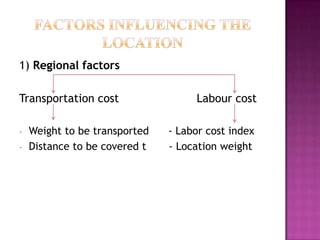
1) Regional factors
Transportation cost Labour cost
- Weight to be transported - Labor cost index
- Distance to be covered t - Location weight
2) Secondary factors
- Agglomeration Tendencies
When many industrial units are established
at an extensive scale then external economies
are realized.
- Deglomeration Tendencies
It is cheapening of production or reduction
in costs due to dispersal of industrial unit
from a particular area.
 UBIQUITOUS
Raw material which are easily available every
where like brick, clay, water etc.
 LOCALIZED
Raw material which are easily available only
at certain regions where like iron-ore, minerals
etc.
a) Pure(Localized) raw material
b) Weight-losing( Localized) raw
material
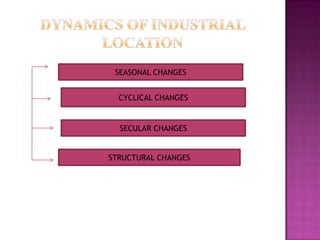
SEASONAL CHANGES
CYCLICAL CHANGES
SECULAR CHANGES
STRUCTURAL CHANGES
A) Factors relating to production
1) Availability of raw materials
2) Availability of labour supply
3) Availability of power supply
4) Transport facilities
5) State control
6) Labour laws and labour unions
7) Financial facilities
8) Cost of land and building
9) Suitable climate
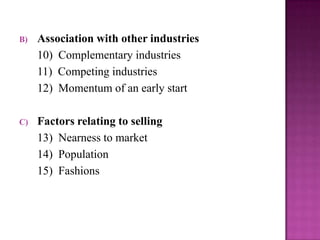
B) Association with other industries
10) Complementary industries
11) Competing industries
12) Momentum of an early start
C) Factors relating to selling
13) Nearness to market
14) Population
15) Fashions
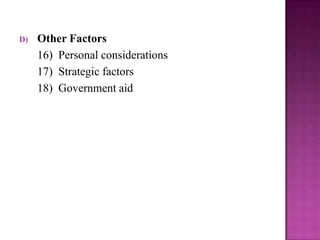
D) Other Factors
16) Personal considerations
17) Strategic factors
18) Government aid
 Scientific selection of industry is very
important in entrepreneurship development
hence various factors affecting must be
considered well before the selection is done.
As the main aim of any industry is to achieve
profits and maintain the same, cost of
production has to be kept under check.
Location has a very significant role to play in
checking the various types of costs.

Unit 1 gsi

  • 2.
    By the wordIndustry, we mean the economic activity which creates forms utility. In other words, it creates economic value through the transformation of raw materials into finished products. In fact one of the dictionary meaning of the word „ INDUSTRY‟ is diligence or assiduous activity at any work or task.
  • 3.
    Industrialization is asystem of economic development in which the major part of the national resources are used to develop a technically up-to-date, diversified national capable of assuring a high rate of growth for the economy as a whole and overcoming economic and social backwardness.
  • 4.
    1. Mining 2. Manufacturing 3.Electricity, gas and water supply.
  • 5.
    “ The ideallocation is that which permits the lowest cost in production and distribution of a product or a service.” John A. Shubin “ Considers it an ideal location where all type of costs of business activities are the minimum.” Shri F.G.Moore
  • 6.
     The aimof any industry is primarily to earn profits.  Profit depends largely on cost of production.  Cost of production depends largely on manufacturing and distribution costs.  An ideal location of industry can economize on these costs.  A wrong or improper location would adversely affect the cost structure and profit.  From national point of view, a balanced growth is essential hence proper location of the industry.  For future expansion of industry, location is equally important where sufficient land and infrastructure would be available.
  • 8.
    According to Weberthe aim behind establishing an industrial unit in a particular area is to minimize the overall cost and maximize the profits.  ASSUMPTIONS OF THE THEORY a) Sources of raw material availability are known. b) Situation of market or consumption centre is also known. c) In the markets there is perfect-competition.
  • 9.
    d) Labor concentrationcentres are fixed and labor is immobile. e) Institutional factors such as interest rate, insurance cost and tax rate are neglected. f) The political, cultural and economic system remains the same.
  • 10.
    1) Regional factors Transportationcost Labour cost - Weight to be transported - Labor cost index - Distance to be covered t - Location weight
  • 11.
    2) Secondary factors -Agglomeration Tendencies When many industrial units are established at an extensive scale then external economies are realized. - Deglomeration Tendencies It is cheapening of production or reduction in costs due to dispersal of industrial unit from a particular area.
  • 12.
     UBIQUITOUS Raw materialwhich are easily available every where like brick, clay, water etc.  LOCALIZED Raw material which are easily available only at certain regions where like iron-ore, minerals etc. a) Pure(Localized) raw material b) Weight-losing( Localized) raw material
  • 14.
  • 15.
    A) Factors relatingto production 1) Availability of raw materials 2) Availability of labour supply 3) Availability of power supply 4) Transport facilities 5) State control 6) Labour laws and labour unions 7) Financial facilities 8) Cost of land and building 9) Suitable climate
  • 16.
    B) Association withother industries 10) Complementary industries 11) Competing industries 12) Momentum of an early start C) Factors relating to selling 13) Nearness to market 14) Population 15) Fashions
  • 17.
    D) Other Factors 16)Personal considerations 17) Strategic factors 18) Government aid
  • 18.
     Scientific selectionof industry is very important in entrepreneurship development hence various factors affecting must be considered well before the selection is done. As the main aim of any industry is to achieve profits and maintain the same, cost of production has to be kept under check. Location has a very significant role to play in checking the various types of costs.