Unflattening Data
Resisting Simple Solutions to Complex Problems
eROI
@eROI
2
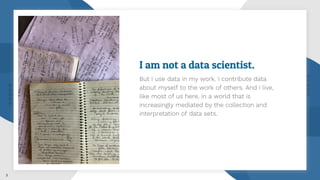
I am not a data scientist.
But I use data in my work. I contribute data
about myself to the work of others. And I live,
like most of us here, in a world that is
increasingly mediated by the collection and
interpretation of data sets.
3
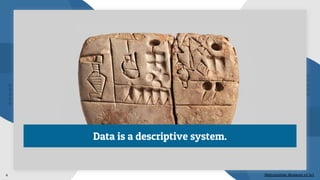
Metropolitan Museum of Art
Data is a descriptive system.
4
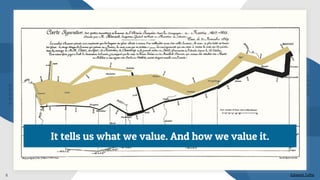
Edward Tufte
It tells us what we value. And how we value it.
5
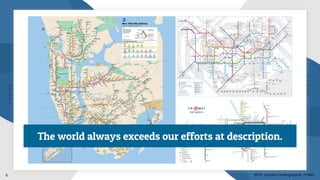
The world always exceeds our efforts at description.
MTA, London Underground, TriMet6
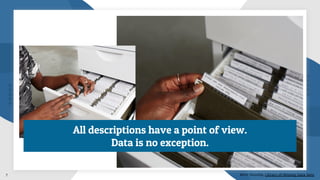
All descriptions have a point of view.
Data is no exception.
Mimi Onuoha, Library of Missing Data Sets7
Collecting Data
“A museum is an exclusive space that brings some things in
and puts some things out. What’s interesting is we don’t
extend [this understanding] to how we define history, to how
we define data, or data sets.” —Sydette Harry
8 Art + Feminism: Careful with Each Other, Dangerous Together
Creating Algorithms
“Algorithms are opinions embedded in code.” —Cathy O’Neil
9 Ted2017: The Era of Blind Faith in Data Must End
What are the stakes here?
“Algorithms are abstracted from the humans and needs that
created them and there are always humans and needs behind
the algorithms we encounter every day.” —Mimi Onuoha
10 On Algorithmic Bias
So, how do we use this tool for good?
How have we ever improved any system we use?
We have to think carefully and listen well.
We have to bring our ethics and our creativity.
And we have to practice.
11
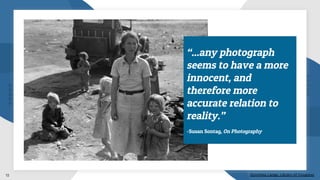
Dorothea Lange, Library of Congress12
“...any photograph
seems to have a more
innocent, and
therefore more
accurate relation to
reality.”
-Susan Sontag, On Photography
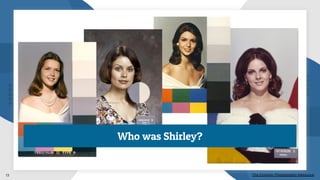
Who was Shirley?
The Eclectic Photography Resource13
A brief manifesto.
Data is a collective resource: we make it collectively
and we should collectively engage in creating its
meaning.
“Any human power can be resisted and changed by
humans.”—Ursula K. Le Guin
14 Speech at the National Book Awards
15
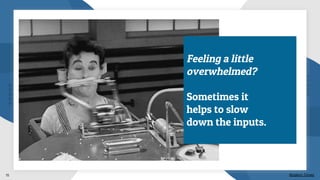
Feeling a little
overwhelmed?
Sometimes it
helps to slow
down the inputs.
Modern Times
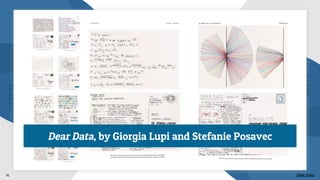
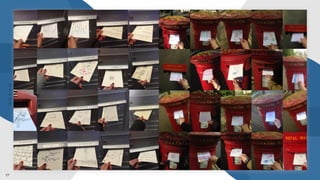
Dear Data, by Giorgia Lupi and Stefanie Posavec
16 Dear Data
17
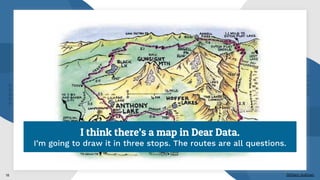
I think there’s a map in Dear Data.
I’m going to draw it in three stops. The routes are all questions.
William Sullivan18
Transparency
How would data look if:
We declared our point of view?
We could claim authorship and fully cite our sources?
We could know who is choosing what to look at and for how long?
We could know how they defined what they’re measuring?
We could know how they understand success?
19
Relationality
How would we use data if:
We considered data science a reciprocal system?
We stopped Data Mining and started Data Exchange?
We worked to be in open conversation with those we’re observing?
We were always also observing ourselves and conveying those
observations?
Data collection and analysis were a form of community building?
20
Inefficiency
How would data change if:
We cultivated patience with and even a wish for the untidy and
unresolved?
They are the friction that allows us to hold onto the world
as it is. They are also where we have something to learn.
There are no failed experiments.
21
22
Practice: The Map and the Territory
23
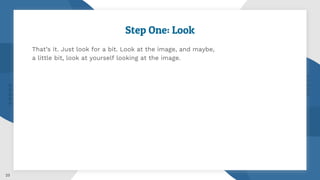
Step One: Look
That’s it. Just look for a bit. Look at the image, and maybe,
a little bit, look at yourself looking at the image.
24 Leonara Carrington
25
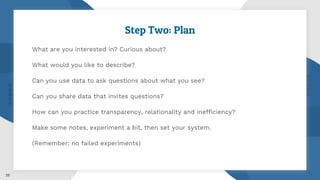
Step Two: Plan
What are you interested in? Curious about?
What would you like to describe?
Can you use data to ask questions about what you see?
Can you share data that invites questions?
How can you practice transparency, relationality and inefficiency?
Make some notes, experiment a bit, then set your system.
(Remember: no failed experiments)
26 Leonara Carrington
27
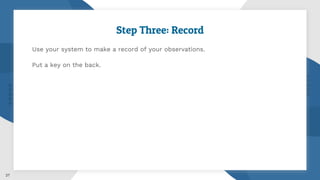
Step Three: Record
Use your system to make a record of your observations.
Put a key on the back.
28 Leonara Carrington
29
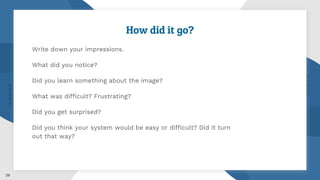
How did it go?
Write down your impressions.
What did you notice?
Did you learn something about the image?
What was difficult? Frustrating?
Did you get surprised?
Did you think your system would be easy or difficult? Did it turn
out that way?
30
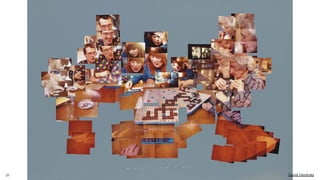
We’re gonna try that one more time.
31 David Hockney
32
Talk Amongst Yourselves!
Common themes?
Successes or frustrations?
How about that three station map? How is that showing up (or
not)?
33
Tell me everything.
(And here is a Selected Bibliography.)
34
Thank you!
New York Times

eROI + Portland Design Week: Unflattering Data

  • 1.
    Unflattening Data Resisting SimpleSolutions to Complex Problems
  • 2.
  • 3.
    I am nota data scientist. But I use data in my work. I contribute data about myself to the work of others. And I live, like most of us here, in a world that is increasingly mediated by the collection and interpretation of data sets. 3
  • 4.
    Metropolitan Museum ofArt Data is a descriptive system. 4
  • 5.
    Edward Tufte It tellsus what we value. And how we value it. 5
  • 6.
    The world alwaysexceeds our efforts at description. MTA, London Underground, TriMet6
  • 7.
    All descriptions havea point of view. Data is no exception. Mimi Onuoha, Library of Missing Data Sets7
  • 8.
    Collecting Data “A museumis an exclusive space that brings some things in and puts some things out. What’s interesting is we don’t extend [this understanding] to how we define history, to how we define data, or data sets.” —Sydette Harry 8 Art + Feminism: Careful with Each Other, Dangerous Together
  • 9.
    Creating Algorithms “Algorithms areopinions embedded in code.” —Cathy O’Neil 9 Ted2017: The Era of Blind Faith in Data Must End
  • 10.
    What are thestakes here? “Algorithms are abstracted from the humans and needs that created them and there are always humans and needs behind the algorithms we encounter every day.” —Mimi Onuoha 10 On Algorithmic Bias
  • 11.
    So, how dowe use this tool for good? How have we ever improved any system we use? We have to think carefully and listen well. We have to bring our ethics and our creativity. And we have to practice. 11
  • 12.
    Dorothea Lange, Libraryof Congress12 “...any photograph seems to have a more innocent, and therefore more accurate relation to reality.” -Susan Sontag, On Photography
  • 13.
    Who was Shirley? TheEclectic Photography Resource13
  • 14.
    A brief manifesto. Datais a collective resource: we make it collectively and we should collectively engage in creating its meaning. “Any human power can be resisted and changed by humans.”—Ursula K. Le Guin 14 Speech at the National Book Awards
  • 15.
    15 Feeling a little overwhelmed? Sometimesit helps to slow down the inputs. Modern Times
  • 16.
    Dear Data, byGiorgia Lupi and Stefanie Posavec 16 Dear Data
  • 17.
  • 18.
    I think there’sa map in Dear Data. I’m going to draw it in three stops. The routes are all questions. William Sullivan18
  • 19.
    Transparency How would datalook if: We declared our point of view? We could claim authorship and fully cite our sources? We could know who is choosing what to look at and for how long? We could know how they defined what they’re measuring? We could know how they understand success? 19
  • 20.
    Relationality How would weuse data if: We considered data science a reciprocal system? We stopped Data Mining and started Data Exchange? We worked to be in open conversation with those we’re observing? We were always also observing ourselves and conveying those observations? Data collection and analysis were a form of community building? 20
  • 21.
    Inefficiency How would datachange if: We cultivated patience with and even a wish for the untidy and unresolved? They are the friction that allows us to hold onto the world as it is. They are also where we have something to learn. There are no failed experiments. 21
  • 22.
    22 Practice: The Mapand the Territory
  • 23.
    23 Step One: Look That’sit. Just look for a bit. Look at the image, and maybe, a little bit, look at yourself looking at the image.
  • 24.
  • 25.
    25 Step Two: Plan Whatare you interested in? Curious about? What would you like to describe? Can you use data to ask questions about what you see? Can you share data that invites questions? How can you practice transparency, relationality and inefficiency? Make some notes, experiment a bit, then set your system. (Remember: no failed experiments)
  • 26.
  • 27.
    27 Step Three: Record Useyour system to make a record of your observations. Put a key on the back.
  • 28.
  • 29.
    29 How did itgo? Write down your impressions. What did you notice? Did you learn something about the image? What was difficult? Frustrating? Did you get surprised? Did you think your system would be easy or difficult? Did it turn out that way?
  • 30.
    30 We’re gonna trythat one more time.
  • 31.
  • 32.
    32 Talk Amongst Yourselves! Commonthemes? Successes or frustrations? How about that three station map? How is that showing up (or not)?
  • 33.
    33 Tell me everything. (Andhere is a Selected Bibliography.)
  • 34.