UNESCO
What is UNESCO?
United Nations Educational, Scientific and
Cultural Organization (UNESCO) is a specialized
agency of the United Nations (UN). It seeks to build
peace through international cooperation in
Education, the Sciences and Culture.
What are the Objectives?
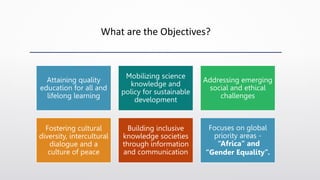
Attaining quality
education for all and
lifelong learning
Mobilizing science
knowledge and
policy for sustainable
development
Addressing emerging
social and ethical
challenges
Fostering cultural
diversity, intercultural
dialogue and a
culture of peace
Building inclusive
knowledge societies
through information
and communication
Focuses on global
priority areas -
“Africa” and
“Gender Equality”.
What is the History
Behind the
Establishment of
UNESCO?
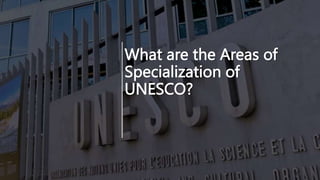
What are the Areas of
Specialization of
UNESCO?
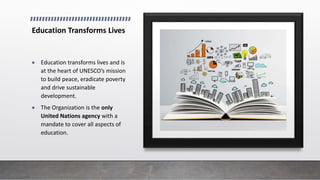
Education Transforms Lives
 Education transforms lives and is
at the heart of UNESCO’s mission
to build peace, eradicate poverty
and drive sustainable
development.
 The Organization is the only
United Nations agency with a
mandate to cover all aspects of
education.
Protecting Our
Heritage and
Fostering
Creativity
 It is becoming a fact that no development can be
sustainable without a strong culture component.
 UNESCO has adopted a three-pronged approach to
make culture takes it rightful place in development
strategies and processes:
Science for a
Sustainable
Future
 Science equips us to find solutions to today’s acute
economic, social and environmental challenges and
to achieving sustainable development and greener
societies.
Social and
Human Sciences
 It promotes mutual understanding among member
states through its intergovernmental Programme
like Management of Social Transformations
(MOST), its Youth Programme and the Culture of
Peace and Non-Violence Programme which include
initiatives for democracy and global citizenship,
intercultural dialogue, peace-building.
Communication and Information
UNESCO advances freedom of
expression and the safety of
journalists, combats online hate
speech, as well as
disinformation and
misinformation through
awareness raising initiatives.
It also supports universal
access to information and
knowledge through promoting
Open Solutions, including Open
Educational Resources, access
for marginalized people, and
multilingualism in Cyberspace.

unesco uni presentationddd................e6

  • 1.
  • 2.
    What is UNESCO? UnitedNations Educational, Scientific and Cultural Organization (UNESCO) is a specialized agency of the United Nations (UN). It seeks to build peace through international cooperation in Education, the Sciences and Culture.
  • 3.
    What are theObjectives? Attaining quality education for all and lifelong learning Mobilizing science knowledge and policy for sustainable development Addressing emerging social and ethical challenges Fostering cultural diversity, intercultural dialogue and a culture of peace Building inclusive knowledge societies through information and communication Focuses on global priority areas - “Africa” and “Gender Equality”.
  • 4.
    What is theHistory Behind the Establishment of UNESCO?
  • 5.
    What are theAreas of Specialization of UNESCO?
  • 6.
    Education Transforms Lives Education transforms lives and is at the heart of UNESCO’s mission to build peace, eradicate poverty and drive sustainable development.  The Organization is the only United Nations agency with a mandate to cover all aspects of education.
  • 7.
    Protecting Our Heritage and Fostering Creativity It is becoming a fact that no development can be sustainable without a strong culture component.  UNESCO has adopted a three-pronged approach to make culture takes it rightful place in development strategies and processes:
  • 8.
    Science for a Sustainable Future Science equips us to find solutions to today’s acute economic, social and environmental challenges and to achieving sustainable development and greener societies.
  • 9.
    Social and Human Sciences It promotes mutual understanding among member states through its intergovernmental Programme like Management of Social Transformations (MOST), its Youth Programme and the Culture of Peace and Non-Violence Programme which include initiatives for democracy and global citizenship, intercultural dialogue, peace-building.
  • 10.
    Communication and Information UNESCOadvances freedom of expression and the safety of journalists, combats online hate speech, as well as disinformation and misinformation through awareness raising initiatives. It also supports universal access to information and knowledge through promoting Open Solutions, including Open Educational Resources, access for marginalized people, and multilingualism in Cyberspace.