UTS
Lesson 1: Introduction to Self-Understanding
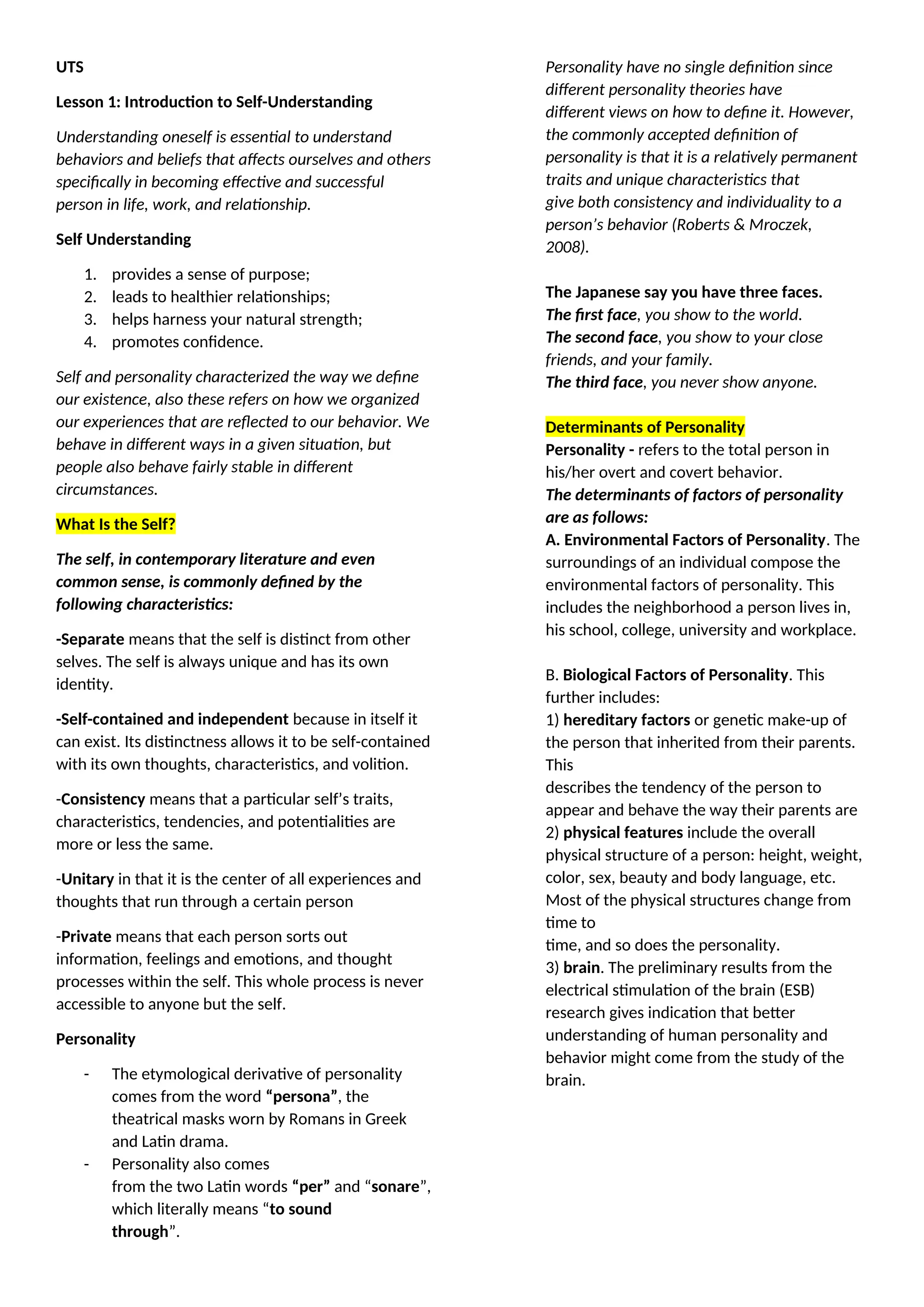
Understanding oneself is essential to understand
behaviors and beliefs that affects ourselves and others
specifically in becoming effective and successful
person in life, work, and relationship.
Self Understanding
1. provides a sense of purpose;
2. leads to healthier relationships;
3. helps harness your natural strength;
4. promotes confidence.
Self and personality characterized the way we define
our existence, also these refers on how we organized
our experiences that are reflected to our behavior. We
behave in different ways in a given situation, but
people also behave fairly stable in different
circumstances.
What Is the Self?
The self, in contemporary literature and even
common sense, is commonly defined by the
following characteristics:
-Separate means that the self is distinct from other
selves. The self is always unique and has its own
identity.
-Self-contained and independent because in itself it
can exist. Its distinctness allows it to be self-contained
with its own thoughts, characteristics, and volition.
-Consistency means that a particular self’s traits,
characteristics, tendencies, and potentialities are
more or less the same.
-Unitary in that it is the center of all experiences and
thoughts that run through a certain person
-Private means that each person sorts out
information, feelings and emotions, and thought
processes within the self. This whole process is never
accessible to anyone but the self.
Personality
- The etymological derivative of personality
comes from the word “persona”, the
theatrical masks worn by Romans in Greek
and Latin drama.
- Personality also comes
from the two Latin words “per” and “sonare”,
which literally means “to sound
through”.
Personality have no single definition since
different personality theories have
different views on how to define it. However,
the commonly accepted definition of
personality is that it is a relatively permanent
traits and unique characteristics that
give both consistency and individuality to a
person’s behavior (Roberts & Mroczek,
2008).
The Japanese say you have three faces.
The first face, you show to the world.
The second face, you show to your close
friends, and your family.
The third face, you never show anyone.
Determinants of Personality
Personality - refers to the total person in
his/her overt and covert behavior.
The determinants of factors of personality
are as follows:
A. Environmental Factors of Personality. The
surroundings of an individual compose the
environmental factors of personality. This
includes the neighborhood a person lives in,
his school, college, university and workplace.
B. Biological Factors of Personality. This
further includes:
1) hereditary factors or genetic make-up of
the person that inherited from their parents.
This
describes the tendency of the person to
appear and behave the way their parents are
2) physical features include the overall
physical structure of a person: height, weight,
color, sex, beauty and body language, etc.
Most of the physical structures change from
time to
time, and so does the personality.
3) brain. The preliminary results from the
electrical stimulation of the brain (ESB)
research gives indication that better
understanding of human personality and
behavior might come from the study of the
brain.
C. Situational Factors of Personality.
Although these factors do not literally create
and shape up an individual’s personality,
situational factors do alter a person’s behavior
and response from time to time. The
situational factors can be commonly observed
when a person behaves contrastingly and
exhibits different traits and characteristics.
D. Cultural Factors. Culture is traditionally
considered as the major determinants of an
individual’s personality. The culture largely
determinants what a person is and what a
person will learn. The culture within a person
is brought up, is very important determinant
of behavior of a person. Culture is complex of
these belief, values, and techniques for
dealing with the environment which are
shared among contemporaries and
transmitted by one generation to the next.
Personality Traits
- reflect people’s characteristic patterns of
thoughts, feelings, and behaviors.
The most widely used system of traits is called the
Five-Factor Model. This system includes five
broad traits that can be remembered with the
acronym OCEAN:
 Openness - the tendency to appreciate
new art, ideas, values, feelings, and
behaviors.
 Conscientiousness - the tendency to be
careful, on-time for appointments, to
follow rules, and to be hard working.
 Extraversion - the tendency to be
talkative, sociable, and to enjoy others;
the tendency to have a dominant style.
 Agreeableness - the tendency to agree
and go along with others rather than to
assert one owns opinions and choices.
 Neuroticism - the tendency to be
frequently experience negative emotions
such as anger, worry, and sadness, as well
as being interpersonally sensitive.
Who Am I?
Self-Concept - understanding of who you are as a
person
Self-Understanding – understanding what your
motives are when you act
In definition, self-concept is generally thought of as
our individual perceptions of our behavior, abilities,
and unique characteristics—a mental picture of who
you are as a person.
Self-concept tends to be more malleable when people
are younger and still going through the process of self-
discovery and identity formation. As people age, self-
perceptions become much more detailed and
organized as people form a better idea of who they
are and what is important to them.
According to the book Essential Social Psychology by
Richard Crisp and Rhiannon Turner:
The individual self consists of attributes and
personality traits that differentiate us from other
individuals. Examples include introversion or
extroversion.
The relational self is defined by our relationships with
significant others. Examples include siblings, friends,
and spouses.
The collective self reflects our membership in social
groups. Examples include British, Republican, African-
American, or gay.
At its most basic, self-concept is a collection of beliefs
one holds about oneself and the responses of others.
It embodies the answer to the question "Who am I?".
Lesson 2: The Self According To Philosophy
Philosophy
- defined as the study of knowledge or wisdom
from its Greek roots, philo (love) and sophia
(wisdom). This field is also considered as “The
Queen of All Sciences” because every
scientific discipline has philosophical
foundations.
Various thinkers for centuries tried to explain the
natural causes of everything that exist specifically the
inquiry on the self preoccupied these philosophers in
the history.
The Greek philosophers were the ones who seriously
questioned myths and moved away from them in
attempting to understand reality by exercising the art
of questioning that satisfies their curiosity, including
the questions about self.
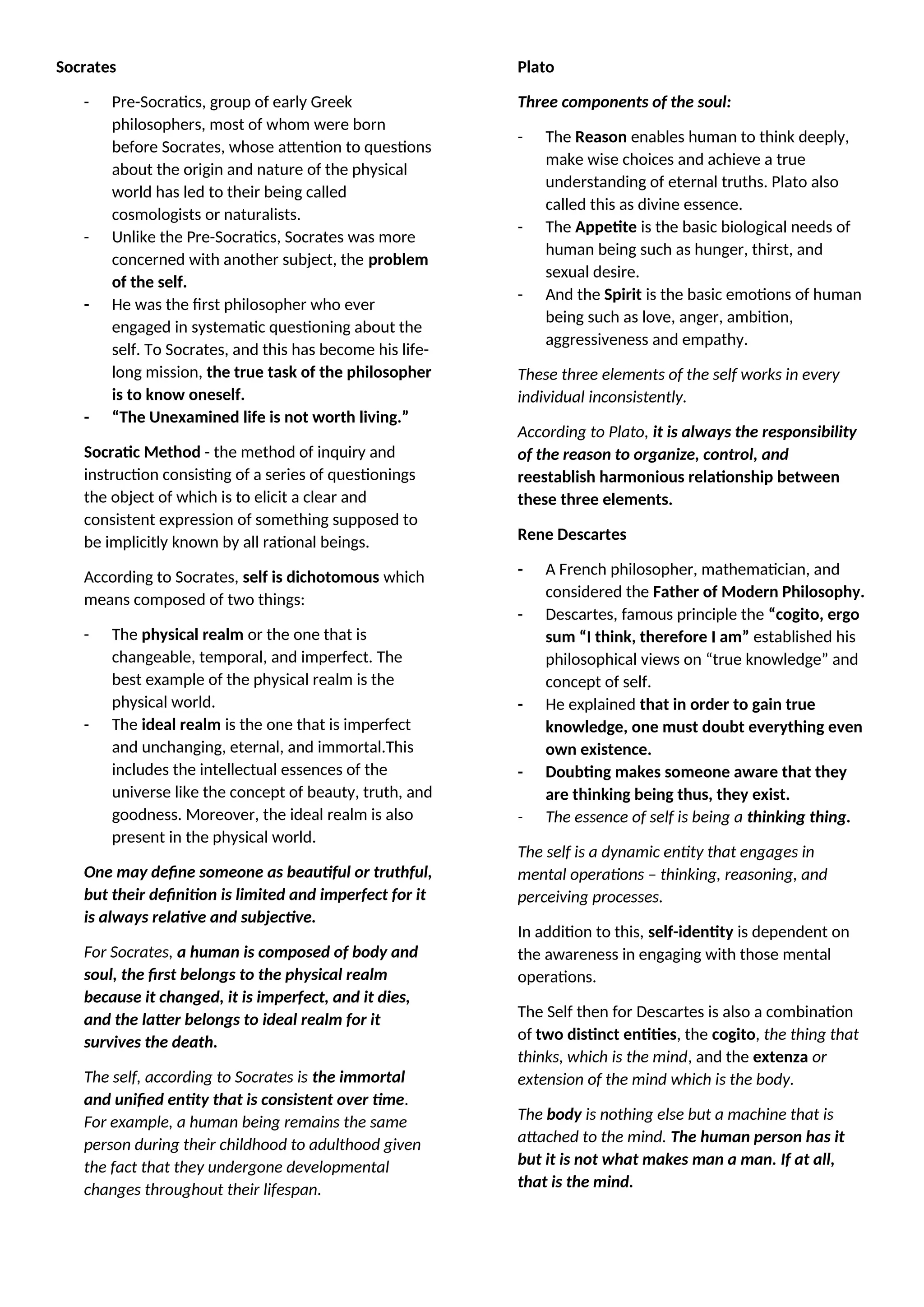
Socrates
- Pre-Socratics, group of early Greek
philosophers, most of whom were born
before Socrates, whose attention to questions
about the origin and nature of the physical
world has led to their being called
cosmologists or naturalists.
- Unlike the Pre-Socratics, Socrates was more
concerned with another subject, the problem
of the self.
- He was the first philosopher who ever
engaged in systematic questioning about the
self. To Socrates, and this has become his life-
long mission, the true task of the philosopher
is to know oneself.
- “The Unexamined life is not worth living.”
Socratic Method - the method of inquiry and
instruction consisting of a series of questionings
the object of which is to elicit a clear and
consistent expression of something supposed to
be implicitly known by all rational beings.
According to Socrates, self is dichotomous which
means composed of two things:
- The physical realm or the one that is
changeable, temporal, and imperfect. The
best example of the physical realm is the
physical world.
- The ideal realm is the one that is imperfect
and unchanging, eternal, and immortal.This
includes the intellectual essences of the
universe like the concept of beauty, truth, and
goodness. Moreover, the ideal realm is also
present in the physical world.
One may define someone as beautiful or truthful,
but their definition is limited and imperfect for it
is always relative and subjective.
For Socrates, a human is composed of body and
soul, the first belongs to the physical realm
because it changed, it is imperfect, and it dies,
and the latter belongs to ideal realm for it
survives the death.
The self, according to Socrates is the immortal
and unified entity that is consistent over time.
For example, a human being remains the same
person during their childhood to adulthood given
the fact that they undergone developmental
changes throughout their lifespan.
Plato
Three components of the soul:
- The Reason enables human to think deeply,
make wise choices and achieve a true
understanding of eternal truths. Plato also
called this as divine essence.
- The Appetite is the basic biological needs of
human being such as hunger, thirst, and
sexual desire.
- And the Spirit is the basic emotions of human
being such as love, anger, ambition,
aggressiveness and empathy.
These three elements of the self works in every
individual inconsistently.
According to Plato, it is always the responsibility
of the reason to organize, control, and
reestablish harmonious relationship between
these three elements.
Rene Descartes
- A French philosopher, mathematician, and
considered the Father of Modern Philosophy.
- Descartes, famous principle the “cogito, ergo
sum “I think, therefore I am” established his
philosophical views on “true knowledge” and
concept of self.
- He explained that in order to gain true
knowledge, one must doubt everything even
own existence.
- Doubting makes someone aware that they
are thinking being thus, they exist.
- The essence of self is being a thinking thing.
The self is a dynamic entity that engages in
mental operations – thinking, reasoning, and
perceiving processes.
In addition to this, self-identity is dependent on
the awareness in engaging with those mental
operations.
The Self then for Descartes is also a combination
of two distinct entities, the cogito, the thing that
thinks, which is the mind, and the extenza or
extension of the mind which is the body.
The body is nothing else but a machine that is
attached to the mind. The human person has it
but it is not what makes man a man. If at all,
that is the mind.
St. Augustine
- He is considered as the last of the great
ancient philosophers whose ideas were
greatly Platonic.
- In melding philosophy and religious beliefs
together, Augustine has been characterized
as Christianity’s first theologian.
- He concluded, “That the body is united with
the soul, so that man may be entire and
complete, is a fact we recognize on the
evidence of our own nature.”
According to St. Augustine, the human nature is
composed of two realms:
1. God as the source of all reality and truth. Through
mystical experience, man is capable of knowing
eternal truths. This is made possible through the
existence of the one eternal truth which is God. He
further added that without God as the source of all
truth, man could never understand eternal truth. This
relationship with God means that those who know
most about God will come closest to understanding
the true nature of the world.
2. The sinfulness of man. The cause of sin or evil is an
act of mans’ freewill. Moral goodness can only be
achieved through the grace of God.
He also stated that real happiness can only be found
in God. For God is love and he created humans for
them to also love. Problems arise because of the
objects humans choose to love. Disordered love
results when man loves the wrong things which he
believes will give him happiness.
John Locke
- An English philosopher and physician and
famous in his concept of “Tabula Rasa” or
Blank Slate that assumes the nurture side of
human development.
Tabula Rasa
- the mind in its hypothetical primary blank or
empty state before receiving outside
impressions.
The self, according to Locke is consciousness. In his
essay entitled On Personal Identity (from his most
famous work, Essay Concerning Human
Understanding) he discussed the reflective analysis of
how an individual may experience the self in
everyday living. He provided the following key points:
1.) To discover the nature of personal identity, it is
important to find out what it means to be a person.
2.) A person is a thinking, intelligent being who has
the abilities to reason and to reflect.
3.) A person is also someone who considers themself
to be the same thing in different times and different
places.
4.) Consciousness as being aware that we are
thinking always accompanies thinking and is an
essential part of the thinking process.
5.) Consciousness makes possible our belief that we
are the same identity in different times and different
places.
The bottom line of his theory on self is that self is not
tied to any particular body or substance. It only
exists in other times and places because of the
memory of those experiences.
David Hume
- He was a Scottish philosopher and also an
empiricist.
Empiricism
- is the school of thought that espouses the
idea that knowledge can only be possible if it
is sensed and experienced. Men can only
attain knowledge by experiencing.
His claim about self is quite controversial because he
assumed that there is no self! In his essay entitled,
"On Personal Identity" (1739) he said that, if we
carefully examine the contents of [our] experience,
we find that there are only two distinct entities,
"impressions" and "ideas".
Impressions
- are the basic sensations of our experience,
the elemental data of our minds: pain,
pleasure, heat, cold, happiness, grief, fear,
exhilaration, and so on.
Ideas
- are copies of impressions that include
thoughts and images that are built up from
our primary impressions through a variety of
relationships, but because they are derivative
copies of impressions, they are once removed
from reality.
Hume considered that the self does not exist because
all of the experiences that a person may have are
just perceptions and this includes the perception of
self. None of these perceptions resemble a unified
and permanent self-identity that exists over time.
Hume explained that the self that is being
experienced by an individual is nothing but a kind of
fictional self. Human created an imaginary creature
which is not real.
Fictional self is created to unify the mental events and
introduce order into an individual lives, but this "self"
has no real existence.
Sigmund Freud
- A well-known Australian psychologist and
considered as the Father of Psychoanalysis.
- His influence in Psychology and therapy is
dominant and popular in the 20th to 21st
century.
The dualistic view of self by Freud involves the
conscious self and unconscious self.
1.) The conscious self is governed by reality principle.
The self is rational, practical, and appropriate to the
social environment. The conscious self has the task of
controlling the constant pressures of the unconscious
self, as its primitive impulses continually seek for
immediate discharge.
2.) The unconscious self is governed by pleasure
principle. It is the self that is aggressive, destructive,
unrealistic and instinctual. Both of Freud's self needs
immediate gratification and reduction of tensions to
optimal levels and the goal of every individual is to
make unconscious conscious
Freud proposed how mind works, he called this as
provinces or structures of the mind. By illustrating the
tip of the iceberg which açcording to him represents
conscious awareness which characterizes the person
in dealing with the external world. The observable
behavior, however, is further controlled bythe
workings of the subconscious/unconscious mind.
Subconscious serves as the repository of past
experiences, repressed memories, fantasies, and
urges.
The three provinces of the mind are:
1.) Id. This is primarily based on the pleasure
principle. It demands immediate satisfaction and is
not hindered by societal expectations.
2.) Ego. The structure that is primarily based on the
reality principle. This mediates between the impulses
of the id and restraints of the superego.
3.) Superego. This is primarily dependent on learning
the difference between right and wrong, thus it is
called moral principle. Morality of actions is largely
dependent on childhood upbringing particularly on
rewards and punishments.
According to Freud, there are two kinds of instinct
that drive individual behavior the eros or the life
instinct and the thanatos of the death instinct.
The energy of eros is called libido and includes urges
necessary for individual and species survival like
thirst, hunger, and sex.
In cases that human behavior is directed towards
destruction in the form of aggression and violence,
such are the manifestations of thanatos.
Gilbert Ryle
- A British analytical philosopher.
- He was an important figure in the field of
Linguistic Analysis which focused on the
solving of philosophical puzzles through an
analysis of language.
- According to Ryle, the self is best understood
as a pattern of behavior, the tendency or
disposition for a person to behave in a
certain way in certain circumstances.
- He opposed the notable ideas of the previous
philosophers and even claimed that hose
were results of confused conceptual thinking,
he termed, category mistake.
- The category mistake happens when we
speak about the self as something
independent of the physical body: a purely
mental entity existing in time but not space
Immanuel Kant
- A German Philosopher who made great
contribution to the fields of metaphysics,
epistemology, and ethics.
- Kant is widely regarded as the greatest
philosopher of the modern period.
- It is the self that makes consciousness for the
person to make sense of everything.
- It is the one that help every individual gain
insight and knowledge. If the self failed to do
this synthesizing function, there would be a
chaotic and insignificant collection of
sensations.
- The self is the product of reason, a regulative
principle because the self regulates
experience by making unified experience
possible and unlike Hume, Kant’s self is not
the object of consciousness, but if makes the
consciousness understandable and unique.
- Kant argued that the sense called
"Transcendental Apperception" is an essence
of our consciousness that provides basis for
understanding and establishing the notion of
"self" by synthesizing one's accumulation of
experiences, intuition and imagination goes.
- For example the idea of time and space, we
may not be able to observe the movement of
time and the vastness of space but we are still
capable of understanding their concept based
from what we can observe as their
representation.
Paul and Patricia Churchland
- An American philosopher interested in the
fields of philosophy of mind, philosophy of
science, cognitive neurobiology,
epistemology, and perception.
- Churchland's central argument is that the
concepts and theoretical vocabulary that
people use to think about the selves-using
such terms as belief, desire, fear, sensation,
pain, joy-actually misrepresent the reality of
minds and selves. He claims that the self is a
product of brain activity.
- Neurophilosophy was coined by Patricia
Churchland, the modern scientific inquiry
looks into the application of neurology to age-
old problems in philosophy. The philosophy
of neuroscience is the study of the
philosophy of science, neuroscience, and
psychology. It aims to explore the relevance
of neurolinguistic experiments/studies to the
philosophy of the mind.
- Patricia Churchland claimed that man’s brain
is responsible for the identity known as self.
The biochemical properties of the brain
according to this philosophy of neuroscience
is really responsible for man’s thoughts,
feelings, and behavior.
- Paul Churchland is one of the many
philosophers and psychologists that viewed
the self from a materialistic point of view,
contending that in the final analysis mental
states are identical with, reducible to, or
explainable in terms of physical brain states.
- Being an eliminative materialist, he believes
that there is a need to develop a new
vocabulary and conceptual framework that is
grounded in neuroscience. This new
framework will be a more accurate reflection
of the human mind and self.
- Eliminative materialism opposes that
people’s common sense understanding of the
mind is false and that most of the mental
states that people subscribe to, in turn, do not
actually exist, this idea also applies on the
understanding of behavior and emotions.
Maurice Merleau-Ponty
- A French philosopher and phenomenologist.
- According to him, the division between the
"mind and the "body" is a product of
confused thinking. The self is experienced as
a unity in which the mental and physical are
seamlessly woven together.
- Developed the concept of self-subject and
contended that perceptions occur
existentially. Thus, the consciousness, the
world, and the human body are all
interconnected as they mutually perceive the
world
- Merleau-Ponty dismisses the Cartesian
Dualism that has spelled so much
devastation in the history of man. For him,
the Cartesian problem is nothing else but
plain misunderstanding
- Phenomenology provides a direct description
of the human experience which serves to
guide man's conscious actions. He further
added that, the world is a field of perception,
and human consciousness assigns meaning to
the world. Thus man cannot separate himself
from his perceptions of the world
Lesson 3: The Self According To Sociology and
Anthropology
Sociology and Anthropology
Sociology and Anthropology are two interrelated
disciplines that contributes to the understanding of
self.
Sociology
- presents the self as a product of modern
society. It is the science that studies the
development, structure, interaction, and
collective behavior of human being.
- Emphasis on society and its origins and
development (social classes, institutions
& structures, social movements)
Anthropology
- is the study of humanity. This broad field
takes an interdisciplinary approach to looking
at human culture, both past and present. The
following set of sociologists and
anthropologist offered their views about self.
- Emphasis on culture and its physical and social
characteristics (kinship, language, religion,
gender, art)
The Self and Person in the Contemporary
Anthropology
The four subfields of anthropology – Archeology,
Biological Anthropology, Linguistics, and Cultural
Anthropology, suggest that human beings are similar
and different in varying ways and tendencies.
The subfields of Anthropology are as follows:
Archeology
- focus on the study of the past and how it
may have contributed to the present ways of
how people conduct their daily lives.
- Archeologists have so far discovered the
unique ways in which human beings adapted
to the changes in their environment in order
for them to survive.
- Among their discoveries around the world is
the species, homo sapiens did not become
extinct because of their ability to think, use
tools and learn from experience.
- In relating to the contemporary society,
people still aim for survival, for their basic
needs to be fulfilled and to live legacy to their
society.
Biological Anthropology
- Focus on how the human body adapts to the
different earth environments.
- Among the activities of Anthropologists are
identification of probable causes of diseases,
physical mutation, and death, evolution, and
comparison of dead and living primates.
- They are interested in explaining how the
biological characteristics of human being
affects their way of living
Linguistic Anthropology
- Focused on using language as means to
discover a group’s manner of social
interaction and their worldview.
- Anthropologists in this field want to discover
how language is used to create and share
meanings, to form ideas and concepts and to
promote social change.
- Furthermore, they also study how language
and modes of communication changes over
time.
Cultural Anthropology
- Focused in knowing what makes one group’s
manner of living forms an essential part of
the member’s personal and societal identity.
This encompasses the principles of Theory of
Cultural Determinism which suggests that the
human nature is determined by the kind of
culture he is born and grew up in.
The following are the ways in which culture may
manifest itself in people:
Symbols
- these are the words, gestures, pictures or
objects that have recognized or accepted
meaning in a particular culture
Heroes
- these are persons from the past or present
who have characteristics that are important in
culture. They may be real of work of fictions.
Rituals
- these are activities participated by a group of
people for the fulfilment of desired objectives
and are concerned to be socially essential.
Values
- these are considered to be the core of every
culture. These are unconscious, neither
discuss or observed, and can only be inferred
from the way people act and react to
situations.
The field of Anthropology offers another way by
which a person can view themselves. As self is
formed or determined by the past and present
condition, by biological characteristics, the
communication and language use, and the lifestyle
we choose to live.
The Self, Society, and Culture
- Remaining the same person and turning
chameleon by adapting to one’s context
seems paradoxical.
- According to Marcel Mauss, every self has two
faces: personne and moi.
- Moi refers to a person’s sense of who he is,
his body, and his basic identity, his biological
givenness. Moi is a person’s basic identity.
- Personne is composed of the social concepts
of what it means to be who he is.
- Personne has much to do with what it means
to live in a particular institution, a particular
family, a particular religion, a particular
nationality and how to behave given
expectations and influences from
others.
- This dynamics and capacity for different
personne can be llustrated better cross-
culturally.
- In the Philippines, Filipinos tend to consider
their territory as a part of who they are.This
includes considering their immediate
surrounding as part of them, thus the
perennial “tapat ko, linis ko.”
- Language is another interesting aspect of
social constructivism.
- Example of interesting facet of our language is
its being gender-neutral.
- It is a salient part of culture and ultimately,
has a tremendous effect in our crafting of
the self.
- In one research, it was found that North
Americans are more likely to attribute
being unique to themselves and claim that
they are better than most people in doing
what they love doing.
- Japanese people, on the other hand, have
been seen to display a degree of modesty.
- If a self is born into a particular society or
culture, the self will have to adjust
according to its exposure.
Self in Families
- The kind of family that we are born in, the
resources available to us (human, spiritual,
economic), and the kind of development that
we will have will certainly affect us.
- Human beings are born virtually helpless and
the dependency period of a human baby to its
parents for nurturing is relatively longer than
most other animals.
- In trying to achieve the goal of becoming a
fully realized human, a child enters a system
of relationships, most important of which is
the family.
- Human persons learn the ways of living and
therefore their selfhood by being in a family.
It is what a family initiates a person to
become that serves as the basis for this
person’s progress.
- Notice how kids reared in a respectful
environment becomes respectful as well and
the converse if raised in a converse family.
- Some behaviors and attitudes, on the other
hand, may be indirectly taught through
rewards and punishments.
- Without a family, biologically and
sociologically, a person may not even survive
or become a human person.
Gender and the Self
- Gender is one of those loci of the self that is
subject to alteration, change, and
development.
- In the Philippines, husbands for most part are
expected to provide for the family. The eldest
man in a family is expected to head the family
and hold it in.
- Nancy, Chodorow, a feminist, argues that
because mothers take the role of taking care
of children, there is a tendency for girls to
imitate the same and reproduce the same
kind of mentality of women as care providers
in the family.
- Men on the other hand, in the periphery of
their own family are taught early on how to
behave like a man. This normally includes
holding in one's emotion, being tough,
fatalistic, not to worry about danger, and
admiration for hard physical labor.
- The sense of self that is being taught makes
sure that an individual fits in a particular
environment, is dangerous and detrimental in
the goal of truly finding one’s self, self-
determination, and growth of the self.
- Gender has to be personally discovered and
asserted and not dictated by culture and the
society.
George Herbert Mead and the Social Self Mead
- is an American philosopher, sociologist, and
psychologist.
- He is regarded as one of the founders of social
psychology and the American sociological
tradition in general. Mead is well-known for
his theory of self.
- He postulated that, the self represents the
sum total of people's conscious perception of
their identity as distinct from others.
- Individual selves are the products of social
interaction and not logical or biological in
nature.
- He claimed that the self is something which
undergoes development because it is not
present instantly at birth.
- In other words, one cannot experience their
self alone, they need other people to
experience their self.
- Symbolic Interactionism - the self is created
and developed through human interaction.
- The social emergence of self is developed due
to the three forms of inter-subjective activity,
the language, play, and the game
He proposed the stages of self formation:
1. Preparatory Stage.
At this stage, children’s behaviors are primarily based
on imitation. It was observed that children imitate the
behaviors of those around them. At this stage,
knowing and understanding the symbols are
important for this will constitute their way of
communicating with others throughout their lives.
2. The Play Stage.
Skills at knowing and understanding the symbols of
communication is important for this constitutes the
basis of socialization.
Children begin to role play and pretend to be other
people. Role-taking in the play stage is the process of
mentally assuming the process of another person to
see how this person might behave or respond in a
given situation (Schefer, 2012).
It is at this stage where child widens his perspective
and realizes that he is not alone and that there are
others around him whose presence he has to
consider.
3. The Game Stage.
Through the learnings that were gained in stage two,
the child now begins to see not only his own
perspective but at the same time the perspective of
others. In this final stage of self development, the
child now has the ability to respond not just to one
but several members of his social environment.
Generalized other the person realizes that people in
society have cultural norms, beliefs and values which
are incorporated into each self. This realization forms
basis of how the person evaluate themselves.
The self, according to Mead is not merely a passive
reflection of the generalized other. The responses of
the individual to the social world are also active, it
means that a person decides what they will do in
reference to the attitude of others but not
mechanically determined by such attitudinal
structures. Here, Mead identified the two phases of
self:
1. the phase which reflects the attitude of the
generalized other or the “me”; and
2. the phase that responds to the attitude of
generalized other or the “I”.
In Mead’s words, the "me" is the social self, and the
"I" is a response to the "me". Mead defines the
"me" as "a conventional, habitual individual and the
“I” as the “novel reply” of the individual to the
generalized other.
Generally, Mead’s theory sees the self as a
perspective that comes out of interactions, and he
sees the meanings of symbols, social objects, and the
self as emerging from negotiated interactions.
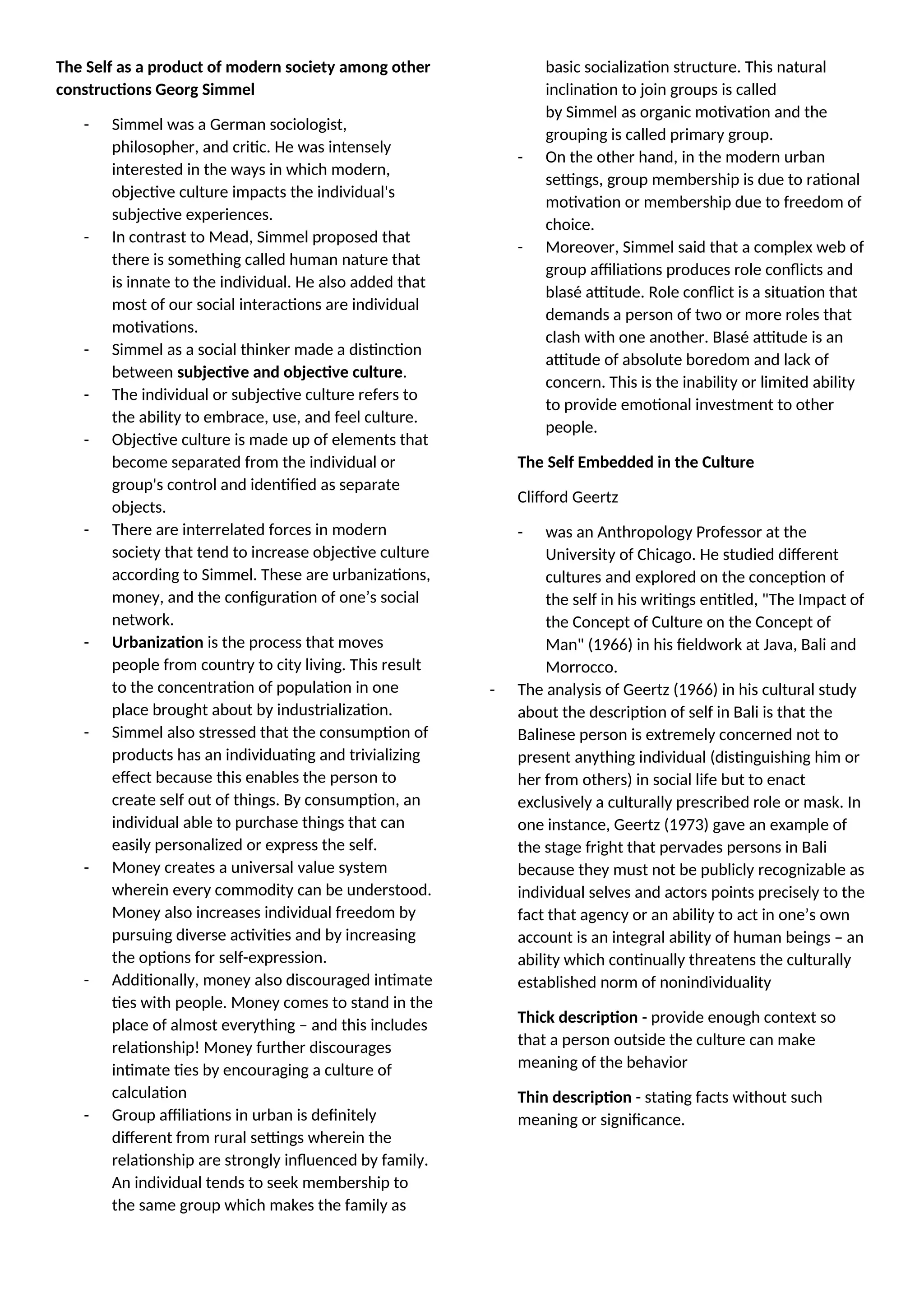
The Self as a product of modern society among other
constructions Georg Simmel
- Simmel was a German sociologist,
philosopher, and critic. He was intensely
interested in the ways in which modern,
objective culture impacts the individual's
subjective experiences.
- In contrast to Mead, Simmel proposed that
there is something called human nature that
is innate to the individual. He also added that
most of our social interactions are individual
motivations.
- Simmel as a social thinker made a distinction
between subjective and objective culture.
- The individual or subjective culture refers to
the ability to embrace, use, and feel culture.
- Objective culture is made up of elements that
become separated from the individual or
group's control and identified as separate
objects.
- There are interrelated forces in modern
society that tend to increase objective culture
according to Simmel. These are urbanizations,
money, and the configuration of one’s social
network.
- Urbanization is the process that moves
people from country to city living. This result
to the concentration of population in one
place brought about by industrialization.
- Simmel also stressed that the consumption of
products has an individuating and trivializing
effect because this enables the person to
create self out of things. By consumption, an
individual able to purchase things that can
easily personalized or express the self.
- Money creates a universal value system
wherein every commodity can be understood.
Money also increases individual freedom by
pursuing diverse activities and by increasing
the options for self-expression.
- Additionally, money also discouraged intimate
ties with people. Money comes to stand in the
place of almost everything – and this includes
relationship! Money further discourages
intimate ties by encouraging a culture of
calculation
- Group affiliations in urban is definitely
different from rural settings wherein the
relationship are strongly influenced by family.
An individual tends to seek membership to
the same group which makes the family as
basic socialization structure. This natural
inclination to join groups is called
by Simmel as organic motivation and the
grouping is called primary group.
- On the other hand, in the modern urban
settings, group membership is due to rational
motivation or membership due to freedom of
choice.
- Moreover, Simmel said that a complex web of
group affiliations produces role conflicts and
blasé attitude. Role conflict is a situation that
demands a person of two or more roles that
clash with one another. Blasé attitude is an
attitude of absolute boredom and lack of
concern. This is the inability or limited ability
to provide emotional investment to other
people.
The Self Embedded in the Culture
Clifford Geertz
- was an Anthropology Professor at the
University of Chicago. He studied different
cultures and explored on the conception of
the self in his writings entitled, "The Impact of
the Concept of Culture on the Concept of
Man" (1966) in his fieldwork at Java, Bali and
Morrocco.
- The analysis of Geertz (1966) in his cultural study
about the description of self in Bali is that the
Balinese person is extremely concerned not to
present anything individual (distinguishing him or
her from others) in social life but to enact
exclusively a culturally prescribed role or mask. In
one instance, Geertz (1973) gave an example of
the stage fright that pervades persons in Bali
because they must not be publicly recognizable as
individual selves and actors points precisely to the
fact that agency or an ability to act in one’s own
account is an integral ability of human beings – an
ability which continually threatens the culturally
established norm of nonindividuality
Thick description - provide enough context so
that a person outside the culture can make
meaning of the behavior
Thin description - stating facts without such
meaning or significance.
William James and the Me-Self and I-Self
- Founder of functionalism
- Published “The Principles of
Psychology”(1890)
- The knower (the pure or the I- Self) and the
known (the objective or the Me-Self)
- The function of the knower (I-Self)
according to James must be the agent
of experience. While the known (Me-
Self) have three different but
interrelated aspects of empirical self
(known today as self-concept): the Me
viewed as material, the Me viewed as
social, and the Me viewed as spiritual
in nature.
I-self or the knower na eexperience po natin ibat
ibang experience pano nalalaman yung mga
knowledge natin na eexperience natin lahat yung
failing
Me-self ito yung nabuong self mula sa pagiging
knower nabuong self as knower
Carl Rogers Real self and Ideal Self
- Founder of client-centered theraphy
- Ne of the prominent humanistic or existential
theorist in personality
- The real self includes all those aspects of
one's identity that are perceived in
awareness. These are the things that are
known to oneself like the attributes that
an individual possesses.
- The ideal self is defined as one's view of
self as one wishes to be. This contains all
the aspirations or wishes of an individual
for themselves.
Real Self eto yung totoong tayo yung actual self
who we are in this moment.
Ideal Self kung ano yung gusto mong maging
Gregg Henriques Multiple and Unified self
- Tripartite Model of Human Consciousness
 Experential self
 Private self
 Public self
- The experiential self or the theater of
consciousness is a domain of self that
defined as felt experience of being.
(ano yung nararamdaman mo at that
specific moment eto yungklase ng self na
nag shushut down pag tayo ay natutulo
at nag oonline pag gising na eexperience
habang ginagawa ang isang bagay) (eg
Listening sa concertsa fav band yung
energy na nararamdaman sa crowd yun
ang experential self)
- The private self consciousness system the
narrator/interpreter is a portion of self
that verbally narrates what is happening
and tries to make sense of what is going
on.
(eto yung private self ito ang sumasago
sa atin pag kinakusap ang sarili inner
voice)9(eg nanunuod ng video tas
nagugutom na tas sinasabi ng inner voice
ay kumain na tama na ganon tapos antok
na sinasabing inner voice na matulog na)
- The public self or Persona, the domain of
self that an individual shows to the public,
and this interacts on how others see an
individual.
(Pag may presentations yung pinepresent
nyo don ay yung public self, froshie fair
self na ipapakita sa public)(How you
present yourslf withothers your identity
and how you interact with other people)
- Unified being is essentially connected to
consciousness, awareness, and agency. A
well-adjusted person is able to accept and
understood the success and failure that
they experienced. They are those kinds of
person who continually adjust, adapt,
evolve and survive as an individual with
integrated, unified, multiple selves.
(Having consistent sense of self across
different situation nagiging consistent
alam kungpano i addapt at i accept ang
different experience positive man o
negative ablity tointegrate and balance
the different parts of ourself into
cohesive whole madaling maka adjust sa
kahi anong environment.
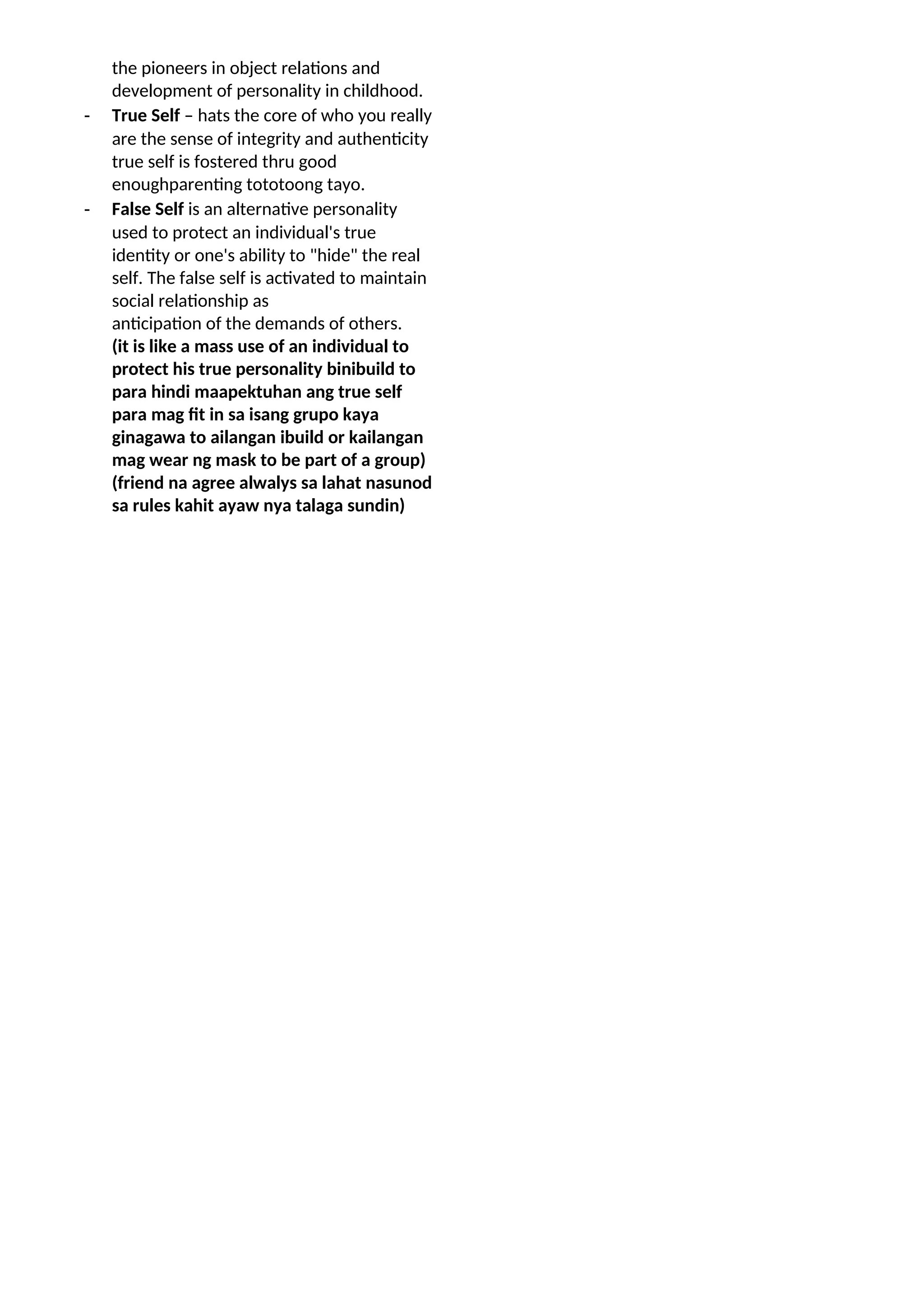
Donnald Winnicott True vs False Self
- a pediatrician in London who studied
Psychoanalysis with Melanie Klein, a
renowned personality theorist and one of
the pioneers in object relations and
development of personality in childhood.
- True Self – hats the core of who you really
are the sense of integrity and authenticity
true self is fostered thru good
enoughparenting tototoong tayo.
- False Self is an alternative personality
used to protect an individual's true
identity or one's ability to "hide" the real
self. The false self is activated to maintain
social relationship as
anticipation of the demands of others.
(it is like a mass use of an individual to
protect his true personality binibuild to
para hindi maapektuhan ang true self
para mag fit in sa isang grupo kaya
ginagawa to ailangan ibuild or kailangan
mag wear ng mask to be part of a group)
(friend na agree alwalys sa lahat nasunod
sa rules kahit ayaw nya talaga sundin)

Understanding the self reviewer. .docx

  • 1.
    UTS Lesson 1: Introductionto Self-Understanding Understanding oneself is essential to understand behaviors and beliefs that affects ourselves and others specifically in becoming effective and successful person in life, work, and relationship. Self Understanding 1. provides a sense of purpose; 2. leads to healthier relationships; 3. helps harness your natural strength; 4. promotes confidence. Self and personality characterized the way we define our existence, also these refers on how we organized our experiences that are reflected to our behavior. We behave in different ways in a given situation, but people also behave fairly stable in different circumstances. What Is the Self? The self, in contemporary literature and even common sense, is commonly defined by the following characteristics: -Separate means that the self is distinct from other selves. The self is always unique and has its own identity. -Self-contained and independent because in itself it can exist. Its distinctness allows it to be self-contained with its own thoughts, characteristics, and volition. -Consistency means that a particular self’s traits, characteristics, tendencies, and potentialities are more or less the same. -Unitary in that it is the center of all experiences and thoughts that run through a certain person -Private means that each person sorts out information, feelings and emotions, and thought processes within the self. This whole process is never accessible to anyone but the self. Personality - The etymological derivative of personality comes from the word “persona”, the theatrical masks worn by Romans in Greek and Latin drama. - Personality also comes from the two Latin words “per” and “sonare”, which literally means “to sound through”. Personality have no single definition since different personality theories have different views on how to define it. However, the commonly accepted definition of personality is that it is a relatively permanent traits and unique characteristics that give both consistency and individuality to a person’s behavior (Roberts & Mroczek, 2008). The Japanese say you have three faces. The first face, you show to the world. The second face, you show to your close friends, and your family. The third face, you never show anyone. Determinants of Personality Personality - refers to the total person in his/her overt and covert behavior. The determinants of factors of personality are as follows: A. Environmental Factors of Personality. The surroundings of an individual compose the environmental factors of personality. This includes the neighborhood a person lives in, his school, college, university and workplace. B. Biological Factors of Personality. This further includes: 1) hereditary factors or genetic make-up of the person that inherited from their parents. This describes the tendency of the person to appear and behave the way their parents are 2) physical features include the overall physical structure of a person: height, weight, color, sex, beauty and body language, etc. Most of the physical structures change from time to time, and so does the personality. 3) brain. The preliminary results from the electrical stimulation of the brain (ESB) research gives indication that better understanding of human personality and behavior might come from the study of the brain.
  • 2.
    C. Situational Factorsof Personality. Although these factors do not literally create and shape up an individual’s personality, situational factors do alter a person’s behavior and response from time to time. The situational factors can be commonly observed when a person behaves contrastingly and exhibits different traits and characteristics. D. Cultural Factors. Culture is traditionally considered as the major determinants of an individual’s personality. The culture largely determinants what a person is and what a person will learn. The culture within a person is brought up, is very important determinant of behavior of a person. Culture is complex of these belief, values, and techniques for dealing with the environment which are shared among contemporaries and transmitted by one generation to the next. Personality Traits - reflect people’s characteristic patterns of thoughts, feelings, and behaviors. The most widely used system of traits is called the Five-Factor Model. This system includes five broad traits that can be remembered with the acronym OCEAN:  Openness - the tendency to appreciate new art, ideas, values, feelings, and behaviors.  Conscientiousness - the tendency to be careful, on-time for appointments, to follow rules, and to be hard working.  Extraversion - the tendency to be talkative, sociable, and to enjoy others; the tendency to have a dominant style.  Agreeableness - the tendency to agree and go along with others rather than to assert one owns opinions and choices.  Neuroticism - the tendency to be frequently experience negative emotions such as anger, worry, and sadness, as well as being interpersonally sensitive. Who Am I? Self-Concept - understanding of who you are as a person Self-Understanding – understanding what your motives are when you act In definition, self-concept is generally thought of as our individual perceptions of our behavior, abilities, and unique characteristics—a mental picture of who you are as a person. Self-concept tends to be more malleable when people are younger and still going through the process of self- discovery and identity formation. As people age, self- perceptions become much more detailed and organized as people form a better idea of who they are and what is important to them. According to the book Essential Social Psychology by Richard Crisp and Rhiannon Turner: The individual self consists of attributes and personality traits that differentiate us from other individuals. Examples include introversion or extroversion. The relational self is defined by our relationships with significant others. Examples include siblings, friends, and spouses. The collective self reflects our membership in social groups. Examples include British, Republican, African- American, or gay. At its most basic, self-concept is a collection of beliefs one holds about oneself and the responses of others. It embodies the answer to the question "Who am I?". Lesson 2: The Self According To Philosophy Philosophy - defined as the study of knowledge or wisdom from its Greek roots, philo (love) and sophia (wisdom). This field is also considered as “The Queen of All Sciences” because every scientific discipline has philosophical foundations. Various thinkers for centuries tried to explain the natural causes of everything that exist specifically the inquiry on the self preoccupied these philosophers in the history. The Greek philosophers were the ones who seriously questioned myths and moved away from them in attempting to understand reality by exercising the art of questioning that satisfies their curiosity, including the questions about self.
  • 3.
    Socrates - Pre-Socratics, groupof early Greek philosophers, most of whom were born before Socrates, whose attention to questions about the origin and nature of the physical world has led to their being called cosmologists or naturalists. - Unlike the Pre-Socratics, Socrates was more concerned with another subject, the problem of the self. - He was the first philosopher who ever engaged in systematic questioning about the self. To Socrates, and this has become his life- long mission, the true task of the philosopher is to know oneself. - “The Unexamined life is not worth living.” Socratic Method - the method of inquiry and instruction consisting of a series of questionings the object of which is to elicit a clear and consistent expression of something supposed to be implicitly known by all rational beings. According to Socrates, self is dichotomous which means composed of two things: - The physical realm or the one that is changeable, temporal, and imperfect. The best example of the physical realm is the physical world. - The ideal realm is the one that is imperfect and unchanging, eternal, and immortal.This includes the intellectual essences of the universe like the concept of beauty, truth, and goodness. Moreover, the ideal realm is also present in the physical world. One may define someone as beautiful or truthful, but their definition is limited and imperfect for it is always relative and subjective. For Socrates, a human is composed of body and soul, the first belongs to the physical realm because it changed, it is imperfect, and it dies, and the latter belongs to ideal realm for it survives the death. The self, according to Socrates is the immortal and unified entity that is consistent over time. For example, a human being remains the same person during their childhood to adulthood given the fact that they undergone developmental changes throughout their lifespan. Plato Three components of the soul: - The Reason enables human to think deeply, make wise choices and achieve a true understanding of eternal truths. Plato also called this as divine essence. - The Appetite is the basic biological needs of human being such as hunger, thirst, and sexual desire. - And the Spirit is the basic emotions of human being such as love, anger, ambition, aggressiveness and empathy. These three elements of the self works in every individual inconsistently. According to Plato, it is always the responsibility of the reason to organize, control, and reestablish harmonious relationship between these three elements. Rene Descartes - A French philosopher, mathematician, and considered the Father of Modern Philosophy. - Descartes, famous principle the “cogito, ergo sum “I think, therefore I am” established his philosophical views on “true knowledge” and concept of self. - He explained that in order to gain true knowledge, one must doubt everything even own existence. - Doubting makes someone aware that they are thinking being thus, they exist. - The essence of self is being a thinking thing. The self is a dynamic entity that engages in mental operations – thinking, reasoning, and perceiving processes. In addition to this, self-identity is dependent on the awareness in engaging with those mental operations. The Self then for Descartes is also a combination of two distinct entities, the cogito, the thing that thinks, which is the mind, and the extenza or extension of the mind which is the body. The body is nothing else but a machine that is attached to the mind. The human person has it but it is not what makes man a man. If at all, that is the mind.
  • 4.
    St. Augustine - Heis considered as the last of the great ancient philosophers whose ideas were greatly Platonic. - In melding philosophy and religious beliefs together, Augustine has been characterized as Christianity’s first theologian. - He concluded, “That the body is united with the soul, so that man may be entire and complete, is a fact we recognize on the evidence of our own nature.” According to St. Augustine, the human nature is composed of two realms: 1. God as the source of all reality and truth. Through mystical experience, man is capable of knowing eternal truths. This is made possible through the existence of the one eternal truth which is God. He further added that without God as the source of all truth, man could never understand eternal truth. This relationship with God means that those who know most about God will come closest to understanding the true nature of the world. 2. The sinfulness of man. The cause of sin or evil is an act of mans’ freewill. Moral goodness can only be achieved through the grace of God. He also stated that real happiness can only be found in God. For God is love and he created humans for them to also love. Problems arise because of the objects humans choose to love. Disordered love results when man loves the wrong things which he believes will give him happiness. John Locke - An English philosopher and physician and famous in his concept of “Tabula Rasa” or Blank Slate that assumes the nurture side of human development. Tabula Rasa - the mind in its hypothetical primary blank or empty state before receiving outside impressions. The self, according to Locke is consciousness. In his essay entitled On Personal Identity (from his most famous work, Essay Concerning Human Understanding) he discussed the reflective analysis of how an individual may experience the self in everyday living. He provided the following key points: 1.) To discover the nature of personal identity, it is important to find out what it means to be a person. 2.) A person is a thinking, intelligent being who has the abilities to reason and to reflect. 3.) A person is also someone who considers themself to be the same thing in different times and different places. 4.) Consciousness as being aware that we are thinking always accompanies thinking and is an essential part of the thinking process. 5.) Consciousness makes possible our belief that we are the same identity in different times and different places. The bottom line of his theory on self is that self is not tied to any particular body or substance. It only exists in other times and places because of the memory of those experiences. David Hume - He was a Scottish philosopher and also an empiricist. Empiricism - is the school of thought that espouses the idea that knowledge can only be possible if it is sensed and experienced. Men can only attain knowledge by experiencing. His claim about self is quite controversial because he assumed that there is no self! In his essay entitled, "On Personal Identity" (1739) he said that, if we carefully examine the contents of [our] experience, we find that there are only two distinct entities, "impressions" and "ideas". Impressions - are the basic sensations of our experience, the elemental data of our minds: pain, pleasure, heat, cold, happiness, grief, fear, exhilaration, and so on. Ideas - are copies of impressions that include thoughts and images that are built up from our primary impressions through a variety of relationships, but because they are derivative copies of impressions, they are once removed from reality.
  • 5.
    Hume considered thatthe self does not exist because all of the experiences that a person may have are just perceptions and this includes the perception of self. None of these perceptions resemble a unified and permanent self-identity that exists over time. Hume explained that the self that is being experienced by an individual is nothing but a kind of fictional self. Human created an imaginary creature which is not real. Fictional self is created to unify the mental events and introduce order into an individual lives, but this "self" has no real existence. Sigmund Freud - A well-known Australian psychologist and considered as the Father of Psychoanalysis. - His influence in Psychology and therapy is dominant and popular in the 20th to 21st century. The dualistic view of self by Freud involves the conscious self and unconscious self. 1.) The conscious self is governed by reality principle. The self is rational, practical, and appropriate to the social environment. The conscious self has the task of controlling the constant pressures of the unconscious self, as its primitive impulses continually seek for immediate discharge. 2.) The unconscious self is governed by pleasure principle. It is the self that is aggressive, destructive, unrealistic and instinctual. Both of Freud's self needs immediate gratification and reduction of tensions to optimal levels and the goal of every individual is to make unconscious conscious Freud proposed how mind works, he called this as provinces or structures of the mind. By illustrating the tip of the iceberg which açcording to him represents conscious awareness which characterizes the person in dealing with the external world. The observable behavior, however, is further controlled bythe workings of the subconscious/unconscious mind. Subconscious serves as the repository of past experiences, repressed memories, fantasies, and urges. The three provinces of the mind are: 1.) Id. This is primarily based on the pleasure principle. It demands immediate satisfaction and is not hindered by societal expectations. 2.) Ego. The structure that is primarily based on the reality principle. This mediates between the impulses of the id and restraints of the superego. 3.) Superego. This is primarily dependent on learning the difference between right and wrong, thus it is called moral principle. Morality of actions is largely dependent on childhood upbringing particularly on rewards and punishments. According to Freud, there are two kinds of instinct that drive individual behavior the eros or the life instinct and the thanatos of the death instinct. The energy of eros is called libido and includes urges necessary for individual and species survival like thirst, hunger, and sex. In cases that human behavior is directed towards destruction in the form of aggression and violence, such are the manifestations of thanatos. Gilbert Ryle - A British analytical philosopher. - He was an important figure in the field of Linguistic Analysis which focused on the solving of philosophical puzzles through an analysis of language. - According to Ryle, the self is best understood as a pattern of behavior, the tendency or disposition for a person to behave in a certain way in certain circumstances. - He opposed the notable ideas of the previous philosophers and even claimed that hose were results of confused conceptual thinking, he termed, category mistake. - The category mistake happens when we speak about the self as something independent of the physical body: a purely mental entity existing in time but not space
  • 6.
    Immanuel Kant - AGerman Philosopher who made great contribution to the fields of metaphysics, epistemology, and ethics. - Kant is widely regarded as the greatest philosopher of the modern period. - It is the self that makes consciousness for the person to make sense of everything. - It is the one that help every individual gain insight and knowledge. If the self failed to do this synthesizing function, there would be a chaotic and insignificant collection of sensations. - The self is the product of reason, a regulative principle because the self regulates experience by making unified experience possible and unlike Hume, Kant’s self is not the object of consciousness, but if makes the consciousness understandable and unique. - Kant argued that the sense called "Transcendental Apperception" is an essence of our consciousness that provides basis for understanding and establishing the notion of "self" by synthesizing one's accumulation of experiences, intuition and imagination goes. - For example the idea of time and space, we may not be able to observe the movement of time and the vastness of space but we are still capable of understanding their concept based from what we can observe as their representation. Paul and Patricia Churchland - An American philosopher interested in the fields of philosophy of mind, philosophy of science, cognitive neurobiology, epistemology, and perception. - Churchland's central argument is that the concepts and theoretical vocabulary that people use to think about the selves-using such terms as belief, desire, fear, sensation, pain, joy-actually misrepresent the reality of minds and selves. He claims that the self is a product of brain activity. - Neurophilosophy was coined by Patricia Churchland, the modern scientific inquiry looks into the application of neurology to age- old problems in philosophy. The philosophy of neuroscience is the study of the philosophy of science, neuroscience, and psychology. It aims to explore the relevance of neurolinguistic experiments/studies to the philosophy of the mind. - Patricia Churchland claimed that man’s brain is responsible for the identity known as self. The biochemical properties of the brain according to this philosophy of neuroscience is really responsible for man’s thoughts, feelings, and behavior. - Paul Churchland is one of the many philosophers and psychologists that viewed the self from a materialistic point of view, contending that in the final analysis mental states are identical with, reducible to, or explainable in terms of physical brain states. - Being an eliminative materialist, he believes that there is a need to develop a new vocabulary and conceptual framework that is grounded in neuroscience. This new framework will be a more accurate reflection of the human mind and self. - Eliminative materialism opposes that people’s common sense understanding of the mind is false and that most of the mental states that people subscribe to, in turn, do not actually exist, this idea also applies on the understanding of behavior and emotions. Maurice Merleau-Ponty - A French philosopher and phenomenologist. - According to him, the division between the "mind and the "body" is a product of confused thinking. The self is experienced as a unity in which the mental and physical are seamlessly woven together. - Developed the concept of self-subject and contended that perceptions occur existentially. Thus, the consciousness, the world, and the human body are all interconnected as they mutually perceive the world - Merleau-Ponty dismisses the Cartesian Dualism that has spelled so much devastation in the history of man. For him, the Cartesian problem is nothing else but plain misunderstanding - Phenomenology provides a direct description of the human experience which serves to guide man's conscious actions. He further added that, the world is a field of perception, and human consciousness assigns meaning to the world. Thus man cannot separate himself from his perceptions of the world
  • 7.
    Lesson 3: TheSelf According To Sociology and Anthropology Sociology and Anthropology Sociology and Anthropology are two interrelated disciplines that contributes to the understanding of self. Sociology - presents the self as a product of modern society. It is the science that studies the development, structure, interaction, and collective behavior of human being. - Emphasis on society and its origins and development (social classes, institutions & structures, social movements) Anthropology - is the study of humanity. This broad field takes an interdisciplinary approach to looking at human culture, both past and present. The following set of sociologists and anthropologist offered their views about self. - Emphasis on culture and its physical and social characteristics (kinship, language, religion, gender, art) The Self and Person in the Contemporary Anthropology The four subfields of anthropology – Archeology, Biological Anthropology, Linguistics, and Cultural Anthropology, suggest that human beings are similar and different in varying ways and tendencies. The subfields of Anthropology are as follows: Archeology - focus on the study of the past and how it may have contributed to the present ways of how people conduct their daily lives. - Archeologists have so far discovered the unique ways in which human beings adapted to the changes in their environment in order for them to survive. - Among their discoveries around the world is the species, homo sapiens did not become extinct because of their ability to think, use tools and learn from experience. - In relating to the contemporary society, people still aim for survival, for their basic needs to be fulfilled and to live legacy to their society. Biological Anthropology - Focus on how the human body adapts to the different earth environments. - Among the activities of Anthropologists are identification of probable causes of diseases, physical mutation, and death, evolution, and comparison of dead and living primates. - They are interested in explaining how the biological characteristics of human being affects their way of living Linguistic Anthropology - Focused on using language as means to discover a group’s manner of social interaction and their worldview. - Anthropologists in this field want to discover how language is used to create and share meanings, to form ideas and concepts and to promote social change. - Furthermore, they also study how language and modes of communication changes over time. Cultural Anthropology - Focused in knowing what makes one group’s manner of living forms an essential part of the member’s personal and societal identity. This encompasses the principles of Theory of Cultural Determinism which suggests that the human nature is determined by the kind of culture he is born and grew up in. The following are the ways in which culture may manifest itself in people: Symbols - these are the words, gestures, pictures or objects that have recognized or accepted meaning in a particular culture Heroes - these are persons from the past or present who have characteristics that are important in culture. They may be real of work of fictions. Rituals - these are activities participated by a group of people for the fulfilment of desired objectives and are concerned to be socially essential.
  • 8.
    Values - these areconsidered to be the core of every culture. These are unconscious, neither discuss or observed, and can only be inferred from the way people act and react to situations. The field of Anthropology offers another way by which a person can view themselves. As self is formed or determined by the past and present condition, by biological characteristics, the communication and language use, and the lifestyle we choose to live. The Self, Society, and Culture - Remaining the same person and turning chameleon by adapting to one’s context seems paradoxical. - According to Marcel Mauss, every self has two faces: personne and moi. - Moi refers to a person’s sense of who he is, his body, and his basic identity, his biological givenness. Moi is a person’s basic identity. - Personne is composed of the social concepts of what it means to be who he is. - Personne has much to do with what it means to live in a particular institution, a particular family, a particular religion, a particular nationality and how to behave given expectations and influences from others. - This dynamics and capacity for different personne can be llustrated better cross- culturally. - In the Philippines, Filipinos tend to consider their territory as a part of who they are.This includes considering their immediate surrounding as part of them, thus the perennial “tapat ko, linis ko.” - Language is another interesting aspect of social constructivism. - Example of interesting facet of our language is its being gender-neutral. - It is a salient part of culture and ultimately, has a tremendous effect in our crafting of the self. - In one research, it was found that North Americans are more likely to attribute being unique to themselves and claim that they are better than most people in doing what they love doing. - Japanese people, on the other hand, have been seen to display a degree of modesty. - If a self is born into a particular society or culture, the self will have to adjust according to its exposure. Self in Families - The kind of family that we are born in, the resources available to us (human, spiritual, economic), and the kind of development that we will have will certainly affect us. - Human beings are born virtually helpless and the dependency period of a human baby to its parents for nurturing is relatively longer than most other animals. - In trying to achieve the goal of becoming a fully realized human, a child enters a system of relationships, most important of which is the family. - Human persons learn the ways of living and therefore their selfhood by being in a family. It is what a family initiates a person to become that serves as the basis for this person’s progress. - Notice how kids reared in a respectful environment becomes respectful as well and the converse if raised in a converse family. - Some behaviors and attitudes, on the other hand, may be indirectly taught through rewards and punishments. - Without a family, biologically and sociologically, a person may not even survive or become a human person. Gender and the Self - Gender is one of those loci of the self that is subject to alteration, change, and development. - In the Philippines, husbands for most part are expected to provide for the family. The eldest man in a family is expected to head the family and hold it in. - Nancy, Chodorow, a feminist, argues that because mothers take the role of taking care of children, there is a tendency for girls to imitate the same and reproduce the same kind of mentality of women as care providers in the family. - Men on the other hand, in the periphery of their own family are taught early on how to behave like a man. This normally includes holding in one's emotion, being tough,
  • 9.
    fatalistic, not toworry about danger, and admiration for hard physical labor. - The sense of self that is being taught makes sure that an individual fits in a particular environment, is dangerous and detrimental in the goal of truly finding one’s self, self- determination, and growth of the self. - Gender has to be personally discovered and asserted and not dictated by culture and the society. George Herbert Mead and the Social Self Mead - is an American philosopher, sociologist, and psychologist. - He is regarded as one of the founders of social psychology and the American sociological tradition in general. Mead is well-known for his theory of self. - He postulated that, the self represents the sum total of people's conscious perception of their identity as distinct from others. - Individual selves are the products of social interaction and not logical or biological in nature. - He claimed that the self is something which undergoes development because it is not present instantly at birth. - In other words, one cannot experience their self alone, they need other people to experience their self. - Symbolic Interactionism - the self is created and developed through human interaction. - The social emergence of self is developed due to the three forms of inter-subjective activity, the language, play, and the game He proposed the stages of self formation: 1. Preparatory Stage. At this stage, children’s behaviors are primarily based on imitation. It was observed that children imitate the behaviors of those around them. At this stage, knowing and understanding the symbols are important for this will constitute their way of communicating with others throughout their lives. 2. The Play Stage. Skills at knowing and understanding the symbols of communication is important for this constitutes the basis of socialization. Children begin to role play and pretend to be other people. Role-taking in the play stage is the process of mentally assuming the process of another person to see how this person might behave or respond in a given situation (Schefer, 2012). It is at this stage where child widens his perspective and realizes that he is not alone and that there are others around him whose presence he has to consider. 3. The Game Stage. Through the learnings that were gained in stage two, the child now begins to see not only his own perspective but at the same time the perspective of others. In this final stage of self development, the child now has the ability to respond not just to one but several members of his social environment. Generalized other the person realizes that people in society have cultural norms, beliefs and values which are incorporated into each self. This realization forms basis of how the person evaluate themselves. The self, according to Mead is not merely a passive reflection of the generalized other. The responses of the individual to the social world are also active, it means that a person decides what they will do in reference to the attitude of others but not mechanically determined by such attitudinal structures. Here, Mead identified the two phases of self: 1. the phase which reflects the attitude of the generalized other or the “me”; and 2. the phase that responds to the attitude of generalized other or the “I”. In Mead’s words, the "me" is the social self, and the "I" is a response to the "me". Mead defines the "me" as "a conventional, habitual individual and the “I” as the “novel reply” of the individual to the generalized other. Generally, Mead’s theory sees the self as a perspective that comes out of interactions, and he sees the meanings of symbols, social objects, and the self as emerging from negotiated interactions.
  • 10.
    The Self asa product of modern society among other constructions Georg Simmel - Simmel was a German sociologist, philosopher, and critic. He was intensely interested in the ways in which modern, objective culture impacts the individual's subjective experiences. - In contrast to Mead, Simmel proposed that there is something called human nature that is innate to the individual. He also added that most of our social interactions are individual motivations. - Simmel as a social thinker made a distinction between subjective and objective culture. - The individual or subjective culture refers to the ability to embrace, use, and feel culture. - Objective culture is made up of elements that become separated from the individual or group's control and identified as separate objects. - There are interrelated forces in modern society that tend to increase objective culture according to Simmel. These are urbanizations, money, and the configuration of one’s social network. - Urbanization is the process that moves people from country to city living. This result to the concentration of population in one place brought about by industrialization. - Simmel also stressed that the consumption of products has an individuating and trivializing effect because this enables the person to create self out of things. By consumption, an individual able to purchase things that can easily personalized or express the self. - Money creates a universal value system wherein every commodity can be understood. Money also increases individual freedom by pursuing diverse activities and by increasing the options for self-expression. - Additionally, money also discouraged intimate ties with people. Money comes to stand in the place of almost everything – and this includes relationship! Money further discourages intimate ties by encouraging a culture of calculation - Group affiliations in urban is definitely different from rural settings wherein the relationship are strongly influenced by family. An individual tends to seek membership to the same group which makes the family as basic socialization structure. This natural inclination to join groups is called by Simmel as organic motivation and the grouping is called primary group. - On the other hand, in the modern urban settings, group membership is due to rational motivation or membership due to freedom of choice. - Moreover, Simmel said that a complex web of group affiliations produces role conflicts and blasé attitude. Role conflict is a situation that demands a person of two or more roles that clash with one another. Blasé attitude is an attitude of absolute boredom and lack of concern. This is the inability or limited ability to provide emotional investment to other people. The Self Embedded in the Culture Clifford Geertz - was an Anthropology Professor at the University of Chicago. He studied different cultures and explored on the conception of the self in his writings entitled, "The Impact of the Concept of Culture on the Concept of Man" (1966) in his fieldwork at Java, Bali and Morrocco. - The analysis of Geertz (1966) in his cultural study about the description of self in Bali is that the Balinese person is extremely concerned not to present anything individual (distinguishing him or her from others) in social life but to enact exclusively a culturally prescribed role or mask. In one instance, Geertz (1973) gave an example of the stage fright that pervades persons in Bali because they must not be publicly recognizable as individual selves and actors points precisely to the fact that agency or an ability to act in one’s own account is an integral ability of human beings – an ability which continually threatens the culturally established norm of nonindividuality Thick description - provide enough context so that a person outside the culture can make meaning of the behavior Thin description - stating facts without such meaning or significance.
  • 11.
    William James andthe Me-Self and I-Self - Founder of functionalism - Published “The Principles of Psychology”(1890) - The knower (the pure or the I- Self) and the known (the objective or the Me-Self) - The function of the knower (I-Self) according to James must be the agent of experience. While the known (Me- Self) have three different but interrelated aspects of empirical self (known today as self-concept): the Me viewed as material, the Me viewed as social, and the Me viewed as spiritual in nature. I-self or the knower na eexperience po natin ibat ibang experience pano nalalaman yung mga knowledge natin na eexperience natin lahat yung failing Me-self ito yung nabuong self mula sa pagiging knower nabuong self as knower Carl Rogers Real self and Ideal Self - Founder of client-centered theraphy - Ne of the prominent humanistic or existential theorist in personality - The real self includes all those aspects of one's identity that are perceived in awareness. These are the things that are known to oneself like the attributes that an individual possesses. - The ideal self is defined as one's view of self as one wishes to be. This contains all the aspirations or wishes of an individual for themselves. Real Self eto yung totoong tayo yung actual self who we are in this moment. Ideal Self kung ano yung gusto mong maging Gregg Henriques Multiple and Unified self - Tripartite Model of Human Consciousness  Experential self  Private self  Public self - The experiential self or the theater of consciousness is a domain of self that defined as felt experience of being. (ano yung nararamdaman mo at that specific moment eto yungklase ng self na nag shushut down pag tayo ay natutulo at nag oonline pag gising na eexperience habang ginagawa ang isang bagay) (eg Listening sa concertsa fav band yung energy na nararamdaman sa crowd yun ang experential self) - The private self consciousness system the narrator/interpreter is a portion of self that verbally narrates what is happening and tries to make sense of what is going on. (eto yung private self ito ang sumasago sa atin pag kinakusap ang sarili inner voice)9(eg nanunuod ng video tas nagugutom na tas sinasabi ng inner voice ay kumain na tama na ganon tapos antok na sinasabing inner voice na matulog na) - The public self or Persona, the domain of self that an individual shows to the public, and this interacts on how others see an individual. (Pag may presentations yung pinepresent nyo don ay yung public self, froshie fair self na ipapakita sa public)(How you present yourslf withothers your identity and how you interact with other people) - Unified being is essentially connected to consciousness, awareness, and agency. A well-adjusted person is able to accept and understood the success and failure that they experienced. They are those kinds of person who continually adjust, adapt, evolve and survive as an individual with integrated, unified, multiple selves. (Having consistent sense of self across different situation nagiging consistent alam kungpano i addapt at i accept ang different experience positive man o negative ablity tointegrate and balance the different parts of ourself into cohesive whole madaling maka adjust sa kahi anong environment. Donnald Winnicott True vs False Self - a pediatrician in London who studied Psychoanalysis with Melanie Klein, a renowned personality theorist and one of
  • 12.
    the pioneers inobject relations and development of personality in childhood. - True Self – hats the core of who you really are the sense of integrity and authenticity true self is fostered thru good enoughparenting tototoong tayo. - False Self is an alternative personality used to protect an individual's true identity or one's ability to "hide" the real self. The false self is activated to maintain social relationship as anticipation of the demands of others. (it is like a mass use of an individual to protect his true personality binibuild to para hindi maapektuhan ang true self para mag fit in sa isang grupo kaya ginagawa to ailangan ibuild or kailangan mag wear ng mask to be part of a group) (friend na agree alwalys sa lahat nasunod sa rules kahit ayaw nya talaga sundin)