LEARNING COMPETENCIES:
• Explainthat knowing oneself can help a person accept
strengths and limitations and deal with others better.
• Differentiate self, personality, and self-concept.
• Identify Freud’s Id, Ego, and Superego.
Code: EsP-PD11/12KO-Ia-1.1
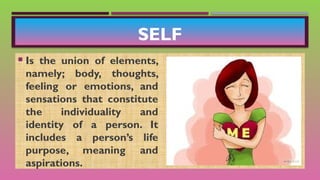
SELF
Is theunion of elements,
namely; body, thoughts,
feeling or emotions, and
sensations that constitute
the individuality and
identity of a person. It
includes a person’s life
purpose, meaning and
aspirations.
IN PSYCHOLOGY,
Personality refersto the set of behaviors, feelings,
thoughts and motives that identifies an individual. It is
the essence of who we are and is the embodiment of
one’s physical, psychological, cognitive, affective and
spiritual self.
PERSONALITY
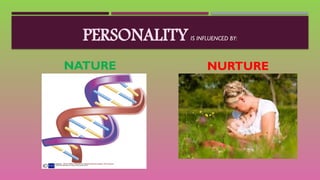
Personality is influencedby both Nature (heredity or
genetic make-up) and Nurture (environment). There is
no single gene that creates a trait. It is always a complex
combination of genes, environmental exposure and
experiences, and cultural backgrounds.
13.
SELF-DEVELOPMENT
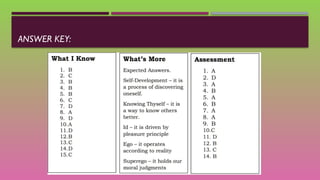
Self-development is aprocess of discovering
oneself by realizing one’s potentials and
capabilities that are shaped over time either by
studying in a formal school or through
environmental factors.
14.
KNOW THYSELF
Accordingto the philosophical point of view,
“An unexamined life is not worth living”,
this is one of the famous lines once uttered by
one of the greatest philosophers of Ancient
Greek, Socrates.
knowing oneself is the open door that leads us
to knowing others better.
15.
SELF-CONCEPT
Self-concept is one’sabstract and general idea about him/herself
particularly toward his/her unique personality and his/her own
perception about his/her set of values, point of views and behavior.
This theory began as Rene Descartes, the Father of Modern
Philosophy, proposed his theory that a person’s existence depends
on his/her perception. Rene
Descartes stated that mind is the seat of consciousness. This
means that it is in the mind that we know everything about
ourselves like our identity, passion, interest, feelings, and/or
intellect, thus everything that we are comes from the mind.
16.
SELF-CONCEPT IS LEARNED
Thisexplains that no individual is born with self-
concept. A person will soon develop this as
he/she grows old. This means that self-concept
can only be acquired as soon as the person
learns how to mingle with others and so this
indicates that self-concept is influenced by the
person’s environment and can be a product of
the person’s socialization.
17.
SELF-CONCEPT IS ORGANIZED
Thisstresses out that one’s perception towards
him/her is firm. This means that a person may
hear other people’s point of view regarding
him/her but will keep on believing that what
he/she thinks of himself/herself is always the
right one. Change on one’s perceptions towards
him/her, however, may also be possible but it
takes time.
18.
SELF-CONCEPT IS DYNAMIC
Asan individual grows older, he/she continues to
encounter problems or challenges that may reveal
his/her self-concept in that particular time or
situation. A person will definitely respond to the
scenario based on his/her own insights and how
he/she perceives himself/herself in the situation.
Thus, self-concept undergoes development as the
person goes through different experiences.
19.
THREE COMPONENTS OFPERSONALITY
(Sigmund Freud who is a well-known psychologist, neurologist and the creator of psychoanalysis theory
and the father of psychoanalysis)
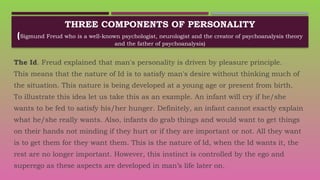
The Id. Freud explained that man's personality is driven by pleasure principle.
This means that the nature of Id is to satisfy man's desire without thinking much of
the situation. This nature is being developed at a young age or present from birth.
To illustrate this idea let us take this as an example. An infant will cry if he/she
wants to be fed to satisfy his/her hunger. Definitely, an infant cannot exactly explain
what he/she really wants. Also, infants do grab things and would want to get things
on their hands not minding if they hurt or if they are important or not. All they want
is to get them for they want them. This is the nature of Id, when the Id wants it, the
rest are no longer important. However, this instinct is controlled by the ego and
superego as these aspects are developed in man’s life later on.
20.
THREE COMPONENTS OFPERSONALITY
(Sigmund Freud who is a well-known psychologist, neurologist and the creator of psychoanalysis theory
and the father of psychoanalysis)
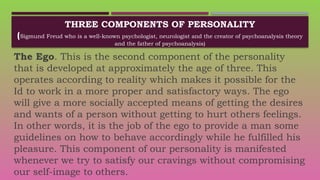
The Ego. This is the second component of the personality
that is developed at approximately the age of three. This
operates according to reality which makes it possible for the
Id to work in a more proper and satisfactory ways. The ego
will give a more socially accepted means of getting the desires
and wants of a person without getting to hurt others feelings.
In other words, it is the job of the ego to provide a man some
guidelines on how to behave accordingly while he fulfilled his
pleasure. This component of our personality is manifested
whenever we try to satisfy our cravings without compromising
our self-image to others.
21.
THREE COMPONENTS OFPERSONALITY
(Sigmund Freud who is a well-known psychologist, neurologist and the creator of psychoanalysis theory
and the father of psychoanalysis)
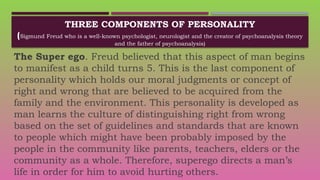
The Super ego. Freud believed that this aspect of man begins
to manifest as a child turns 5. This is the last component of
personality which holds our moral judgments or concept of
right and wrong that are believed to be acquired from the
family and the environment. This personality is developed as
man learns the culture of distinguishing right from wrong
based on the set of guidelines and standards that are known
to people which might have been probably imposed by the
people in the community like parents, teachers, elders or the
community as a whole. Therefore, superego directs a man’s
life in order for him to avoid hurting others.
22.
THREE COMPONENTS OFPERSONALITY
(Sigmund Freud who is a well-known psychologist, neurologist and the creator of psychoanalysis theory
and the father of psychoanalysis)
23.
KNOWING ONESELF
Adolescence isthe time when young people start to ask
questions about themselves, about their future, and even about
their religious and political beliefs. During this stage of
development, the young person grapples with his or her identity
thus, knowing oneself is important.
24.
REFLECTION
Write what youhave learned and your reflections on the topic discussed.This
will serve as your journal entry, which you will continue to do throughout the
semester.
In the journal, write down your thoughts, feelings and realizations about the
lesson. Pay special attention to what kinds of emotions you are feeling and
how these are affecting your thoughts about yourself.
List down things about yourself that you would like to improve on and create
a work plan on how to do this.
25.
AGREEMENT WITH MYSELF
Writean “Agreement with myself” document where
you will write your commitment for your personal
development for the semester. List down the things
you want to learn and change about yourself.Attach
your picture and signature to it and submit it to me.
26.
IN ADDITION:
Ask five(5) persons (friends, family members,
neighbors) on what they understand about personal
development and compare this with your own
understanding and experiences.
#3 1. Have you ever asked yourself this question?
2. Why do you think it’s important to know ourselves?
#4 before you can truly understand the world or make good choices, you must first understand yourself—your feelings, strengths, weaknesses, and values. When you know yourself, it’s easier to grow, learn, and make wise decisions in life.
👉 Imagine you know that you get distracted easily when using your phone while studying. Because you understand yourself, you decide to put your phone away and study in a quiet place. This helps you focus and get better grades.
Lesson: By knowing yourself (your habits and weaknesses), you can make smarter choices that lead to success.
#5 The self is what makes us who we are.
It is the union of different elements:
#6 our physical being
Body
The body is our physical aspect.
It includes:
Physical attributes – height, weight, appearance, skin color, features, etc.
Health – how strong or weak we are, our overall wellness.
Posture and poise – the way we carry ourselves, our movements, and presence.
#7 the way we think and process ideas
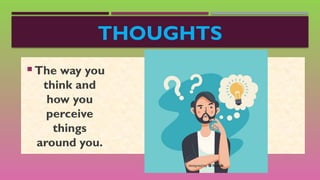
Thoughts are the way you think and perceive things around you.
They include:
Ideas – what comes to your mind.
Beliefs – what you accept as true.
Perceptions – how you interpret situations or people.
Thoughts shape how you understand yourself and how you respond to the world.
👉 Example: If you think positively, you are more likely to see challenges as opportunities.
#8 our reactions to experiences
what we experience through our senses
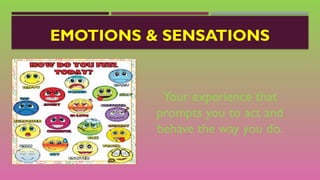
These are your inner experiences that influence how you act and behave.
Emotions – your feelings, such as happiness, sadness, anger, fear, or excitement.
Sensations – what you experience through your senses (sight, hearing, touch, taste, smell).
Together, they:
Affect your mood and decisions.
Guide your reactions to situations.
Shape how you relate to others.
👉 Example:
If you feel nervous before speaking in class (emotion) and your hands shake (sensation), that experience may affect your confidence and behavior.
#9 Personal Development means improving yourself — your skills, habits, attitude, and character — so you can grow and reach your goals.
But before you can improve, you must first understand who you are.
What are my strengths?
What are my weaknesses?
What are my values and dreams?
👉 Why it’s the first step:
If you know yourself, you can:
Use your strengths wisely.
Work on your weaknesses.
Make better choices in life.
Build healthier relationships with others.
#10 Personality is the unique set of behaviors, feelings, thoughts, and motives that identify an individual.
It is the essence of who we are, making each person different from others.
Personality is the embodiment of our:
Physical self – body and appearance
Psychological self – mindset and mental health
Cognitive self – the way we think and reason
Affective self – our emotions and moods
Spiritual self – values, faith, and sense of meaning in life
👉 In short, personality is the total package of the self that shows in how we act, think, and relate to others.
Personality is what makes you YOU.
It is the way you think, feel, and behave that makes you different from others.
👉 Example:
Some people are quiet and shy, others are outgoing and talkative.
That difference is because of personality.
#12 What Influences Personality?
Personality is shaped by two main factors:
Nature (Heredity / Genetic Make-up)
These are the traits we inherit from our parents through genes.
Example: natural talents, intelligence, or temperament.
Nurture (Environment / Experiences)
These are the influences from our surroundings.
Example: family, friends, culture, education, and life experiences.
👉 Important to remember:
There is no single gene that creates a personality trait.
Personality comes from a complex mix of:
Genes (nature)
Experiences and environment (nurture)
Culture and background
✨ Easy Example for Class:
Two siblings may share the same parents (same genes), but if one grows up surrounded by music while the other grows up focused on sports, their personalities will develop differently.
#13 Self-development is the process of discovering who you are by realizing your potentials (what you can become) and capabilities (what you can do).
It does not happen instantly — it is shaped over time through:
Formal education (what you learn in school)
Environmental factors (family, friends, community, experiences)
👉 In short, self-development is about growing, improving, and becoming the best version of yourself.
#14 According to philosophy, “An unexamined life is not worth living.”
This famous line was spoken by Socrates, one of the greatest philosophers of Ancient Greece.
It means that if we do not stop to reflect and understand ourselves, life loses its true meaning.
Knowing oneself is the first step toward growth, wisdom, and making good choices.
When we truly know who we are — our strengths, weaknesses, values, and dreams — we also learn to understand and respect others better.
👉 In short: Knowing yourself is the open door that leads you to knowing others.
#15 The idea of self-concept goes back to René Descartes, known as the Father of Modern Philosophy.
He proposed that a person’s existence depends on perception.
Descartes said the mind is the seat of consciousness — meaning:
In the mind, we become aware of our identity, passions, interests, feelings, and intellect.
Therefore, everything we know about ourselves comes from the mind.
In short: Self-concept is how we define ourselves in our own minds — it’s our mental picture of who we are.
Who you are (identity)
What you believe in (values)
What you can do (abilities)
How you feel about yourself (self-image)
👉 Example: If you think “I am kind,” “I am shy,” or “I am good at drawing” — that’s part of your self-concept.
#16 Self-Concept is Learned
We are not born knowing who we are.
We develop it as we grow and interact with other people.
It comes from:
Environment (family, school, community)
Socialization (friends, culture, experiences)
This means our idea of who we are is shaped by the people and world around us.
👉 Example: A child may think “I am smart” because teachers praise their answers, or “I am funny” because friends laugh at their jokes.
#17 Self-concept is like a fixed picture of yourself in your mind.
Even if other people say things about you, you usually believe more in what you think about yourself.
Your self-concept can change, but it takes time and experience.
👉 Example: If you believe “I am friendly,” even if someone says you’re shy, you will still see yourself as friendly.
#18 Dynamic means changing.
As we grow older, we face new problems and challenges.
In every situation, how we see ourselves affects how we respond.
Because of this, our self-concept can develop and change through time and experience.
👉 Example: A shy student may think “I’m not confident.” But after joining activities and speaking in class, they may later see themselves as “braver and more confident.”
#19 According to Sigmund Freud, the Id is the part of personality that follows the pleasure principle.
It wants to satisfy desires and needs immediately, without thinking of consequences.
The Id is present from birth.
👉 Example:
A baby cries when hungry — not because it understands hunger, but because it wants food right away.
A child grabs toys without thinking if it belongs to someone else — the Id just wants it.
⚖️ However, as a person grows, the Ego and Superego develop to control and balance the Id’s strong desires.
#20 The Ego develops around age 3.
It follows the reality principle – it helps us get what we want in a way that is realistic and socially acceptable.
The Ego acts as a bridge between the Id (desires) and the real world.
It makes sure we can satisfy our wants without hurting others or ruining our self-image.
👉 Example:
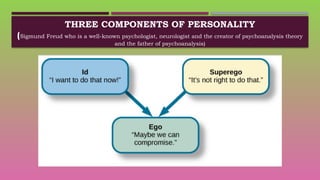
The Id says: “I want that cake now!”
The Ego says: “Wait until after dinner, then you can have some.”
⚖️ The Ego helps us behave properly while still finding ways to enjoy pleasure.
#21 The Superego develops around age 5.
It is the moral part of our personality — the voice that tells us what is right or wrong.
We learn it from:
Family (parents, elders)
Teachers
Community and culture
👉 Example:
The Id says: “Take your classmate’s toy.”
The Ego says: “Wait, ask nicely or borrow it.”
The Superego says: “Don’t take it. Stealing is wrong.”
⚖️ The Superego guides us to follow rules, values, and standards so we don’t hurt others and we live properly in society.
#23 Adolescence is the stage of growing up between childhood and adulthood.
At this time, young people start to ask big questions like:
Who am I?
What do I want to be in the future?
What do I believe in (religion, values, politics)?
This stage is about searching for identity — trying to understand oneself.
That is why knowing yourself becomes very important during adolescence.
👉 Example: Teenagers may try new hobbies, make different friends, or explore personal beliefs because they are figuring out their true identity.
Adolescence usually covers the ages 10 to 19 years old (according to the World Health Organization).
It is often divided into stages:
Early Adolescence (10–13 years old): start of puberty, body changes, curiosity, stronger need for friends.
Middle Adolescence (14–16 years old): stronger emotions, search for identity, independence from parents, peer influence.
Late Adolescence (17–19 years old): clearer sense of self, preparing for future (career, relationships, responsibilities).
👉 In short: Adolescence is the “teen years.”