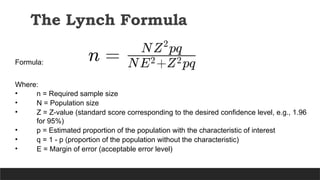
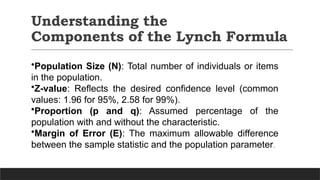
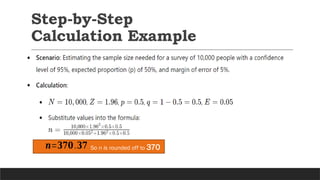
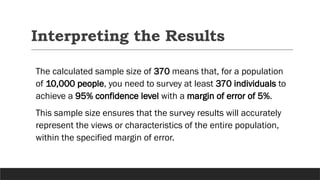
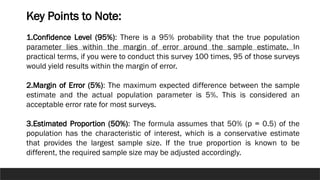
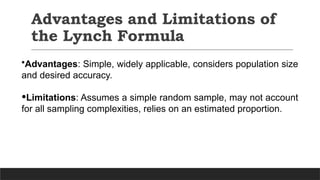
The Lynch formula is a statistical tool used to determine the minimum sample size needed for surveys, ensuring accurate representation of the population within cost and logistical constraints. Key components include population size, z-value for confidence level, estimated proportions, and margin of error, with an example calculating a required sample size of 370 for a population of 10,000 at a 95% confidence level with a 5% margin of error. While simple and applicable across various fields, the formula has limitations, such as assuming random sampling and relying on estimated population proportions.