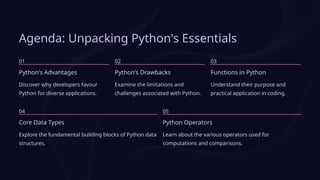
Agenda: Unpacking Python'sEssentials
01
Python's Advantages
Discover why developers favour
Python for diverse applications.
02
Python's Drawbacks
Examine the limitations and
challenges associated with Python.
03
Functions in Python
Understand their purpose and
practical application in coding.
04
Core Data Types
Explore the fundamental building blocks of Python data
structures.
05
Python Operators
Learn about the various operators used for
computations and comparisons.
3.
Python's Prowess: KeyAdvantages
Simplicity & Readability
Python's syntax closely resembles English, making it easy to
learn and write. Its clear structure enhances code readability
and maintainability, reducing development time and effort.
Versatility & Ecosystem
Extremely versatile, Python is used in web development, data
science, AI, machine learning, and automation. A vast
ecosystem of libraries and frameworks supports almost any
task.
Large Community Support
A global, active community means abundant resources,
tutorials, and immediate help for developers. This strong
support system continually contributes to Python's growth.
4.
Python's Pitfalls: Understandingthe Drawbacks
Speed Limitations
Python is an interpreted
language, which can lead to
slower execution speeds
compared to compiled
languages like C++ or Java,
especially for CPU-intensive
tasks.
Memory Consumption
Python can be memory-
intensive due to its dynamic
typing and automatic garbage
collection. This might be a
concern for applications with
strict memory constraints.
Runtime Errors
As an interpreted language,
errors often appear only at
runtime, making debugging
more challenging compared
to languages with compile-
time error checks.
While powerful, these aspects require careful consideration for specific project requirements.
5.
Demystifying Python
Functions: Whatare they?
"A function is a block of
organized, reusable code that is
used to perform a single, related
action."
Functions in Python encapsulate specific tasks, making code
modular, reusable, and easier to maintain. They improve clarity
by breaking down complex problems into smaller, manageable
units. This promotes efficient development and reduces
redundancy.
6.
Practical Application: Howto Use Python Functions
Defining a Function
def greet(name): """ This function greets the person passed
in as a parameter. """ print("Hello, " + name + "!")
• def: Keyword to define a function.
• greet: Function name.
• (name): Parameter for input.
• """Docstring""": Explains the function.
Calling a Function
# Calling the functiongreet("Alice") greet("Bob")
• greet("Alice"): Executes the function, passing "Alice" as the
name argument.
• Output:
• Hello, Alice!
• Hello, Bob!
Functions can take arguments, perform operations, and return values, allowing for dynamic and structured programming.
7.
Python's Building Blocks:Essential Data Types
Text Type: str
Represents sequences of characters (e.g., "Hello World",
"Python"). Used for textual data.
Numeric Types: int, float, complex
• int: Whole numbers (e.g., 10, -5).
• float: Decimal numbers (e.g., 3.14, -0.5).
• complex: Numbers with real and imaginary parts (e.g., 3+5j).
Sequence Types: list, tuple, range
• list: Ordered, mutable collections (e.g., [1, 2, 3]).
• tuple: Ordered, immutable collections (e.g., (1, 2, 3)).
• range: Immutable sequence of numbers (e.g., range(0, 5)).
Mapping Type: dict
Ordered (from Python 3.7+), mutable collection of key-value
pairs (e.g., {'name': 'Alice', 'age': 30}).
Understanding these types is crucial for effective data handling and manipulation in Python.
8.
Operating in Python:An Overview of Operators
Operators are special symbols that perform operations on values and variables.
Arithmetic Operators
Perform mathematical operations (+, -, *, /, %, **, //).
Example: x + y
Assignment Operators
Assign values to variables (=, +=, -=, *=, /=).
Example: x = 10
Comparison Operators
Compare two values and return a boolean
(==, !=, <, >, <=, >=).
Example: x == y
Logical Operators
Combine conditional statements (and, or, not).
Example: x > 5 and y < 10
These operators are fundamental for controlling program flow and performing calculations.
9.
Key Learnings: Pythonin a Nutshell
Developer-Friendly
Python's simplicity and readability accelerate development and simplify
maintenance.
Versatile Applications
From web to AI, its extensive libraries cater to diverse project needs.
Essential Functions
Functions are key for modular and reusable code, enhancing efficiency.
Core Data Types
Understanding types like str, int, list, dict is crucial for data manipulation
Powerful Operators
Operators facilitate calculations, comparisons, and logical operations,
forming the backbone of Python logic.
Continuous Evolution
Python's vibrant community ensures constant updates and support,
keeping it relevant and powerful.
10.
Thank You forYour
Attention!
Python: Powering
Innovation, One Line
at a Time.



![Python's Building Blocks: Essential Data Types
Text Type: str
Represents sequences of characters (e.g., "Hello World",
"Python"). Used for textual data.
Numeric Types: int, float, complex
• int: Whole numbers (e.g., 10, -5).
• float: Decimal numbers (e.g., 3.14, -0.5).
• complex: Numbers with real and imaginary parts (e.g., 3+5j).
Sequence Types: list, tuple, range
• list: Ordered, mutable collections (e.g., [1, 2, 3]).
• tuple: Ordered, immutable collections (e.g., (1, 2, 3)).
• range: Immutable sequence of numbers (e.g., range(0, 5)).
Mapping Type: dict
Ordered (from Python 3.7+), mutable collection of key-value
pairs (e.g., {'name': 'Alice', 'age': 30}).
Understanding these types is crucial for effective data handling and manipulation in Python.](https://image.slidesharecdn.com/pythonteam-250907043441-2edfe577/85/pythonteam-done-by-all-the-team-members-pptx-7-320.jpg)


