Funding for this seminar
Agenda for Today
• Morning:
– Lindsay Green-Barber, CIR
– Amy Shaw, KETC-TV/Nine Network, St. Louis
• Lunch
Agenda for Today
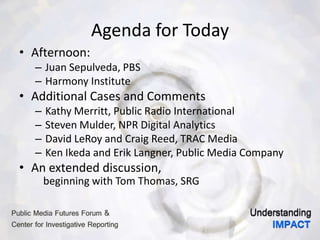
• Afternoon:
– Juan Sepulveda, PBS
– Harmony Institute
• Additional Cases and Comments
– Kathy Merritt, Public Radio International
– Steven Mulder, NPR Digital Analytics
– David LeRoy and Craig Reed, TRAC Media
– Ken Ikeda and Erik Langner, Public Media Company
• An extended discussion,
beginning with Tom Thomas, SRG
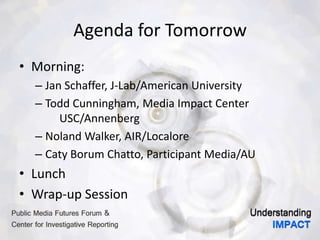
Agenda for Tomorrow
• Morning:
– Jan Schaffer, J-Lab/American University
– Todd Cunningham, Media Impact Center
USC/Annenberg
– Noland Walker, AIR/Localore
– Caty Borum Chatto, Participant Media/AU
• Lunch
• Wrap-up Session
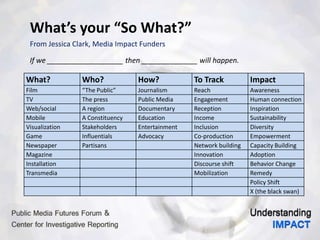
What? Who? How? To Track Impact
Film “The Public” Journalism Reach Awareness
TV The press Public Media Engagement Human connection
Web/social A region Documentary Reception Inspiration
Mobile A Constituency Education Income Sustainability
Visualization Stakeholders Entertainment Inclusion Diversity
Game Influentials Advocacy Co-production Empowerment
Newspaper Partisans Network building Capacity Building
Magazine Innovation Adoption
Installation Discourse shift Behavior Change
Transmedia Mobilization Remedy
Policy Shift
X (the black swan)
What’s your “So What?”
If we ___________________ then ______________ will happen.
From Jessica Clark, Media Impact Funders
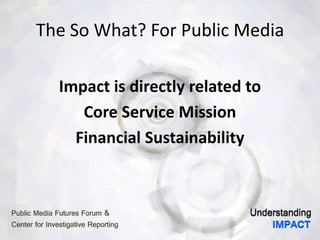
The So What? For Public Media
Impact is directly related to
Core Service Mission
Financial Sustainability
Legacy Impact Metrics
Audience Measurement
Total Revenues, all sources
Audience-sensitive revenue
0
500
1,000
1,500
2,000
2,500
1997 2000 2003 2006 2009 2012
Millions
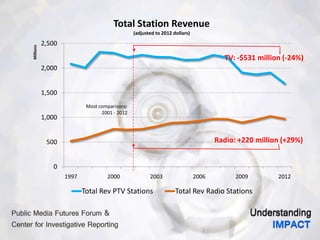
Total Station Revenue
(adjusted to 2012 dollars)
Total Rev PTV Stations Total Rev Radio Stations
Radio: +220 million (+29%)
Most comparisons:
2001 - 2012
TV: -$531 million (-24%)
0
100
200
300
400
500
600
700
1997 2000 2003 2006 2009 2012
Millions
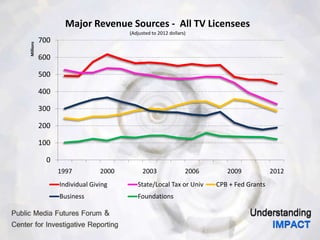
Major Revenue Sources - All TV Licensees
(Adjusted to 2012 dollars)
Individual Giving State/Local Tax or Univ CPB + Fed Grants
Business Foundations
0
100
200
300
400
500
600
700
1997 2000 2003 2006 2009 2012
Millions
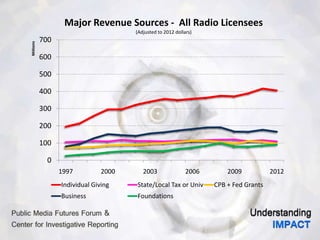
Major Revenue Sources - All Radio Licensees
(Adjusted to 2012 dollars)
Individual Giving State/Local Tax or Univ CPB + Fed Grants
Business Foundations
0
100
200
300
400
500
600
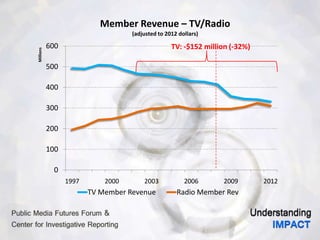
1997 2000 2003 2006 2009 2012
Millions
Member Revenue – TV/Radio
(adjusted to 2012 dollars)
TV Member Revenue Radio Member Rev
TV: -$152 million (-32%)
0.0
1.0
2.0
3.0
4.0
5.0
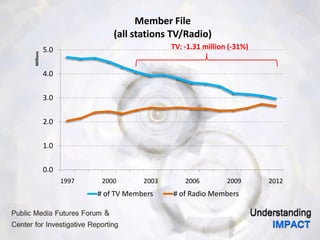
1997 2000 2003 2006 2009 2012
Millions
Member File
(all stations TV/Radio)
# of TV Members # of Radio Members
TV: -1.31 million (-31%)
0
100
200
300
400
500
600
700
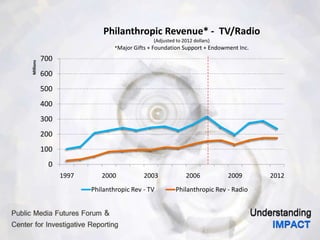
1997 2000 2003 2006 2009 2012
Millions Philanthropic Revenue* - TV/Radio
(Adjusted to 2012 dollars)
*Major Gifts + Foundation Support + Endowment Inc.
Philanthropic Rev - TV Philanthropic Rev - Radio
0
100
200
300
400
500
600
700
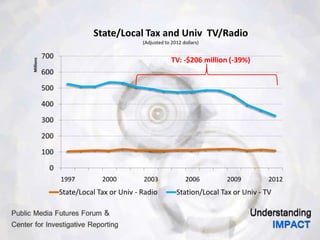
1997 2000 2003 2006 2009 2012
Millions State/Local Tax and Univ TV/Radio
(Adjusted to 2012 dollars)
State/Local Tax or Univ - Radio Station/Local Tax or Univ - TV
TV: -$206 million (-39%)
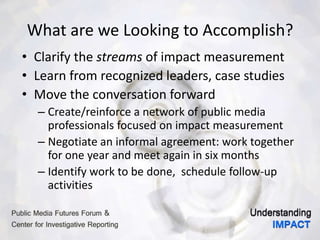
What are we Looking to Accomplish?
• Clarify the streams of impact measurement
What are we Looking to Accomplish?
• Clarify the streams of impact measurement
• Learn from recognized leaders, case studies
What are we Looking to Accomplish?
• Clarify the streams of impact measurement
• Learn from recognized leaders, case studies
• Move the conversation forward
– Create/reinforce a network of public media
professionals focused on impact measurement
– Negotiate an informal agreement: work together
for one year and meet again in six months
– Identify work to be done, schedule follow-up
activities
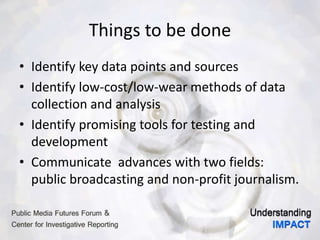
Things to be done
• Identify key data points and sources
• Identify low-cost/low-wear methods of data
collection and analysis
• Identify promising tools for testing and
development
• Communicate advances with two fields:
public broadcasting and non-profit journalism.
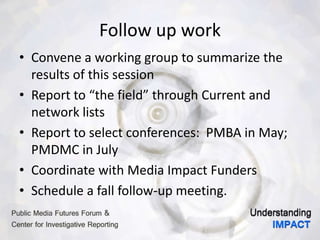
Follow up work
• Convene a working group to summarize the
results of this session
• Report to “the field” through Current and
network lists
• Report to select conferences: PMBA in May;
PMDMC in July
• Coordinate with Media Impact Funders
• Schedule a fall follow-up meeting.

Understanding Impact, an introduction to Dissection D

  • 2.
  • 3.
    Agenda for Today •Morning: – Lindsay Green-Barber, CIR – Amy Shaw, KETC-TV/Nine Network, St. Louis • Lunch
  • 4.
    Agenda for Today •Afternoon: – Juan Sepulveda, PBS – Harmony Institute • Additional Cases and Comments – Kathy Merritt, Public Radio International – Steven Mulder, NPR Digital Analytics – David LeRoy and Craig Reed, TRAC Media – Ken Ikeda and Erik Langner, Public Media Company • An extended discussion, beginning with Tom Thomas, SRG
  • 5.
    Agenda for Tomorrow •Morning: – Jan Schaffer, J-Lab/American University – Todd Cunningham, Media Impact Center USC/Annenberg – Noland Walker, AIR/Localore – Caty Borum Chatto, Participant Media/AU • Lunch • Wrap-up Session
  • 6.
    What? Who? How?To Track Impact Film “The Public” Journalism Reach Awareness TV The press Public Media Engagement Human connection Web/social A region Documentary Reception Inspiration Mobile A Constituency Education Income Sustainability Visualization Stakeholders Entertainment Inclusion Diversity Game Influentials Advocacy Co-production Empowerment Newspaper Partisans Network building Capacity Building Magazine Innovation Adoption Installation Discourse shift Behavior Change Transmedia Mobilization Remedy Policy Shift X (the black swan) What’s your “So What?” If we ___________________ then ______________ will happen. From Jessica Clark, Media Impact Funders
  • 7.
    The So What?For Public Media Impact is directly related to Core Service Mission Financial Sustainability
  • 8.
    Legacy Impact Metrics AudienceMeasurement Total Revenues, all sources Audience-sensitive revenue
  • 9.
    0 500 1,000 1,500 2,000 2,500 1997 2000 20032006 2009 2012 Millions Total Station Revenue (adjusted to 2012 dollars) Total Rev PTV Stations Total Rev Radio Stations Radio: +220 million (+29%) Most comparisons: 2001 - 2012 TV: -$531 million (-24%)
  • 10.
    0 100 200 300 400 500 600 700 1997 2000 20032006 2009 2012 Millions Major Revenue Sources - All TV Licensees (Adjusted to 2012 dollars) Individual Giving State/Local Tax or Univ CPB + Fed Grants Business Foundations
  • 11.
    0 100 200 300 400 500 600 700 1997 2000 20032006 2009 2012 Millions Major Revenue Sources - All Radio Licensees (Adjusted to 2012 dollars) Individual Giving State/Local Tax or Univ CPB + Fed Grants Business Foundations
  • 12.
    0 100 200 300 400 500 600 1997 2000 20032006 2009 2012 Millions Member Revenue – TV/Radio (adjusted to 2012 dollars) TV Member Revenue Radio Member Rev TV: -$152 million (-32%)
  • 13.
    0.0 1.0 2.0 3.0 4.0 5.0 1997 2000 20032006 2009 2012 Millions Member File (all stations TV/Radio) # of TV Members # of Radio Members TV: -1.31 million (-31%)
  • 14.
    0 100 200 300 400 500 600 700 1997 2000 20032006 2009 2012 Millions Philanthropic Revenue* - TV/Radio (Adjusted to 2012 dollars) *Major Gifts + Foundation Support + Endowment Inc. Philanthropic Rev - TV Philanthropic Rev - Radio
  • 15.
    0 100 200 300 400 500 600 700 1997 2000 20032006 2009 2012 Millions State/Local Tax and Univ TV/Radio (Adjusted to 2012 dollars) State/Local Tax or Univ - Radio Station/Local Tax or Univ - TV TV: -$206 million (-39%)
  • 16.
    What are weLooking to Accomplish? • Clarify the streams of impact measurement
  • 18.
    What are weLooking to Accomplish? • Clarify the streams of impact measurement • Learn from recognized leaders, case studies
  • 21.
    What are weLooking to Accomplish? • Clarify the streams of impact measurement • Learn from recognized leaders, case studies • Move the conversation forward – Create/reinforce a network of public media professionals focused on impact measurement – Negotiate an informal agreement: work together for one year and meet again in six months – Identify work to be done, schedule follow-up activities
  • 22.
    Things to bedone • Identify key data points and sources • Identify low-cost/low-wear methods of data collection and analysis • Identify promising tools for testing and development • Communicate advances with two fields: public broadcasting and non-profit journalism.
  • 23.
    Follow up work •Convene a working group to summarize the results of this session • Report to “the field” through Current and network lists • Report to select conferences: PMBA in May; PMDMC in July • Coordinate with Media Impact Funders • Schedule a fall follow-up meeting.