UNDERSTANDING
HRIS AND HRIS
ANALYTICS
LEVERAGING
TECHNOLOGY FOR
EFFICIENT HR
MANAGEMENT
Introduction
Components of HRIS
Introduction to HRIS Analytics
Types of HRIS Analytics
HR Metrics and KPIs
Case Study: Implementing HRIS
Analytics
Future Trends in HRIS and HRIS
Analytics
Relationship of HRIS with HRIS
analytic
Conclusion
2
INTRODUCTION
DEFINE HRIS
HRIS (Human Resource Information System)
is a software solution that helps organizations
manage their HR operations and processes
electronically. It centralizes employee data,
automates routine tasks, and supports
strategic HR decision-making.
Importance of HR technology: Explain how HR
technology has revolutionized HR
management, making processes more
efficient, accurate, and strategic.
4
COMPONENTS
OF HRIS
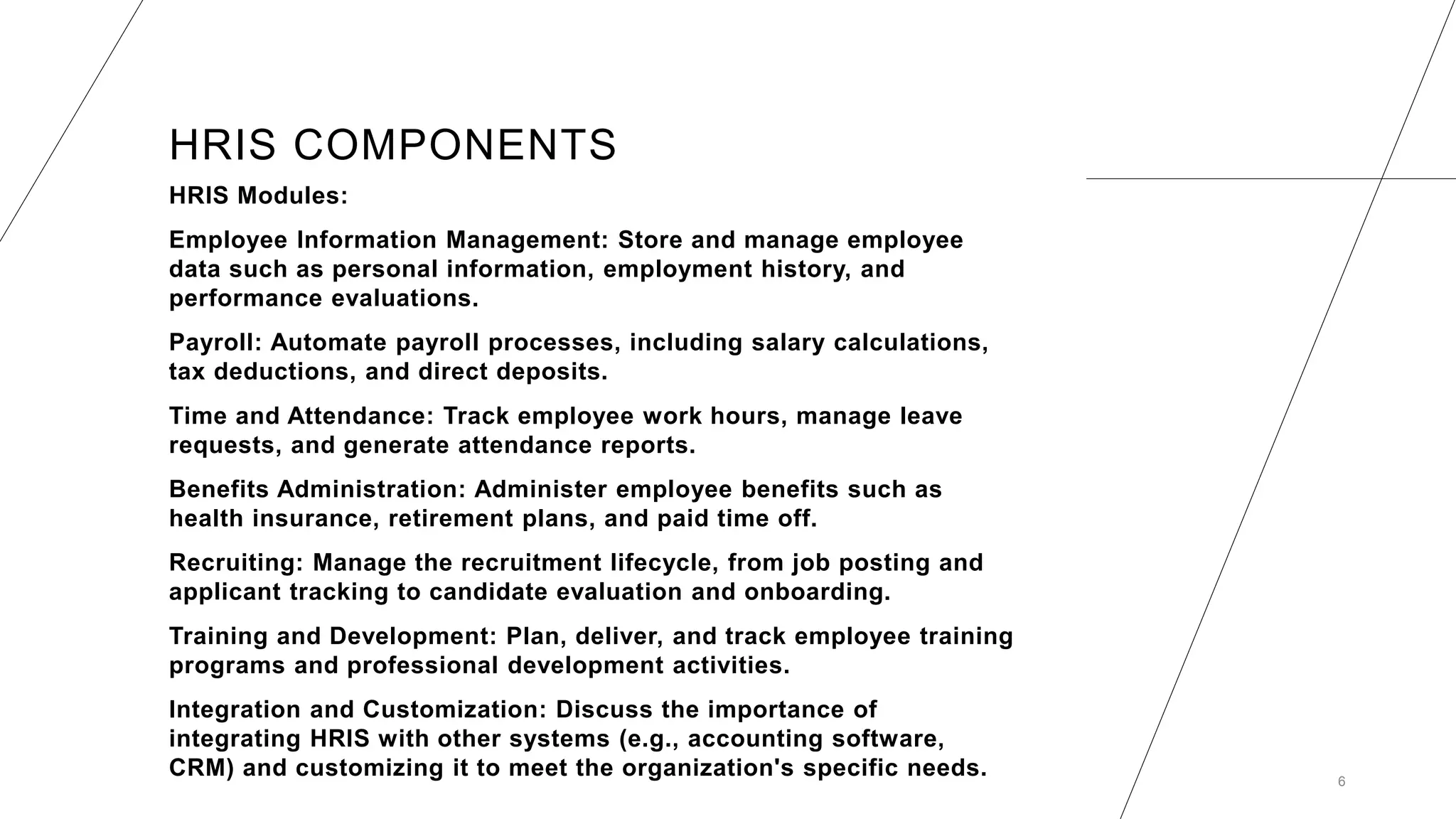
HRIS COMPONENTS
HRIS Modules:
Employee Information Management: Store and manage employee
data such as personal information, employment history, and
performance evaluations.
Payroll: Automate payroll processes, including salary calculations,
tax deductions, and direct deposits.
Time and Attendance: Track employee work hours, manage leave
requests, and generate attendance reports.
Benefits Administration: Administer employee benefits such as
health insurance, retirement plans, and paid time off.
Recruiting: Manage the recruitment lifecycle, from job posting and
applicant tracking to candidate evaluation and onboarding.
Training and Development: Plan, deliver, and track employee training
programs and professional development activities.
Integration and Customization: Discuss the importance of
integrating HRIS with other systems (e.g., accounting software,
CRM) and customizing it to meet the organization's specific needs. 6
INTRODUCTION
TO HRIS
ANALYTICS
DEFINE HRIS
ANALYTICS
Define HRIS Analytics: HRIS analytics involves
analyzing HR data to gain insights into
workforce trends, identify areas for
improvement, and support data-driven
decision-making.
Importance of Data Analytics in HR
Management: Explain how HR analytics helps
HR professionals understand employee
behavior, predict future trends, and optimize
HR processes.
8
TYPES OF HRIS
ANALYTICS
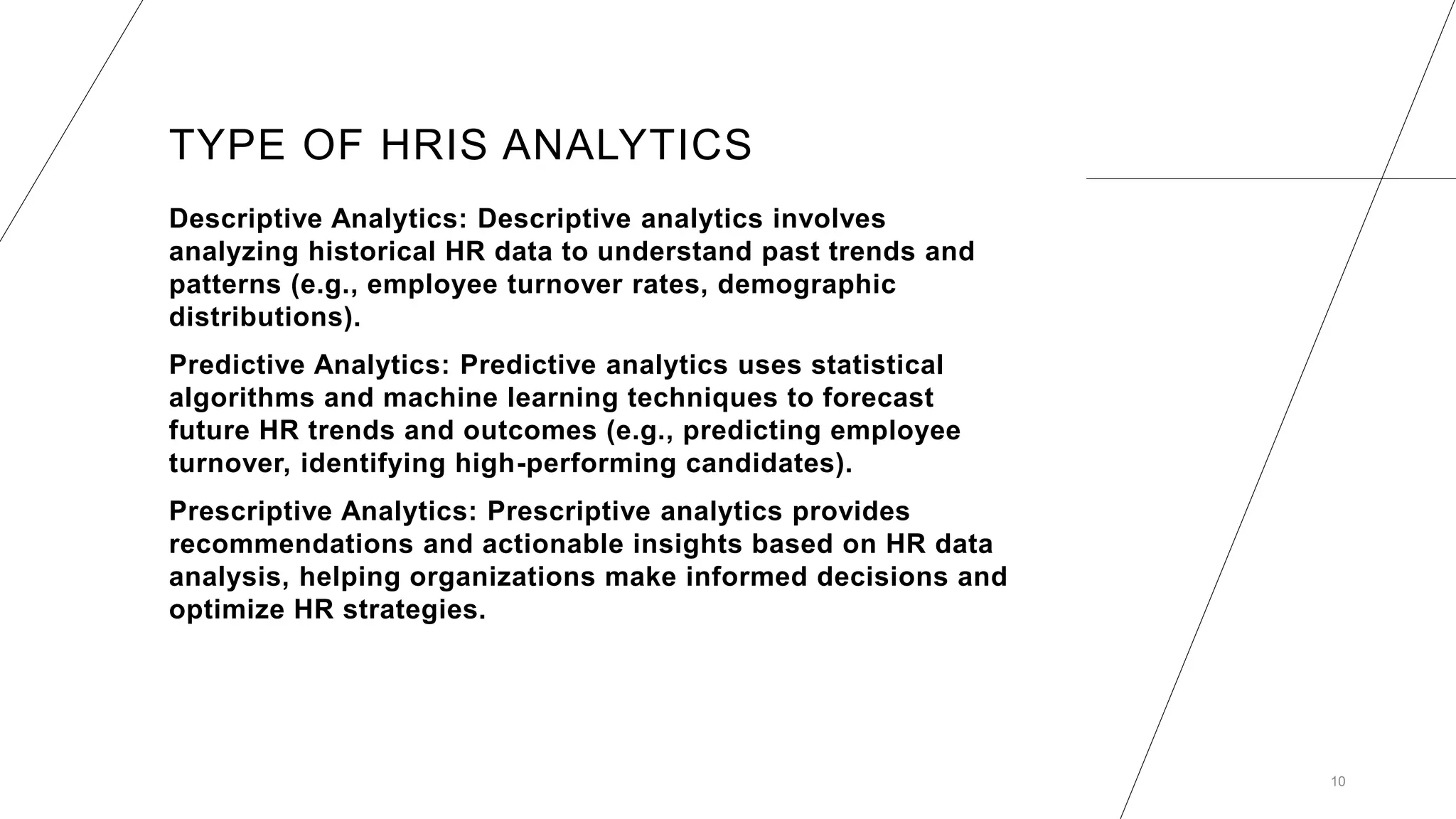
TYPE OF HRIS ANALYTICS
Descriptive Analytics: Descriptive analytics involves
analyzing historical HR data to understand past trends and
patterns (e.g., employee turnover rates, demographic
distributions).
Predictive Analytics: Predictive analytics uses statistical
algorithms and machine learning techniques to forecast
future HR trends and outcomes (e.g., predicting employee
turnover, identifying high-performing candidates).
Prescriptive Analytics: Prescriptive analytics provides
recommendations and actionable insights based on HR data
analysis, helping organizations make informed decisions and
optimize HR strategies.
10
HR METRICS AND KPIS
Examples of HR Metrics
Employee Turnover Rate: The
percentage of employees who leave
the organization within a certain
period.
Time to Fill: The average number of
days it takes to fill a vacant position.
Cost per Hire: The total cost
incurred to fill a vacant position,
including recruitment advertising,
agency fees, and employee training.
Training ROI: The return on
investment from employee training
and development programs.
Key Performance Indicators
(KPIs)
KPIs are specific metrics used to
measure the performance of HR
processes and initiatives (e.g.,
employee engagement, talent
acquisition effectiveness, HR
service delivery).
11
HRIS ANALYTICS TOOLS
Overview of popular HR analytics software/tools
1. ADP Workforce Now
2. BambooHR
3. SAP SuccessFactors
4. Workday
5. PeopleSoft
12
CASE STUDY: IMPLEMENTING HRIS
ANALYTICS
Provide a real-life example of a company that implemented HRIS
analytics to improve HR performance and achieve strategic
objectives.
Discuss the challenges faced during the implementation process
and the solutions implemented to overcome them.
Highlight the benefits realized from implementing HRIS analytics,
such as improved decision-making, increased employee
productivity, and reduced turnover.
13
FUTURE TRENDS IN HRIS AND HRIS ANALYTICS
1. AI and Machine Learning Integration: Discuss how AI and machine
learning technologies are being integrated into HRIS to automate
repetitive tasks, personalize employee experiences, and enhance
decision-making.
2. Predictive Workforce Analytics: Predictive workforce analytics will
enable organizations to anticipate future HR trends and outcomes,
allowing them to proactively address workforce challenges and
opportunities.
3. Blockchain for HR Data Security: Explore the potential of blockchain
technology to enhance HR data security, privacy, and transparency by
creating tamper-proof, decentralized HR databases.
14
HRIS ITS RELATED TO HRIS
ANALYTIC
HRIS stands for Human Resource Information System. It's essentially a
software solution that facilitates the management of HR processes and
data. HRIS encompasses a wide range of functionalities, including
employee data management, payroll processing, recruitment,
performance management, and more.
HRIS analytics, on the other hand, refers to the analytical capabilities
embedded within HRIS software or performed using data collected by
HRIS. These analytics involve the analysis of HR-related data to gain
insights into various aspects of human resources management, such as
workforce productivity, employee engagement, turnover rates, recruitment
effectiveness, and training impact.
In essence, while HRIS focuses on the system itself and its functionalities
for managing HR processes, HRIS analytics leverage the data within the
system to provide actionable insights for strategic decision-making and
optimizing HR practices. They are closely related as the analytics
component adds value to the HRIS by enabling data-driven decision-
making and performance evaluation.
15
CONCLUSION
16
Recap the key points discussed in the presentation,
emphasizing the importance of HRIS and HRIS
analytics in modern HR management.
Encourage the audience to leverage technology to
optimize HR processes, improve decision-making,
and drive business success.
THANK YOU
17

Understanding HRIS and HRIS Analytics.pptx

  • 1.
  • 2.
    LEVERAGING TECHNOLOGY FOR EFFICIENT HR MANAGEMENT Introduction Componentsof HRIS Introduction to HRIS Analytics Types of HRIS Analytics HR Metrics and KPIs Case Study: Implementing HRIS Analytics Future Trends in HRIS and HRIS Analytics Relationship of HRIS with HRIS analytic Conclusion 2
  • 3.
  • 4.
    DEFINE HRIS HRIS (HumanResource Information System) is a software solution that helps organizations manage their HR operations and processes electronically. It centralizes employee data, automates routine tasks, and supports strategic HR decision-making. Importance of HR technology: Explain how HR technology has revolutionized HR management, making processes more efficient, accurate, and strategic. 4
  • 5.
  • 6.
    HRIS COMPONENTS HRIS Modules: EmployeeInformation Management: Store and manage employee data such as personal information, employment history, and performance evaluations. Payroll: Automate payroll processes, including salary calculations, tax deductions, and direct deposits. Time and Attendance: Track employee work hours, manage leave requests, and generate attendance reports. Benefits Administration: Administer employee benefits such as health insurance, retirement plans, and paid time off. Recruiting: Manage the recruitment lifecycle, from job posting and applicant tracking to candidate evaluation and onboarding. Training and Development: Plan, deliver, and track employee training programs and professional development activities. Integration and Customization: Discuss the importance of integrating HRIS with other systems (e.g., accounting software, CRM) and customizing it to meet the organization's specific needs. 6
  • 7.
  • 8.
    DEFINE HRIS ANALYTICS Define HRISAnalytics: HRIS analytics involves analyzing HR data to gain insights into workforce trends, identify areas for improvement, and support data-driven decision-making. Importance of Data Analytics in HR Management: Explain how HR analytics helps HR professionals understand employee behavior, predict future trends, and optimize HR processes. 8
  • 9.
  • 10.
    TYPE OF HRISANALYTICS Descriptive Analytics: Descriptive analytics involves analyzing historical HR data to understand past trends and patterns (e.g., employee turnover rates, demographic distributions). Predictive Analytics: Predictive analytics uses statistical algorithms and machine learning techniques to forecast future HR trends and outcomes (e.g., predicting employee turnover, identifying high-performing candidates). Prescriptive Analytics: Prescriptive analytics provides recommendations and actionable insights based on HR data analysis, helping organizations make informed decisions and optimize HR strategies. 10
  • 11.
    HR METRICS ANDKPIS Examples of HR Metrics Employee Turnover Rate: The percentage of employees who leave the organization within a certain period. Time to Fill: The average number of days it takes to fill a vacant position. Cost per Hire: The total cost incurred to fill a vacant position, including recruitment advertising, agency fees, and employee training. Training ROI: The return on investment from employee training and development programs. Key Performance Indicators (KPIs) KPIs are specific metrics used to measure the performance of HR processes and initiatives (e.g., employee engagement, talent acquisition effectiveness, HR service delivery). 11
  • 12.
    HRIS ANALYTICS TOOLS Overviewof popular HR analytics software/tools 1. ADP Workforce Now 2. BambooHR 3. SAP SuccessFactors 4. Workday 5. PeopleSoft 12
  • 13.
    CASE STUDY: IMPLEMENTINGHRIS ANALYTICS Provide a real-life example of a company that implemented HRIS analytics to improve HR performance and achieve strategic objectives. Discuss the challenges faced during the implementation process and the solutions implemented to overcome them. Highlight the benefits realized from implementing HRIS analytics, such as improved decision-making, increased employee productivity, and reduced turnover. 13
  • 14.
    FUTURE TRENDS INHRIS AND HRIS ANALYTICS 1. AI and Machine Learning Integration: Discuss how AI and machine learning technologies are being integrated into HRIS to automate repetitive tasks, personalize employee experiences, and enhance decision-making. 2. Predictive Workforce Analytics: Predictive workforce analytics will enable organizations to anticipate future HR trends and outcomes, allowing them to proactively address workforce challenges and opportunities. 3. Blockchain for HR Data Security: Explore the potential of blockchain technology to enhance HR data security, privacy, and transparency by creating tamper-proof, decentralized HR databases. 14
  • 15.
    HRIS ITS RELATEDTO HRIS ANALYTIC HRIS stands for Human Resource Information System. It's essentially a software solution that facilitates the management of HR processes and data. HRIS encompasses a wide range of functionalities, including employee data management, payroll processing, recruitment, performance management, and more. HRIS analytics, on the other hand, refers to the analytical capabilities embedded within HRIS software or performed using data collected by HRIS. These analytics involve the analysis of HR-related data to gain insights into various aspects of human resources management, such as workforce productivity, employee engagement, turnover rates, recruitment effectiveness, and training impact. In essence, while HRIS focuses on the system itself and its functionalities for managing HR processes, HRIS analytics leverage the data within the system to provide actionable insights for strategic decision-making and optimizing HR practices. They are closely related as the analytics component adds value to the HRIS by enabling data-driven decision- making and performance evaluation. 15
  • 16.
    CONCLUSION 16 Recap the keypoints discussed in the presentation, emphasizing the importance of HRIS and HRIS analytics in modern HR management. Encourage the audience to leverage technology to optimize HR processes, improve decision-making, and drive business success.
  • 17.