Key Performance
Indicators (KPIs)
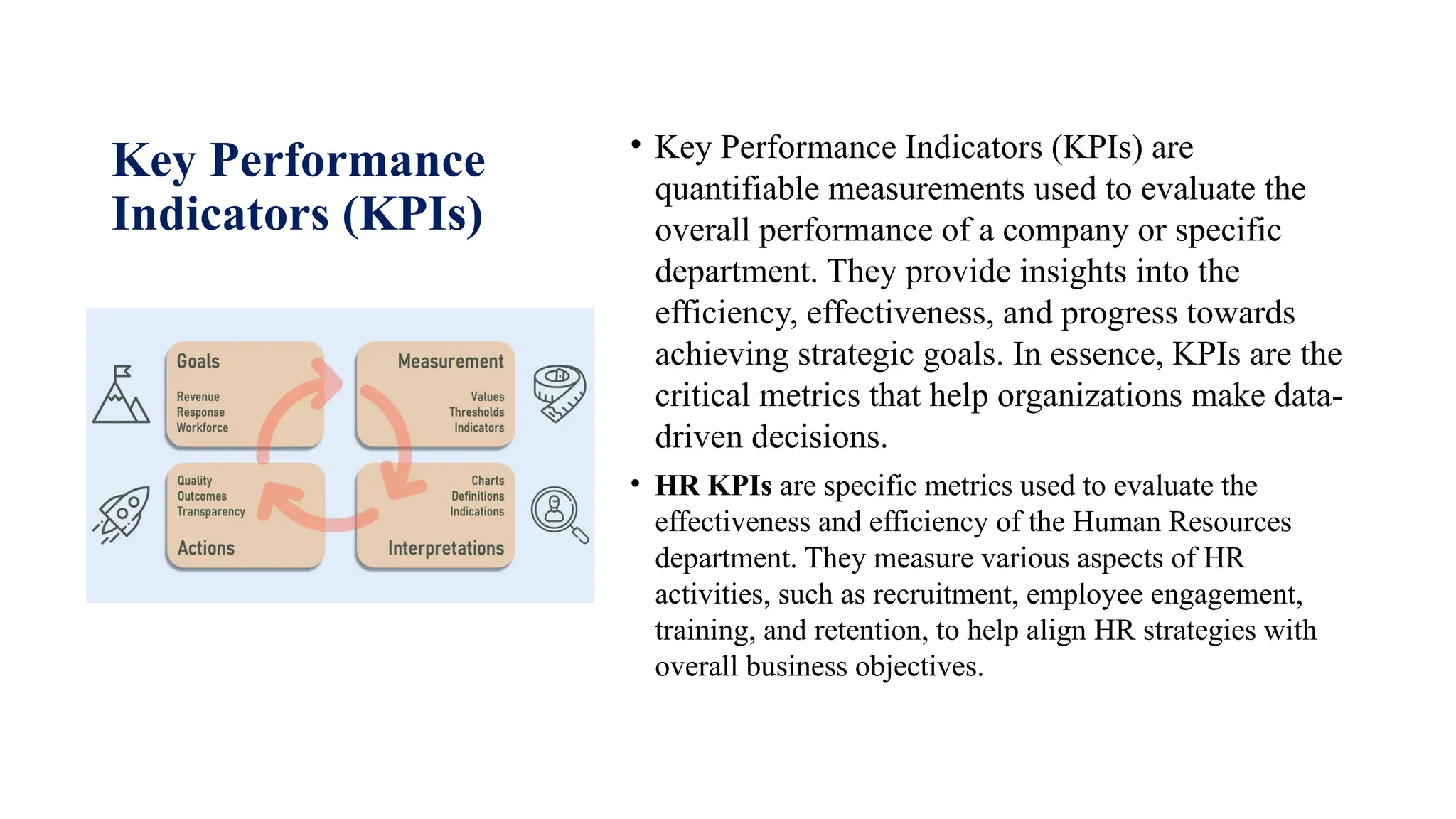
• Key Performance Indicators (KPIs) are
quantifiable measurements used to evaluate the
overall performance of a company or specific
department. They provide insights into the
efficiency, effectiveness, and progress towards
achieving strategic goals. In essence, KPIs are the
critical metrics that help organizations make data-
driven decisions.
• HR KPIs are specific metrics used to evaluate the
effectiveness and efficiency of the Human Resources
department. They measure various aspects of HR
activities, such as recruitment, employee engagement,
training, and retention, to help align HR strategies with
overall business objectives.
KPIs in HR Analytics
HR analytics focuses on people-related metrics that help measure the effectiveness of HR
functions and their impact on the business. Examples include:
• Recruitment KPIs: time to hire, cost per hire, offer acceptance rate
• Employee Onboarding KPIs: time to productivity, employee satisfaction with
onboarding
• Employee Engagement KPIs: employee satisfaction, turnover rate, absenteeism rate
• Performance Management KPIs: performance appraisal completion rate, goal
achievement rate
• Learning and Development KPIs: training completion rates, employee skill
development
• Talent Management KPIs: promotion rates, employee development costs
• Diversity and Inclusion KPIs: diversity hiring rate, employee satisfaction with diversity
initiatives
Key Points When Selecting KPIs
• Alignment with Strategic Objectives: Effective KPIs directly correlate
with an organization's strategic goals. They should be designed to measure
progress towards achieving these objectives.
• Relevance: KPIs should be relevant to the specific department or function
they are measuring. For example, HR KPIs should focus on human capital
metrics.
• Time-bound: KPIs should have specific timeframes for measurement and
evaluation to track performance trends.
• Data-Driven Decision Making: HR analytics using KPIs enables data-
driven decisions that improve HR processes and outcomes.
• Balance of Leading and Lagging Indicators: Both types of KPIs are
essential for understanding past performance and predicting future trends.
Analyzing HR Data
Once you've identified your KPIs, the next step is to collect and analyze the relevant data.
• Data collection: Gathering data from various HR systems (HRIS, performance
management, learning management systems).
• Data cleaning: Ensuring data accuracy and consistency.
• Data analysis: Using statistical methods and data visualization tools to uncover patterns
and trends
Data sources for HR analytics:
• HR information systems (HRIS)
• Performance management systems
• Talent management systems
• Employee surveys
• Exit interviews
• External data sources (e.g., labor market data)
Techniques in Analyzing HR Data
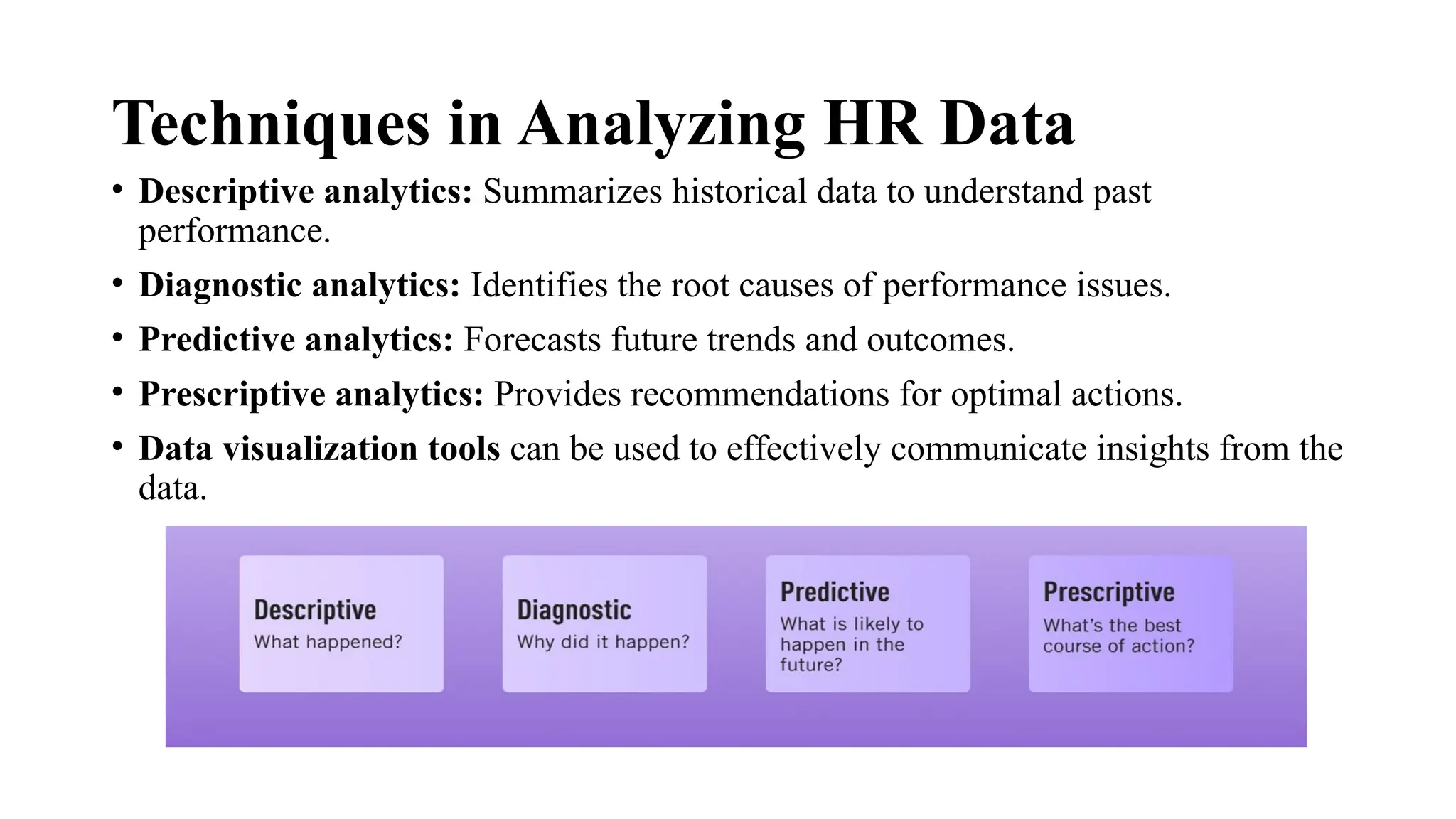
• Descriptive analytics: Summarizes historical data to understand past
performance.
• Diagnostic analytics: Identifies the root causes of performance issues.
• Predictive analytics: Forecasts future trends and outcomes.
• Prescriptive analytics: Provides recommendations for optimal actions.
• Data visualization tools can be used to effectively communicate insights from the
data.
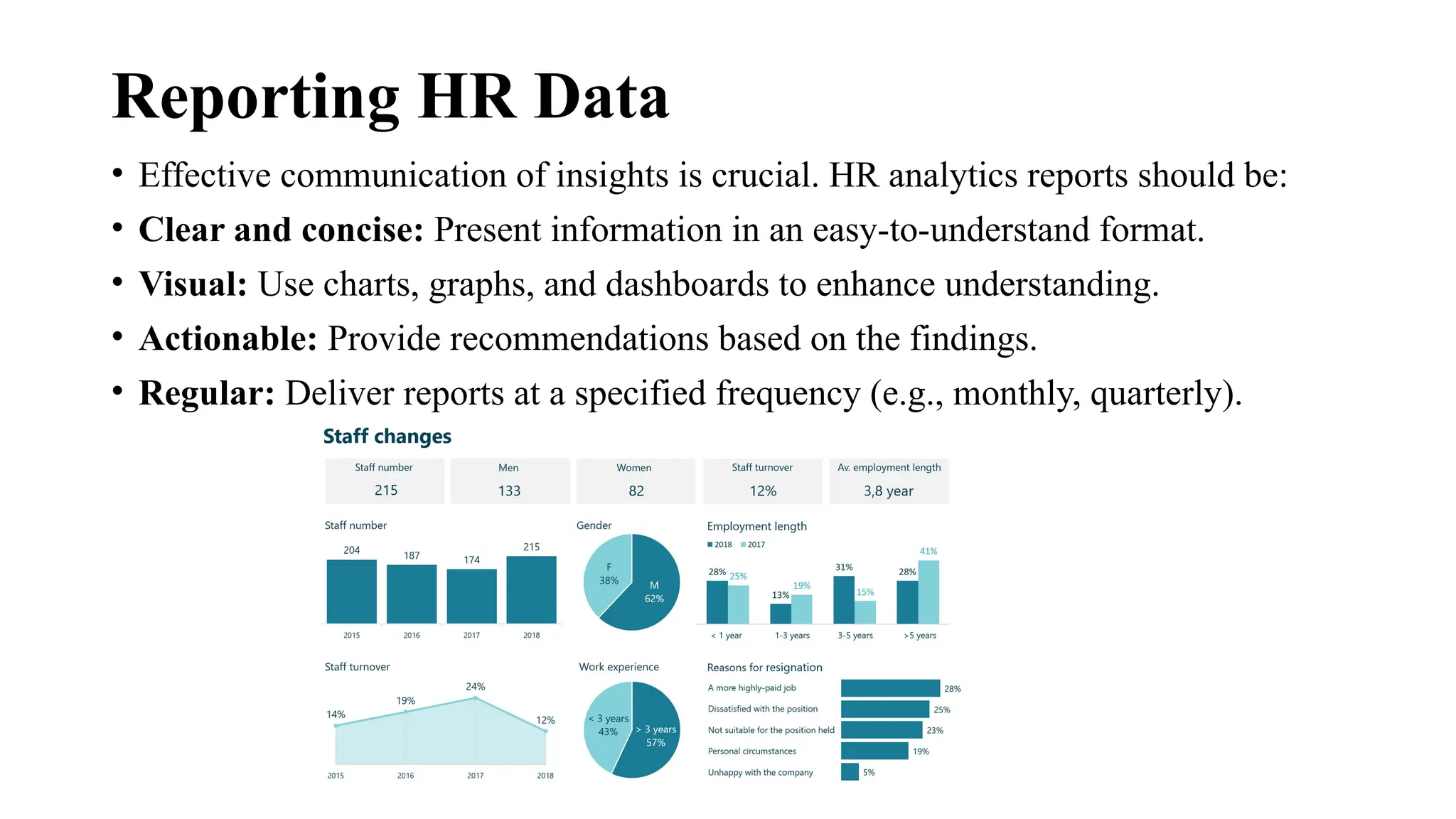
Reporting HR Data
• Effective communication of insights is crucial. HR analytics reports should be:
• Clear and concise: Present information in an easy-to-understand format.
• Visual: Use charts, graphs, and dashboards to enhance understanding.
• Actionable: Provide recommendations based on the findings.
• Regular: Deliver reports at a specified frequency (e.g., monthly, quarterly).
Interpreting HR Analytics Results
• Once you have the data and insights, the real work begins: understanding
what it means for your organization. Here's how to extract maximum value
from your HR analytics:
• Storytelling with Data: Transform numbers into narratives. Explain
complex findings in simple terms that resonate with stakeholders.
• Benchmarking: Compare your organization's performance against
industry standards or competitors. Identify areas of strength and weakness.
• Root Cause Analysis: Dig deeper into trends to uncover underlying
causes. For example, high turnover might be due to low engagement,
inadequate compensation, or lack of career growth opportunities.
• Identifying Opportunities: Use insights to uncover potential
improvements. For instance, if training completion rates are low, offer
more flexible or engaging training options.
Predicting Future KPIs
• HR analytics isn't just about the past; it's about shaping the future.
Predictive analytics can help you anticipate challenges and opportunities.
• Forecasting Trends: Use historical data to predict future trends in
employee turnover, hiring needs, and skill gaps.
• Scenario Planning: Model different future scenarios based on various
assumptions. This helps in decision-making and risk mitigation.
• Talent Acquisition Forecasting: Predict future hiring needs based on
business growth, attrition rates, and skill requirements.
• Succession Planning: Identify potential successors based on
performance, skills, and career aspirations.
Examples of KPI Forecasting in HR
• Predicting Employee Turnover: Analyze historical turnover rates,
employee satisfaction scores, and economic indicators to forecast
future attrition.
• Forecasting Hiring Needs: Estimate future staffing requirements
based on business growth, attrition rates, and project timelines.
• Predicting Training Needs: Identify skill gaps and anticipate future
training requirements based on organizational goals and technological
advancements.
• Budgeting for HR Expenses: Forecast HR costs based on historical
data, projected headcount, and salary trends.
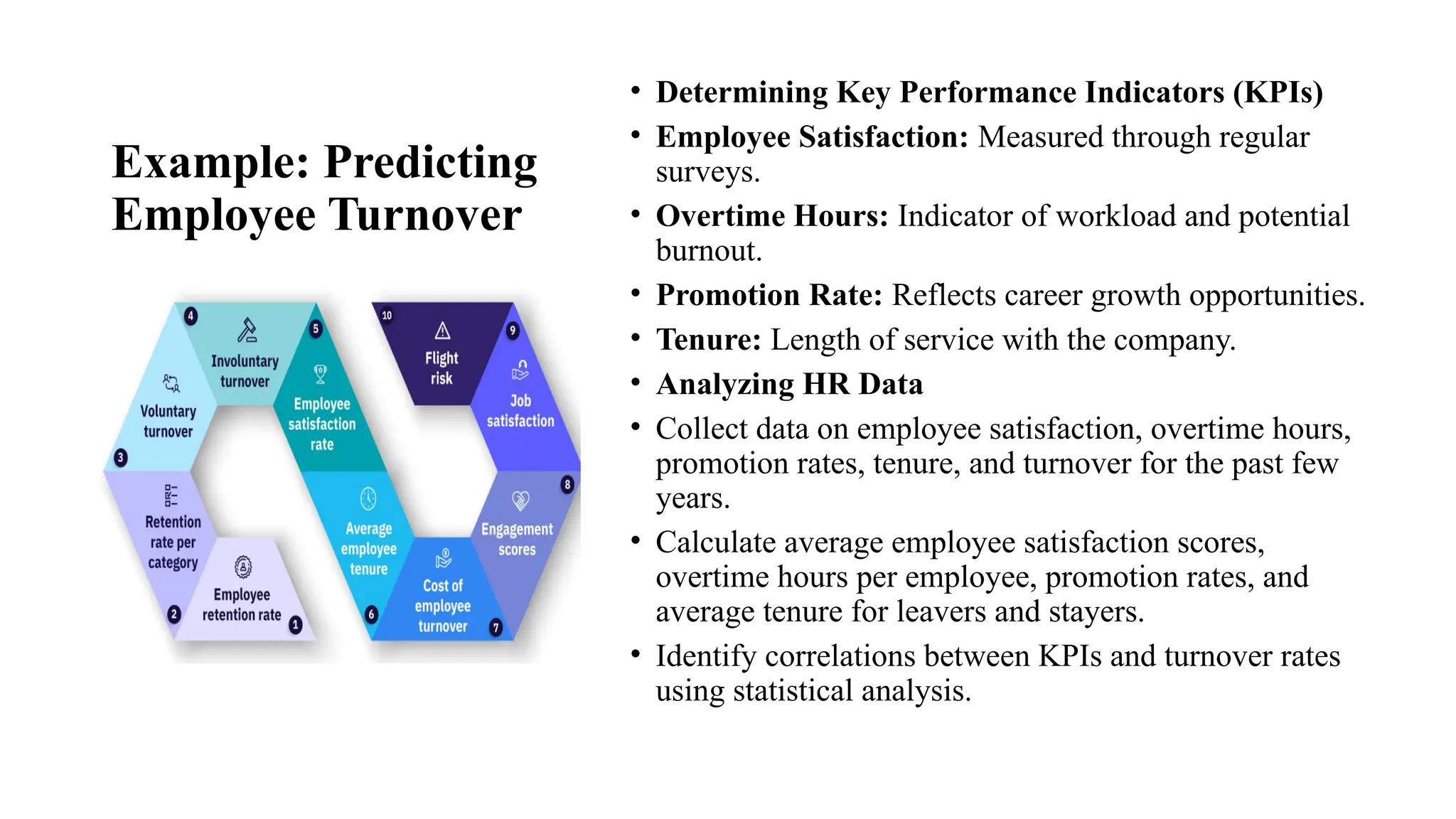
Example: Predicting
Employee Turnover
• Determining Key Performance Indicators (KPIs)
• Employee Satisfaction: Measured through regular
surveys.
• Overtime Hours: Indicator of workload and potential
burnout.
• Promotion Rate: Reflects career growth opportunities.
• Tenure: Length of service with the company.
• Analyzing HR Data
• Collect data on employee satisfaction, overtime hours,
promotion rates, tenure, and turnover for the past few
years.
• Calculate average employee satisfaction scores,
overtime hours per employee, promotion rates, and
average tenure for leavers and stayers.
• Identify correlations between KPIs and turnover rates
using statistical analysis.
• Reporting HR Data
• Create a dashboard visualizing trends in employee satisfaction, overtime hours, promotion
rates, and turnover over time.
• Generate reports highlighting departments or employee segments with high turnover rates.
• Interpreting Results
• Analyze the correlation between employee satisfaction, overtime hours, promotion rates, and
turnover.
• Identify patterns: For example, departments with high overtime and low promotion rates
might have higher turnover.
• Determine root causes: Deep dive into specific departments or employee groups with high
turnover to understand underlying issues.
• Predicting the Future
• Build a predictive model using historical data to forecast turnover rates based on KPIs.
• Identify employees at risk of leaving based on their current data points.
• Implement early intervention strategies for at-risk employees (e.g., targeted engagement
programs, career development plans).

Key Performance Indicators (KPIs) KPIs in HR Analytics

  • 1.
    Key Performance Indicators (KPIs) •Key Performance Indicators (KPIs) are quantifiable measurements used to evaluate the overall performance of a company or specific department. They provide insights into the efficiency, effectiveness, and progress towards achieving strategic goals. In essence, KPIs are the critical metrics that help organizations make data- driven decisions. • HR KPIs are specific metrics used to evaluate the effectiveness and efficiency of the Human Resources department. They measure various aspects of HR activities, such as recruitment, employee engagement, training, and retention, to help align HR strategies with overall business objectives.
  • 2.
    KPIs in HRAnalytics HR analytics focuses on people-related metrics that help measure the effectiveness of HR functions and their impact on the business. Examples include: • Recruitment KPIs: time to hire, cost per hire, offer acceptance rate • Employee Onboarding KPIs: time to productivity, employee satisfaction with onboarding • Employee Engagement KPIs: employee satisfaction, turnover rate, absenteeism rate • Performance Management KPIs: performance appraisal completion rate, goal achievement rate • Learning and Development KPIs: training completion rates, employee skill development • Talent Management KPIs: promotion rates, employee development costs • Diversity and Inclusion KPIs: diversity hiring rate, employee satisfaction with diversity initiatives
  • 3.
    Key Points WhenSelecting KPIs • Alignment with Strategic Objectives: Effective KPIs directly correlate with an organization's strategic goals. They should be designed to measure progress towards achieving these objectives. • Relevance: KPIs should be relevant to the specific department or function they are measuring. For example, HR KPIs should focus on human capital metrics. • Time-bound: KPIs should have specific timeframes for measurement and evaluation to track performance trends. • Data-Driven Decision Making: HR analytics using KPIs enables data- driven decisions that improve HR processes and outcomes. • Balance of Leading and Lagging Indicators: Both types of KPIs are essential for understanding past performance and predicting future trends.
  • 4.
    Analyzing HR Data Onceyou've identified your KPIs, the next step is to collect and analyze the relevant data. • Data collection: Gathering data from various HR systems (HRIS, performance management, learning management systems). • Data cleaning: Ensuring data accuracy and consistency. • Data analysis: Using statistical methods and data visualization tools to uncover patterns and trends Data sources for HR analytics: • HR information systems (HRIS) • Performance management systems • Talent management systems • Employee surveys • Exit interviews • External data sources (e.g., labor market data)
  • 5.
    Techniques in AnalyzingHR Data • Descriptive analytics: Summarizes historical data to understand past performance. • Diagnostic analytics: Identifies the root causes of performance issues. • Predictive analytics: Forecasts future trends and outcomes. • Prescriptive analytics: Provides recommendations for optimal actions. • Data visualization tools can be used to effectively communicate insights from the data.
  • 6.
    Reporting HR Data •Effective communication of insights is crucial. HR analytics reports should be: • Clear and concise: Present information in an easy-to-understand format. • Visual: Use charts, graphs, and dashboards to enhance understanding. • Actionable: Provide recommendations based on the findings. • Regular: Deliver reports at a specified frequency (e.g., monthly, quarterly).
  • 7.
    Interpreting HR AnalyticsResults • Once you have the data and insights, the real work begins: understanding what it means for your organization. Here's how to extract maximum value from your HR analytics: • Storytelling with Data: Transform numbers into narratives. Explain complex findings in simple terms that resonate with stakeholders. • Benchmarking: Compare your organization's performance against industry standards or competitors. Identify areas of strength and weakness. • Root Cause Analysis: Dig deeper into trends to uncover underlying causes. For example, high turnover might be due to low engagement, inadequate compensation, or lack of career growth opportunities. • Identifying Opportunities: Use insights to uncover potential improvements. For instance, if training completion rates are low, offer more flexible or engaging training options.
  • 8.
    Predicting Future KPIs •HR analytics isn't just about the past; it's about shaping the future. Predictive analytics can help you anticipate challenges and opportunities. • Forecasting Trends: Use historical data to predict future trends in employee turnover, hiring needs, and skill gaps. • Scenario Planning: Model different future scenarios based on various assumptions. This helps in decision-making and risk mitigation. • Talent Acquisition Forecasting: Predict future hiring needs based on business growth, attrition rates, and skill requirements. • Succession Planning: Identify potential successors based on performance, skills, and career aspirations.
  • 9.
    Examples of KPIForecasting in HR • Predicting Employee Turnover: Analyze historical turnover rates, employee satisfaction scores, and economic indicators to forecast future attrition. • Forecasting Hiring Needs: Estimate future staffing requirements based on business growth, attrition rates, and project timelines. • Predicting Training Needs: Identify skill gaps and anticipate future training requirements based on organizational goals and technological advancements. • Budgeting for HR Expenses: Forecast HR costs based on historical data, projected headcount, and salary trends.
  • 10.
    Example: Predicting Employee Turnover •Determining Key Performance Indicators (KPIs) • Employee Satisfaction: Measured through regular surveys. • Overtime Hours: Indicator of workload and potential burnout. • Promotion Rate: Reflects career growth opportunities. • Tenure: Length of service with the company. • Analyzing HR Data • Collect data on employee satisfaction, overtime hours, promotion rates, tenure, and turnover for the past few years. • Calculate average employee satisfaction scores, overtime hours per employee, promotion rates, and average tenure for leavers and stayers. • Identify correlations between KPIs and turnover rates using statistical analysis.
  • 11.
    • Reporting HRData • Create a dashboard visualizing trends in employee satisfaction, overtime hours, promotion rates, and turnover over time. • Generate reports highlighting departments or employee segments with high turnover rates. • Interpreting Results • Analyze the correlation between employee satisfaction, overtime hours, promotion rates, and turnover. • Identify patterns: For example, departments with high overtime and low promotion rates might have higher turnover. • Determine root causes: Deep dive into specific departments or employee groups with high turnover to understand underlying issues. • Predicting the Future • Build a predictive model using historical data to forecast turnover rates based on KPIs. • Identify employees at risk of leaving based on their current data points. • Implement early intervention strategies for at-risk employees (e.g., targeted engagement programs, career development plans).