
UNDERSTANDING FINGERPRINT 
SKIN CHARACTERISTICS AND 
IMAGE QUALITY 
ADAM GRAHAM 
STEPHEN ELLIOTT
OVERVIEW 
• Problem Statement 
• Motivation 
• Literature Review 
• Demographics 
• Analysis
INTRODUCTION 
•Relationship between moisture, oiliness, and 
elasticity 
•Relationship between individual skin 
characteristics and quality
WHY ARE YOU DOING THIS? 
• This research is being conducted to determine whether 
there is a relationship between moisture, oiliness, 
elasticity, and image quality. 
• The relationship or lack thereof will determine whether 
the skin characteristic data is worthwhile to collect.
MOTIVATION 
• Articles have linked skin moisture, oiliness, and elasticity to 
image quality but most do not have data on skin measurements 
to statistically prove the interaction effects.[5][7][15][16][21][22] 
• There is no methodology or consistent measure for collecting 
these fingerprint skin measurements. 
• Measurements are collected across different types of 
devices.[2][7][14] 
• Collecting poor quality data can be time consuming and 
expensive. It costs about $2.00 per capture using traditional 
capture stations.[1]
PROBLEM STATEMENT 
• This research examines skin moisture, oiliness, 
temperature, and elasticity and their relationship 
to fingerprint fidelity image quality
SIGNIFICANCE 
• This problem is important because collecting the skin 
characteristic data is time consuming and if 
unnecessary, can save that time. 
• Collecting poor fingerprint data can be costly. 
• Image quality affects performance therefore the best 
image quality should always try to be achieved. [8]
SKIN STRUCTURE 
Figure 1: Layers of the 
skin[11]
PORES 
• A pore is defined as a very small opening on the 
surface of your skin that liquid comes out through 
when you sweat. [12] 
•These pore structures are what creates the 
moisture on a fingerprint.
SEBACEOUS GLANDS 
• A sebaceous gland is the organ responsible for 
producing the oil content (sebum) on the skin.[18] 
• Free sebaceous glands open directly onto the 
skin’s surface (pg 385)[18]
OILINESS 
• Oiliness is defined as excessively high in naturally 
secreted oils. [10]
LITERATURE 
• Senior & Bolle (2001) stated that oil on the 
fingerprint often leads to poor image quality.[16]
LITERATURE 
•Wang (2013) stated that oil on the fingerprint 
often leads to poor image quality.[15]
LITERATURE 
•Yun & Cho (2006) stated that oil on the fingerprint 
often leads to poor image quality.[22]
MOISTURE 
• Moisture is defined as liquid diffused or condensed 
in a relatively small quantity. [9]
LITERATURE 
• Kang et al. (2003) stated that when moisture is 
lower, image quality will be greatly reduced rather 
than when the moisture is higher.[7]
ELASTICITY 
• Elasticity is defined as resilience, or the ability of 
something to return to its original shape after it 
has been manipulated. [4][13]
LITERATURE 
•Wang (2013) also stated that elasticity can cause 
distortion which leads to poor image quality.[21] 
•Wang (2013) stated that too much force or too 
little force also affect the image quality.[21]
LITERATURE 
•When you age, the skin loses its elastic properties 
and becomes increasingly dry (Scheidat et al., 
2011).
IMAGE QUALITY 
• Fingerprint image quality is defined as the 
measure of ridge and valley clarity and the ability 
to extract the important features of the finger.[3]
FIDELITY IMAGE QUALITY 
• Fidelity image quality is described as the degree to 
which a sample is an accurate representation of its 
source. [17]
LITERATURE 
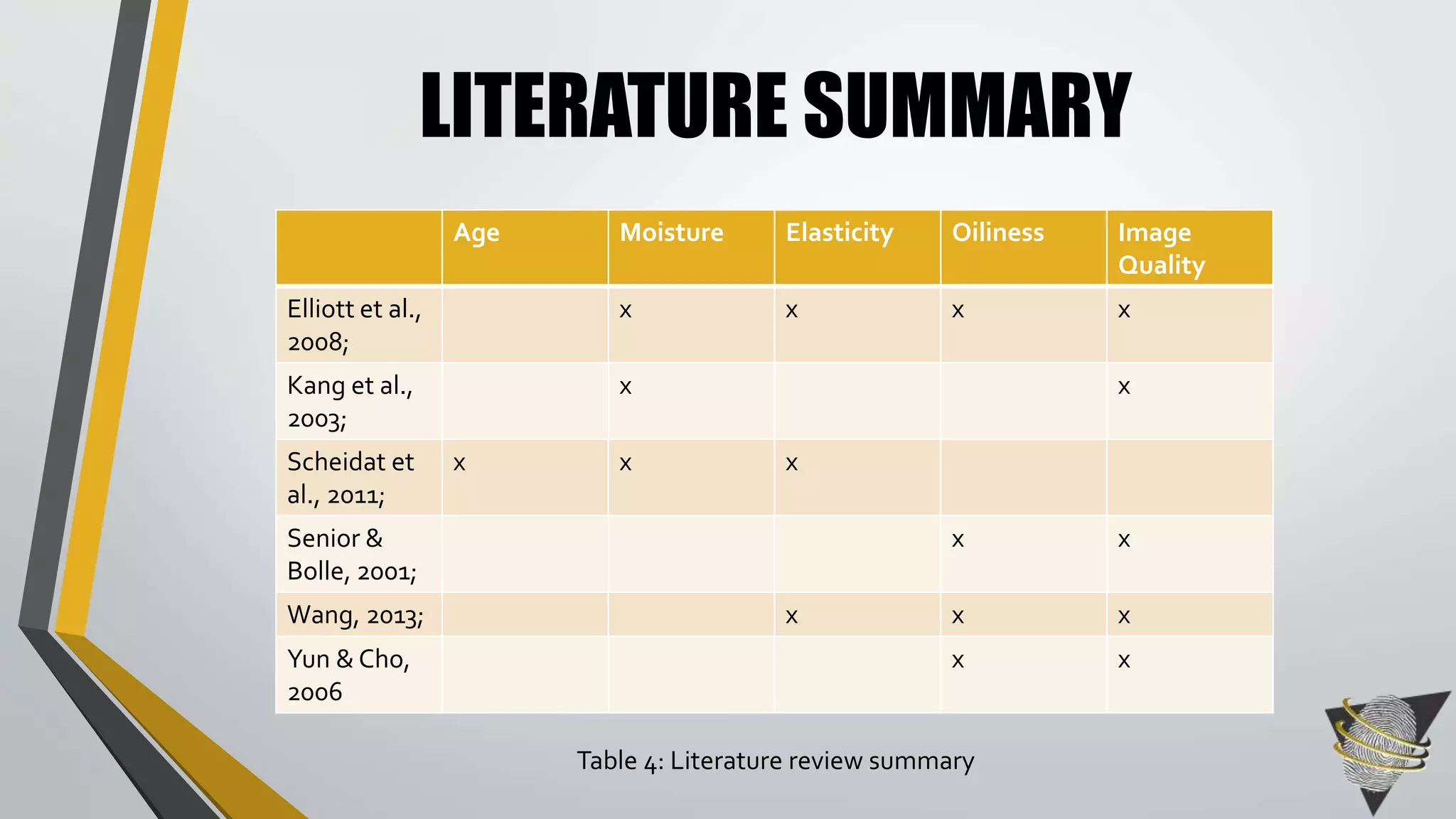
• Elliott et al. (2008) related moisture, oiliness, and 
elasticity to image quality.[5] 
• Elliott et al. (2008) stated that there is a 
relationship between the skin characteristics and 
image quality but it isn’t a linear relationship.[5]
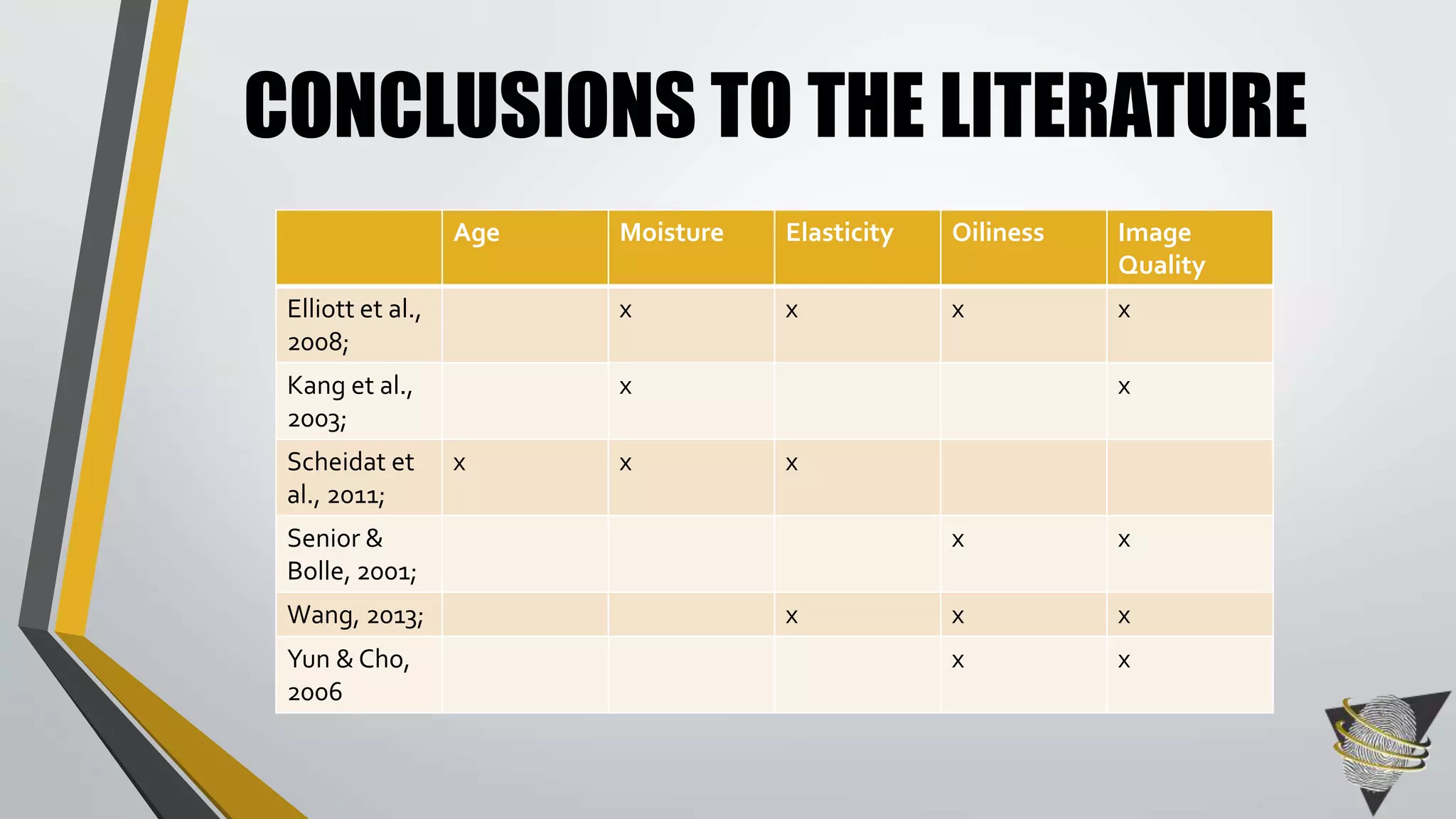
LITERATURE SUMMARY 
Age Moisture Elasticity Oiliness Image 
Quality 
Elliott et al., 
2008; 
x x x x 
Kang et al., 
2003; 
x x 
Scheidat et 
al., 2011; 
x x x 
Senior & 
Bolle, 2001; 
x x 
Wang, 2013; x x x 
Yun & Cho, 
x x 
2006 
Table 4: Literature review summary
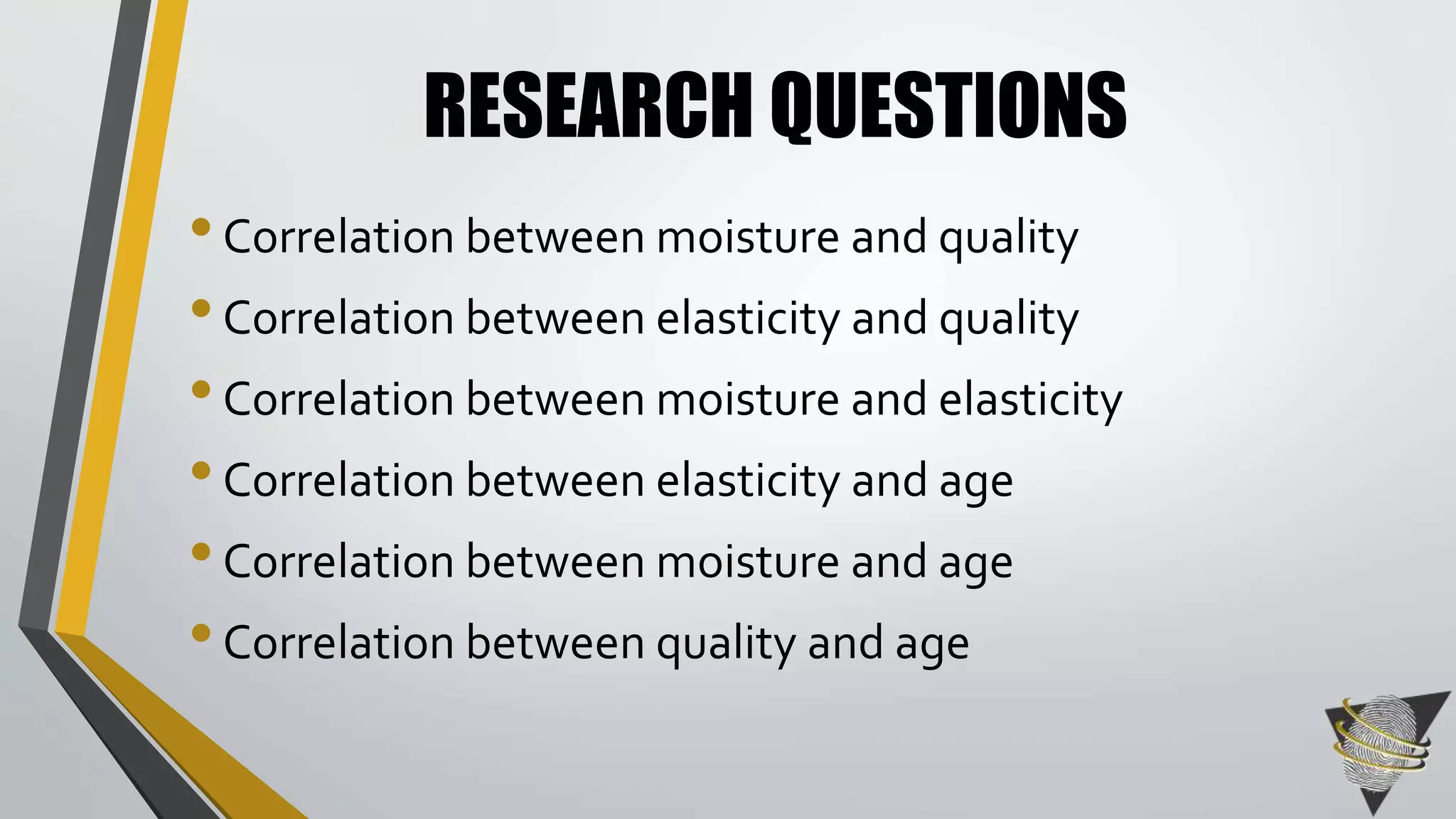
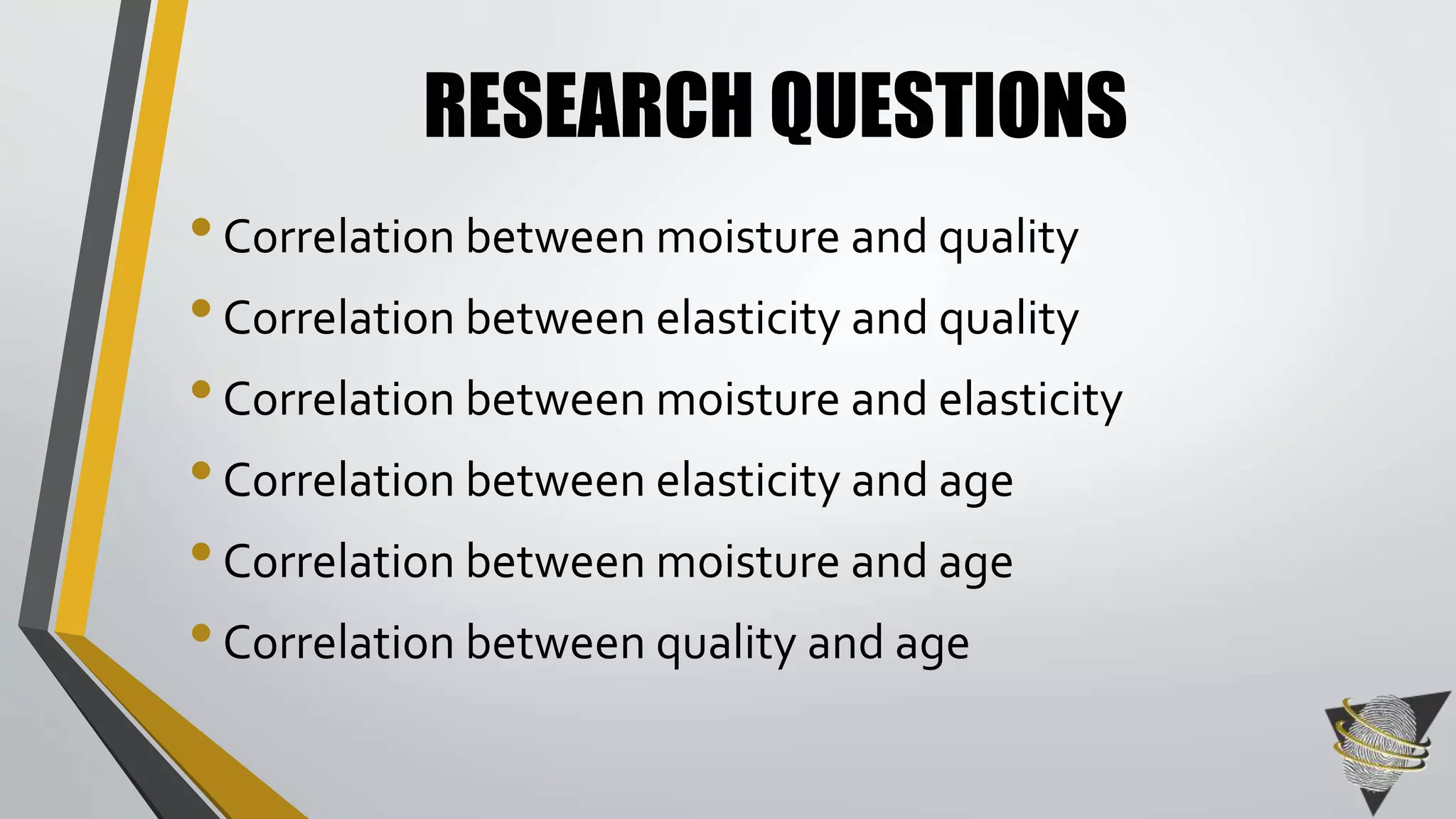
RESEARCH QUESTIONS 
• Correlation between moisture and quality 
• Correlation between elasticity and quality 
• Correlation between moisture and elasticity 
• Correlation between elasticity and age 
• Correlation between moisture and age 
• Correlation between quality and age
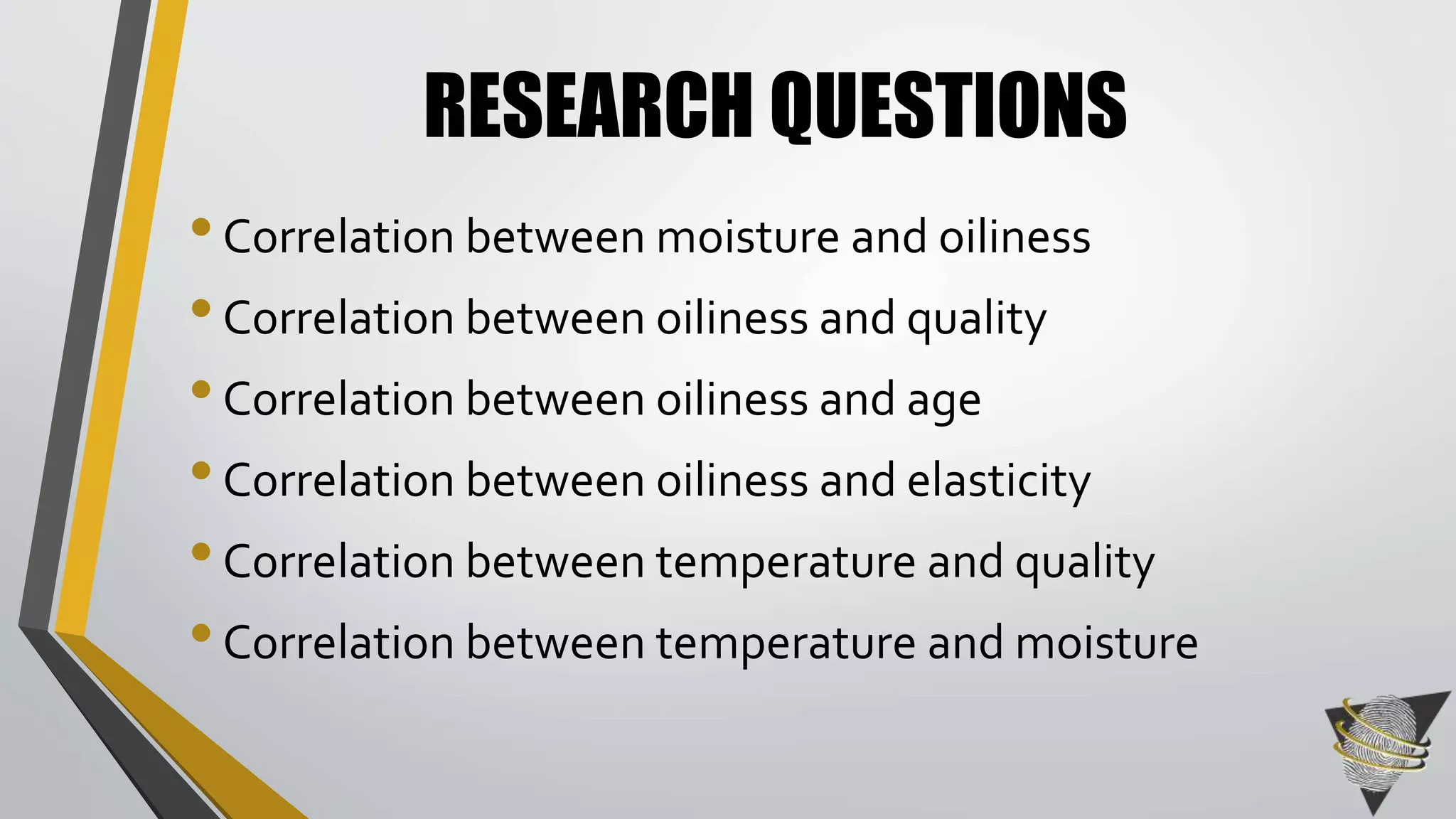
RESEARCH QUESTIONS 
• Correlation between moisture and oiliness 
• Correlation between oiliness and quality 
• Correlation between oiliness and age 
• Correlation between oiliness and elasticity 
• Correlation between temperature and quality 
• Correlation between temperature and moisture
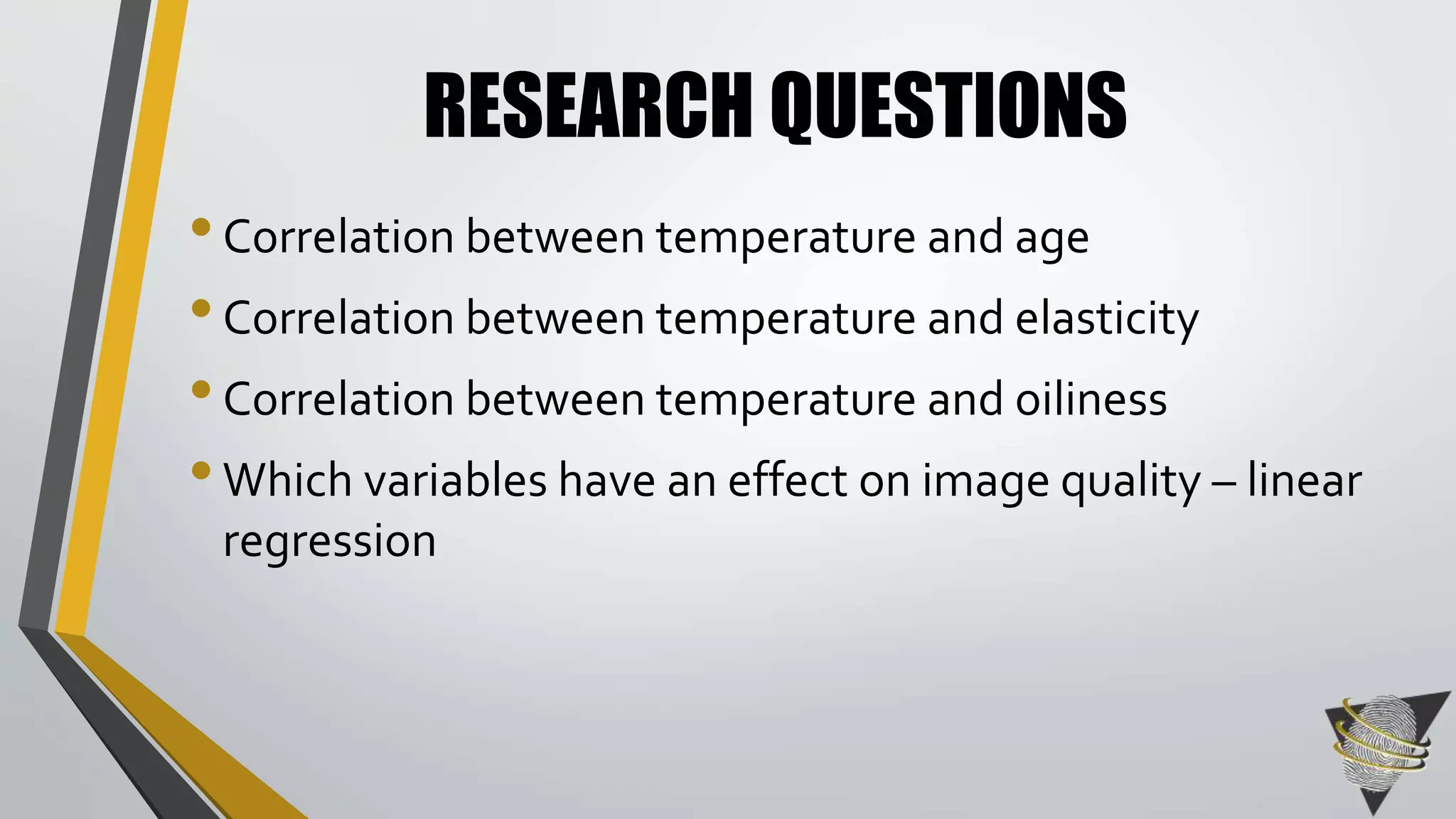
RESEARCH QUESTIONS 
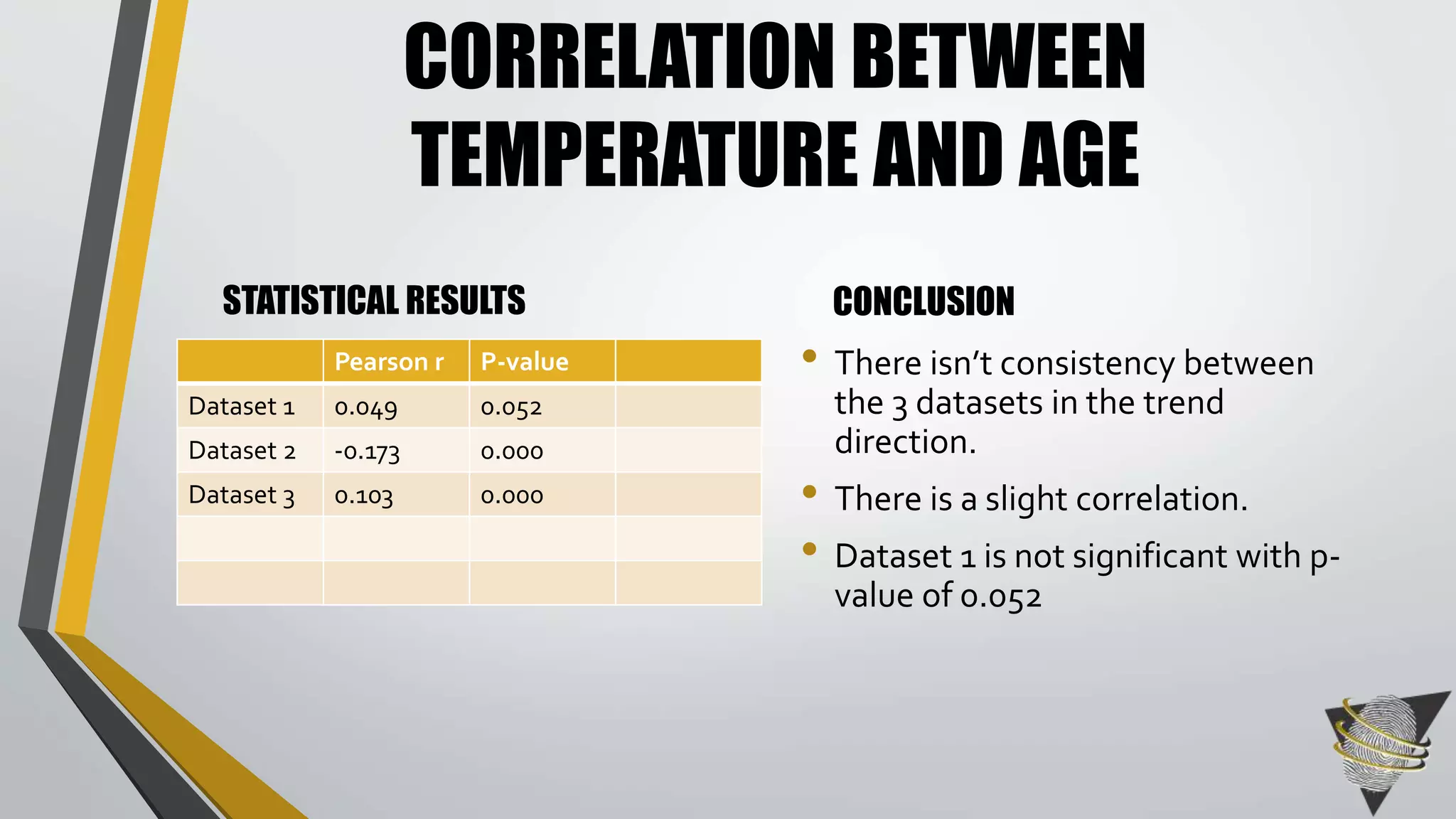
• Correlation between temperature and age 
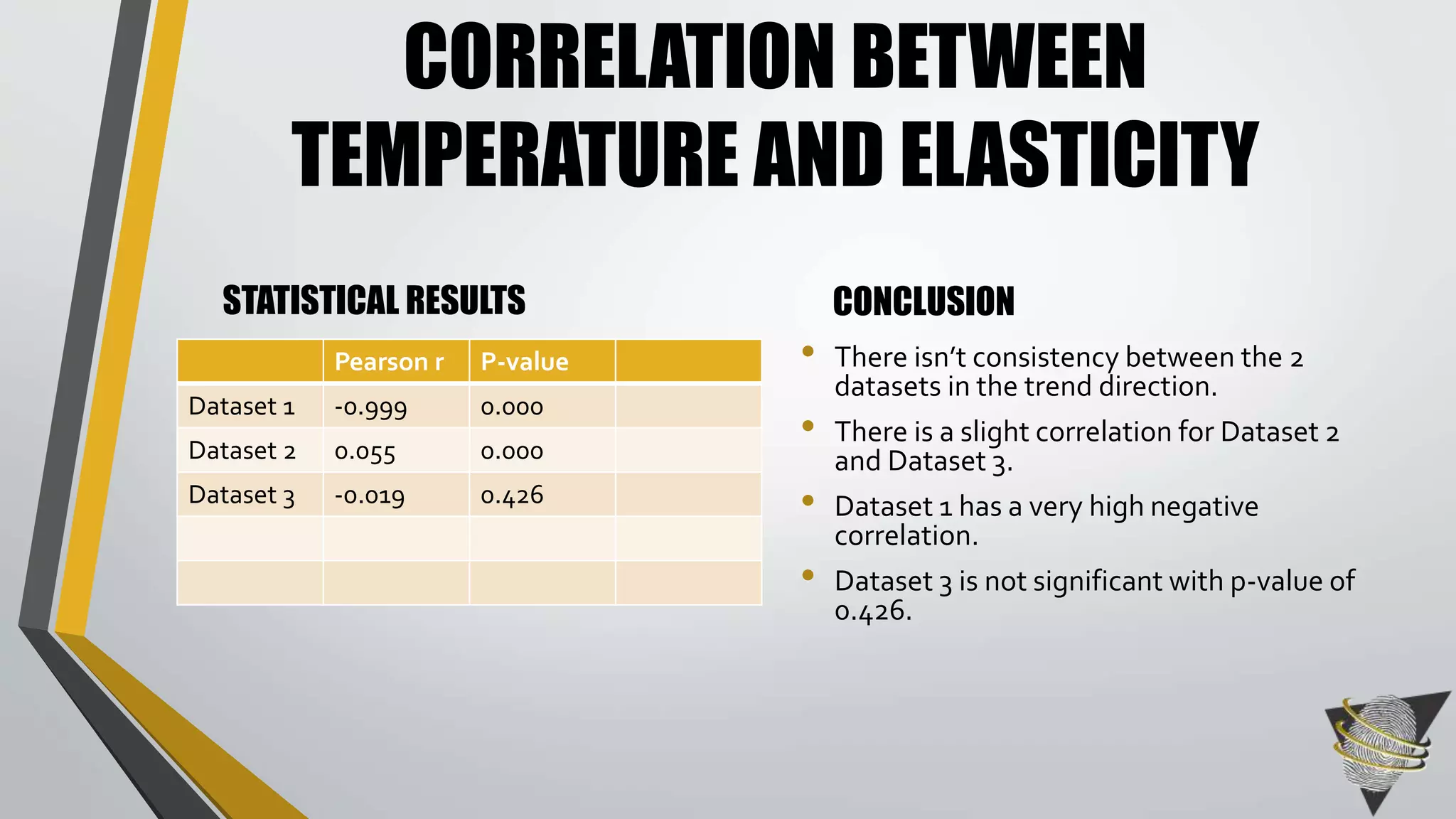
• Correlation between temperature and elasticity 
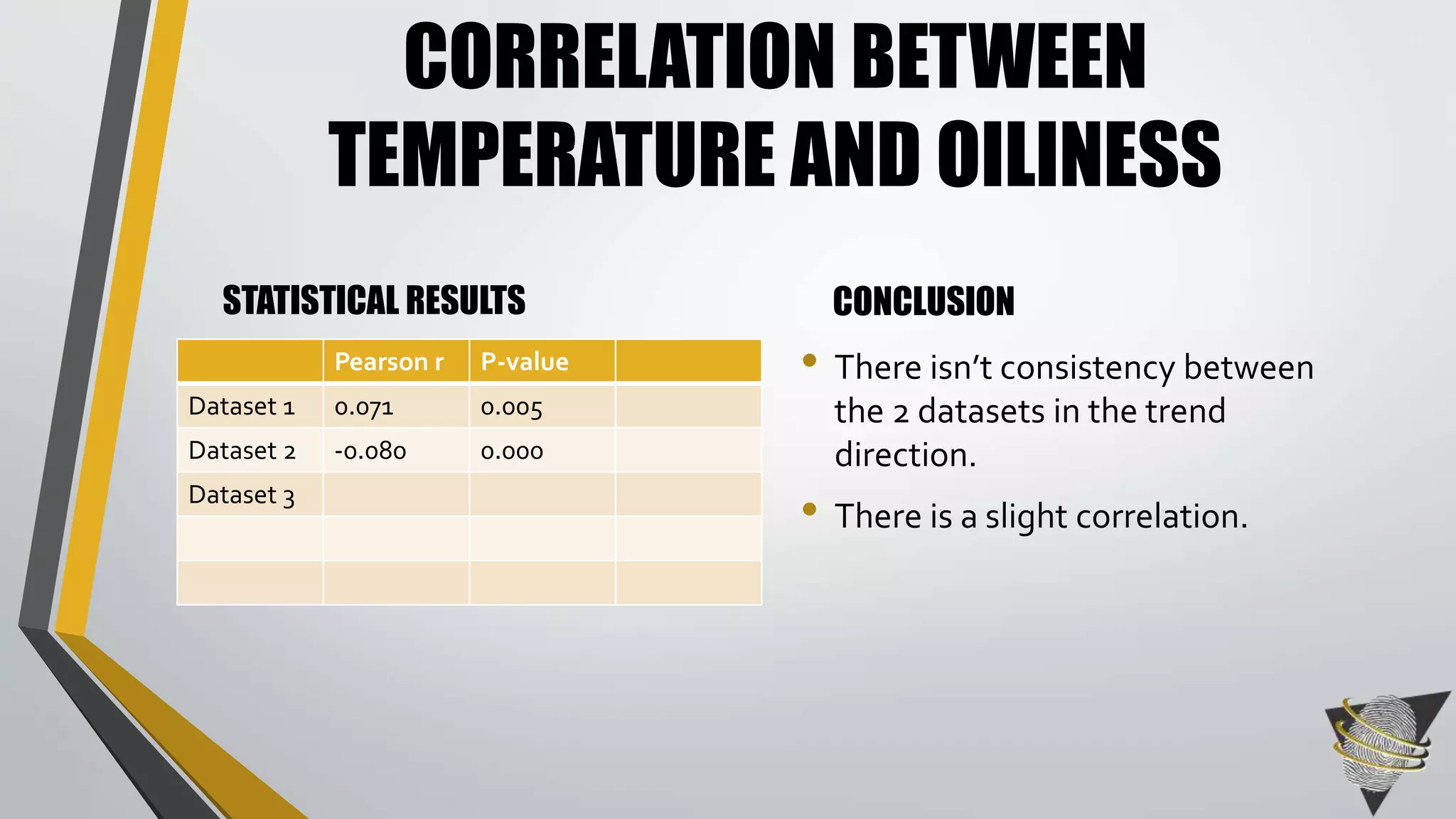
• Correlation between temperature and oiliness 
• Which variables have an effect on image quality – linear 
regression
FINGERPRINT 
•Devices 
• Digital Persona UareU 4000 
• Moritex MSA Pro 
• Triplesense
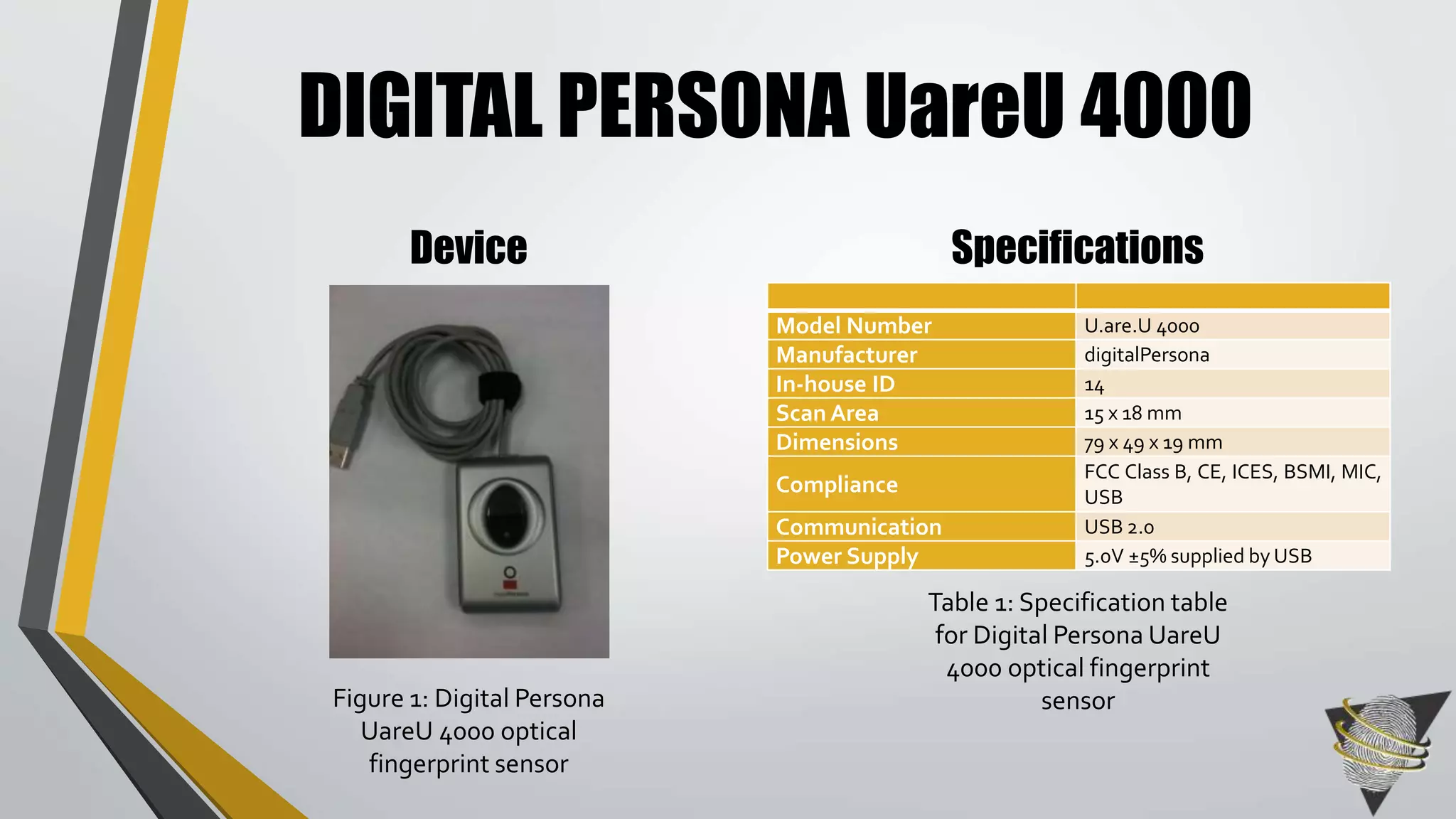
DIGITAL PERSONA UareU 4000 
Device Specifications 
Model Number U.are.U 4000 
Manufacturer digitalPersona 
In-house ID 14 
ScanArea 15 x 18mm 
Dimensions 79 x 49 x 19mm 
Compliance 
FCC Class B, CE, ICES, BSMI, MIC, 
USB 
Communication USB 2.0 
Power Supply 5.0V ±5%supplied by USB 
Figure 1: Digital Persona 
UareU 4000 optical 
fingerprint sensor 
Table 1: Specification table 
for Digital Persona UareU 
4000 optical fingerprint 
sensor
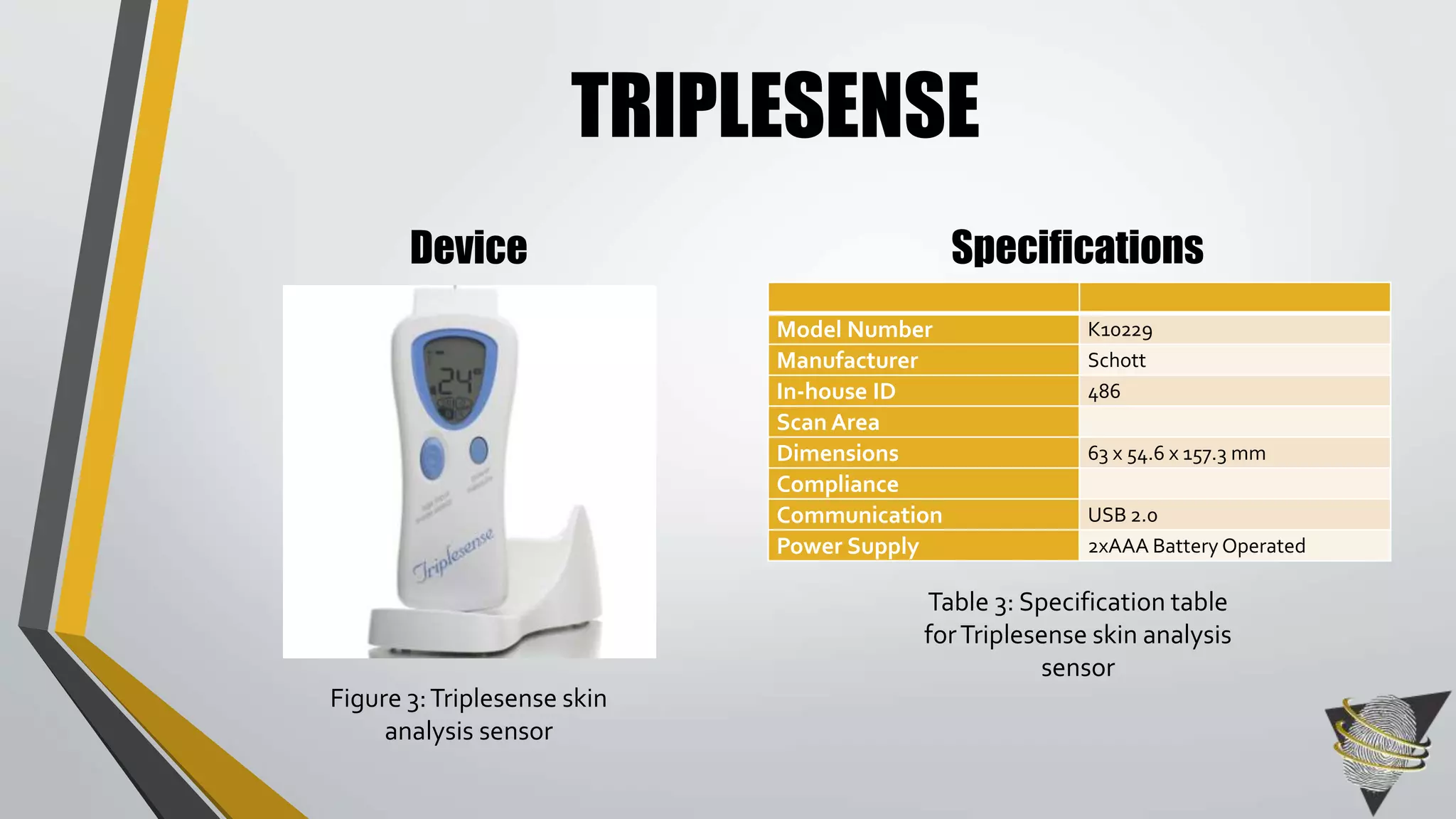
MORITEX MSA PRO 
Device Specifications 
Model Number MSA Pro 
Manufacturer Moritex 
In-house ID 512 
ScanArea - 
Dimensions 226 x 81 x 77mm 
Compliance 
Communication USB 2.0 
Power Supply 5.0V DC 
Table 2: Specification table 
for Moritex MSA Pro skin 
analysis counseling system 
Figure 2: Moritex MSA Pro 
skin analysis counseling 
system
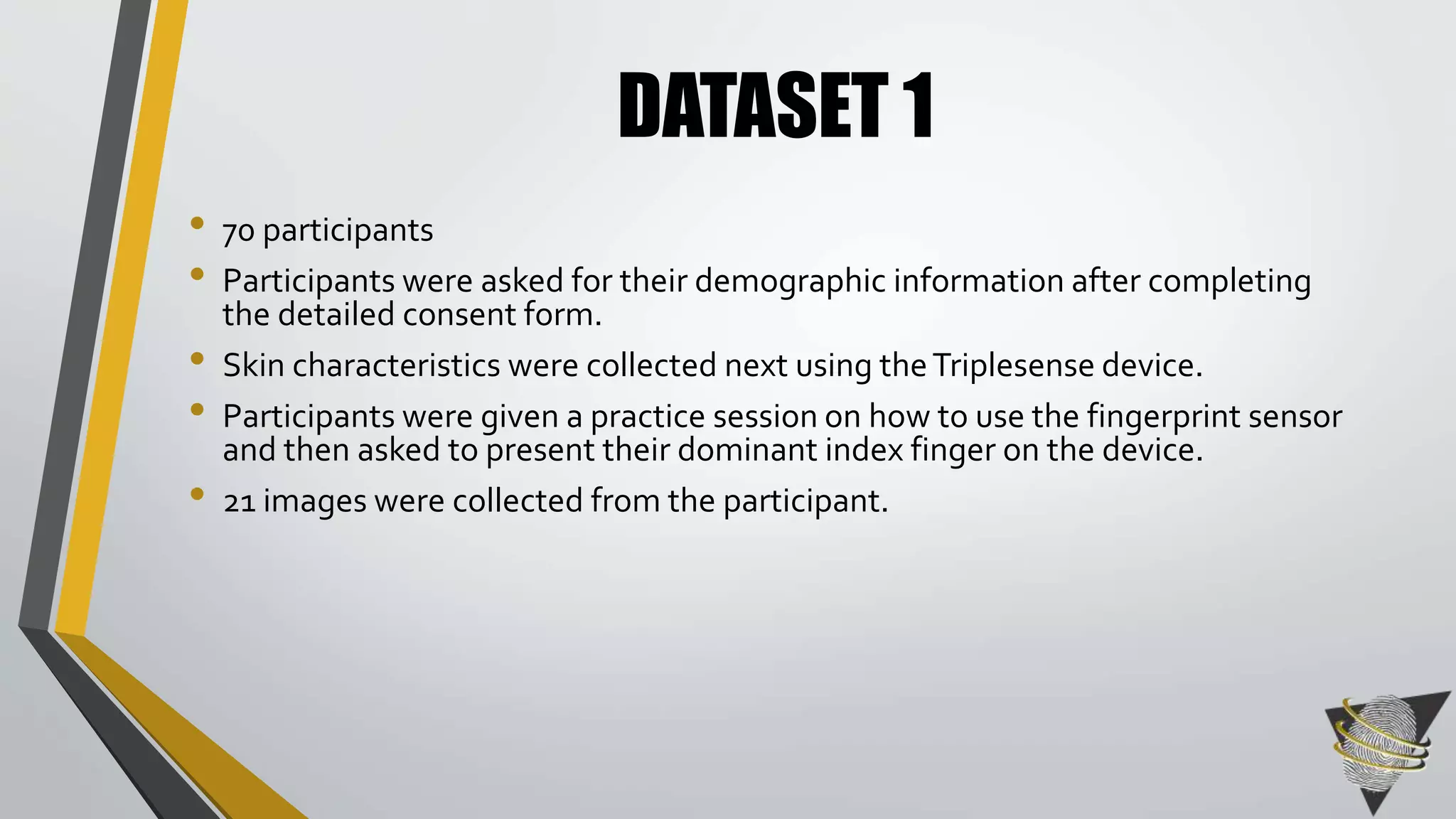
TRIPLESENSE 
Device Specifications 
Model Number K10229 
Manufacturer Schott 
In-house ID 486 
ScanArea 
Dimensions 63 x 54.6 x 157.3mm 
Compliance 
Communication USB 2.0 
Power Supply 2xAAA BatteryOperated 
Table 3: Specification table 
for Triplesense skin analysis 
sensor 
Figure 3: Triplesense skin 
analysis sensor
DESCRIPTION OF DATASETS
DATASET 1 
• 70 participants 
• Participants were asked for their demographic information after completing 
the detailed consent form. 
• Skin characteristics were collected next using the Triplesense device. 
• Participants were given a practice session on how to use the fingerprint sensor 
and then asked to present their dominant index finger on the device. 
• 21 images were collected from the participant.
DEMOGRAPHICS
AGE 
Figure 4: Age breakdown for Dataset 11 
[1] Datarun 1456
GENDER 
[1] Datarun 1456 
Figure 5: Gender breakdown for Dataset 11
ETHNICITY 
[1] Datarun 1456 
Figure 6: Ethnicity breakdown for Dataset 11
DATASET 2 
• 188 subjects 
• Participants were asked for their demographic information after completing the detailed consent form. 
• Skin characteristics were collected next using the Triplesense device. 
• Participants were asked to present their dominant index finger on the first device from a pre-randomized 
order of devices. Peak pressure was also recorded while interacting with the sensor using a pressure 
measuring device. 
• The participant then had their skin characteristics collected again and proceeded to the remaining devices, 
having their skin characteristics measured before using each device. 
• The data collection concluded after all devices had been used.
DEMOGRAPHICS
AGE 
[1] Datarun 1457 
Figure 7: Age breakdown for Dataset 21
GENDER 
[1] Datarun 1457 
Figure 8: Gender breakdown for Dataset 21
• DHS2012 Dataset: 77 participants 
• Participants were asked for their demographic information after completing the detailed consent form. 
• Skin characteristics were collected next using the Moritex MSA Pro device. 
• After having their skin characteristics collected, the participant proceeded to the passport and driver’s 
license scanning station. 
• Upon having their identification scanned, the participant proceeded to the fingerprint station. 
• The participants had their fingerprints collected on up to 8 different sensors. Fingerprints were captured on 
the participants left index, left middle, right index, and right middle fingers. 
• Participants were given 18 attempts to collect 6 captures of each fingerprint, thus totaling 24 images on 
each device. 
DATASET 3
DEMOGRAPHICS
AGE 
Figure 9: Age breakdown for Dataset 31 
[1] Datarun 1455
GENDER 
Figure 10: Gender breakdown for Dataset 31 
[1] Datarun 1455
ETHNICITY 
Figure 11: Ethnicity breakdown for Dataset 31 
[1] Datarun 1455
ANALYSIS
RESEARCH QUESTIONS 
• Correlation between moisture and quality 
• Correlation between elasticity and quality 
• Correlation between moisture and elasticity 
• Correlation between elasticity and age 
• Correlation between moisture and age 
• Correlation between quality and age
RESEARCH QUESTIONS 
• Correlation between moisture and oiliness 
• Correlation between oiliness and quality 
• Correlation between oiliness and age 
• Correlation between oiliness and elasticity 
• Correlation between temperature and quality 
• Correlation between temperature and moisture
RESEARCH QUESTIONS 
• Correlation between temperature and age 
• Correlation between temperature and elasticity 
• Correlation between temperature and oiliness 
• Which variables have an effect on image quality – linear 
regression
CORRELATION 
• A correlation is described as a measure of strength 
of a relationship between two variables by means 
of a single number called a correlation 
coefficient.[19]
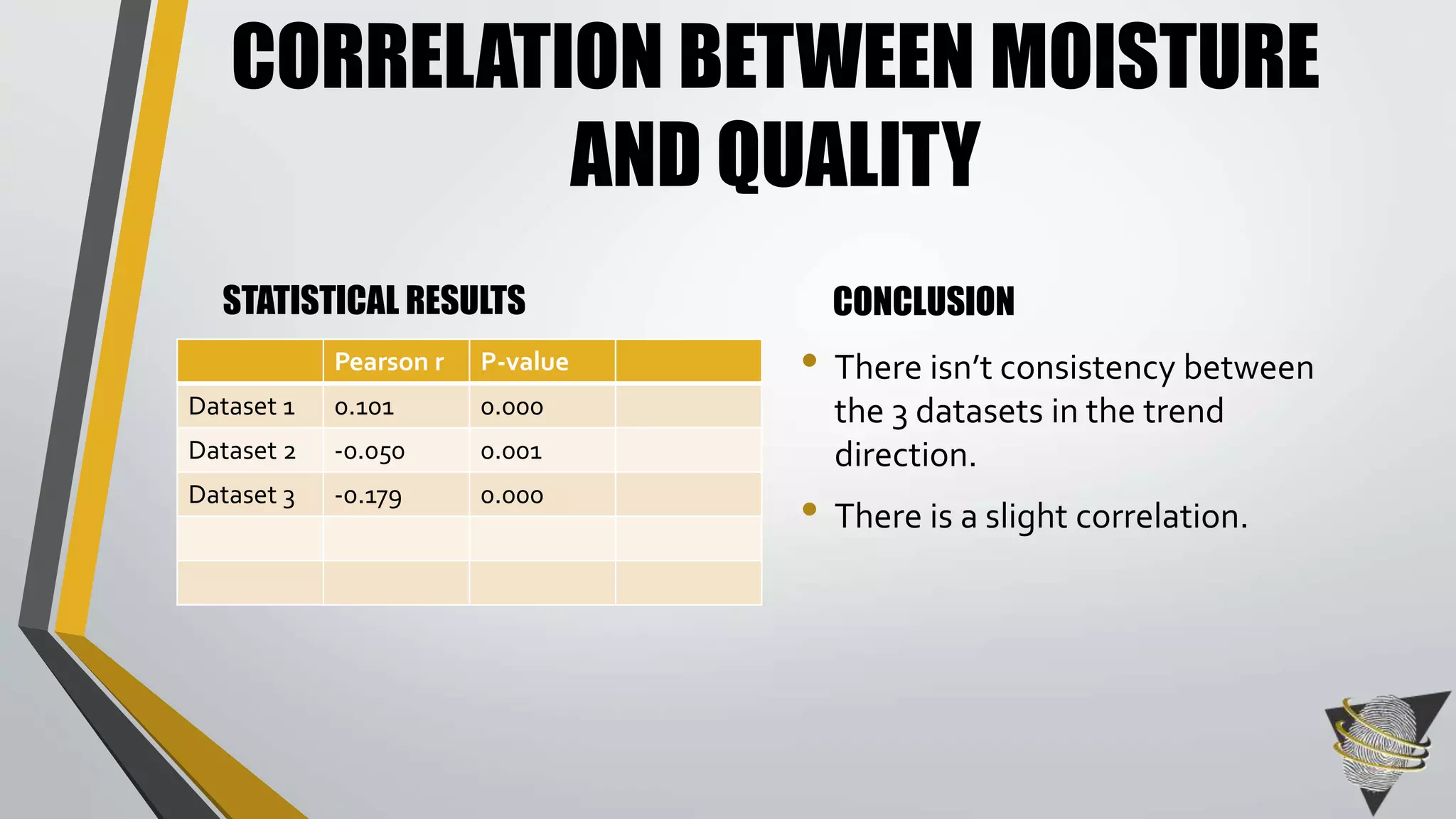
CORRELATION BETWEEN MOISTURE 
AND QUALITY 
STATISTICAL RESULTS 
Pearson r P-value 
Dataset 1 0.101 0.000 
Dataset 2 -0.050 0.001 
Dataset 3 -0.179 0.000 
CONCLUSION 
• There isn’t consistency between 
the 3 datasets in the trend 
direction. 
• There is a slight correlation.
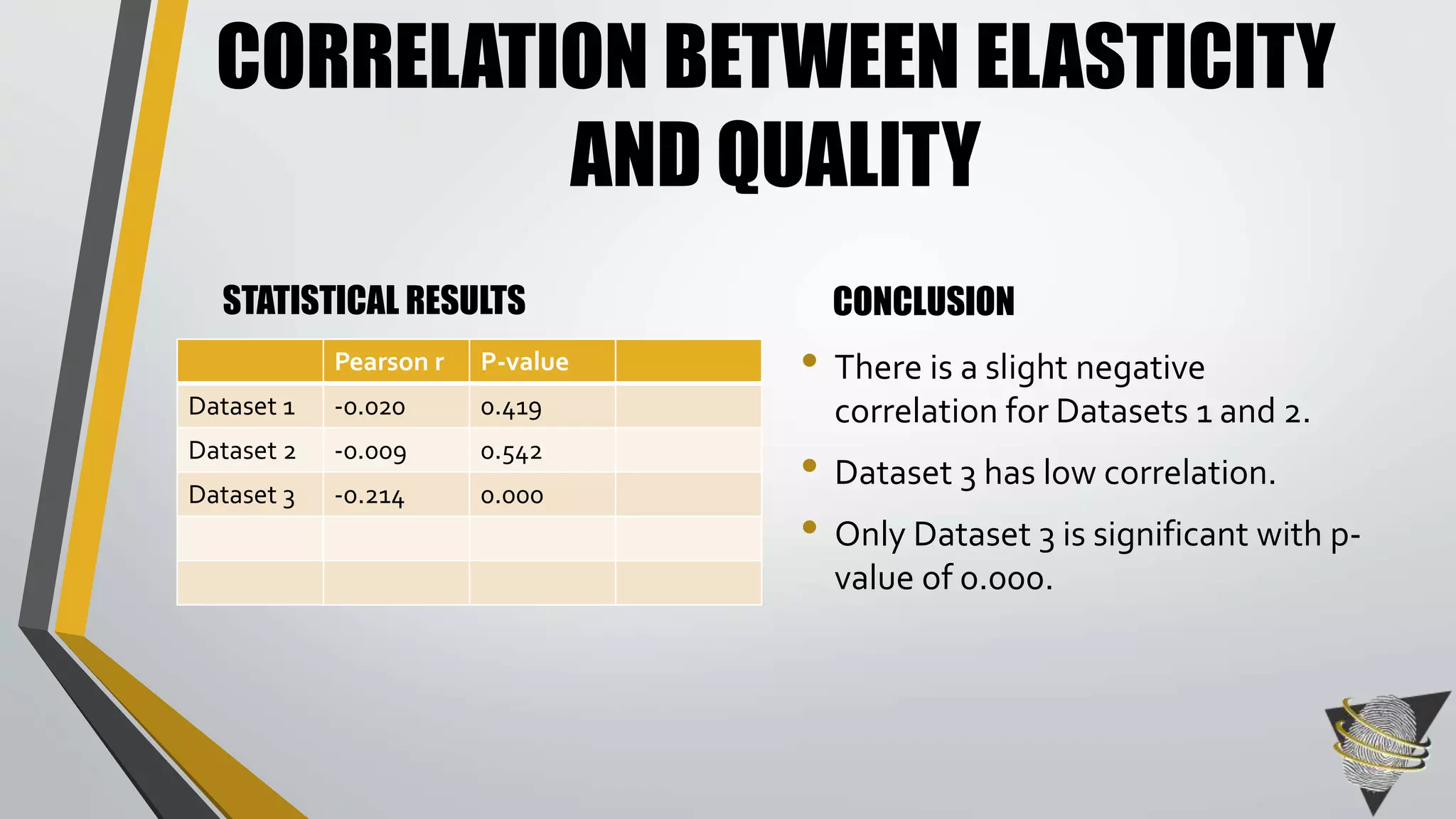
CORRELATION BETWEEN ELASTICITY 
AND QUALITY 
STATISTICAL RESULTS 
Pearson r P-value 
Dataset 1 -0.020 0.419 
Dataset 2 -0.009 0.542 
Dataset 3 -0.214 0.000 
CONCLUSION 
• There is a slight negative 
correlation for Datasets 1 and 2. 
• Dataset 3 has low correlation. 
• Only Dataset 3 is significant with p-value 
of 0.000.
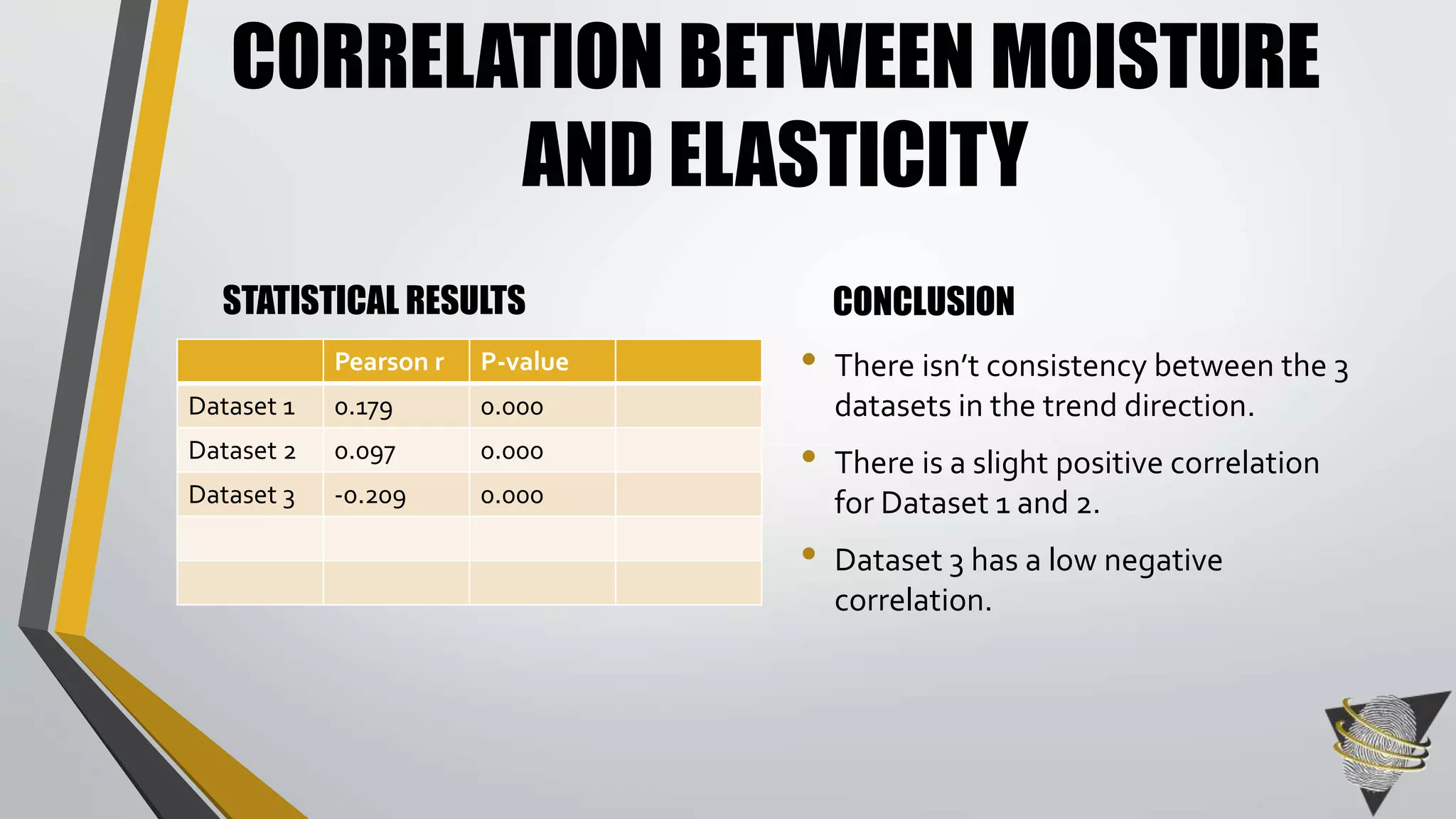
CORRELATION BETWEEN MOISTURE 
AND ELASTICITY 
STATISTICAL RESULTS 
Pearson r P-value 
Dataset 1 0.179 0.000 
Dataset 2 0.097 0.000 
Dataset 3 -0.209 0.000 
CONCLUSION 
• There isn’t consistency between the 3 
datasets in the trend direction. 
• There is a slight positive correlation 
for Dataset 1 and 2. 
• Dataset 3 has a low negative 
correlation.
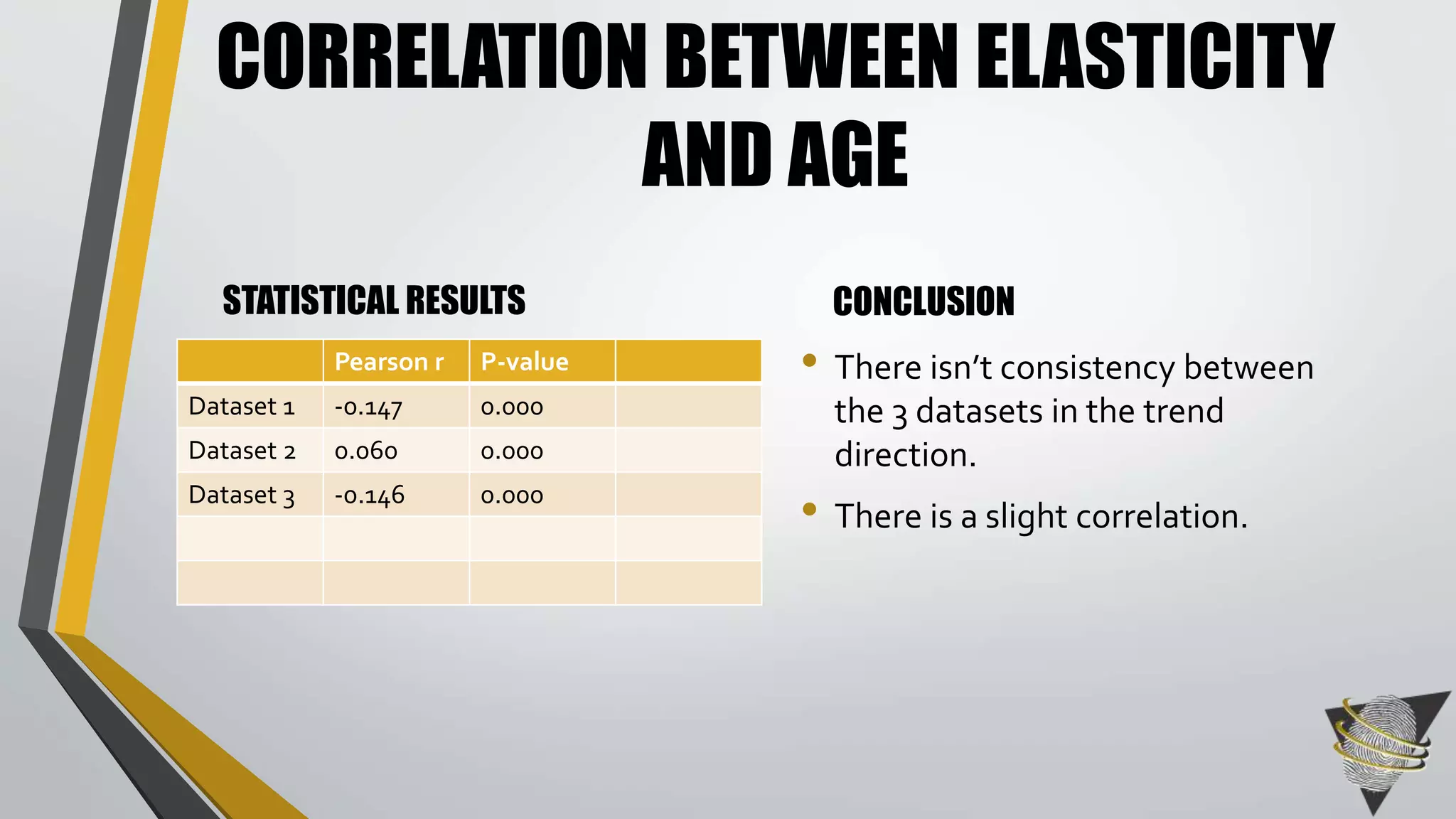
CORRELATION BETWEEN ELASTICITY 
AND AGE 
STATISTICAL RESULTS CONCLUSION 
• There isn’t consistency between 
the 3 datasets in the trend 
direction. 
• There is a slight correlation. 
Pearson r P-value 
Dataset 1 -0.147 0.000 
Dataset 2 0.060 0.000 
Dataset 3 -0.146 0.000
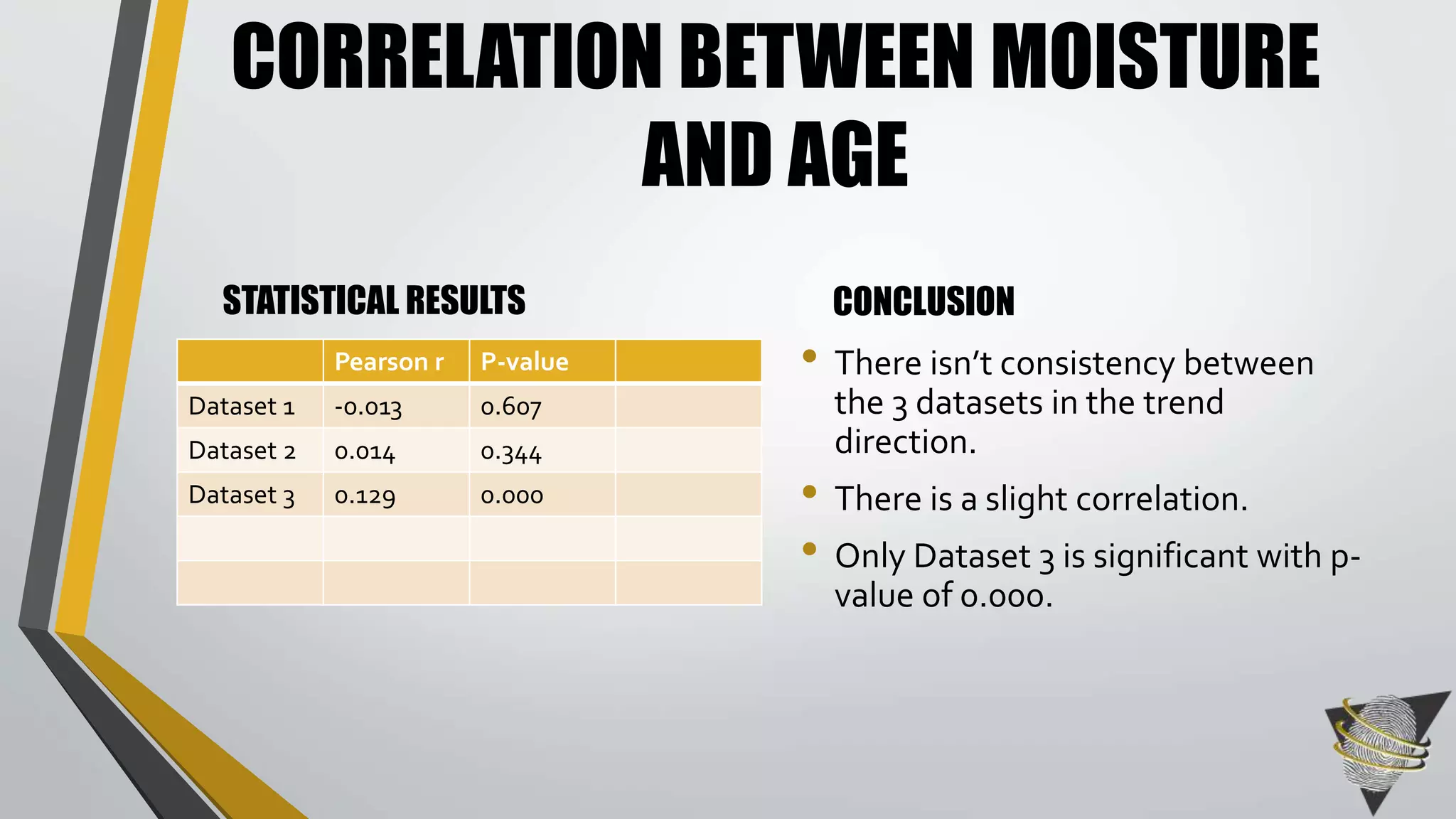
CORRELATION BETWEEN MOISTURE 
AND AGE 
STATISTICAL RESULTS CONCLUSION 
• There isn’t consistency between 
the 3 datasets in the trend 
direction. 
• There is a slight correlation. 
• Only Dataset 3 is significant with p-value 
of 0.000. 
Pearson r P-value 
Dataset 1 -0.013 0.607 
Dataset 2 0.014 0.344 
Dataset 3 0.129 0.000
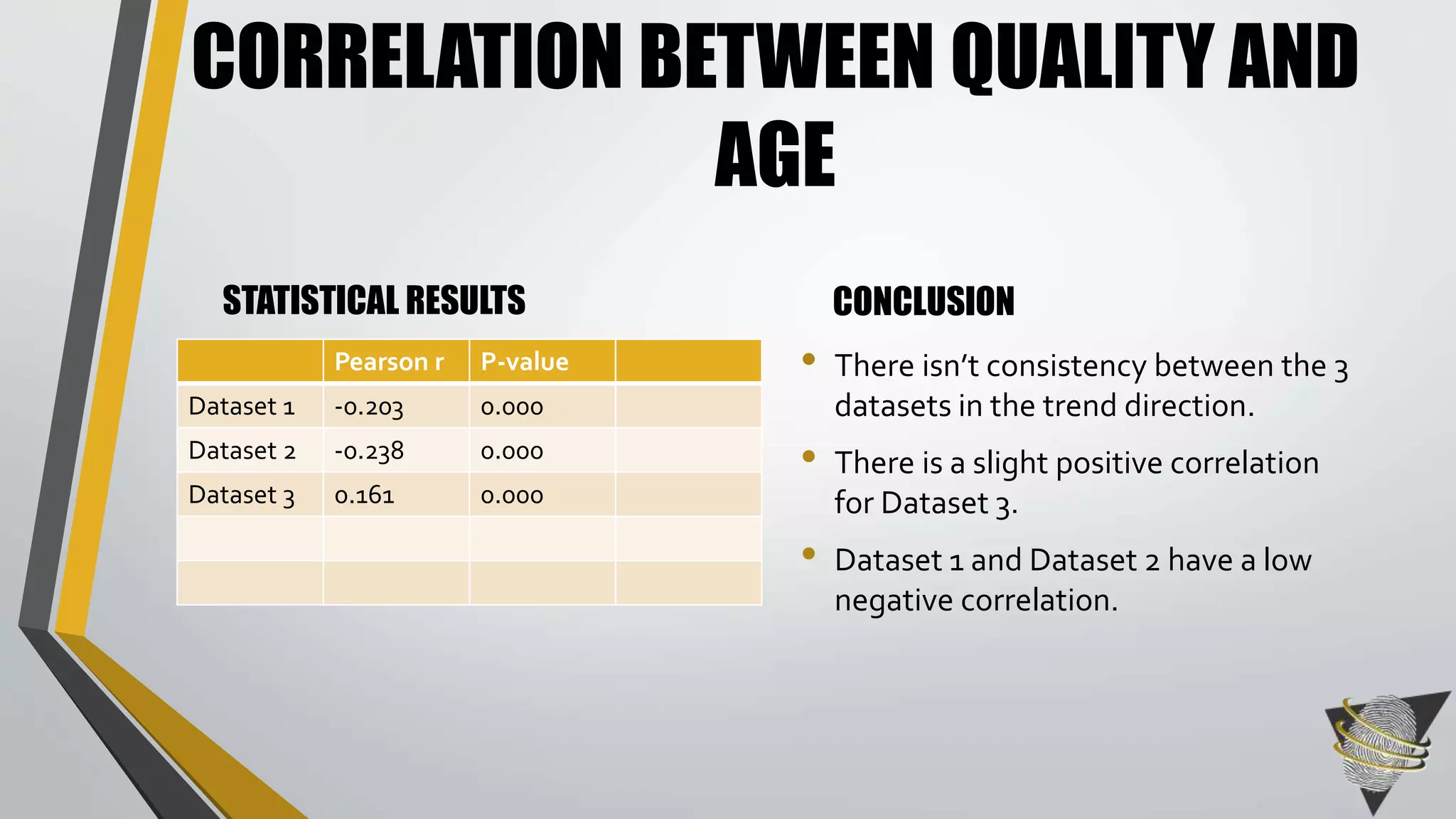
CORRELATION BETWEEN QUALITY AND 
AGE 
STATISTICAL RESULTS CONCLUSION 
• There isn’t consistency between the 3 
datasets in the trend direction. 
• There is a slight positive correlation 
for Dataset 3. 
• Dataset 1 and Dataset 2 have a low 
negative correlation. 
Pearson r P-value 
Dataset 1 -0.203 0.000 
Dataset 2 -0.238 0.000 
Dataset 3 0.161 0.000
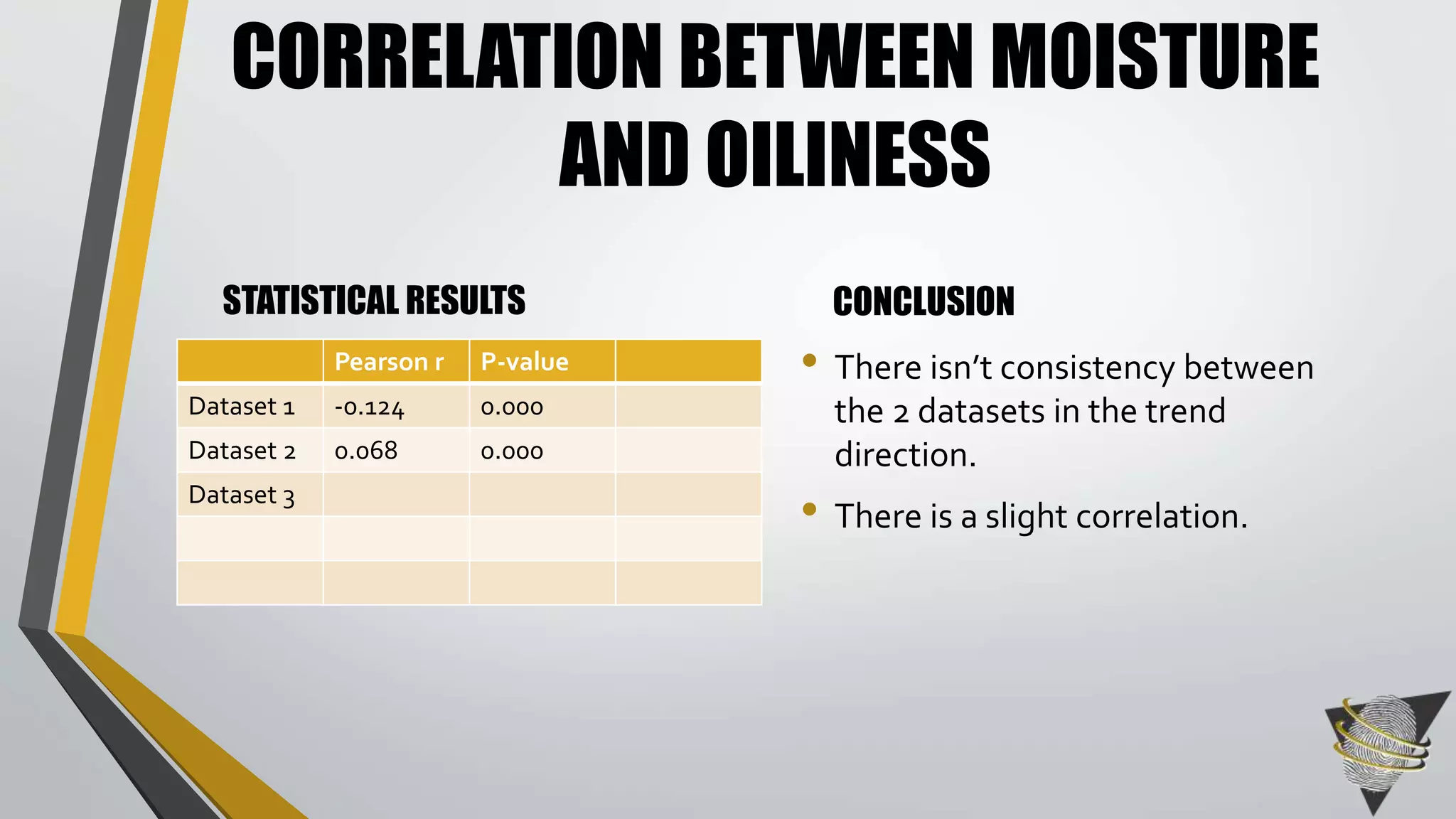
CORRELATION BETWEEN MOISTURE 
AND OILINESS 
STATISTICAL RESULTS CONCLUSION 
• There isn’t consistency between 
the 2 datasets in the trend 
direction. 
• There is a slight correlation. 
Pearson r P-value 
Dataset 1 -0.124 0.000 
Dataset 2 0.068 0.000 
Dataset 3
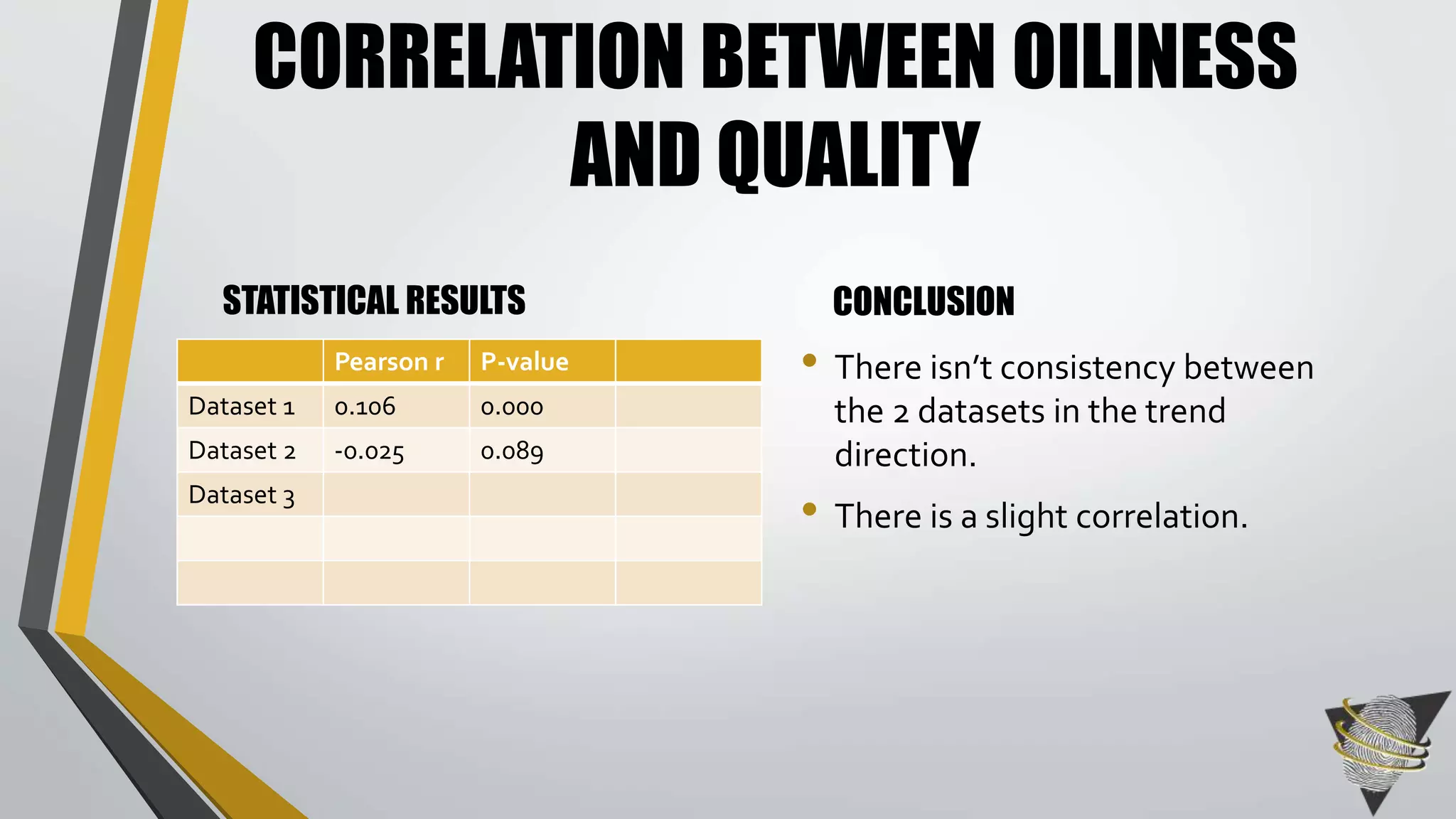
CORRELATION BETWEEN OILINESS 
AND QUALITY 
STATISTICAL RESULTS CONCLUSION 
• There isn’t consistency between 
the 2 datasets in the trend 
direction. 
• There is a slight correlation. 
Pearson r P-value 
Dataset 1 0.106 0.000 
Dataset 2 -0.025 0.089 
Dataset 3
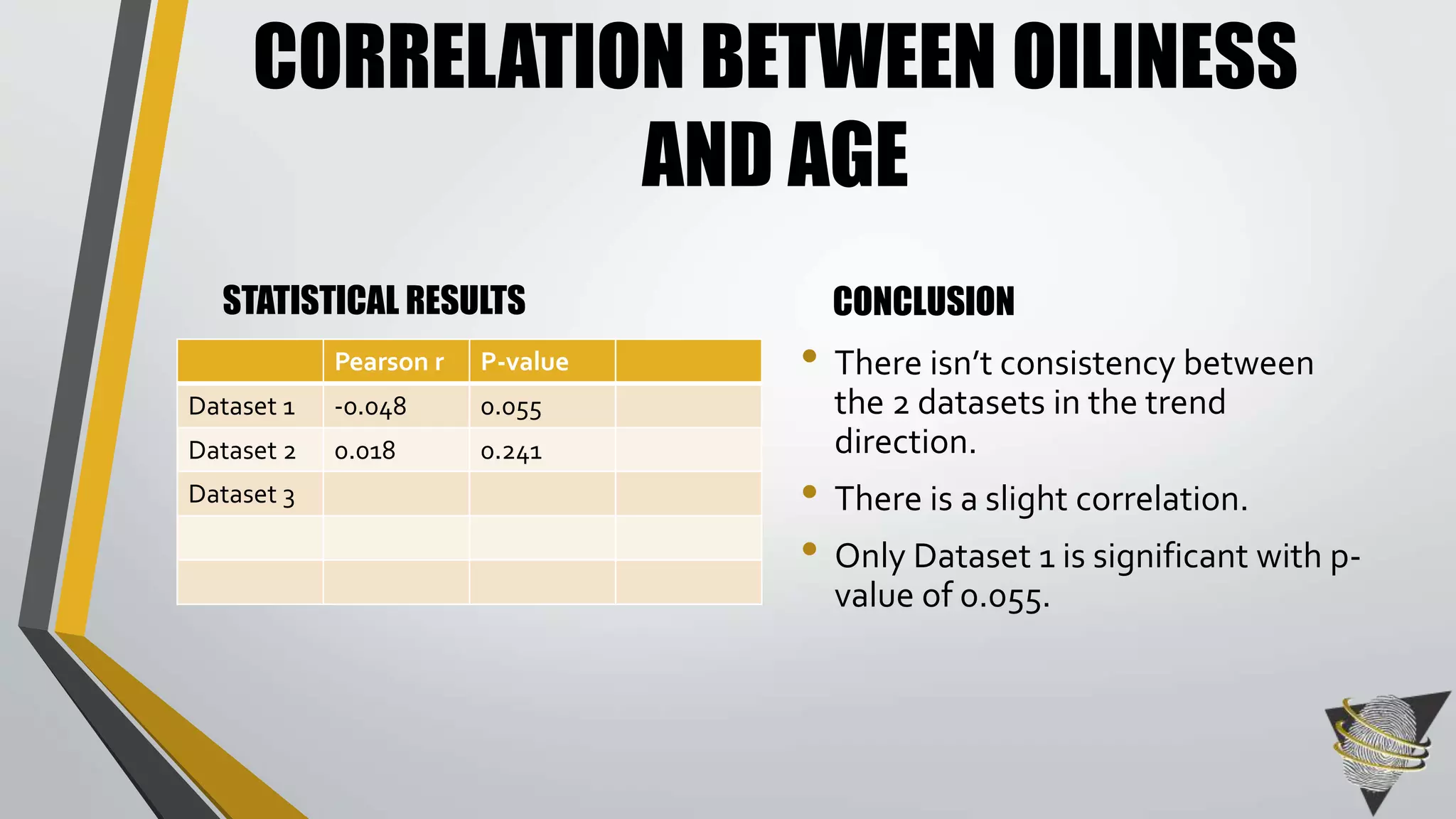
CORRELATION BETWEEN OILINESS 
AND AGE 
STATISTICAL RESULTS CONCLUSION 
• There isn’t consistency between 
the 2 datasets in the trend 
direction. 
• There is a slight correlation. 
• Only Dataset 1 is significant with p-value 
of 0.055. 
Pearson r P-value 
Dataset 1 -0.048 0.055 
Dataset 2 0.018 0.241 
Dataset 3
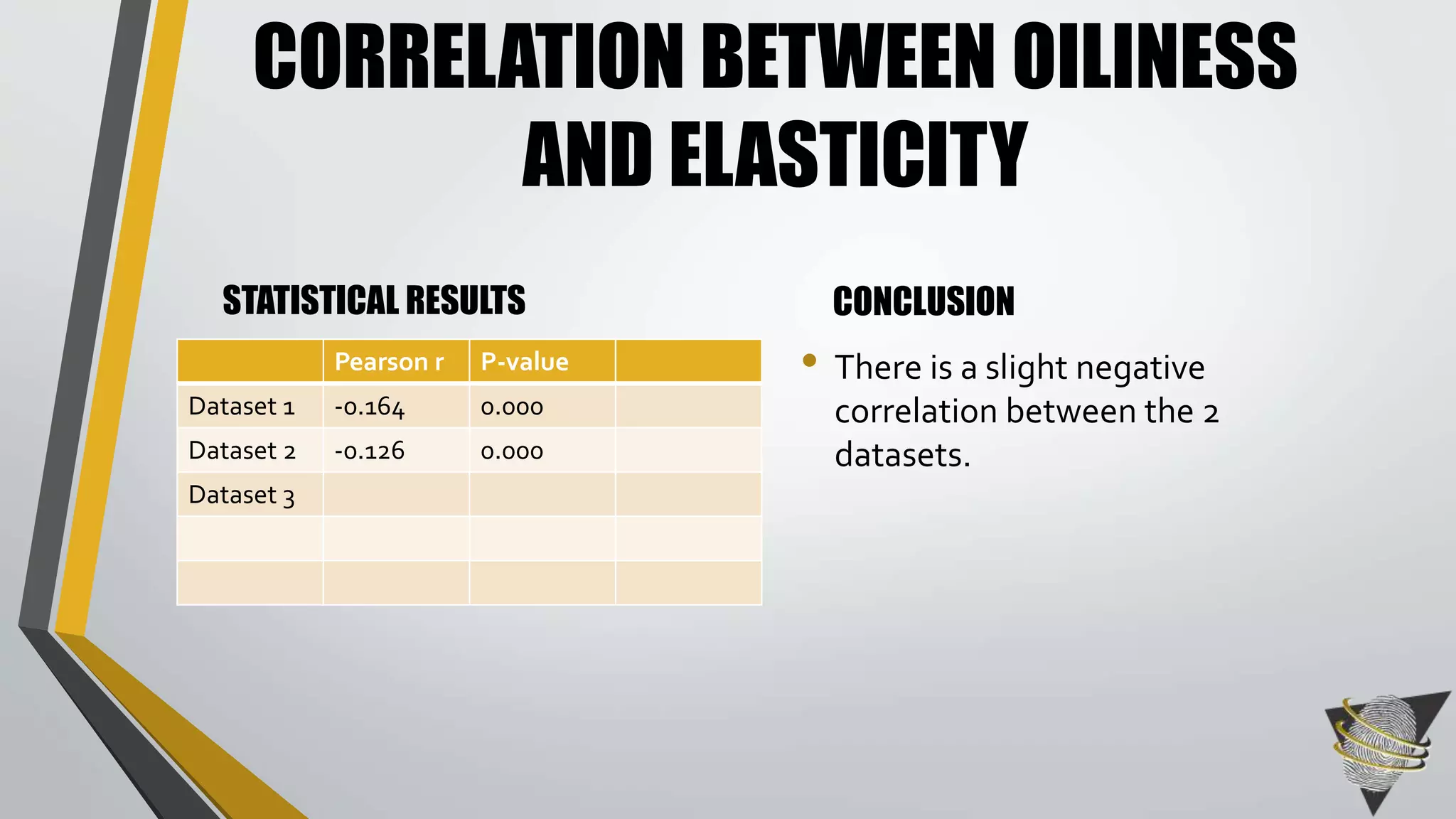
CORRELATION BETWEEN OILINESS 
AND ELASTICITY 
STATISTICAL RESULTS CONCLUSION 
• There is a slight negative 
correlation between the 2 
datasets. 
Pearson r P-value 
Dataset 1 -0.164 0.000 
Dataset 2 -0.126 0.000 
Dataset 3
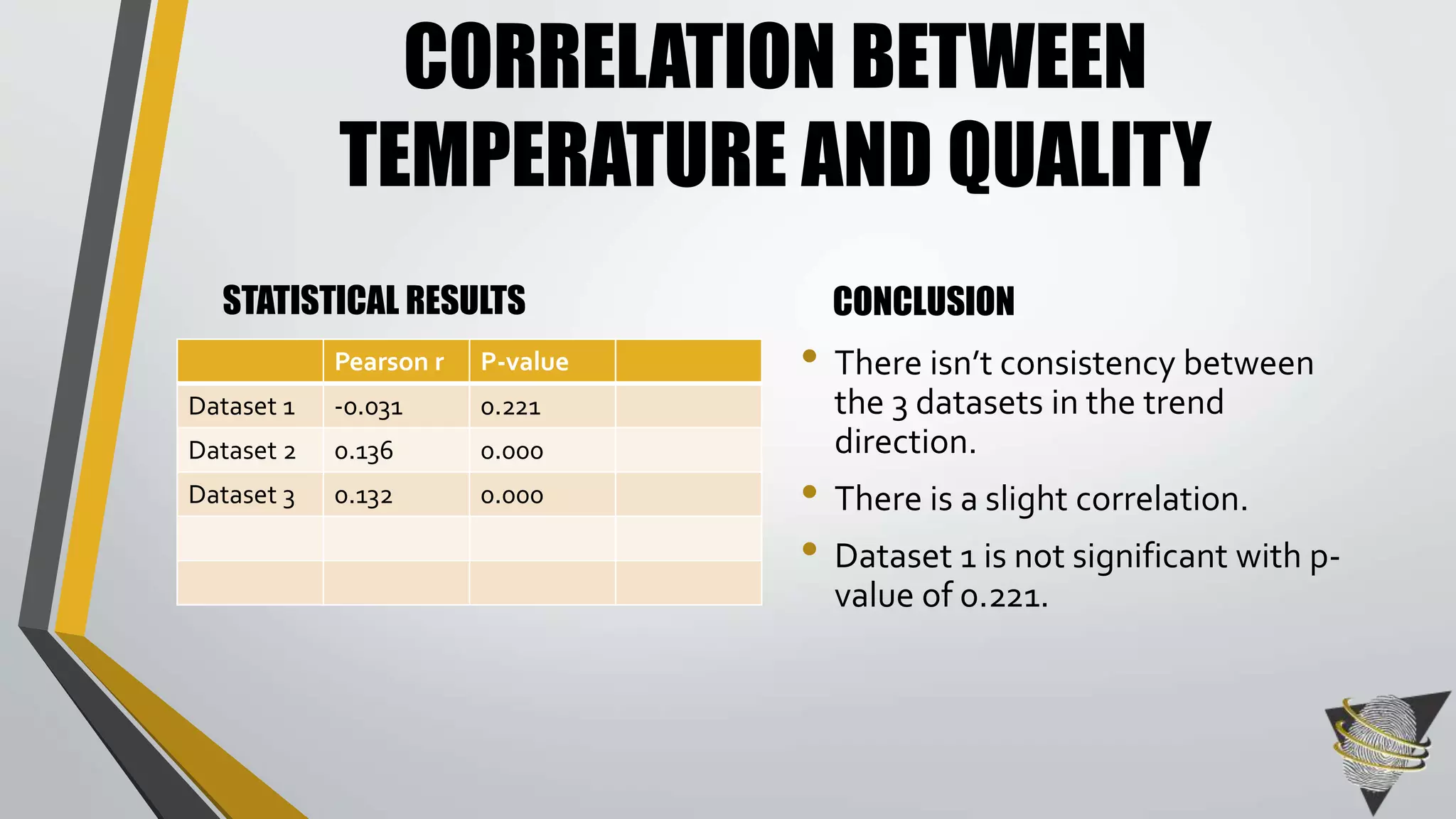
CORRELATION BETWEEN 
TEMPERATURE AND QUALITY 
STATISTICAL RESULTS CONCLUSION 
• There isn’t consistency between 
the 3 datasets in the trend 
direction. 
• There is a slight correlation. 
• Dataset 1 is not significant with p-value 
of 0.221. 
Pearson r P-value 
Dataset 1 -0.031 0.221 
Dataset 2 0.136 0.000 
Dataset 3 0.132 0.000
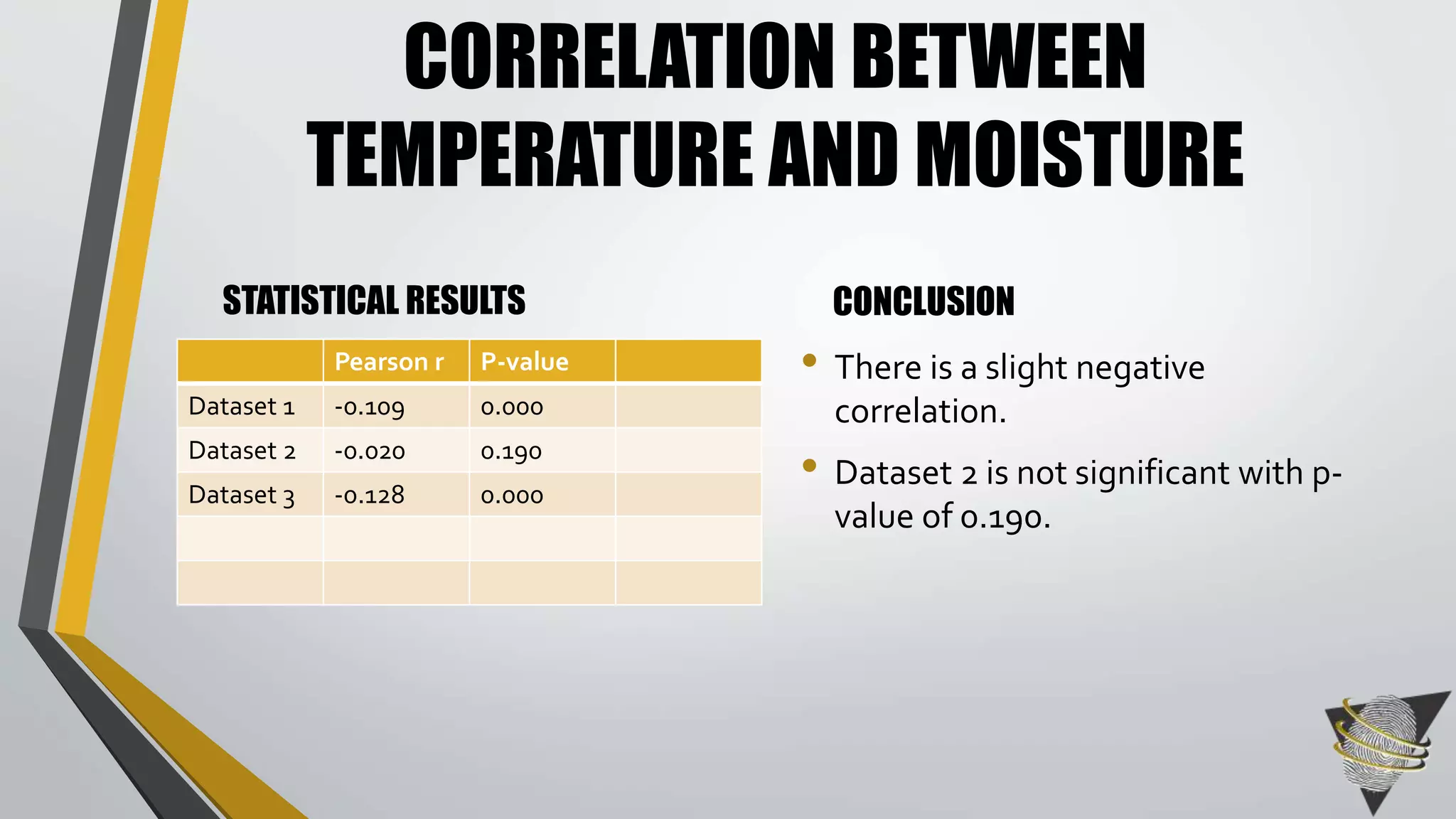
CORRELATION BETWEEN 
TEMPERATURE AND MOISTURE 
STATISTICAL RESULTS CONCLUSION 
• There is a slight negative 
correlation. 
• Dataset 2 is not significant with p-value 
of 0.190. 
Pearson r P-value 
Dataset 1 -0.109 0.000 
Dataset 2 -0.020 0.190 
Dataset 3 -0.128 0.000
CORRELATION BETWEEN 
TEMPERATURE AND AGE 
STATISTICAL RESULTS CONCLUSION 
• There isn’t consistency between 
the 3 datasets in the trend 
direction. 
• There is a slight correlation. 
• Dataset 1 is not significant with p-value 
of 0.052 
Pearson r P-value 
Dataset 1 0.049 0.052 
Dataset 2 -0.173 0.000 
Dataset 3 0.103 0.000
CORRELATION BETWEEN 
TEMPERATURE AND ELASTICITY 
STATISTICAL RESULTS CONCLUSION 
• There isn’t consistency between the 2 
datasets in the trend direction. 
• There is a slight correlation for Dataset 2 
and Dataset 3. 
• Dataset 1 has a very high negative 
correlation. 
• Dataset 3 is not significant with p-value of 
0.426. 
Pearson r P-value 
Dataset 1 -0.999 0.000 
Dataset 2 0.055 0.000 
Dataset 3 -0.019 0.426
CORRELATION BETWEEN 
TEMPERATURE AND OILINESS 
STATISTICAL RESULTS CONCLUSION 
• There isn’t consistency between 
the 2 datasets in the trend 
direction. 
• There is a slight correlation. 
Pearson r P-value 
Dataset 1 0.071 0.005 
Dataset 2 -0.080 0.000 
Dataset 3
LINEAR REGRESSION 
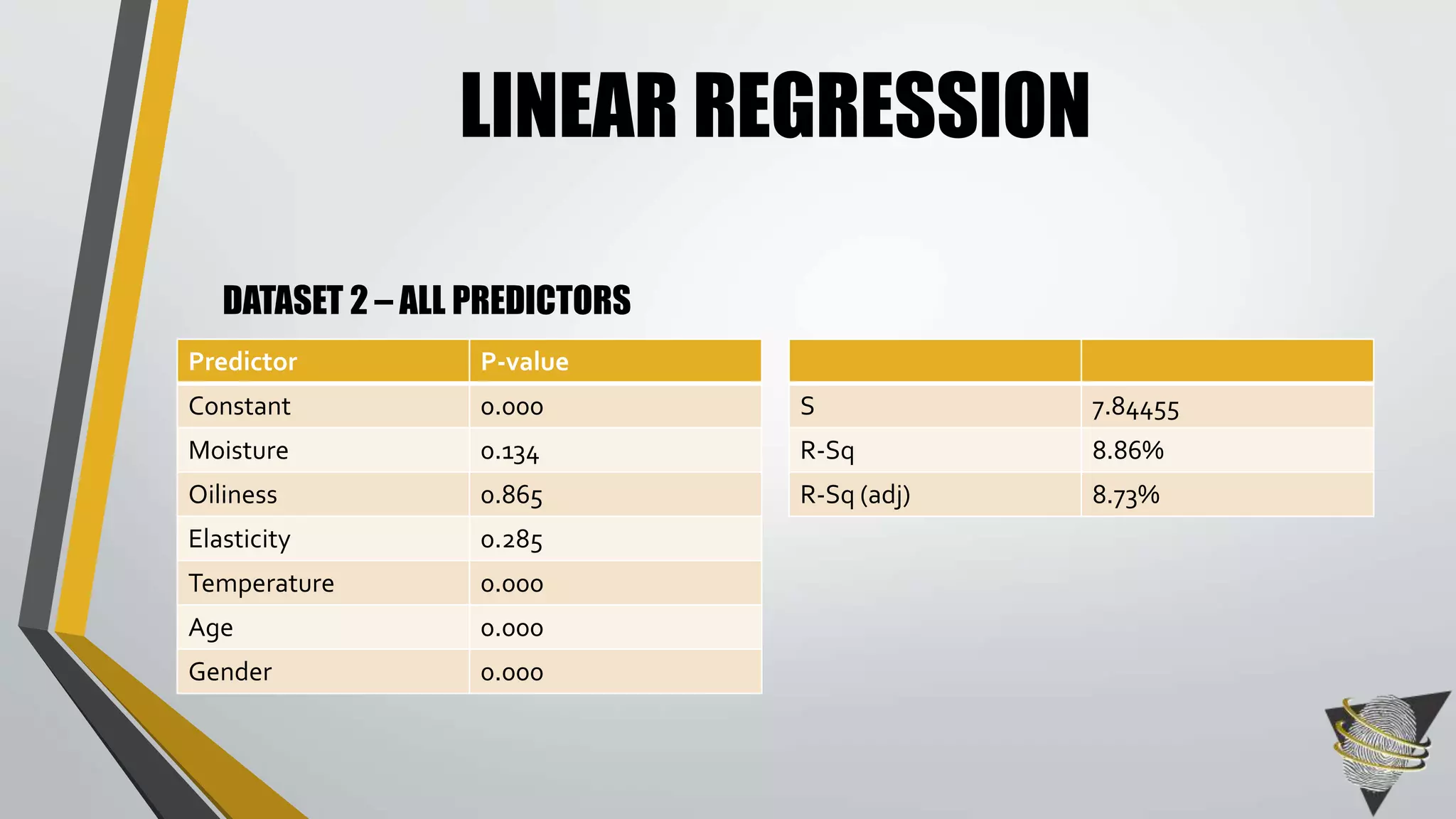
• Linear regression is conducted to test the null 
hypothesis with all variables included.
BACKWARD ELIMINATION 
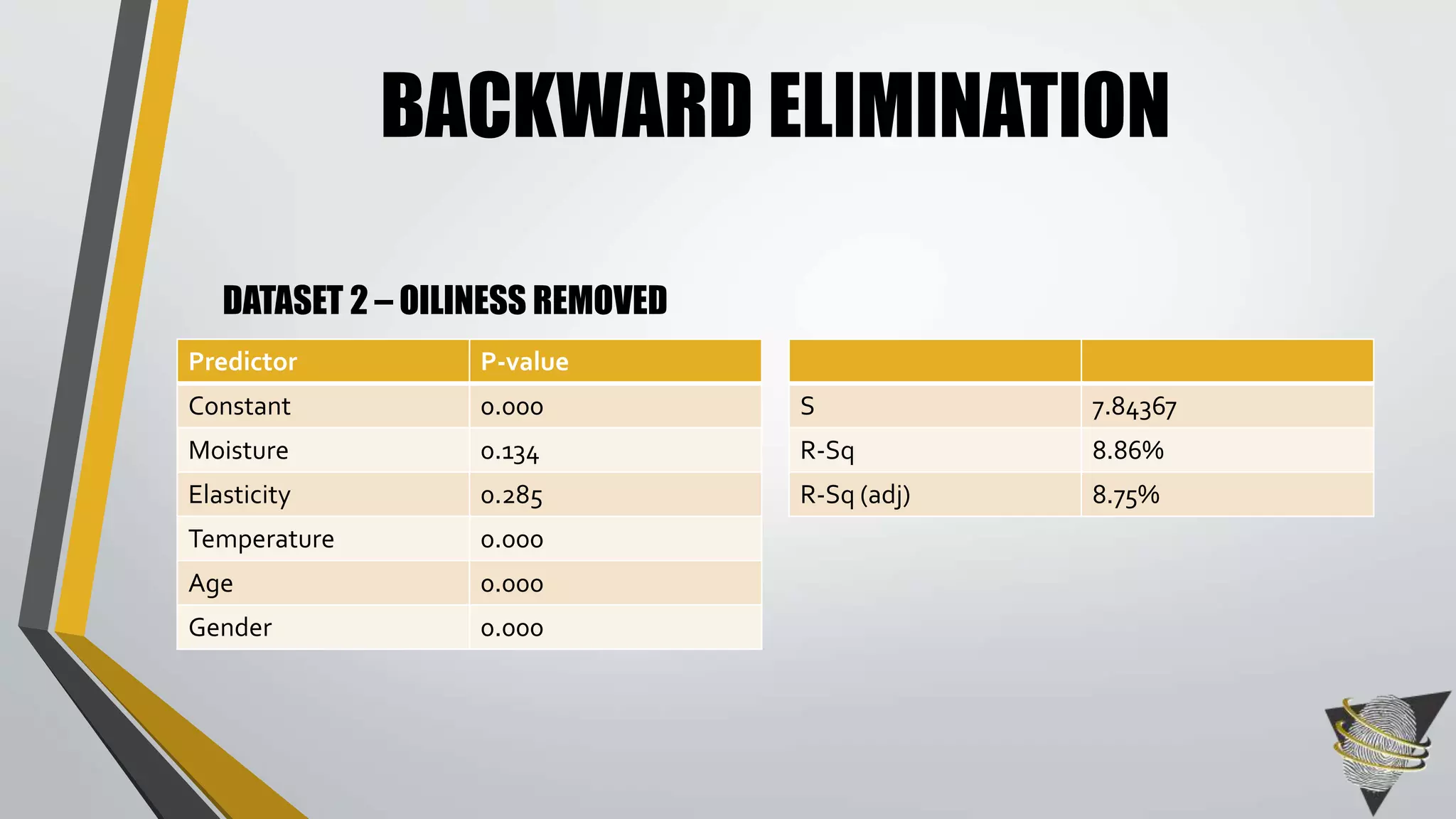
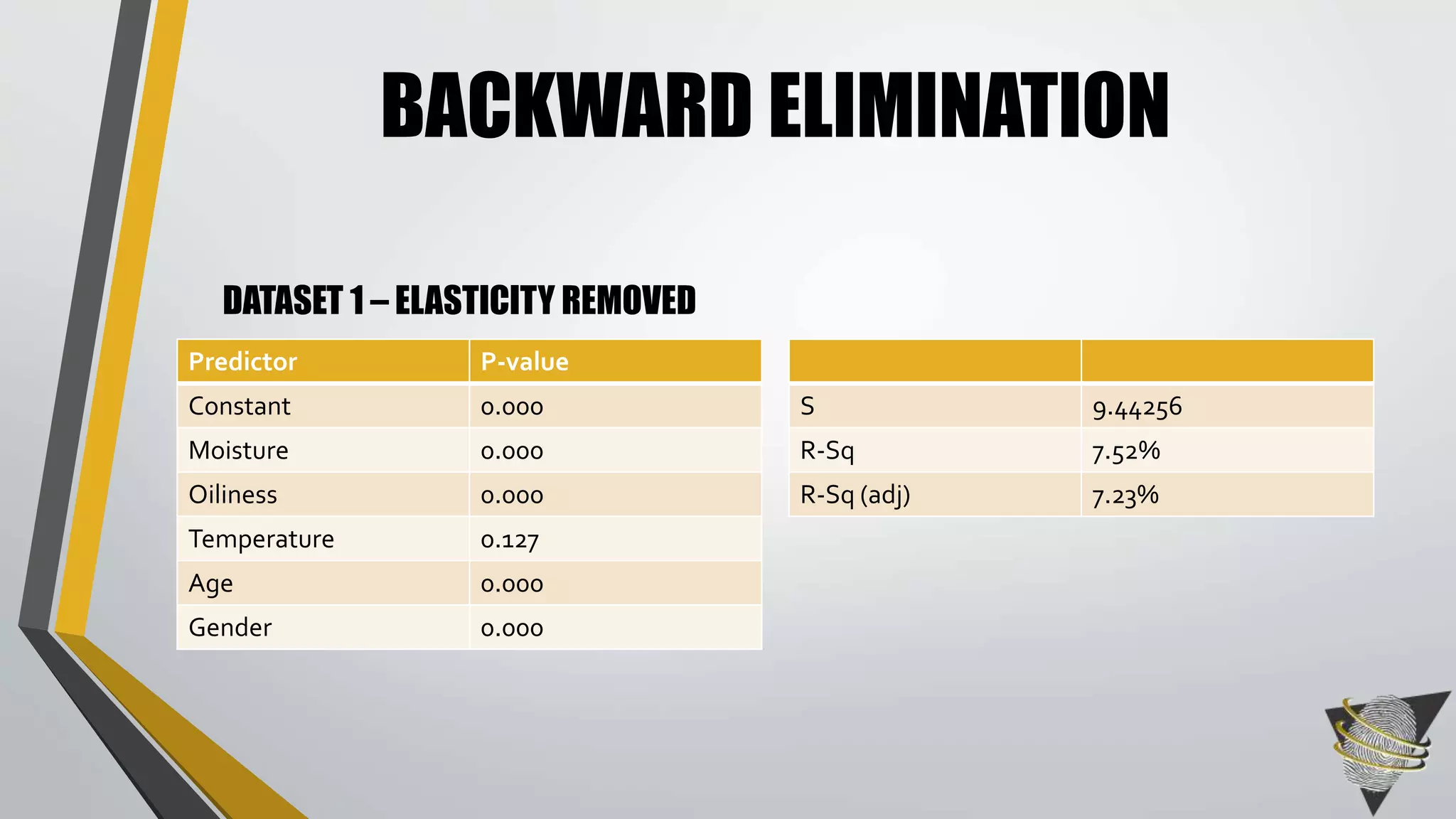
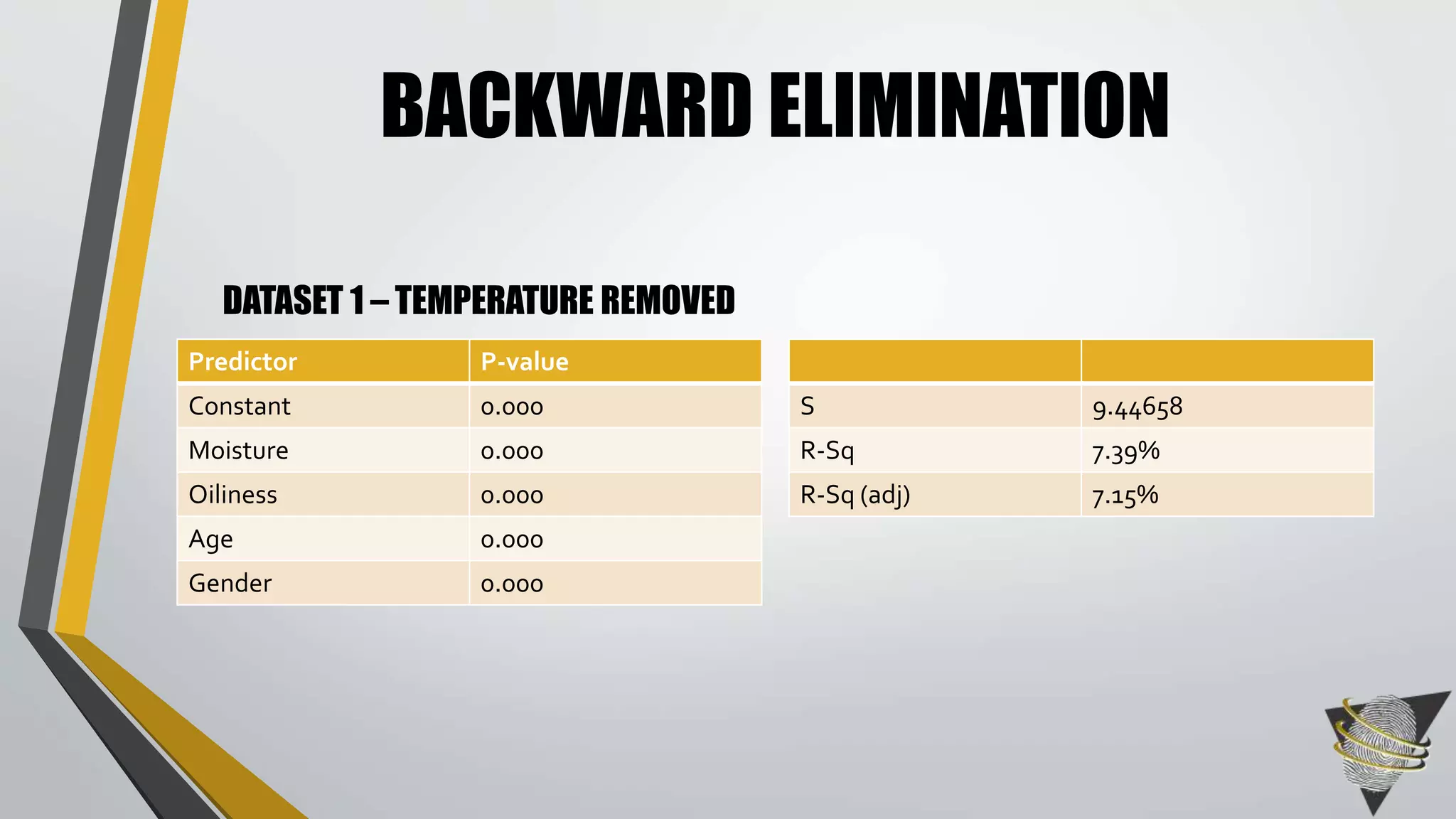
• Upon performing a linear regression, backward 
elimination can be completed to remove the variables 
deemed to be insignificant based upon the chosen 
significance level. 
• In backward elimination, one variable is removed and 
the linear regression is re-run until all the variables are 
significant.[20]
LINEAR REGRESSION 
DATASET 2 – ALL PREDICTORS 
Predictor P-value 
Constant 0.000 
Moisture 0.134 
Oiliness 0.865 
Elasticity 0.285 
Temperature 0.000 
Age 0.000 
Gender 0.000 
S 7.84455 
R-Sq 8.86% 
R-Sq (adj) 8.73%
BACKWARD ELIMINATION 
DATASET 2 – OILINESS REMOVED 
Predictor P-value 
Constant 0.000 
Moisture 0.134 
Elasticity 0.285 
Temperature 0.000 
Age 0.000 
Gender 0.000 
S 7.84367 
R-Sq 8.86% 
R-Sq (adj) 8.75%
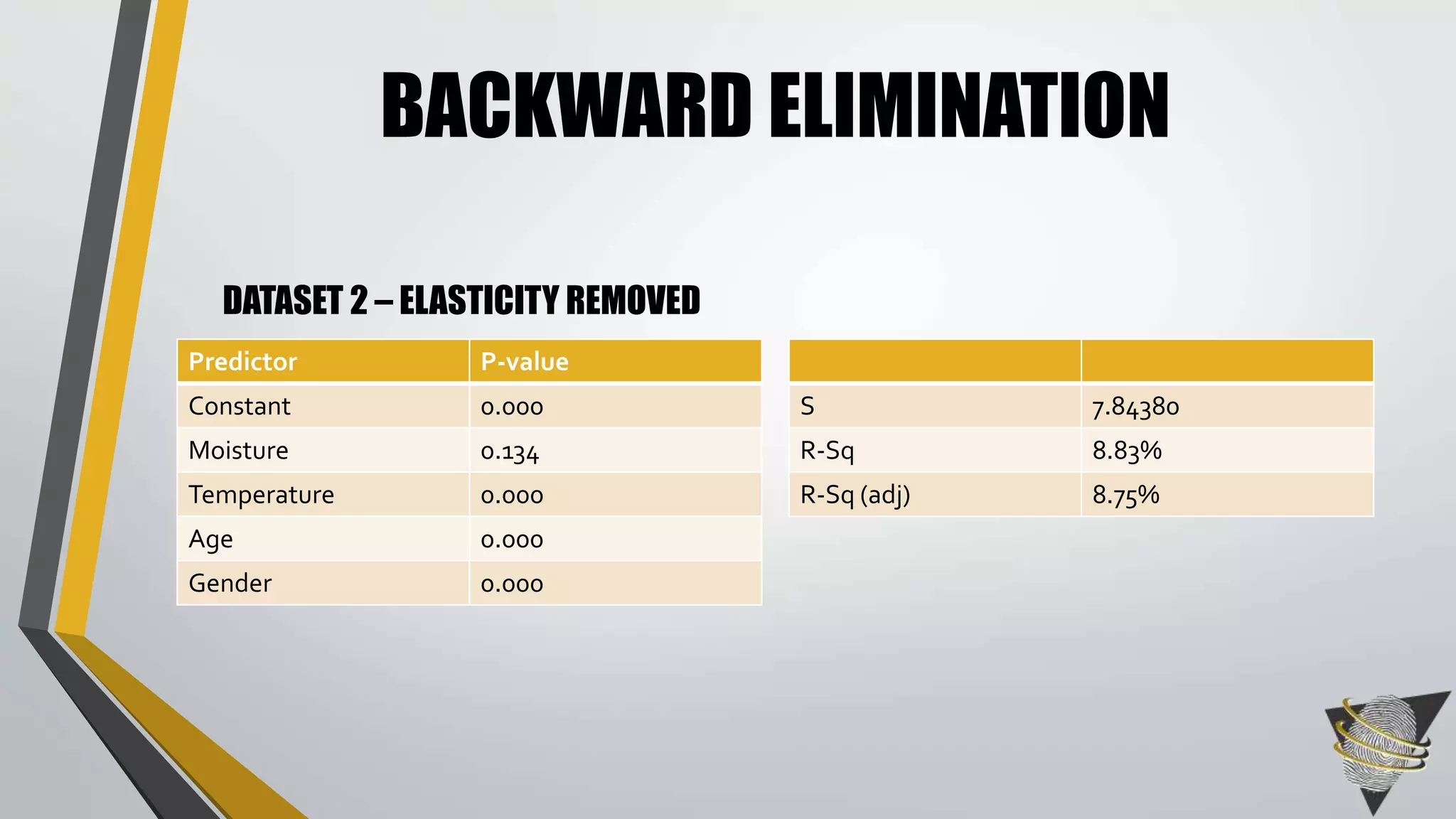
BACKWARD ELIMINATION 
DATASET 2 – ELASTICITY REMOVED 
Predictor P-value 
Constant 0.000 
Moisture 0.134 
Temperature 0.000 
Age 0.000 
Gender 0.000 
S 7.84380 
R-Sq 8.83% 
R-Sq (adj) 8.75%
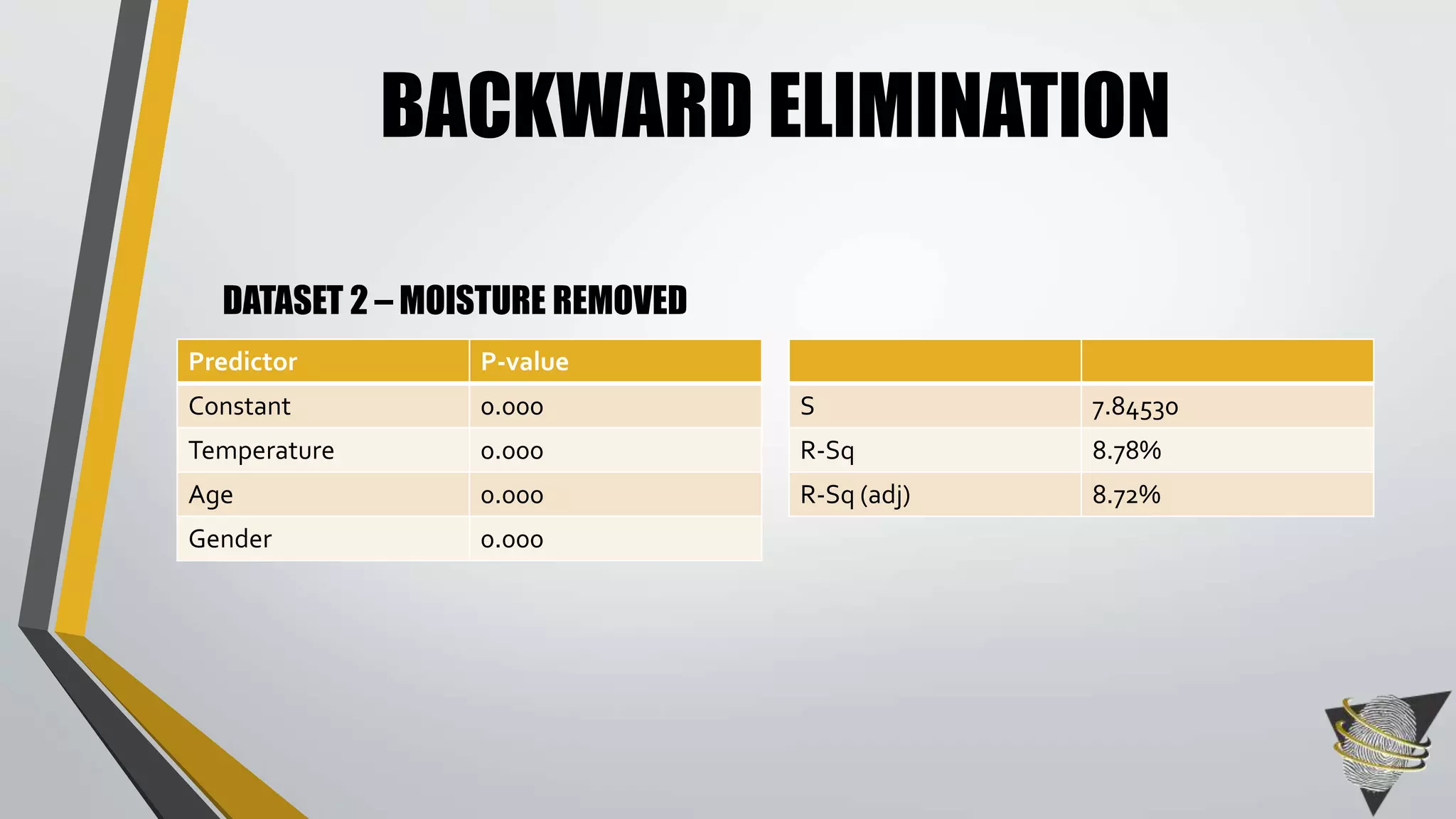
BACKWARD ELIMINATION 
DATASET 2 – MOISTURE REMOVED 
Predictor P-value 
Constant 0.000 
Temperature 0.000 
Age 0.000 
Gender 0.000 
S 7.84530 
R-Sq 8.78% 
R-Sq (adj) 8.72%
LINEAR REGRESSION 
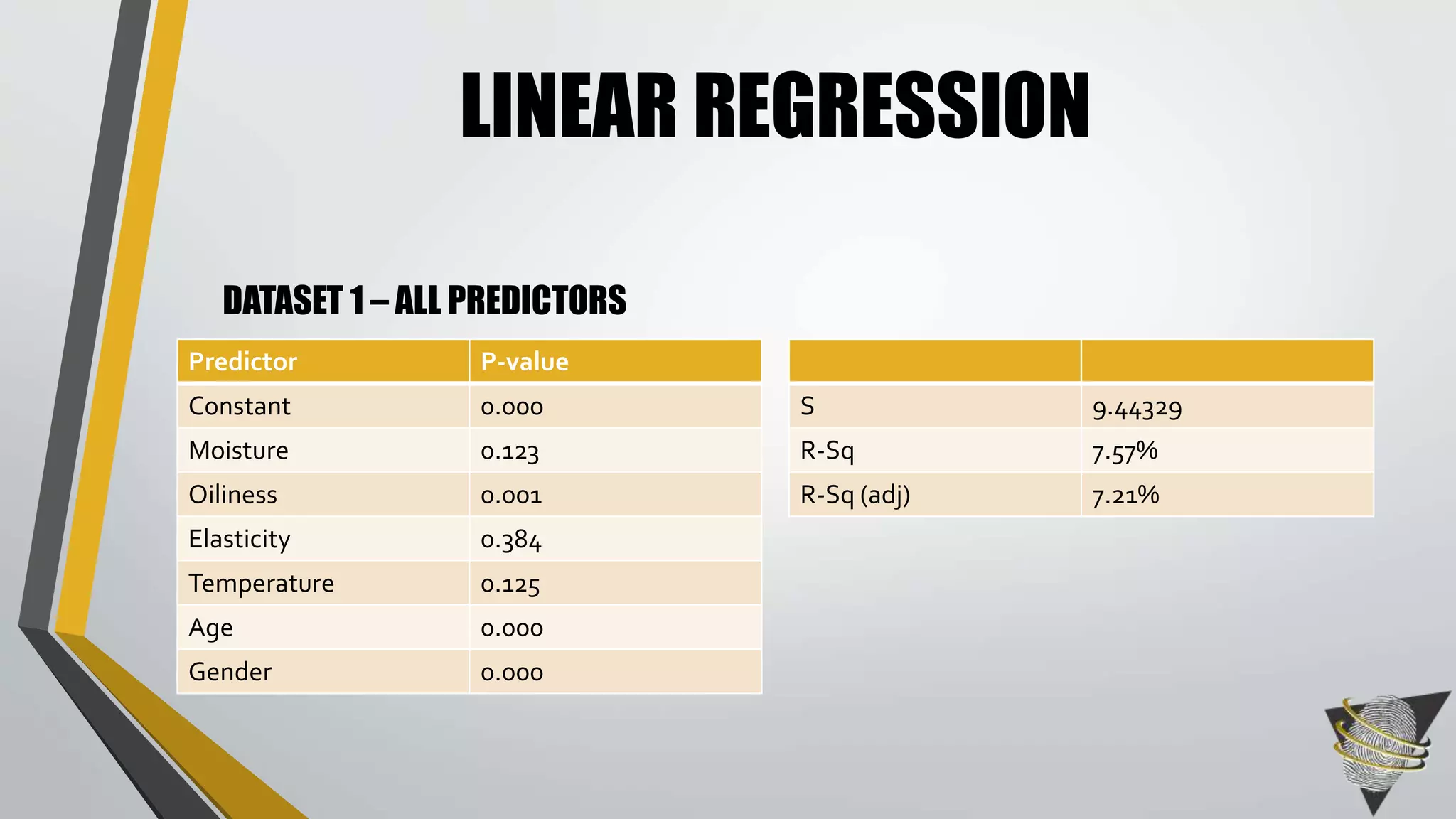
DATASET 1 – ALL PREDICTORS 
Predictor P-value 
Constant 0.000 
Moisture 0.123 
Oiliness 0.001 
Elasticity 0.384 
Temperature 0.125 
Age 0.000 
Gender 0.000 
S 9.44329 
R-Sq 7.57% 
R-Sq (adj) 7.21%
BACKWARD ELIMINATION 
DATASET 1 – ELASTICITY REMOVED 
Predictor P-value 
Constant 0.000 
Moisture 0.000 
Oiliness 0.000 
Temperature 0.127 
Age 0.000 
Gender 0.000 
S 9.44256 
R-Sq 7.52% 
R-Sq (adj) 7.23%
BACKWARD ELIMINATION 
DATASET 1 – TEMPERATURE REMOVED 
Predictor P-value 
Constant 0.000 
Moisture 0.000 
Oiliness 0.000 
Age 0.000 
Gender 0.000 
S 9.44658 
R-Sq 7.39% 
R-Sq (adj) 7.15%
LINEAR REGRESSION 
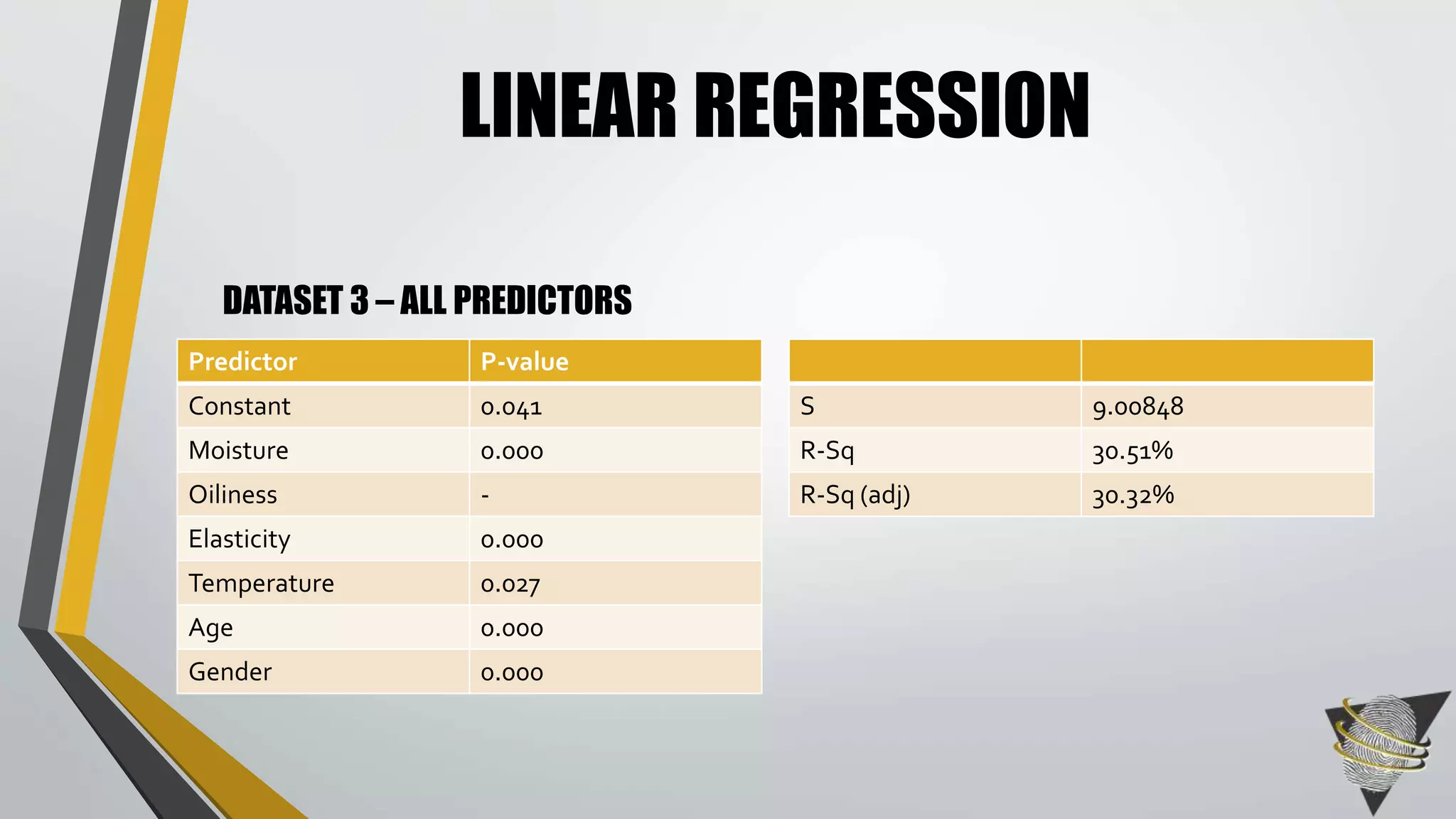
DATASET 3 – ALL PREDICTORS 
Predictor P-value 
Constant 0.041 
Moisture 0.000 
Oiliness - 
Elasticity 0.000 
Temperature 0.027 
Age 0.000 
Gender 0.000 
S 9.00848 
R-Sq 30.51% 
R-Sq (adj) 30.32%
CONCLUSIONS 
• Across the datasets, the values in the skin characteristics weren’t consistent. In 
the linear regression, each dataset produced a different set of predictors that 
remained significant. This suggests that the measurements may not be 
equivalent or there is no consistency in the way measurements are conducted. 
• It isn’t clear which skin characteristics have an effect on the fingerprint image 
quality due to the inconsistency between the datasets. 
• After getting to a significant set of predictors, quality in the datasets is only 
explained by between 7.39% and 30.51%. This leaves us with another 69.49% to 
82.61% of unexplained variation in image quality.
CONCLUSIONS TO THE LITERATURE 
Age Moisture Elasticity Oiliness Image 
Quality 
Elliott et al., 
2008; 
x x x x 
Kang et al., 
2003; 
x x 
Scheidat et 
al., 2011; 
x x x 
Senior & 
Bolle, 2001; 
x x 
Wang, 2013; x x x 
Yun & Cho, 
x x 
2006
RECOMMENDATIONS 
• Since the data shows different variables affecting image quality, through linear regression 
and backward elimination, this signals that there may be other variables to look at. The 
data could be collected further with a more controlled study, although may produce the 
same or varying results since these variables only explain a small portion of image quality. 
• The lack of consistency provides enough reason not to continue collecting the skin 
characteristic data as there isn’t a clear picture on the effects on image quality. 
• The inconsistency and lack of explanation on image quality suggest that it isn’t a good use 
of time and money to collect this data.
REFERENCES 
• [1] Aware. (2009). Identification Flats: A Revolution in Fingerprint Biometics. Retrieved from 
http://www.aware.com/biometrics/pdfs/WP_IDFlats.pdf 
• [2] Blomeke, C. R., Modi, S. K., & Elliott, S. J. (2008). Investigating the Relationship Between Fingerprint Image 
Quality and Skin Characteristics. In International Carnahan Conference on Security Technology (pp. 158–161). 
• [3] Chen, Y., Dass, S., & Jain, A. (2005). Fingerprint Quality Indices for Predicting Authentication Performance. In T. 
Kanade, A. Jain, & N. K. Ratha (Eds.), Audio- and Video-Based Biometric Person Authentication (pp. 160–170). 
Springer Berlin Heidelberg. doi:10.1007/11527923_17 
• [4] Elasticity. (2014). merriam-webster.com. Retrieved from http://www.merriam-webster.com/dictionary/elasticity 
• [5] Elliott, S. J., & Kukula, E. P. (2010). A Definitional Framework for the Human-Biometric Sensor Interaction 
Model. In B. V. K. Vijaya Kumar, S. Prabhakar, & A. A. Ross (Eds.), Biometric Technology for Human Identification VII 
(Vol. 7667, pp. 1–8). doi:10.1117/12.850595
REFERENCES 
• [6] Gilchrest, B. a. (1996). A review of skin ageing and its medical therapy. The British journal of dermatology, 
135(6), 867–75. Retrieved from http://www.ncbi.nlm.nih.gov/pubmed/8977705 
• [7] Kang, H., Lee, B., Kim, H., Shin, D., & Kim, J. (2003). A Study on Performance Evaluation of Fingerprint Sensors 
Performance Evaluation Model for Biometric Products. In Audio- and Video-Based Biometric Person Authentication 
(pp. 574–583). Springer-Verlag. 
• [8] Modi, S. K., Elliott, S. J., Whetsone, J., & Kim, H. (2007). Impact of Age Groups on Fingerprint Recognition 
Performance. In 2007 IEEE Workshop on Automatic Identification Advanced Technologies (pp. 19–23). 
doi:10.1109/AUTOID.2007.380586 
• [9] Moisture. (2014). merriam-webster.com. Retrieved from http://www.merriam-webster.com/dictionary/moisture 
• [10] Oiliness. (2014). merriam-webster.com. Retrieved from http://www.merriam-webster.com/dictionary/oiliness
REFERENCES 
• [11] OpenStax College. (2013). Layers of the Skin. Retrieved from http://cnx.org/content/m46060/latest/ 
• [12] Pore. (2014). merriam-webster.com. Retrieved from http://www.merriam-webster.com/dictionary/pore 
• [13] Resilience. (2014). merriam-webster.com. Retrieved from http://www.merriam-webster. 
com/dictionary/resilience 
• [14] Ryu, H. S., Joo, Y. H., Kim, S. O., Park, K. C., & Youn, S. W. (2008). Influence of age and regional differences on 
skin elasticity as measured by the Cutometer. Skin Research and Technology, 14(3), 354–358. doi:10.1111/j.1600- 
0846.2008.00302.x 
• [15] Scheidat, T., Heinze, J., Vielhauer, C., Dittmann, J., & Kraetzer, C. (2011). Comparative Review of Studies on 
Aging Effects in Context of Biometric Authentication. In D. Akopian, R. Creutzburg, C. G. M. Snoek, N. Sebe, & L. 
Kennedy (Eds.), (Vol. 7881, pp. 788110–1 – 788110–9). doi:10.1117/12.872417 
• [16] Senior, A., & Bolle, R. (2001). Improved Fingerprint Matching by Distortion Removal. IEICE Transactions on 
Information and Systems, E84(7), 825–831.
REFERENCES 
• [17] Tabassi, E., & Grother, P. (2009). Fingerprint Image Quality. In Encyclopedia of Biometrics. doi:10.1007/978-0- 
387-73003-5_257 
• [18] Thody, A. J., & Shuster, S. (1989). Control and function of sebaceous glands. Physiological Reviews, 69, 383– 
416. 
• [19] Walpole, R., Myers, R., Myers, S., & Ye, K. (2007). Correlation. In Probability and Statistics for Engineers and 
Scientists 8th Ed. (8th ed., pp. 432–436). Pearson Prentice Hall. 
• [20] Walpole, R., Myers, R., Myers, S., & Ye, K. (2007). Sequential Methods for Model Selection. In Probability and 
Statistics for Engineers and Scientists (8th ed., pp. 479–485). Pearson Prentice Hall. 
• [21] Wang, L. (2013). The Effect of Force on Fingerprint Image Quality and Fingerprint Distortion. International 
Journal of Electrical and Computer Engineering (IJECE), 3(3), 294–300. Retrieved from 
http://iaesjournal.com/online/index.php/IJECE/article/view/2489/pdf 
• [22] Yun, E.-K., & Cho, S.-B. (2006). Adaptive Fingerprint Image Enhancement with Fingerprint Image Quality 
Analysis. Image and Vision Computing, 24(1), 101–110. doi:10.1016/j.imavis.2005.09.017

Understanding Fingerprint Skin Characteristics and Image Quality

  • 1.
    UNDERSTANDING FINGERPRINT SKINCHARACTERISTICS AND IMAGE QUALITY ADAM GRAHAM STEPHEN ELLIOTT
  • 2.
    OVERVIEW • ProblemStatement • Motivation • Literature Review • Demographics • Analysis
  • 3.
    INTRODUCTION •Relationship betweenmoisture, oiliness, and elasticity •Relationship between individual skin characteristics and quality
  • 4.
    WHY ARE YOUDOING THIS? • This research is being conducted to determine whether there is a relationship between moisture, oiliness, elasticity, and image quality. • The relationship or lack thereof will determine whether the skin characteristic data is worthwhile to collect.
  • 5.
    MOTIVATION • Articleshave linked skin moisture, oiliness, and elasticity to image quality but most do not have data on skin measurements to statistically prove the interaction effects.[5][7][15][16][21][22] • There is no methodology or consistent measure for collecting these fingerprint skin measurements. • Measurements are collected across different types of devices.[2][7][14] • Collecting poor quality data can be time consuming and expensive. It costs about $2.00 per capture using traditional capture stations.[1]
  • 6.
    PROBLEM STATEMENT •This research examines skin moisture, oiliness, temperature, and elasticity and their relationship to fingerprint fidelity image quality
  • 7.
    SIGNIFICANCE • Thisproblem is important because collecting the skin characteristic data is time consuming and if unnecessary, can save that time. • Collecting poor fingerprint data can be costly. • Image quality affects performance therefore the best image quality should always try to be achieved. [8]
  • 8.
    SKIN STRUCTURE Figure1: Layers of the skin[11]
  • 9.
    PORES • Apore is defined as a very small opening on the surface of your skin that liquid comes out through when you sweat. [12] •These pore structures are what creates the moisture on a fingerprint.
  • 10.
    SEBACEOUS GLANDS •A sebaceous gland is the organ responsible for producing the oil content (sebum) on the skin.[18] • Free sebaceous glands open directly onto the skin’s surface (pg 385)[18]
  • 11.
    OILINESS • Oilinessis defined as excessively high in naturally secreted oils. [10]
  • 12.
    LITERATURE • Senior& Bolle (2001) stated that oil on the fingerprint often leads to poor image quality.[16]
  • 13.
    LITERATURE •Wang (2013)stated that oil on the fingerprint often leads to poor image quality.[15]
  • 14.
    LITERATURE •Yun &Cho (2006) stated that oil on the fingerprint often leads to poor image quality.[22]
  • 15.
    MOISTURE • Moistureis defined as liquid diffused or condensed in a relatively small quantity. [9]
  • 16.
    LITERATURE • Kanget al. (2003) stated that when moisture is lower, image quality will be greatly reduced rather than when the moisture is higher.[7]
  • 17.
    ELASTICITY • Elasticityis defined as resilience, or the ability of something to return to its original shape after it has been manipulated. [4][13]
  • 18.
    LITERATURE •Wang (2013)also stated that elasticity can cause distortion which leads to poor image quality.[21] •Wang (2013) stated that too much force or too little force also affect the image quality.[21]
  • 19.
    LITERATURE •When youage, the skin loses its elastic properties and becomes increasingly dry (Scheidat et al., 2011).
  • 20.
    IMAGE QUALITY •Fingerprint image quality is defined as the measure of ridge and valley clarity and the ability to extract the important features of the finger.[3]
  • 21.
    FIDELITY IMAGE QUALITY • Fidelity image quality is described as the degree to which a sample is an accurate representation of its source. [17]
  • 22.
    LITERATURE • Elliottet al. (2008) related moisture, oiliness, and elasticity to image quality.[5] • Elliott et al. (2008) stated that there is a relationship between the skin characteristics and image quality but it isn’t a linear relationship.[5]
  • 23.
    LITERATURE SUMMARY AgeMoisture Elasticity Oiliness Image Quality Elliott et al., 2008; x x x x Kang et al., 2003; x x Scheidat et al., 2011; x x x Senior & Bolle, 2001; x x Wang, 2013; x x x Yun & Cho, x x 2006 Table 4: Literature review summary
  • 24.
    RESEARCH QUESTIONS •Correlation between moisture and quality • Correlation between elasticity and quality • Correlation between moisture and elasticity • Correlation between elasticity and age • Correlation between moisture and age • Correlation between quality and age
  • 25.
    RESEARCH QUESTIONS •Correlation between moisture and oiliness • Correlation between oiliness and quality • Correlation between oiliness and age • Correlation between oiliness and elasticity • Correlation between temperature and quality • Correlation between temperature and moisture
  • 26.
    RESEARCH QUESTIONS •Correlation between temperature and age • Correlation between temperature and elasticity • Correlation between temperature and oiliness • Which variables have an effect on image quality – linear regression
  • 27.
    FINGERPRINT •Devices •Digital Persona UareU 4000 • Moritex MSA Pro • Triplesense
  • 28.
    DIGITAL PERSONA UareU4000 Device Specifications Model Number U.are.U 4000 Manufacturer digitalPersona In-house ID 14 ScanArea 15 x 18mm Dimensions 79 x 49 x 19mm Compliance FCC Class B, CE, ICES, BSMI, MIC, USB Communication USB 2.0 Power Supply 5.0V ±5%supplied by USB Figure 1: Digital Persona UareU 4000 optical fingerprint sensor Table 1: Specification table for Digital Persona UareU 4000 optical fingerprint sensor
  • 29.
    MORITEX MSA PRO Device Specifications Model Number MSA Pro Manufacturer Moritex In-house ID 512 ScanArea - Dimensions 226 x 81 x 77mm Compliance Communication USB 2.0 Power Supply 5.0V DC Table 2: Specification table for Moritex MSA Pro skin analysis counseling system Figure 2: Moritex MSA Pro skin analysis counseling system
  • 30.
    TRIPLESENSE Device Specifications Model Number K10229 Manufacturer Schott In-house ID 486 ScanArea Dimensions 63 x 54.6 x 157.3mm Compliance Communication USB 2.0 Power Supply 2xAAA BatteryOperated Table 3: Specification table for Triplesense skin analysis sensor Figure 3: Triplesense skin analysis sensor
  • 31.
  • 32.
    DATASET 1 •70 participants • Participants were asked for their demographic information after completing the detailed consent form. • Skin characteristics were collected next using the Triplesense device. • Participants were given a practice session on how to use the fingerprint sensor and then asked to present their dominant index finger on the device. • 21 images were collected from the participant.
  • 33.
  • 34.
    AGE Figure 4:Age breakdown for Dataset 11 [1] Datarun 1456
  • 35.
    GENDER [1] Datarun1456 Figure 5: Gender breakdown for Dataset 11
  • 36.
    ETHNICITY [1] Datarun1456 Figure 6: Ethnicity breakdown for Dataset 11
  • 37.
    DATASET 2 •188 subjects • Participants were asked for their demographic information after completing the detailed consent form. • Skin characteristics were collected next using the Triplesense device. • Participants were asked to present their dominant index finger on the first device from a pre-randomized order of devices. Peak pressure was also recorded while interacting with the sensor using a pressure measuring device. • The participant then had their skin characteristics collected again and proceeded to the remaining devices, having their skin characteristics measured before using each device. • The data collection concluded after all devices had been used.
  • 38.
  • 39.
    AGE [1] Datarun1457 Figure 7: Age breakdown for Dataset 21
  • 40.
    GENDER [1] Datarun1457 Figure 8: Gender breakdown for Dataset 21
  • 41.
    • DHS2012 Dataset:77 participants • Participants were asked for their demographic information after completing the detailed consent form. • Skin characteristics were collected next using the Moritex MSA Pro device. • After having their skin characteristics collected, the participant proceeded to the passport and driver’s license scanning station. • Upon having their identification scanned, the participant proceeded to the fingerprint station. • The participants had their fingerprints collected on up to 8 different sensors. Fingerprints were captured on the participants left index, left middle, right index, and right middle fingers. • Participants were given 18 attempts to collect 6 captures of each fingerprint, thus totaling 24 images on each device. DATASET 3
  • 42.
  • 43.
    AGE Figure 9:Age breakdown for Dataset 31 [1] Datarun 1455
  • 44.
    GENDER Figure 10:Gender breakdown for Dataset 31 [1] Datarun 1455
  • 45.
    ETHNICITY Figure 11:Ethnicity breakdown for Dataset 31 [1] Datarun 1455
  • 46.
  • 47.
    RESEARCH QUESTIONS •Correlation between moisture and quality • Correlation between elasticity and quality • Correlation between moisture and elasticity • Correlation between elasticity and age • Correlation between moisture and age • Correlation between quality and age
  • 48.
    RESEARCH QUESTIONS •Correlation between moisture and oiliness • Correlation between oiliness and quality • Correlation between oiliness and age • Correlation between oiliness and elasticity • Correlation between temperature and quality • Correlation between temperature and moisture
  • 49.
    RESEARCH QUESTIONS •Correlation between temperature and age • Correlation between temperature and elasticity • Correlation between temperature and oiliness • Which variables have an effect on image quality – linear regression
  • 50.
    CORRELATION • Acorrelation is described as a measure of strength of a relationship between two variables by means of a single number called a correlation coefficient.[19]
  • 51.
    CORRELATION BETWEEN MOISTURE AND QUALITY STATISTICAL RESULTS Pearson r P-value Dataset 1 0.101 0.000 Dataset 2 -0.050 0.001 Dataset 3 -0.179 0.000 CONCLUSION • There isn’t consistency between the 3 datasets in the trend direction. • There is a slight correlation.
  • 52.
    CORRELATION BETWEEN ELASTICITY AND QUALITY STATISTICAL RESULTS Pearson r P-value Dataset 1 -0.020 0.419 Dataset 2 -0.009 0.542 Dataset 3 -0.214 0.000 CONCLUSION • There is a slight negative correlation for Datasets 1 and 2. • Dataset 3 has low correlation. • Only Dataset 3 is significant with p-value of 0.000.
  • 53.
    CORRELATION BETWEEN MOISTURE AND ELASTICITY STATISTICAL RESULTS Pearson r P-value Dataset 1 0.179 0.000 Dataset 2 0.097 0.000 Dataset 3 -0.209 0.000 CONCLUSION • There isn’t consistency between the 3 datasets in the trend direction. • There is a slight positive correlation for Dataset 1 and 2. • Dataset 3 has a low negative correlation.
  • 54.
    CORRELATION BETWEEN ELASTICITY AND AGE STATISTICAL RESULTS CONCLUSION • There isn’t consistency between the 3 datasets in the trend direction. • There is a slight correlation. Pearson r P-value Dataset 1 -0.147 0.000 Dataset 2 0.060 0.000 Dataset 3 -0.146 0.000
  • 55.
    CORRELATION BETWEEN MOISTURE AND AGE STATISTICAL RESULTS CONCLUSION • There isn’t consistency between the 3 datasets in the trend direction. • There is a slight correlation. • Only Dataset 3 is significant with p-value of 0.000. Pearson r P-value Dataset 1 -0.013 0.607 Dataset 2 0.014 0.344 Dataset 3 0.129 0.000
  • 56.
    CORRELATION BETWEEN QUALITYAND AGE STATISTICAL RESULTS CONCLUSION • There isn’t consistency between the 3 datasets in the trend direction. • There is a slight positive correlation for Dataset 3. • Dataset 1 and Dataset 2 have a low negative correlation. Pearson r P-value Dataset 1 -0.203 0.000 Dataset 2 -0.238 0.000 Dataset 3 0.161 0.000
  • 57.
    CORRELATION BETWEEN MOISTURE AND OILINESS STATISTICAL RESULTS CONCLUSION • There isn’t consistency between the 2 datasets in the trend direction. • There is a slight correlation. Pearson r P-value Dataset 1 -0.124 0.000 Dataset 2 0.068 0.000 Dataset 3
  • 58.
    CORRELATION BETWEEN OILINESS AND QUALITY STATISTICAL RESULTS CONCLUSION • There isn’t consistency between the 2 datasets in the trend direction. • There is a slight correlation. Pearson r P-value Dataset 1 0.106 0.000 Dataset 2 -0.025 0.089 Dataset 3
  • 59.
    CORRELATION BETWEEN OILINESS AND AGE STATISTICAL RESULTS CONCLUSION • There isn’t consistency between the 2 datasets in the trend direction. • There is a slight correlation. • Only Dataset 1 is significant with p-value of 0.055. Pearson r P-value Dataset 1 -0.048 0.055 Dataset 2 0.018 0.241 Dataset 3
  • 60.
    CORRELATION BETWEEN OILINESS AND ELASTICITY STATISTICAL RESULTS CONCLUSION • There is a slight negative correlation between the 2 datasets. Pearson r P-value Dataset 1 -0.164 0.000 Dataset 2 -0.126 0.000 Dataset 3
  • 61.
    CORRELATION BETWEEN TEMPERATUREAND QUALITY STATISTICAL RESULTS CONCLUSION • There isn’t consistency between the 3 datasets in the trend direction. • There is a slight correlation. • Dataset 1 is not significant with p-value of 0.221. Pearson r P-value Dataset 1 -0.031 0.221 Dataset 2 0.136 0.000 Dataset 3 0.132 0.000
  • 62.
    CORRELATION BETWEEN TEMPERATUREAND MOISTURE STATISTICAL RESULTS CONCLUSION • There is a slight negative correlation. • Dataset 2 is not significant with p-value of 0.190. Pearson r P-value Dataset 1 -0.109 0.000 Dataset 2 -0.020 0.190 Dataset 3 -0.128 0.000
  • 63.
    CORRELATION BETWEEN TEMPERATUREAND AGE STATISTICAL RESULTS CONCLUSION • There isn’t consistency between the 3 datasets in the trend direction. • There is a slight correlation. • Dataset 1 is not significant with p-value of 0.052 Pearson r P-value Dataset 1 0.049 0.052 Dataset 2 -0.173 0.000 Dataset 3 0.103 0.000
  • 64.
    CORRELATION BETWEEN TEMPERATUREAND ELASTICITY STATISTICAL RESULTS CONCLUSION • There isn’t consistency between the 2 datasets in the trend direction. • There is a slight correlation for Dataset 2 and Dataset 3. • Dataset 1 has a very high negative correlation. • Dataset 3 is not significant with p-value of 0.426. Pearson r P-value Dataset 1 -0.999 0.000 Dataset 2 0.055 0.000 Dataset 3 -0.019 0.426
  • 65.
    CORRELATION BETWEEN TEMPERATUREAND OILINESS STATISTICAL RESULTS CONCLUSION • There isn’t consistency between the 2 datasets in the trend direction. • There is a slight correlation. Pearson r P-value Dataset 1 0.071 0.005 Dataset 2 -0.080 0.000 Dataset 3
  • 66.
    LINEAR REGRESSION •Linear regression is conducted to test the null hypothesis with all variables included.
  • 67.
    BACKWARD ELIMINATION •Upon performing a linear regression, backward elimination can be completed to remove the variables deemed to be insignificant based upon the chosen significance level. • In backward elimination, one variable is removed and the linear regression is re-run until all the variables are significant.[20]
  • 68.
    LINEAR REGRESSION DATASET2 – ALL PREDICTORS Predictor P-value Constant 0.000 Moisture 0.134 Oiliness 0.865 Elasticity 0.285 Temperature 0.000 Age 0.000 Gender 0.000 S 7.84455 R-Sq 8.86% R-Sq (adj) 8.73%
  • 69.
    BACKWARD ELIMINATION DATASET2 – OILINESS REMOVED Predictor P-value Constant 0.000 Moisture 0.134 Elasticity 0.285 Temperature 0.000 Age 0.000 Gender 0.000 S 7.84367 R-Sq 8.86% R-Sq (adj) 8.75%
  • 70.
    BACKWARD ELIMINATION DATASET2 – ELASTICITY REMOVED Predictor P-value Constant 0.000 Moisture 0.134 Temperature 0.000 Age 0.000 Gender 0.000 S 7.84380 R-Sq 8.83% R-Sq (adj) 8.75%
  • 71.
    BACKWARD ELIMINATION DATASET2 – MOISTURE REMOVED Predictor P-value Constant 0.000 Temperature 0.000 Age 0.000 Gender 0.000 S 7.84530 R-Sq 8.78% R-Sq (adj) 8.72%
  • 72.
    LINEAR REGRESSION DATASET1 – ALL PREDICTORS Predictor P-value Constant 0.000 Moisture 0.123 Oiliness 0.001 Elasticity 0.384 Temperature 0.125 Age 0.000 Gender 0.000 S 9.44329 R-Sq 7.57% R-Sq (adj) 7.21%
  • 73.
    BACKWARD ELIMINATION DATASET1 – ELASTICITY REMOVED Predictor P-value Constant 0.000 Moisture 0.000 Oiliness 0.000 Temperature 0.127 Age 0.000 Gender 0.000 S 9.44256 R-Sq 7.52% R-Sq (adj) 7.23%
  • 74.
    BACKWARD ELIMINATION DATASET1 – TEMPERATURE REMOVED Predictor P-value Constant 0.000 Moisture 0.000 Oiliness 0.000 Age 0.000 Gender 0.000 S 9.44658 R-Sq 7.39% R-Sq (adj) 7.15%
  • 75.
    LINEAR REGRESSION DATASET3 – ALL PREDICTORS Predictor P-value Constant 0.041 Moisture 0.000 Oiliness - Elasticity 0.000 Temperature 0.027 Age 0.000 Gender 0.000 S 9.00848 R-Sq 30.51% R-Sq (adj) 30.32%
  • 76.
    CONCLUSIONS • Acrossthe datasets, the values in the skin characteristics weren’t consistent. In the linear regression, each dataset produced a different set of predictors that remained significant. This suggests that the measurements may not be equivalent or there is no consistency in the way measurements are conducted. • It isn’t clear which skin characteristics have an effect on the fingerprint image quality due to the inconsistency between the datasets. • After getting to a significant set of predictors, quality in the datasets is only explained by between 7.39% and 30.51%. This leaves us with another 69.49% to 82.61% of unexplained variation in image quality.
  • 77.
    CONCLUSIONS TO THELITERATURE Age Moisture Elasticity Oiliness Image Quality Elliott et al., 2008; x x x x Kang et al., 2003; x x Scheidat et al., 2011; x x x Senior & Bolle, 2001; x x Wang, 2013; x x x Yun & Cho, x x 2006
  • 78.
    RECOMMENDATIONS • Sincethe data shows different variables affecting image quality, through linear regression and backward elimination, this signals that there may be other variables to look at. The data could be collected further with a more controlled study, although may produce the same or varying results since these variables only explain a small portion of image quality. • The lack of consistency provides enough reason not to continue collecting the skin characteristic data as there isn’t a clear picture on the effects on image quality. • The inconsistency and lack of explanation on image quality suggest that it isn’t a good use of time and money to collect this data.
  • 79.
    REFERENCES • [1]Aware. (2009). Identification Flats: A Revolution in Fingerprint Biometics. Retrieved from http://www.aware.com/biometrics/pdfs/WP_IDFlats.pdf • [2] Blomeke, C. R., Modi, S. K., & Elliott, S. J. (2008). Investigating the Relationship Between Fingerprint Image Quality and Skin Characteristics. In International Carnahan Conference on Security Technology (pp. 158–161). • [3] Chen, Y., Dass, S., & Jain, A. (2005). Fingerprint Quality Indices for Predicting Authentication Performance. In T. Kanade, A. Jain, & N. K. Ratha (Eds.), Audio- and Video-Based Biometric Person Authentication (pp. 160–170). Springer Berlin Heidelberg. doi:10.1007/11527923_17 • [4] Elasticity. (2014). merriam-webster.com. Retrieved from http://www.merriam-webster.com/dictionary/elasticity • [5] Elliott, S. J., & Kukula, E. P. (2010). A Definitional Framework for the Human-Biometric Sensor Interaction Model. In B. V. K. Vijaya Kumar, S. Prabhakar, & A. A. Ross (Eds.), Biometric Technology for Human Identification VII (Vol. 7667, pp. 1–8). doi:10.1117/12.850595
  • 80.
    REFERENCES • [6]Gilchrest, B. a. (1996). A review of skin ageing and its medical therapy. The British journal of dermatology, 135(6), 867–75. Retrieved from http://www.ncbi.nlm.nih.gov/pubmed/8977705 • [7] Kang, H., Lee, B., Kim, H., Shin, D., & Kim, J. (2003). A Study on Performance Evaluation of Fingerprint Sensors Performance Evaluation Model for Biometric Products. In Audio- and Video-Based Biometric Person Authentication (pp. 574–583). Springer-Verlag. • [8] Modi, S. K., Elliott, S. J., Whetsone, J., & Kim, H. (2007). Impact of Age Groups on Fingerprint Recognition Performance. In 2007 IEEE Workshop on Automatic Identification Advanced Technologies (pp. 19–23). doi:10.1109/AUTOID.2007.380586 • [9] Moisture. (2014). merriam-webster.com. Retrieved from http://www.merriam-webster.com/dictionary/moisture • [10] Oiliness. (2014). merriam-webster.com. Retrieved from http://www.merriam-webster.com/dictionary/oiliness
  • 81.
    REFERENCES • [11]OpenStax College. (2013). Layers of the Skin. Retrieved from http://cnx.org/content/m46060/latest/ • [12] Pore. (2014). merriam-webster.com. Retrieved from http://www.merriam-webster.com/dictionary/pore • [13] Resilience. (2014). merriam-webster.com. Retrieved from http://www.merriam-webster. com/dictionary/resilience • [14] Ryu, H. S., Joo, Y. H., Kim, S. O., Park, K. C., & Youn, S. W. (2008). Influence of age and regional differences on skin elasticity as measured by the Cutometer. Skin Research and Technology, 14(3), 354–358. doi:10.1111/j.1600- 0846.2008.00302.x • [15] Scheidat, T., Heinze, J., Vielhauer, C., Dittmann, J., & Kraetzer, C. (2011). Comparative Review of Studies on Aging Effects in Context of Biometric Authentication. In D. Akopian, R. Creutzburg, C. G. M. Snoek, N. Sebe, & L. Kennedy (Eds.), (Vol. 7881, pp. 788110–1 – 788110–9). doi:10.1117/12.872417 • [16] Senior, A., & Bolle, R. (2001). Improved Fingerprint Matching by Distortion Removal. IEICE Transactions on Information and Systems, E84(7), 825–831.
  • 82.
    REFERENCES • [17]Tabassi, E., & Grother, P. (2009). Fingerprint Image Quality. In Encyclopedia of Biometrics. doi:10.1007/978-0- 387-73003-5_257 • [18] Thody, A. J., & Shuster, S. (1989). Control and function of sebaceous glands. Physiological Reviews, 69, 383– 416. • [19] Walpole, R., Myers, R., Myers, S., & Ye, K. (2007). Correlation. In Probability and Statistics for Engineers and Scientists 8th Ed. (8th ed., pp. 432–436). Pearson Prentice Hall. • [20] Walpole, R., Myers, R., Myers, S., & Ye, K. (2007). Sequential Methods for Model Selection. In Probability and Statistics for Engineers and Scientists (8th ed., pp. 479–485). Pearson Prentice Hall. • [21] Wang, L. (2013). The Effect of Force on Fingerprint Image Quality and Fingerprint Distortion. International Journal of Electrical and Computer Engineering (IJECE), 3(3), 294–300. Retrieved from http://iaesjournal.com/online/index.php/IJECE/article/view/2489/pdf • [22] Yun, E.-K., & Cho, S.-B. (2006). Adaptive Fingerprint Image Enhancement with Fingerprint Image Quality Analysis. Image and Vision Computing, 24(1), 101–110. doi:10.1016/j.imavis.2005.09.017

Editor's Notes

  • #59 1. Test type and use   You want to tell your reader what type of analysis you conducted. You also want to tell your reader why this particular analysis was used. What did your analysis tests for? Example   You can report data from your own experiments by using the template below.   A ________________________________________ was computed to assess the   relationship between (Variable 1) _____________________ and (Variable 2)   ____________________.”     Some people refer to Pearson’s r as a “Pearson product-moment correlation coefficient” so that’s how I’ll refer to it here. If we were reporting data for our example, we might write a sentence like this.   “A Pearson product-moment correlation coefficient was computed to assess the relationship between the amount of water that one consumed and rating of skin elasticity.”   2. Pearson’s r value and (possibly) significance values.     You want to tell your reader the value of Pearson’s r so that they can understand the strength of the relationship between variables. You also might want to tell your reader whether or not there was a significant difference between condition means. Recall that some people believe you should report significance when you conduct a Pearson’s r, but other people don’t feel the same way. I am going to tell you how to report significance so that we have all our bases covered. You can report data from your own experiments by using the template below.   “There was a correlation (no correlation) between the two variables [r = _______, n =_______, p = ________].”    Just fill in the blanks by using the SPSS output     Once the blanks are full…   You have a sentence that looks very scientific but was actually very simple to produce.   “There was a positive correlation between the two variables, r = 0.985, n = 5, p = 0.002.”