




When an Apple a Day Isn’t Enough…
Most  Americans either receive health insurance coverage through their employers or are covered by a family member’s policy.
If you leave your job you will lose your employer-supported group coverage.
Not every employer offers health insurance, especially small businesses.
You may not be eligible for health insurance through your company if you work part-time. http://healthcompare.org/
COBRA (Consolidated Omnibus BudgetReconciliation Act) allows for an extension ofcoverage through the group health plan for aspecified length of time, although the  premiumis usually higher. HealthCompare.org
Indemnity health care plans offer a greater choice of care providers. You are not restricted to a specific group of physicians, hospitals, specialists or other health care providers. HealthCompare.org
   Managed care plans work  within a network of doctors and hospitals or “providers.” To receive the benefits of the discounts negotiated with specific doctors, hospitals and health care providers, you must use services from providers in the health plan’s network. HealthCompare.org
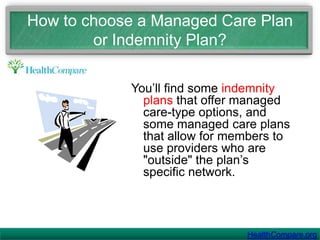
You’ll find some indemnity plans that offer managed care-type options, and some managed care plans that allow for members to use providers who are "outside" the plan’s specific network.HealthCompare.org
   Three common types of managed health care plansPPO plans
HMO plans
POS plansHealthCompare.org
Health plans negotiate discount agreements with doctors, hospitals and other providers, and pass along the negotiated or discounted prices to plan members.
HMOs use restrictions to control costs.HealthCompare.org
   You may need to select a primary care physician from a register of area physicians. Use as a gateway for all your health care needs and decisions, including referrals to obtain specialized medical treatment so costs can be managed easily.HealthCompare.org
Health Maintenance Organizations (HMOs) often require you to see a provider within the network and to obtain referrals from a primary care physician. HealthCompare.org
Questions to compare plans:How do I determine which doctors are accepting new patients?
Can I change doctors?
How are referrals handled if I need care from a specialist?
How is emergency care handled?
What services are covered, including preventive care?
What if I need services not provided by the HMO network?
Are there additional fees or co-payments required for office visits, emergency care or other services and, if so, how much are they? HealthCompare.org
    Preferred Provider Organizations (PPO) are a form of managed care plan. PPO does not necessarily require that you choose a primary care physician to supervise and make decisions for your health care.
In addition, with a PPO, you may be able to access providers and services outside of the “preferred” provider network. HealthCompare.org
    It is important to note that PPO plans will likely involve more out of pocket costs than an HMO.  PPOs typically involve deductibles, co-payments, and coinsurance amounts. 

Understanding Basic Health Plans

  • 1.
    When an Applea Day Isn’t Enough…
  • 2.
    Most Americanseither receive health insurance coverage through their employers or are covered by a family member’s policy.
  • 3.
    If you leaveyour job you will lose your employer-supported group coverage.
  • 4.
    Not every employeroffers health insurance, especially small businesses.
  • 5.
    You may notbe eligible for health insurance through your company if you work part-time. http://healthcompare.org/
  • 6.
    COBRA (Consolidated OmnibusBudgetReconciliation Act) allows for an extension ofcoverage through the group health plan for aspecified length of time, although the premiumis usually higher. HealthCompare.org
  • 7.
    Indemnity health careplans offer a greater choice of care providers. You are not restricted to a specific group of physicians, hospitals, specialists or other health care providers. HealthCompare.org
  • 8.
    Managed care plans work  within a network of doctors and hospitals or “providers.” To receive the benefits of the discounts negotiated with specific doctors, hospitals and health care providers, you must use services from providers in the health plan’s network. HealthCompare.org
  • 9.
    You’ll find someindemnity plans that offer managed care-type options, and some managed care plans that allow for members to use providers who are "outside" the plan’s specific network.HealthCompare.org
  • 10.
    Three common types of managed health care plansPPO plans
  • 11.
  • 12.
  • 13.
    Health plans negotiatediscount agreements with doctors, hospitals and other providers, and pass along the negotiated or discounted prices to plan members.
  • 14.
    HMOs use restrictionsto control costs.HealthCompare.org
  • 15.
    You may need to select a primary care physician from a register of area physicians. Use as a gateway for all your health care needs and decisions, including referrals to obtain specialized medical treatment so costs can be managed easily.HealthCompare.org
  • 16.
    Health Maintenance Organizations(HMOs) often require you to see a provider within the network and to obtain referrals from a primary care physician. HealthCompare.org
  • 17.
    Questions to compareplans:How do I determine which doctors are accepting new patients?
  • 18.
    Can I changedoctors?
  • 19.
    How are referralshandled if I need care from a specialist?
  • 20.
    How is emergencycare handled?
  • 21.
    What services arecovered, including preventive care?
  • 22.
    What if Ineed services not provided by the HMO network?
  • 23.
    Are there additionalfees or co-payments required for office visits, emergency care or other services and, if so, how much are they? HealthCompare.org
  • 24.
    Preferred Provider Organizations (PPO) are a form of managed care plan. PPO does not necessarily require that you choose a primary care physician to supervise and make decisions for your health care.
  • 25.
    In addition, witha PPO, you may be able to access providers and services outside of the “preferred” provider network. HealthCompare.org
  • 26.
    It is important to note that PPO plans will likely involve more out of pocket costs than an HMO.  PPOs typically involve deductibles, co-payments, and coinsurance amounts. 

Editor's Notes

  • #21 John & Mary, many people do not realize that insurance costs the same no matter where you buy it as it is regulated by the state. The advantage of working with an agent is that you have someone on your side making sure you get what you are looking for at the best price available.The advantage of working with me versus other agents is I actually work with the largest selection of carriers available. What I mean by this is most agents only work with just two or three companies and then try to find reasons why you should buy one of those companies. It is more important to me that you actually get the plan you need regardless of which company it is with. I am sure you are tired of having to shop for insurance, right?Well, you can feel comfortable that today we will find the best plan for you and you won’t have to keep shopping around. Would that be okay with you?
  • #22 As I mentioned, we work with the largest selection of insurance companies. This is the list of companies we currently represent. Did you realize there were so many of them? It is nice to know that we are checking with all of these companies to find you the right plan and not just two or three, isn’t it? Of course it is.Who are a couple of people that you know that are struggling trying to find insurance right now? Are they open minded people? Do you think they would mind if I sent them a letter or email?Great. What are their names and address or email address?John & Mary, the information I will go through should answer most of your questions,   Option 1. But I would like you to use this notepad to write down any questions that come up so we can address those at the end. Would that be okay? GreatOption 2. But if you have a question, stop me, because I can only help if this makes sense. Fair enough? Great.