UnConference 2019
1
25th October 2019
Prasanth Sasikumar
Augmented Human Lab
What is Remote
Collaboration?
Remote collaboration refers to the
ability to engage as a team from
anywhere in the world.
2
Image Source: https://www.viewsonic.com
3
Why Remote Collaboration?
● Productivity
● Workforce Diversity
● Reduces cost for workers
● Helps close gender gap in Tech
● Reduces Stress
● Prolong careers
● Benefits the environment
● Increases talent pool
● Employee Retention
Why do we need
better remote
Collaboration?
According to Saleforce, 86% of
employees and executives cite lack
of collaboration or ineffective
communication for workplace
failures.
4
Image Source: https://www.viewsonic.com
https://blog.bit.ai/collaboration-statistics/
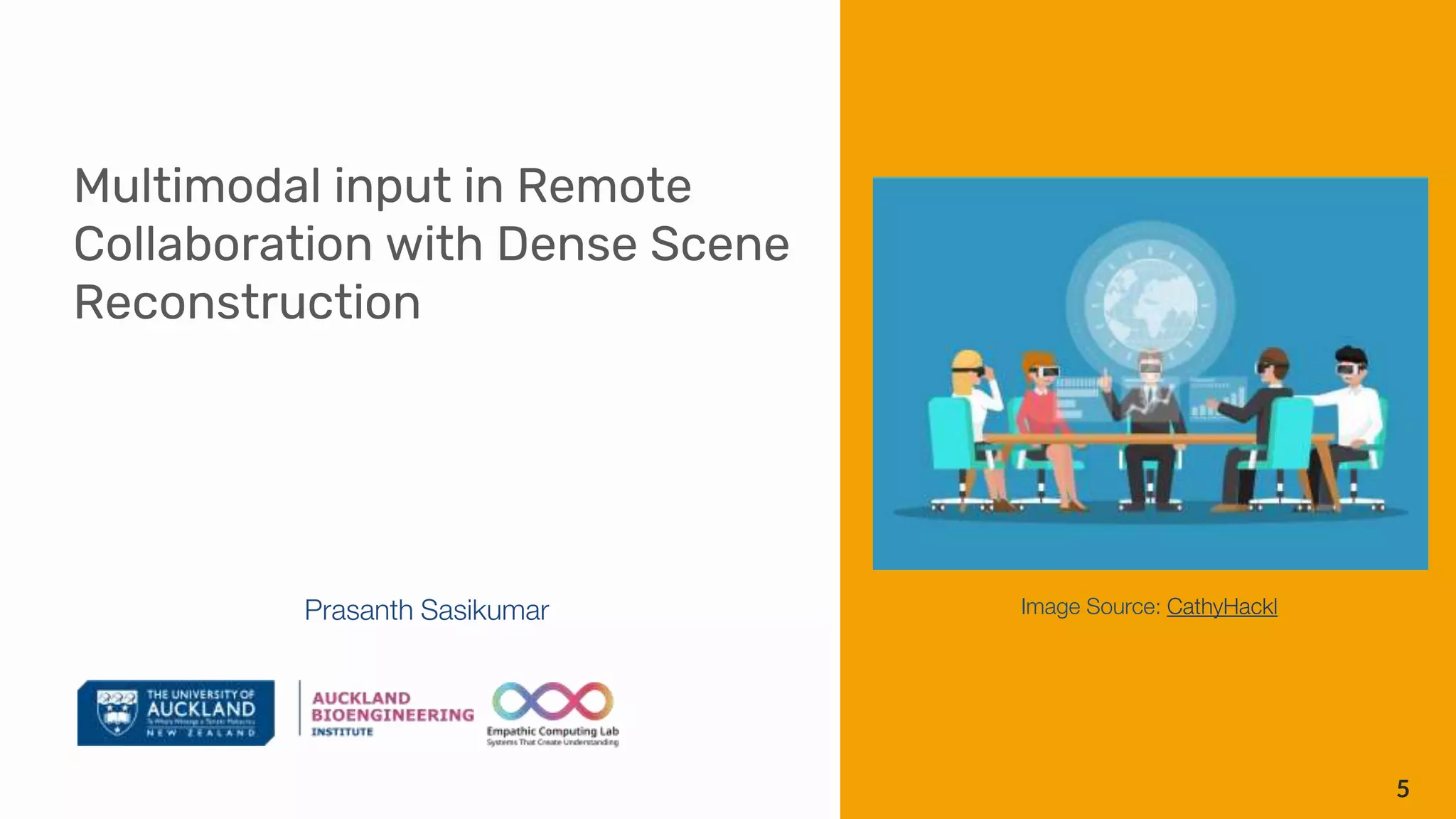
Multimodal input in Remote
Collaboration with Dense Scene
Reconstruction
Prasanth Sasikumar
5
Image Source: CathyHackl
Multimodal Input
6
Dense Scene
Reconstruction
● Physiological Sensors :
EEG, EOG, EDA, ECG, EMG,BVP
● Emotion Detection
● Emotion Representation
● Scene Reconstruction:
Real Time 3D reconstruction
3D Representation
● Depth Cameras
● Portable remote collaboration
solutions
7
Previous Work
● Spatial Audio Navigation for large scale remote
collaboration
● Augmented Collaborative Application for car
showroom
● 3D Dense reconstruction using Depth cameras
● Comparing device and natural communication
cues in remote collaboration
● Hyperscanning in VR
The Effect of Spatial Auditory
and Visual Cues in Mixed Reality
Remote Collaboration
Jing Yang, Prasanth Sasikumar, Huidong Bai, Mark Billinghurst
8
Image Source: CathyHackl
Introduction
9
While visual cues have been
investigated in several collaborative
MR systems, spatial auditory
cues remain underexplored
Image Source: Techcrunch
10
face-to-face
communication
Most people still prefer face-to-face communication over
current audio video-conferencing solutions
Partly because they usually fail to convey the subtle
nonverbal cues that are important in face-to-face
conversations.
Image Source: Freshbooks
Navigation over a large area
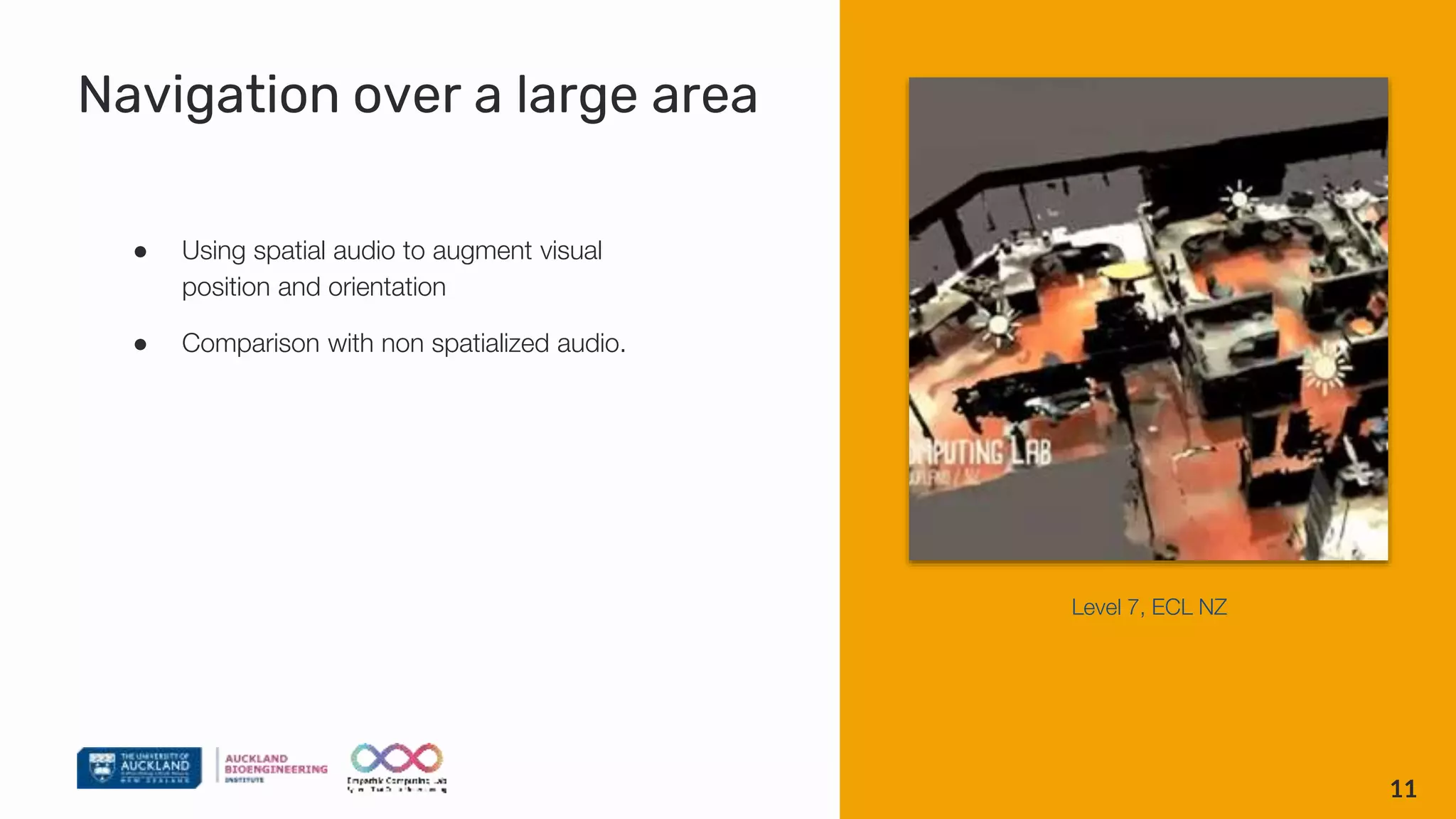
● Using spatial audio to augment visual
position and orientation
● Comparison with non spatialized audio.
11
Level 7, ECL NZ
Related Work
12
Since the first two-way video
telephony system back in
the 1960’s, remote collaboration
has become more and more
convenient with commercial multi-
party video-conference systems
that are currently used in our office
life.
AT&T Picture phone 1964 (wikipedia)
Related Work
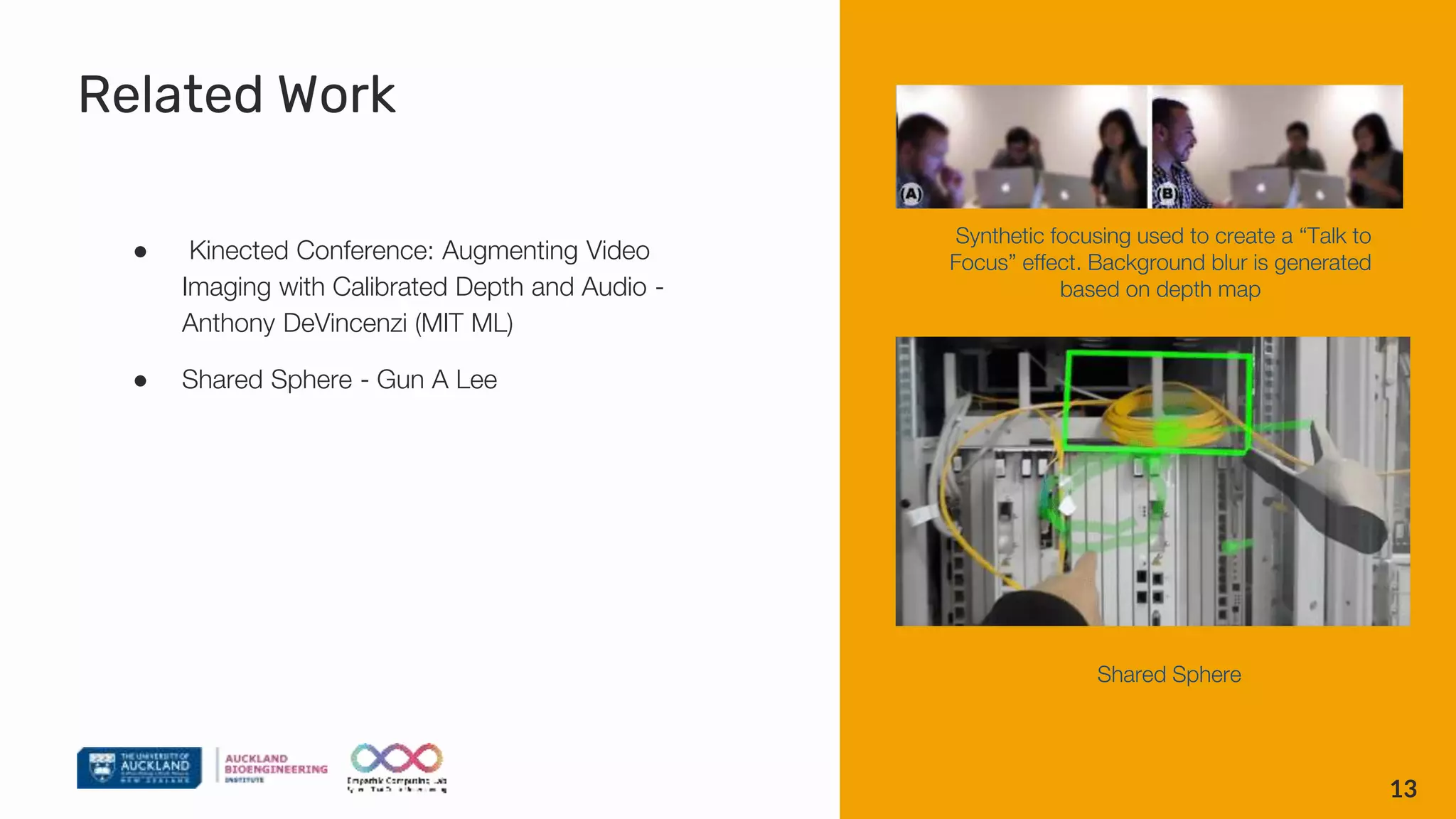
● Kinected Conference: Augmenting Video
Imaging with Calibrated Depth and Audio -
Anthony DeVincenzi (MIT ML)
● Shared Sphere - Gun A Lee
13
Synthetic focusing used to create a “Talk to
Focus” effect. Background blur is generated
based on depth map
Shared Sphere
● An MR remote collaboration system that spatializes user’s voice and auditory beacons.
● One of the first user studies that explores how spatial auditory cues can help an MR remote collaboration
task and enhance the local worker’s experience.
● One of the first user studies that explores how hybrid spatial auditory and visual cues can help an MR
remote collaboration task and enhance the local worker’s experience.
● An analysis of the users’ verbal communication in an MR remote collaboration task under different
conditions.
Our Novel Contribution
14
Implementation &
User Study
15
+ Magic Leap AR headset
+ Remote Helper - Actor
+ Unity 3D game engine
+ Spatialization Plugin
+ Second generation HTC Vive HMD System Overview
Study 1: Spatial Auditory
Cues
● Conditions
○ Non-spatialized voice (A1): Both users talked to
each other like in a normal phone or video call.
○ Spatialized voice (A2): The remote expert’s voice
was spatialized to the local worker.
○ Non-spatialized voice + spatialized auditory beacon
(A3): Only the auditory beacon (a 2 s long but
looping, wide band musical sound) was spatialized
from the target object. Voice was delivered as in
A1.
○ Spatialized voice + spatialized auditory beacon
Asked people to recall character N before the
currently displayed one.
16
Finding cues with audio
Lego Placement
Study 2: Spatial Auditory
Cues + Visual Cues
● Conditions
○ Spatialized voice + spatialized auditory beacon
(H1)
○ H1 + hand gestures (H2): The remote expert would
use hand gestures to precisely indicate the target
block when the block entered the local worker’s
FoV.
○ H1 + head frustum (H3): The head frustum of the
remote expert would always be visible in the AR
display.
○ H1 + hand gestures + head frustum (H4): All spatial
auditory and visual cues were shared to the local
worker.
17
Finding cues with audio
Lego Placement
Results
18
We found that the spatialized
remote expert’s voice and auditory
beacons could efficiently guide an
object search task in a large area.
Social Presence (Exp 1)
Ranking (Exp 2)
Workload (Exp 2)
Discussion
19
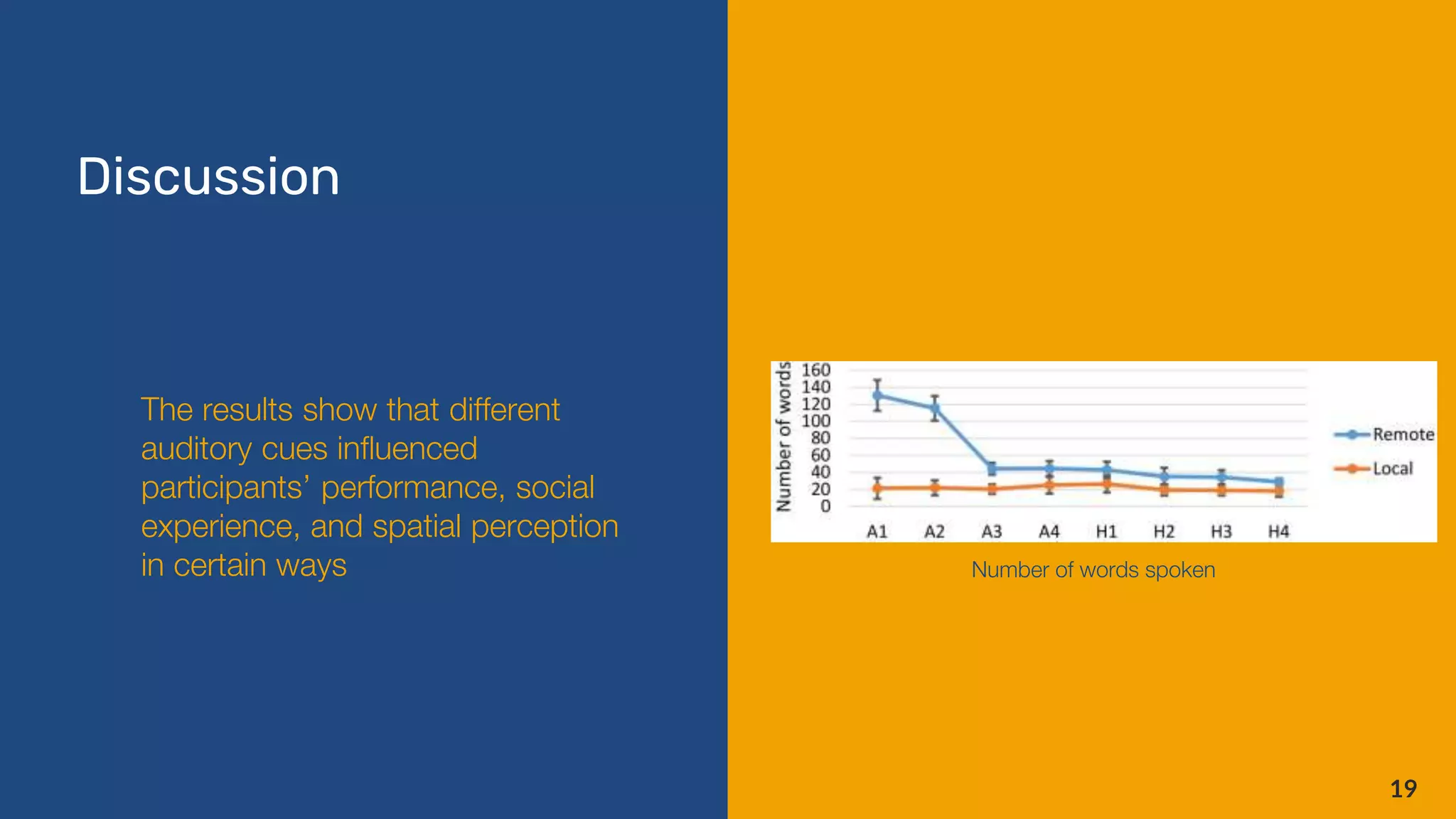
The results show that different
auditory cues influenced
participants’ performance, social
experience, and spatial perception
in certain ways Number of words spoken
Conclusion &
Future Works
20
We presented a novel MR remote
collaboration system that features
both spatial auditory and visual
cues. Through two user studies,
we found that the spatialized
remote expert’s voice and auditory
beacons could efficiently guide an
object search task in a large area.
Image Source: Techcrunch
Thank you!
21
UnConference 2019
Prasanth Sasikumar
Augmented Human Lab

Unconference2019

  • 1.
    UnConference 2019 1 25th October2019 Prasanth Sasikumar Augmented Human Lab
  • 2.
    What is Remote Collaboration? Remotecollaboration refers to the ability to engage as a team from anywhere in the world. 2 Image Source: https://www.viewsonic.com
  • 3.
    3 Why Remote Collaboration? ●Productivity ● Workforce Diversity ● Reduces cost for workers ● Helps close gender gap in Tech ● Reduces Stress ● Prolong careers ● Benefits the environment ● Increases talent pool ● Employee Retention
  • 4.
    Why do weneed better remote Collaboration? According to Saleforce, 86% of employees and executives cite lack of collaboration or ineffective communication for workplace failures. 4 Image Source: https://www.viewsonic.com https://blog.bit.ai/collaboration-statistics/
  • 5.
    Multimodal input inRemote Collaboration with Dense Scene Reconstruction Prasanth Sasikumar 5 Image Source: CathyHackl
  • 6.
    Multimodal Input 6 Dense Scene Reconstruction ●Physiological Sensors : EEG, EOG, EDA, ECG, EMG,BVP ● Emotion Detection ● Emotion Representation ● Scene Reconstruction: Real Time 3D reconstruction 3D Representation ● Depth Cameras ● Portable remote collaboration solutions
  • 7.
    7 Previous Work ● SpatialAudio Navigation for large scale remote collaboration ● Augmented Collaborative Application for car showroom ● 3D Dense reconstruction using Depth cameras ● Comparing device and natural communication cues in remote collaboration ● Hyperscanning in VR
  • 8.
    The Effect ofSpatial Auditory and Visual Cues in Mixed Reality Remote Collaboration Jing Yang, Prasanth Sasikumar, Huidong Bai, Mark Billinghurst 8 Image Source: CathyHackl
  • 9.
    Introduction 9 While visual cueshave been investigated in several collaborative MR systems, spatial auditory cues remain underexplored Image Source: Techcrunch
  • 10.
    10 face-to-face communication Most people stillprefer face-to-face communication over current audio video-conferencing solutions Partly because they usually fail to convey the subtle nonverbal cues that are important in face-to-face conversations. Image Source: Freshbooks
  • 11.
    Navigation over alarge area ● Using spatial audio to augment visual position and orientation ● Comparison with non spatialized audio. 11 Level 7, ECL NZ
  • 12.
    Related Work 12 Since thefirst two-way video telephony system back in the 1960’s, remote collaboration has become more and more convenient with commercial multi- party video-conference systems that are currently used in our office life. AT&T Picture phone 1964 (wikipedia)
  • 13.
    Related Work ● KinectedConference: Augmenting Video Imaging with Calibrated Depth and Audio - Anthony DeVincenzi (MIT ML) ● Shared Sphere - Gun A Lee 13 Synthetic focusing used to create a “Talk to Focus” effect. Background blur is generated based on depth map Shared Sphere
  • 14.
    ● An MRremote collaboration system that spatializes user’s voice and auditory beacons. ● One of the first user studies that explores how spatial auditory cues can help an MR remote collaboration task and enhance the local worker’s experience. ● One of the first user studies that explores how hybrid spatial auditory and visual cues can help an MR remote collaboration task and enhance the local worker’s experience. ● An analysis of the users’ verbal communication in an MR remote collaboration task under different conditions. Our Novel Contribution 14
  • 15.
    Implementation & User Study 15 +Magic Leap AR headset + Remote Helper - Actor + Unity 3D game engine + Spatialization Plugin + Second generation HTC Vive HMD System Overview
  • 16.
    Study 1: SpatialAuditory Cues ● Conditions ○ Non-spatialized voice (A1): Both users talked to each other like in a normal phone or video call. ○ Spatialized voice (A2): The remote expert’s voice was spatialized to the local worker. ○ Non-spatialized voice + spatialized auditory beacon (A3): Only the auditory beacon (a 2 s long but looping, wide band musical sound) was spatialized from the target object. Voice was delivered as in A1. ○ Spatialized voice + spatialized auditory beacon Asked people to recall character N before the currently displayed one. 16 Finding cues with audio Lego Placement
  • 17.
    Study 2: SpatialAuditory Cues + Visual Cues ● Conditions ○ Spatialized voice + spatialized auditory beacon (H1) ○ H1 + hand gestures (H2): The remote expert would use hand gestures to precisely indicate the target block when the block entered the local worker’s FoV. ○ H1 + head frustum (H3): The head frustum of the remote expert would always be visible in the AR display. ○ H1 + hand gestures + head frustum (H4): All spatial auditory and visual cues were shared to the local worker. 17 Finding cues with audio Lego Placement
  • 18.
    Results 18 We found thatthe spatialized remote expert’s voice and auditory beacons could efficiently guide an object search task in a large area. Social Presence (Exp 1) Ranking (Exp 2) Workload (Exp 2)
  • 19.
    Discussion 19 The results showthat different auditory cues influenced participants’ performance, social experience, and spatial perception in certain ways Number of words spoken
  • 20.
    Conclusion & Future Works 20 Wepresented a novel MR remote collaboration system that features both spatial auditory and visual cues. Through two user studies, we found that the spatialized remote expert’s voice and auditory beacons could efficiently guide an object search task in a large area. Image Source: Techcrunch
  • 21.
    Thank you! 21 UnConference 2019 PrasanthSasikumar Augmented Human Lab

Editor's Notes

  • #3 Would you Trust a Driverless vehicle? [Click and read the next stat] https://phys.org AAA - American Automobile Association
  • #5 Would you Trust a Driverless vehicle? [Click and read the next stat] https://phys.org AAA - American Automobile Association
  • #6 Good Afternoon everyone! Hope you guys are not sleepy after delicious lunch… I am Kunal Gupta, presenting my research on topic “ In AI We Trust” in which we investigated the relationship between Biosignals, Human Trust and Cognitive Load in VR.
  • #7 With the rapid advancements in artificial intelligence technology to make consumer products smart, human trust on smart machines is an important factor while designing human-computer interactions.
  • #8 With the rapid advancements in artificial intelligence technology to make consumer products smart, human trust on smart machines is an important factor while designing human-computer interactions. For a user to rely on a system, she should be trusting the information provided by the system. If the task is completed as per user’s satisfaction, they will start trusting the system.
  • #9 Good Afternoon everyone! Hope you guys are not sleepy after delicious lunch… I am Kunal Gupta, presenting my research on topic “ In AI We Trust” in which we investigated the relationship between Biosignals, Human Trust and Cognitive Load in VR.
  • #10 With the rapid advancements in artificial intelligence technology to make consumer products smart, human trust on smart machines is an important factor while designing human-computer interactions.
  • #11 With the rapid advancements in artificial intelligence technology to make consumer products smart, human trust on smart machines is an important factor while designing human-computer interactions. For a user to rely on a system, she should be trusting the information provided by the system. If the task is completed as per user’s satisfaction, they will start trusting the system.
  • #12 But defining trust is tricky! Even in psychology research, There are various factors that influences the human trust on a VR agent such as how a virtual avatar sounds or look. Or how they talk, their accent, and how they move, how they interact. Also previous experiences of the user with the virtual entity contributes to the established trust. Image Source - https://www.wired.com/story/facebook-oculus-codec-avatars-vr/
  • #13 With the rapid advancements in artificial intelligence technology to make consumer products smart, human trust on smart machines is an important factor while designing human-computer interactions.
  • #17 But defining trust is tricky! Even in psychology research, There are various factors that influences the human trust on a VR agent such as how a virtual avatar sounds or look. Or how they talk, their accent, and how they move, how they interact. Also previous experiences of the user with the virtual entity contributes to the established trust. Image Source - https://www.wired.com/story/facebook-oculus-codec-avatars-vr/
  • #18 But defining trust is tricky! Even in psychology research, There are various factors that influences the human trust on a VR agent such as how a virtual avatar sounds or look. Or how they talk, their accent, and how they move, how they interact. Also previous experiences of the user with the virtual entity contributes to the established trust. Image Source - https://www.wired.com/story/facebook-oculus-codec-avatars-vr/
  • #19 With the rapid advancements in artificial intelligence technology to make consumer products smart, human trust on smart machines is an important factor while designing human-computer interactions.
  • #20 How the conversation changed from where are you? (details) to is it here? Limitaion We used actor for Remote expert, conducted the study during office hours
  • #21 With the rapid advancements in artificial intelligence technology to make consumer products smart, human trust on smart machines is an important factor while designing human-computer interactions.