
UMB 
(Urea Molasses Blocks) 
Submitted to: 
Dr. Muhammad Farooq 
By: 
H.M.Naeem Akhtar
IMPORTANCE OF UMB 
Most of the animals live on fibrous feeds like 
mature pastures and crop 
These feeds are: 
Deficient in protein, minerals 
and vitamins and are poorly digestible. 
⦿ Both these characteristics keep intake and 
productivity low. 
⦿ Supplementation with Urea Molasses Blocks 
(UMB) can increase digestibility of fibrous feeds 
by up to 20%, increase the nutrients the animal 
receives and can increase feed intake by 25 to 
30%.
⦿ If another good quality protein source such 
as cottonseed is added to the block, the 
animal will grow faster. 
⦿ Animals also benefit if other feedstuffs 
such as vitamins, minerals, medicines, etc. 
are added to the block. 
⦿ Blocks are an easy way to make and store 
molasses and urea and also feed to 
animals. 
⦿ They can easily be made and used in 
villages. A person may make and sell 
blocks to farmers as a source of income.
Basic Components 
The basic components of UMB are: 
⦿ 1.molasses 
⦿ 2.urea 
⦿ 3.fibrous feeds (wheat bran) 
⦿ 4.salt 
⦿ 5.Cement (a binding agent).
Molasses 
⦿Molasses is used 
to induce animals to eat the 
block due to its sweet 
taste. Molasses provides 
energy and some other 
nutrients and minerals like 
sulfur. 
⦿ The block should not 
contain more than 40 to 
50% molasses or it will 
break too easily and take 
too long to dry.
Urea 
⦿Ureaknown to 
farmers as fertilizer for 
crop production is used 
to make the block. 
⦿ The amount of urea 
should be limited to 10% 
to avoid poisoning. 
⦿ Urea is essential in 
improving digestibility 
and providing protein.
Cereal bran 
⦿Cereal bran 
is the most common fibrous 
feed used. The bran 
provides protein and helps 
hold the block together. 
Finely chopped straw or 
finely ground leaves from 
leguminous shrubs can 
substitute for cereal bran.
Salt 
⦿Salt in the range of 5 to 10% is 
added to the blocks to supply minerals 
and to control the rate of consumption. 
⦿ Calcium carbonate and di-calcium 
phosphate can be added to provide 
additional calcium and phosphorus.
Cement 
⦿Cement is used to make the block 
hard. 
⦿ About 10 to 15% is sufficient. 
⦿ Higher levels make the blocks too hard. 
⦿ Cement also provides calcium. 
⦿ Clay such as that used in brick making can 
be mixed with cement to improve block 
hardness and reduce drying time. 
⦿ It can reduce cost of the block.
Other Ingredients 
⦿Other ingredients can 
be added to provide additional nutrients. 
⦿ Dried poultry litter or oilseed cakes can 
be added to supply protein. 
⦿ Trace mineralized salt can be used to 
provide additional minerals that may be 
lacking.
How to make UMB? 
⦿ How to make Urea Molasses Blocks 
⦿ Urea Molasses blocks can be 
manufactured on the farm. 
⦿ Manufacturing is easy and simple and 
different processes exist which may be 
used according to local conditions.
Different Steps 
⦿ The manufacturing can be divided into 
four steps: 
⦿ 1. Preparation of the components 
⦿ 2. Mixing 
⦿ 3. Molding 
⦿ 4. Drying
Preparation of the 
components 
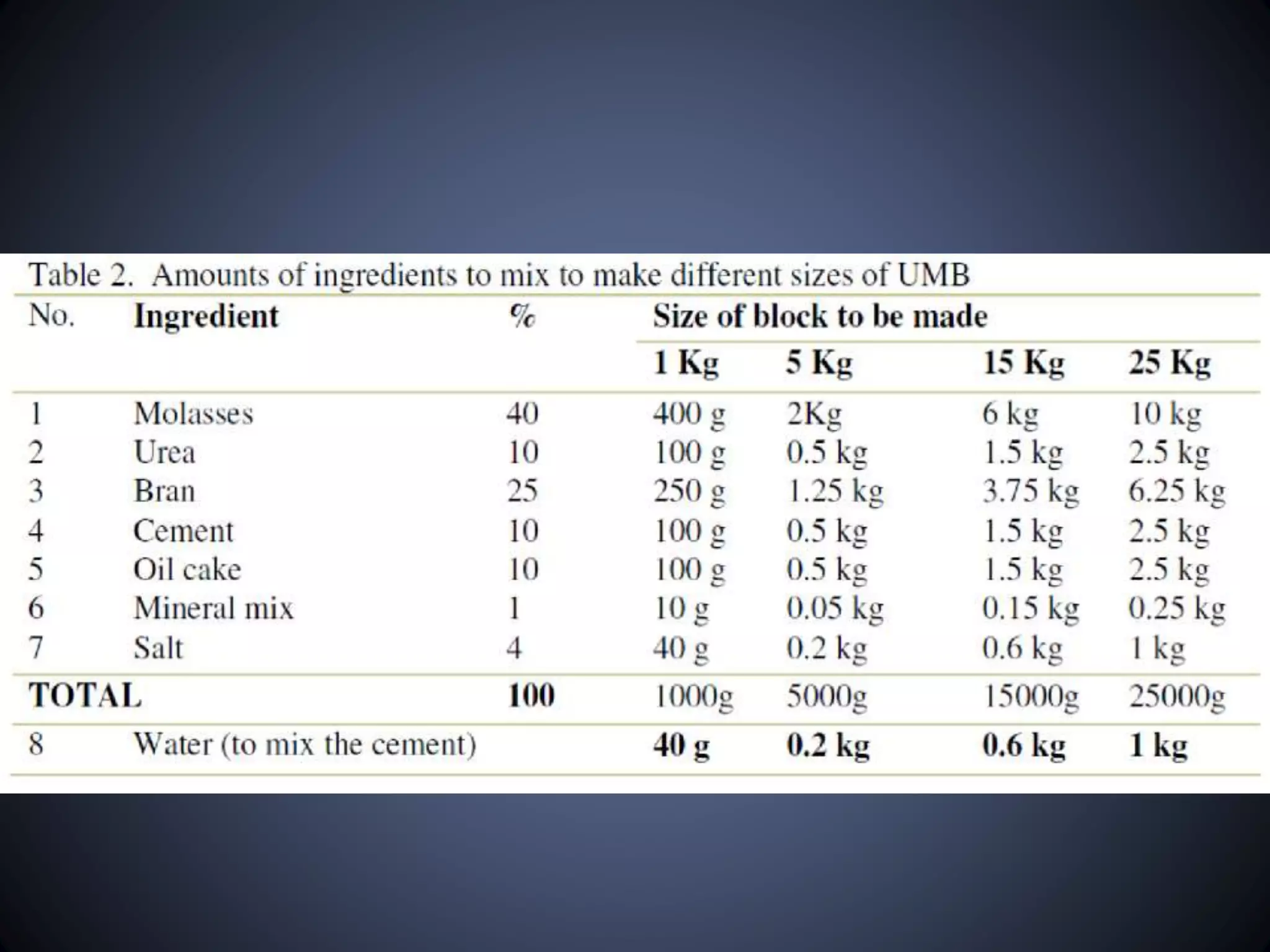
⦿ The amount of the different ingredients 
depends on the size of the block to be 
manufactured and the formula to be 
used. 
⦿ Table shows the amount of ingredients 
to be mixed to make 1, 5, 15 or 25 kilo 
grams of block based on formula 
alternative “A” in Table 1.
Mixing 
⦿ Good mixing is a key for good block making. 
⦿ Urea must be mixed thoroughly . 
⦿ Do the following to mix the ingredients: 
⦿ weigh the amount of ingredients based on the 
formula of the block; 
⦿ Add urea to the molasses while continuously 
mixing.
⦿ The urea is mixed with molasses and 
thoroughly stirred for about 20 minutes; 
⦿ The molasses can be heated in the sun to 
improve handling and mixing; 
⦿ Never add water to molasses 
⦿ Make the cement into a paste with water 
prior to adding to the rest of the 
ingredients. 
⦿ Mixing the salt with cement accelerates 
hardening.
⦿ High levels of molasses and urea tend to 
decrease block hardness. 
⦿ Check block hardness after drying and 
make the following adjustments to the 
formula used if necessary. 
⦿ If the block is too hard, reduce the 
proportion of cement or clay and slightly 
increase the proportion of molasses. 
⦿ If too soft, increase cement or clay and 
reduce molasses.
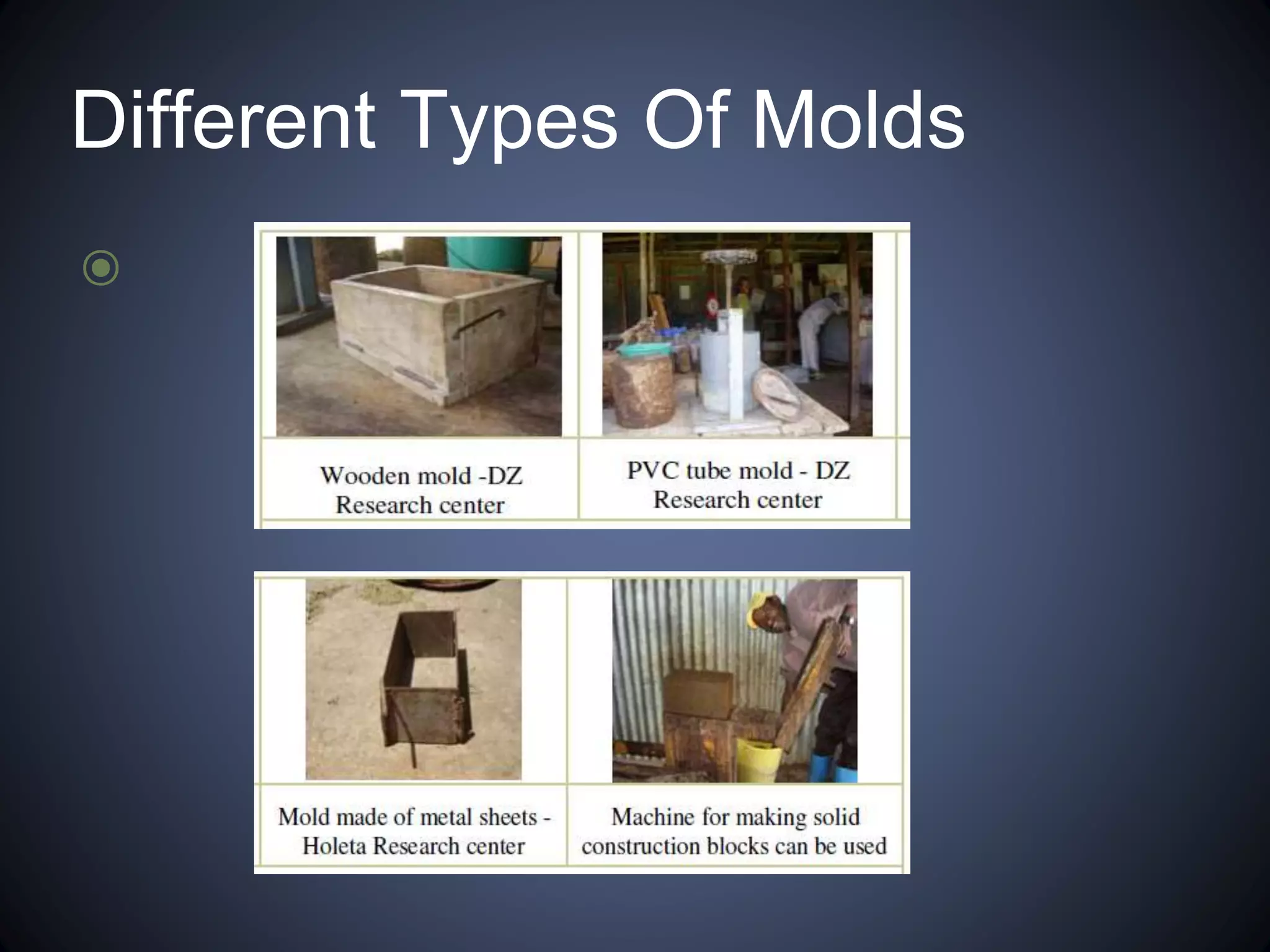
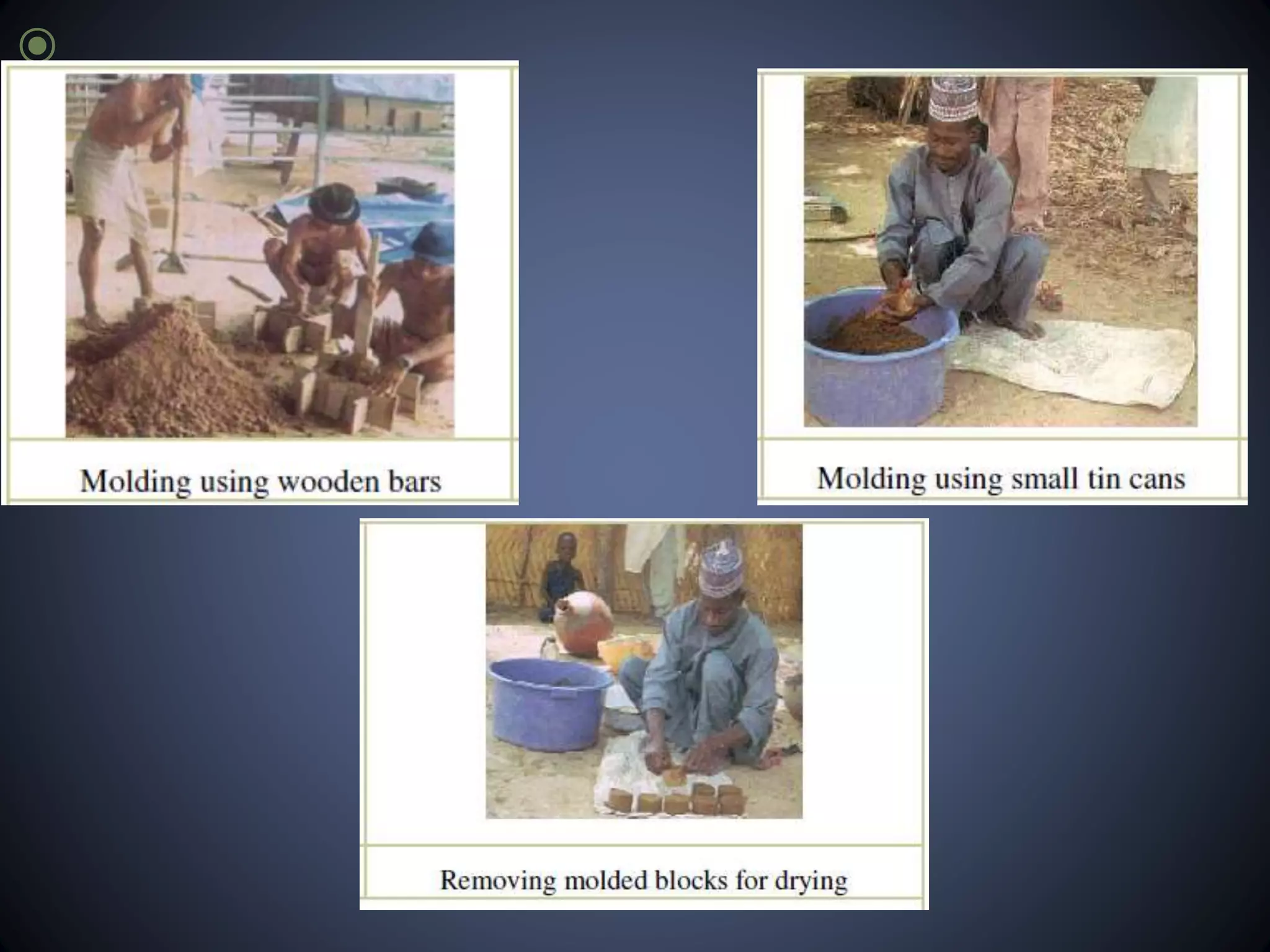
Casting and Molds 
⦿ Once the ingredients 
are thoroughly mixed, 
place the mixture into 
molds. 
⦿ Any local container 
such as tin cans or 
small buckets can be 
used as a mold. 
⦿ Using a plastic sheet 
to line the molds will 
make block removal 
from the mold easier.
Different Types Of Molds 
⦿
⦿
Drying and Storage of 
UMB 
⦿ Remove the blocks from the molds after 
24 hours and place on racks to dry. 
⦿ Leave the blocks to dry for at least 5 
days depending upon the weather 
condition.
⦿ 
Different steps
Characteristics of a good 
UMB 
⦿A block is considered to be good 
when it fulfills the following: 
⦿ Ingredients are well distributed 
throughout the block. 
⦿ It does not have lumps of urea and lime. 
⦿ It is hard enough not to be squashed 
between our fingers and not to break 
when a person steps on it.
⦿ Our hands should feel the sticky 
molasses when we hold the block. 
⦿ The amount of molasses needs to be 
increased the next time we make a 
block if it doesn’t feel sticky.
Feeding and Intake of 
UMB 
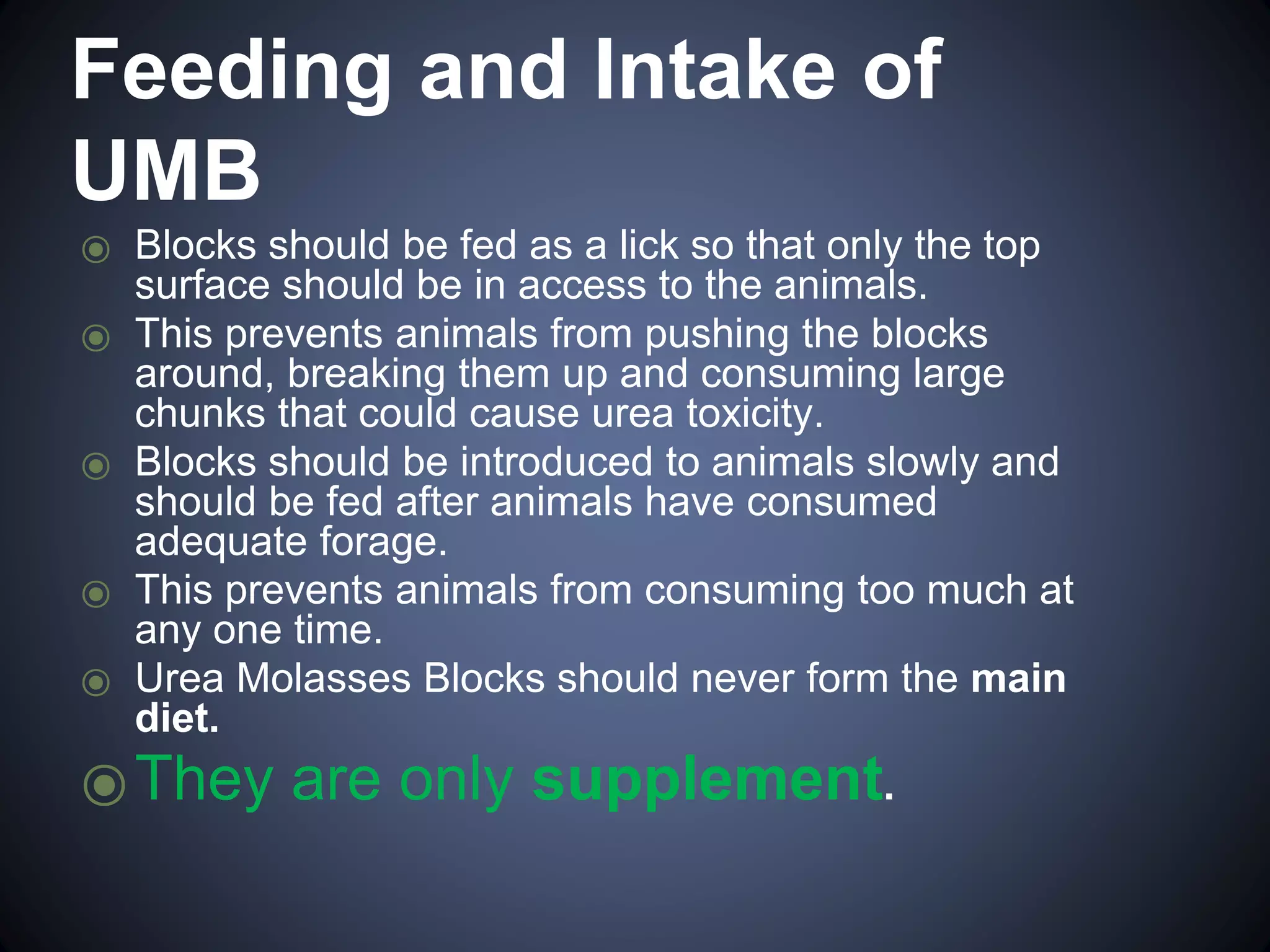
⦿ Blocks should be fed as a lick so that only the top 
surface should be in access to the animals. 
⦿ This prevents animals from pushing the blocks 
around, breaking them up and consuming large 
chunks that could cause urea toxicity. 
⦿ Blocks should be introduced to animals slowly and 
should be fed after animals have consumed 
adequate forage. 
⦿ This prevents animals from consuming too much at 
any one time. 
⦿ Urea Molasses Blocks should never form the main 
diet. 
⦿They are only supplement.
⦿ This prevents animals from consuming 
too much at any one time. 
⦿ Urea Molasses Blocks should never 
form the main diet. 
⦿They are only 
supplement.
⦿ Block hardness will affect its rate of intake. 
⦿ If it is too soft, it will be consumed too 
rapidly and there is the risk of toxicity. 
⦿ If too hard, intake may be too little. 
⦿ High levels of urea in Urea Molasses 
Blocks may reduce intake of the block due 
to the bitter taste. 
⦿ High levels or imbalances in minerals may 
result in excessive consumption in a short 
time also leading to urea poisoning.
Precautions 
⦿ Feed to ruminants only (sheep, goats, 
cattle, camels). 
⦿ Do not feed to mono-gastric, i.e. Horses, 
donkeys, or pigs. 
⦿ Do not feed to young ruminants less 
than six months of age (kids, lambs). 
⦿ Blocks should be used as a supplement 
and not as the basic ration.
⦿ Never give blocks to an animal with an 
empty stomach. 
⦿ There is the risk of poisoning due to 
excessive consumption. 
⦿ The amount of blocks fed to sheep and 
goats should be limited to 100 
grams/day.
⦿ The blocks should never be supplied in 
ground form or dissolved in water as this 
can result in over consumption. 
⦿ Supply sufficient amount of water.
UMB

UMB

  • 1.
    UMB (Urea MolassesBlocks) Submitted to: Dr. Muhammad Farooq By: H.M.Naeem Akhtar
  • 2.
    IMPORTANCE OF UMB Most of the animals live on fibrous feeds like mature pastures and crop These feeds are: Deficient in protein, minerals and vitamins and are poorly digestible. ⦿ Both these characteristics keep intake and productivity low. ⦿ Supplementation with Urea Molasses Blocks (UMB) can increase digestibility of fibrous feeds by up to 20%, increase the nutrients the animal receives and can increase feed intake by 25 to 30%.
  • 3.
    ⦿ If anothergood quality protein source such as cottonseed is added to the block, the animal will grow faster. ⦿ Animals also benefit if other feedstuffs such as vitamins, minerals, medicines, etc. are added to the block. ⦿ Blocks are an easy way to make and store molasses and urea and also feed to animals. ⦿ They can easily be made and used in villages. A person may make and sell blocks to farmers as a source of income.
  • 4.
    Basic Components Thebasic components of UMB are: ⦿ 1.molasses ⦿ 2.urea ⦿ 3.fibrous feeds (wheat bran) ⦿ 4.salt ⦿ 5.Cement (a binding agent).
  • 5.
    Molasses ⦿Molasses isused to induce animals to eat the block due to its sweet taste. Molasses provides energy and some other nutrients and minerals like sulfur. ⦿ The block should not contain more than 40 to 50% molasses or it will break too easily and take too long to dry.
  • 6.
    Urea ⦿Ureaknown to farmers as fertilizer for crop production is used to make the block. ⦿ The amount of urea should be limited to 10% to avoid poisoning. ⦿ Urea is essential in improving digestibility and providing protein.
  • 7.
    Cereal bran ⦿Cerealbran is the most common fibrous feed used. The bran provides protein and helps hold the block together. Finely chopped straw or finely ground leaves from leguminous shrubs can substitute for cereal bran.
  • 8.
    Salt ⦿Salt inthe range of 5 to 10% is added to the blocks to supply minerals and to control the rate of consumption. ⦿ Calcium carbonate and di-calcium phosphate can be added to provide additional calcium and phosphorus.
  • 9.
    Cement ⦿Cement isused to make the block hard. ⦿ About 10 to 15% is sufficient. ⦿ Higher levels make the blocks too hard. ⦿ Cement also provides calcium. ⦿ Clay such as that used in brick making can be mixed with cement to improve block hardness and reduce drying time. ⦿ It can reduce cost of the block.
  • 10.
    Other Ingredients ⦿Otheringredients can be added to provide additional nutrients. ⦿ Dried poultry litter or oilseed cakes can be added to supply protein. ⦿ Trace mineralized salt can be used to provide additional minerals that may be lacking.
  • 11.
    How to makeUMB? ⦿ How to make Urea Molasses Blocks ⦿ Urea Molasses blocks can be manufactured on the farm. ⦿ Manufacturing is easy and simple and different processes exist which may be used according to local conditions.
  • 12.
    Different Steps ⦿The manufacturing can be divided into four steps: ⦿ 1. Preparation of the components ⦿ 2. Mixing ⦿ 3. Molding ⦿ 4. Drying
  • 13.
    Preparation of the components ⦿ The amount of the different ingredients depends on the size of the block to be manufactured and the formula to be used. ⦿ Table shows the amount of ingredients to be mixed to make 1, 5, 15 or 25 kilo grams of block based on formula alternative “A” in Table 1.
  • 15.
    Mixing ⦿ Goodmixing is a key for good block making. ⦿ Urea must be mixed thoroughly . ⦿ Do the following to mix the ingredients: ⦿ weigh the amount of ingredients based on the formula of the block; ⦿ Add urea to the molasses while continuously mixing.
  • 16.
    ⦿ The ureais mixed with molasses and thoroughly stirred for about 20 minutes; ⦿ The molasses can be heated in the sun to improve handling and mixing; ⦿ Never add water to molasses ⦿ Make the cement into a paste with water prior to adding to the rest of the ingredients. ⦿ Mixing the salt with cement accelerates hardening.
  • 17.
    ⦿ High levelsof molasses and urea tend to decrease block hardness. ⦿ Check block hardness after drying and make the following adjustments to the formula used if necessary. ⦿ If the block is too hard, reduce the proportion of cement or clay and slightly increase the proportion of molasses. ⦿ If too soft, increase cement or clay and reduce molasses.
  • 18.
    Casting and Molds ⦿ Once the ingredients are thoroughly mixed, place the mixture into molds. ⦿ Any local container such as tin cans or small buckets can be used as a mold. ⦿ Using a plastic sheet to line the molds will make block removal from the mold easier.
  • 19.
  • 20.
  • 21.
    Drying and Storageof UMB ⦿ Remove the blocks from the molds after 24 hours and place on racks to dry. ⦿ Leave the blocks to dry for at least 5 days depending upon the weather condition.
  • 22.
  • 23.
    Characteristics of agood UMB ⦿A block is considered to be good when it fulfills the following: ⦿ Ingredients are well distributed throughout the block. ⦿ It does not have lumps of urea and lime. ⦿ It is hard enough not to be squashed between our fingers and not to break when a person steps on it.
  • 24.
    ⦿ Our handsshould feel the sticky molasses when we hold the block. ⦿ The amount of molasses needs to be increased the next time we make a block if it doesn’t feel sticky.
  • 25.
    Feeding and Intakeof UMB ⦿ Blocks should be fed as a lick so that only the top surface should be in access to the animals. ⦿ This prevents animals from pushing the blocks around, breaking them up and consuming large chunks that could cause urea toxicity. ⦿ Blocks should be introduced to animals slowly and should be fed after animals have consumed adequate forage. ⦿ This prevents animals from consuming too much at any one time. ⦿ Urea Molasses Blocks should never form the main diet. ⦿They are only supplement.
  • 26.
    ⦿ This preventsanimals from consuming too much at any one time. ⦿ Urea Molasses Blocks should never form the main diet. ⦿They are only supplement.
  • 27.
    ⦿ Block hardnesswill affect its rate of intake. ⦿ If it is too soft, it will be consumed too rapidly and there is the risk of toxicity. ⦿ If too hard, intake may be too little. ⦿ High levels of urea in Urea Molasses Blocks may reduce intake of the block due to the bitter taste. ⦿ High levels or imbalances in minerals may result in excessive consumption in a short time also leading to urea poisoning.
  • 28.
    Precautions ⦿ Feedto ruminants only (sheep, goats, cattle, camels). ⦿ Do not feed to mono-gastric, i.e. Horses, donkeys, or pigs. ⦿ Do not feed to young ruminants less than six months of age (kids, lambs). ⦿ Blocks should be used as a supplement and not as the basic ration.
  • 29.
    ⦿ Never giveblocks to an animal with an empty stomach. ⦿ There is the risk of poisoning due to excessive consumption. ⦿ The amount of blocks fed to sheep and goats should be limited to 100 grams/day.
  • 30.
    ⦿ The blocksshould never be supplied in ground form or dissolved in water as this can result in over consumption. ⦿ Supply sufficient amount of water.