All rights reserved @ULOOP consortium 2010-2013
http://www.uloop.eu/
Aalborg, May 10th 2012
FIA session 2.4 - Standardization
1
ULOOP: Standardization Aspects
Rute Sofia (rute.sofia@ulusofona.pt)
SITI/University Lusófona
EU IST FP7 ULOOP: User-centric Wireless Local Loop
http://uloop.eu
All rights reserved @ULOOP consortium 2010-2013
http://www.uloop.eu/
Aalborg, May 10th 2012
FIA session 2.4 - Standardization
2
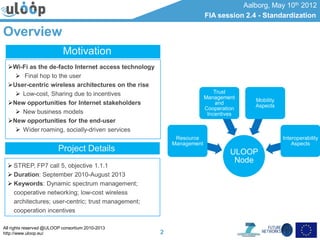
Motivation
Wi-Fi as the de-facto Internet access technology
 Final hop to the user
User-centric wireless architectures on the rise
 Low-cost, Sharing due to incentives
New opportunities for Internet stakeholders
 New business models
New opportunities for the end-user
 Wider roaming, socially-driven services
Project Details
 STREP, FP7 call 5, objective 1.1.1
 Duration: September 2010-August 2013
 Keywords: Dynamic spectrum management;
cooperative networking; low-cost wireless
architectures; user-centric; trust management;
cooperation incentives
Overview
ULOOP
Node
Resource
Management
Trust
Management
and
Cooperation
Incentives
Mobility
Aspects
Interoperability
Aspects
All rights reserved @ULOOP consortium 2010-2013
http://www.uloop.eu/
Aalborg, May 10th 2012
FIA session 2.4 - Standardization
3
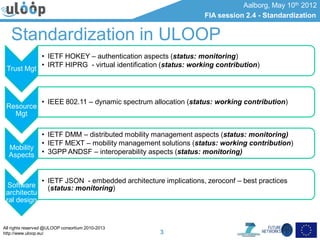
Standardization in ULOOP
Trust Mgt
• IETF HOKEY – authentication aspects (status: monitoring)
• IRTF HIPRG - virtual identification (status: working contribution)
Resource
Mgt
• IEEE 802.11 – dynamic spectrum allocation (status: working contribution)
Mobility
Aspects
• IETF DMM – distributed mobility management aspects (status: monitoring)
• IETF MEXT – mobility management solutions (status: working contribution)
• 3GPP ANDSF – interoperability aspects (status: monitoring)
Software
architectu
ral design
• IETF JSON - embedded architecture implications, zeroconf – best practices
(status: monitoring)
All rights reserved @ULOOP consortium 2010-2013
http://www.uloop.eu/
Aalborg, May 10th 2012
FIA session 2.4 - Standardization
4
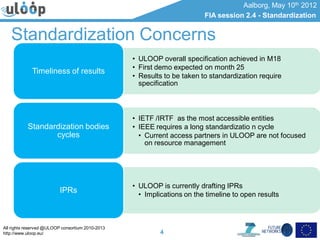
Standardization Concerns
• ULOOP overall specification achieved in M18
• First demo expected on month 25
• Results to be taken to standardization require
specification
Timeliness of results
• IETF /IRTF as the most accessible entities
• IEEE requires a long standardizatio n cycle
• Current access partners in ULOOP are not focused
on resource management
Standardization bodies
cycles
• ULOOP is currently drafting IPRs
• Implications on the timeline to open results
IPRs
All rights reserved @ULOOP consortium 2010-2013
http://www.uloop.eu/
Aalborg, May 10th 2012
FIA session 2.4 - Standardization
5
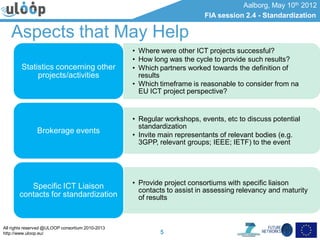
Aspects that May Help
• Where were other ICT projects successful?
• How long was the cycle to provide such results?
• Which partners worked towards the definition of
results
• Which timeframe is reasonable to consider from na
EU ICT project perspective?
Statistics concerning other
projects/activities
• Regular workshops, events, etc to discuss potential
standardization
• Invite main representants of relevant bodies (e.g.
3GPP, relevant groups; IEEE; IETF) to the event
Brokerage events
• Provide project consortiums with specific liaison
contacts to assist in assessing relevancy and maturity
of results
Specific ICT Liaison
contacts for standardization
All rights reserved @ULOOP consortium 2010-2013
http://www.uloop.eu/
Aalborg, May 10th 2012
FIA session 2.4 - Standardization
6
Project ULOOP
User-centric Wireless Local Loop
FP7/2007-2013
Project ULOOP has received funding from the
EU IST Seventh Framework Programme
under grant agreement no. 257418
Participants
Alcatel-Lucent Bell Labs, (FR)
COFAC c.r.l./University Lusófona (PT)
Huawei Technologies Duesseldorf GmbH (DE)
ARIA S.p.A (IT)
Caixa Mágica Software Lda (PT)
FON Wireless Ltd (UK)
Technische Universität Berlin (DE)
University of Kent (UK)
Université de Genève (CH)
Level7 srlu (IT)
University of Urbino (IT)
Contact
info@uloop.eu
http://www.uloop.eu/
FP7 ULOOP Project group on LinkedIn
#uloopproject on Twitter

ULOOP standardization

  • 1.
    All rights reserved@ULOOP consortium 2010-2013 http://www.uloop.eu/ Aalborg, May 10th 2012 FIA session 2.4 - Standardization 1 ULOOP: Standardization Aspects Rute Sofia (rute.sofia@ulusofona.pt) SITI/University Lusófona EU IST FP7 ULOOP: User-centric Wireless Local Loop http://uloop.eu
  • 2.
    All rights reserved@ULOOP consortium 2010-2013 http://www.uloop.eu/ Aalborg, May 10th 2012 FIA session 2.4 - Standardization 2 Motivation Wi-Fi as the de-facto Internet access technology  Final hop to the user User-centric wireless architectures on the rise  Low-cost, Sharing due to incentives New opportunities for Internet stakeholders  New business models New opportunities for the end-user  Wider roaming, socially-driven services Project Details  STREP, FP7 call 5, objective 1.1.1  Duration: September 2010-August 2013  Keywords: Dynamic spectrum management; cooperative networking; low-cost wireless architectures; user-centric; trust management; cooperation incentives Overview ULOOP Node Resource Management Trust Management and Cooperation Incentives Mobility Aspects Interoperability Aspects
  • 3.
    All rights reserved@ULOOP consortium 2010-2013 http://www.uloop.eu/ Aalborg, May 10th 2012 FIA session 2.4 - Standardization 3 Standardization in ULOOP Trust Mgt • IETF HOKEY – authentication aspects (status: monitoring) • IRTF HIPRG - virtual identification (status: working contribution) Resource Mgt • IEEE 802.11 – dynamic spectrum allocation (status: working contribution) Mobility Aspects • IETF DMM – distributed mobility management aspects (status: monitoring) • IETF MEXT – mobility management solutions (status: working contribution) • 3GPP ANDSF – interoperability aspects (status: monitoring) Software architectu ral design • IETF JSON - embedded architecture implications, zeroconf – best practices (status: monitoring)
  • 4.
    All rights reserved@ULOOP consortium 2010-2013 http://www.uloop.eu/ Aalborg, May 10th 2012 FIA session 2.4 - Standardization 4 Standardization Concerns • ULOOP overall specification achieved in M18 • First demo expected on month 25 • Results to be taken to standardization require specification Timeliness of results • IETF /IRTF as the most accessible entities • IEEE requires a long standardizatio n cycle • Current access partners in ULOOP are not focused on resource management Standardization bodies cycles • ULOOP is currently drafting IPRs • Implications on the timeline to open results IPRs
  • 5.
    All rights reserved@ULOOP consortium 2010-2013 http://www.uloop.eu/ Aalborg, May 10th 2012 FIA session 2.4 - Standardization 5 Aspects that May Help • Where were other ICT projects successful? • How long was the cycle to provide such results? • Which partners worked towards the definition of results • Which timeframe is reasonable to consider from na EU ICT project perspective? Statistics concerning other projects/activities • Regular workshops, events, etc to discuss potential standardization • Invite main representants of relevant bodies (e.g. 3GPP, relevant groups; IEEE; IETF) to the event Brokerage events • Provide project consortiums with specific liaison contacts to assist in assessing relevancy and maturity of results Specific ICT Liaison contacts for standardization
  • 6.
    All rights reserved@ULOOP consortium 2010-2013 http://www.uloop.eu/ Aalborg, May 10th 2012 FIA session 2.4 - Standardization 6 Project ULOOP User-centric Wireless Local Loop FP7/2007-2013 Project ULOOP has received funding from the EU IST Seventh Framework Programme under grant agreement no. 257418 Participants Alcatel-Lucent Bell Labs, (FR) COFAC c.r.l./University Lusófona (PT) Huawei Technologies Duesseldorf GmbH (DE) ARIA S.p.A (IT) Caixa Mágica Software Lda (PT) FON Wireless Ltd (UK) Technische Universität Berlin (DE) University of Kent (UK) Université de Genève (CH) Level7 srlu (IT) University of Urbino (IT) Contact info@uloop.eu http://www.uloop.eu/ FP7 ULOOP Project group on LinkedIn #uloopproject on Twitter