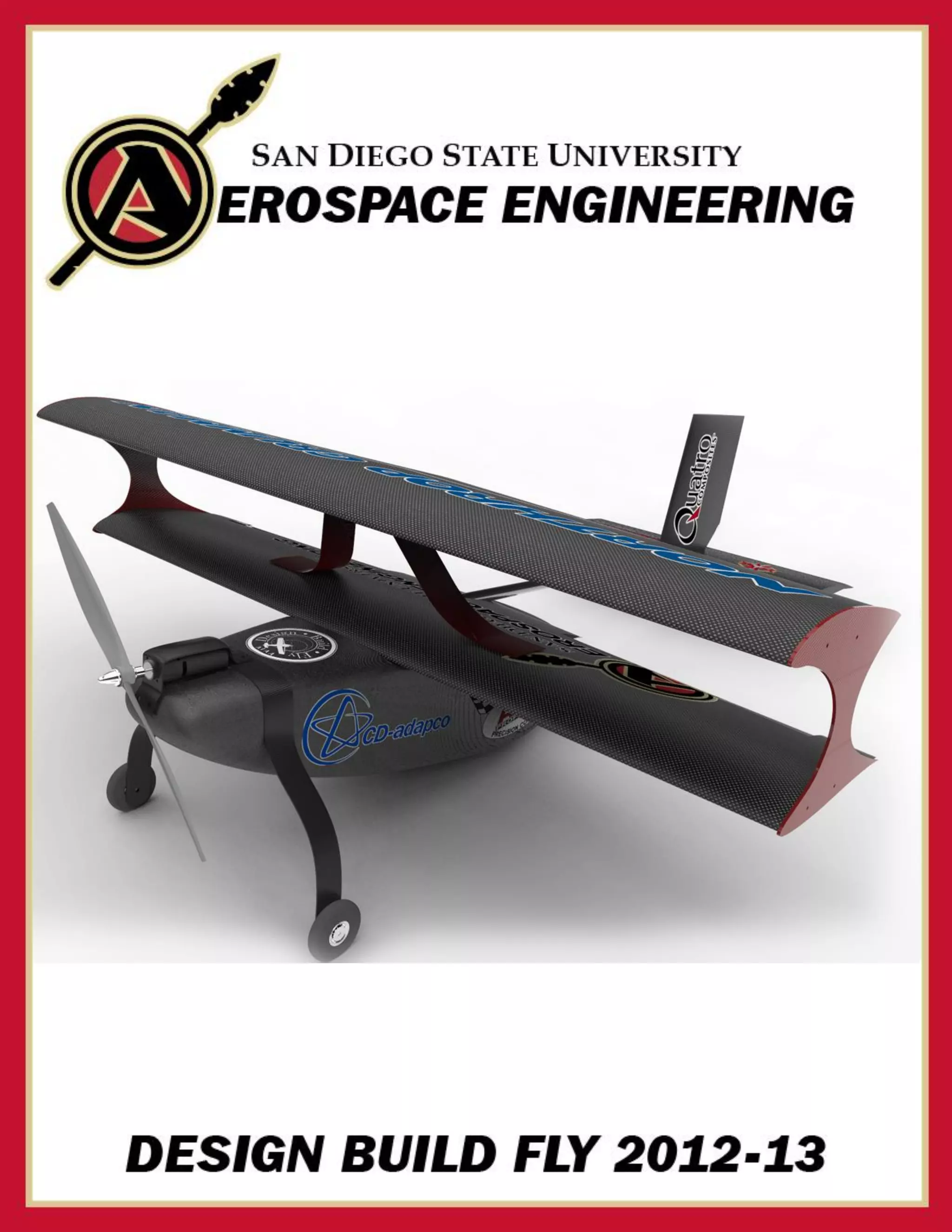
1San Diego State University
2San Diego State University
Table of Contents
1.0 Executive Summary ................................................................................................................5
2.0 Management Summary...........................................................................................................6
2.1 Team Organization........................................................................................................................6
2.2 Working Plan.................................................................................................................................7
3.0 Conceptual Design..................................................................................................................8
3.1 Mission Requirements...................................................................................................................8
3.2 Translating Mission Requirements Into Design Requirements...................................................12
3.3 Conceptual Design Selection......................................................................................................14
3.4 Component Layout Section.........................................................................................................15
3.5 Selected Conceptual Design.......................................................................................................18
4.0 Preliminary Design................................................................................................................19
4.1 Design and Analysis Methodology..............................................................................................19
4.2 Mission Model .............................................................................................................................19
4.3 Initial Sizing .................................................................................................................................20
4.4 Aerodynamics..............................................................................................................................20
4.5 Stability and Control ....................................................................................................................23
4.6 Propulsion ...................................................................................................................................25
4.7 Structures....................................................................................................................................28
4.8 Aircraft Mission Performance......................................................................................................29
5.0 Detail Design..........................................................................................................................29
5.1 Dimensional Parameters.............................................................................................................30
5.2 Structural Characteristics............................................................................................................30
5.3 System Design, Component Selection and Integration ..............................................................31
5.4 Aircraft Component Weight and Balance....................................................................................35
5.5 Flight Performance Summary .....................................................................................................36
5.6 Mission Performance Summary..................................................................................................37
3San Diego State University
5.7 Drawing Package ........................................................................................................................38
6.0 Manufacturing Plan and Processes ....................................................................................45
6.1 Manufacturing and Material Selection.........................................................................................45
6.2 Manufacturing Schedule .............................................................................................................47
6.3 Aircraft Manufacturing Process...................................................................................................47
7.0 Testing Plan...........................................................................................................................49
7.1 Propulsion System Testing .........................................................................................................50
7.2 Structural Testing ........................................................................................................................50
7.3 Flight Testing...............................................................................................................................50
8.0 Performance Results ............................................................................................................52
8.1 Propulsion Test Results ............................................................................................................530
8.2 Wing Tip Results .......................................................................................................................530
8.3 Landing Gear Results ...............................................................................................................531
8.4 Material Testing...........................................................................................................................54
8.5 Flight Testing...............................................................................................................................54
8.6 Aerodynamic Results ..................................................................................................................55
9.0 References.............................................................................................................................59
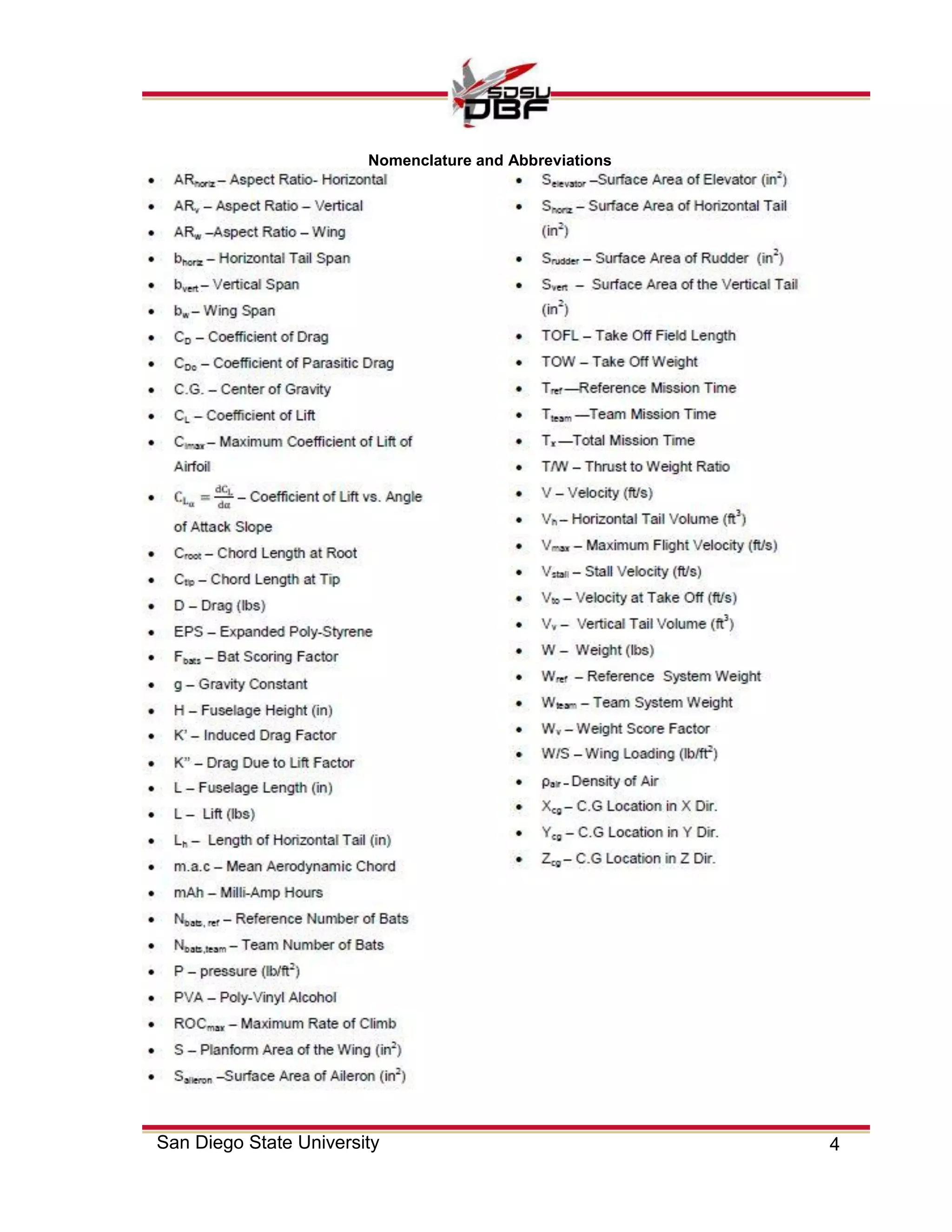
4San Diego State University
Nomenclature and Abbreviations
5San Diego State University
1.0 EXECUTIVE SUMMARY
The American Institute of Aeronautics and Astronautics (AIAA) through the applied
Aerodynamics, Aircraft Design, Design Engineering and Flight Test Technical Committees and the
AIAA Foundation invited students from universities around the world to the Cessna/Raytheon Missile
Systems Student Design Build Fly (DBF) competition. As an extra-curricular challenge, students from
San Diego State University entered the competition with an aircraft that met all general and mission
requirements. The design of the aircraft was analyzed and altered until optimal performance was
reached to ensure it would be competitive. During the conceptual design phase, scoring analysis
showed that in order to obtain the highest possible score the weight and wingspan must be
minimized, flight times must be reduced, and the optimal payload of four rockets for mission two must
be used. Therefore, the aircraft was designed to achieve optimal performance utilizing a bi-wing
configuration, strong propulsion system, internal payload bay capable of carrying four Estes rockets,
and external wing mounted pylons capable of handling all load cases as required by mission three.
The aircraft employs the use of two different airfoils (E210 and SD7032) to provide an ample
amount of lift in order to get off the ground in the 30' x 30' runway. Designed with an aspect ratio of
0.96 per wing, a high overall CL, and a low drag coefficient, the aircraft achieves optimal aerodynamic
efficiency. The conventional empennage, low drag pylons, and streamlined fuselage create a fast
and dynamically stable aircraft.
Material used consisted of both high density foam and carbon fiber ensuring a very lightweight,
strong, and reliable aircraft. The team took advantage of the numerous manufacturing capabilities
located on campus in constructing the aircraft. Airfoils were cut using a CNC hot wire foam cutter and
then strengthened using a carbon fiber layup. The fuselage was constructed using a bladder molding
process to ensure a rigid structure capable of handling required loadings.
Comprehensive finite element and fluid analysis in addition to extensive flight testing proved that
the aircraft not only met all mission specifications but also excelled in performance capabilities. The
pilot became highly familiar with the handling of the aircraft during rigorous the flight test schedule
which was used to analyze and verify the design changes and performance predictions. Unloaded,
the aircraft weighs 3.50lbs and has a wingspan of 38.75 inches. Countless hours of work from
disciplined and dedicated team members culminated to create a highly competitive, efficient, and
lightweight aircraft destined to take the top prize in this year’s competition.
6San Diego State University
2.0 MANAGEMENT SUMMARY
2.1 TEAM ORGANIZATION
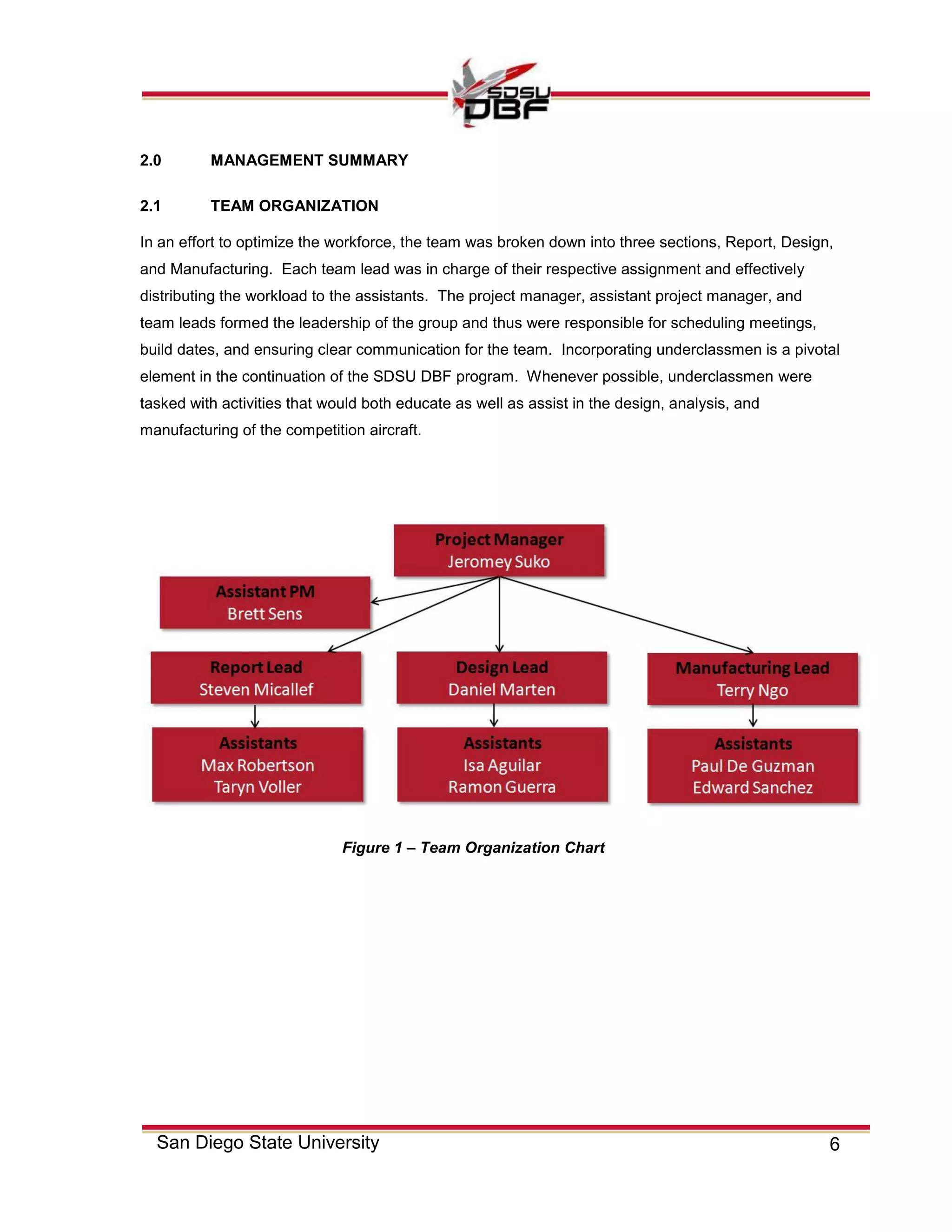
In an effort to optimize the workforce, the team was broken down into three sections, Report, Design,
and Manufacturing. Each team lead was in charge of their respective assignment and effectively
distributing the workload to the assistants. The project manager, assistant project manager, and
team leads formed the leadership of the group and thus were responsible for scheduling meetings,
build dates, and ensuring clear communication for the team. Incorporating underclassmen is a pivotal
element in the continuation of the SDSU DBF program. Whenever possible, underclassmen were
tasked with activities that would both educate as well as assist in the design, analysis, and
manufacturing of the competition aircraft.
Figure 1 – Team Organization Chart
7San Diego State University
2.2 WORKING PLAN
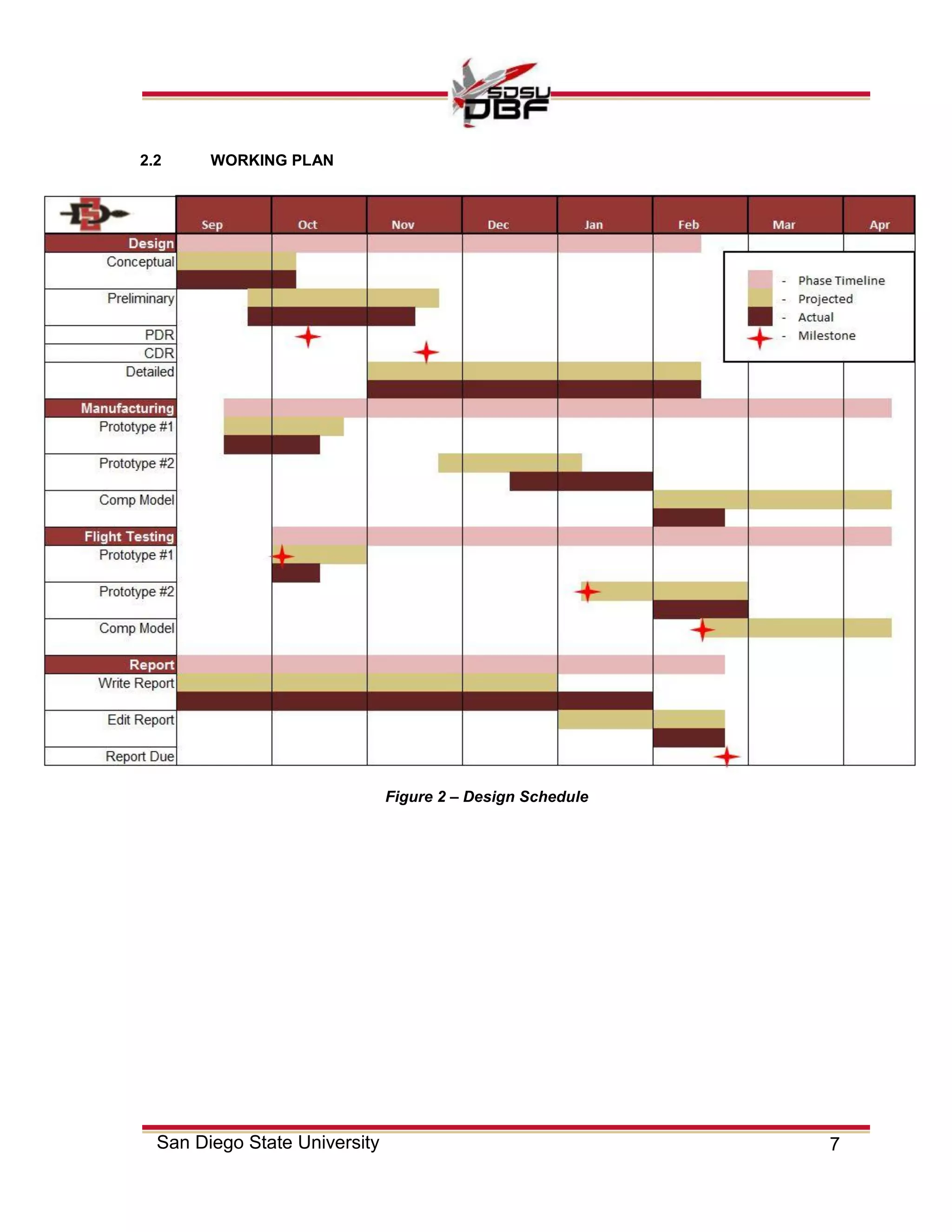
Figure 2 – Design Schedule
8San Diego State University
3.0 CONCEPTUAL DESIGN
The conceptual design phase of the project was driven by the rules and requirements of the
competition as well as past SDSU DBF experience. In order to produce the highest scoring aircraft, a
comprehensive set of design requirements was allocated to the competition rules constraints. A
Figure of Merit (FOM) analysis was then carried out so to guide the development of the aircraft using
the prior derived design requirements and constraints.
3.1 MISSION REQUIREMENTS
Each mission takes off from a simulated small austere field. The rules for the 2012-2013 AIAA DBF
competition specify for all missions:
o Ground rolling take-off and landing
o Takeoff from inside a 30x30 ft. square marked on the runway
o Complete a successful landing after each mission for a score
o Have a latching lid stores case able to be opened on one side only
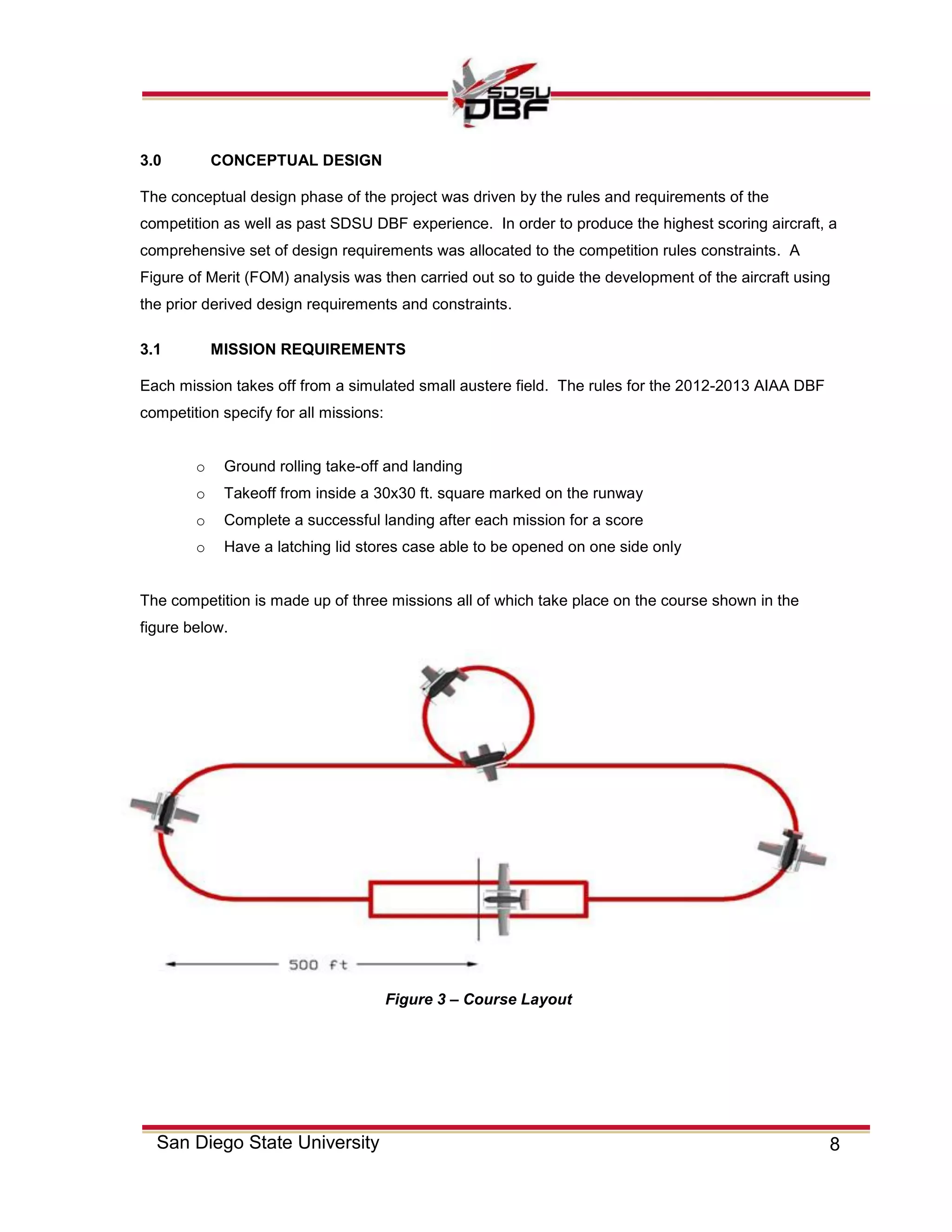
The competition is made up of three missions all of which take place on the course shown in the
figure below.
Figure 3 – Course Layout
9San Diego State University
3.1.1 Mission 1: Short Take-off
Mission 1 requires the aircraft to complete as many full laps as possible in four minutes without any
payload. Teams will only be credited for the full laps completed, meaning that a team cannot receive
points for completing a partial lap. The score for Mission 1 is given below:







max
1
#
#
2
Laps
Laps
M
Where, #Laps represents the number of laps our team completed and #Lapsmax represents the most
number of laps completed by any team in the competition.
3.1.2 Mission 2: Stealth Mission
Mission 2 requires the aircraft to complete three laps with an internal stores payload consisting of
Mini-Max model rockets ballasted to 4oz. The internal stores must be secured to a mounting rack
that is a permanent part of the structure. All stores must be aligned in the direction of flight and not
come in contact with anything other than the mounting rack on which they are secured. Scoring for
this mission is given below:
Where, #Rockets represents the number of rockets carried by our team and #Rocketsmax represents
the most rockets carried by any team in the competition.







max
2
#
#
4
Rockets
Rockets
M
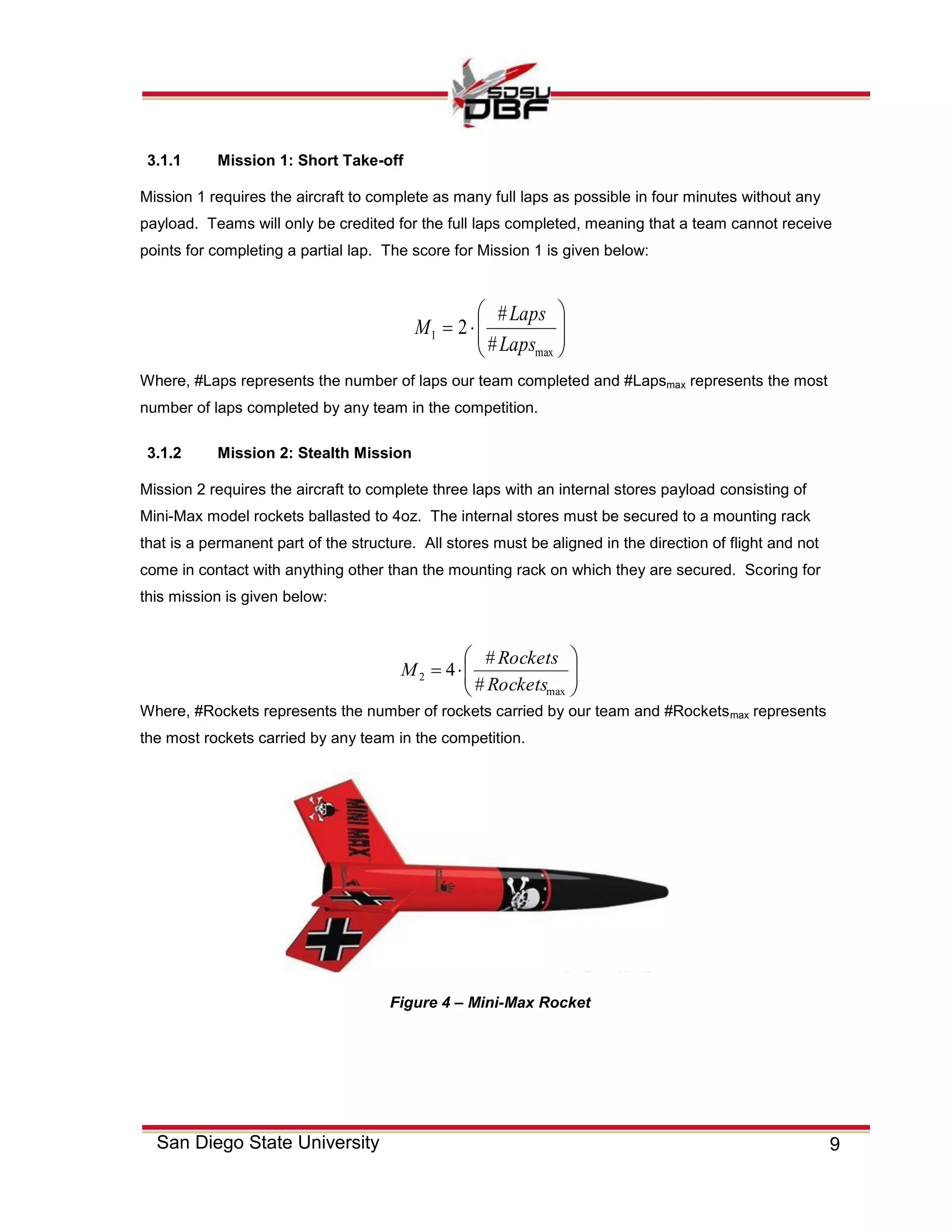
Figure 4 – Mini-Max Rocket
10San Diego State University
3.1.3 Mission 3: Strike Mission
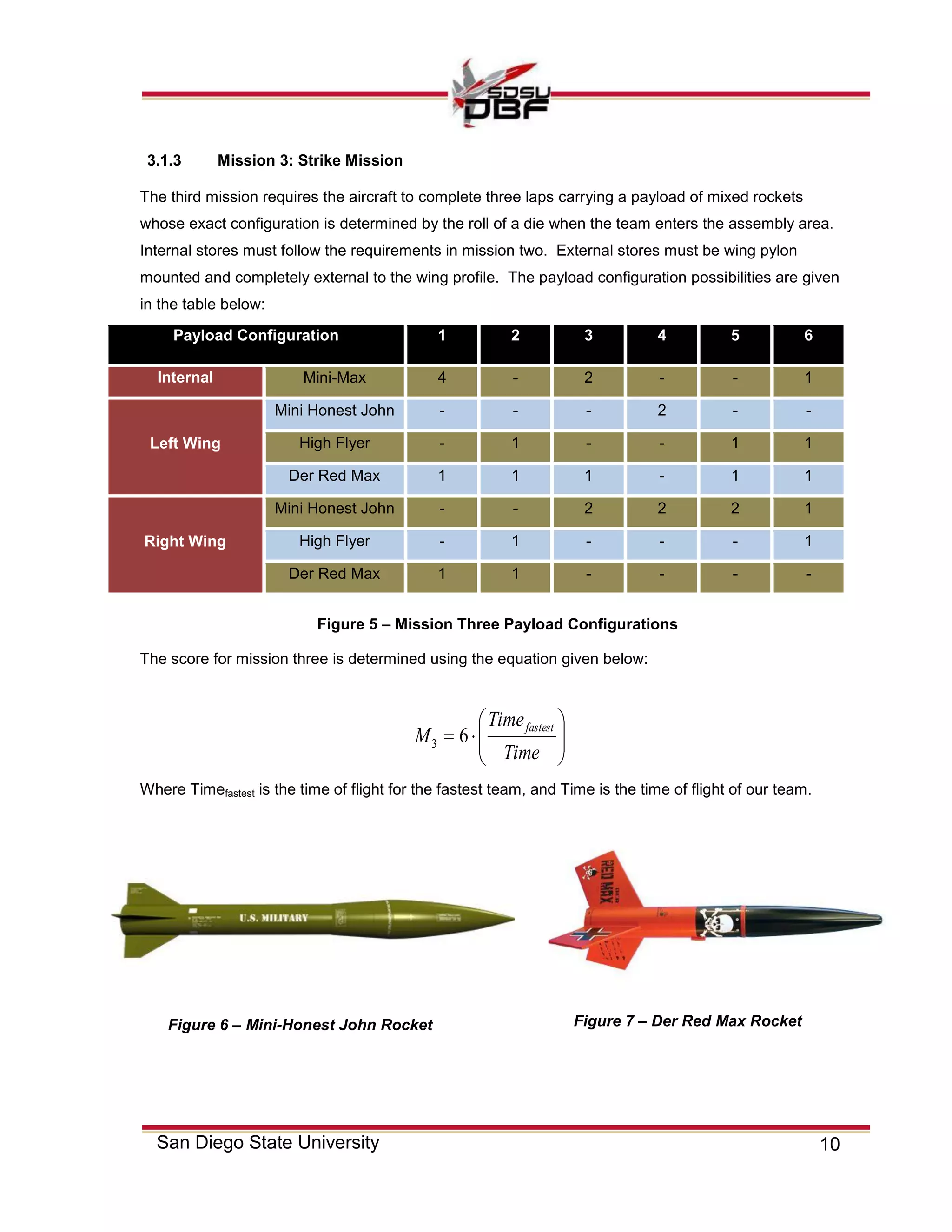
The third mission requires the aircraft to complete three laps carrying a payload of mixed rockets
whose exact configuration is determined by the roll of a die when the team enters the assembly area.
Internal stores must follow the requirements in mission two. External stores must be wing pylon
mounted and completely external to the wing profile. The payload configuration possibilities are given
in the table below:
Payload Configuration 1 2 3 4 5 6
Internal Mini-Max 4 - 2 - - 1
Left Wing
Mini Honest John - - - 2 - -
High Flyer - 1 - - 1 1
Der Red Max 1 1 1 - 1 1
Right Wing
Mini Honest John - - 2 2 2 1
High Flyer - 1 - - - 1
Der Red Max 1 1 - - - -
The score for mission three is determined using the equation given below:







Time
Time
M
fastest
63
Where Timefastest is the time of flight for the fastest team, and Time is the time of flight of our team.
Figure 6 – Mini-Honest John Rocket Figure 7 – Der Red Max Rocket
Figure 5 – Mission Three Payload Configurations
11San Diego State University
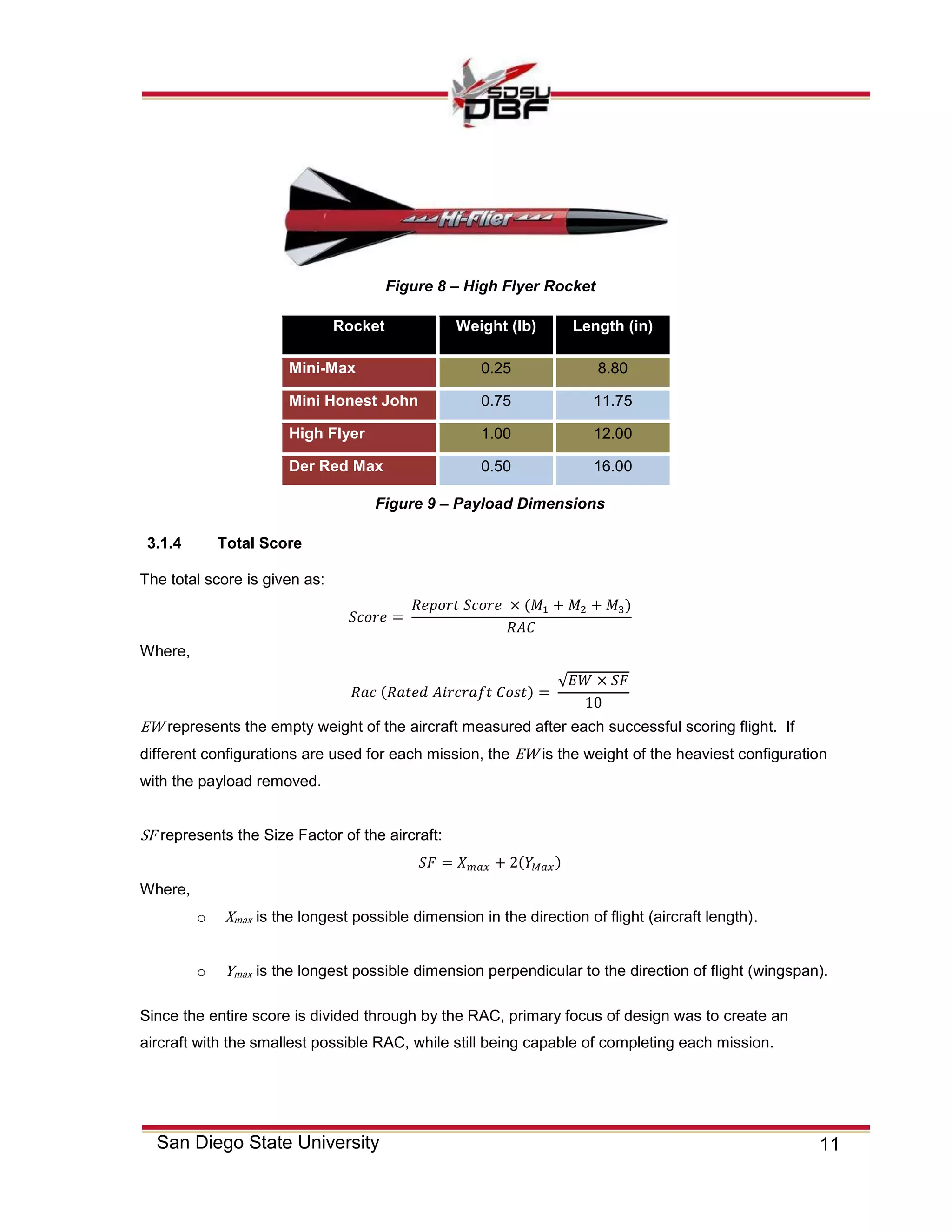
Rocket Weight (lb) Length (in)
Mini-Max 0.25 8.80
Mini Honest John 0.75 11.75
High Flyer 1.00 12.00
Der Red Max 0.50 16.00
3.1.4 Total Score
The total score is given as:
Where,
√
EW represents the empty weight of the aircraft measured after each successful scoring flight. If
different configurations are used for each mission, the EW is the weight of the heaviest configuration
with the payload removed.
SF represents the Size Factor of the aircraft:
Where,
o Xmax is the longest possible dimension in the direction of flight (aircraft length).
o Ymax is the longest possible dimension perpendicular to the direction of flight (wingspan).
Since the entire score is divided through by the RAC, primary focus of design was to create an
aircraft with the smallest possible RAC, while still being capable of completing each mission.
Figure 8 – High Flyer Rocket
Figure 9 – Payload Dimensions
12San Diego State University
3.2 TRANSLATING MISSION REQUIREMENTS INTO DESIGN REQUIREMENTS
The mission requirements of this competition demand an aircraft to be designed for speed, versatility,
and the ability to takeoff in a short distance.
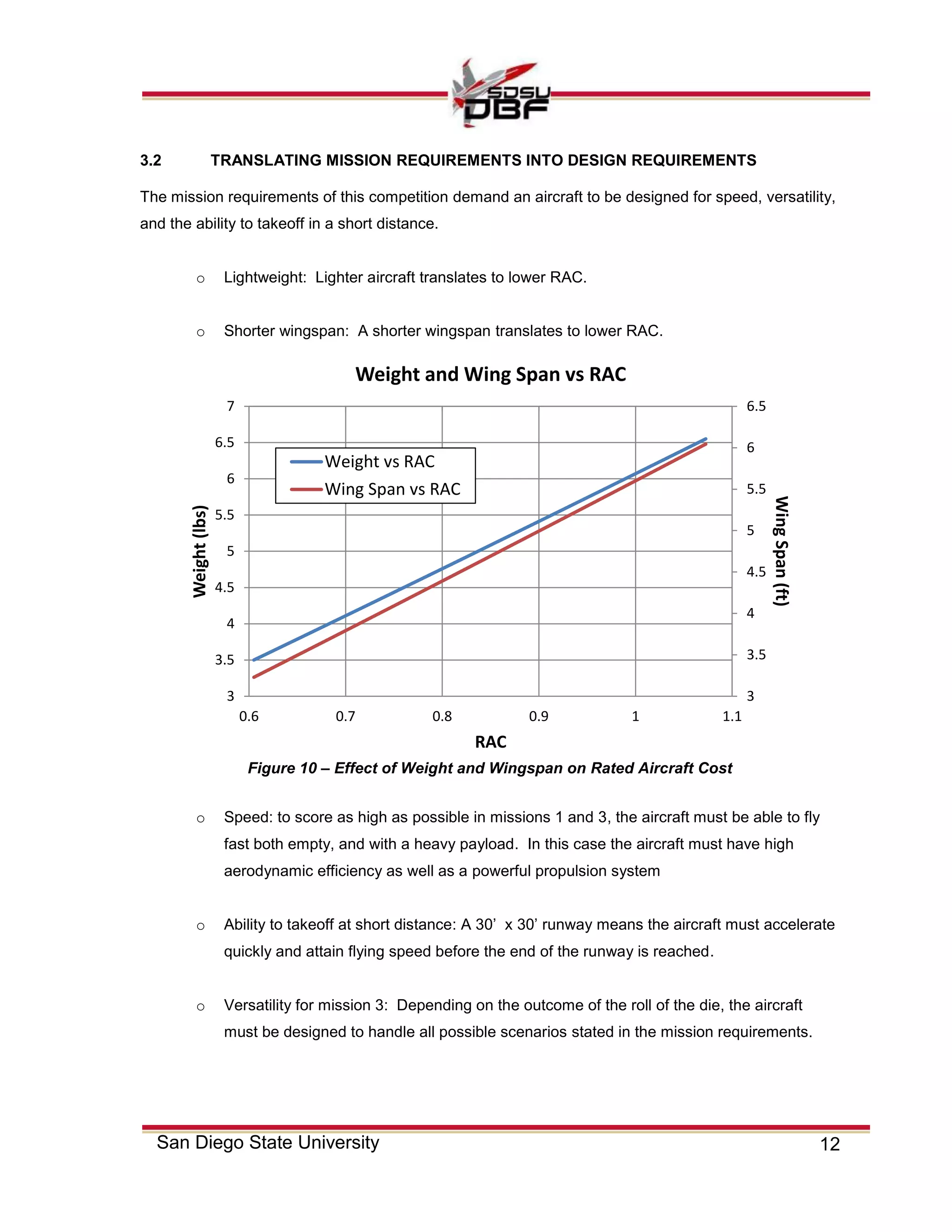
o Lightweight: Lighter aircraft translates to lower RAC.
o Shorter wingspan: A shorter wingspan translates to lower RAC.
o Speed: to score as high as possible in missions 1 and 3, the aircraft must be able to fly
fast both empty, and with a heavy payload. In this case the aircraft must have high
aerodynamic efficiency as well as a powerful propulsion system
o Ability to takeoff at short distance: A 30’ x 30’ runway means the aircraft must accelerate
quickly and attain flying speed before the end of the runway is reached.
o Versatility for mission 3: Depending on the outcome of the roll of the die, the aircraft
must be designed to handle all possible scenarios stated in the mission requirements.
3
3.5
4
4.5
5
5.5
6
6.5
3
3.5
4
4.5
5
5.5
6
6.5
7
0.6 0.7 0.8 0.9 1 1.1
WingSpan(ft)
Weight(lbs)
RAC
Weight and Wing Span vs RAC
Weight vs RAC
Wing Span vs RAC
Figure 10 – Effect of Weight and Wingspan on Rated Aircraft Cost
13San Diego State University
o Easy manufacturing so it can be repaired during the competition if need be. In the event
of failure of any component of the plane, it must be able to be fixed in no more than 12
hours so as to carry on with the competition
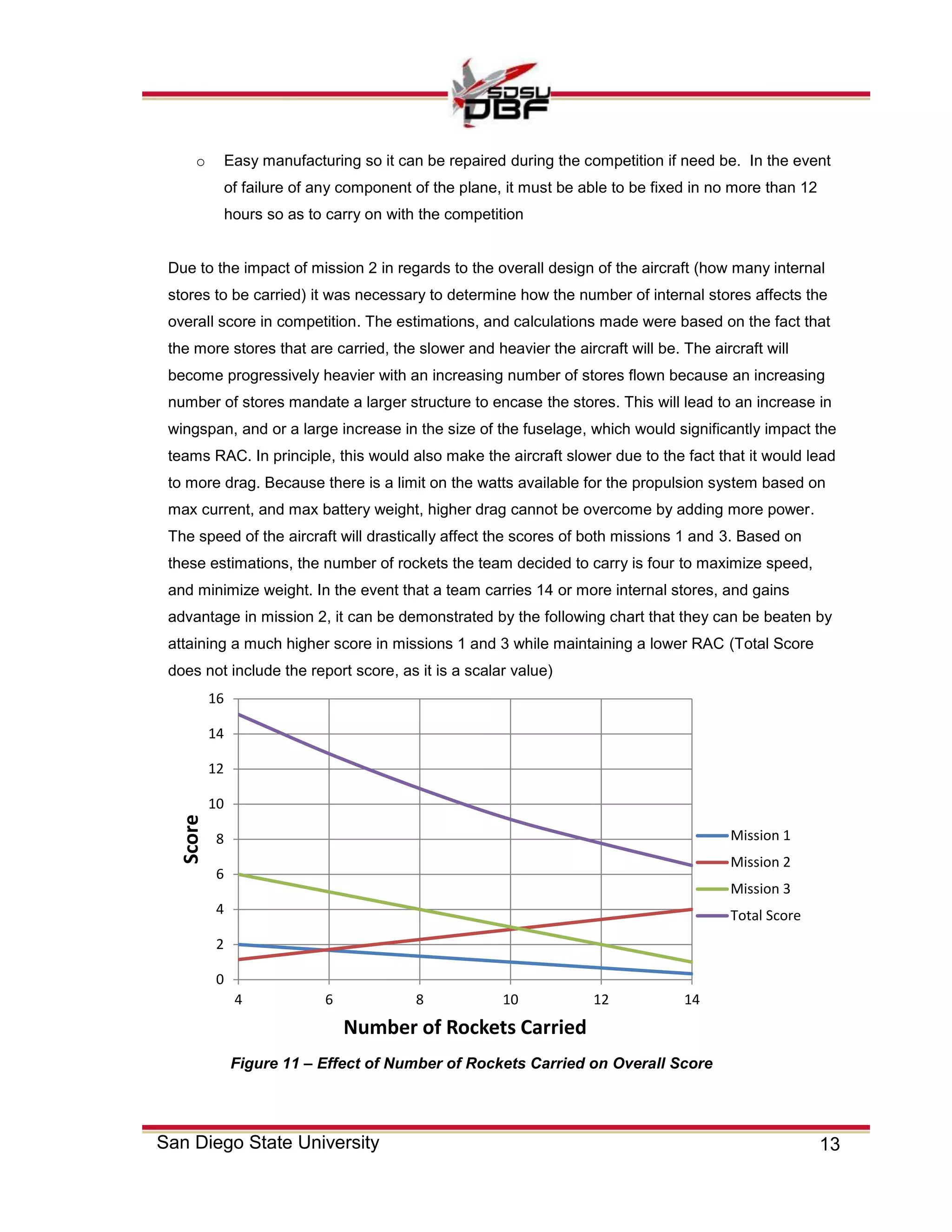
Due to the impact of mission 2 in regards to the overall design of the aircraft (how many internal
stores to be carried) it was necessary to determine how the number of internal stores affects the
overall score in competition. The estimations, and calculations made were based on the fact that
the more stores that are carried, the slower and heavier the aircraft will be. The aircraft will
become progressively heavier with an increasing number of stores flown because an increasing
number of stores mandate a larger structure to encase the stores. This will lead to an increase in
wingspan, and or a large increase in the size of the fuselage, which would significantly impact the
teams RAC. In principle, this would also make the aircraft slower due to the fact that it would lead
to more drag. Because there is a limit on the watts available for the propulsion system based on
max current, and max battery weight, higher drag cannot be overcome by adding more power.
The speed of the aircraft will drastically affect the scores of both missions 1 and 3. Based on
these estimations, the number of rockets the team decided to carry is four to maximize speed,
and minimize weight. In the event that a team carries 14 or more internal stores, and gains
advantage in mission 2, it can be demonstrated by the following chart that they can be beaten by
attaining a much higher score in missions 1 and 3 while maintaining a lower RAC (Total Score
does not include the report score, as it is a scalar value)
0
2
4
6
8
10
12
14
16
4 6 8 10 12 14
Score
Number of Rockets Carried
Mission 1
Mission 2
Mission 3
Total Score
Figure 11 – Effect of Number of Rockets Carried on Overall Score
14San Diego State University
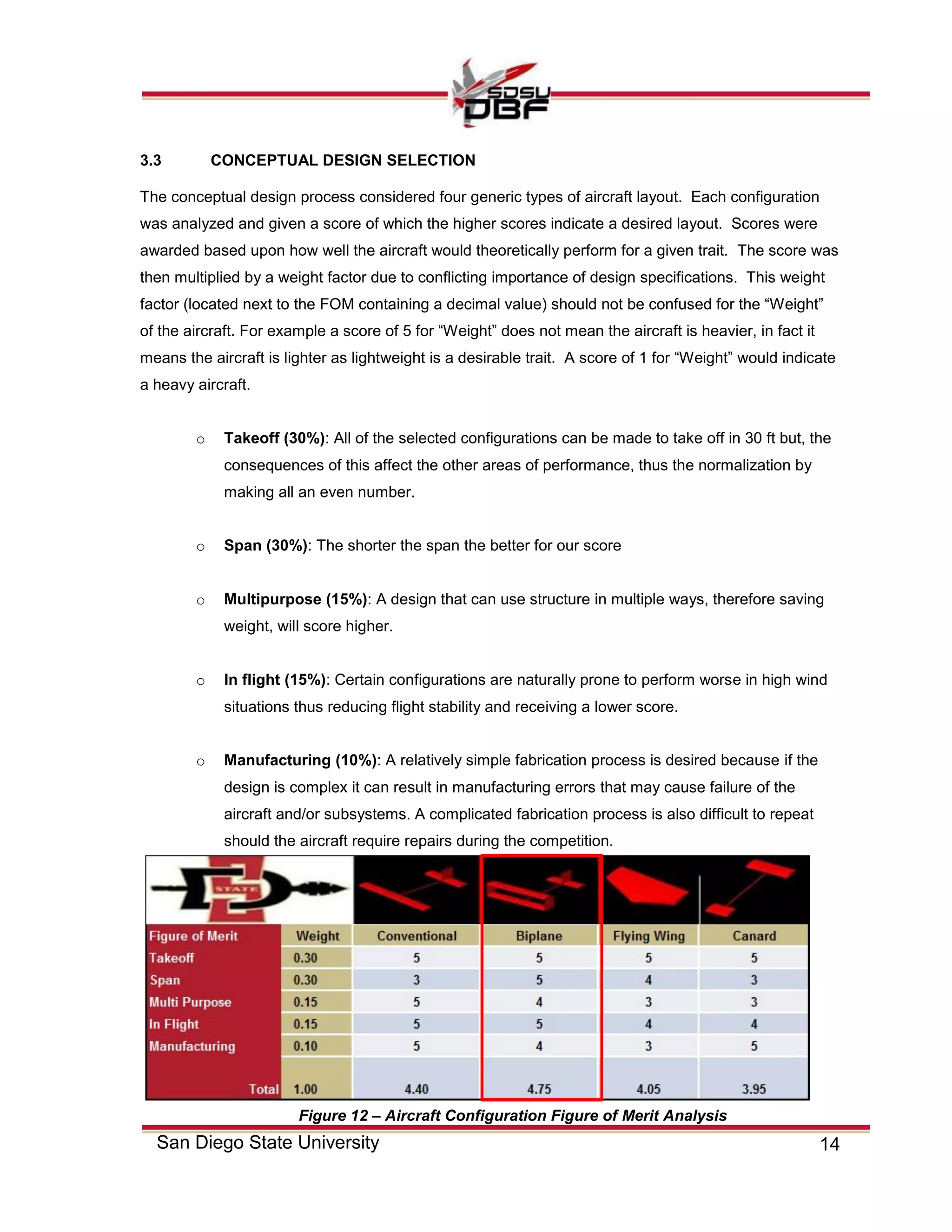
3.3 CONCEPTUAL DESIGN SELECTION
The conceptual design process considered four generic types of aircraft layout. Each configuration
was analyzed and given a score of which the higher scores indicate a desired layout. Scores were
awarded based upon how well the aircraft would theoretically perform for a given trait. The score was
then multiplied by a weight factor due to conflicting importance of design specifications. This weight
factor (located next to the FOM containing a decimal value) should not be confused for the “Weight”
of the aircraft. For example a score of 5 for “Weight” does not mean the aircraft is heavier, in fact it
means the aircraft is lighter as lightweight is a desirable trait. A score of 1 for “Weight” would indicate
a heavy aircraft.
o Takeoff (30%): All of the selected configurations can be made to take off in 30 ft but, the
consequences of this affect the other areas of performance, thus the normalization by
making all an even number.
o Span (30%): The shorter the span the better for our score
o Multipurpose (15%): A design that can use structure in multiple ways, therefore saving
weight, will score higher.
o In flight (15%): Certain configurations are naturally prone to perform worse in high wind
situations thus reducing flight stability and receiving a lower score.
o Manufacturing (10%): A relatively simple fabrication process is desired because if the
design is complex it can result in manufacturing errors that may cause failure of the
aircraft and/or subsystems. A complicated fabrication process is also difficult to repeat
should the aircraft require repairs during the competition.
Figure 12 – Aircraft Configuration Figure of Merit Analysis
15San Diego State University
3.4 COMPONENT LAYOUT SECTION
The component layout selection process analyzed various elements of an aircraft in order to
determine the overall conceptual design. Each element configuration of the aircraft was considered
and given a score for certain traits as described in section 3.3.
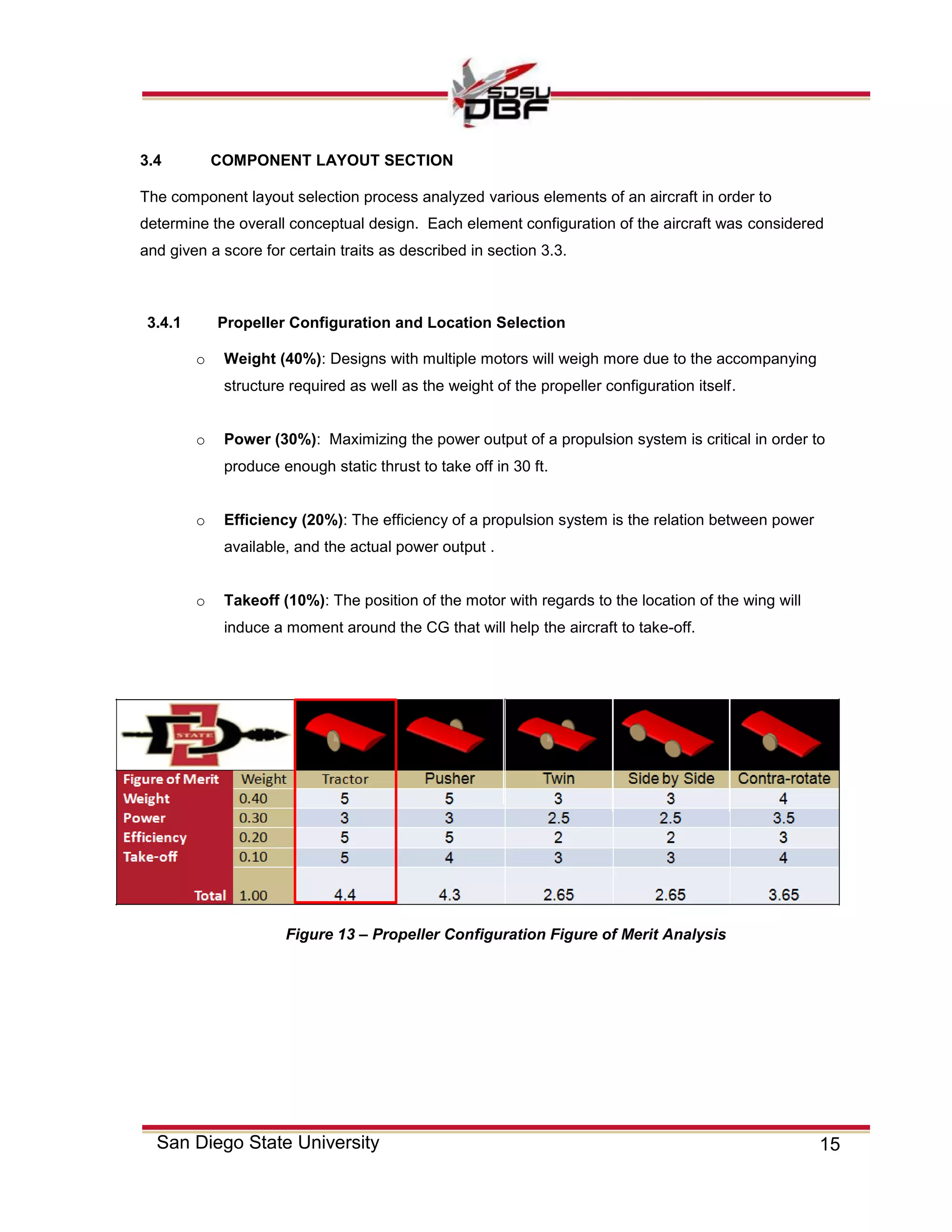
3.4.1 Propeller Configuration and Location Selection
o Weight (40%): Designs with multiple motors will weigh more due to the accompanying
structure required as well as the weight of the propeller configuration itself.
o Power (30%): Maximizing the power output of a propulsion system is critical in order to
produce enough static thrust to take off in 30 ft.
o Efficiency (20%): The efficiency of a propulsion system is the relation between power
available, and the actual power output .
o Takeoff (10%): The position of the motor with regards to the location of the wing will
induce a moment around the CG that will help the aircraft to take-off.
Figure 13 – Propeller Configuration Figure of Merit Analysis
16San Diego State University
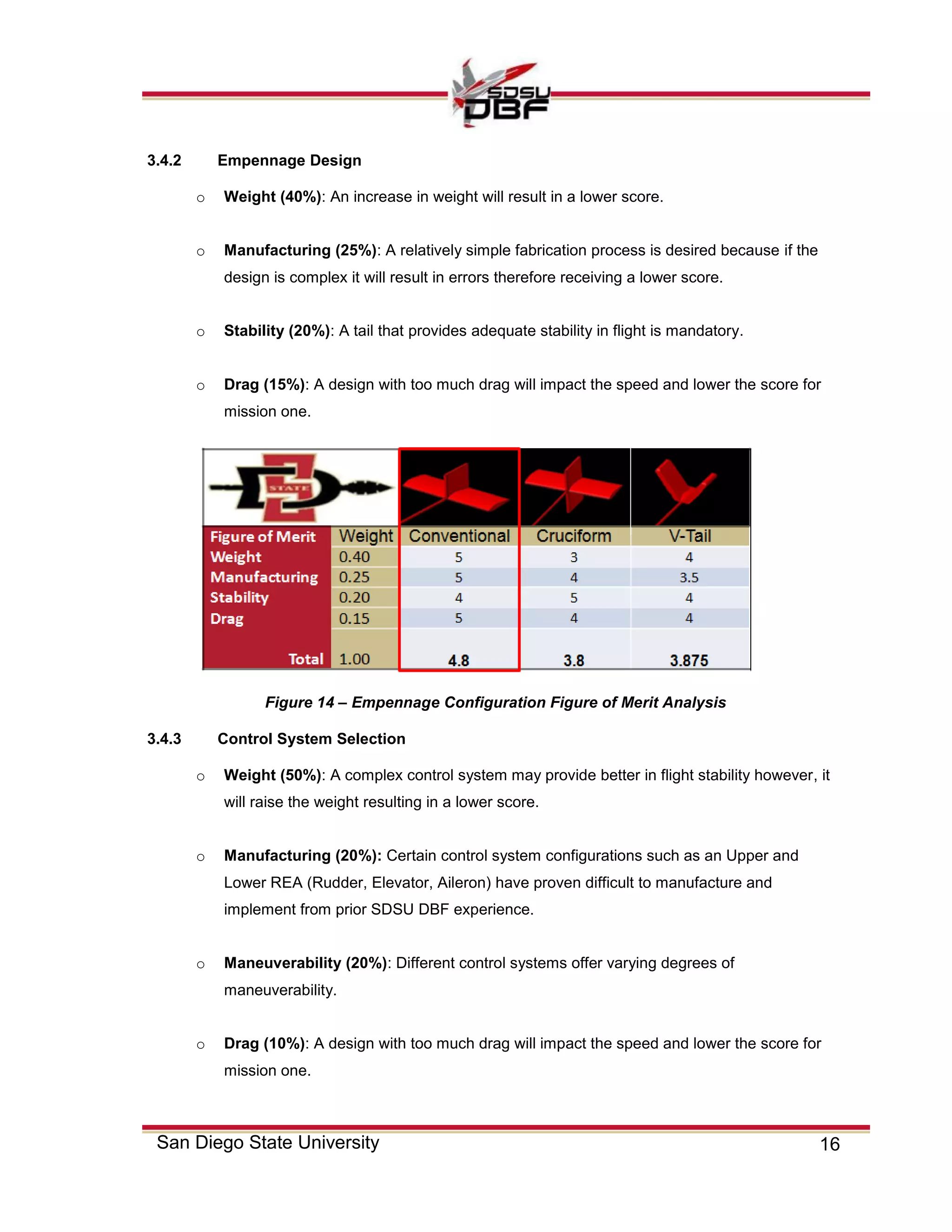
3.4.2 Empennage Design
o Weight (40%): An increase in weight will result in a lower score.
o Manufacturing (25%): A relatively simple fabrication process is desired because if the
design is complex it will result in errors therefore receiving a lower score.
o Stability (20%): A tail that provides adequate stability in flight is mandatory.
o Drag (15%): A design with too much drag will impact the speed and lower the score for
mission one.
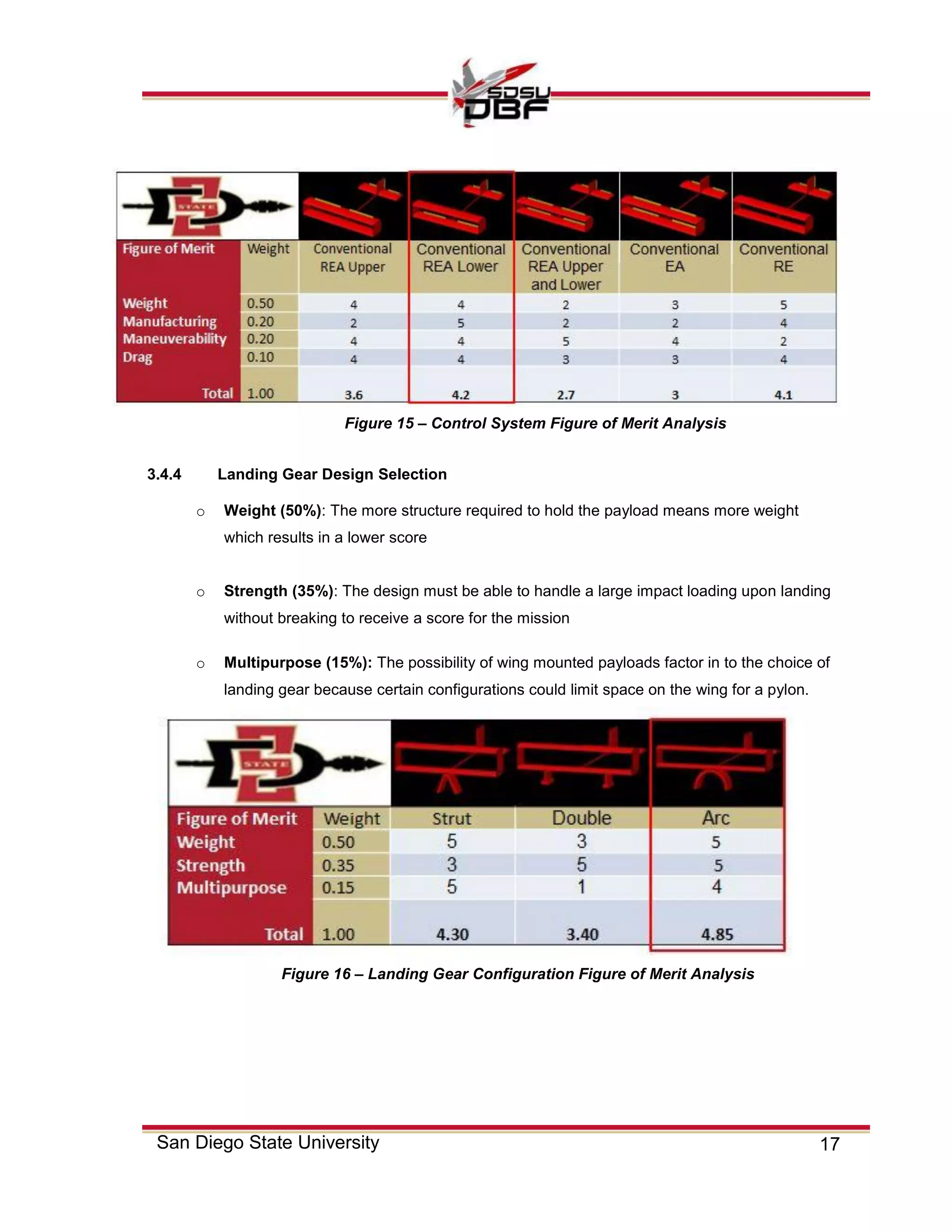
3.4.3 Control System Selection
o Weight (50%): A complex control system may provide better in flight stability however, it
will raise the weight resulting in a lower score.
o Manufacturing (20%): Certain control system configurations such as an Upper and
Lower REA (Rudder, Elevator, Aileron) have proven difficult to manufacture and
implement from prior SDSU DBF experience.
o Maneuverability (20%): Different control systems offer varying degrees of
maneuverability.
o Drag (10%): A design with too much drag will impact the speed and lower the score for
mission one.
Figure 14 – Empennage Configuration Figure of Merit Analysis
17San Diego State University
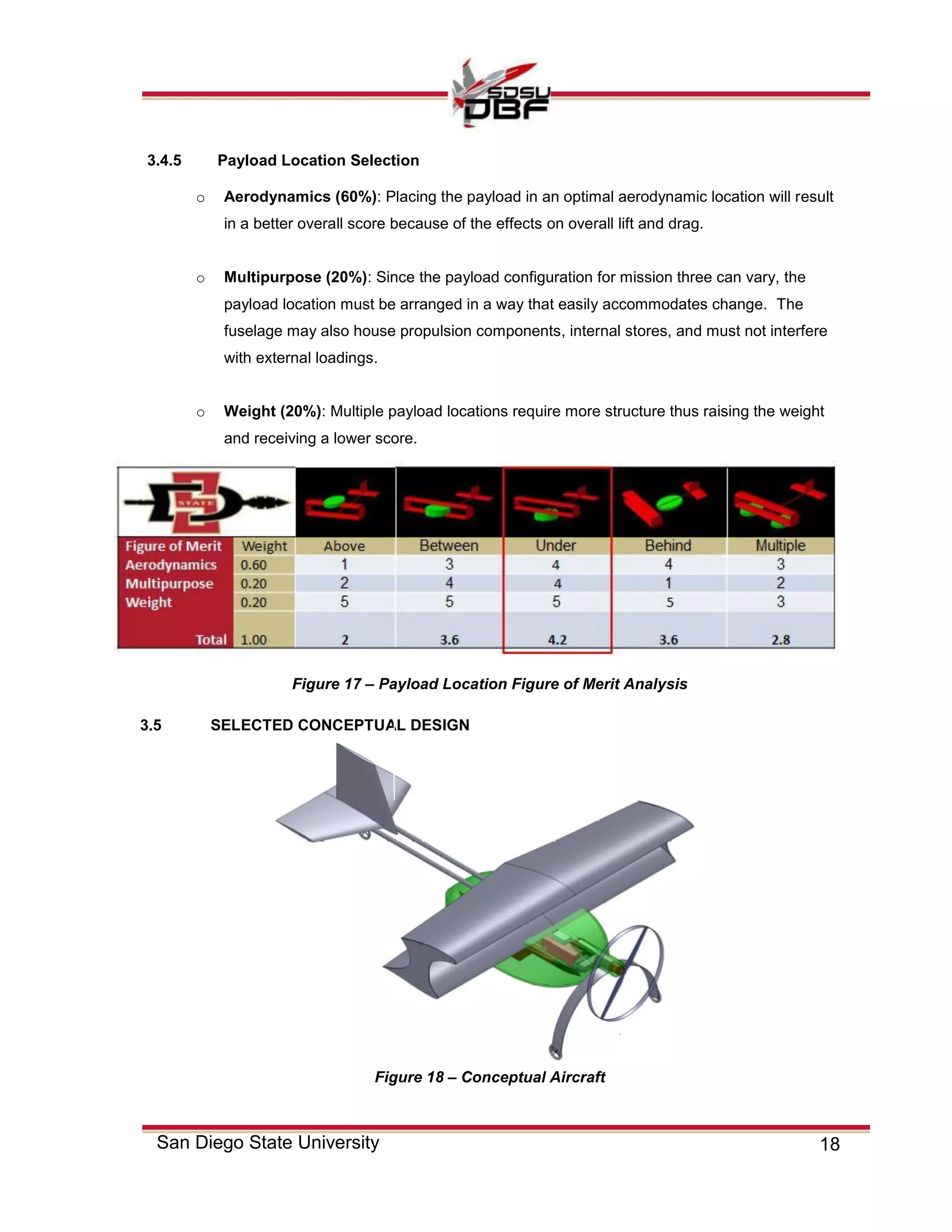
3.4.4 Landing Gear Design Selection
o Weight (50%): The more structure required to hold the payload means more weight
which results in a lower score
o Strength (35%): The design must be able to handle a large impact loading upon landing
without breaking to receive a score for the mission
o Multipurpose (15%): The possibility of wing mounted payloads factor in to the choice of
landing gear because certain configurations could limit space on the wing for a pylon.
Figure 15 – Control System Figure of Merit Analysis
Figure 16 – Landing Gear Configuration Figure of Merit Analysis
18San Diego State University
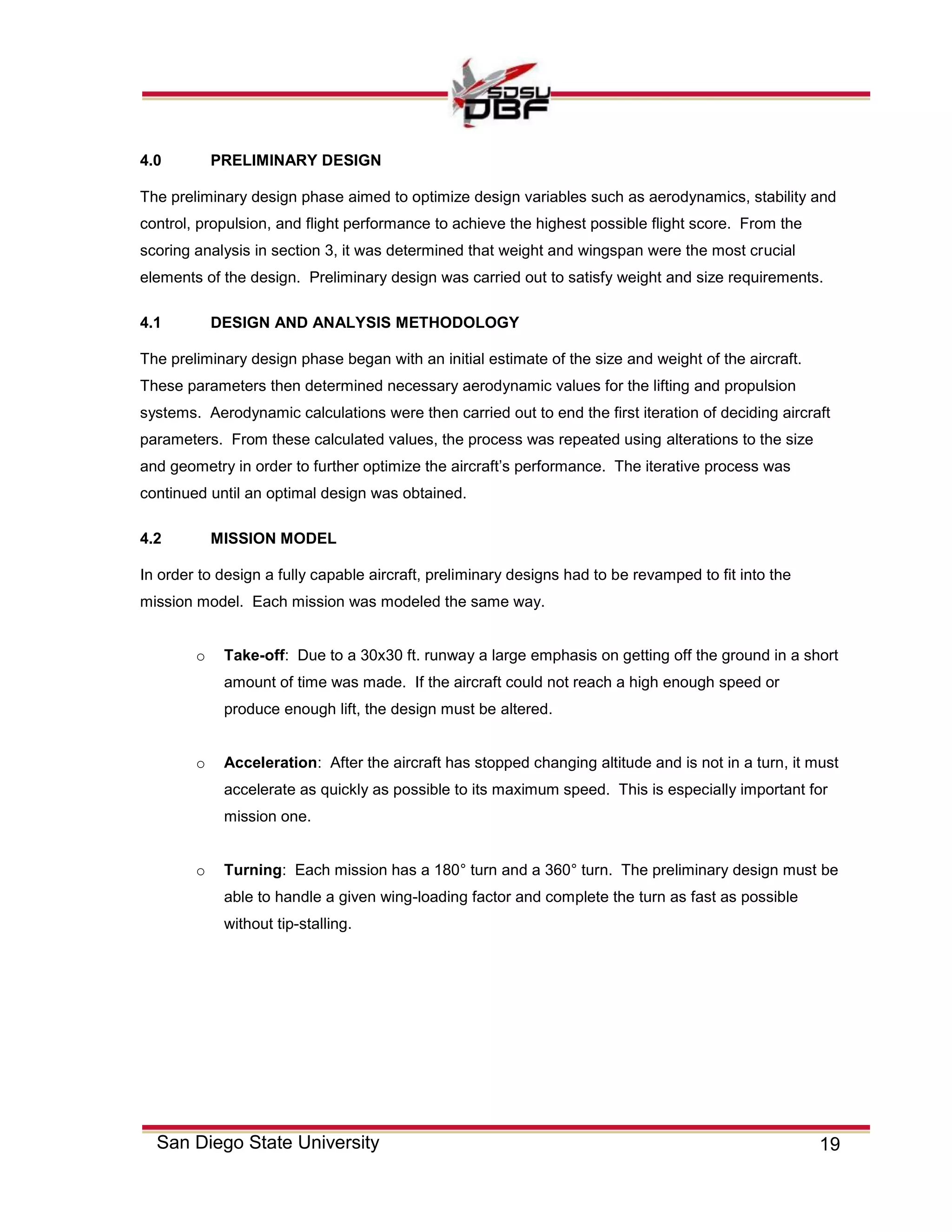
3.4.5 Payload Location Selection
o Aerodynamics (60%): Placing the payload in an optimal aerodynamic location will result
in a better overall score because of the effects on overall lift and drag.
o Multipurpose (20%): Since the payload configuration for mission three can vary, the
payload location must be arranged in a way that easily accommodates change. The
fuselage may also house propulsion components, internal stores, and must not interfere
with external loadings.
o Weight (20%): Multiple payload locations require more structure thus raising the weight
and receiving a lower score.
3.5 SELECTED CONCEPTUAL DESIGN
Figure 17 – Payload Location Figure of Merit Analysis
Figure 18 – Conceptual Aircraft
19San Diego State University
4.0 PRELIMINARY DESIGN
The preliminary design phase aimed to optimize design variables such as aerodynamics, stability and
control, propulsion, and flight performance to achieve the highest possible flight score. From the
scoring analysis in section 3, it was determined that weight and wingspan were the most crucial
elements of the design. Preliminary design was carried out to satisfy weight and size requirements.
4.1 DESIGN AND ANALYSIS METHODOLOGY
The preliminary design phase began with an initial estimate of the size and weight of the aircraft.
These parameters then determined necessary aerodynamic values for the lifting and propulsion
systems. Aerodynamic calculations were then carried out to end the first iteration of deciding aircraft
parameters. From these calculated values, the process was repeated using alterations to the size
and geometry in order to further optimize the aircraft’s performance. The iterative process was
continued until an optimal design was obtained.
4.2 MISSION MODEL
In order to design a fully capable aircraft, preliminary designs had to be revamped to fit into the
mission model. Each mission was modeled the same way.
o Take-off: Due to a 30x30 ft. runway a large emphasis on getting off the ground in a short
amount of time was made. If the aircraft could not reach a high enough speed or
produce enough lift, the design must be altered.
o Acceleration: After the aircraft has stopped changing altitude and is not in a turn, it must
accelerate as quickly as possible to its maximum speed. This is especially important for
mission one.
o Turning: Each mission has a 180° turn and a 360° turn. The preliminary design must be
able to handle a given wing-loading factor and complete the turn as fast as possible
without tip-stalling.
20San Diego State University
4.3 INITIAL SIZING
To obtain the highest score possible, the aircraft should be able to carry four rockets. Fewer rockets
allow a lighter fuselage and higher speed. The fuselage of the aircraft was then tailored to
accommodate the least amount of rockets. Reducing the wingspan was also important in the initial
sizing process. Using a biplane configuration, sizing efforts were made in order to optimize the
lift/span ratio.
4.4 AERODYNAMICS
The aerodynamics group is responsible for airfoil selection, sizing, and configuration given the
constraints of weight, size, and power. The design of the airfoil began by selecting an airfoil,
performing aerodynamic simulations, and then altering both the size and configuration. Using
6
XFOIL
and
6
XFLR-5, the group was able to narrow down the list of useable airfoils.
4.4.1 Airfoil Selection
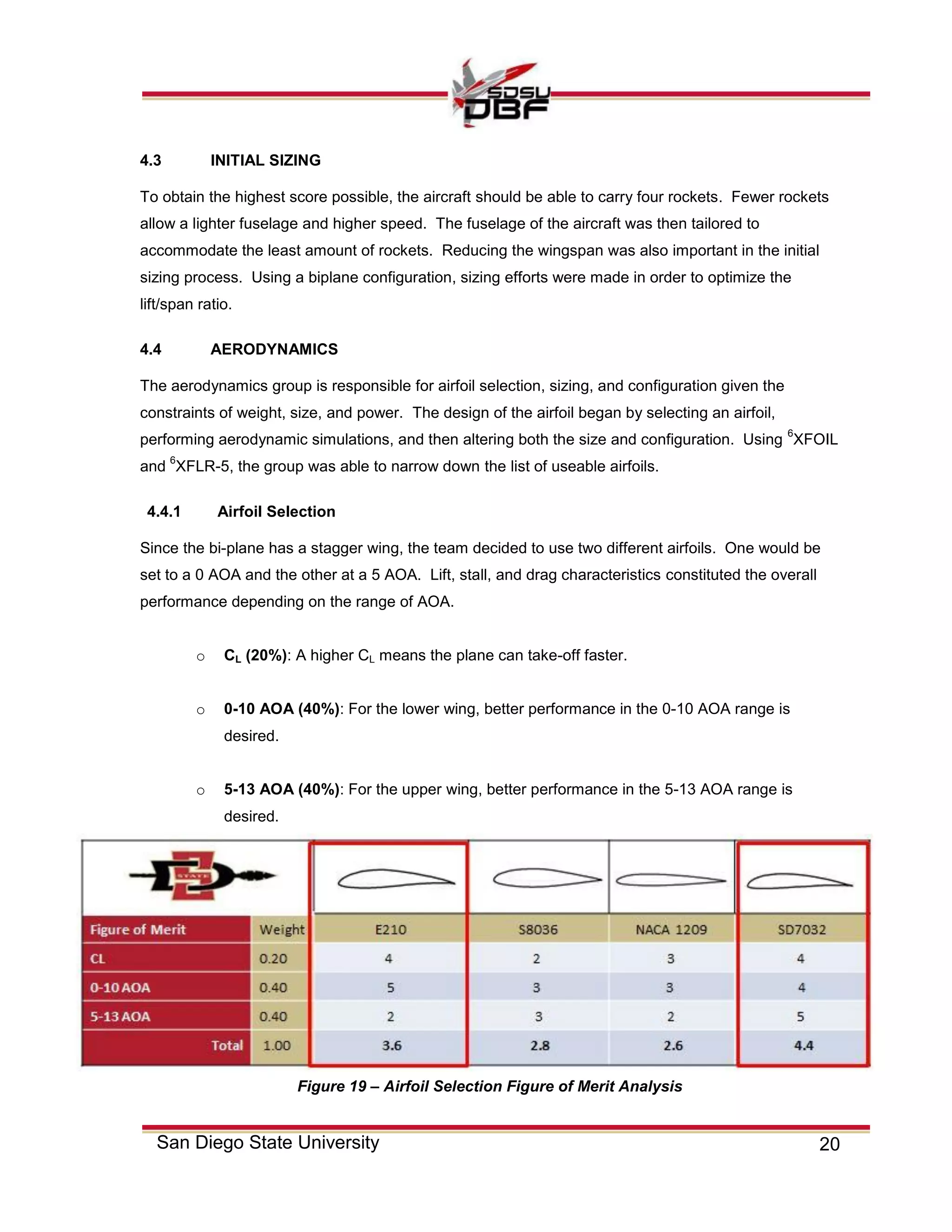
Since the bi-plane has a stagger wing, the team decided to use two different airfoils. One would be
set to a 0 AOA and the other at a 5 AOA. Lift, stall, and drag characteristics constituted the overall
performance depending on the range of AOA.
o CL (20%): A higher CL means the plane can take-off faster.
o 0-10 AOA (40%): For the lower wing, better performance in the 0-10 AOA range is
desired.
o 5-13 AOA (40%): For the upper wing, better performance in the 5-13 AOA range is
desired.
Figure 19 – Airfoil Selection Figure of Merit Analysis
21San Diego State University
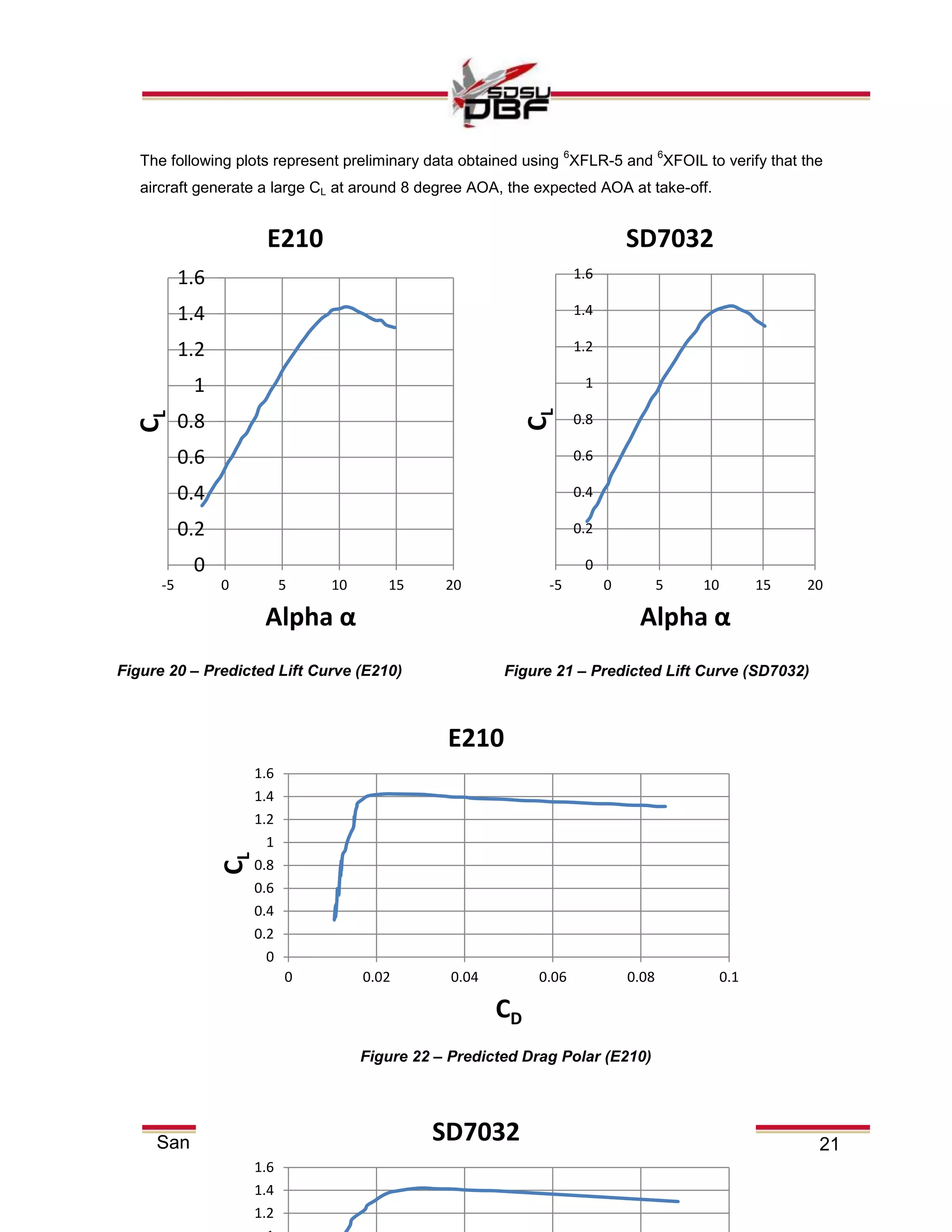
The following plots represent preliminary data obtained using
6
XFLR-5 and
6
XFOIL to verify that the
aircraft generate a large CL at around 8 degree AOA, the expected AOA at take-off.
Figure 22 – Predicted Drag Polar (E210)
0
0.2
0.4
0.6
0.8
1
1.2
1.4
1.6
-5 0 5 10 15 20
CL
Alpha α
E210
0
0.2
0.4
0.6
0.8
1
1.2
1.4
1.6
0 0.02 0.04 0.06 0.08 0.1
CL
CD
E210
0
0.2
0.4
0.6
0.8
1
1.2
1.4
1.6
-5 0 5 10 15 20
CL
Alpha α
SD7032
1.2
1.4
1.6
SD7032
Figure 20 – Predicted Lift Curve (E210) Figure 21 – Predicted Lift Curve (SD7032)
22San Diego State University
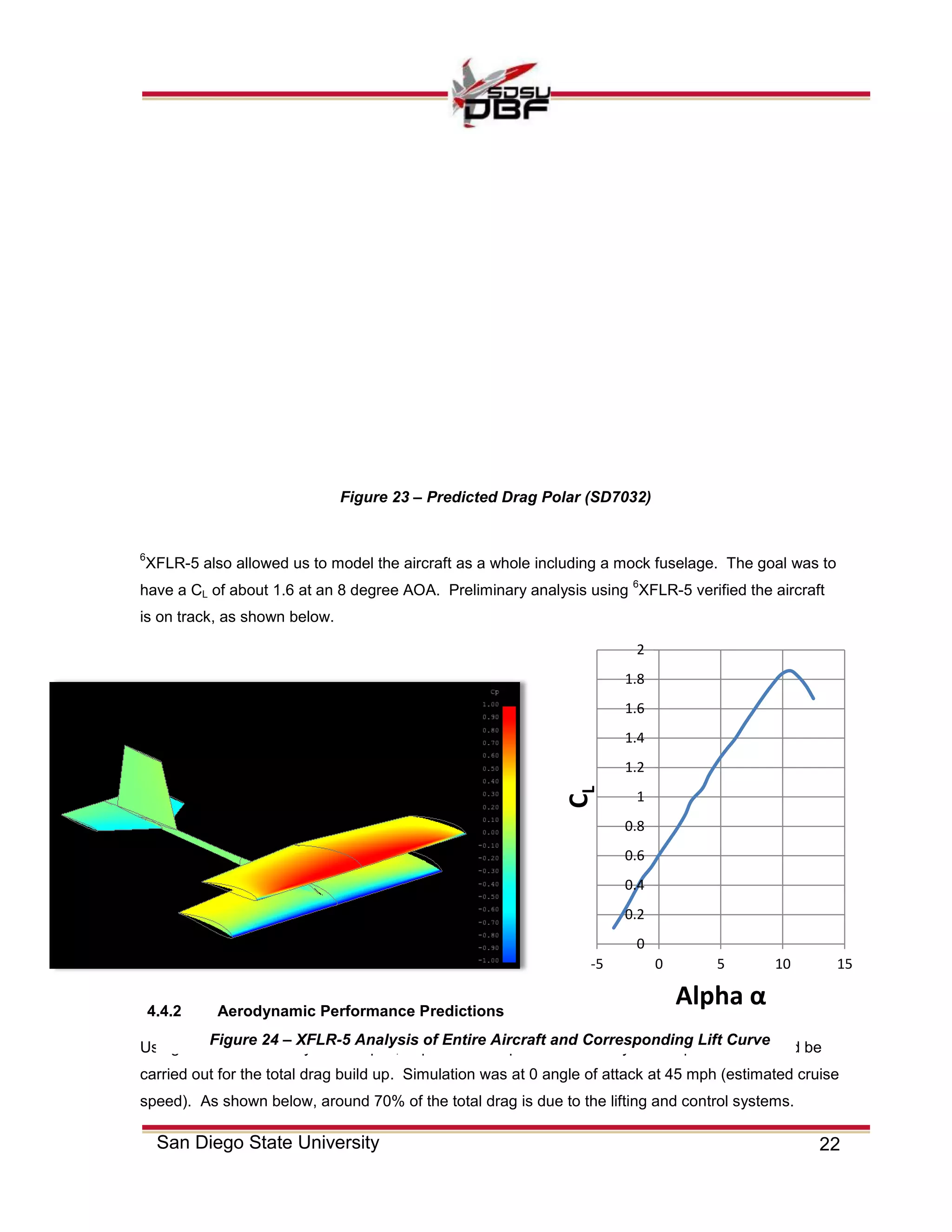
6
XFLR-5 also allowed us to model the aircraft as a whole including a mock fuselage. The goal was to
have a CL of about 1.6 at an 8 degree AOA. Preliminary analysis using
6
XFLR-5 verified the aircraft
is on track, as shown below.
4.4.2 Aerodynamic Performance Predictions
Using
15
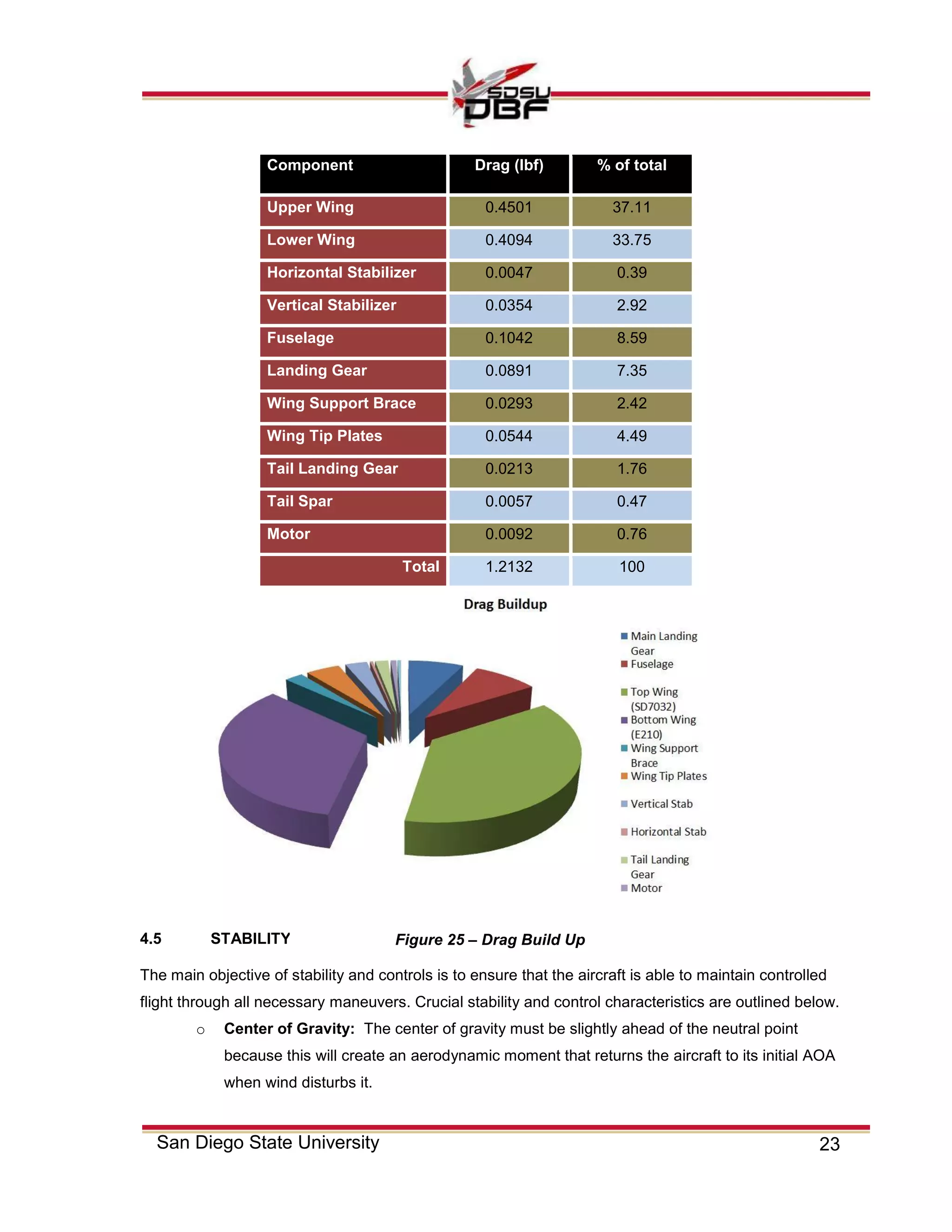
STAR-CCM + by CD Adapco, to perform computational fluid dynamics predictions could be
carried out for the total drag build up. Simulation was at 0 angle of attack at 45 mph (estimated cruise
speed). As shown below, around 70% of the total drag is due to the lifting and control systems.
0
0.2
0.4
0.6
0.8
1
1.2
1.4
1.6
1.8
2
-5 0 5 10 15
CL
Alpha α
Figure 23 – Predicted Drag Polar (SD7032)
Figure 24 – XFLR-5 Analysis of Entire Aircraft and Corresponding Lift Curve
23San Diego State University
Component Drag (lbf) % of total
Upper Wing 0.4501 37.11
Lower Wing 0.4094 33.75
Horizontal Stabilizer 0.0047 0.39
Vertical Stabilizer 0.0354 2.92
Fuselage 0.1042 8.59
Landing Gear 0.0891 7.35
Wing Support Brace 0.0293 2.42
Wing Tip Plates 0.0544 4.49
Tail Landing Gear 0.0213 1.76
Tail Spar 0.0057 0.47
Motor 0.0092 0.76
Total 1.2132 100
4.5 STABILITY AND CONTROL
The main objective of stability and controls is to ensure that the aircraft is able to maintain controlled
flight through all necessary maneuvers. Crucial stability and control characteristics are outlined below.
o Center of Gravity: The center of gravity must be slightly ahead of the neutral point
because this will create an aerodynamic moment that returns the aircraft to its initial AOA
when wind disturbs it.
Figure 25 – Drag Build Up
24San Diego State University
o Static Margin: A large static margin will be overly stable but less responsive to pilot
inputs while a small static margin is less stable but more responsive to pilot inputs. With
the average static margin of stability being between 5%-15%, it was determined that the
team would design the aircraft with a 10% static margin of stability in order to strike a
balance between maneuverability and stability.
o Aircraft Analysis: The weights of each component treated as a point loads distributed
through various locations in the aircraft dictate the static margin of 10%. With a wing
loading of 10.57 oz per ft
2
the total stability and responsiveness of our airplane was found
to be 0.78 rad
-1
. This small number determines how fast the plane responds to a control
surface change or a wind perturbation.
4.5.1 Ailerons
Initially, both the upper and lower wing had ailerons but, there were negative aspects associated with
having four ailerons that were determined to be unsuitable for the design. The primary concern was
that there was a large increase in drag for a less than desirable increase maneuverability. After flight
testing it was confirmed that a larger, single set of larger ailerons on the bottom wing was more
efficient in terms of weight, maneuverability, and drag than two sets of ailerons. This allowed for a
simplified control system as well as a reduction in weight. According to
10
Aircraft Design by Daniel p.
Raymer, ailerons should be sized for 20% of the chord and 40% of the span of the wing. The selected
sizing of the single aileron set was 23% of the chord and 61% of the span. Differences may lie in the
fact that small radio controlled aircraft tend to not always match predictions of full scaled aircraft.
4.5.2 Horizontal Stabilizer
Typically small and lightweight aircraft use a symmetric airfoil for the horizontal stabilizer to provide
stability and pitching moment for various AOA. A semi-symmetric airfoil could increase the total CL,
however that would require a larger airfoil thus increasing weight and moving the CG back of the
entire aircraft backward. The chosen airfoil for the horizontal stabilizer is the NACA 0008, a thin,
symmetric airfoil.
o Elevator: Using the suggested values from
10
Raymer, the elevator should be
approximately 40% of the horizontal stabilizer.
4.5.3 Vertical Stabilizer
The vertical stabilizer was chosen to be 50% of the size of the horizontal stabilizer based on values
from
10
Raymer. The airfoil is the same as the horizontal stabilizer.
25San Diego State University
o Rudder: Using the suggested values from
10
Raymer, the rudder should be
approximately 40% of the vertical stabilizer.
4.6 PROPULSION
Given the mission objectives, the following propulsion requirements were determined:
o High Speed: Mission one is dependent upon how fast the aircraft can fly. From a
propulsion perspective this involves maximizing thrust. In order to do so, special
attention must be given to storing the maximum amount of energy in the batteries and
then efficiently converting it into usable power.
o High Static Thrust: Due to the 30’ x 30’ runway, it is crucial to develop a high value of
static thrust to accelerate quickly to achieve take-off velocity without blowing the safety
fuse.
4.6.1 Propulsion Sizing
While having a lot of power is beneficial it requires more weight and its effect on the RAC would out-
weigh any of these benefits. To optimize the propulsion system it was determined that various
components would have the following weights:
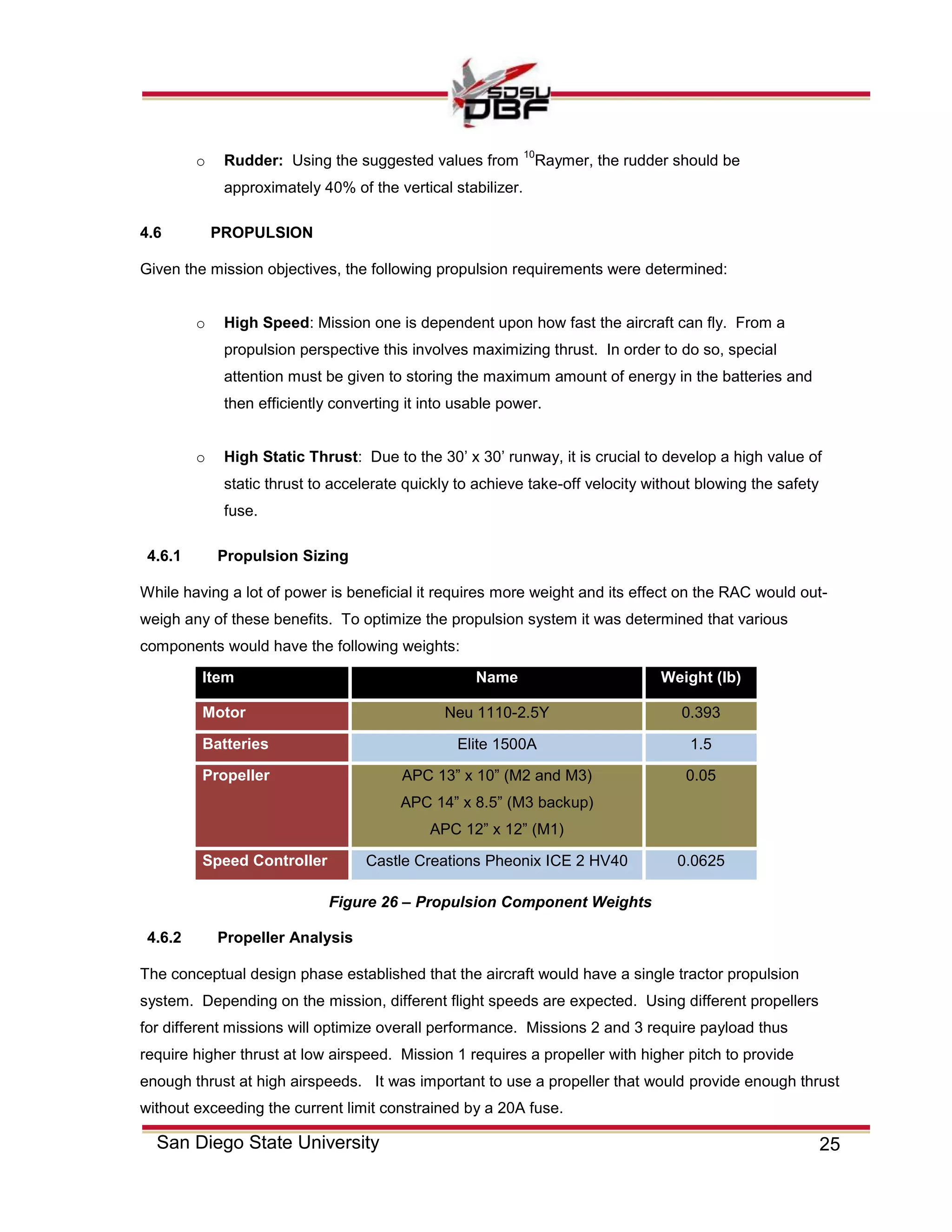
Item Name Weight (lb)
Motor Neu 1110-2.5Y 0.393
Batteries Elite 1500A 1.5
Propeller APC 13” x 10” (M2 and M3)
APC 14” x 8.5” (M3 backup)
APC 12” x 12” (M1)
0.05
Speed Controller Castle Creations Pheonix ICE 2 HV40 0.0625
4.6.2 Propeller Analysis
The conceptual design phase established that the aircraft would have a single tractor propulsion
system. Depending on the mission, different flight speeds are expected. Using different propellers
for different missions will optimize overall performance. Missions 2 and 3 require payload thus
require higher thrust at low airspeed. Mission 1 requires a propeller with higher pitch to provide
enough thrust at high airspeeds. It was important to use a propeller that would provide enough thrust
without exceeding the current limit constrained by a 20A fuse.
Figure 26 – Propulsion Component Weights
26San Diego State University
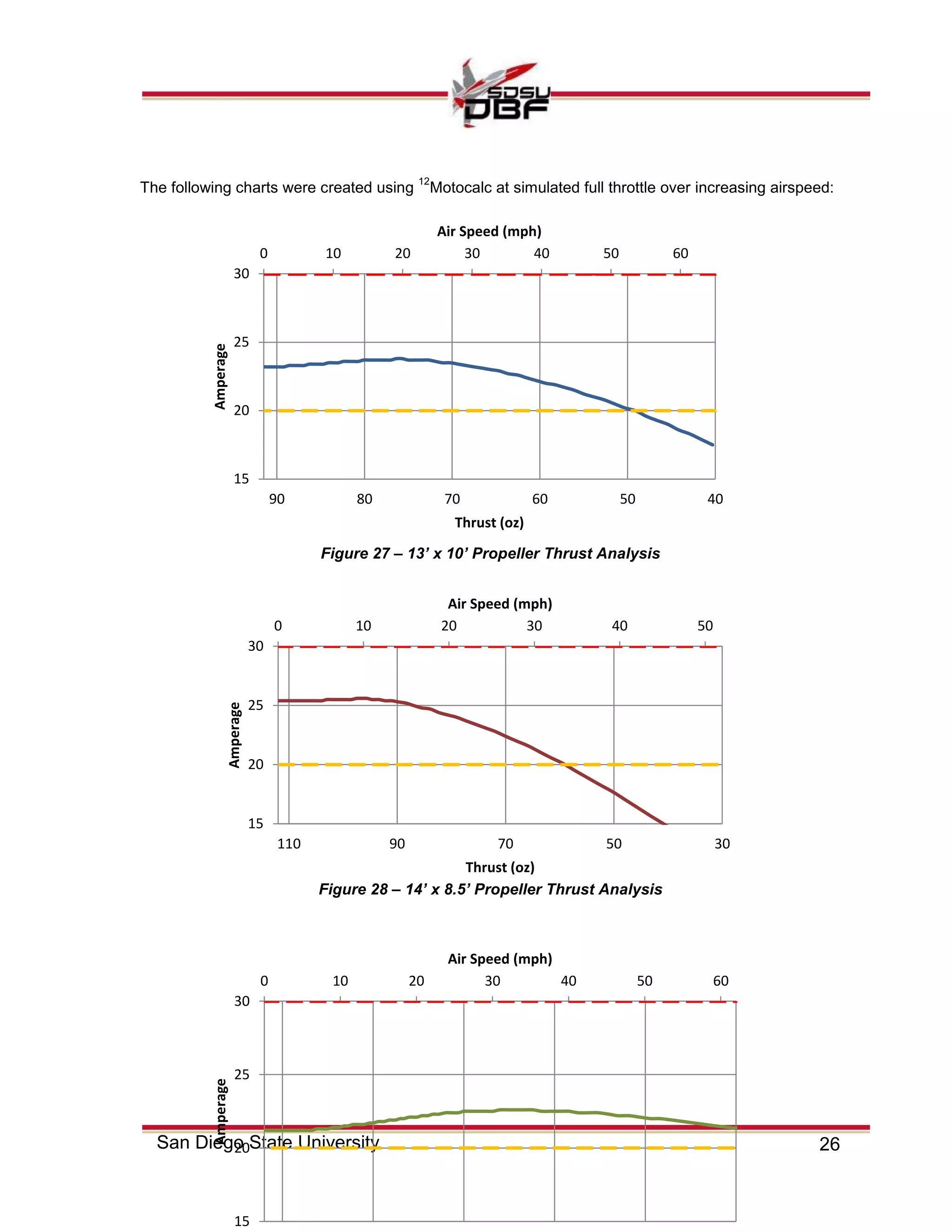
The following charts were created using
12
Motocalc at simulated full throttle over increasing airspeed:
0 10 20 30 40 50 60
15
20
25
30
405060708090
Air Speed (mph)
Amperage
Thrust (oz)
0 10 20 30 40 50
15
20
25
30
30507090110
Air Speed (mph)
Amperage
Thrust (oz)
0 10 20 30 40 50 60
15
20
25
30
Air Speed (mph)
Amperage
Figure 27 – 13’ x 10’ Propeller Thrust Analysis
Figure 28 – 14’ x 8.5’ Propeller Thrust Analysis
27San Diego State University
4.6.3 Battery Analysis
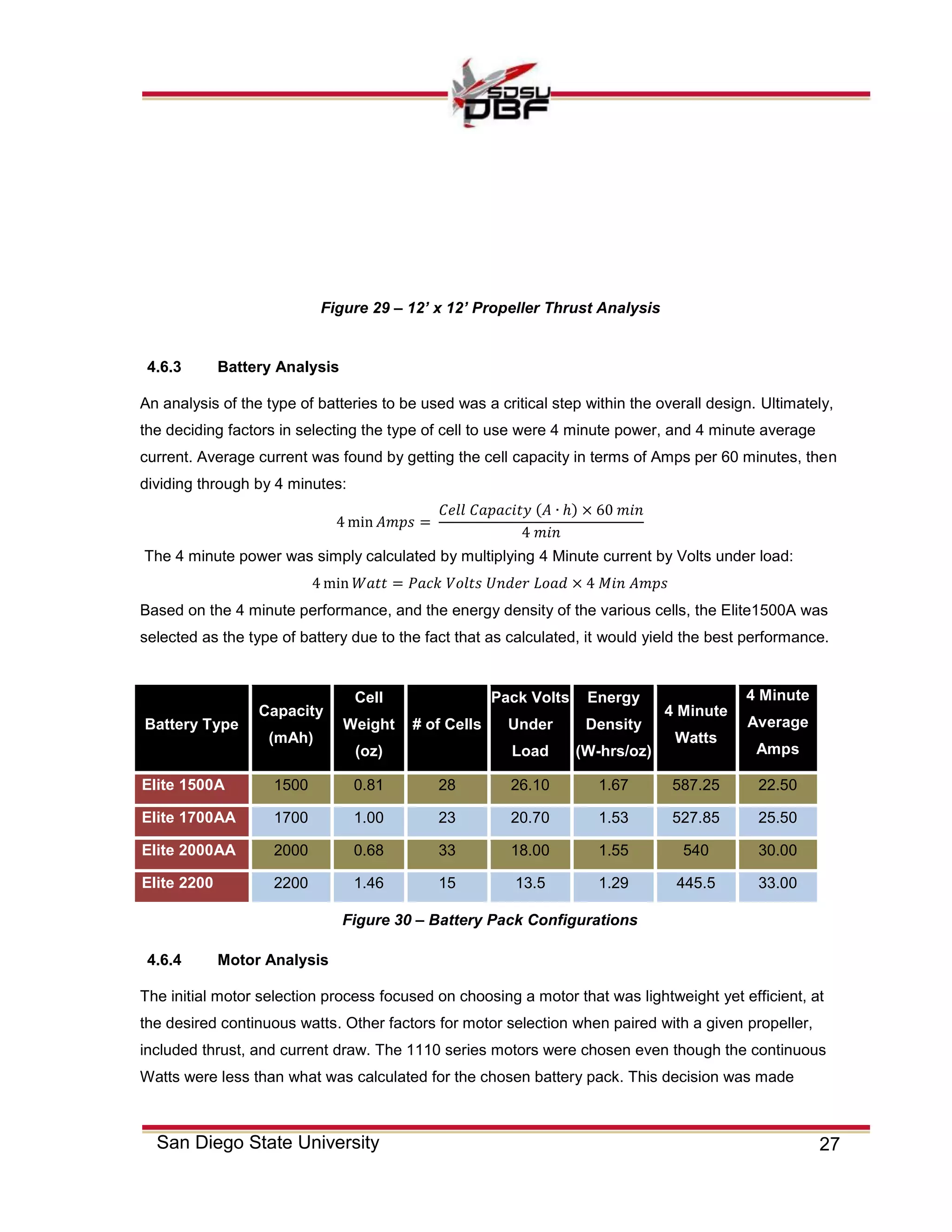
An analysis of the type of batteries to be used was a critical step within the overall design. Ultimately,
the deciding factors in selecting the type of cell to use were 4 minute power, and 4 minute average
current. Average current was found by getting the cell capacity in terms of Amps per 60 minutes, then
dividing through by 4 minutes:
The 4 minute power was simply calculated by multiplying 4 Minute current by Volts under load:
Based on the 4 minute performance, and the energy density of the various cells, the Elite1500A was
selected as the type of battery due to the fact that as calculated, it would yield the best performance.
Battery Type
Capacity
(mAh)
Cell
Weight
(oz)
# of Cells
Pack Volts
Under
Load
Energy
Density
(W-hrs/oz)
4 Minute
Watts
4 Minute
Average
Amps
Elite 1500A 1500 0.81 28 26.10 1.67 587.25 22.50
Elite 1700AA 1700 1.00 23 20.70 1.53 527.85 25.50
Elite 2000AA 2000 0.68 33 18.00 1.55 540 30.00
Elite 2200 2200 1.46 15 13.5 1.29 445.5 33.00
4.6.4 Motor Analysis
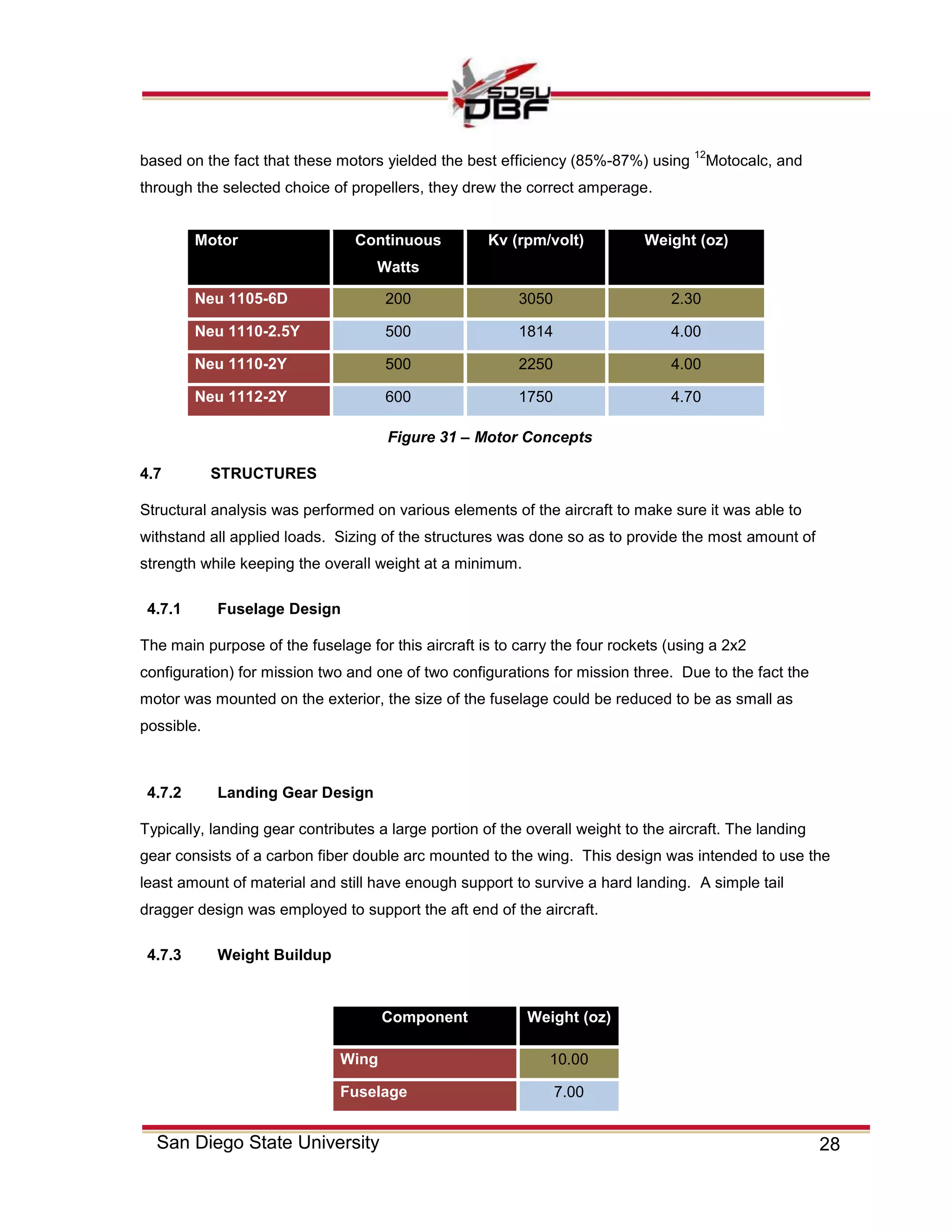
The initial motor selection process focused on choosing a motor that was lightweight yet efficient, at
the desired continuous watts. Other factors for motor selection when paired with a given propeller,
included thrust, and current draw. The 1110 series motors were chosen even though the continuous
Watts were less than what was calculated for the chosen battery pack. This decision was made
Figure 29 – 12’ x 12’ Propeller Thrust Analysis
Figure 30 – Battery Pack Configurations
28San Diego State University
based on the fact that these motors yielded the best efficiency (85%-87%) using
12
Motocalc, and
through the selected choice of propellers, they drew the correct amperage.
Motor Continuous
Watts
Kv (rpm/volt) Weight (oz)
Neu 1105-6D 200 3050 2.30
Neu 1110-2.5Y 500 1814 4.00
Neu 1110-2Y 500 2250 4.00
Neu 1112-2Y 600 1750 4.70
4.7 STRUCTURES
Structural analysis was performed on various elements of the aircraft to make sure it was able to
withstand all applied loads. Sizing of the structures was done so as to provide the most amount of
strength while keeping the overall weight at a minimum.
4.7.1 Fuselage Design
The main purpose of the fuselage for this aircraft is to carry the four rockets (using a 2x2
configuration) for mission two and one of two configurations for mission three. Due to the fact the
motor was mounted on the exterior, the size of the fuselage could be reduced to be as small as
possible.
4.7.2 Landing Gear Design
Typically, landing gear contributes a large portion of the overall weight to the aircraft. The landing
gear consists of a carbon fiber double arc mounted to the wing. This design was intended to use the
least amount of material and still have enough support to survive a hard landing. A simple tail
dragger design was employed to support the aft end of the aircraft.
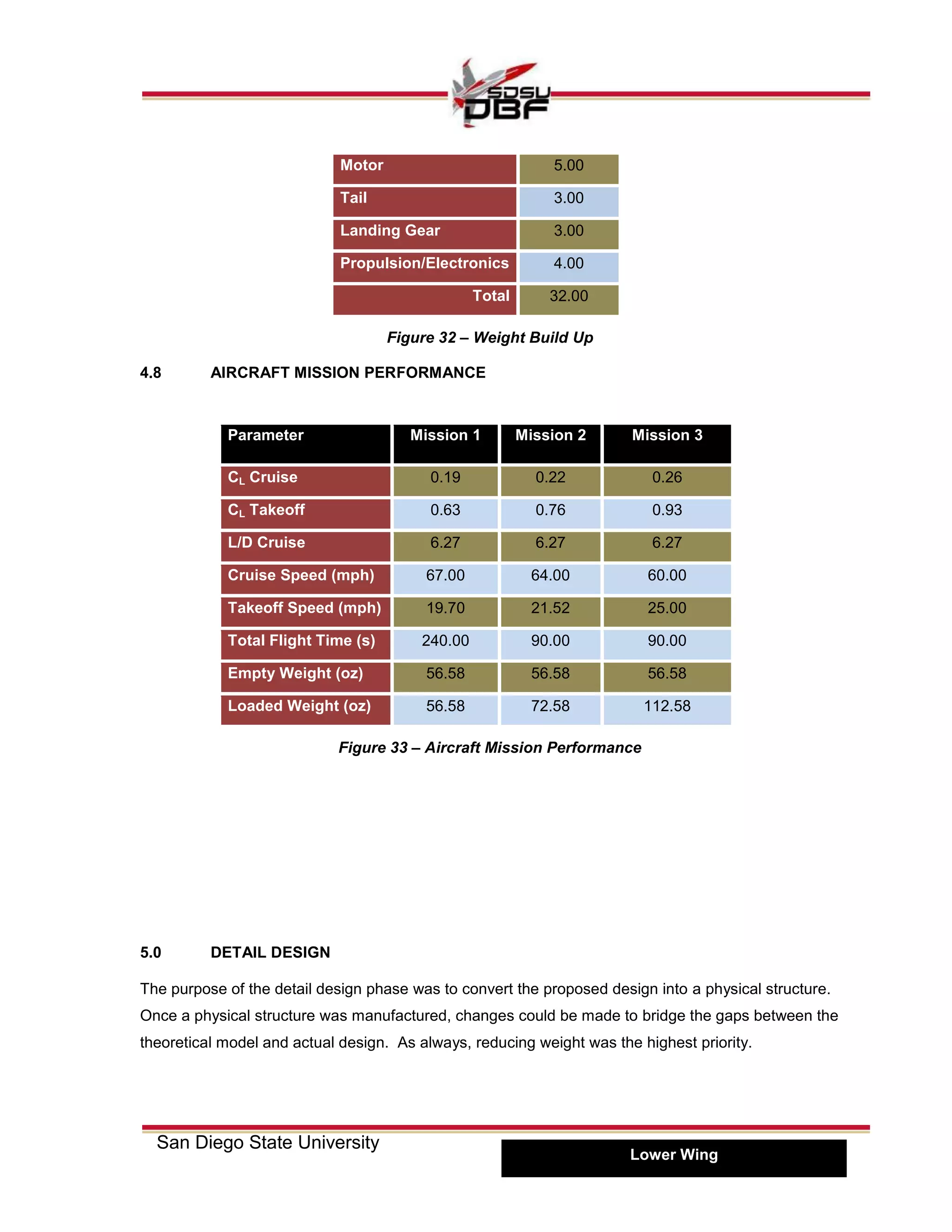
4.7.3 Weight Buildup
Component Weight (oz)
Wing 10.00
Fuselage 7.00
Figure 31 – Motor Concepts
29San Diego State University
Motor 5.00
Tail 3.00
Landing Gear 3.00
Propulsion/Electronics 4.00
Total 32.00
4.8 AIRCRAFT MISSION PERFORMANCE
Parameter Mission 1 Mission 2 Mission 3
CL Cruise 0.19 0.22 0.26
CL Takeoff 0.63 0.76 0.93
L/D Cruise 6.27 6.27 6.27
Cruise Speed (mph) 67.00 64.00 60.00
Takeoff Speed (mph) 19.70 21.52 25.00
Total Flight Time (s) 240.00 90.00 90.00
Empty Weight (oz) 56.58 56.58 56.58
Loaded Weight (oz) 56.58 72.58 112.58
5.0 DETAIL DESIGN
The purpose of the detail design phase was to convert the proposed design into a physical structure.
Once a physical structure was manufactured, changes could be made to bridge the gaps between the
theoretical model and actual design. As always, reducing weight was the highest priority.
Lower Wing
Figure 32 – Weight Build Up
Figure 33 – Aircraft Mission Performance
30San Diego State University
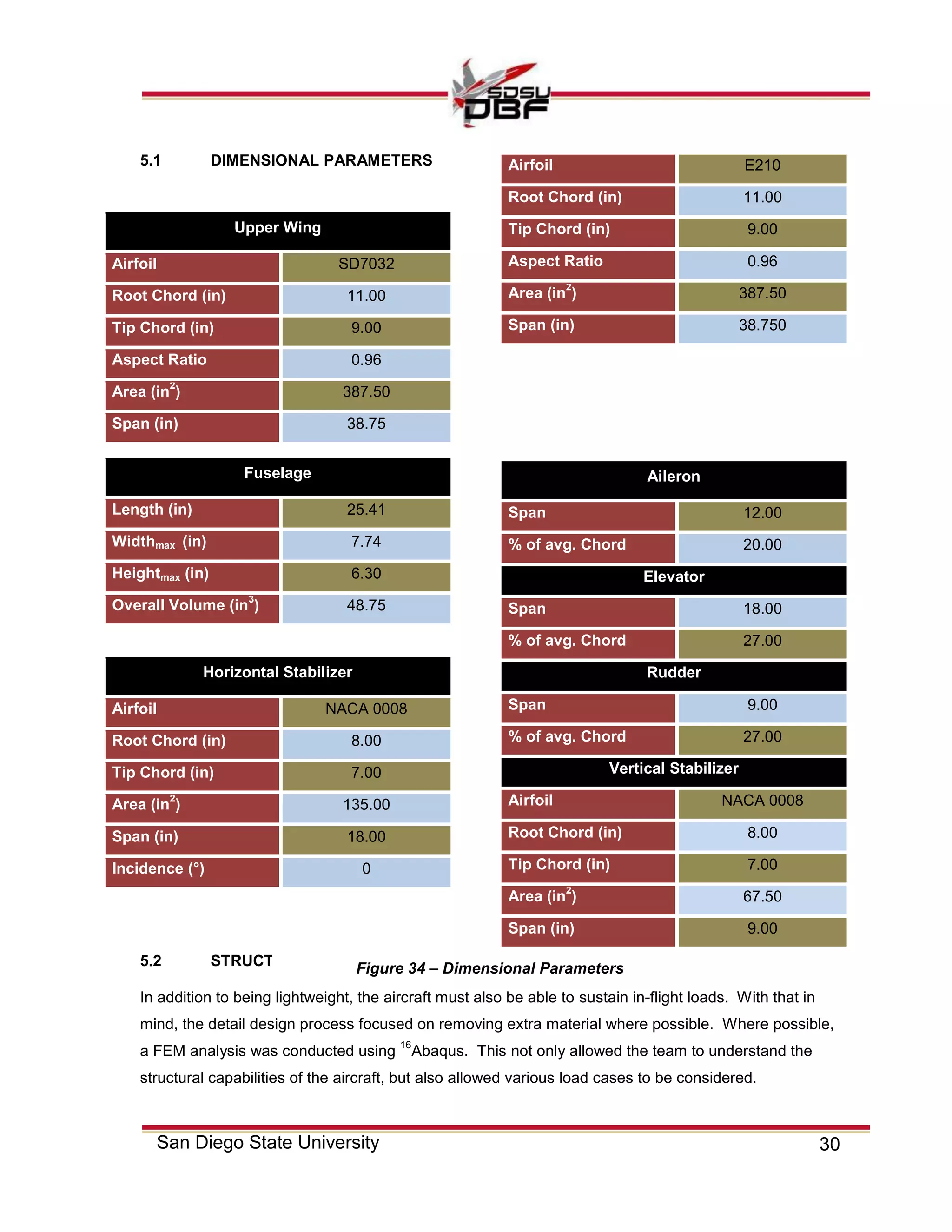
5.1 DIMENSIONAL PARAMETERS
Upper Wing
Airfoil SD7032
Root Chord (in) 11.00
Tip Chord (in) 9.00
Aspect Ratio 0.96
Area (in
2
) 387.50
Span (in) 38.75
Horizontal Stabilizer
Airfoil NACA 0008
Root Chord (in) 8.00
Tip Chord (in) 7.00
Area (in
2
) 135.00
Span (in) 18.00
Incidence (°) 0
5.2 STRUCTURAL CHARACTERISTICS
In addition to being lightweight, the aircraft must also be able to sustain in-flight loads. With that in
mind, the detail design process focused on removing extra material where possible. Where possible,
a FEM analysis was conducted using
16
Abaqus. This not only allowed the team to understand the
structural capabilities of the aircraft, but also allowed various load cases to be considered.
Airfoil E210
Root Chord (in) 11.00
Tip Chord (in) 9.00
Aspect Ratio 0.96
Area (in
2
) 387.50
Span (in) 38.750
Fuselage
Length (in) 25.41
Widthmax (in) 7.74
Heightmax (in) 6.30
Overall Volume (in
3
) 48.75
Aileron
Span 12.00
% of avg. Chord 20.00
Elevator
Span 18.00
% of avg. Chord 27.00
Rudder
Span 9.00
% of avg. Chord 27.00
Vertical Stabilizer
Airfoil NACA 0008
Root Chord (in) 8.00
Tip Chord (in) 7.00
Area (in
2
) 67.50
Span (in) 9.00
Figure 34 – Dimensional Parameters
31San Diego State University
5.3 SYSTEM DESIGN, COMPONENT SELECTION AND INTEGRATION
5.3.1 Bi-Wing System
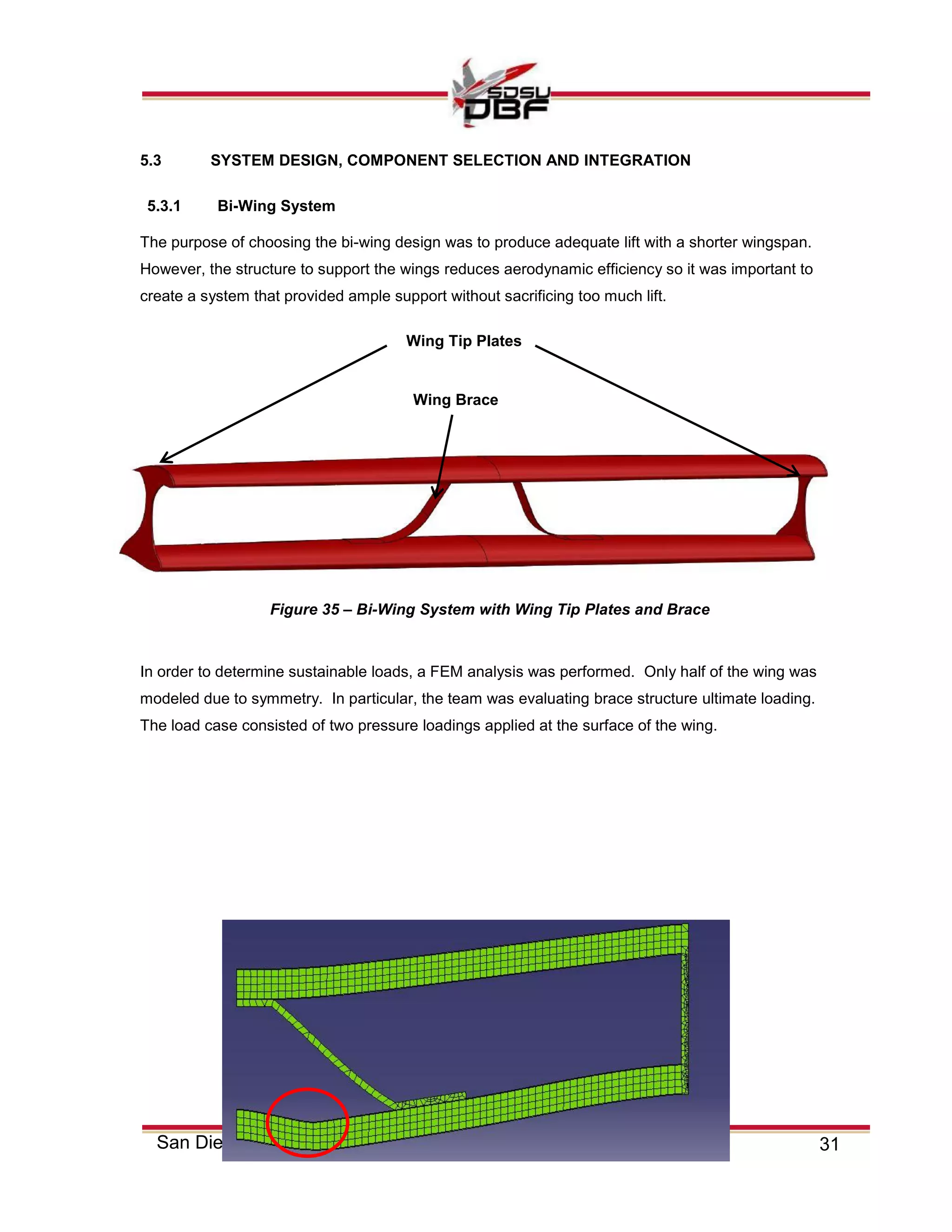
The purpose of choosing the bi-wing design was to produce adequate lift with a shorter wingspan.
However, the structure to support the wings reduces aerodynamic efficiency so it was important to
create a system that provided ample support without sacrificing too much lift.
In order to determine sustainable loads, a FEM analysis was performed. Only half of the wing was
modeled due to symmetry. In particular, the team was evaluating brace structure ultimate loading.
The load case consisted of two pressure loadings applied at the surface of the wing.
Wing Tip Plates
Figure 35 – Bi-Wing System with Wing Tip Plates and Brace
Wing Brace
32San Diego State University
It was determined that the bi-wing setup would be able to safely handle a wing loading of up to 25.6-
lbs while in flight. Figure 36 shows the wing brace and wing tip plates could successfully handle the
loads but local buckling occurs in the bottom wing on the inside of the support brace.
5.3.2 Payload Systems
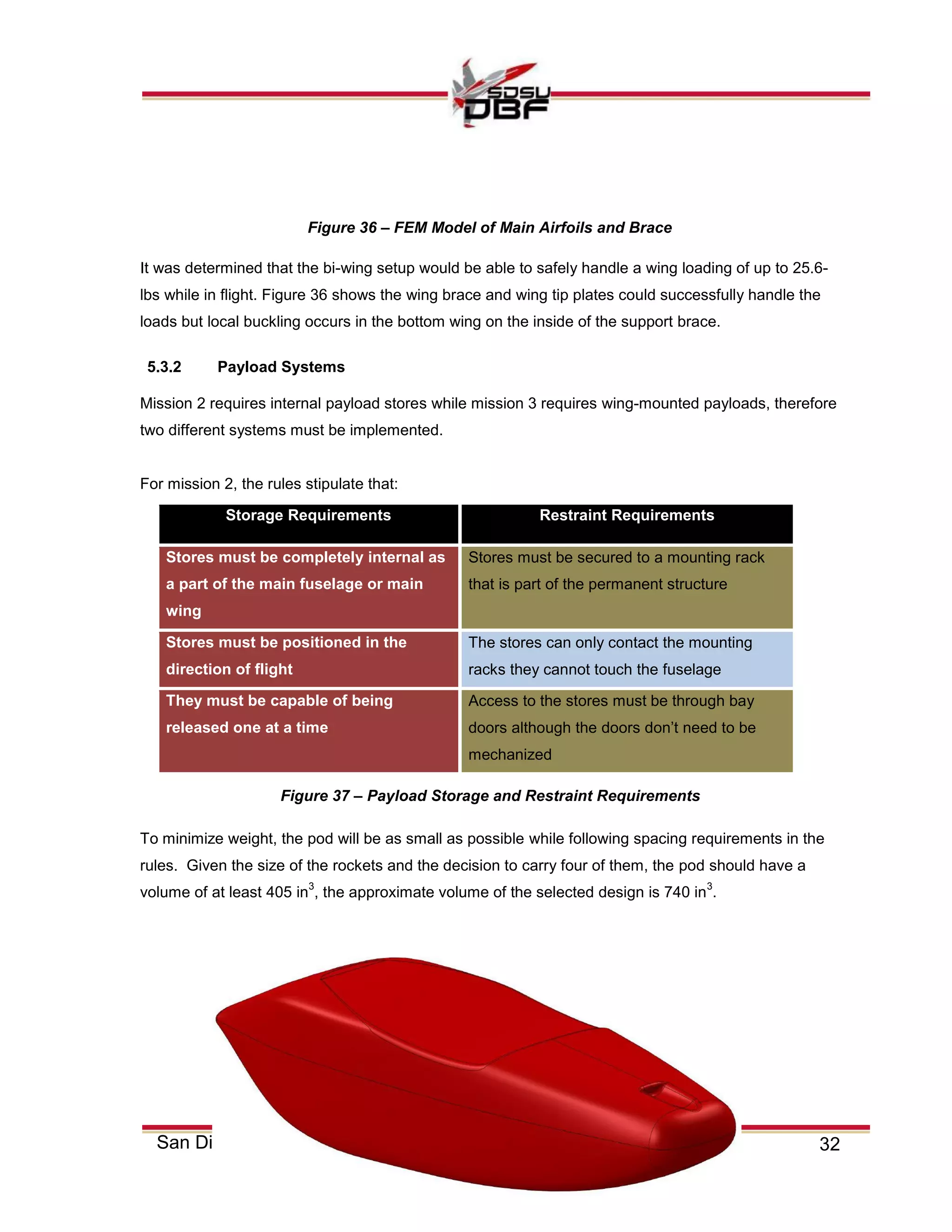
Mission 2 requires internal payload stores while mission 3 requires wing-mounted payloads, therefore
two different systems must be implemented.
For mission 2, the rules stipulate that:
Storage Requirements Restraint Requirements
Stores must be completely internal as
a part of the main fuselage or main
wing
Stores must be secured to a mounting rack
that is part of the permanent structure
Stores must be positioned in the
direction of flight
The stores can only contact the mounting
racks they cannot touch the fuselage
They must be capable of being
released one at a time
Access to the stores must be through bay
doors although the doors don’t need to be
mechanized
To minimize weight, the pod will be as small as possible while following spacing requirements in the
rules. Given the size of the rockets and the decision to carry four of them, the pod should have a
volume of at least 405 in
3
, the approximate volume of the selected design is 740 in
3
.
Figure 36 – FEM Model of Main Airfoils and Brace
Figure 37 – Payload Storage and Restraint Requirements
33San Diego State University
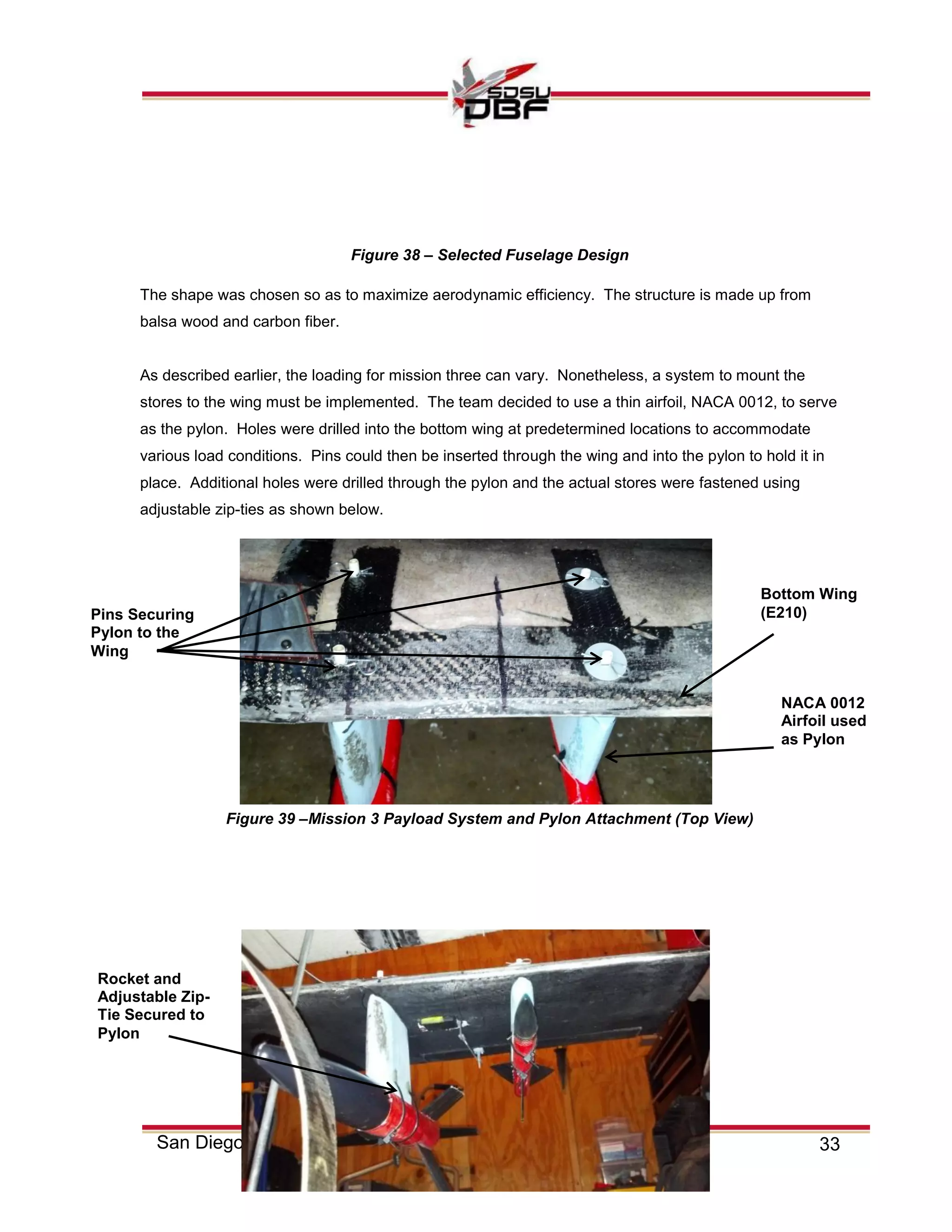
The shape was chosen so as to maximize aerodynamic efficiency. The structure is made up from
balsa wood and carbon fiber.
As described earlier, the loading for mission three can vary. Nonetheless, a system to mount the
stores to the wing must be implemented. The team decided to use a thin airfoil, NACA 0012, to serve
as the pylon. Holes were drilled into the bottom wing at predetermined locations to accommodate
various load conditions. Pins could then be inserted through the wing and into the pylon to hold it in
place. Additional holes were drilled through the pylon and the actual stores were fastened using
adjustable zip-ties as shown below.
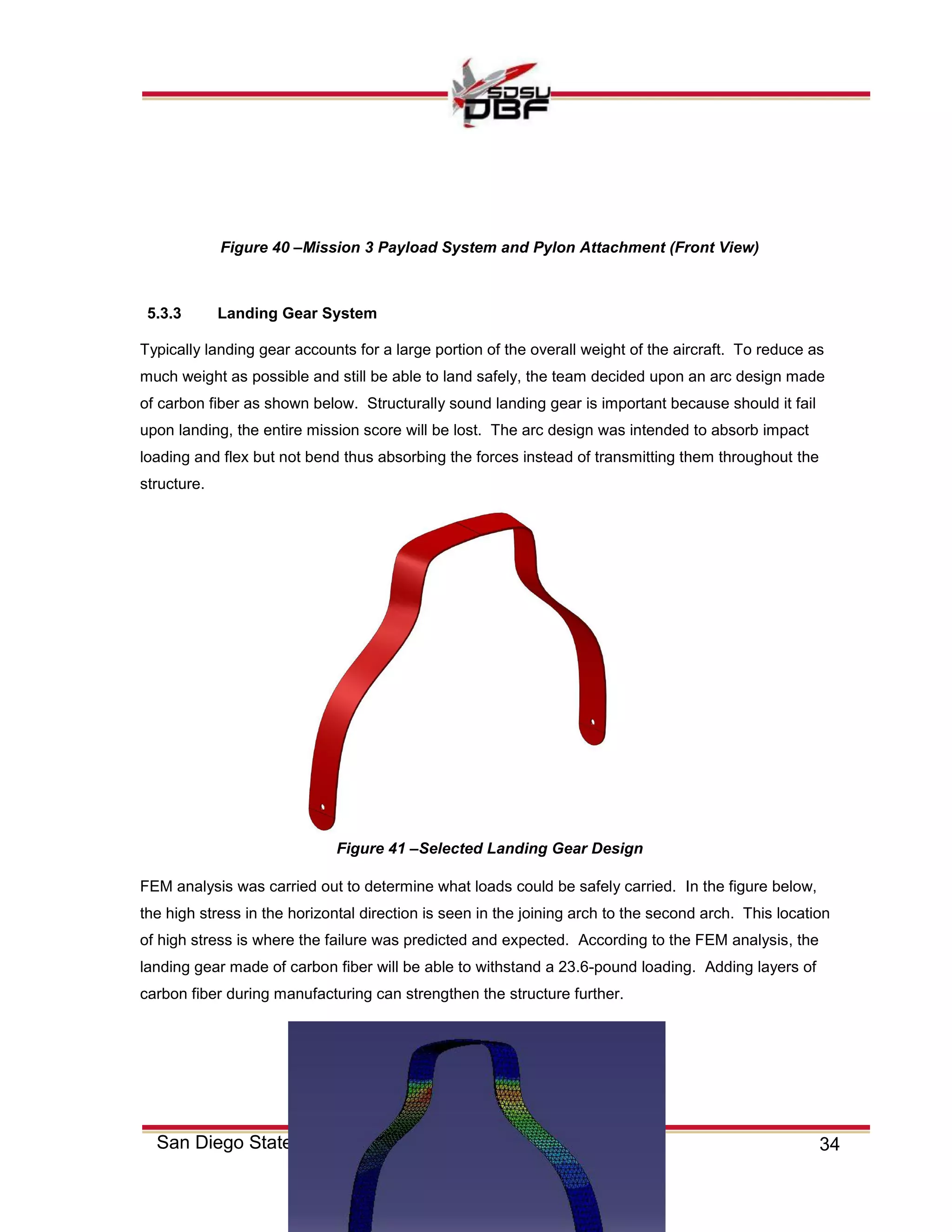
Rocket and
Adjustable Zip-
Tie Secured to
Pylon
Pins Securing
Pylon to the
Wing
Figure 39 –Mission 3 Payload System and Pylon Attachment (Top View)
Figure 38 – Selected Fuselage Design
NACA 0012
Airfoil used
as Pylon
Bottom Wing
(E210)
34San Diego State University
5.3.3 Landing Gear System
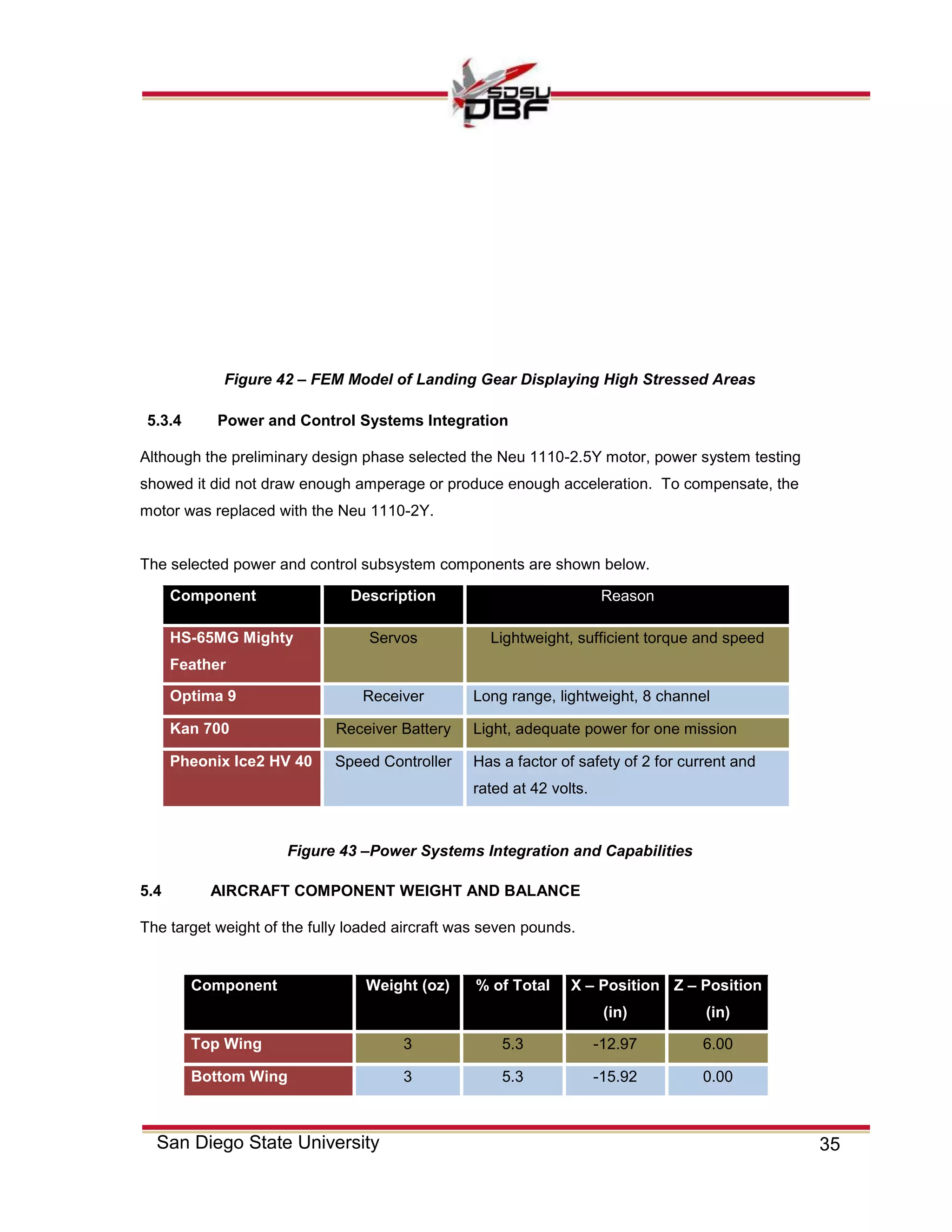
Typically landing gear accounts for a large portion of the overall weight of the aircraft. To reduce as
much weight as possible and still be able to land safely, the team decided upon an arc design made
of carbon fiber as shown below. Structurally sound landing gear is important because should it fail
upon landing, the entire mission score will be lost. The arc design was intended to absorb impact
loading and flex but not bend thus absorbing the forces instead of transmitting them throughout the
structure.
FEM analysis was carried out to determine what loads could be safely carried. In the figure below,
the high stress in the horizontal direction is seen in the joining arch to the second arch. This location
of high stress is where the failure was predicted and expected. According to the FEM analysis, the
landing gear made of carbon fiber will be able to withstand a 23.6-pound loading. Adding layers of
carbon fiber during manufacturing can strengthen the structure further.
Figure 40 –Mission 3 Payload System and Pylon Attachment (Front View)
Figure 41 –Selected Landing Gear Design
35San Diego State University
5.3.4 Power and Control Systems Integration
Although the preliminary design phase selected the Neu 1110-2.5Y motor, power system testing
showed it did not draw enough amperage or produce enough acceleration. To compensate, the
motor was replaced with the Neu 1110-2Y.
The selected power and control subsystem components are shown below.
Component Description Reason
HS-65MG Mighty
Feather
Servos Lightweight, sufficient torque and speed
Optima 9 Receiver Long range, lightweight, 8 channel
Kan 700 Receiver Battery Light, adequate power for one mission
Pheonix Ice2 HV 40 Speed Controller Has a factor of safety of 2 for current and
rated at 42 volts.
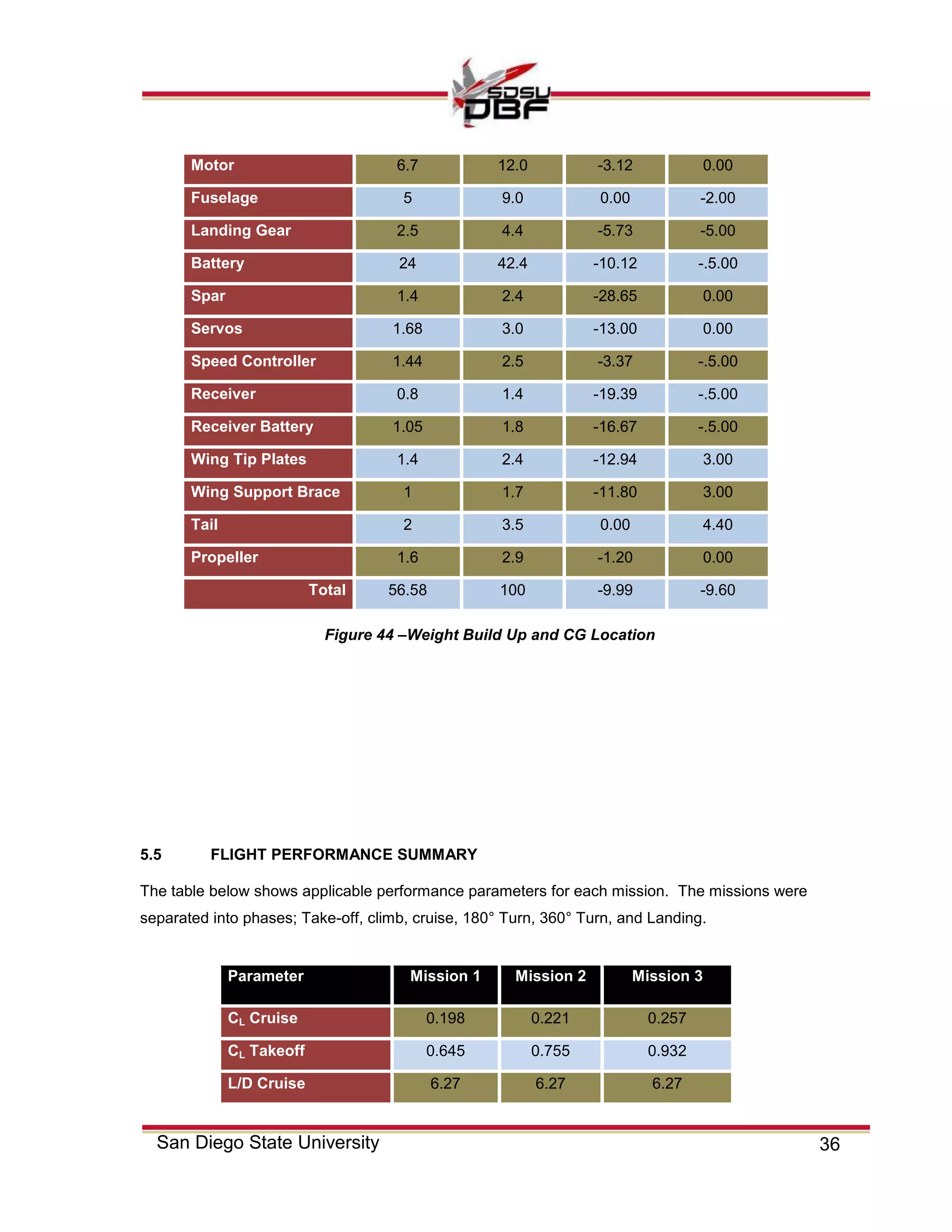
5.4 AIRCRAFT COMPONENT WEIGHT AND BALANCE
The target weight of the fully loaded aircraft was seven pounds.
Component Weight (oz) % of Total X – Position
(in)
Z – Position
(in)
Top Wing 3 5.3 -12.97 6.00
Bottom Wing 3 5.3 -15.92 0.00
Figure 42 – FEM Model of Landing Gear Displaying High Stressed Areas
Figure 43 –Power Systems Integration and Capabilities
36San Diego State University
Motor 6.7 12.0 -3.12 0.00
Fuselage 5 9.0 0.00 -2.00
Landing Gear 2.5 4.4 -5.73 -5.00
Battery 24 42.4 -10.12 -.5.00
Spar 1.4 2.4 -28.65 0.00
Servos 1.68 3.0 -13.00 0.00
Speed Controller 1.44 2.5 -3.37 -.5.00
Receiver 0.8 1.4 -19.39 -.5.00
Receiver Battery 1.05 1.8 -16.67 -.5.00
Wing Tip Plates 1.4 2.4 -12.94 3.00
Wing Support Brace 1 1.7 -11.80 3.00
Tail 2 3.5 0.00 4.40
Propeller 1.6 2.9 -1.20 0.00
Total 56.58 100 -9.99 -9.60
5.5 FLIGHT PERFORMANCE SUMMARY
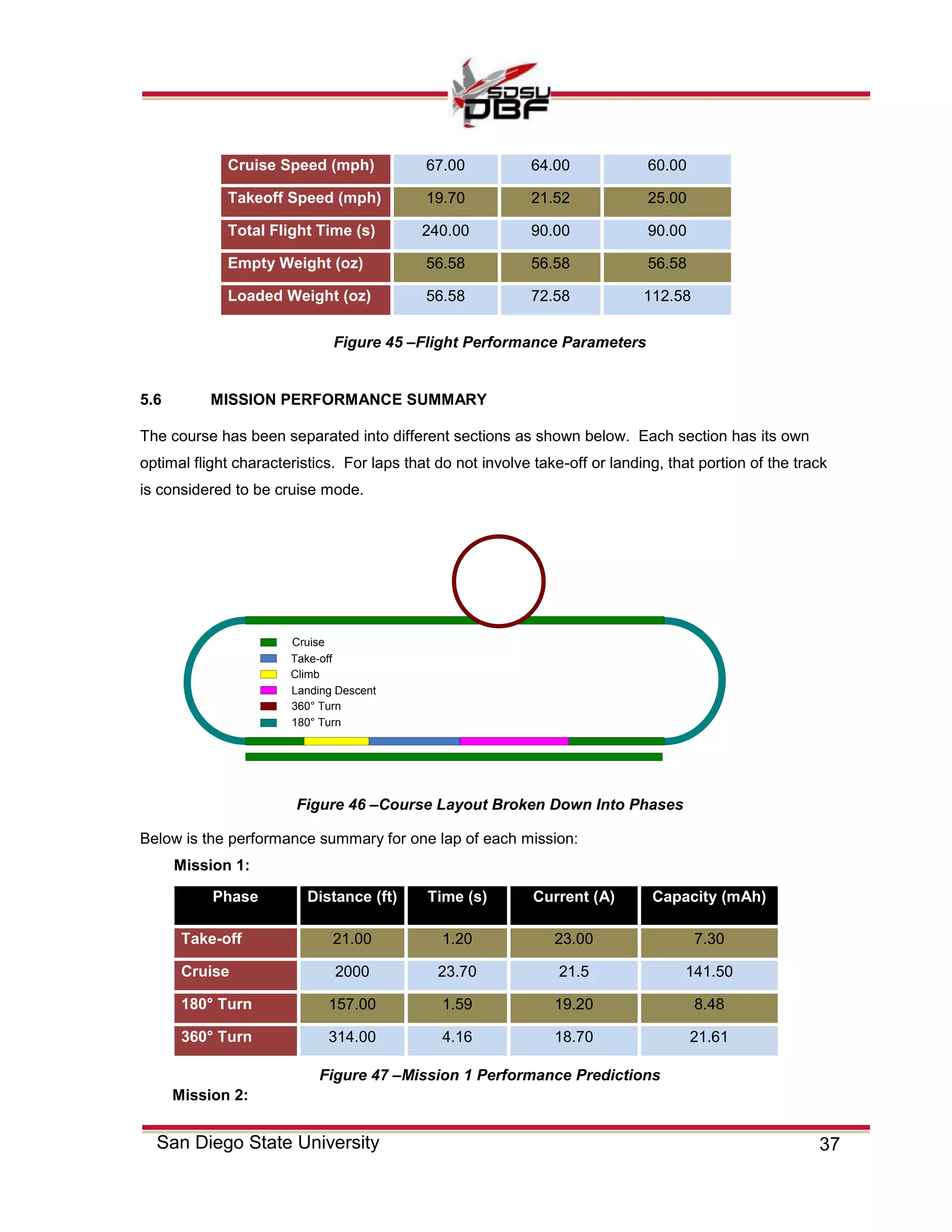
The table below shows applicable performance parameters for each mission. The missions were
separated into phases; Take-off, climb, cruise, 180° Turn, 360° Turn, and Landing.
Parameter Mission 1 Mission 2 Mission 3
CL Cruise 0.198 0.221 0.257
CL Takeoff 0.645 0.755 0.932
L/D Cruise 6.27 6.27 6.27
Figure 44 –Weight Build Up and CG Location
37San Diego State University
Cruise Speed (mph) 67.00 64.00 60.00
Takeoff Speed (mph) 19.70 21.52 25.00
Total Flight Time (s) 240.00 90.00 90.00
Empty Weight (oz) 56.58 56.58 56.58
Loaded Weight (oz) 56.58 72.58 112.58
5.6 MISSION PERFORMANCE SUMMARY
The course has been separated into different sections as shown below. Each section has its own
optimal flight characteristics. For laps that do not involve take-off or landing, that portion of the track
is considered to be cruise mode.
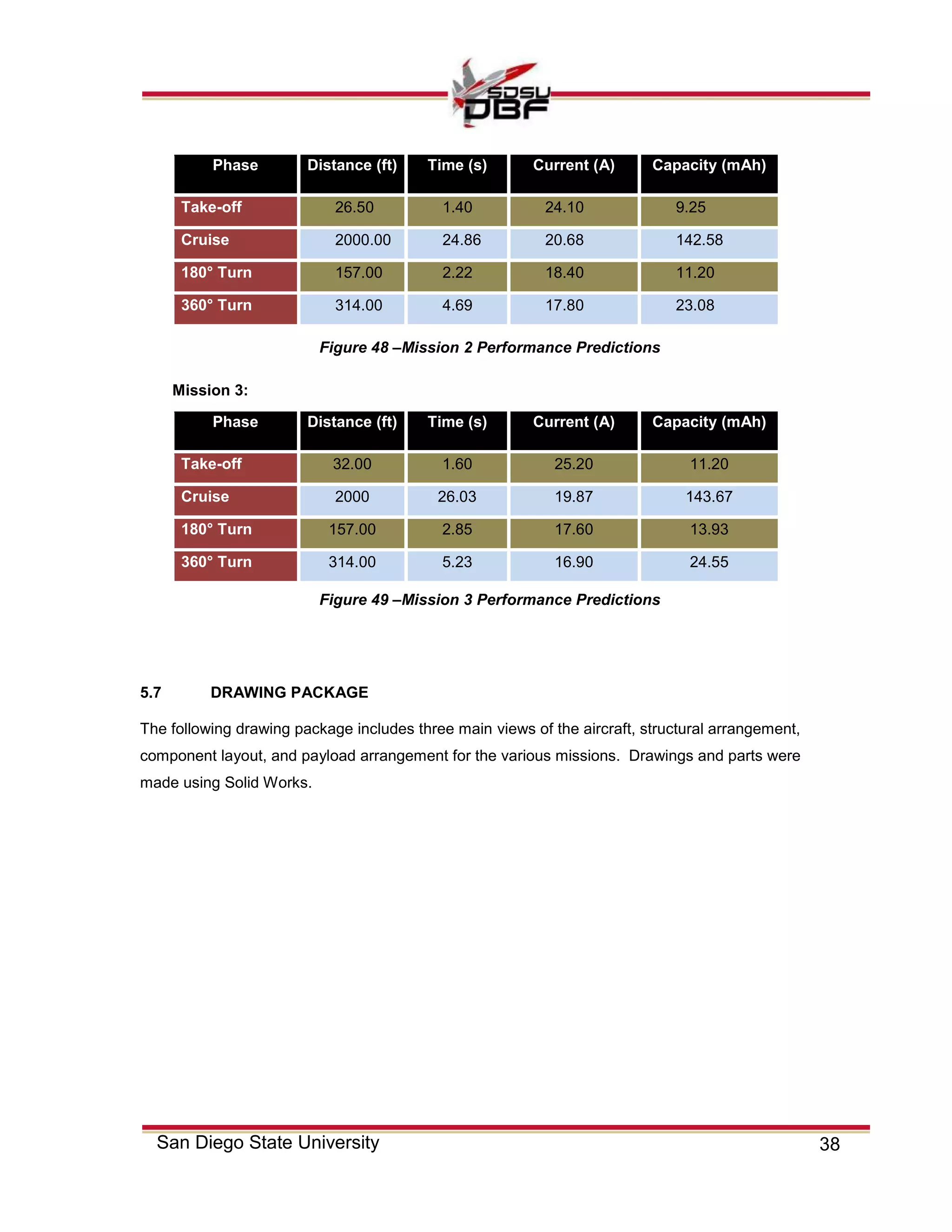
Below is the performance summary for one lap of each mission:
Mission 1:
Phase Distance (ft) Time (s) Current (A) Capacity (mAh)
Take-off 21.00 1.20 23.00 7.30
Cruise 2000 23.70 21.5 141.50
180° Turn 157.00 1.59 19.20 8.48
360° Turn 314.00 4.16 18.70 21.61
Mission 2:
Cruise
Take-off
Climb
Landing Descent
360° Turn
180° Turn
Figure 45 –Flight Performance Parameters
Figure 46 –Course Layout Broken Down Into Phases
Figure 47 –Mission 1 Performance Predictions
38San Diego State University
Phase Distance (ft) Time (s) Current (A) Capacity (mAh)
Take-off 26.50 1.40 24.10 9.25
Cruise 2000.00 24.86 20.68 142.58
180° Turn 157.00 2.22 18.40 11.20
360° Turn 314.00 4.69 17.80 23.08
Mission 3:
Phase Distance (ft) Time (s) Current (A) Capacity (mAh)
Take-off 32.00 1.60 25.20 11.20
Cruise 2000 26.03 19.87 143.67
180° Turn 157.00 2.85 17.60 13.93
360° Turn 314.00 5.23 16.90 24.55
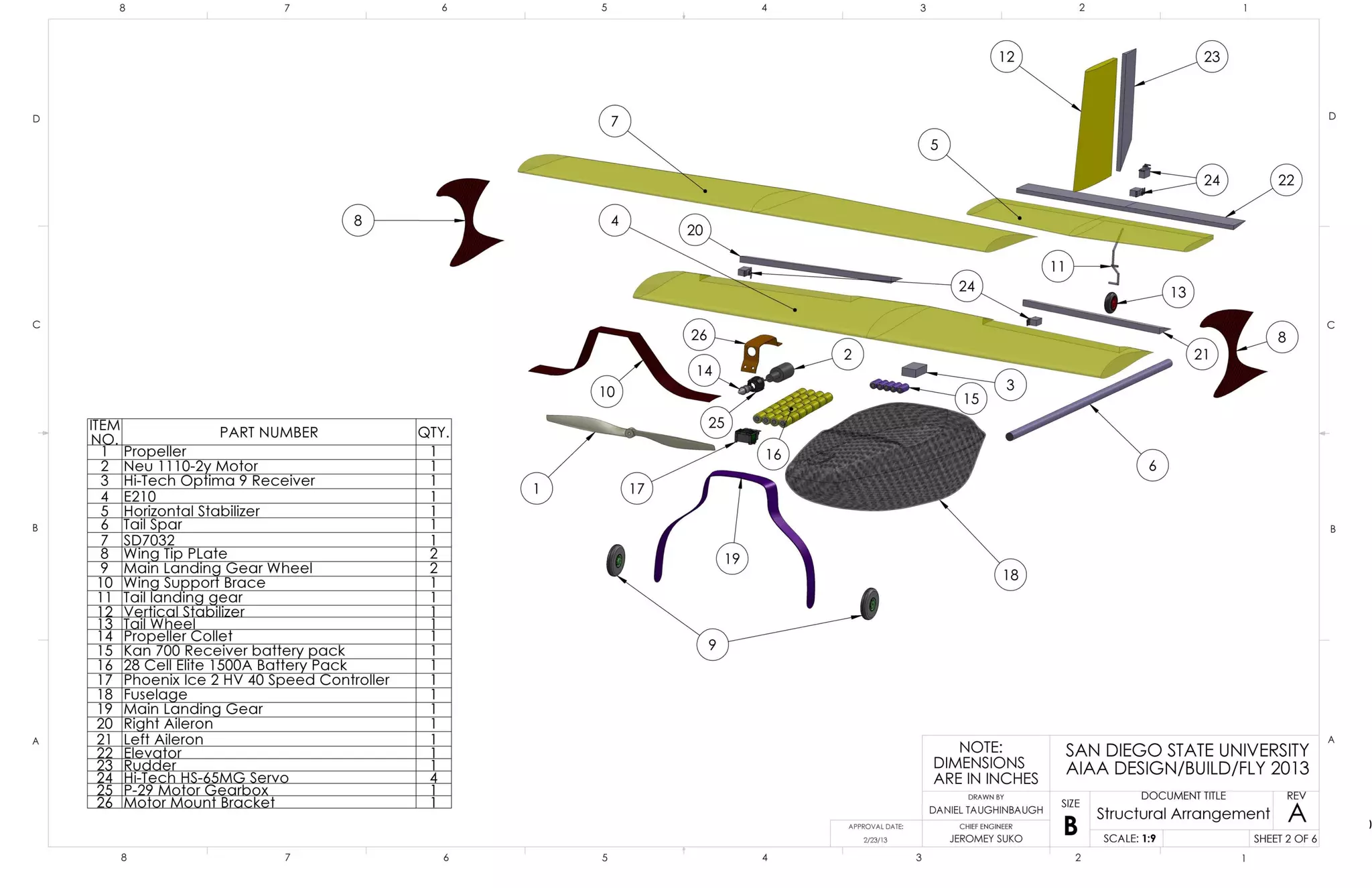
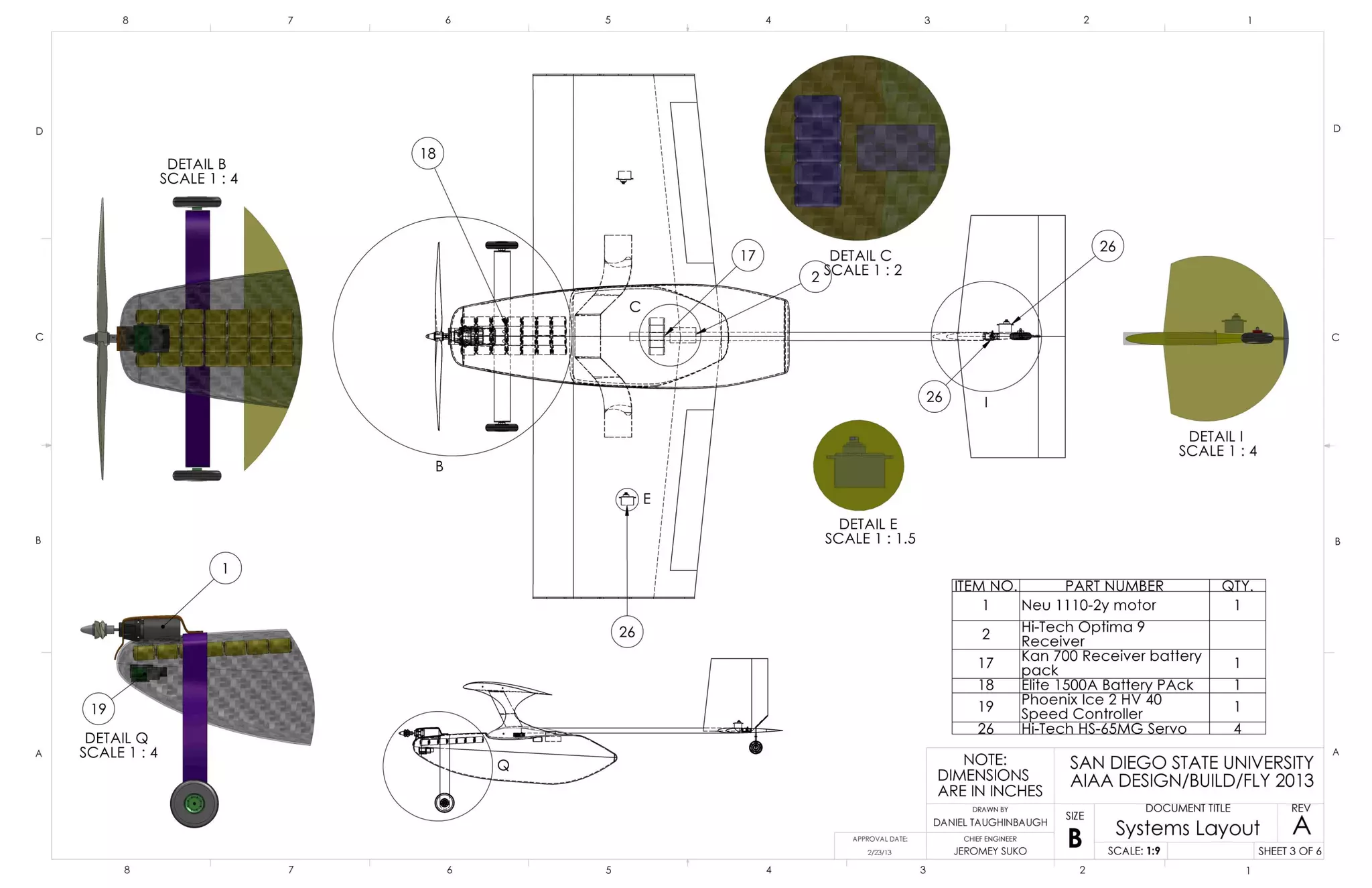
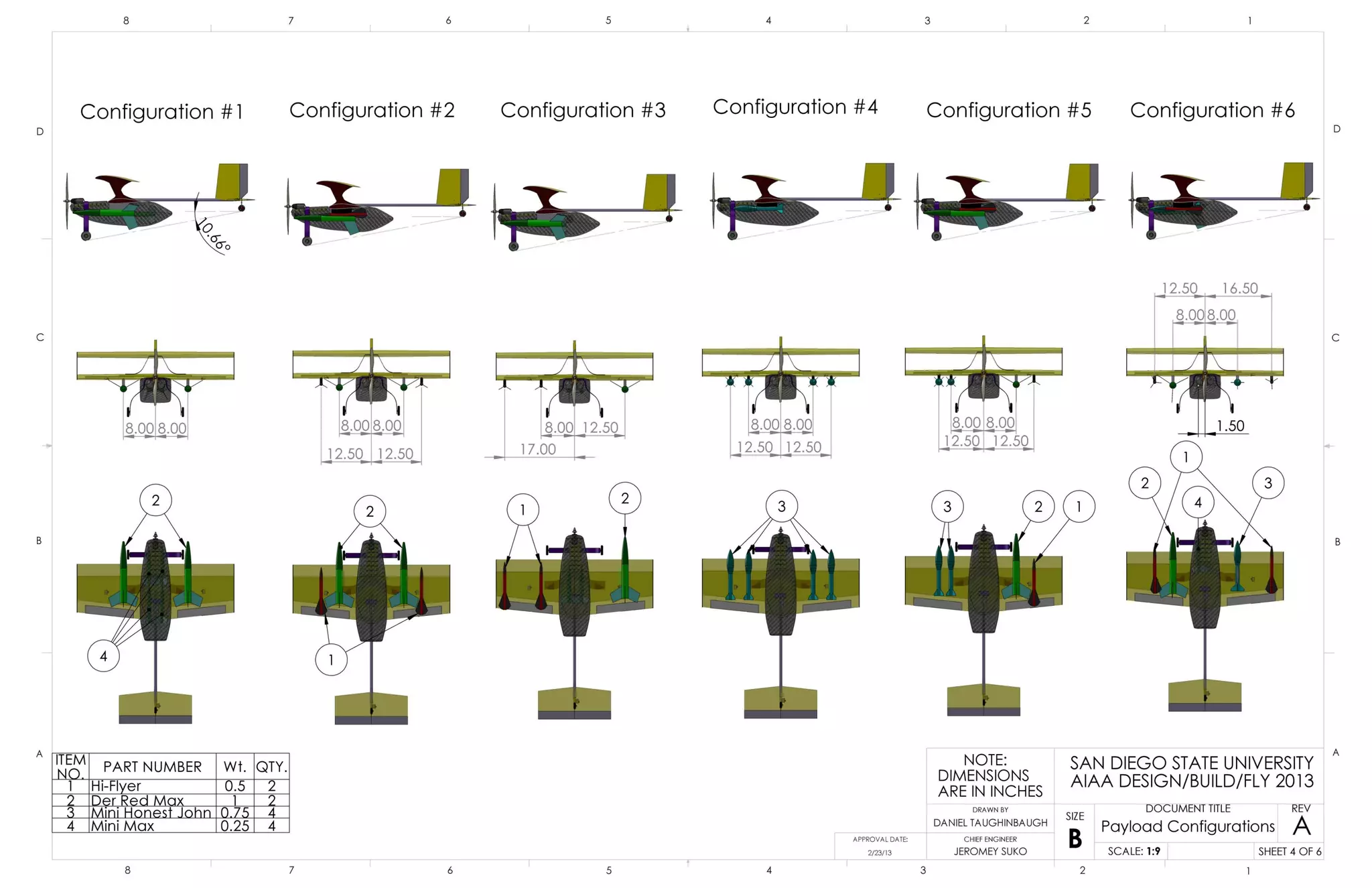
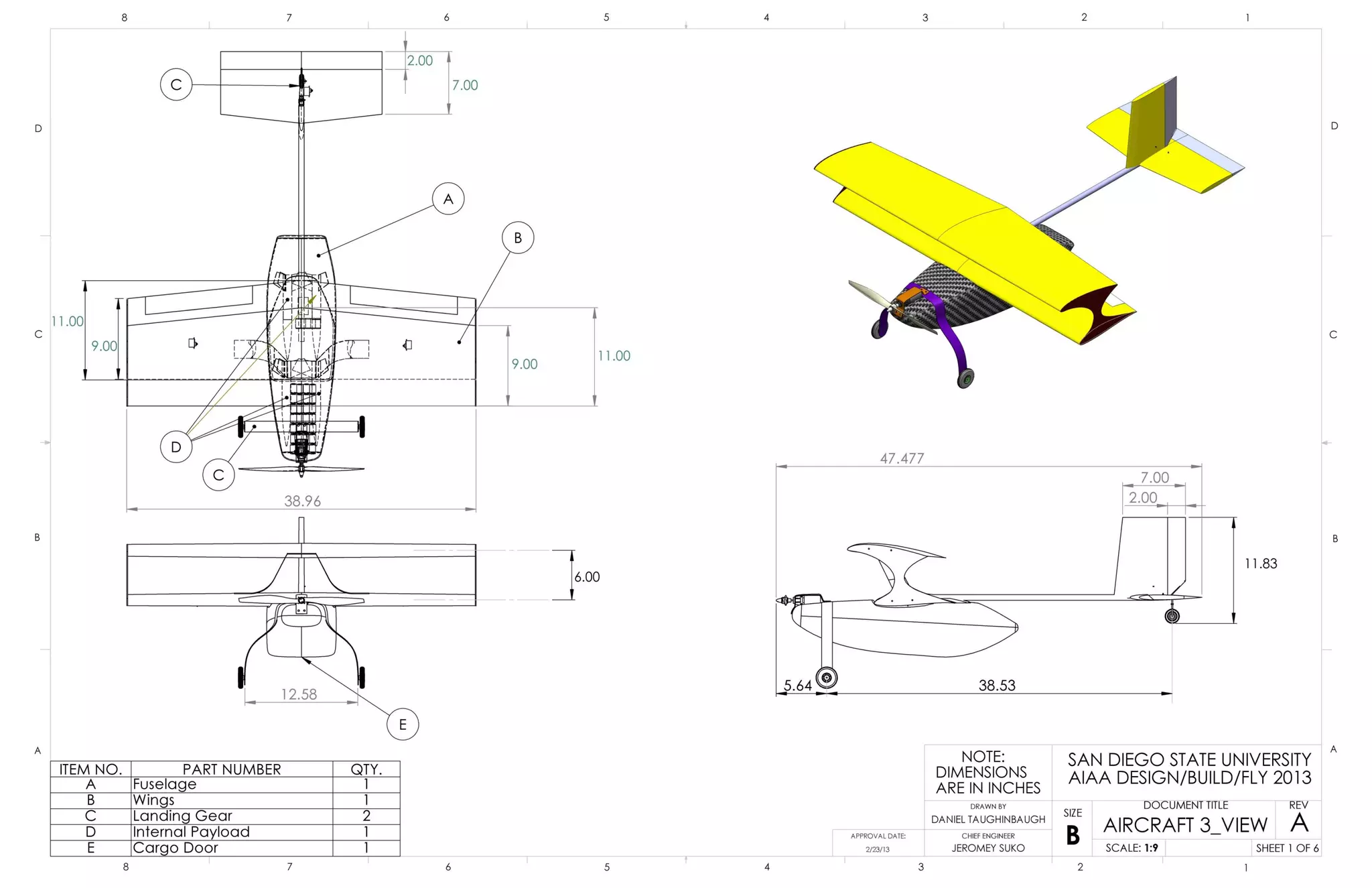
5.7 DRAWING PACKAGE
The following drawing package includes three main views of the aircraft, structural arrangement,
component layout, and payload arrangement for the various missions. Drawings and parts were
made using Solid Works.
Figure 48 –Mission 2 Performance Predictions
Figure 49 –Mission 3 Performance Predictions
39an Diego State University
40San Diego State University
41San Diego State University
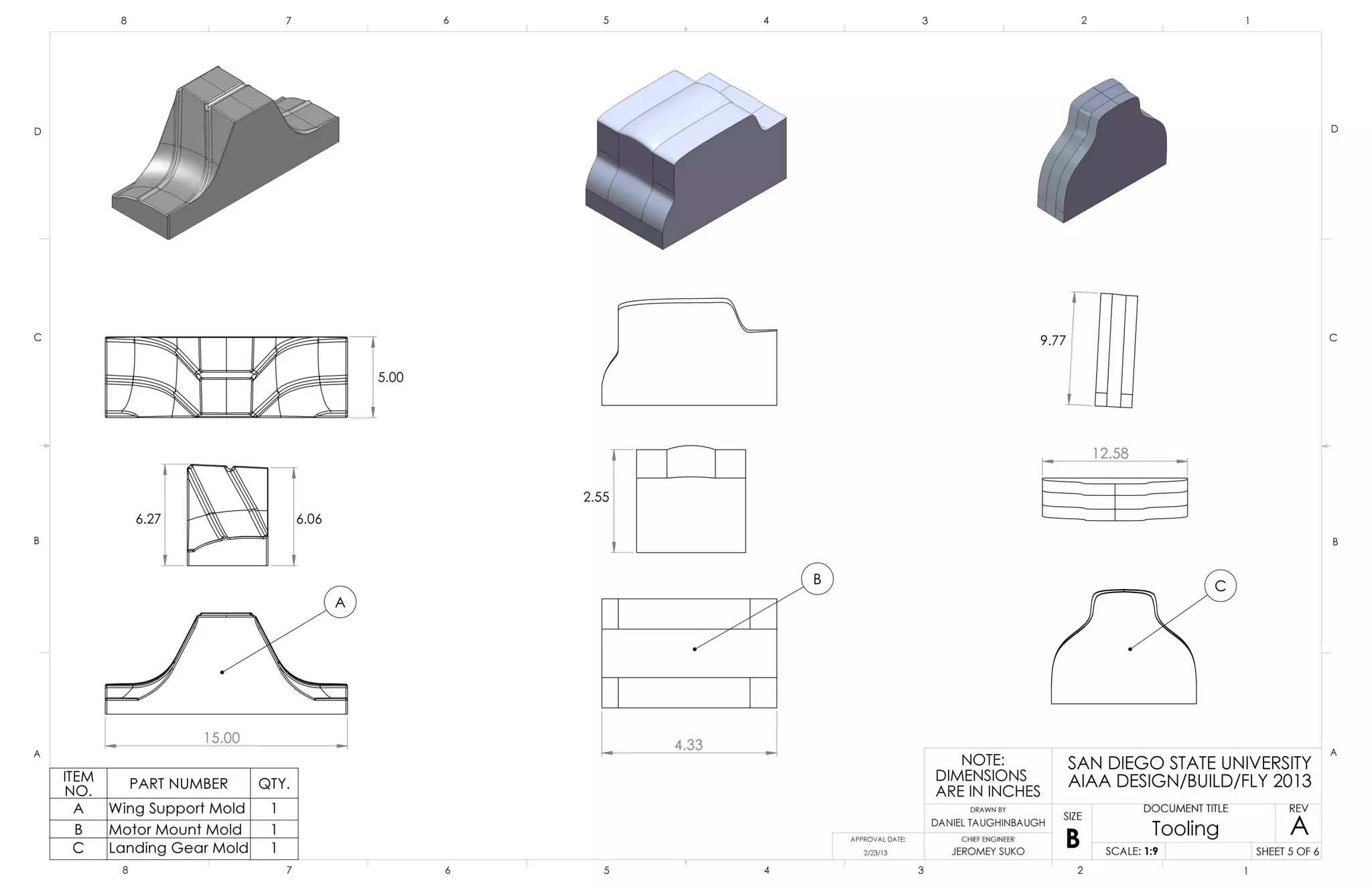
42San Diego State University
43San Diego State University
44San Diego State University
45San Diego State University
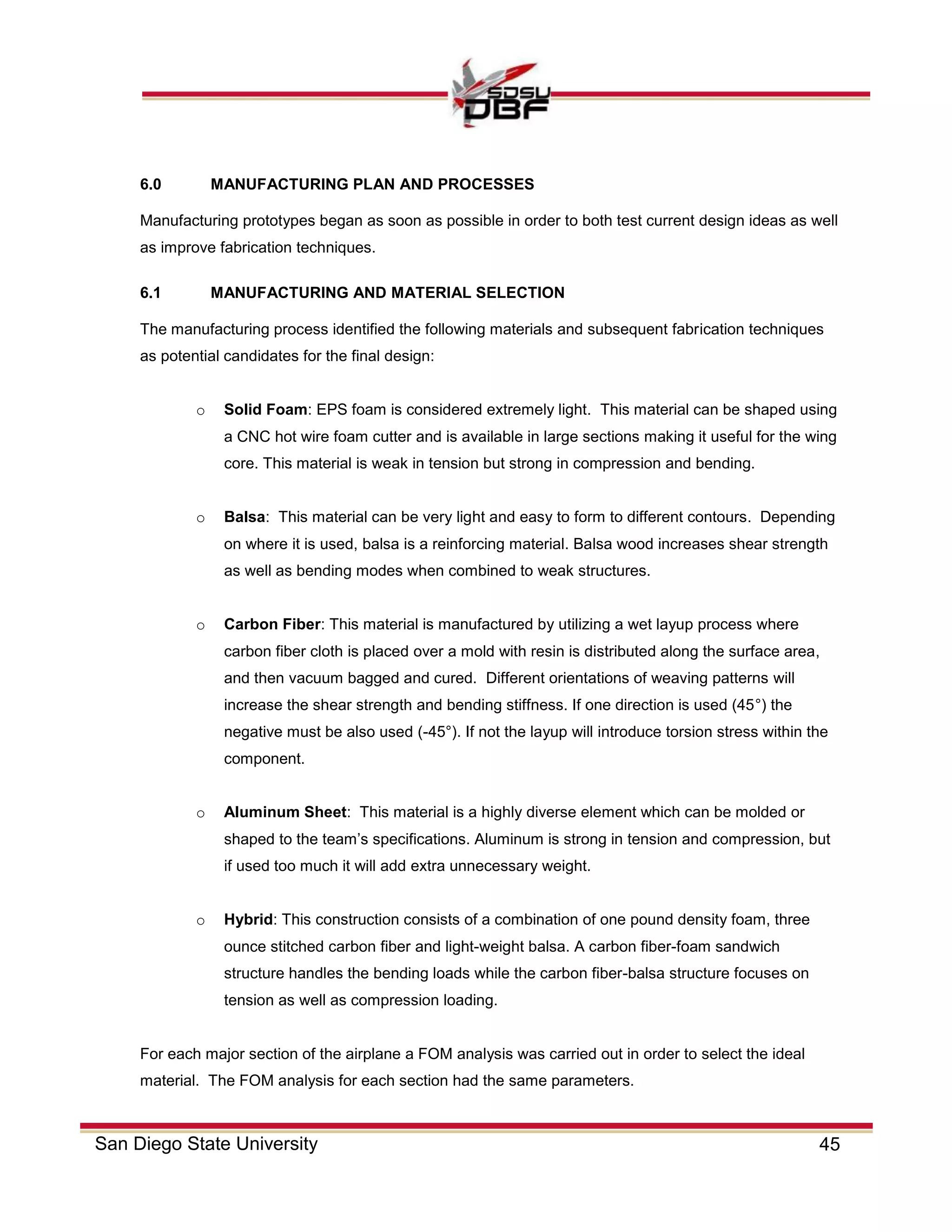
6.0 MANUFACTURING PLAN AND PROCESSES
Manufacturing prototypes began as soon as possible in order to both test current design ideas as well
as improve fabrication techniques.
6.1 MANUFACTURING AND MATERIAL SELECTION
The manufacturing process identified the following materials and subsequent fabrication techniques
as potential candidates for the final design:
o Solid Foam: EPS foam is considered extremely light. This material can be shaped using
a CNC hot wire foam cutter and is available in large sections making it useful for the wing
core. This material is weak in tension but strong in compression and bending.
o Balsa: This material can be very light and easy to form to different contours. Depending
on where it is used, balsa is a reinforcing material. Balsa wood increases shear strength
as well as bending modes when combined to weak structures.
o Carbon Fiber: This material is manufactured by utilizing a wet layup process where
carbon fiber cloth is placed over a mold with resin is distributed along the surface area,
and then vacuum bagged and cured. Different orientations of weaving patterns will
increase the shear strength and bending stiffness. If one direction is used (45°) the
negative must be also used (-45°). If not the layup will introduce torsion stress within the
component.
o Aluminum Sheet: This material is a highly diverse element which can be molded or
shaped to the team’s specifications. Aluminum is strong in tension and compression, but
if used too much it will add extra unnecessary weight.
o Hybrid: This construction consists of a combination of one pound density foam, three
ounce stitched carbon fiber and light-weight balsa. A carbon fiber-foam sandwich
structure handles the bending loads while the carbon fiber-balsa structure focuses on
tension as well as compression loading.
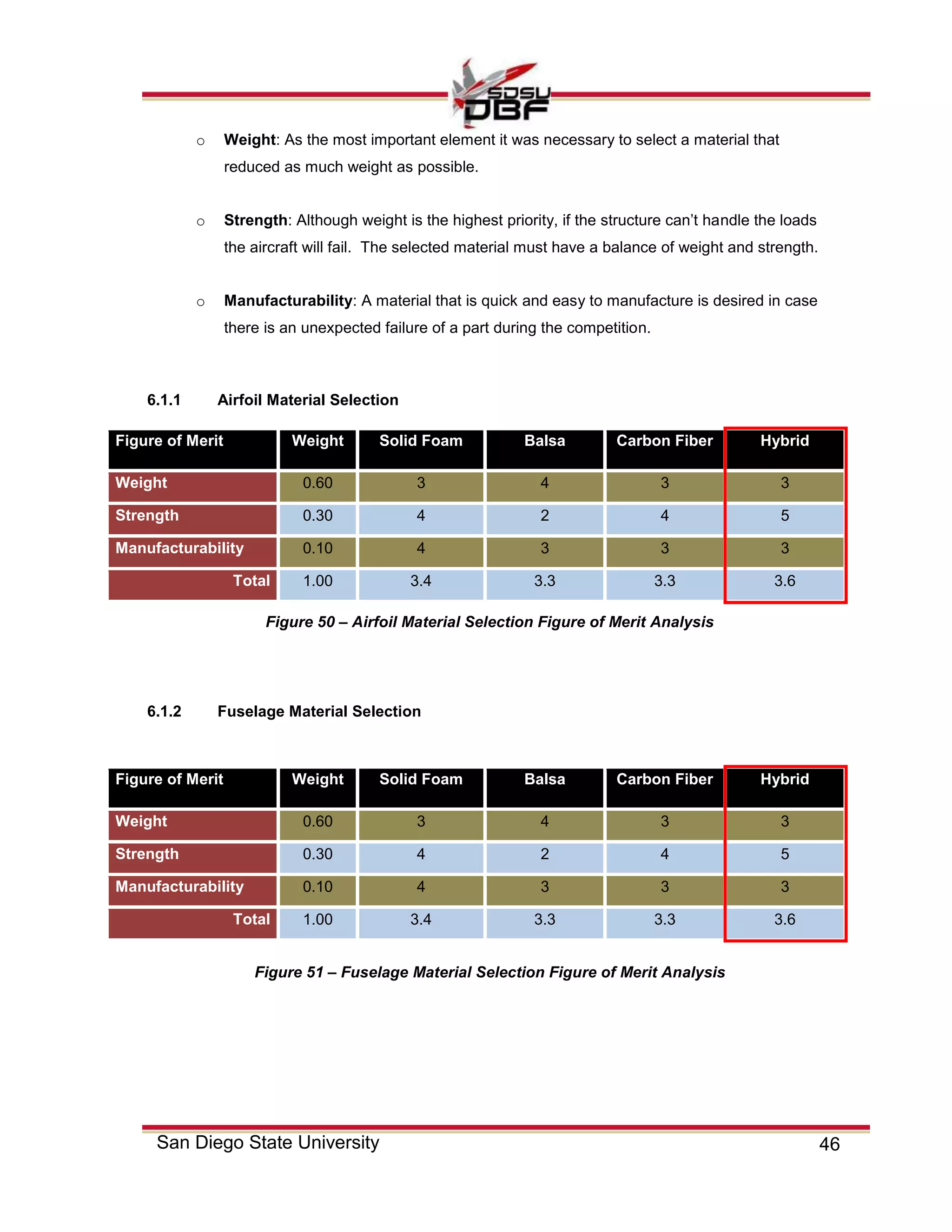
For each major section of the airplane a FOM analysis was carried out in order to select the ideal
material. The FOM analysis for each section had the same parameters.
46San Diego State University
o Weight: As the most important element it was necessary to select a material that
reduced as much weight as possible.
o Strength: Although weight is the highest priority, if the structure can’t handle the loads
the aircraft will fail. The selected material must have a balance of weight and strength.
o Manufacturability: A material that is quick and easy to manufacture is desired in case
there is an unexpected failure of a part during the competition.
6.1.1 Airfoil Material Selection
Figure of Merit Weight Solid Foam Balsa Carbon Fiber Hybrid
Weight 0.60 3 4 3 3
Strength 0.30 4 2 4 5
Manufacturability 0.10 4 3 3 3
Total 1.00 3.4 3.3 3.3 3.6
6.1.2 Fuselage Material Selection
Figure of Merit Weight Solid Foam Balsa Carbon Fiber Hybrid
Weight 0.60 3 4 3 3
Strength 0.30 4 2 4 5
Manufacturability 0.10 4 3 3 3
Total 1.00 3.4 3.3 3.3 3.6
Figure 50 – Airfoil Material Selection Figure of Merit Analysis
Figure 51 – Fuselage Material Selection Figure of Merit Analysis
47San Diego State University
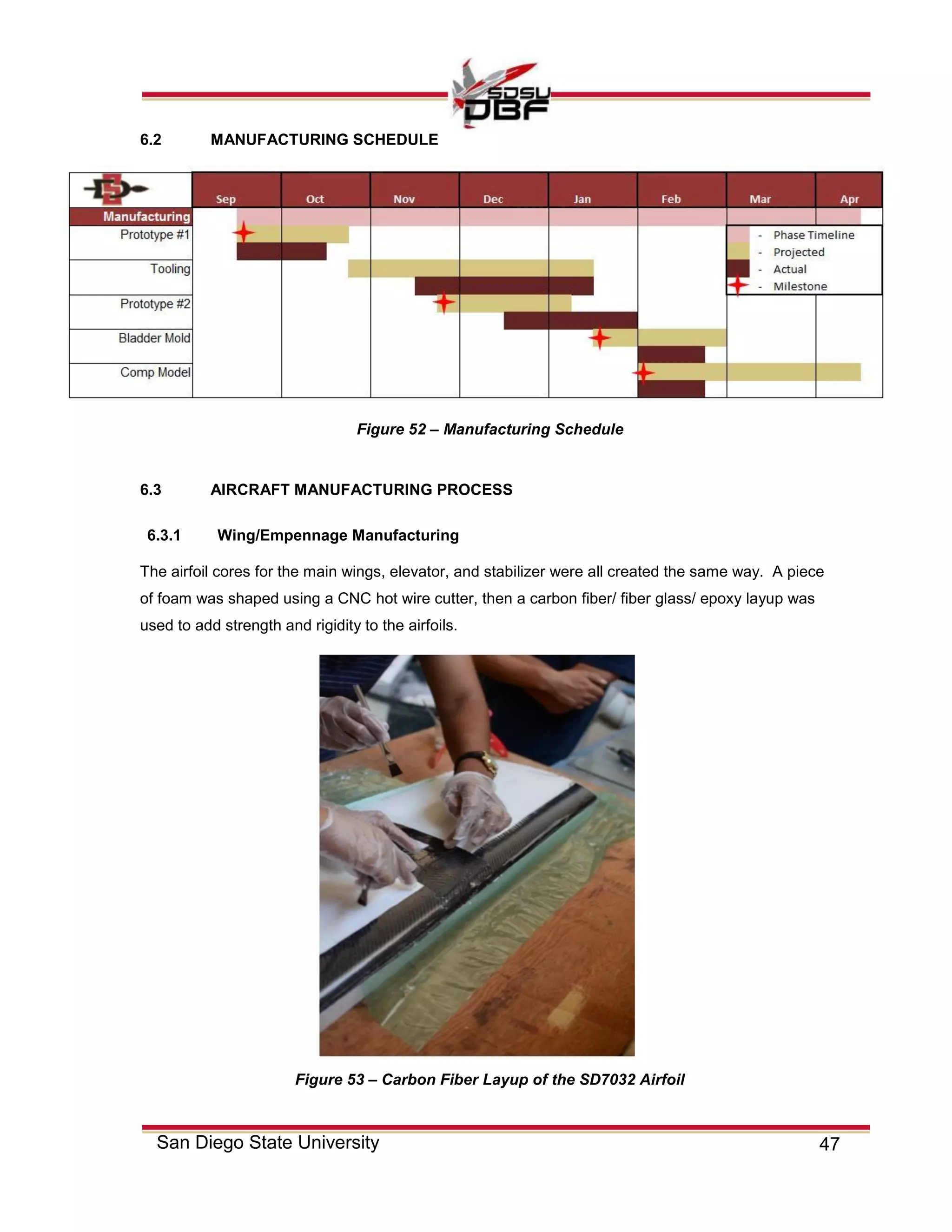
6.2 MANUFACTURING SCHEDULE
6.3 AIRCRAFT MANUFACTURING PROCESS
6.3.1 Wing/Empennage Manufacturing
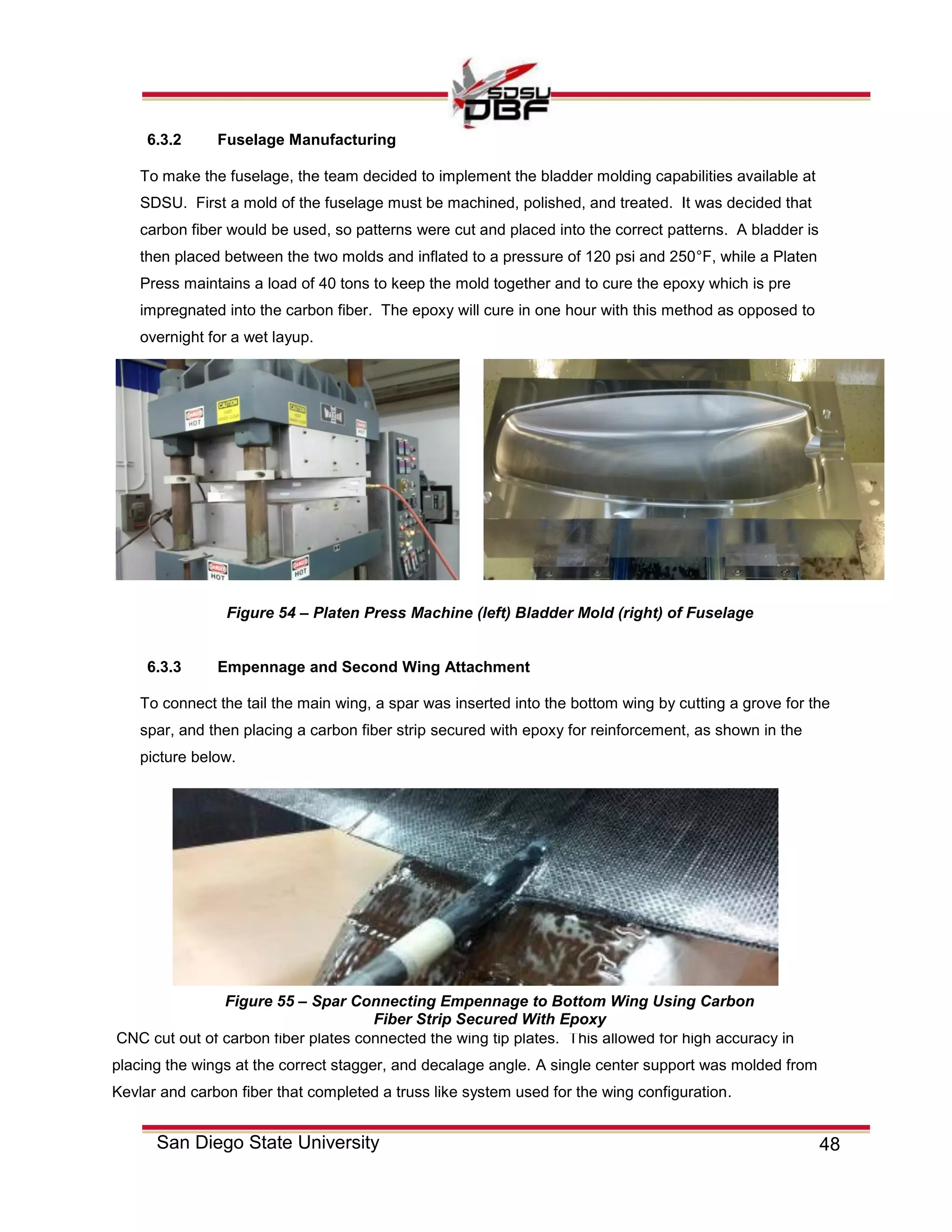
The airfoil cores for the main wings, elevator, and stabilizer were all created the same way. A piece
of foam was shaped using a CNC hot wire cutter, then a carbon fiber/ fiber glass/ epoxy layup was
used to add strength and rigidity to the airfoils.
Figure 52 – Manufacturing Schedule
Figure 53 – Carbon Fiber Layup of the SD7032 Airfoil
48San Diego State University
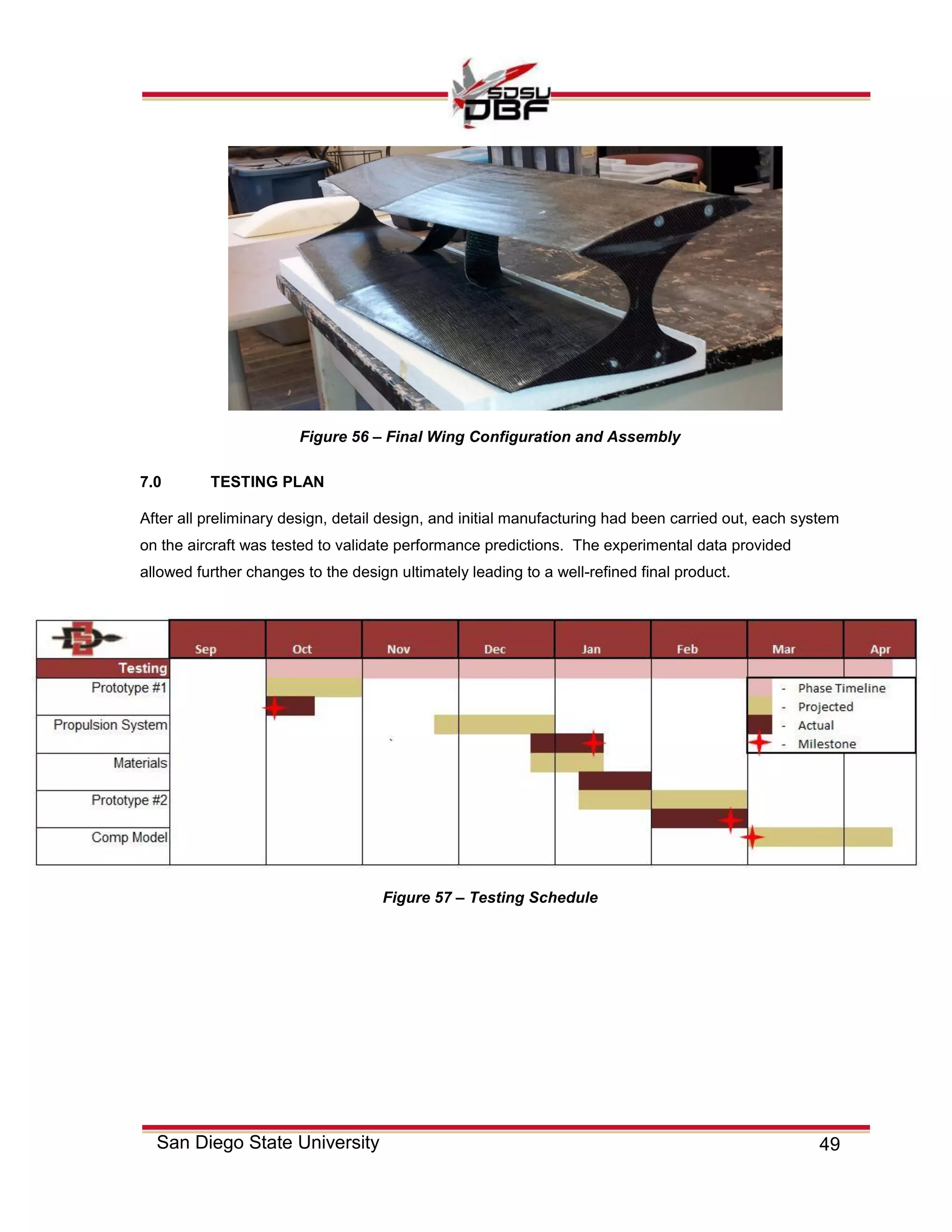
6.3.2 Fuselage Manufacturing
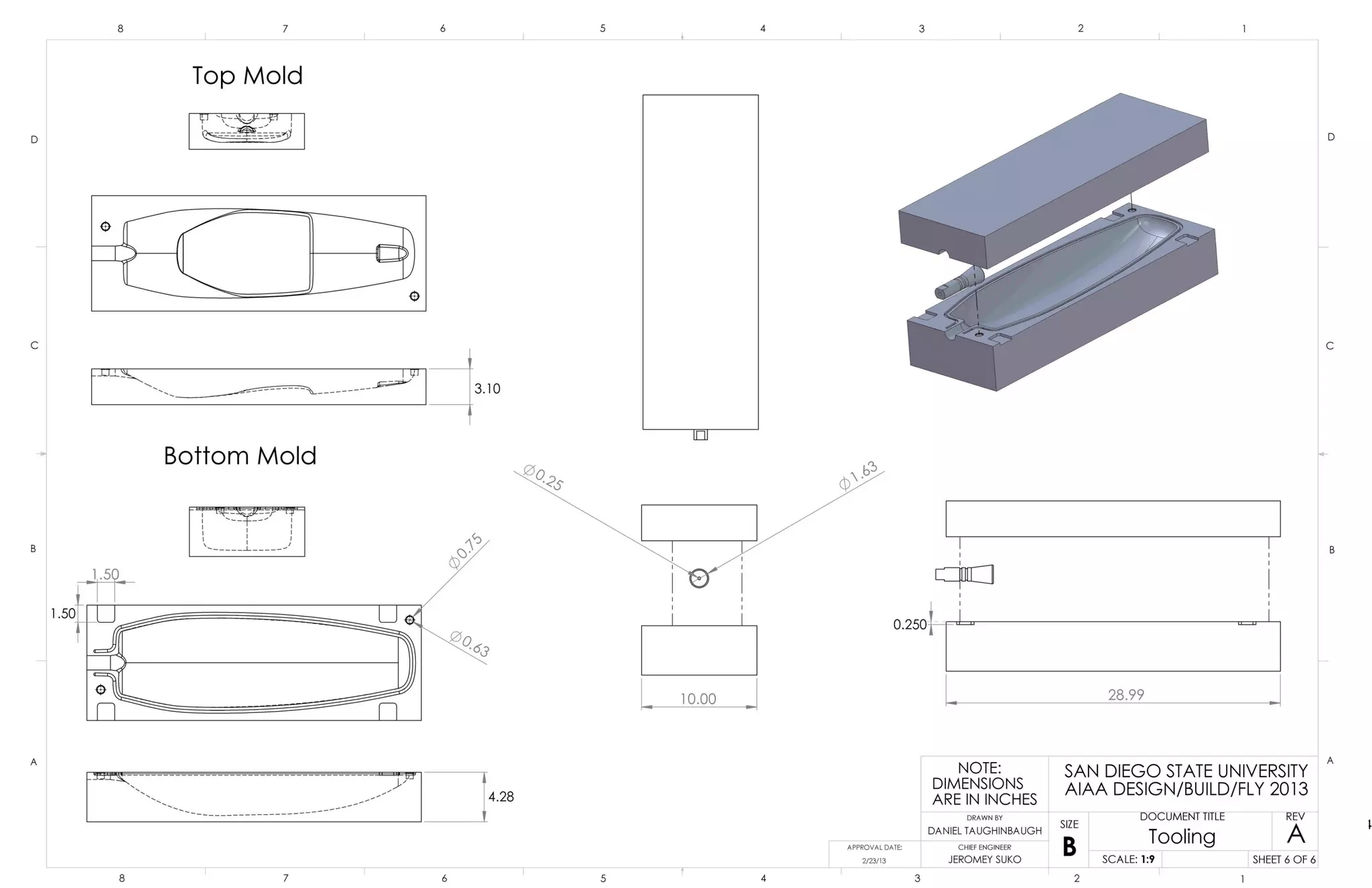
To make the fuselage, the team decided to implement the bladder molding capabilities available at
SDSU. First a mold of the fuselage must be machined, polished, and treated. It was decided that
carbon fiber would be used, so patterns were cut and placed into the correct patterns. A bladder is
then placed between the two molds and inflated to a pressure of 120 psi and 250°F, while a Platen
Press maintains a load of 40 tons to keep the mold together and to cure the epoxy which is pre
impregnated into the carbon fiber. The epoxy will cure in one hour with this method as opposed to
overnight for a wet layup.
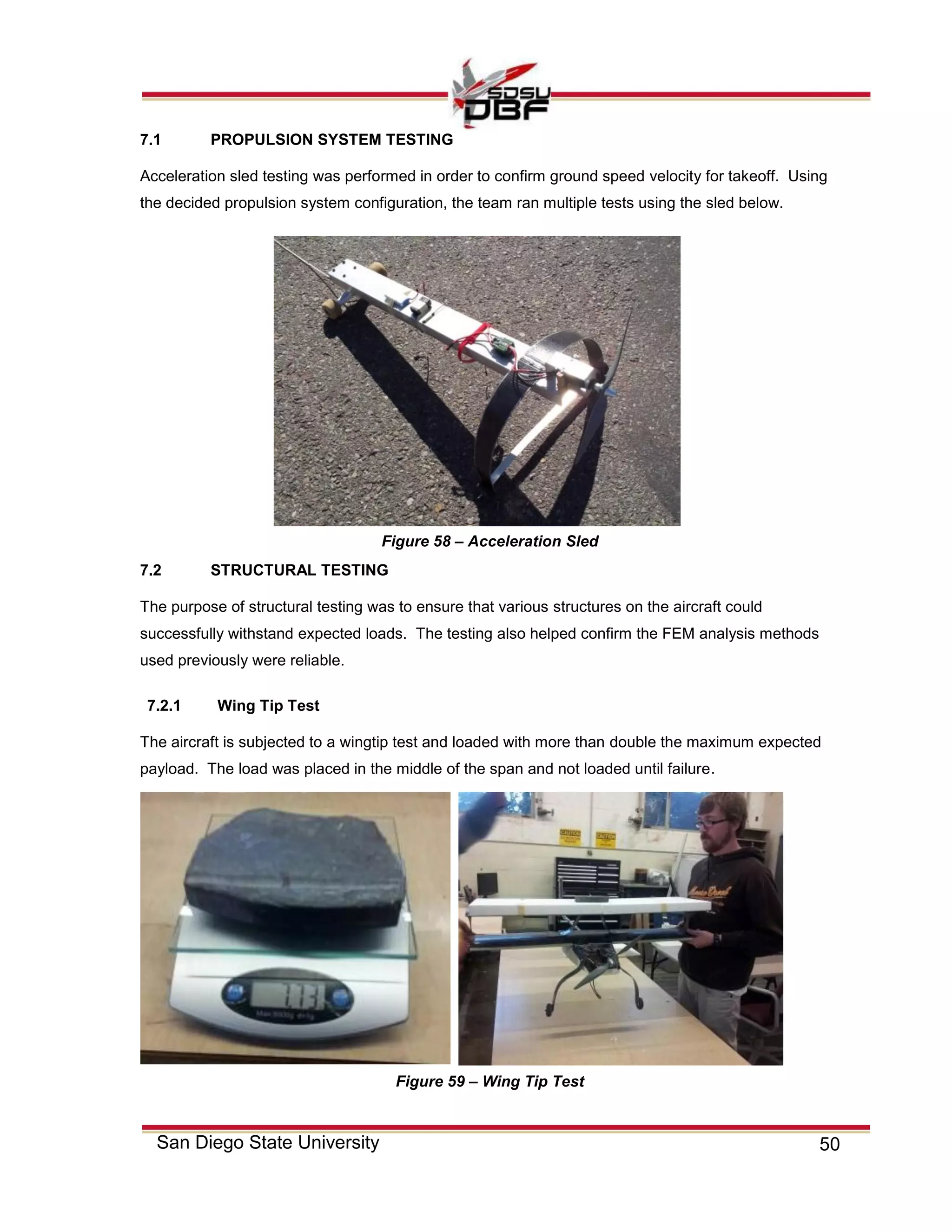
6.3.3 Empennage and Second Wing Attachment
To connect the tail the main wing, a spar was inserted into the bottom wing by cutting a grove for the
spar, and then placing a carbon fiber strip secured with epoxy for reinforcement, as shown in the
picture below.
CNC cut out of carbon fiber plates connected the wing tip plates. This allowed for high accuracy in
placing the wings at the correct stagger, and decalage angle. A single center support was molded from
Kevlar and carbon fiber that completed a truss like system used for the wing configuration.
Figure 54 – Platen Press Machine (left) Bladder Mold (right) of Fuselage
Figure 55 – Spar Connecting Empennage to Bottom Wing Using Carbon
Fiber Strip Secured With Epoxy
49San Diego State University
7.0 TESTING PLAN
After all preliminary design, detail design, and initial manufacturing had been carried out, each system
on the aircraft was tested to validate performance predictions. The experimental data provided
allowed further changes to the design ultimately leading to a well-refined final product.
Figure 56 – Final Wing Configuration and Assembly
Figure 57 – Testing Schedule
50San Diego State University
7.1 PROPULSION SYSTEM TESTING
Acceleration sled testing was performed in order to confirm ground speed velocity for takeoff. Using
the decided propulsion system configuration, the team ran multiple tests using the sled below.
7.2 STRUCTURAL TESTING
The purpose of structural testing was to ensure that various structures on the aircraft could
successfully withstand expected loads. The testing also helped confirm the FEM analysis methods
used previously were reliable.
7.2.1 Wing Tip Test
The aircraft is subjected to a wingtip test and loaded with more than double the maximum expected
payload. The load was placed in the middle of the span and not loaded until failure.
Figure 58 – Acceleration Sled
Figure 59 – Wing Tip Test
51San Diego State University
7.2.2 Landing Gear Test
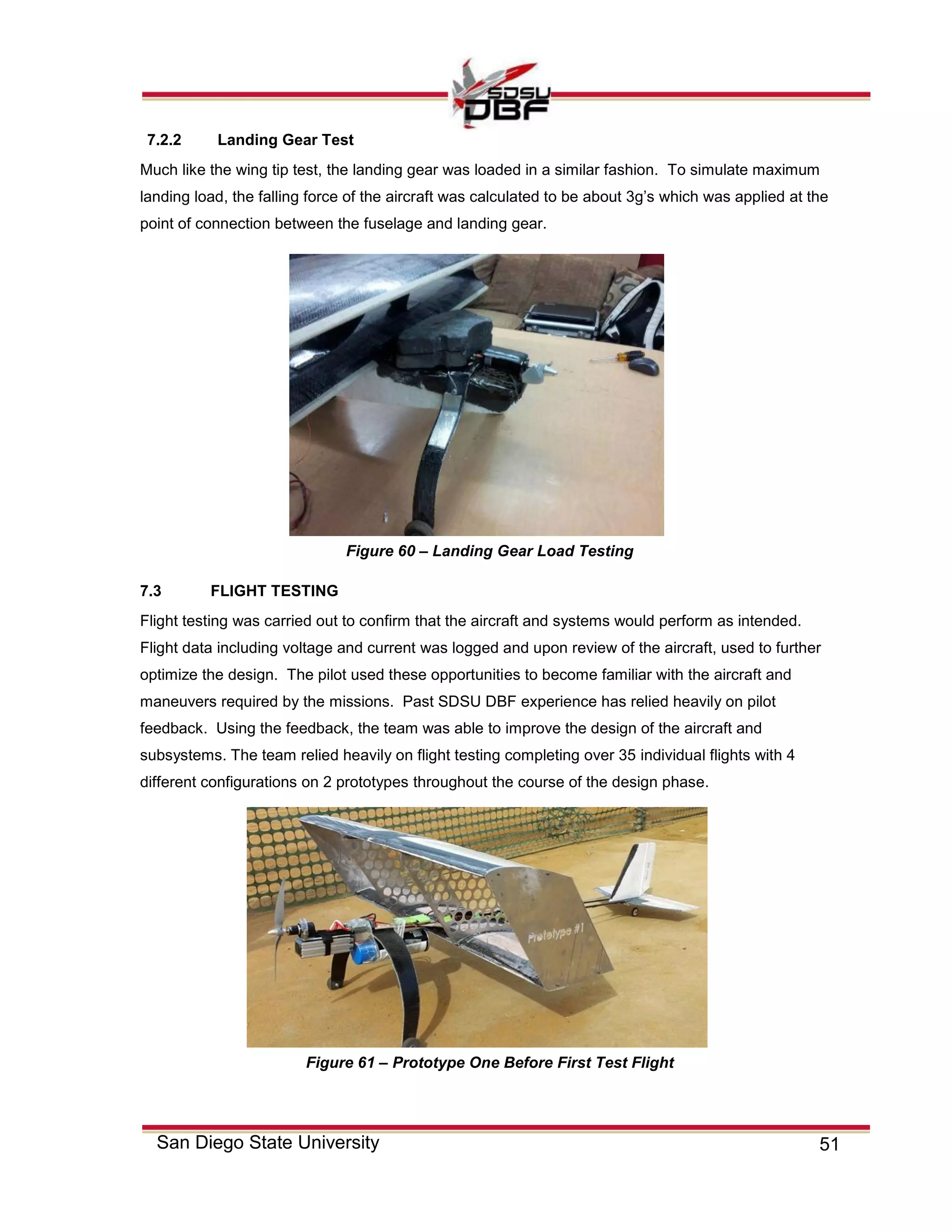
Much like the wing tip test, the landing gear was loaded in a similar fashion. To simulate maximum
landing load, the falling force of the aircraft was calculated to be about 3g’s which was applied at the
point of connection between the fuselage and landing gear.
7.3 FLIGHT TESTING
Flight testing was carried out to confirm that the aircraft and systems would perform as intended.
Flight data including voltage and current was logged and upon review of the aircraft, used to further
optimize the design. The pilot used these opportunities to become familiar with the aircraft and
maneuvers required by the missions. Past SDSU DBF experience has relied heavily on pilot
feedback. Using the feedback, the team was able to improve the design of the aircraft and
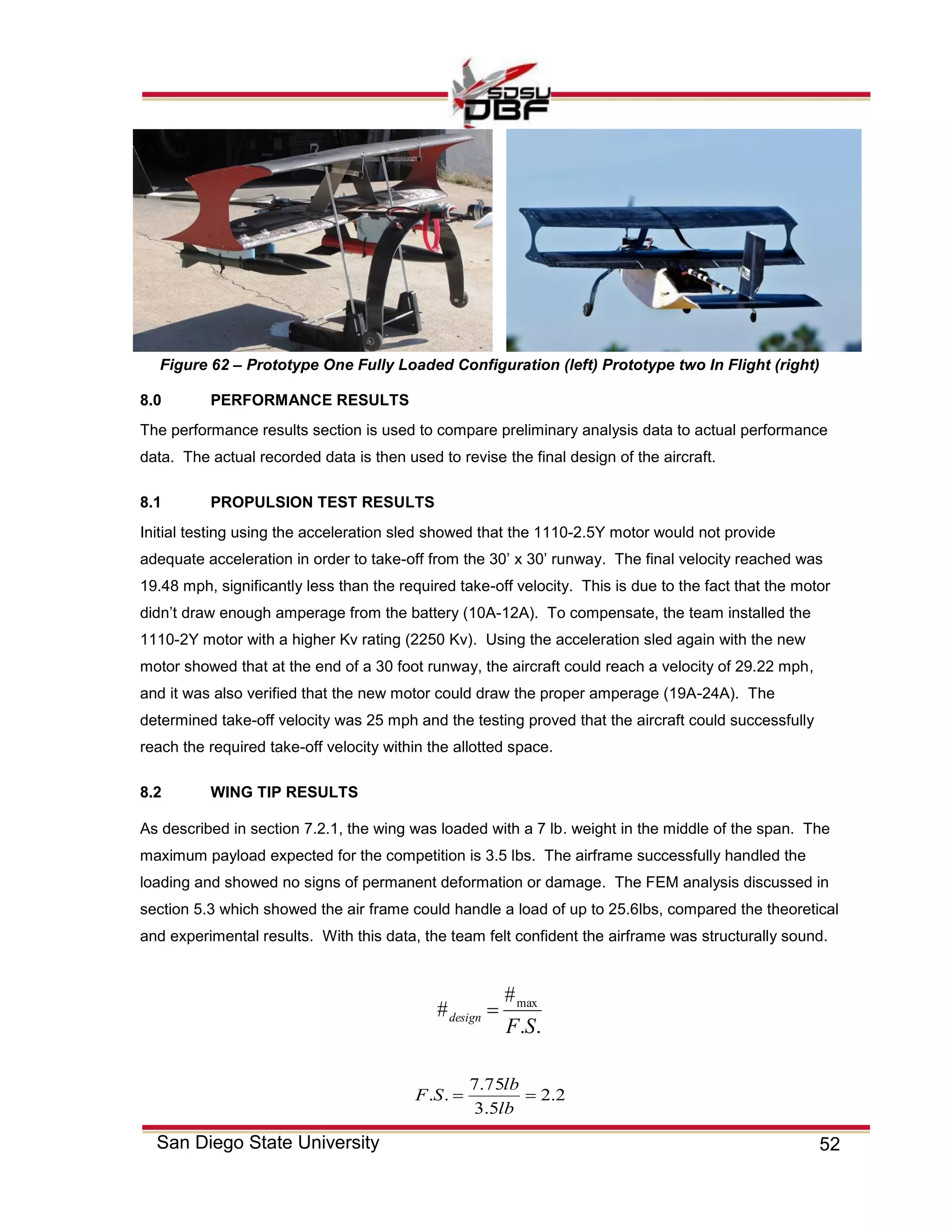
subsystems. The team relied heavily on flight testing completing over 35 individual flights with 4
different configurations on 2 prototypes throughout the course of the design phase.
Figure 60 – Landing Gear Load Testing
Figure 61 – Prototype One Before First Test Flight
52San Diego State University
8.0 PERFORMANCE RESULTS
The performance results section is used to compare preliminary analysis data to actual performance
data. The actual recorded data is then used to revise the final design of the aircraft.
8.1 PROPULSION TEST RESULTS
Initial testing using the acceleration sled showed that the 1110-2.5Y motor would not provide
adequate acceleration in order to take-off from the 30’ x 30’ runway. The final velocity reached was
19.48 mph, significantly less than the required take-off velocity. This is due to the fact that the motor
didn’t draw enough amperage from the battery (10A-12A). To compensate, the team installed the
1110-2Y motor with a higher Kv rating (2250 Kv). Using the acceleration sled again with the new
motor showed that at the end of a 30 foot runway, the aircraft could reach a velocity of 29.22 mph,
and it was also verified that the new motor could draw the proper amperage (19A-24A). The
determined take-off velocity was 25 mph and the testing proved that the aircraft could successfully
reach the required take-off velocity within the allotted space.
8.2 WING TIP RESULTS
As described in section 7.2.1, the wing was loaded with a 7 lb. weight in the middle of the span. The
maximum payload expected for the competition is 3.5 lbs. The airframe successfully handled the
loading and showed no signs of permanent deformation or damage. The FEM analysis discussed in
section 5.3 which showed the air frame could handle a load of up to 25.6lbs, compared the theoretical
and experimental results. With this data, the team felt confident the airframe was structurally sound.
..
#
# max
SF
design 
2.2
5.3
75.7
.. 
lb
lb
SF
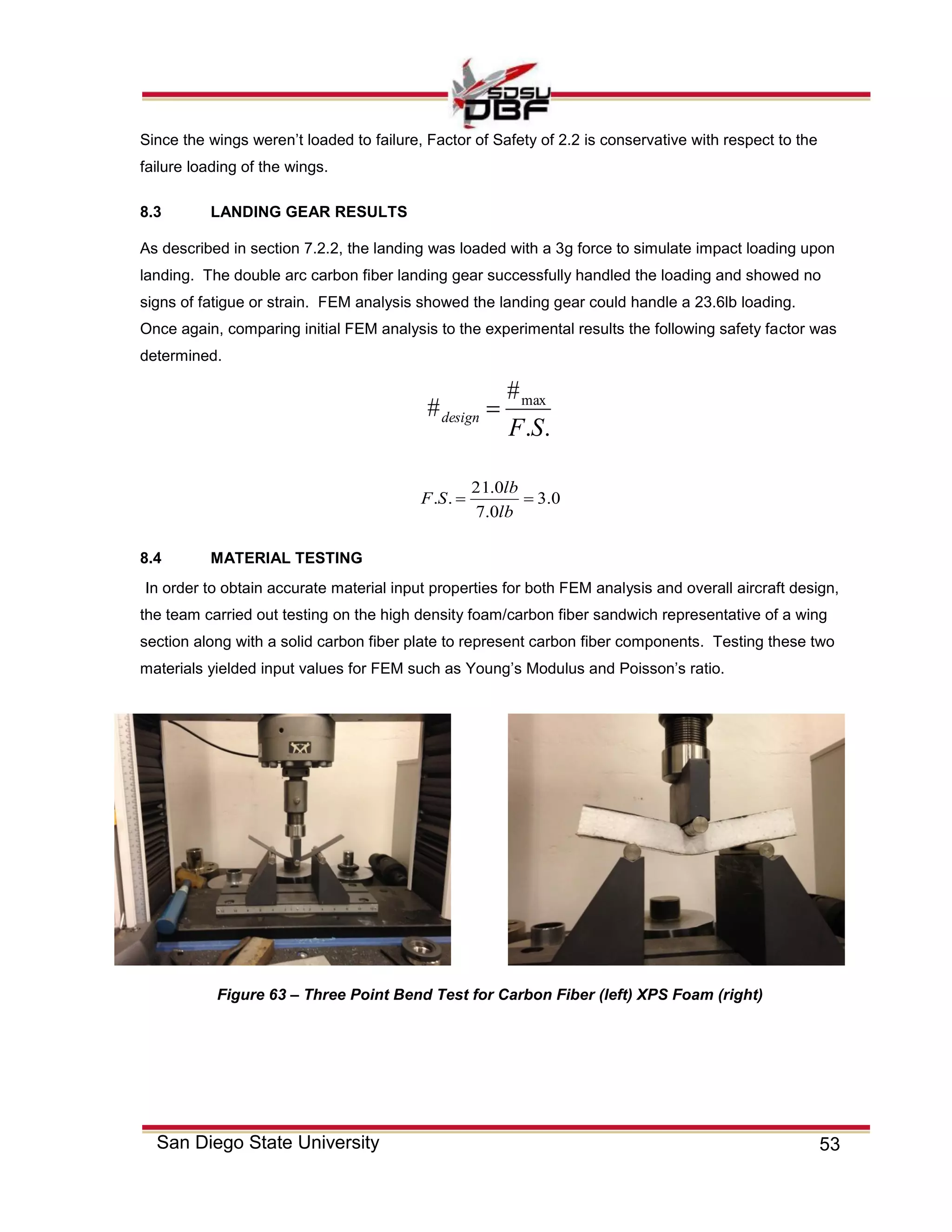
Figure 62 – Prototype One Fully Loaded Configuration (left) Prototype two In Flight (right)
53San Diego State University
Since the wings weren’t loaded to failure, Factor of Safety of 2.2 is conservative with respect to the
failure loading of the wings.
8.3 LANDING GEAR RESULTS
As described in section 7.2.2, the landing was loaded with a 3g force to simulate impact loading upon
landing. The double arc carbon fiber landing gear successfully handled the loading and showed no
signs of fatigue or strain. FEM analysis showed the landing gear could handle a 23.6lb loading.
Once again, comparing initial FEM analysis to the experimental results the following safety factor was
determined.
..
#
# max
SF
design 
0.3
0.7
0.21
.. 
lb
lb
SF
8.4 MATERIAL TESTING
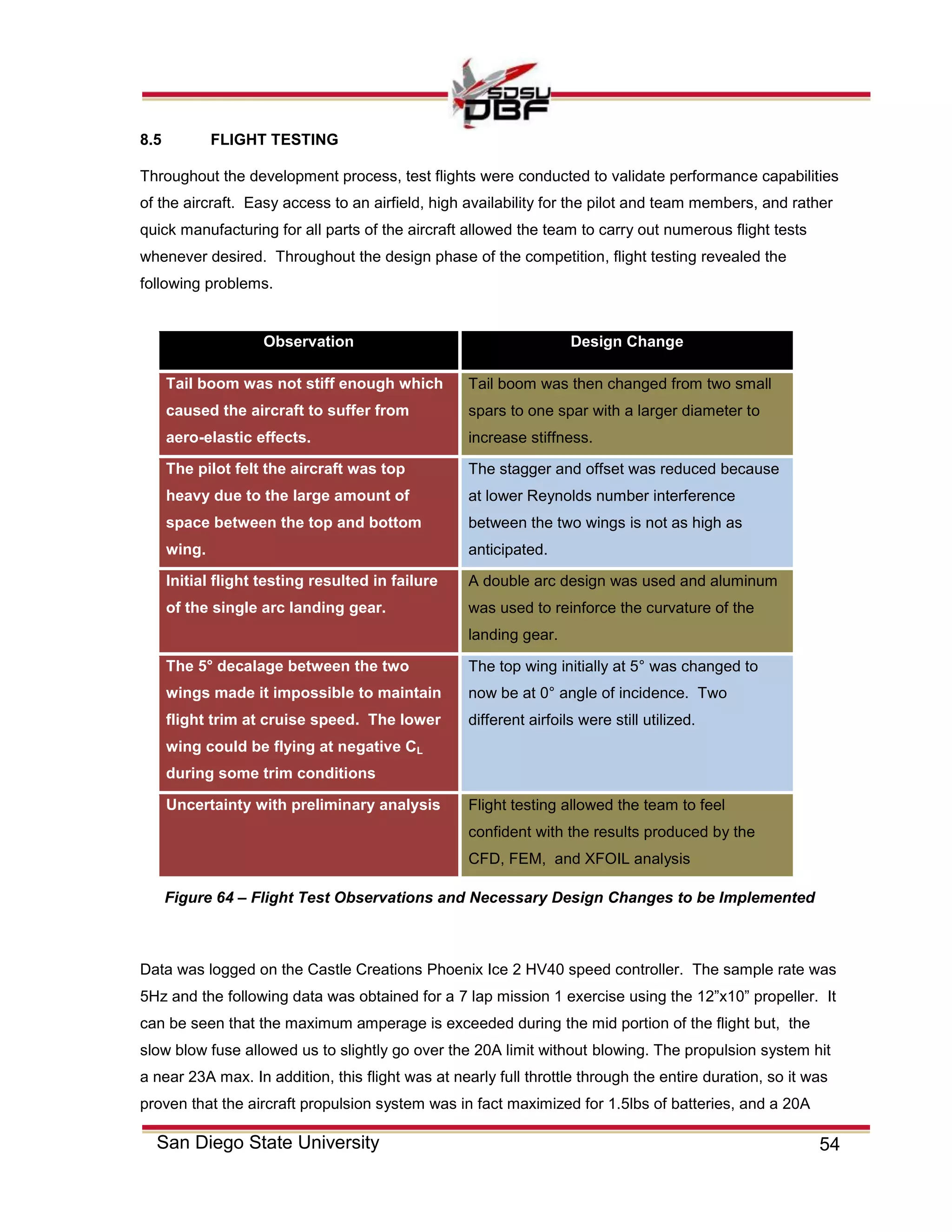
In order to obtain accurate material input properties for both FEM analysis and overall aircraft design,
the team carried out testing on the high density foam/carbon fiber sandwich representative of a wing
section along with a solid carbon fiber plate to represent carbon fiber components. Testing these two
materials yielded input values for FEM such as Young’s Modulus and Poisson’s ratio.
Figure 63 – Three Point Bend Test for Carbon Fiber (left) XPS Foam (right)
54San Diego State University
8.5 FLIGHT TESTING
Throughout the development process, test flights were conducted to validate performance capabilities
of the aircraft. Easy access to an airfield, high availability for the pilot and team members, and rather
quick manufacturing for all parts of the aircraft allowed the team to carry out numerous flight tests
whenever desired. Throughout the design phase of the competition, flight testing revealed the
following problems.
Observation Design Change
Tail boom was not stiff enough which
caused the aircraft to suffer from
aero-elastic effects.
Tail boom was then changed from two small
spars to one spar with a larger diameter to
increase stiffness.
The pilot felt the aircraft was top
heavy due to the large amount of
space between the top and bottom
wing.
The stagger and offset was reduced because
at lower Reynolds number interference
between the two wings is not as high as
anticipated.
Initial flight testing resulted in failure
of the single arc landing gear.
A double arc design was used and aluminum
was used to reinforce the curvature of the
landing gear.
The 5° decalage between the two
wings made it impossible to maintain
flight trim at cruise speed. The lower
wing could be flying at negative CL
during some trim conditions
The top wing initially at 5° was changed to
now be at 0° angle of incidence. Two
different airfoils were still utilized.
Uncertainty with preliminary analysis Flight testing allowed the team to feel
confident with the results produced by the
CFD, FEM, and XFOIL analysis
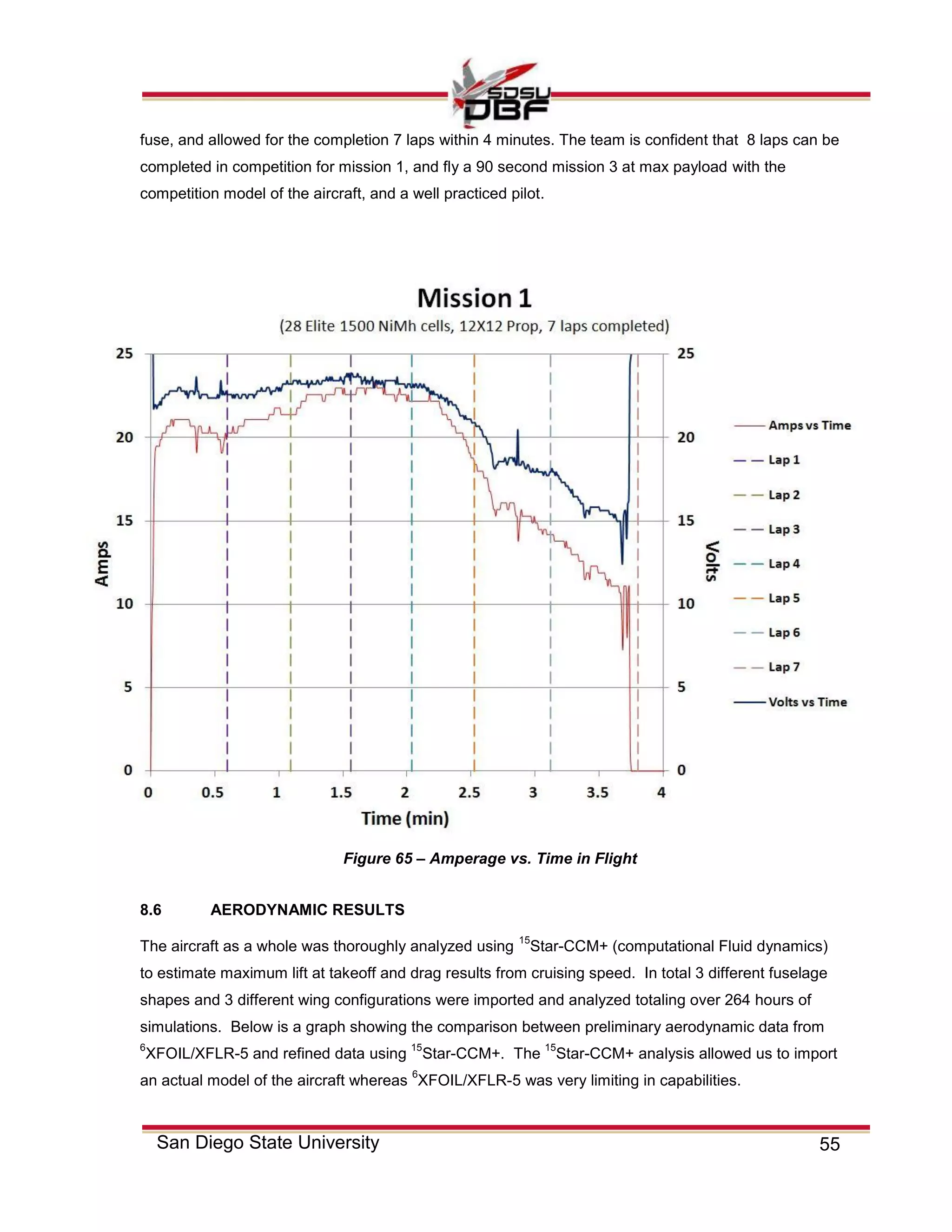
Data was logged on the Castle Creations Phoenix Ice 2 HV40 speed controller. The sample rate was
5Hz and the following data was obtained for a 7 lap mission 1 exercise using the 12”x10” propeller. It
can be seen that the maximum amperage is exceeded during the mid portion of the flight but, the
slow blow fuse allowed us to slightly go over the 20A limit without blowing. The propulsion system hit
a near 23A max. In addition, this flight was at nearly full throttle through the entire duration, so it was
proven that the aircraft propulsion system was in fact maximized for 1.5lbs of batteries, and a 20A
Figure 64 – Flight Test Observations and Necessary Design Changes to be Implemented
55San Diego State University
fuse, and allowed for the completion 7 laps within 4 minutes. The team is confident that 8 laps can be
completed in competition for mission 1, and fly a 90 second mission 3 at max payload with the
competition model of the aircraft, and a well practiced pilot.
8.6 AERODYNAMIC RESULTS
The aircraft as a whole was thoroughly analyzed using
15
Star-CCM+ (computational Fluid dynamics)
to estimate maximum lift at takeoff and drag results from cruising speed. In total 3 different fuselage
shapes and 3 different wing configurations were imported and analyzed totaling over 264 hours of
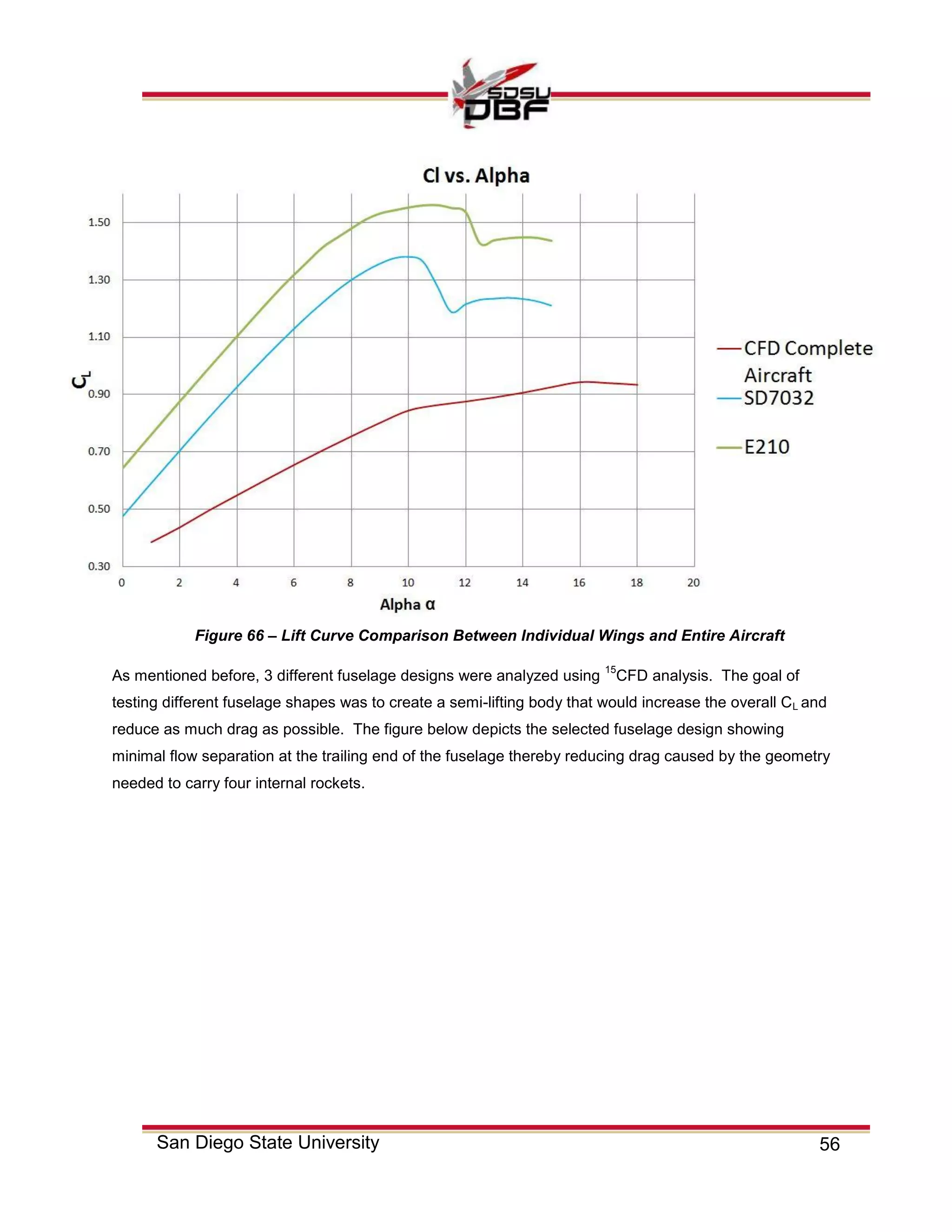
simulations. Below is a graph showing the comparison between preliminary aerodynamic data from
6
XFOIL/XFLR-5 and refined data using
15
Star-CCM+. The
15
Star-CCM+ analysis allowed us to import
an actual model of the aircraft whereas
6
XFOIL/XFLR-5 was very limiting in capabilities.
Figure 65 – Amperage vs. Time in Flight
56San Diego State University
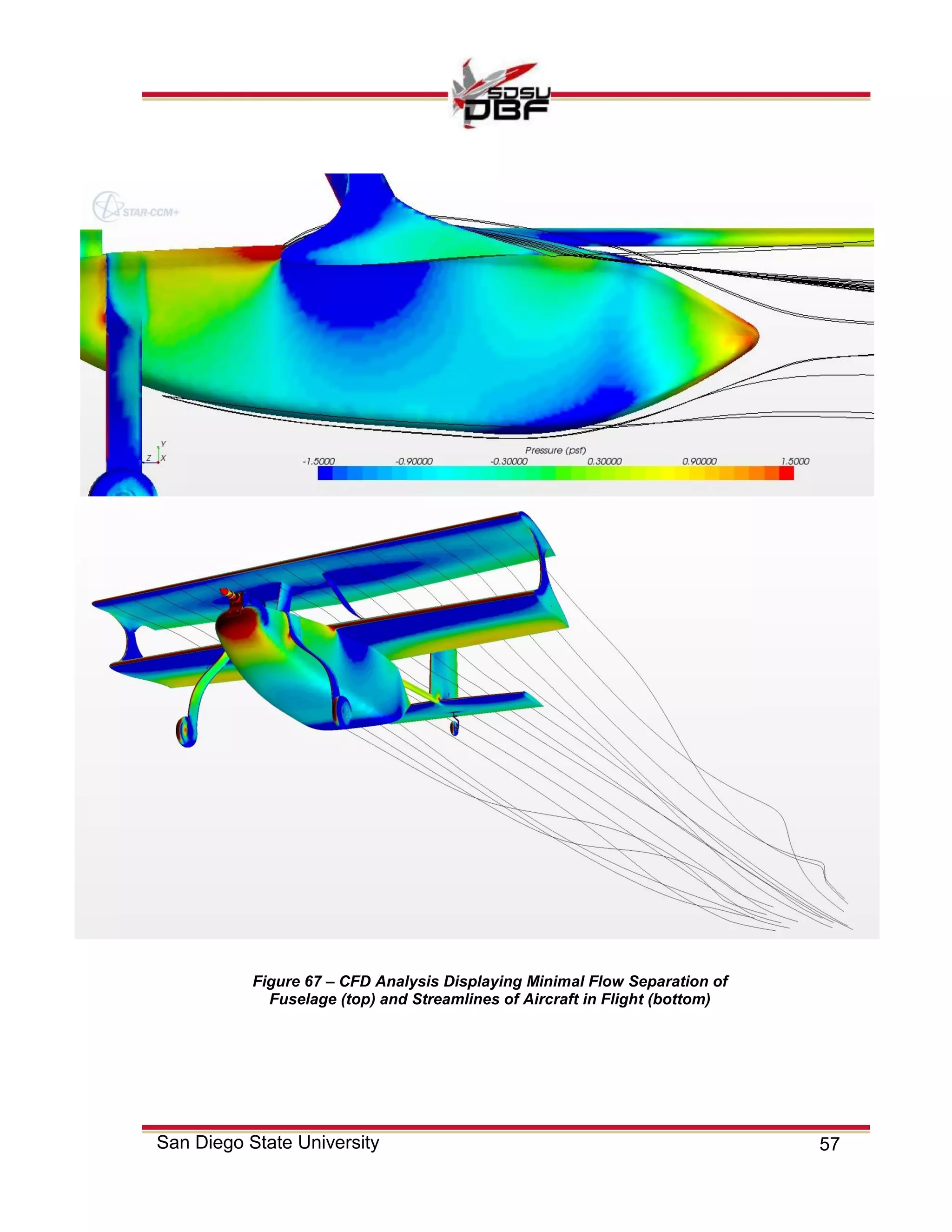
As mentioned before, 3 different fuselage designs were analyzed using
15
CFD analysis. The goal of
testing different fuselage shapes was to create a semi-lifting body that would increase the overall CL and
reduce as much drag as possible. The figure below depicts the selected fuselage design showing
minimal flow separation at the trailing end of the fuselage thereby reducing drag caused by the geometry
needed to carry four internal rockets.
Figure 66 – Lift Curve Comparison Between Individual Wings and Entire Aircraft
57San Diego State University
Figure 67 – CFD Analysis Displaying Minimal Flow Separation of
Fuselage (top) and Streamlines of Aircraft in Flight (bottom)
58San Diego State University
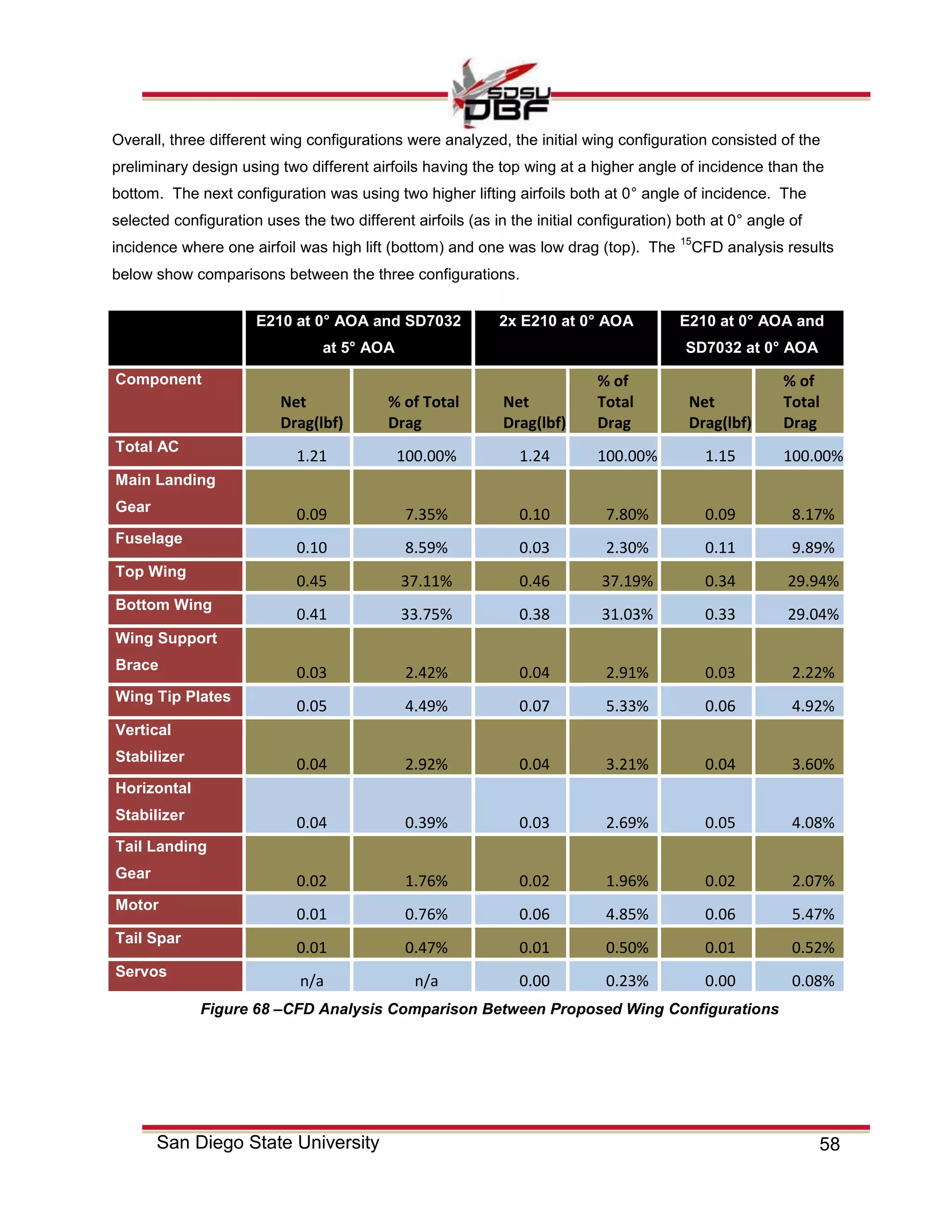
Overall, three different wing configurations were analyzed, the initial wing configuration consisted of the
preliminary design using two different airfoils having the top wing at a higher angle of incidence than the
bottom. The next configuration was using two higher lifting airfoils both at 0° angle of incidence. The
selected configuration uses the two different airfoils (as in the initial configuration) both at 0° angle of
incidence where one airfoil was high lift (bottom) and one was low drag (top). The
15
CFD analysis results
below show comparisons between the three configurations.
E210 at 0° AOA and SD7032
at 5° AOA
2x E210 at 0° AOA E210 at 0° AOA and
SD7032 at 0° AOA
Component
Net
Drag(lbf)
% of Total
Drag
Net
Drag(lbf)
% of
Total
Drag
Net
Drag(lbf)
% of
Total
Drag
Total AC
1.21 100.00% 1.24 100.00% 1.15 100.00%
Main Landing
Gear
0.09 7.35% 0.10 7.80% 0.09 8.17%
Fuselage
0.10 8.59% 0.03 2.30% 0.11 9.89%
Top Wing
0.45 37.11% 0.46 37.19% 0.34 29.94%
Bottom Wing
0.41 33.75% 0.38 31.03% 0.33 29.04%
Wing Support
Brace
0.03 2.42% 0.04 2.91% 0.03 2.22%
Wing Tip Plates
0.05 4.49% 0.07 5.33% 0.06 4.92%
Vertical
Stabilizer
0.04 2.92% 0.04 3.21% 0.04 3.60%
Horizontal
Stabilizer
0.04 0.39% 0.03 2.69% 0.05 4.08%
Tail Landing
Gear
0.02 1.76% 0.02 1.96% 0.02 2.07%
Motor
0.01 0.76% 0.06 4.85% 0.06 5.47%
Tail Spar
0.01 0.47% 0.01 0.50% 0.01 0.52%
Servos
n/a n/a 0.00 0.23% 0.00 0.08%
Figure 68 –CFD Analysis Comparison Between Proposed Wing Configurations
59San Diego State University
9.0 REFERENCES
1
AIAA. (2012 04-September). 2012/13 Rules and Vehicle Design. Retrieved 2012 04-Sept. from AIAA
DBF: [http://www.aiaadbf.org/2012_files/2012_rules.htm]
2
Abbott and A.E. Von Doenhoff. Theory of Wing Sections, New York: Dover 1959
3
Anderson, John D. Introduction to Flight. New York: McGraw-Hill, 1989
4
Anderson, John D. Fundamentals of Aerodynamics. New York: McGraw-Hill, 1991
5
Bandu N. Pamadi, Performance, Stability, Dynamics and Control of Airplanes. AIAA Education
Series, 2004.
6
Drela, Mark. XFOIL 6.96 user Guide. Boston MIT, 1986
7
Etkin, Bernard. Dynamics of Flight. New York: John Wiley & Sons, 1996
8
Kroo, Ilan Aircraft Design: Synthesis and Analysis, Version 0.9.
http://adg.stanford.edu/aa241/AircraftDesign.html
9
Nicolai, Leland. Fundamentals of Aircraft Design. San Jose: Mets, 1984
10
Raymer, D. (2008). Aircraft Design: A Conceptual Approach. Reston, Virginia: American Institute of
Aeronautics and Astronautics.
11
Roskam, Jan. Airplane Design: Part VI. Lawrence: DARcorporation, 2000
12
Motocalc 8. s.l. :Capable Computing inc. http://www.motocalc.com/index.html
13
Muller, Markus. eCalc. http://wwww.ecalc.ch/motocalc_e.htm?ecalc
14
UGS Corp., ComponentOne, DriveWorks Ltd., Geometric Ltd., Microsoft Corporation, Spatial
Corp., Luxology, Inc., The University of Tennessee, Siemens industry Software Limited, and
Siemens Product Lifecycle Management Software inc. SolidWorks 2012. Vers. Student.
Waltham: Dassault Systemes, 1993. Computer Software.
15
Star-CCM+. By CD-adapco. http://www.cd-adapco.com/products/star_ccm_plus/
16
UGS Corp., ComponentOne, DriveWorks Ltd., Geometric Ltd., Microsoft Corporation, Spatial
Corp., Luxology, Inc., The University of Tennessee, Siemens industry Software Limited, and
Siemens Product Lifecycle Management Software inc. Abaqus 2010. Vers.
Waltham: Dassault Systemes, 1993. Computer Software.

2013DBF_SanDiegoStateUniversity

  • 1.
    1San Diego StateUniversity
  • 2.
    2San Diego StateUniversity Table of Contents 1.0 Executive Summary ................................................................................................................5 2.0 Management Summary...........................................................................................................6 2.1 Team Organization........................................................................................................................6 2.2 Working Plan.................................................................................................................................7 3.0 Conceptual Design..................................................................................................................8 3.1 Mission Requirements...................................................................................................................8 3.2 Translating Mission Requirements Into Design Requirements...................................................12 3.3 Conceptual Design Selection......................................................................................................14 3.4 Component Layout Section.........................................................................................................15 3.5 Selected Conceptual Design.......................................................................................................18 4.0 Preliminary Design................................................................................................................19 4.1 Design and Analysis Methodology..............................................................................................19 4.2 Mission Model .............................................................................................................................19 4.3 Initial Sizing .................................................................................................................................20 4.4 Aerodynamics..............................................................................................................................20 4.5 Stability and Control ....................................................................................................................23 4.6 Propulsion ...................................................................................................................................25 4.7 Structures....................................................................................................................................28 4.8 Aircraft Mission Performance......................................................................................................29 5.0 Detail Design..........................................................................................................................29 5.1 Dimensional Parameters.............................................................................................................30 5.2 Structural Characteristics............................................................................................................30 5.3 System Design, Component Selection and Integration ..............................................................31 5.4 Aircraft Component Weight and Balance....................................................................................35 5.5 Flight Performance Summary .....................................................................................................36 5.6 Mission Performance Summary..................................................................................................37
  • 3.
    3San Diego StateUniversity 5.7 Drawing Package ........................................................................................................................38 6.0 Manufacturing Plan and Processes ....................................................................................45 6.1 Manufacturing and Material Selection.........................................................................................45 6.2 Manufacturing Schedule .............................................................................................................47 6.3 Aircraft Manufacturing Process...................................................................................................47 7.0 Testing Plan...........................................................................................................................49 7.1 Propulsion System Testing .........................................................................................................50 7.2 Structural Testing ........................................................................................................................50 7.3 Flight Testing...............................................................................................................................50 8.0 Performance Results ............................................................................................................52 8.1 Propulsion Test Results ............................................................................................................530 8.2 Wing Tip Results .......................................................................................................................530 8.3 Landing Gear Results ...............................................................................................................531 8.4 Material Testing...........................................................................................................................54 8.5 Flight Testing...............................................................................................................................54 8.6 Aerodynamic Results ..................................................................................................................55 9.0 References.............................................................................................................................59
  • 4.
    4San Diego StateUniversity Nomenclature and Abbreviations
  • 5.
    5San Diego StateUniversity 1.0 EXECUTIVE SUMMARY The American Institute of Aeronautics and Astronautics (AIAA) through the applied Aerodynamics, Aircraft Design, Design Engineering and Flight Test Technical Committees and the AIAA Foundation invited students from universities around the world to the Cessna/Raytheon Missile Systems Student Design Build Fly (DBF) competition. As an extra-curricular challenge, students from San Diego State University entered the competition with an aircraft that met all general and mission requirements. The design of the aircraft was analyzed and altered until optimal performance was reached to ensure it would be competitive. During the conceptual design phase, scoring analysis showed that in order to obtain the highest possible score the weight and wingspan must be minimized, flight times must be reduced, and the optimal payload of four rockets for mission two must be used. Therefore, the aircraft was designed to achieve optimal performance utilizing a bi-wing configuration, strong propulsion system, internal payload bay capable of carrying four Estes rockets, and external wing mounted pylons capable of handling all load cases as required by mission three. The aircraft employs the use of two different airfoils (E210 and SD7032) to provide an ample amount of lift in order to get off the ground in the 30' x 30' runway. Designed with an aspect ratio of 0.96 per wing, a high overall CL, and a low drag coefficient, the aircraft achieves optimal aerodynamic efficiency. The conventional empennage, low drag pylons, and streamlined fuselage create a fast and dynamically stable aircraft. Material used consisted of both high density foam and carbon fiber ensuring a very lightweight, strong, and reliable aircraft. The team took advantage of the numerous manufacturing capabilities located on campus in constructing the aircraft. Airfoils were cut using a CNC hot wire foam cutter and then strengthened using a carbon fiber layup. The fuselage was constructed using a bladder molding process to ensure a rigid structure capable of handling required loadings. Comprehensive finite element and fluid analysis in addition to extensive flight testing proved that the aircraft not only met all mission specifications but also excelled in performance capabilities. The pilot became highly familiar with the handling of the aircraft during rigorous the flight test schedule which was used to analyze and verify the design changes and performance predictions. Unloaded, the aircraft weighs 3.50lbs and has a wingspan of 38.75 inches. Countless hours of work from disciplined and dedicated team members culminated to create a highly competitive, efficient, and lightweight aircraft destined to take the top prize in this year’s competition.
  • 6.
    6San Diego StateUniversity 2.0 MANAGEMENT SUMMARY 2.1 TEAM ORGANIZATION In an effort to optimize the workforce, the team was broken down into three sections, Report, Design, and Manufacturing. Each team lead was in charge of their respective assignment and effectively distributing the workload to the assistants. The project manager, assistant project manager, and team leads formed the leadership of the group and thus were responsible for scheduling meetings, build dates, and ensuring clear communication for the team. Incorporating underclassmen is a pivotal element in the continuation of the SDSU DBF program. Whenever possible, underclassmen were tasked with activities that would both educate as well as assist in the design, analysis, and manufacturing of the competition aircraft. Figure 1 – Team Organization Chart
  • 7.
    7San Diego StateUniversity 2.2 WORKING PLAN Figure 2 – Design Schedule
  • 8.
    8San Diego StateUniversity 3.0 CONCEPTUAL DESIGN The conceptual design phase of the project was driven by the rules and requirements of the competition as well as past SDSU DBF experience. In order to produce the highest scoring aircraft, a comprehensive set of design requirements was allocated to the competition rules constraints. A Figure of Merit (FOM) analysis was then carried out so to guide the development of the aircraft using the prior derived design requirements and constraints. 3.1 MISSION REQUIREMENTS Each mission takes off from a simulated small austere field. The rules for the 2012-2013 AIAA DBF competition specify for all missions: o Ground rolling take-off and landing o Takeoff from inside a 30x30 ft. square marked on the runway o Complete a successful landing after each mission for a score o Have a latching lid stores case able to be opened on one side only The competition is made up of three missions all of which take place on the course shown in the figure below. Figure 3 – Course Layout
  • 9.
    9San Diego StateUniversity 3.1.1 Mission 1: Short Take-off Mission 1 requires the aircraft to complete as many full laps as possible in four minutes without any payload. Teams will only be credited for the full laps completed, meaning that a team cannot receive points for completing a partial lap. The score for Mission 1 is given below:        max 1 # # 2 Laps Laps M Where, #Laps represents the number of laps our team completed and #Lapsmax represents the most number of laps completed by any team in the competition. 3.1.2 Mission 2: Stealth Mission Mission 2 requires the aircraft to complete three laps with an internal stores payload consisting of Mini-Max model rockets ballasted to 4oz. The internal stores must be secured to a mounting rack that is a permanent part of the structure. All stores must be aligned in the direction of flight and not come in contact with anything other than the mounting rack on which they are secured. Scoring for this mission is given below: Where, #Rockets represents the number of rockets carried by our team and #Rocketsmax represents the most rockets carried by any team in the competition.        max 2 # # 4 Rockets Rockets M Figure 4 – Mini-Max Rocket
  • 10.
    10San Diego StateUniversity 3.1.3 Mission 3: Strike Mission The third mission requires the aircraft to complete three laps carrying a payload of mixed rockets whose exact configuration is determined by the roll of a die when the team enters the assembly area. Internal stores must follow the requirements in mission two. External stores must be wing pylon mounted and completely external to the wing profile. The payload configuration possibilities are given in the table below: Payload Configuration 1 2 3 4 5 6 Internal Mini-Max 4 - 2 - - 1 Left Wing Mini Honest John - - - 2 - - High Flyer - 1 - - 1 1 Der Red Max 1 1 1 - 1 1 Right Wing Mini Honest John - - 2 2 2 1 High Flyer - 1 - - - 1 Der Red Max 1 1 - - - - The score for mission three is determined using the equation given below:        Time Time M fastest 63 Where Timefastest is the time of flight for the fastest team, and Time is the time of flight of our team. Figure 6 – Mini-Honest John Rocket Figure 7 – Der Red Max Rocket Figure 5 – Mission Three Payload Configurations
  • 11.
    11San Diego StateUniversity Rocket Weight (lb) Length (in) Mini-Max 0.25 8.80 Mini Honest John 0.75 11.75 High Flyer 1.00 12.00 Der Red Max 0.50 16.00 3.1.4 Total Score The total score is given as: Where, √ EW represents the empty weight of the aircraft measured after each successful scoring flight. If different configurations are used for each mission, the EW is the weight of the heaviest configuration with the payload removed. SF represents the Size Factor of the aircraft: Where, o Xmax is the longest possible dimension in the direction of flight (aircraft length). o Ymax is the longest possible dimension perpendicular to the direction of flight (wingspan). Since the entire score is divided through by the RAC, primary focus of design was to create an aircraft with the smallest possible RAC, while still being capable of completing each mission. Figure 8 – High Flyer Rocket Figure 9 – Payload Dimensions
  • 12.
    12San Diego StateUniversity 3.2 TRANSLATING MISSION REQUIREMENTS INTO DESIGN REQUIREMENTS The mission requirements of this competition demand an aircraft to be designed for speed, versatility, and the ability to takeoff in a short distance. o Lightweight: Lighter aircraft translates to lower RAC. o Shorter wingspan: A shorter wingspan translates to lower RAC. o Speed: to score as high as possible in missions 1 and 3, the aircraft must be able to fly fast both empty, and with a heavy payload. In this case the aircraft must have high aerodynamic efficiency as well as a powerful propulsion system o Ability to takeoff at short distance: A 30’ x 30’ runway means the aircraft must accelerate quickly and attain flying speed before the end of the runway is reached. o Versatility for mission 3: Depending on the outcome of the roll of the die, the aircraft must be designed to handle all possible scenarios stated in the mission requirements. 3 3.5 4 4.5 5 5.5 6 6.5 3 3.5 4 4.5 5 5.5 6 6.5 7 0.6 0.7 0.8 0.9 1 1.1 WingSpan(ft) Weight(lbs) RAC Weight and Wing Span vs RAC Weight vs RAC Wing Span vs RAC Figure 10 – Effect of Weight and Wingspan on Rated Aircraft Cost
  • 13.
    13San Diego StateUniversity o Easy manufacturing so it can be repaired during the competition if need be. In the event of failure of any component of the plane, it must be able to be fixed in no more than 12 hours so as to carry on with the competition Due to the impact of mission 2 in regards to the overall design of the aircraft (how many internal stores to be carried) it was necessary to determine how the number of internal stores affects the overall score in competition. The estimations, and calculations made were based on the fact that the more stores that are carried, the slower and heavier the aircraft will be. The aircraft will become progressively heavier with an increasing number of stores flown because an increasing number of stores mandate a larger structure to encase the stores. This will lead to an increase in wingspan, and or a large increase in the size of the fuselage, which would significantly impact the teams RAC. In principle, this would also make the aircraft slower due to the fact that it would lead to more drag. Because there is a limit on the watts available for the propulsion system based on max current, and max battery weight, higher drag cannot be overcome by adding more power. The speed of the aircraft will drastically affect the scores of both missions 1 and 3. Based on these estimations, the number of rockets the team decided to carry is four to maximize speed, and minimize weight. In the event that a team carries 14 or more internal stores, and gains advantage in mission 2, it can be demonstrated by the following chart that they can be beaten by attaining a much higher score in missions 1 and 3 while maintaining a lower RAC (Total Score does not include the report score, as it is a scalar value) 0 2 4 6 8 10 12 14 16 4 6 8 10 12 14 Score Number of Rockets Carried Mission 1 Mission 2 Mission 3 Total Score Figure 11 – Effect of Number of Rockets Carried on Overall Score
  • 14.
    14San Diego StateUniversity 3.3 CONCEPTUAL DESIGN SELECTION The conceptual design process considered four generic types of aircraft layout. Each configuration was analyzed and given a score of which the higher scores indicate a desired layout. Scores were awarded based upon how well the aircraft would theoretically perform for a given trait. The score was then multiplied by a weight factor due to conflicting importance of design specifications. This weight factor (located next to the FOM containing a decimal value) should not be confused for the “Weight” of the aircraft. For example a score of 5 for “Weight” does not mean the aircraft is heavier, in fact it means the aircraft is lighter as lightweight is a desirable trait. A score of 1 for “Weight” would indicate a heavy aircraft. o Takeoff (30%): All of the selected configurations can be made to take off in 30 ft but, the consequences of this affect the other areas of performance, thus the normalization by making all an even number. o Span (30%): The shorter the span the better for our score o Multipurpose (15%): A design that can use structure in multiple ways, therefore saving weight, will score higher. o In flight (15%): Certain configurations are naturally prone to perform worse in high wind situations thus reducing flight stability and receiving a lower score. o Manufacturing (10%): A relatively simple fabrication process is desired because if the design is complex it can result in manufacturing errors that may cause failure of the aircraft and/or subsystems. A complicated fabrication process is also difficult to repeat should the aircraft require repairs during the competition. Figure 12 – Aircraft Configuration Figure of Merit Analysis
  • 15.
    15San Diego StateUniversity 3.4 COMPONENT LAYOUT SECTION The component layout selection process analyzed various elements of an aircraft in order to determine the overall conceptual design. Each element configuration of the aircraft was considered and given a score for certain traits as described in section 3.3. 3.4.1 Propeller Configuration and Location Selection o Weight (40%): Designs with multiple motors will weigh more due to the accompanying structure required as well as the weight of the propeller configuration itself. o Power (30%): Maximizing the power output of a propulsion system is critical in order to produce enough static thrust to take off in 30 ft. o Efficiency (20%): The efficiency of a propulsion system is the relation between power available, and the actual power output . o Takeoff (10%): The position of the motor with regards to the location of the wing will induce a moment around the CG that will help the aircraft to take-off. Figure 13 – Propeller Configuration Figure of Merit Analysis
  • 16.
    16San Diego StateUniversity 3.4.2 Empennage Design o Weight (40%): An increase in weight will result in a lower score. o Manufacturing (25%): A relatively simple fabrication process is desired because if the design is complex it will result in errors therefore receiving a lower score. o Stability (20%): A tail that provides adequate stability in flight is mandatory. o Drag (15%): A design with too much drag will impact the speed and lower the score for mission one. 3.4.3 Control System Selection o Weight (50%): A complex control system may provide better in flight stability however, it will raise the weight resulting in a lower score. o Manufacturing (20%): Certain control system configurations such as an Upper and Lower REA (Rudder, Elevator, Aileron) have proven difficult to manufacture and implement from prior SDSU DBF experience. o Maneuverability (20%): Different control systems offer varying degrees of maneuverability. o Drag (10%): A design with too much drag will impact the speed and lower the score for mission one. Figure 14 – Empennage Configuration Figure of Merit Analysis
  • 17.
    17San Diego StateUniversity 3.4.4 Landing Gear Design Selection o Weight (50%): The more structure required to hold the payload means more weight which results in a lower score o Strength (35%): The design must be able to handle a large impact loading upon landing without breaking to receive a score for the mission o Multipurpose (15%): The possibility of wing mounted payloads factor in to the choice of landing gear because certain configurations could limit space on the wing for a pylon. Figure 15 – Control System Figure of Merit Analysis Figure 16 – Landing Gear Configuration Figure of Merit Analysis
  • 18.
    18San Diego StateUniversity 3.4.5 Payload Location Selection o Aerodynamics (60%): Placing the payload in an optimal aerodynamic location will result in a better overall score because of the effects on overall lift and drag. o Multipurpose (20%): Since the payload configuration for mission three can vary, the payload location must be arranged in a way that easily accommodates change. The fuselage may also house propulsion components, internal stores, and must not interfere with external loadings. o Weight (20%): Multiple payload locations require more structure thus raising the weight and receiving a lower score. 3.5 SELECTED CONCEPTUAL DESIGN Figure 17 – Payload Location Figure of Merit Analysis Figure 18 – Conceptual Aircraft
  • 19.
    19San Diego StateUniversity 4.0 PRELIMINARY DESIGN The preliminary design phase aimed to optimize design variables such as aerodynamics, stability and control, propulsion, and flight performance to achieve the highest possible flight score. From the scoring analysis in section 3, it was determined that weight and wingspan were the most crucial elements of the design. Preliminary design was carried out to satisfy weight and size requirements. 4.1 DESIGN AND ANALYSIS METHODOLOGY The preliminary design phase began with an initial estimate of the size and weight of the aircraft. These parameters then determined necessary aerodynamic values for the lifting and propulsion systems. Aerodynamic calculations were then carried out to end the first iteration of deciding aircraft parameters. From these calculated values, the process was repeated using alterations to the size and geometry in order to further optimize the aircraft’s performance. The iterative process was continued until an optimal design was obtained. 4.2 MISSION MODEL In order to design a fully capable aircraft, preliminary designs had to be revamped to fit into the mission model. Each mission was modeled the same way. o Take-off: Due to a 30x30 ft. runway a large emphasis on getting off the ground in a short amount of time was made. If the aircraft could not reach a high enough speed or produce enough lift, the design must be altered. o Acceleration: After the aircraft has stopped changing altitude and is not in a turn, it must accelerate as quickly as possible to its maximum speed. This is especially important for mission one. o Turning: Each mission has a 180° turn and a 360° turn. The preliminary design must be able to handle a given wing-loading factor and complete the turn as fast as possible without tip-stalling.
  • 20.
    20San Diego StateUniversity 4.3 INITIAL SIZING To obtain the highest score possible, the aircraft should be able to carry four rockets. Fewer rockets allow a lighter fuselage and higher speed. The fuselage of the aircraft was then tailored to accommodate the least amount of rockets. Reducing the wingspan was also important in the initial sizing process. Using a biplane configuration, sizing efforts were made in order to optimize the lift/span ratio. 4.4 AERODYNAMICS The aerodynamics group is responsible for airfoil selection, sizing, and configuration given the constraints of weight, size, and power. The design of the airfoil began by selecting an airfoil, performing aerodynamic simulations, and then altering both the size and configuration. Using 6 XFOIL and 6 XFLR-5, the group was able to narrow down the list of useable airfoils. 4.4.1 Airfoil Selection Since the bi-plane has a stagger wing, the team decided to use two different airfoils. One would be set to a 0 AOA and the other at a 5 AOA. Lift, stall, and drag characteristics constituted the overall performance depending on the range of AOA. o CL (20%): A higher CL means the plane can take-off faster. o 0-10 AOA (40%): For the lower wing, better performance in the 0-10 AOA range is desired. o 5-13 AOA (40%): For the upper wing, better performance in the 5-13 AOA range is desired. Figure 19 – Airfoil Selection Figure of Merit Analysis
  • 21.
    21San Diego StateUniversity The following plots represent preliminary data obtained using 6 XFLR-5 and 6 XFOIL to verify that the aircraft generate a large CL at around 8 degree AOA, the expected AOA at take-off. Figure 22 – Predicted Drag Polar (E210) 0 0.2 0.4 0.6 0.8 1 1.2 1.4 1.6 -5 0 5 10 15 20 CL Alpha α E210 0 0.2 0.4 0.6 0.8 1 1.2 1.4 1.6 0 0.02 0.04 0.06 0.08 0.1 CL CD E210 0 0.2 0.4 0.6 0.8 1 1.2 1.4 1.6 -5 0 5 10 15 20 CL Alpha α SD7032 1.2 1.4 1.6 SD7032 Figure 20 – Predicted Lift Curve (E210) Figure 21 – Predicted Lift Curve (SD7032)
  • 22.
    22San Diego StateUniversity 6 XFLR-5 also allowed us to model the aircraft as a whole including a mock fuselage. The goal was to have a CL of about 1.6 at an 8 degree AOA. Preliminary analysis using 6 XFLR-5 verified the aircraft is on track, as shown below. 4.4.2 Aerodynamic Performance Predictions Using 15 STAR-CCM + by CD Adapco, to perform computational fluid dynamics predictions could be carried out for the total drag build up. Simulation was at 0 angle of attack at 45 mph (estimated cruise speed). As shown below, around 70% of the total drag is due to the lifting and control systems. 0 0.2 0.4 0.6 0.8 1 1.2 1.4 1.6 1.8 2 -5 0 5 10 15 CL Alpha α Figure 23 – Predicted Drag Polar (SD7032) Figure 24 – XFLR-5 Analysis of Entire Aircraft and Corresponding Lift Curve
  • 23.
    23San Diego StateUniversity Component Drag (lbf) % of total Upper Wing 0.4501 37.11 Lower Wing 0.4094 33.75 Horizontal Stabilizer 0.0047 0.39 Vertical Stabilizer 0.0354 2.92 Fuselage 0.1042 8.59 Landing Gear 0.0891 7.35 Wing Support Brace 0.0293 2.42 Wing Tip Plates 0.0544 4.49 Tail Landing Gear 0.0213 1.76 Tail Spar 0.0057 0.47 Motor 0.0092 0.76 Total 1.2132 100 4.5 STABILITY AND CONTROL The main objective of stability and controls is to ensure that the aircraft is able to maintain controlled flight through all necessary maneuvers. Crucial stability and control characteristics are outlined below. o Center of Gravity: The center of gravity must be slightly ahead of the neutral point because this will create an aerodynamic moment that returns the aircraft to its initial AOA when wind disturbs it. Figure 25 – Drag Build Up
  • 24.
    24San Diego StateUniversity o Static Margin: A large static margin will be overly stable but less responsive to pilot inputs while a small static margin is less stable but more responsive to pilot inputs. With the average static margin of stability being between 5%-15%, it was determined that the team would design the aircraft with a 10% static margin of stability in order to strike a balance between maneuverability and stability. o Aircraft Analysis: The weights of each component treated as a point loads distributed through various locations in the aircraft dictate the static margin of 10%. With a wing loading of 10.57 oz per ft 2 the total stability and responsiveness of our airplane was found to be 0.78 rad -1 . This small number determines how fast the plane responds to a control surface change or a wind perturbation. 4.5.1 Ailerons Initially, both the upper and lower wing had ailerons but, there were negative aspects associated with having four ailerons that were determined to be unsuitable for the design. The primary concern was that there was a large increase in drag for a less than desirable increase maneuverability. After flight testing it was confirmed that a larger, single set of larger ailerons on the bottom wing was more efficient in terms of weight, maneuverability, and drag than two sets of ailerons. This allowed for a simplified control system as well as a reduction in weight. According to 10 Aircraft Design by Daniel p. Raymer, ailerons should be sized for 20% of the chord and 40% of the span of the wing. The selected sizing of the single aileron set was 23% of the chord and 61% of the span. Differences may lie in the fact that small radio controlled aircraft tend to not always match predictions of full scaled aircraft. 4.5.2 Horizontal Stabilizer Typically small and lightweight aircraft use a symmetric airfoil for the horizontal stabilizer to provide stability and pitching moment for various AOA. A semi-symmetric airfoil could increase the total CL, however that would require a larger airfoil thus increasing weight and moving the CG back of the entire aircraft backward. The chosen airfoil for the horizontal stabilizer is the NACA 0008, a thin, symmetric airfoil. o Elevator: Using the suggested values from 10 Raymer, the elevator should be approximately 40% of the horizontal stabilizer. 4.5.3 Vertical Stabilizer The vertical stabilizer was chosen to be 50% of the size of the horizontal stabilizer based on values from 10 Raymer. The airfoil is the same as the horizontal stabilizer.
  • 25.
    25San Diego StateUniversity o Rudder: Using the suggested values from 10 Raymer, the rudder should be approximately 40% of the vertical stabilizer. 4.6 PROPULSION Given the mission objectives, the following propulsion requirements were determined: o High Speed: Mission one is dependent upon how fast the aircraft can fly. From a propulsion perspective this involves maximizing thrust. In order to do so, special attention must be given to storing the maximum amount of energy in the batteries and then efficiently converting it into usable power. o High Static Thrust: Due to the 30’ x 30’ runway, it is crucial to develop a high value of static thrust to accelerate quickly to achieve take-off velocity without blowing the safety fuse. 4.6.1 Propulsion Sizing While having a lot of power is beneficial it requires more weight and its effect on the RAC would out- weigh any of these benefits. To optimize the propulsion system it was determined that various components would have the following weights: Item Name Weight (lb) Motor Neu 1110-2.5Y 0.393 Batteries Elite 1500A 1.5 Propeller APC 13” x 10” (M2 and M3) APC 14” x 8.5” (M3 backup) APC 12” x 12” (M1) 0.05 Speed Controller Castle Creations Pheonix ICE 2 HV40 0.0625 4.6.2 Propeller Analysis The conceptual design phase established that the aircraft would have a single tractor propulsion system. Depending on the mission, different flight speeds are expected. Using different propellers for different missions will optimize overall performance. Missions 2 and 3 require payload thus require higher thrust at low airspeed. Mission 1 requires a propeller with higher pitch to provide enough thrust at high airspeeds. It was important to use a propeller that would provide enough thrust without exceeding the current limit constrained by a 20A fuse. Figure 26 – Propulsion Component Weights
  • 26.
    26San Diego StateUniversity The following charts were created using 12 Motocalc at simulated full throttle over increasing airspeed: 0 10 20 30 40 50 60 15 20 25 30 405060708090 Air Speed (mph) Amperage Thrust (oz) 0 10 20 30 40 50 15 20 25 30 30507090110 Air Speed (mph) Amperage Thrust (oz) 0 10 20 30 40 50 60 15 20 25 30 Air Speed (mph) Amperage Figure 27 – 13’ x 10’ Propeller Thrust Analysis Figure 28 – 14’ x 8.5’ Propeller Thrust Analysis
  • 27.
    27San Diego StateUniversity 4.6.3 Battery Analysis An analysis of the type of batteries to be used was a critical step within the overall design. Ultimately, the deciding factors in selecting the type of cell to use were 4 minute power, and 4 minute average current. Average current was found by getting the cell capacity in terms of Amps per 60 minutes, then dividing through by 4 minutes: The 4 minute power was simply calculated by multiplying 4 Minute current by Volts under load: Based on the 4 minute performance, and the energy density of the various cells, the Elite1500A was selected as the type of battery due to the fact that as calculated, it would yield the best performance. Battery Type Capacity (mAh) Cell Weight (oz) # of Cells Pack Volts Under Load Energy Density (W-hrs/oz) 4 Minute Watts 4 Minute Average Amps Elite 1500A 1500 0.81 28 26.10 1.67 587.25 22.50 Elite 1700AA 1700 1.00 23 20.70 1.53 527.85 25.50 Elite 2000AA 2000 0.68 33 18.00 1.55 540 30.00 Elite 2200 2200 1.46 15 13.5 1.29 445.5 33.00 4.6.4 Motor Analysis The initial motor selection process focused on choosing a motor that was lightweight yet efficient, at the desired continuous watts. Other factors for motor selection when paired with a given propeller, included thrust, and current draw. The 1110 series motors were chosen even though the continuous Watts were less than what was calculated for the chosen battery pack. This decision was made Figure 29 – 12’ x 12’ Propeller Thrust Analysis Figure 30 – Battery Pack Configurations
  • 28.
    28San Diego StateUniversity based on the fact that these motors yielded the best efficiency (85%-87%) using 12 Motocalc, and through the selected choice of propellers, they drew the correct amperage. Motor Continuous Watts Kv (rpm/volt) Weight (oz) Neu 1105-6D 200 3050 2.30 Neu 1110-2.5Y 500 1814 4.00 Neu 1110-2Y 500 2250 4.00 Neu 1112-2Y 600 1750 4.70 4.7 STRUCTURES Structural analysis was performed on various elements of the aircraft to make sure it was able to withstand all applied loads. Sizing of the structures was done so as to provide the most amount of strength while keeping the overall weight at a minimum. 4.7.1 Fuselage Design The main purpose of the fuselage for this aircraft is to carry the four rockets (using a 2x2 configuration) for mission two and one of two configurations for mission three. Due to the fact the motor was mounted on the exterior, the size of the fuselage could be reduced to be as small as possible. 4.7.2 Landing Gear Design Typically, landing gear contributes a large portion of the overall weight to the aircraft. The landing gear consists of a carbon fiber double arc mounted to the wing. This design was intended to use the least amount of material and still have enough support to survive a hard landing. A simple tail dragger design was employed to support the aft end of the aircraft. 4.7.3 Weight Buildup Component Weight (oz) Wing 10.00 Fuselage 7.00 Figure 31 – Motor Concepts
  • 29.
    29San Diego StateUniversity Motor 5.00 Tail 3.00 Landing Gear 3.00 Propulsion/Electronics 4.00 Total 32.00 4.8 AIRCRAFT MISSION PERFORMANCE Parameter Mission 1 Mission 2 Mission 3 CL Cruise 0.19 0.22 0.26 CL Takeoff 0.63 0.76 0.93 L/D Cruise 6.27 6.27 6.27 Cruise Speed (mph) 67.00 64.00 60.00 Takeoff Speed (mph) 19.70 21.52 25.00 Total Flight Time (s) 240.00 90.00 90.00 Empty Weight (oz) 56.58 56.58 56.58 Loaded Weight (oz) 56.58 72.58 112.58 5.0 DETAIL DESIGN The purpose of the detail design phase was to convert the proposed design into a physical structure. Once a physical structure was manufactured, changes could be made to bridge the gaps between the theoretical model and actual design. As always, reducing weight was the highest priority. Lower Wing Figure 32 – Weight Build Up Figure 33 – Aircraft Mission Performance
  • 30.
    30San Diego StateUniversity 5.1 DIMENSIONAL PARAMETERS Upper Wing Airfoil SD7032 Root Chord (in) 11.00 Tip Chord (in) 9.00 Aspect Ratio 0.96 Area (in 2 ) 387.50 Span (in) 38.75 Horizontal Stabilizer Airfoil NACA 0008 Root Chord (in) 8.00 Tip Chord (in) 7.00 Area (in 2 ) 135.00 Span (in) 18.00 Incidence (°) 0 5.2 STRUCTURAL CHARACTERISTICS In addition to being lightweight, the aircraft must also be able to sustain in-flight loads. With that in mind, the detail design process focused on removing extra material where possible. Where possible, a FEM analysis was conducted using 16 Abaqus. This not only allowed the team to understand the structural capabilities of the aircraft, but also allowed various load cases to be considered. Airfoil E210 Root Chord (in) 11.00 Tip Chord (in) 9.00 Aspect Ratio 0.96 Area (in 2 ) 387.50 Span (in) 38.750 Fuselage Length (in) 25.41 Widthmax (in) 7.74 Heightmax (in) 6.30 Overall Volume (in 3 ) 48.75 Aileron Span 12.00 % of avg. Chord 20.00 Elevator Span 18.00 % of avg. Chord 27.00 Rudder Span 9.00 % of avg. Chord 27.00 Vertical Stabilizer Airfoil NACA 0008 Root Chord (in) 8.00 Tip Chord (in) 7.00 Area (in 2 ) 67.50 Span (in) 9.00 Figure 34 – Dimensional Parameters
  • 31.
    31San Diego StateUniversity 5.3 SYSTEM DESIGN, COMPONENT SELECTION AND INTEGRATION 5.3.1 Bi-Wing System The purpose of choosing the bi-wing design was to produce adequate lift with a shorter wingspan. However, the structure to support the wings reduces aerodynamic efficiency so it was important to create a system that provided ample support without sacrificing too much lift. In order to determine sustainable loads, a FEM analysis was performed. Only half of the wing was modeled due to symmetry. In particular, the team was evaluating brace structure ultimate loading. The load case consisted of two pressure loadings applied at the surface of the wing. Wing Tip Plates Figure 35 – Bi-Wing System with Wing Tip Plates and Brace Wing Brace
  • 32.
    32San Diego StateUniversity It was determined that the bi-wing setup would be able to safely handle a wing loading of up to 25.6- lbs while in flight. Figure 36 shows the wing brace and wing tip plates could successfully handle the loads but local buckling occurs in the bottom wing on the inside of the support brace. 5.3.2 Payload Systems Mission 2 requires internal payload stores while mission 3 requires wing-mounted payloads, therefore two different systems must be implemented. For mission 2, the rules stipulate that: Storage Requirements Restraint Requirements Stores must be completely internal as a part of the main fuselage or main wing Stores must be secured to a mounting rack that is part of the permanent structure Stores must be positioned in the direction of flight The stores can only contact the mounting racks they cannot touch the fuselage They must be capable of being released one at a time Access to the stores must be through bay doors although the doors don’t need to be mechanized To minimize weight, the pod will be as small as possible while following spacing requirements in the rules. Given the size of the rockets and the decision to carry four of them, the pod should have a volume of at least 405 in 3 , the approximate volume of the selected design is 740 in 3 . Figure 36 – FEM Model of Main Airfoils and Brace Figure 37 – Payload Storage and Restraint Requirements
  • 33.
    33San Diego StateUniversity The shape was chosen so as to maximize aerodynamic efficiency. The structure is made up from balsa wood and carbon fiber. As described earlier, the loading for mission three can vary. Nonetheless, a system to mount the stores to the wing must be implemented. The team decided to use a thin airfoil, NACA 0012, to serve as the pylon. Holes were drilled into the bottom wing at predetermined locations to accommodate various load conditions. Pins could then be inserted through the wing and into the pylon to hold it in place. Additional holes were drilled through the pylon and the actual stores were fastened using adjustable zip-ties as shown below. Rocket and Adjustable Zip- Tie Secured to Pylon Pins Securing Pylon to the Wing Figure 39 –Mission 3 Payload System and Pylon Attachment (Top View) Figure 38 – Selected Fuselage Design NACA 0012 Airfoil used as Pylon Bottom Wing (E210)
  • 34.
    34San Diego StateUniversity 5.3.3 Landing Gear System Typically landing gear accounts for a large portion of the overall weight of the aircraft. To reduce as much weight as possible and still be able to land safely, the team decided upon an arc design made of carbon fiber as shown below. Structurally sound landing gear is important because should it fail upon landing, the entire mission score will be lost. The arc design was intended to absorb impact loading and flex but not bend thus absorbing the forces instead of transmitting them throughout the structure. FEM analysis was carried out to determine what loads could be safely carried. In the figure below, the high stress in the horizontal direction is seen in the joining arch to the second arch. This location of high stress is where the failure was predicted and expected. According to the FEM analysis, the landing gear made of carbon fiber will be able to withstand a 23.6-pound loading. Adding layers of carbon fiber during manufacturing can strengthen the structure further. Figure 40 –Mission 3 Payload System and Pylon Attachment (Front View) Figure 41 –Selected Landing Gear Design
  • 35.
    35San Diego StateUniversity 5.3.4 Power and Control Systems Integration Although the preliminary design phase selected the Neu 1110-2.5Y motor, power system testing showed it did not draw enough amperage or produce enough acceleration. To compensate, the motor was replaced with the Neu 1110-2Y. The selected power and control subsystem components are shown below. Component Description Reason HS-65MG Mighty Feather Servos Lightweight, sufficient torque and speed Optima 9 Receiver Long range, lightweight, 8 channel Kan 700 Receiver Battery Light, adequate power for one mission Pheonix Ice2 HV 40 Speed Controller Has a factor of safety of 2 for current and rated at 42 volts. 5.4 AIRCRAFT COMPONENT WEIGHT AND BALANCE The target weight of the fully loaded aircraft was seven pounds. Component Weight (oz) % of Total X – Position (in) Z – Position (in) Top Wing 3 5.3 -12.97 6.00 Bottom Wing 3 5.3 -15.92 0.00 Figure 42 – FEM Model of Landing Gear Displaying High Stressed Areas Figure 43 –Power Systems Integration and Capabilities
  • 36.
    36San Diego StateUniversity Motor 6.7 12.0 -3.12 0.00 Fuselage 5 9.0 0.00 -2.00 Landing Gear 2.5 4.4 -5.73 -5.00 Battery 24 42.4 -10.12 -.5.00 Spar 1.4 2.4 -28.65 0.00 Servos 1.68 3.0 -13.00 0.00 Speed Controller 1.44 2.5 -3.37 -.5.00 Receiver 0.8 1.4 -19.39 -.5.00 Receiver Battery 1.05 1.8 -16.67 -.5.00 Wing Tip Plates 1.4 2.4 -12.94 3.00 Wing Support Brace 1 1.7 -11.80 3.00 Tail 2 3.5 0.00 4.40 Propeller 1.6 2.9 -1.20 0.00 Total 56.58 100 -9.99 -9.60 5.5 FLIGHT PERFORMANCE SUMMARY The table below shows applicable performance parameters for each mission. The missions were separated into phases; Take-off, climb, cruise, 180° Turn, 360° Turn, and Landing. Parameter Mission 1 Mission 2 Mission 3 CL Cruise 0.198 0.221 0.257 CL Takeoff 0.645 0.755 0.932 L/D Cruise 6.27 6.27 6.27 Figure 44 –Weight Build Up and CG Location
  • 37.
    37San Diego StateUniversity Cruise Speed (mph) 67.00 64.00 60.00 Takeoff Speed (mph) 19.70 21.52 25.00 Total Flight Time (s) 240.00 90.00 90.00 Empty Weight (oz) 56.58 56.58 56.58 Loaded Weight (oz) 56.58 72.58 112.58 5.6 MISSION PERFORMANCE SUMMARY The course has been separated into different sections as shown below. Each section has its own optimal flight characteristics. For laps that do not involve take-off or landing, that portion of the track is considered to be cruise mode. Below is the performance summary for one lap of each mission: Mission 1: Phase Distance (ft) Time (s) Current (A) Capacity (mAh) Take-off 21.00 1.20 23.00 7.30 Cruise 2000 23.70 21.5 141.50 180° Turn 157.00 1.59 19.20 8.48 360° Turn 314.00 4.16 18.70 21.61 Mission 2: Cruise Take-off Climb Landing Descent 360° Turn 180° Turn Figure 45 –Flight Performance Parameters Figure 46 –Course Layout Broken Down Into Phases Figure 47 –Mission 1 Performance Predictions
  • 38.
    38San Diego StateUniversity Phase Distance (ft) Time (s) Current (A) Capacity (mAh) Take-off 26.50 1.40 24.10 9.25 Cruise 2000.00 24.86 20.68 142.58 180° Turn 157.00 2.22 18.40 11.20 360° Turn 314.00 4.69 17.80 23.08 Mission 3: Phase Distance (ft) Time (s) Current (A) Capacity (mAh) Take-off 32.00 1.60 25.20 11.20 Cruise 2000 26.03 19.87 143.67 180° Turn 157.00 2.85 17.60 13.93 360° Turn 314.00 5.23 16.90 24.55 5.7 DRAWING PACKAGE The following drawing package includes three main views of the aircraft, structural arrangement, component layout, and payload arrangement for the various missions. Drawings and parts were made using Solid Works. Figure 48 –Mission 2 Performance Predictions Figure 49 –Mission 3 Performance Predictions
  • 39.
    39an Diego StateUniversity
  • 40.
  • 41.
  • 42.
  • 43.
  • 44.
  • 45.
    45San Diego StateUniversity 6.0 MANUFACTURING PLAN AND PROCESSES Manufacturing prototypes began as soon as possible in order to both test current design ideas as well as improve fabrication techniques. 6.1 MANUFACTURING AND MATERIAL SELECTION The manufacturing process identified the following materials and subsequent fabrication techniques as potential candidates for the final design: o Solid Foam: EPS foam is considered extremely light. This material can be shaped using a CNC hot wire foam cutter and is available in large sections making it useful for the wing core. This material is weak in tension but strong in compression and bending. o Balsa: This material can be very light and easy to form to different contours. Depending on where it is used, balsa is a reinforcing material. Balsa wood increases shear strength as well as bending modes when combined to weak structures. o Carbon Fiber: This material is manufactured by utilizing a wet layup process where carbon fiber cloth is placed over a mold with resin is distributed along the surface area, and then vacuum bagged and cured. Different orientations of weaving patterns will increase the shear strength and bending stiffness. If one direction is used (45°) the negative must be also used (-45°). If not the layup will introduce torsion stress within the component. o Aluminum Sheet: This material is a highly diverse element which can be molded or shaped to the team’s specifications. Aluminum is strong in tension and compression, but if used too much it will add extra unnecessary weight. o Hybrid: This construction consists of a combination of one pound density foam, three ounce stitched carbon fiber and light-weight balsa. A carbon fiber-foam sandwich structure handles the bending loads while the carbon fiber-balsa structure focuses on tension as well as compression loading. For each major section of the airplane a FOM analysis was carried out in order to select the ideal material. The FOM analysis for each section had the same parameters.
  • 46.
    46San Diego StateUniversity o Weight: As the most important element it was necessary to select a material that reduced as much weight as possible. o Strength: Although weight is the highest priority, if the structure can’t handle the loads the aircraft will fail. The selected material must have a balance of weight and strength. o Manufacturability: A material that is quick and easy to manufacture is desired in case there is an unexpected failure of a part during the competition. 6.1.1 Airfoil Material Selection Figure of Merit Weight Solid Foam Balsa Carbon Fiber Hybrid Weight 0.60 3 4 3 3 Strength 0.30 4 2 4 5 Manufacturability 0.10 4 3 3 3 Total 1.00 3.4 3.3 3.3 3.6 6.1.2 Fuselage Material Selection Figure of Merit Weight Solid Foam Balsa Carbon Fiber Hybrid Weight 0.60 3 4 3 3 Strength 0.30 4 2 4 5 Manufacturability 0.10 4 3 3 3 Total 1.00 3.4 3.3 3.3 3.6 Figure 50 – Airfoil Material Selection Figure of Merit Analysis Figure 51 – Fuselage Material Selection Figure of Merit Analysis
  • 47.
    47San Diego StateUniversity 6.2 MANUFACTURING SCHEDULE 6.3 AIRCRAFT MANUFACTURING PROCESS 6.3.1 Wing/Empennage Manufacturing The airfoil cores for the main wings, elevator, and stabilizer were all created the same way. A piece of foam was shaped using a CNC hot wire cutter, then a carbon fiber/ fiber glass/ epoxy layup was used to add strength and rigidity to the airfoils. Figure 52 – Manufacturing Schedule Figure 53 – Carbon Fiber Layup of the SD7032 Airfoil
  • 48.
    48San Diego StateUniversity 6.3.2 Fuselage Manufacturing To make the fuselage, the team decided to implement the bladder molding capabilities available at SDSU. First a mold of the fuselage must be machined, polished, and treated. It was decided that carbon fiber would be used, so patterns were cut and placed into the correct patterns. A bladder is then placed between the two molds and inflated to a pressure of 120 psi and 250°F, while a Platen Press maintains a load of 40 tons to keep the mold together and to cure the epoxy which is pre impregnated into the carbon fiber. The epoxy will cure in one hour with this method as opposed to overnight for a wet layup. 6.3.3 Empennage and Second Wing Attachment To connect the tail the main wing, a spar was inserted into the bottom wing by cutting a grove for the spar, and then placing a carbon fiber strip secured with epoxy for reinforcement, as shown in the picture below. CNC cut out of carbon fiber plates connected the wing tip plates. This allowed for high accuracy in placing the wings at the correct stagger, and decalage angle. A single center support was molded from Kevlar and carbon fiber that completed a truss like system used for the wing configuration. Figure 54 – Platen Press Machine (left) Bladder Mold (right) of Fuselage Figure 55 – Spar Connecting Empennage to Bottom Wing Using Carbon Fiber Strip Secured With Epoxy
  • 49.
    49San Diego StateUniversity 7.0 TESTING PLAN After all preliminary design, detail design, and initial manufacturing had been carried out, each system on the aircraft was tested to validate performance predictions. The experimental data provided allowed further changes to the design ultimately leading to a well-refined final product. Figure 56 – Final Wing Configuration and Assembly Figure 57 – Testing Schedule
  • 50.
    50San Diego StateUniversity 7.1 PROPULSION SYSTEM TESTING Acceleration sled testing was performed in order to confirm ground speed velocity for takeoff. Using the decided propulsion system configuration, the team ran multiple tests using the sled below. 7.2 STRUCTURAL TESTING The purpose of structural testing was to ensure that various structures on the aircraft could successfully withstand expected loads. The testing also helped confirm the FEM analysis methods used previously were reliable. 7.2.1 Wing Tip Test The aircraft is subjected to a wingtip test and loaded with more than double the maximum expected payload. The load was placed in the middle of the span and not loaded until failure. Figure 58 – Acceleration Sled Figure 59 – Wing Tip Test
  • 51.
    51San Diego StateUniversity 7.2.2 Landing Gear Test Much like the wing tip test, the landing gear was loaded in a similar fashion. To simulate maximum landing load, the falling force of the aircraft was calculated to be about 3g’s which was applied at the point of connection between the fuselage and landing gear. 7.3 FLIGHT TESTING Flight testing was carried out to confirm that the aircraft and systems would perform as intended. Flight data including voltage and current was logged and upon review of the aircraft, used to further optimize the design. The pilot used these opportunities to become familiar with the aircraft and maneuvers required by the missions. Past SDSU DBF experience has relied heavily on pilot feedback. Using the feedback, the team was able to improve the design of the aircraft and subsystems. The team relied heavily on flight testing completing over 35 individual flights with 4 different configurations on 2 prototypes throughout the course of the design phase. Figure 60 – Landing Gear Load Testing Figure 61 – Prototype One Before First Test Flight
  • 52.
    52San Diego StateUniversity 8.0 PERFORMANCE RESULTS The performance results section is used to compare preliminary analysis data to actual performance data. The actual recorded data is then used to revise the final design of the aircraft. 8.1 PROPULSION TEST RESULTS Initial testing using the acceleration sled showed that the 1110-2.5Y motor would not provide adequate acceleration in order to take-off from the 30’ x 30’ runway. The final velocity reached was 19.48 mph, significantly less than the required take-off velocity. This is due to the fact that the motor didn’t draw enough amperage from the battery (10A-12A). To compensate, the team installed the 1110-2Y motor with a higher Kv rating (2250 Kv). Using the acceleration sled again with the new motor showed that at the end of a 30 foot runway, the aircraft could reach a velocity of 29.22 mph, and it was also verified that the new motor could draw the proper amperage (19A-24A). The determined take-off velocity was 25 mph and the testing proved that the aircraft could successfully reach the required take-off velocity within the allotted space. 8.2 WING TIP RESULTS As described in section 7.2.1, the wing was loaded with a 7 lb. weight in the middle of the span. The maximum payload expected for the competition is 3.5 lbs. The airframe successfully handled the loading and showed no signs of permanent deformation or damage. The FEM analysis discussed in section 5.3 which showed the air frame could handle a load of up to 25.6lbs, compared the theoretical and experimental results. With this data, the team felt confident the airframe was structurally sound. .. # # max SF design  2.2 5.3 75.7 ..  lb lb SF Figure 62 – Prototype One Fully Loaded Configuration (left) Prototype two In Flight (right)
  • 53.
    53San Diego StateUniversity Since the wings weren’t loaded to failure, Factor of Safety of 2.2 is conservative with respect to the failure loading of the wings. 8.3 LANDING GEAR RESULTS As described in section 7.2.2, the landing was loaded with a 3g force to simulate impact loading upon landing. The double arc carbon fiber landing gear successfully handled the loading and showed no signs of fatigue or strain. FEM analysis showed the landing gear could handle a 23.6lb loading. Once again, comparing initial FEM analysis to the experimental results the following safety factor was determined. .. # # max SF design  0.3 0.7 0.21 ..  lb lb SF 8.4 MATERIAL TESTING In order to obtain accurate material input properties for both FEM analysis and overall aircraft design, the team carried out testing on the high density foam/carbon fiber sandwich representative of a wing section along with a solid carbon fiber plate to represent carbon fiber components. Testing these two materials yielded input values for FEM such as Young’s Modulus and Poisson’s ratio. Figure 63 – Three Point Bend Test for Carbon Fiber (left) XPS Foam (right)
  • 54.
    54San Diego StateUniversity 8.5 FLIGHT TESTING Throughout the development process, test flights were conducted to validate performance capabilities of the aircraft. Easy access to an airfield, high availability for the pilot and team members, and rather quick manufacturing for all parts of the aircraft allowed the team to carry out numerous flight tests whenever desired. Throughout the design phase of the competition, flight testing revealed the following problems. Observation Design Change Tail boom was not stiff enough which caused the aircraft to suffer from aero-elastic effects. Tail boom was then changed from two small spars to one spar with a larger diameter to increase stiffness. The pilot felt the aircraft was top heavy due to the large amount of space between the top and bottom wing. The stagger and offset was reduced because at lower Reynolds number interference between the two wings is not as high as anticipated. Initial flight testing resulted in failure of the single arc landing gear. A double arc design was used and aluminum was used to reinforce the curvature of the landing gear. The 5° decalage between the two wings made it impossible to maintain flight trim at cruise speed. The lower wing could be flying at negative CL during some trim conditions The top wing initially at 5° was changed to now be at 0° angle of incidence. Two different airfoils were still utilized. Uncertainty with preliminary analysis Flight testing allowed the team to feel confident with the results produced by the CFD, FEM, and XFOIL analysis Data was logged on the Castle Creations Phoenix Ice 2 HV40 speed controller. The sample rate was 5Hz and the following data was obtained for a 7 lap mission 1 exercise using the 12”x10” propeller. It can be seen that the maximum amperage is exceeded during the mid portion of the flight but, the slow blow fuse allowed us to slightly go over the 20A limit without blowing. The propulsion system hit a near 23A max. In addition, this flight was at nearly full throttle through the entire duration, so it was proven that the aircraft propulsion system was in fact maximized for 1.5lbs of batteries, and a 20A Figure 64 – Flight Test Observations and Necessary Design Changes to be Implemented
  • 55.
    55San Diego StateUniversity fuse, and allowed for the completion 7 laps within 4 minutes. The team is confident that 8 laps can be completed in competition for mission 1, and fly a 90 second mission 3 at max payload with the competition model of the aircraft, and a well practiced pilot. 8.6 AERODYNAMIC RESULTS The aircraft as a whole was thoroughly analyzed using 15 Star-CCM+ (computational Fluid dynamics) to estimate maximum lift at takeoff and drag results from cruising speed. In total 3 different fuselage shapes and 3 different wing configurations were imported and analyzed totaling over 264 hours of simulations. Below is a graph showing the comparison between preliminary aerodynamic data from 6 XFOIL/XFLR-5 and refined data using 15 Star-CCM+. The 15 Star-CCM+ analysis allowed us to import an actual model of the aircraft whereas 6 XFOIL/XFLR-5 was very limiting in capabilities. Figure 65 – Amperage vs. Time in Flight
  • 56.
    56San Diego StateUniversity As mentioned before, 3 different fuselage designs were analyzed using 15 CFD analysis. The goal of testing different fuselage shapes was to create a semi-lifting body that would increase the overall CL and reduce as much drag as possible. The figure below depicts the selected fuselage design showing minimal flow separation at the trailing end of the fuselage thereby reducing drag caused by the geometry needed to carry four internal rockets. Figure 66 – Lift Curve Comparison Between Individual Wings and Entire Aircraft
  • 57.
    57San Diego StateUniversity Figure 67 – CFD Analysis Displaying Minimal Flow Separation of Fuselage (top) and Streamlines of Aircraft in Flight (bottom)
  • 58.
    58San Diego StateUniversity Overall, three different wing configurations were analyzed, the initial wing configuration consisted of the preliminary design using two different airfoils having the top wing at a higher angle of incidence than the bottom. The next configuration was using two higher lifting airfoils both at 0° angle of incidence. The selected configuration uses the two different airfoils (as in the initial configuration) both at 0° angle of incidence where one airfoil was high lift (bottom) and one was low drag (top). The 15 CFD analysis results below show comparisons between the three configurations. E210 at 0° AOA and SD7032 at 5° AOA 2x E210 at 0° AOA E210 at 0° AOA and SD7032 at 0° AOA Component Net Drag(lbf) % of Total Drag Net Drag(lbf) % of Total Drag Net Drag(lbf) % of Total Drag Total AC 1.21 100.00% 1.24 100.00% 1.15 100.00% Main Landing Gear 0.09 7.35% 0.10 7.80% 0.09 8.17% Fuselage 0.10 8.59% 0.03 2.30% 0.11 9.89% Top Wing 0.45 37.11% 0.46 37.19% 0.34 29.94% Bottom Wing 0.41 33.75% 0.38 31.03% 0.33 29.04% Wing Support Brace 0.03 2.42% 0.04 2.91% 0.03 2.22% Wing Tip Plates 0.05 4.49% 0.07 5.33% 0.06 4.92% Vertical Stabilizer 0.04 2.92% 0.04 3.21% 0.04 3.60% Horizontal Stabilizer 0.04 0.39% 0.03 2.69% 0.05 4.08% Tail Landing Gear 0.02 1.76% 0.02 1.96% 0.02 2.07% Motor 0.01 0.76% 0.06 4.85% 0.06 5.47% Tail Spar 0.01 0.47% 0.01 0.50% 0.01 0.52% Servos n/a n/a 0.00 0.23% 0.00 0.08% Figure 68 –CFD Analysis Comparison Between Proposed Wing Configurations
  • 59.
    59San Diego StateUniversity 9.0 REFERENCES 1 AIAA. (2012 04-September). 2012/13 Rules and Vehicle Design. Retrieved 2012 04-Sept. from AIAA DBF: [http://www.aiaadbf.org/2012_files/2012_rules.htm] 2 Abbott and A.E. Von Doenhoff. Theory of Wing Sections, New York: Dover 1959 3 Anderson, John D. Introduction to Flight. New York: McGraw-Hill, 1989 4 Anderson, John D. Fundamentals of Aerodynamics. New York: McGraw-Hill, 1991 5 Bandu N. Pamadi, Performance, Stability, Dynamics and Control of Airplanes. AIAA Education Series, 2004. 6 Drela, Mark. XFOIL 6.96 user Guide. Boston MIT, 1986 7 Etkin, Bernard. Dynamics of Flight. New York: John Wiley & Sons, 1996 8 Kroo, Ilan Aircraft Design: Synthesis and Analysis, Version 0.9. http://adg.stanford.edu/aa241/AircraftDesign.html 9 Nicolai, Leland. Fundamentals of Aircraft Design. San Jose: Mets, 1984 10 Raymer, D. (2008). Aircraft Design: A Conceptual Approach. Reston, Virginia: American Institute of Aeronautics and Astronautics. 11 Roskam, Jan. Airplane Design: Part VI. Lawrence: DARcorporation, 2000 12 Motocalc 8. s.l. :Capable Computing inc. http://www.motocalc.com/index.html 13 Muller, Markus. eCalc. http://wwww.ecalc.ch/motocalc_e.htm?ecalc 14 UGS Corp., ComponentOne, DriveWorks Ltd., Geometric Ltd., Microsoft Corporation, Spatial Corp., Luxology, Inc., The University of Tennessee, Siemens industry Software Limited, and Siemens Product Lifecycle Management Software inc. SolidWorks 2012. Vers. Student. Waltham: Dassault Systemes, 1993. Computer Software. 15 Star-CCM+. By CD-adapco. http://www.cd-adapco.com/products/star_ccm_plus/ 16 UGS Corp., ComponentOne, DriveWorks Ltd., Geometric Ltd., Microsoft Corporation, Spatial Corp., Luxology, Inc., The University of Tennessee, Siemens industry Software Limited, and Siemens Product Lifecycle Management Software inc. Abaqus 2010. Vers. Waltham: Dassault Systemes, 1993. Computer Software.