Urban Big Data Centre
Sarah Currier
UBDC Senior Project Manager
Presentation to Women in Tech Scotland, Glasgow, 22 March 2016
Vision
The Urban Big Data Centre is a national data service for researchers,
urban practitioners, and citizens, offering data, support and training
centred on the use of innovative methods and complex urban data to
address global social, behavioural and environmental city challenges.
 Strategic Themes - dynamic resource management; social inclusion;
lifelong learning; economic and business innovations; citizen
engagement and citizen science;
 Data Activities – open, safeguarded and confidential data; “naturally
occurring” data; real-time analytics; data linkage;
 Multiple Urban Sectors - transport, housing, education, economic
development, environment, energy – particularly their connections.
innovations for sustainable and socially just cities
Data Services
Methods and Social
Science Research
Data images from flickr under Creative Commons
What We Do
The Urban Big Data Centre provides a national data service,
free at the point of use, and open to UK-based researchers,
policymakers, third sector organisations, businesses and
citizens. The service includes:
 data collections and data products;
 data sourcing services;
 research support services;
 knowledge exchange and outreach activities; and
 training and capacity building services.
innovations for sustainable and socially just cities
Methods and Social
Science Research
Data Services
Data image from flickr under Creative Commons
High-Spec Computing
Cluster
Virtual Machines
Statistical Software GIS Software
User
DataLinux / Windows
Image: http://www.publicdomainpictures.net/view-
image.php?image=56855&picture=gingerbread-person-with-decorations
Linkage System
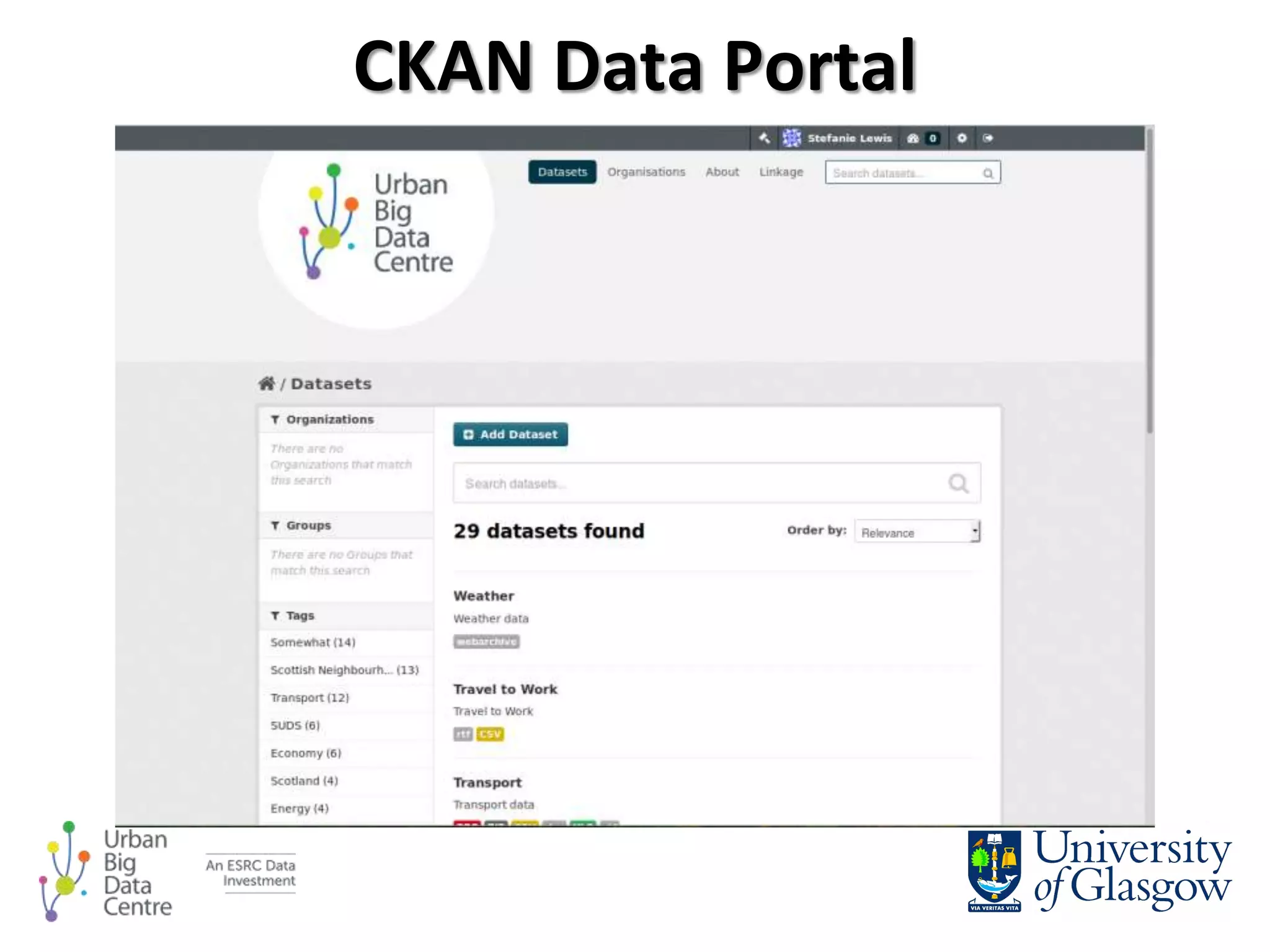
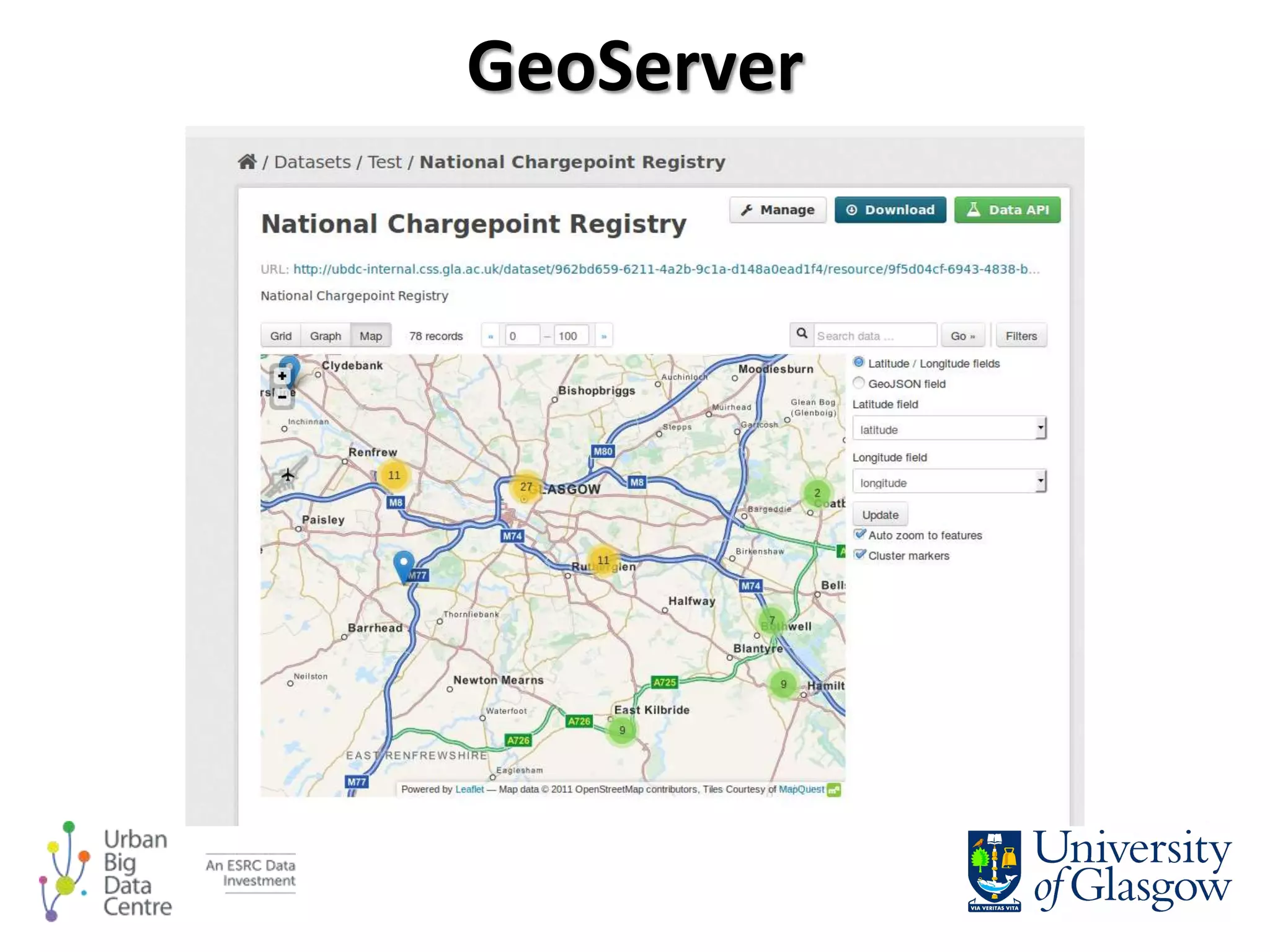
CKAN Data Portal
GeoServer
We offer 3 levels of data:
 Open data: Data which can be placed in the public domain with
minimal restrictions on usage.
 Safeguarded data: Data where license conditions or other
considerations mean that access needs to be restricted.
 Controlled data: The most secure level – data which could
potentially provide information about individuals.
We also produce our own Data Products (SUDS, iMCD …)
Plus, we have a Data Sourcing Service – we can help you find and use
data that is otherwise unavailable …
… and we can in some cases we can acquire that data for our Data
Collection.
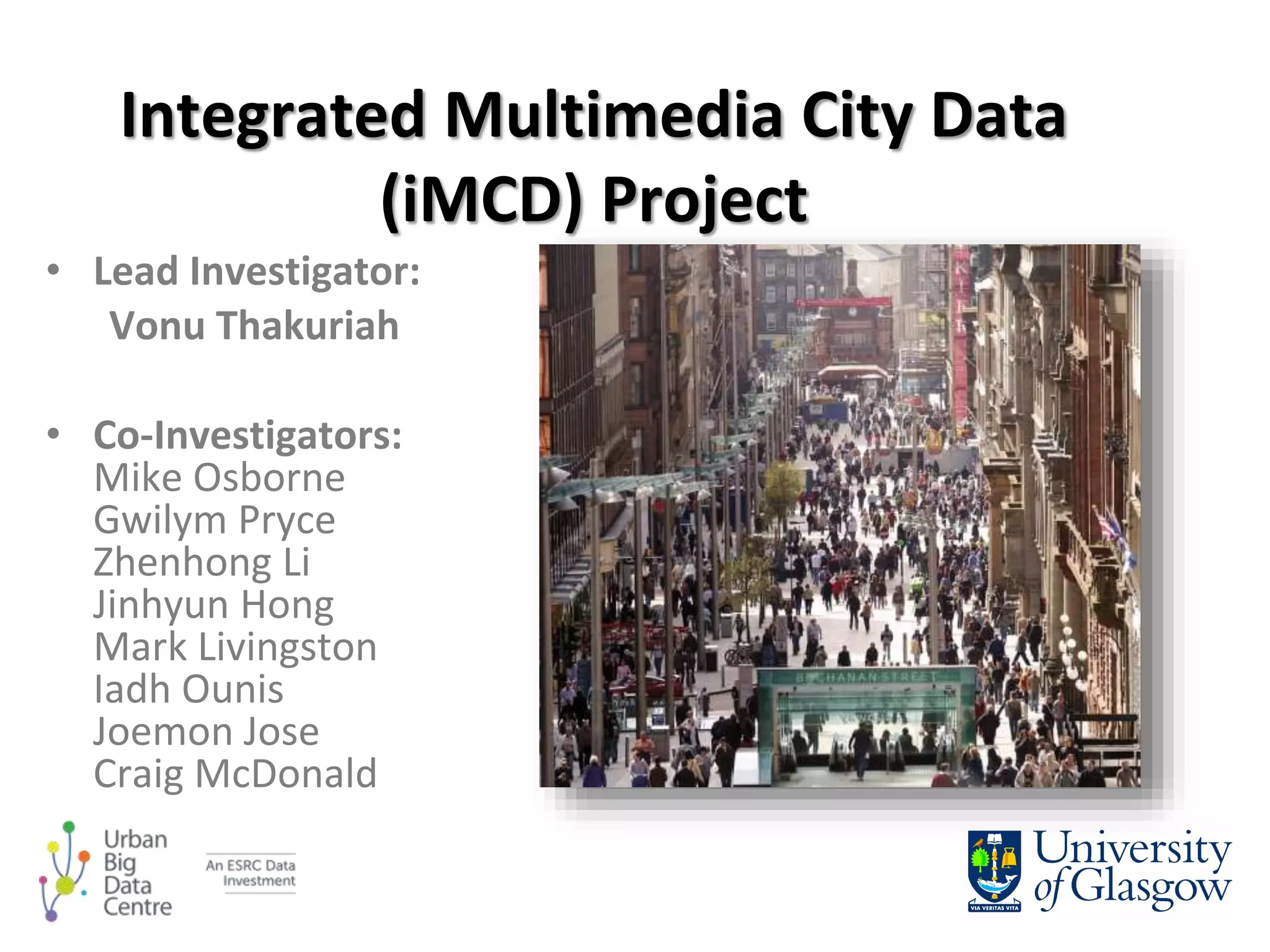
• Lead Investigator:
Vonu Thakuriah
• Co-Investigators:
Mike Osborne
Gwilym Pryce
Zhenhong Li
Jinhyun Hong
Mark Livingston
Iadh Ounis
Joemon Jose
Craig McDonald
Integrated Multimedia City Data
(iMCD) Project
The Survey
• 1500 Greater Glasgow Households
• Attitudes, values, literacy/ knowledge &
behaviours
– Education/ skills
– Sustainability
– Transport
– Cultural/ civic activities
– ICT/ technology
• Linked Data Products
GPS Sensors
Lifelogging Cameras
Social Media Capture:
Glasgow Memories Server
• 12 months capture:
– online news archives;
– social media posts
– user blogs (Tumblr)
– photos (e.g. Flickr)
Keywords: Learning Cities indicators…
Why is this
train always
late?
Why isn’t
this station
accessible?
Urban Indicators Project
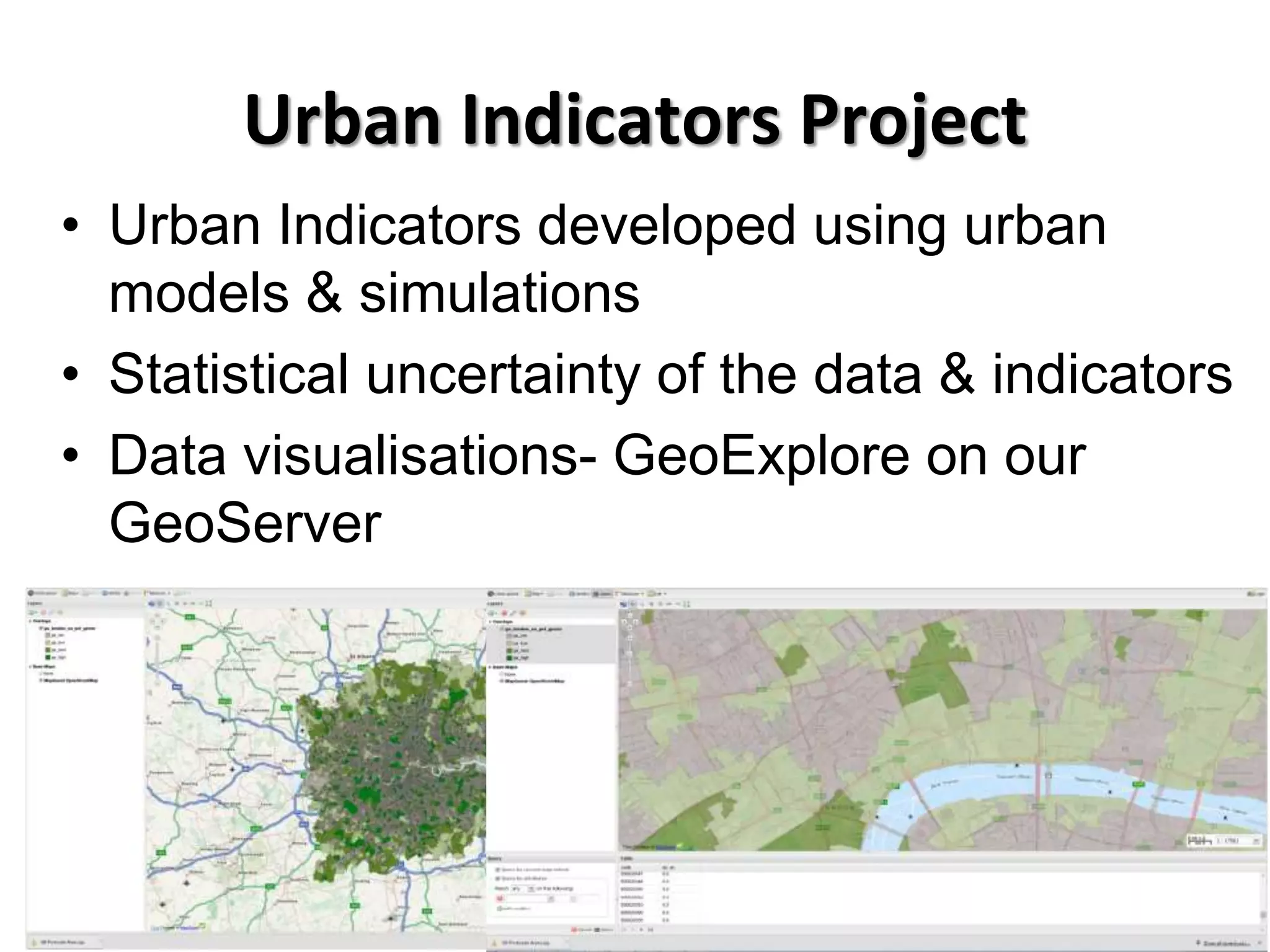
• Urban Indicators developed using urban
models & simulations
• Statistical uncertainty of the data & indicators
• Data visualisations- GeoExplore on our
GeoServer
Other new data for you
• Strava App Data: Cycling data covering
Glasgow (and all-Scotland coming later)
• LiDAR: High resolution image data of the
Earth's surface – Glasgow
• Nestoria: Data on Glasgow and Paisley housing
market (and Zoopla data coming soon too)
Visit http://ubdc.ac.uk/our-services/research-services/call-for-
expressions-of-interest/ for more information.
An example …
Datascape of Movement Patterns in Glasgow
http://ubdc.ac.uk/blog/2015/november/movement-patterns-in-glasgow/
https://www.youtube.com/watch?v=xzpRUuDjiO4
WHAT DO YOU THINK OF THE COLOUR SCHEME?!?
CREDITS FOR VIDEO
This data visualisation was created by the Glasgow School of Art's Digital Design Studio on behalf of the Urban Big
Data Centre using iMCD GPS Survey Data.
Data sources in addition to the iMCD project data include: LiDAR data from Blue Sky and satellite imagery from EU
Spacing Imaging.
This was created as part of the 13th Annual ESRC Festival of Social Science, which took place from 7-14 November 2015
with over 200 free events nationwide. Run by the Economic and Social Research Council, the Festival provides an
opportunity for anyone to meet with some of the country’s leading social scientists and discover, discuss and debate the
role that research plays in everyday life. With a whole range of creative and engaging events there’s something for
everyone including businesses, charities, schools and government agencies. A full programme is available at
www.esrc.ac.uk/festival.
Credits
Thanks to these excellent UBDC women for their
slides, upon which this presentation was built:
• Prof Vonu Thakuriah (UBDC Director)
• Dr Stefanie Lewis (former UBDC Scientific Computing Officer)
• Sila Nowicka (UBDC Research Associate in Urban Methods,
Modelling and Simulations)
• Dr Catherine Lido (UBDC Research Associate in Social Justice,
Place and Lifelong Education)
• Hana Ros (UBDC Business and Communications Officer)
And some guys too. Their names are on the website.
Follow us on Twitter, Facebook, LinkedIn or YouTube.
Contact me on sarah.currier@glasgow.ac.uk or 0141 330 8534
Urban Big Data Centre

Urban Big Data Centre

  • 1.
    Urban Big DataCentre Sarah Currier UBDC Senior Project Manager Presentation to Women in Tech Scotland, Glasgow, 22 March 2016
  • 3.
    Vision The Urban BigData Centre is a national data service for researchers, urban practitioners, and citizens, offering data, support and training centred on the use of innovative methods and complex urban data to address global social, behavioural and environmental city challenges.  Strategic Themes - dynamic resource management; social inclusion; lifelong learning; economic and business innovations; citizen engagement and citizen science;  Data Activities – open, safeguarded and confidential data; “naturally occurring” data; real-time analytics; data linkage;  Multiple Urban Sectors - transport, housing, education, economic development, environment, energy – particularly their connections. innovations for sustainable and socially just cities
  • 4.
    Data Services Methods andSocial Science Research Data images from flickr under Creative Commons
  • 5.
    What We Do TheUrban Big Data Centre provides a national data service, free at the point of use, and open to UK-based researchers, policymakers, third sector organisations, businesses and citizens. The service includes:  data collections and data products;  data sourcing services;  research support services;  knowledge exchange and outreach activities; and  training and capacity building services. innovations for sustainable and socially just cities
  • 6.
    Methods and Social ScienceResearch Data Services Data image from flickr under Creative Commons
  • 7.
    High-Spec Computing Cluster Virtual Machines StatisticalSoftware GIS Software User DataLinux / Windows Image: http://www.publicdomainpictures.net/view- image.php?image=56855&picture=gingerbread-person-with-decorations
  • 8.
  • 9.
  • 10.
  • 11.
    We offer 3levels of data:  Open data: Data which can be placed in the public domain with minimal restrictions on usage.  Safeguarded data: Data where license conditions or other considerations mean that access needs to be restricted.  Controlled data: The most secure level – data which could potentially provide information about individuals. We also produce our own Data Products (SUDS, iMCD …) Plus, we have a Data Sourcing Service – we can help you find and use data that is otherwise unavailable … … and we can in some cases we can acquire that data for our Data Collection.
  • 12.
    • Lead Investigator: VonuThakuriah • Co-Investigators: Mike Osborne Gwilym Pryce Zhenhong Li Jinhyun Hong Mark Livingston Iadh Ounis Joemon Jose Craig McDonald Integrated Multimedia City Data (iMCD) Project
  • 13.
    The Survey • 1500Greater Glasgow Households • Attitudes, values, literacy/ knowledge & behaviours – Education/ skills – Sustainability – Transport – Cultural/ civic activities – ICT/ technology • Linked Data Products
  • 14.
  • 15.
  • 16.
    Social Media Capture: GlasgowMemories Server • 12 months capture: – online news archives; – social media posts – user blogs (Tumblr) – photos (e.g. Flickr) Keywords: Learning Cities indicators… Why is this train always late? Why isn’t this station accessible?
  • 17.
    Urban Indicators Project •Urban Indicators developed using urban models & simulations • Statistical uncertainty of the data & indicators • Data visualisations- GeoExplore on our GeoServer
  • 18.
    Other new datafor you • Strava App Data: Cycling data covering Glasgow (and all-Scotland coming later) • LiDAR: High resolution image data of the Earth's surface – Glasgow • Nestoria: Data on Glasgow and Paisley housing market (and Zoopla data coming soon too) Visit http://ubdc.ac.uk/our-services/research-services/call-for- expressions-of-interest/ for more information.
  • 19.
    An example … Datascapeof Movement Patterns in Glasgow http://ubdc.ac.uk/blog/2015/november/movement-patterns-in-glasgow/ https://www.youtube.com/watch?v=xzpRUuDjiO4 WHAT DO YOU THINK OF THE COLOUR SCHEME?!? CREDITS FOR VIDEO This data visualisation was created by the Glasgow School of Art's Digital Design Studio on behalf of the Urban Big Data Centre using iMCD GPS Survey Data. Data sources in addition to the iMCD project data include: LiDAR data from Blue Sky and satellite imagery from EU Spacing Imaging. This was created as part of the 13th Annual ESRC Festival of Social Science, which took place from 7-14 November 2015 with over 200 free events nationwide. Run by the Economic and Social Research Council, the Festival provides an opportunity for anyone to meet with some of the country’s leading social scientists and discover, discuss and debate the role that research plays in everyday life. With a whole range of creative and engaging events there’s something for everyone including businesses, charities, schools and government agencies. A full programme is available at www.esrc.ac.uk/festival.
  • 20.
    Credits Thanks to theseexcellent UBDC women for their slides, upon which this presentation was built: • Prof Vonu Thakuriah (UBDC Director) • Dr Stefanie Lewis (former UBDC Scientific Computing Officer) • Sila Nowicka (UBDC Research Associate in Urban Methods, Modelling and Simulations) • Dr Catherine Lido (UBDC Research Associate in Social Justice, Place and Lifelong Education) • Hana Ros (UBDC Business and Communications Officer) And some guys too. Their names are on the website. Follow us on Twitter, Facebook, LinkedIn or YouTube. Contact me on sarah.currier@glasgow.ac.uk or 0141 330 8534

Editor's Notes

  • #2 Introduction
  • #5 The ESRC established the Urban Big Data Centre to address social, economic and environmental challenges facing cities. We are one of three Centres in their Big Data Network, but we have a particular focus on urban big data / cities. Our aim as a research resource is to promote the use of innovative methods and complex urban data to address global city challenges. We are a “resource” because beyond conducting research, the UBDC primarily focuses on methods and technologies to manage, link and analyse multi-sectoral urban big data, and to provide an integrated data service to support UK researchers (later slides expand on this).
  • #7 The ESRC established the Urban Big Data Centre to address social, economic and environmental challenges facing cities. We are one of three Centres in their Big Data Network, but we have a particular focus on urban big data / cities. Our aim as a research resource is to promote the use of innovative methods and complex urban data to address global city challenges. We are a “resource” because beyond conducting research, the UBDC primarily focuses on methods and technologies to manage, link and analyse multi-sectoral urban big data, and to provide an integrated data service to support UK researchers (later slides expand on this).
  • #8 - If anyone is interested in our services, we are very keen to partner with business and local governments, as well as third sector organisations and citizen scientists. We are here to support multiple types of users who would like to use our data and data services.
  • #9 This chart explains the “User Journey” for accessing and using UBDC data services, and includes the approvals process that is required for certain data. Much more detail can be found in a document called “UBDC Data Services: Guide for researchers” which is available on our website with further information.
  • #10 The UBDC supports 3 different levels of data: Open data: This data has very little restrictions on usage. We have an open data portal (linked from our website) with 900+ data sets, but this will continue to grow substantially. Safeguarded data: Due to license conditions, access to this is restricted and users will need to be approved to use this data. To apply for access, there is a “Research Enquiry Form” on our website that can be completed in the first instance, and approved users will gain access. Controlled data: This is very secure data because it could potentially have private information about individuals – we ensure privacy and confidentiality are protected at all times. For researchers who provide clear justification for needing access to this data (and how it will contribute to the public good) we will help negotiate access with the organisations that hold controlled data on a case-by-case basis (note: The UBDC does not actually hold controlled data – just helps negotiate),
  • #11 The UBDC supports 3 different levels of data: Open data: This data has very little restrictions on usage. We have an open data portal (linked from our website) with 900+ data sets, but this will continue to grow substantially. Safeguarded data: Due to license conditions, access to this is restricted and users will need to be approved to use this data. To apply for access, there is a “Research Enquiry Form” on our website that can be completed in the first instance, and approved users will gain access. Controlled data: This is very secure data because it could potentially have private information about individuals – we ensure privacy and confidentiality are protected at all times. For researchers who provide clear justification for needing access to this data (and how it will contribute to the public good) we will help negotiate access with the organisations that hold controlled data on a case-by-case basis (note: The UBDC does not actually hold controlled data – just helps negotiate),
  • #12 The UBDC supports 3 different levels of data: Open data: This data has very little restrictions on usage. We have an open data portal (linked from our website) with 900+ data sets, but this will continue to grow substantially. Safeguarded data: Due to license conditions, access to this is restricted and users will need to be approved to use this data. To apply for access, there is a “Research Enquiry Form” on our website that can be completed in the first instance, and approved users will gain access. Controlled data: This is very secure data because it could potentially have private information about individuals – we ensure privacy and confidentiality are protected at all times. For researchers who provide clear justification for needing access to this data (and how it will contribute to the public good) we will help negotiate access with the organisations that hold controlled data on a case-by-case basis (note: The UBDC does not actually hold controlled data – just helps negotiate),
  • #22 As this was just a quick overview of the UBDC, if you want to learn more please connect with us by: Sign up for our email newsletter via our website Follow us on Twitter @UrbanBigData Connect with us on LinkedIn (search Urban Big Data Centre) Email ubdc@glasgow.ac.uk or fill out the general enquiry form on our website