National Aeronautics and Space Administration


      Re-entry and Risk Assessment for
        the NASA Upper Atmosphere
          Research Satellite (UARS)


                          NASA Orbital Debris Program Office
                           Lyndon B. Johnson Space Center
National Aeronautics and Space Administration


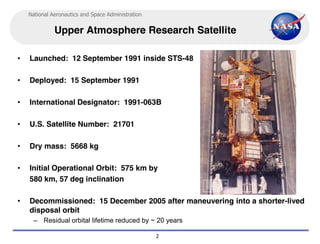
              Upper Atmosphere Research Satellite

•   Launched: 12 September 1991 inside STS-48

•   Deployed: 15 September 1991

•   International Designator: 1991-063B

•   U.S. Satellite Number: 21701

•   Dry mass: 5668 kg

•   Initial Operational Orbit: 575 km by
    580 km, 57 deg inclination

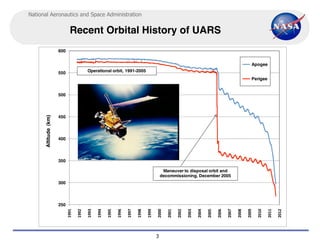
•   Decommissioned: 15 December 2005 after maneuvering into a shorter-lived
    disposal orbit
      – Residual orbital lifetime reduced by ~ 20 years

                                                    2
National Aeronautics and Space Administration


                              Recent Orbital History of UARS
                      600


                                                                                                                                                             Apogee
                      550                 Operational orbit, 1991-2005
                                                                                                                                                             Perigee


                      500
      Altitude (km)


                      450


                      400


                      350

                                                                                                Maneuver to disposal orbit and
                                                                                               decommissioning, December 2005
                      300


                      250
                            1991

                                   1992

                                          1993

                                                 1994

                                                        1995

                                                               1996

                                                                      1997

                                                                             1998

                                                                                    1999

                                                                                           2000

                                                                                                  2001

                                                                                                         2002

                                                                                                                2003

                                                                                                                       2004

                                                                                                                              2005

                                                                                                                                     2006

                                                                                                                                            2007

                                                                                                                                                   2008

                                                                                                                                                          2009

                                                                                                                                                                 2010

                                                                                                                                                                        2011

                                                                                                                                                                               2012
                                                                                           3
National Aeronautics and Space Administration


                          U.S. Reentry Predictions

•   The official source of reentry predictions for uncontrolled space objects is
    USSTRATCOM’s Joint Space Operations Center (JSpOC).

•   Normal procedure is for TIP (Tracking and Impact Prediction) messages to
    be prepared and released to the public (via the Space-Track.org website) at
    the following intervals:

      – T – 4 days, T – 3 days, T – 2 days, T – 1 day, T – 12 hours, T – 6 hours, and T – 2
        hours


•   TIP messages provide the best estimates of reentry time and location but
    have large uncertainties. Even at T – 2 hours, the uncertainty of reentry
    time is on average +/- 25 minutes for nearly circular orbits. This equates to
    +/- 12,000 km on the Earth.

•   A final, post-reentry assessment message is normally issued within a few
    hours of reentry.

                                                    4
National Aeronautics and Space Administration


                 IADC Monitoring of UARS Reentry

•   During 1996-1997 the Inter-Agency Space Debris Coordination Committee
    (IADC) developed a reentry risk object data communications network for the
    exchange of tracking data and reentry predictions in the event of the
    imminent reentry of a hazardous satellite.

•   The main server for the network is located at ESOC in Darmstadt, Germany.
      – Internet access is double-password protected and limited to one representative of each
        IADC member agency.


•   Exercises of the communications network are normally conducted annually.
      – First exercise in 1998; latest (12th) exercise in April 2010.
      – Targets of opportunity (natural orbital decays) are selected by consensus.
      – Results of the exercises are not released to the public in real-time or post-reentry.


•   At the recommendation of NASA, the IADC has accepted UARS as the
    subject of the 2011 IADC Reentry Risk Object Exercise.

              UARS does NOT meet the IADC definition of a risk object.

                                                    5
National Aeronautics and Space Administration

                     NASA Reentry Risk Capability

•   NASA’s highest fidelity software program for reentering satellites is called 
    ORSAT: Object Reentry Survival Analysis Tool. The program:

     – Assesses spacecraft, launch vehicle stage, and other man-made space object
       component survivability during atmospheric entry from sub-orbital, orbital, and deep
       space trajectories.

     – Assesses human casualty risk associated with uncontrolled reentries.

     – Characterizes surviving debris footprints associated with controlled reentries for the
       purpose of avoiding inhabited regions and the Antarctic permanent ice pack.


•   ORSAT has supported many NASA, DoD, and other domestic and foreign
    programs during the past two decades.

        The principal outputs of ORSAT are component demise altitude or
             location, surviving mass, and kinetic energy of impact.


                                                    6
National Aeronautics and Space Administration


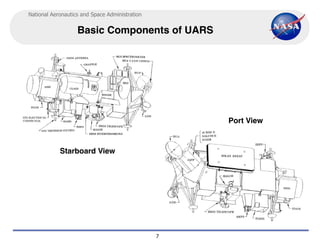
                   Basic Components of UARS


                                                    Port View


            Starboard View


                                                7
National Aeronautics and Space Administration


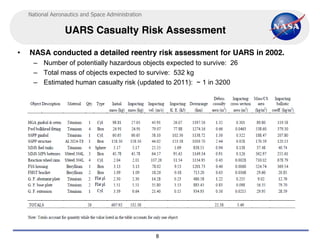
                  UARS Casualty Risk Assessment

•   NASA conducted a detailed reentry risk assessment for UARS in 2002.
      – Number of potentially hazardous objects expected to survive: 26
      – Total mass of objects expected to survive: 532 kg
      – Estimated human casualty risk (updated to 2011): ~ 1 in 3200


                                                    8
National Aeronautics and Space Administration

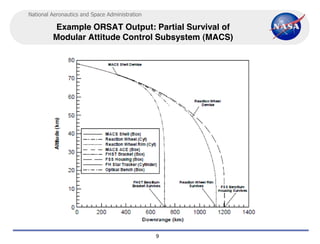
         Example ORSAT Output: Partial Survival of
         Modular Attitude Control Subsystem (MACS)


                                                9
National Aeronautics and Space Administration


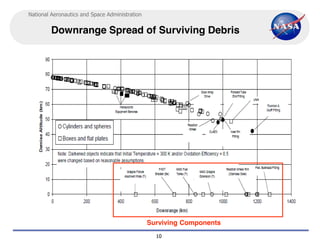
         Downrange Spread of Surviving Debris


                                                Surviving Components
                                                  10
National Aeronautics and Space Administration


                                         Summary

•   No NASA or USG human casualty reentry risk limits existed when UARS
    was designed, built, and launched.

•   NASA, the USG, and some foreign space agencies now seek to limit human
    casualty risks from reentering space objects to less than 1 in 10,000.

•   UARS is a moderate-sized space object. Uncontrolled reentries of objects
    more massive than UARS are not frequent, but neither are they unusual.

      – Combined Dragon mockup and Falcon 9 second stage reentry in June 2010 was more
        massive.


•   Since the beginning of the space age, there has been no confirmed report
    of an injury resulting from reentering space objects.

•   NASA, DoD, and the IADC will be monitoring the decay and reentry of UARS
    carefully.

                                                    11

Uars status

  • 1.
    National Aeronautics and Space Administration Re-entry and Risk Assessment for the NASA Upper Atmosphere Research Satellite (UARS) NASA Orbital Debris Program Office Lyndon B. Johnson Space Center
  • 2.
    National Aeronautics and Space Administration Upper Atmosphere Research Satellite • Launched: 12 September 1991 inside STS-48 • Deployed: 15 September 1991 • International Designator: 1991-063B • U.S. Satellite Number: 21701 • Dry mass: 5668 kg • Initial Operational Orbit: 575 km by 580 km, 57 deg inclination • Decommissioned: 15 December 2005 after maneuvering into a shorter-lived disposal orbit – Residual orbital lifetime reduced by ~ 20 years 2
  • 3.
    National Aeronautics and Space Administration Recent Orbital History of UARS 600 Apogee 550 Operational orbit, 1991-2005 Perigee 500 Altitude (km) 450 400 350 Maneuver to disposal orbit and decommissioning, December 2005 300 250 1991 1992 1993 1994 1995 1996 1997 1998 1999 2000 2001 2002 2003 2004 2005 2006 2007 2008 2009 2010 2011 2012 3
  • 4.
    National Aeronautics and Space Administration U.S. Reentry Predictions • The official source of reentry predictions for uncontrolled space objects is USSTRATCOM’s Joint Space Operations Center (JSpOC). • Normal procedure is for TIP (Tracking and Impact Prediction) messages to be prepared and released to the public (via the Space-Track.org website) at the following intervals: – T – 4 days, T – 3 days, T – 2 days, T – 1 day, T – 12 hours, T – 6 hours, and T – 2 hours • TIP messages provide the best estimates of reentry time and location but have large uncertainties. Even at T – 2 hours, the uncertainty of reentry time is on average +/- 25 minutes for nearly circular orbits. This equates to +/- 12,000 km on the Earth. • A final, post-reentry assessment message is normally issued within a few hours of reentry. 4
  • 5.
    National Aeronautics and Space Administration IADC Monitoring of UARS Reentry • During 1996-1997 the Inter-Agency Space Debris Coordination Committee (IADC) developed a reentry risk object data communications network for the exchange of tracking data and reentry predictions in the event of the imminent reentry of a hazardous satellite. • The main server for the network is located at ESOC in Darmstadt, Germany. – Internet access is double-password protected and limited to one representative of each IADC member agency. • Exercises of the communications network are normally conducted annually. – First exercise in 1998; latest (12th) exercise in April 2010. – Targets of opportunity (natural orbital decays) are selected by consensus. – Results of the exercises are not released to the public in real-time or post-reentry. • At the recommendation of NASA, the IADC has accepted UARS as the subject of the 2011 IADC Reentry Risk Object Exercise. UARS does NOT meet the IADC definition of a risk object. 5
  • 6.
    National Aeronautics and Space Administration NASA Reentry Risk Capability • NASA’s highest fidelity software program for reentering satellites is called  ORSAT: Object Reentry Survival Analysis Tool. The program: – Assesses spacecraft, launch vehicle stage, and other man-made space object component survivability during atmospheric entry from sub-orbital, orbital, and deep space trajectories. – Assesses human casualty risk associated with uncontrolled reentries. – Characterizes surviving debris footprints associated with controlled reentries for the purpose of avoiding inhabited regions and the Antarctic permanent ice pack. • ORSAT has supported many NASA, DoD, and other domestic and foreign programs during the past two decades. The principal outputs of ORSAT are component demise altitude or location, surviving mass, and kinetic energy of impact. 6
  • 7.
    National Aeronautics and Space Administration Basic Components of UARS Port View Starboard View 7
  • 8.
    National Aeronautics and Space Administration UARS Casualty Risk Assessment • NASA conducted a detailed reentry risk assessment for UARS in 2002. – Number of potentially hazardous objects expected to survive: 26 – Total mass of objects expected to survive: 532 kg – Estimated human casualty risk (updated to 2011): ~ 1 in 3200 8
  • 9.
    National Aeronautics and Space Administration Example ORSAT Output: Partial Survival of Modular Attitude Control Subsystem (MACS) 9
  • 10.
    National Aeronautics and Space Administration Downrange Spread of Surviving Debris Surviving Components 10
  • 11.
    National Aeronautics and Space Administration Summary • No NASA or USG human casualty reentry risk limits existed when UARS was designed, built, and launched. • NASA, the USG, and some foreign space agencies now seek to limit human casualty risks from reentering space objects to less than 1 in 10,000. • UARS is a moderate-sized space object. Uncontrolled reentries of objects more massive than UARS are not frequent, but neither are they unusual. – Combined Dragon mockup and Falcon 9 second stage reentry in June 2010 was more massive. • Since the beginning of the space age, there has been no confirmed report of an injury resulting from reentering space objects. • NASA, DoD, and the IADC will be monitoring the decay and reentry of UARS carefully. 11