
Sustainable Transportation Challenges: Case Study on the UConn Prepaid Fare Program Failure Edmund J. Zolnik, Ph.D. Assistant Professor School of Public Policy George Mason University Van Pool Boot Camp George Mason University Arlington, VA USA November 7, 2011
Research Question Review of the Literature Analysis Conclusions Acknowledgments Outline
Research Question Is Unlimited Access (UA) a solution to the problem of  transit demand management in the nonmetropolitan US?
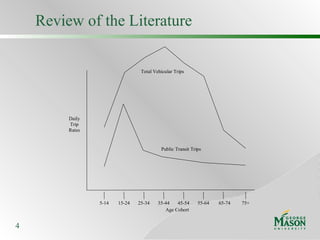
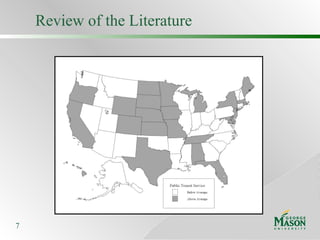
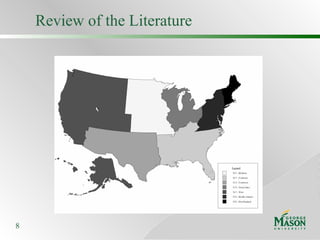
Review of the Literature
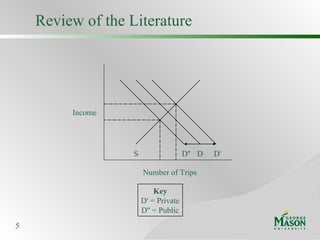
Review of the Literature D Number of Trips Income D '' D ' S Key D' = Private D '' = Public
Rural Transportation Problem Definition: Low Density Long Trips Over reliance on private modes of  transportation Complications: Rural Rebound  ->  Congestion  Air Pollution
Review of the Literature
Unlimited Access (UA) Definition: Students, faculty and staff (as well as  residents) are afforded unlimited use of  transit services. Operation: University Transit Agency Municipal Government Private Contractor Funding: Federal, State and Local Governments Student Fees Parking Permits and Fines General Funds
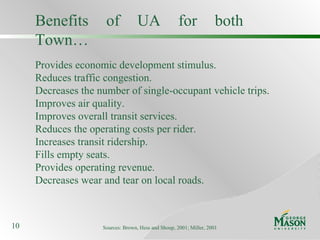
Sources: Brown, Hess and Shoup, 2001; Miller, 2001 Benefits of UA for both Town… Provides economic development stimulus. Reduces traffic congestion. Decreases the number of single-occupant vehicle trips. Improves air quality. Improves overall transit services. Reduces the operating costs per rider. Increases transit ridership. Fills empty seats. Provides operating revenue. Decreases wear and tear on local roads.
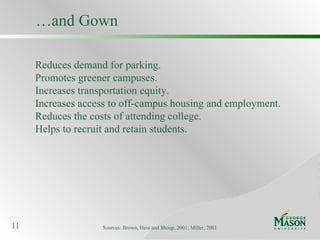
Sources: Brown, Hess and Shoup, 2001; Miller, 2001 … and Gown Reduces demand for parking. Promotes greener campuses. Increases transportation equity. Increases access to off-campus housing and employment. Reduces the costs of attending college. Helps to recruit and retain students.
Review of the Literature Brown, Hess and Shoup, 2001 “ The diversity of locations where universities offer Unlimited Access – from small towns to large cities – indicates that it can work almost  anywhere…” (p. 235) “ No university has terminated a (UA) program, and some university administrators told us that Unlimited Access was one of the greatest success stories on their campus.” (p. 259)
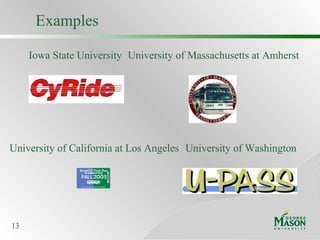
Examples University of California at Los Angeles University of Washington Iowa State University University of Massachusetts at Amherst
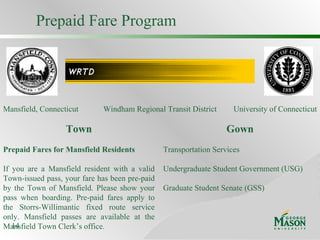
Prepaid Fare Program Gown Transportation Services Undergraduate Student Government (USG) Graduate Student Senate (GSS) Town Prepaid Fares for Mansfield Residents If you are a Mansfield resident with a valid Town-issued pass, your fare has been pre-paid by the Town of Mansfield. Please show your pass when boarding. Pre-paid fares apply to the Storrs-Willimantic fixed route service only. Mansfield passes are available at the Mansfield Town Clerk’s office. Windham Regional Transit District Mansfield, Connecticut University of Connecticut
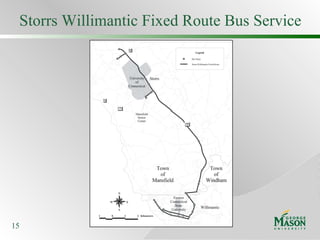
Storrs Willimantic Fixed Route Bus Service
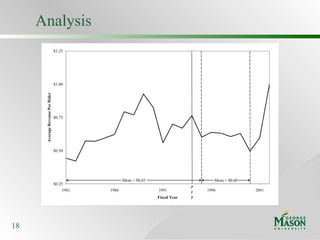
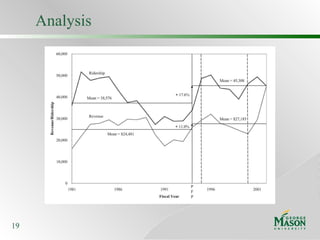
Analysis
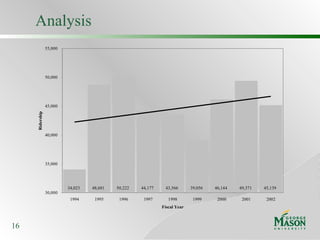
Analysis
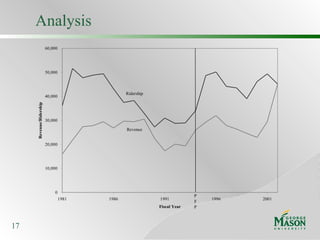
Analysis
Analysis
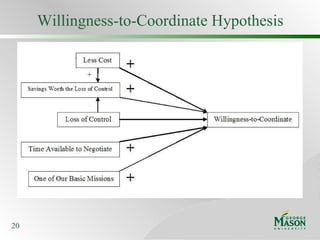
Willingness-to-Coordinate Hypothesis
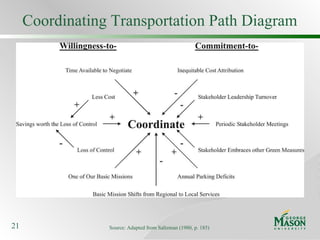
Coordinating Transportation Path Diagram Source: Adapted from Saltzman (1980, p. 185)
Conclusions Successful UA programs require annual stakeholders meetings. Towns and gowns may define green differently in the long-term. The interests of university administrations may not coincide with the community in the long-term. Small-town UA programs in the northeast are vulnerable to fiscal shortages at the state level. Source: Ewing et al. 2003
Babinicz, A. Executive Director, Clemson Area Transit, Clemson, SC Byam, A. General Manager, UMass Transit, Amherst, MA Freniere, J. Manager, Transportation Services, University of Connecticut, Storrs, CT Hultgren, L. Director of Public Works, Mansfield, CT Miller, R. Director, Office of Environmental Policy,  University of Connecticut, Storrs, CT Acknowledgments

Sustainable Transportation Challenges: Case Study on the UConn Prepaid Fare Program Failure - by Dr. Ed Zolnik - Professor, Public Policy at GMU

  • 1.
    Sustainable Transportation Challenges:Case Study on the UConn Prepaid Fare Program Failure Edmund J. Zolnik, Ph.D. Assistant Professor School of Public Policy George Mason University Van Pool Boot Camp George Mason University Arlington, VA USA November 7, 2011
  • 2.
    Research Question Reviewof the Literature Analysis Conclusions Acknowledgments Outline
  • 3.
    Research Question IsUnlimited Access (UA) a solution to the problem of transit demand management in the nonmetropolitan US?
  • 4.
    Review of theLiterature
  • 5.
    Review of theLiterature D Number of Trips Income D '' D ' S Key D' = Private D '' = Public
  • 6.
    Rural Transportation ProblemDefinition: Low Density Long Trips Over reliance on private modes of transportation Complications: Rural Rebound -> Congestion Air Pollution
  • 7.
    Review of theLiterature
  • 8.
    Review of theLiterature
  • 9.
    Unlimited Access (UA)Definition: Students, faculty and staff (as well as residents) are afforded unlimited use of transit services. Operation: University Transit Agency Municipal Government Private Contractor Funding: Federal, State and Local Governments Student Fees Parking Permits and Fines General Funds
  • 10.
    Sources: Brown, Hessand Shoup, 2001; Miller, 2001 Benefits of UA for both Town… Provides economic development stimulus. Reduces traffic congestion. Decreases the number of single-occupant vehicle trips. Improves air quality. Improves overall transit services. Reduces the operating costs per rider. Increases transit ridership. Fills empty seats. Provides operating revenue. Decreases wear and tear on local roads.
  • 11.
    Sources: Brown, Hessand Shoup, 2001; Miller, 2001 … and Gown Reduces demand for parking. Promotes greener campuses. Increases transportation equity. Increases access to off-campus housing and employment. Reduces the costs of attending college. Helps to recruit and retain students.
  • 12.
    Review of theLiterature Brown, Hess and Shoup, 2001 “ The diversity of locations where universities offer Unlimited Access – from small towns to large cities – indicates that it can work almost anywhere…” (p. 235) “ No university has terminated a (UA) program, and some university administrators told us that Unlimited Access was one of the greatest success stories on their campus.” (p. 259)
  • 13.
    Examples University ofCalifornia at Los Angeles University of Washington Iowa State University University of Massachusetts at Amherst
  • 14.
    Prepaid Fare ProgramGown Transportation Services Undergraduate Student Government (USG) Graduate Student Senate (GSS) Town Prepaid Fares for Mansfield Residents If you are a Mansfield resident with a valid Town-issued pass, your fare has been pre-paid by the Town of Mansfield. Please show your pass when boarding. Pre-paid fares apply to the Storrs-Willimantic fixed route service only. Mansfield passes are available at the Mansfield Town Clerk’s office. Windham Regional Transit District Mansfield, Connecticut University of Connecticut
  • 15.
    Storrs Willimantic FixedRoute Bus Service
  • 16.
  • 17.
  • 18.
  • 19.
  • 20.
  • 21.
    Coordinating Transportation PathDiagram Source: Adapted from Saltzman (1980, p. 185)
  • 22.
    Conclusions Successful UAprograms require annual stakeholders meetings. Towns and gowns may define green differently in the long-term. The interests of university administrations may not coincide with the community in the long-term. Small-town UA programs in the northeast are vulnerable to fiscal shortages at the state level. Source: Ewing et al. 2003
  • 23.
    Babinicz, A. ExecutiveDirector, Clemson Area Transit, Clemson, SC Byam, A. General Manager, UMass Transit, Amherst, MA Freniere, J. Manager, Transportation Services, University of Connecticut, Storrs, CT Hultgren, L. Director of Public Works, Mansfield, CT Miller, R. Director, Office of Environmental Policy, University of Connecticut, Storrs, CT Acknowledgments