TYPES OF PURCHASING SYSTEM
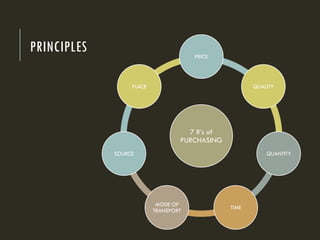
PRINCIPLES
7 R’s of
PURCHASING
PRICE
QUALITY
QUANTITY
TIME
MODE OF
TRANSPORT
SOURCE
PLACE
WHAT IS A PURCHASING SYSYTEM?
A method used by businesses to buy products and/or services.
A purchasing system manages the entire acquisition process, from
requisition, to purchase order, to product receipt, to payment.
Purchasing systems are a key component of effective inventory
management in that they monitor existing stock and help companies
determine what to buy, how much to buy and when to buy it.
FUNCTIONS OF PURCHASE DEPARTMENT
Purchase materials at lowest possible cost while maintaining quality.
Maintain good relationship with the suppliers.
Take advantage of economies of scale.
Maintain records efficiently.
Develop highly competent personnel.
Co-ordinate with all the departments of the organization.
TYPES OF PURCHASING SYSTEM
Tender System
Stockless Purchase System
Blanket Order
E-Purchasing / E-Procurement
Subcontracting
Rate Contract Method
Petty Cash System
Capital Equipment Purchase
SUBCONTRACTING What is Subcontracting?
Examples
WHAT IS SUBCONTRACTING?
Subcontracting refers to the process of entering a contractual
agreement with an outside person or company to perform a certain
amount of work.
The outside person or company in this arrangement is known as a
subcontractor.
Many small businesses hire subcontractors to assist with a wide variety
of functions.
Example:
A small business may use an outside firm to prepare its payroll.
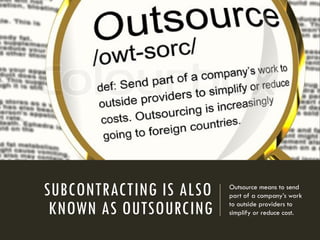
SUBCONTRACTING IS ALSO
KNOWN AS OUTSOURCING
Outsource means to send
part of a company’s work
to outside providers to
simplify or reduce cost.
ADVANTAGES & DISADVANTAGES
Advantages:
Cost Saving
Increased Efficiency
Continuity & Risk Management
Disadvantages:
Loss of Managerial Control
Quality Problems
Hidden Costs
HIDDEN COSTS OF SUBCONTRACTING
EXAMPLES
Subcontracting is probably most prevalent in the construction industry,
where builders often subcontract plumbing, electrical work, drywall,
painting, and other tasks.
In some cases, a general contractor may only be used as the
construction manager or supervisor. In that case, subcontracting
accounts for all of the physical work done on the premises. The
general contractor's only responsibility is to approve the contracts,
keep the project within budget, and inspect the work.
TENDER SYSTEM
What is Tender?
Types of Tender
Advantages
Disadvantages
WHAT IS TENDER?
In this system the entity invites suppliers to give their quotations.
The supplier with the lowest quotation wins the contract.
It is a kind of contract mostly followed by large organisations and
governments when purchases are of large value.
TYPES OF TENDER
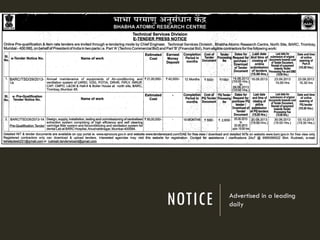
Open Tender
This is where an opportunity (including all tender documents) is
advertised inviting providers to bid directly for a contract.
All interest parties then submit a tender.
Scoring takes place and the successful organisation is awarded the
contract.
Sometimes there is a selection stage first, which is then followed by
the award stage.
NOTICE Advertised in a leading
daily
TYPES OF TENDER
Restricted Tender
This involves the opportunity being advertised in the relevant places
and media.
Organisations will then submit an expression of interest and fill in a
pre qualification questionnaire.
Successful organisations will go onto select list and be given an
invitation to tender with the tender documents.
Tender documents are completed and submitted.
From the submitted tender documents scoring takes place and the
successful organisation is awarded the contract.
TYPES OF TENDER
Negotiated Tender
It can only be used in a limited number of carefully defined cases
(e.g. large capital projects where a range of solutions to deliver are
possible).
An opportunity is advertised (the specification is not established at the
start of the process) and organisations can submit an expression of
interest and fill in a pre qualification questionnaire.
Successful bidders are invited to negotiate with the procuring body,
which is called the dialogue phase.
Once dialogue has generated solutions to the agreed requirements,
final tenders are submitted based on each bidders individual solution.
Scoring then takes place and the successful organisation is awarded
the contract.
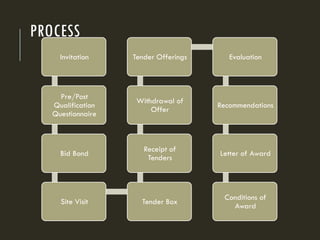
PROCESS
Invitation
Pre/Post
Qualification
Questionnaire
Bid Bond
Site Visit Tender Box
Receipt of
Tenders
Withdrawal of
Offer
Tender Offerings Evaluation
Recommendations
Letter of Award
Conditions of
Award
ADVANTAGES & DISADVANTAGES
Advantages:
Competitive
Lower Cost
Transparent Process
Disadvantages:
Low Price usually Detriment of Quality
Time consuming
BLANKET ORDER
What is Blanket Order?
Advantages &
Disadvantages
WHAT IS BLANKET ORDER?
Company purchase many small items on day to day basis. It becomes
difficult to have inventory for all.
It is most popular method for purchasing items which are used
regularly.
There are two methods:
Agreement is made to supply a Fixed Quantity of the product at a
Fixed Price for a Specific Period.
Agreement is made to supply for a Specific Period but the Quantity is
unknown.
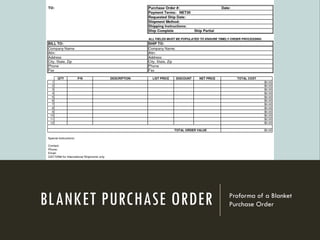
BLANKET PURCHASE ORDER Proforma of a Blanket
Purchase Order
ADVANTAGES
Flexible
Avoid negotiation
Avoid placement of new order again and again
Advantage to supplier to plan the work at his place
Reduces clerical activities
Protections against higher pricing in future
DISADVANTAGES
Petty frauds
It requires flexible internal control
Poor vendor performances
Difficult to determine and forecast the quantity
CAPITAL EQUIPMENT
PURCHASE
What is Capital Equipment
Purchase?
Advantages
Disadvantages
WHAT IS CAPITAL PURCHASE
EQUIPMENT?
It is a purchasing system which requires high capital.
It is used to purchase large value assets such as Machinery and
Equipments
ADVANTAGES & DISADVANTAGES
Advantages:
Flexible
One Time Investment
Increased Co-ordination & Communication
Disadvantages:
Requires lots of capital
Decision making is difficult
PETTY CASH SYSTEM
What is Petty Cash
System?
Advantages
Disadvantages
WHAT IS PETTY CASH SYSTEM?
A small fund of cash is kept in hand for purchases or reimbursements
which are too small to be worth submitting to the more rigorous
purchase and reimbursement procedures of a company or institution.
Petty cash funds must be safeguarded and documented to ensure that
thefts do not occur.
ADVANTAGES & DISADVANTAGES
Advantages:
Easy
Time saving
Disadvantages:
Embezzlement of Funds
Cuts down on accountability
Accounting Errors
Lot of Paper Work
EXAMPLES
Purchase of Stationery like pen, pencil, paper, book, etc.
Purchase of Postal Stamps.
IMPORTS
What are Imports?
Advantages
Disadvantages
Process
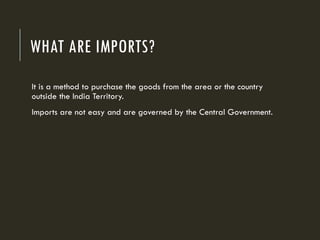
WHAT ARE IMPORTS?
It is a method to purchase the goods from the area or the country
outside the India Territory.
Imports are not easy and are governed by the Central Government.
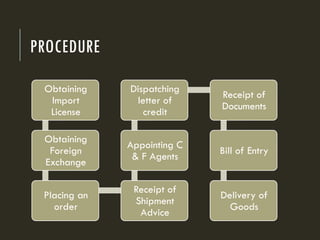
PROCEDURE
Obtaining
Import
License
Obtaining
Foreign
Exchange
Placing an
order
Receipt of
Shipment
Advice
Appointing C
& F Agents
Dispatching
letter of
credit
Receipt of
Documents
Bill of Entry
Delivery of
Goods
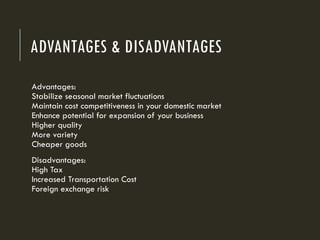
ADVANTAGES & DISADVANTAGES
Advantages:
Stabilize seasonal market fluctuations
Maintain cost competitiveness in your domestic market
Enhance potential for expansion of your business
Higher quality
More variety
Cheaper goods
Disadvantages:
High Tax
Increased Transportation Cost
Foreign exchange risk
E-PURCHASING
What is E-Purchasing?
Advantages
Disadvantages
E-PURCHASING / E-PROCUREMENT
E-procurement is the business-to-business or business-to-consumer or
business-to-government purchase and sale of supplies, work, and
services through the Internet.
E-procurement helps to achieve benefits such as increased efficiency
and cost reduction.
ADVANTAGES
Reducing Cost
Visibility of spend
Productivity
Control
Quicker processing times
Better communication
DISADVANTAGES
High Learning curve
Human or system errors in orders
No hardcopies
Training costs
System failure
ORDER ON TELEPHONE
What is Order on
Telephone?
Advantages
Disadvantages
WHAT IS ORDER ON TELEPHONE?
It is a method used to place orders of small value.
In this method the purchase department does not prepare a formal
purchase order.
The order is placed by telephone.
The price is discussed an finalized on the telephone.
This works well with the captive type of vendors
ORDER ON TELEPHONE
A purchase manager in a
restaurant placing the
orders for the grocery over
the telephone
RATE CONTRACT METHOD
What is Rate Contract
Method?
Process
WHAT IS RATE CONTRACT METHOD?
A Rate Contract or a Rate Agreement (RC in short) is a procurement
cost reduction strategy aimed at standardizing procurement prices for
commonly procured, homogenous and price varying inputs.
The basic idea behind a rate contract is to aid a company in
establishing parameters for the purchase of goods and services
necessary for the continued operation of the business.
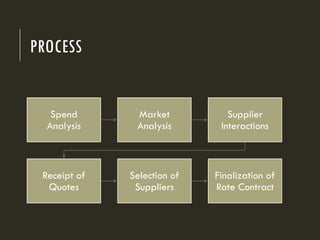
PROCESS
Spend
Analysis
Market
Analysis
Supplier
Interactions
Receipt of
Quotes
Selection of
Suppliers
Finalization of
Rate Contract
STOCKLESS PURCHASING
What is Stockless
Purchasing?
Examples
Advantages &
Disadvantages
WHAT IS STOCKLESS PURCHASING?
Stockless purchase system can be defined as Arrangement in which a
supplier holds the items ordered by the customer in its own warehouse,
and releases them as and when required by the customer.
It is also known as just-in-time purchasing.
In this system the vendor has a clear idea of the requirements of the
buyer and holds the stock in convenient location.
The seller has the financial responsibility of holding the stock.
EXAMPLES
Tyre warehouse near automobile manufacturing units.
Petrol pumps in transport undertaking.
Aviation fuel pumps at airport.
ADVANTAGES & DISADVANTAGES
Advantages:
Reduced warehouse space
Eliminate the cost of storing, maintaining and distributing supplies
Increased inventory turnover
Less manpower
Disadvantages:
High cost
Need of complex technology
COMPANIES AND PURCHASE
SYSTEMS
INDIAN RAILYWAY CATERING AND
TOURISIM CORPRATION
Indian Railway Catering and Tourism Corporation uses Open Tender
and Selective Tender for purchase of Capital Equipment.
It uses subcontracting for maintenance, catering and cleaning.
It uses blanket order to purchase day to day items like stationery, etc.

Types of Purchasing systems across industries

  • 1.
  • 2.
  • 4.
    WHAT IS APURCHASING SYSYTEM? A method used by businesses to buy products and/or services. A purchasing system manages the entire acquisition process, from requisition, to purchase order, to product receipt, to payment. Purchasing systems are a key component of effective inventory management in that they monitor existing stock and help companies determine what to buy, how much to buy and when to buy it.
  • 5.
    FUNCTIONS OF PURCHASEDEPARTMENT Purchase materials at lowest possible cost while maintaining quality. Maintain good relationship with the suppliers. Take advantage of economies of scale. Maintain records efficiently. Develop highly competent personnel. Co-ordinate with all the departments of the organization.
  • 6.
    TYPES OF PURCHASINGSYSTEM Tender System Stockless Purchase System Blanket Order E-Purchasing / E-Procurement Subcontracting Rate Contract Method Petty Cash System Capital Equipment Purchase
  • 7.
    SUBCONTRACTING What isSubcontracting? Examples
  • 8.
    WHAT IS SUBCONTRACTING? Subcontractingrefers to the process of entering a contractual agreement with an outside person or company to perform a certain amount of work. The outside person or company in this arrangement is known as a subcontractor. Many small businesses hire subcontractors to assist with a wide variety of functions. Example: A small business may use an outside firm to prepare its payroll.
  • 9.
    SUBCONTRACTING IS ALSO KNOWNAS OUTSOURCING Outsource means to send part of a company’s work to outside providers to simplify or reduce cost.
  • 10.
    ADVANTAGES & DISADVANTAGES Advantages: CostSaving Increased Efficiency Continuity & Risk Management Disadvantages: Loss of Managerial Control Quality Problems Hidden Costs
  • 11.
    HIDDEN COSTS OFSUBCONTRACTING
  • 12.
    EXAMPLES Subcontracting is probablymost prevalent in the construction industry, where builders often subcontract plumbing, electrical work, drywall, painting, and other tasks. In some cases, a general contractor may only be used as the construction manager or supervisor. In that case, subcontracting accounts for all of the physical work done on the premises. The general contractor's only responsibility is to approve the contracts, keep the project within budget, and inspect the work.
  • 13.
    TENDER SYSTEM What isTender? Types of Tender Advantages Disadvantages
  • 14.
    WHAT IS TENDER? Inthis system the entity invites suppliers to give their quotations. The supplier with the lowest quotation wins the contract. It is a kind of contract mostly followed by large organisations and governments when purchases are of large value.
  • 15.
    TYPES OF TENDER OpenTender This is where an opportunity (including all tender documents) is advertised inviting providers to bid directly for a contract. All interest parties then submit a tender. Scoring takes place and the successful organisation is awarded the contract. Sometimes there is a selection stage first, which is then followed by the award stage.
  • 16.
    NOTICE Advertised ina leading daily
  • 17.
    TYPES OF TENDER RestrictedTender This involves the opportunity being advertised in the relevant places and media. Organisations will then submit an expression of interest and fill in a pre qualification questionnaire. Successful organisations will go onto select list and be given an invitation to tender with the tender documents. Tender documents are completed and submitted. From the submitted tender documents scoring takes place and the successful organisation is awarded the contract.
  • 18.
    TYPES OF TENDER NegotiatedTender It can only be used in a limited number of carefully defined cases (e.g. large capital projects where a range of solutions to deliver are possible). An opportunity is advertised (the specification is not established at the start of the process) and organisations can submit an expression of interest and fill in a pre qualification questionnaire. Successful bidders are invited to negotiate with the procuring body, which is called the dialogue phase. Once dialogue has generated solutions to the agreed requirements, final tenders are submitted based on each bidders individual solution. Scoring then takes place and the successful organisation is awarded the contract.
  • 19.
    PROCESS Invitation Pre/Post Qualification Questionnaire Bid Bond Site VisitTender Box Receipt of Tenders Withdrawal of Offer Tender Offerings Evaluation Recommendations Letter of Award Conditions of Award
  • 20.
    ADVANTAGES & DISADVANTAGES Advantages: Competitive LowerCost Transparent Process Disadvantages: Low Price usually Detriment of Quality Time consuming
  • 21.
    BLANKET ORDER What isBlanket Order? Advantages & Disadvantages
  • 22.
    WHAT IS BLANKETORDER? Company purchase many small items on day to day basis. It becomes difficult to have inventory for all. It is most popular method for purchasing items which are used regularly. There are two methods: Agreement is made to supply a Fixed Quantity of the product at a Fixed Price for a Specific Period. Agreement is made to supply for a Specific Period but the Quantity is unknown.
  • 23.
    BLANKET PURCHASE ORDERProforma of a Blanket Purchase Order
  • 24.
    ADVANTAGES Flexible Avoid negotiation Avoid placementof new order again and again Advantage to supplier to plan the work at his place Reduces clerical activities Protections against higher pricing in future
  • 25.
    DISADVANTAGES Petty frauds It requiresflexible internal control Poor vendor performances Difficult to determine and forecast the quantity
  • 26.
    CAPITAL EQUIPMENT PURCHASE What isCapital Equipment Purchase? Advantages Disadvantages
  • 27.
    WHAT IS CAPITALPURCHASE EQUIPMENT? It is a purchasing system which requires high capital. It is used to purchase large value assets such as Machinery and Equipments
  • 28.
    ADVANTAGES & DISADVANTAGES Advantages: Flexible OneTime Investment Increased Co-ordination & Communication Disadvantages: Requires lots of capital Decision making is difficult
  • 29.
    PETTY CASH SYSTEM Whatis Petty Cash System? Advantages Disadvantages
  • 30.
    WHAT IS PETTYCASH SYSTEM? A small fund of cash is kept in hand for purchases or reimbursements which are too small to be worth submitting to the more rigorous purchase and reimbursement procedures of a company or institution. Petty cash funds must be safeguarded and documented to ensure that thefts do not occur.
  • 31.
    ADVANTAGES & DISADVANTAGES Advantages: Easy Timesaving Disadvantages: Embezzlement of Funds Cuts down on accountability Accounting Errors Lot of Paper Work
  • 32.
    EXAMPLES Purchase of Stationerylike pen, pencil, paper, book, etc. Purchase of Postal Stamps.
  • 33.
  • 34.
    WHAT ARE IMPORTS? Itis a method to purchase the goods from the area or the country outside the India Territory. Imports are not easy and are governed by the Central Government.
  • 35.
    PROCEDURE Obtaining Import License Obtaining Foreign Exchange Placing an order Receipt of Shipment Advice AppointingC & F Agents Dispatching letter of credit Receipt of Documents Bill of Entry Delivery of Goods
  • 36.
    ADVANTAGES & DISADVANTAGES Advantages: Stabilizeseasonal market fluctuations Maintain cost competitiveness in your domestic market Enhance potential for expansion of your business Higher quality More variety Cheaper goods Disadvantages: High Tax Increased Transportation Cost Foreign exchange risk
  • 37.
  • 38.
    E-PURCHASING / E-PROCUREMENT E-procurementis the business-to-business or business-to-consumer or business-to-government purchase and sale of supplies, work, and services through the Internet. E-procurement helps to achieve benefits such as increased efficiency and cost reduction.
  • 39.
    ADVANTAGES Reducing Cost Visibility ofspend Productivity Control Quicker processing times Better communication
  • 40.
    DISADVANTAGES High Learning curve Humanor system errors in orders No hardcopies Training costs System failure
  • 41.
    ORDER ON TELEPHONE Whatis Order on Telephone? Advantages Disadvantages
  • 42.
    WHAT IS ORDERON TELEPHONE? It is a method used to place orders of small value. In this method the purchase department does not prepare a formal purchase order. The order is placed by telephone. The price is discussed an finalized on the telephone. This works well with the captive type of vendors
  • 43.
    ORDER ON TELEPHONE Apurchase manager in a restaurant placing the orders for the grocery over the telephone
  • 44.
    RATE CONTRACT METHOD Whatis Rate Contract Method? Process
  • 45.
    WHAT IS RATECONTRACT METHOD? A Rate Contract or a Rate Agreement (RC in short) is a procurement cost reduction strategy aimed at standardizing procurement prices for commonly procured, homogenous and price varying inputs. The basic idea behind a rate contract is to aid a company in establishing parameters for the purchase of goods and services necessary for the continued operation of the business.
  • 46.
  • 47.
    STOCKLESS PURCHASING What isStockless Purchasing? Examples Advantages & Disadvantages
  • 48.
    WHAT IS STOCKLESSPURCHASING? Stockless purchase system can be defined as Arrangement in which a supplier holds the items ordered by the customer in its own warehouse, and releases them as and when required by the customer. It is also known as just-in-time purchasing. In this system the vendor has a clear idea of the requirements of the buyer and holds the stock in convenient location. The seller has the financial responsibility of holding the stock.
  • 49.
    EXAMPLES Tyre warehouse nearautomobile manufacturing units. Petrol pumps in transport undertaking. Aviation fuel pumps at airport.
  • 50.
    ADVANTAGES & DISADVANTAGES Advantages: Reducedwarehouse space Eliminate the cost of storing, maintaining and distributing supplies Increased inventory turnover Less manpower Disadvantages: High cost Need of complex technology
  • 51.
  • 52.
    INDIAN RAILYWAY CATERINGAND TOURISIM CORPRATION Indian Railway Catering and Tourism Corporation uses Open Tender and Selective Tender for purchase of Capital Equipment. It uses subcontracting for maintenance, catering and cleaning. It uses blanket order to purchase day to day items like stationery, etc.

Editor's Notes

  • #19 A bid bond is issued as part of a bidding process by the surety to the project owner, to in hopes guarantee that the winning bidder will undertake the contract under the terms at which they bid. Performance bond: A bond issued to one party of a contract as a guarantee against the failure of the other party to meet obligations specified in the contract.
  • #49 Volkswagen India have a factory in Pune, Chakan. Goodyear tires have a warehouse in the same area. They tires are supplied when they are needed. Volkswagen don’t hold the stock for the same.
  • #50 Inventory Turnover is a measure of the number of times inventory is sold or used