Types of Medicine
• You can buy medicines from a drugstore or a pharmacy.
• Drugstores or pharmacies sell medicines.
• Medicines are classified as prescription medications
and over-the-counter (OTC) medications.
Availability
Prescription Medicines
•Medications that are prescribed or ordered by a
doctor are called prescription drugs or prescription
medications.
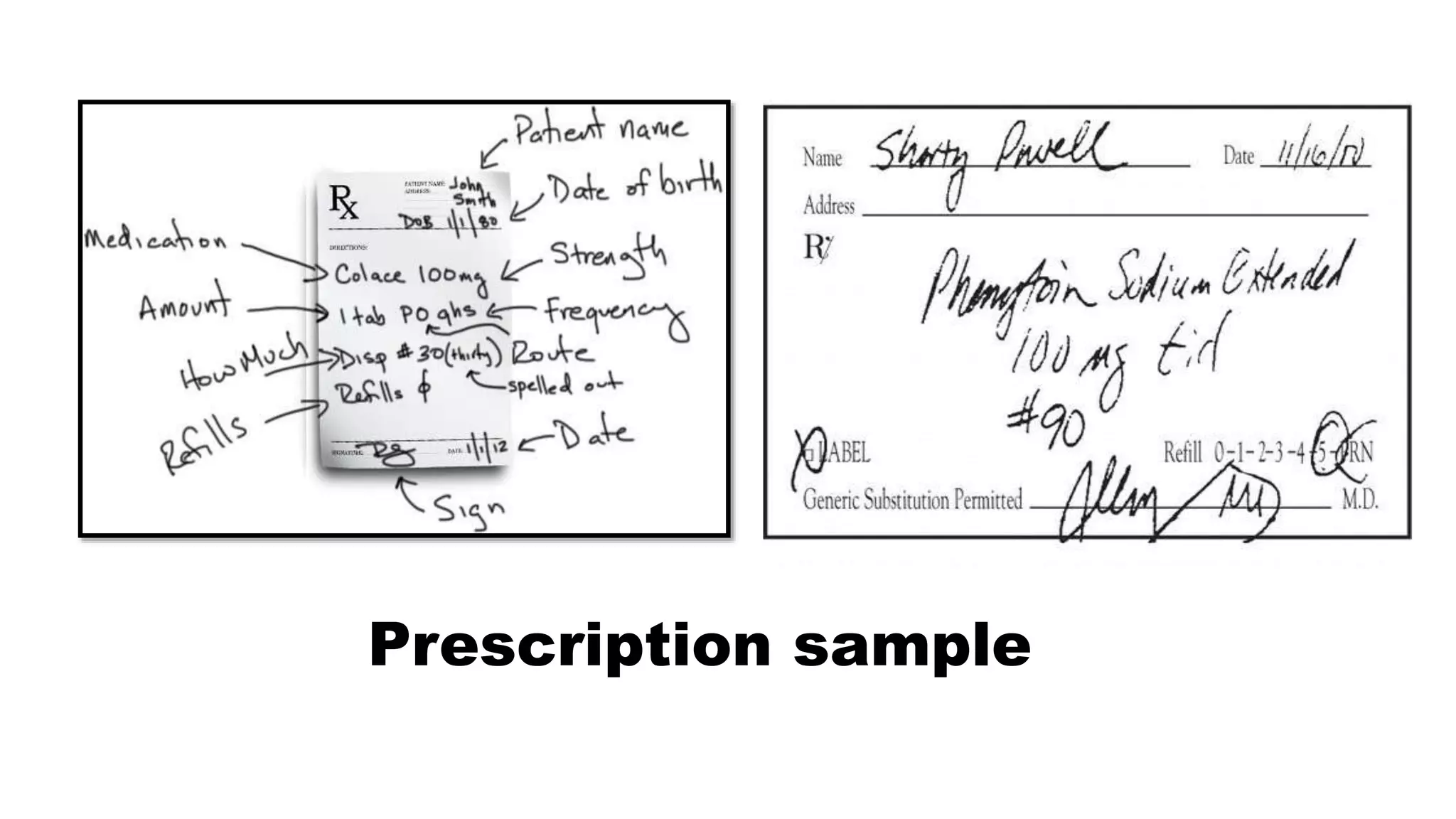
•The doctor will write medicines recommended on a
special paper called a prescription pad.
Prescription sample
•Brand name is given by the marker of the
medicine.
•Generic name is the general name of a
medicine.
•Pharmaceuticals the makers of medicines.
Pharmaceuticals
Nonprescription or OTC medications
•These are medicines bought from a drugstore with or
without a prescription order from a doctor.
•OTC medications can be harmful.
•They can be dangerous because there is no guidance
from a doctor.
•The route of medicine refers to how they are given to
the patient.
•There are different routes for medicines.
•Medicines can be delivered in many ways such as
oral, parenteral, topical, drops, and others.
Route
Oral: Syrup, Pills, Tablets, and Capsules
•Oral medicines are medicines taken by mouth.
•They are absorbed in your digestive system.
•They may be swallowed either with or without
chewing.
•Syrup- is a liquid form of the medicine that you can
drink
- This form of medicine is used especially if you have
difficulty swallowing or chewing.
- The syrup is usually measured with a spoon or
teaspoon.
Syrup
•Pills and tablets- are small solid forms of medicine.
They may look like candy which is why you should
always ask your parents or a trusted adult if
something is good for you.
•Tablet- are usually flat and round.
•Pills- may be cylindrical in shape.
Pills and Tablets
•Capsules- are medicines that are cylindrical in form.
- They can be solid, transparent with granules, or soft
and jelly- like inside.
- Once inside the stomach, the outer covering
dissolves and releases the medicine.
capsules
• Parenteral medications are medicines that do not pass
through the mouth and the stomach.
• They are injected onto the skin, into the tissues, into the
muscles, or directly into the blood.
• Parental medicines or injections are a little painful
compared to taking oral medications.
Parenteral Medications
• Topical medicines are medicines applied directly onto
the skin.
- An example of topical medicines are creams, gels,
lotions, and ointments.
- It is important to wash your hands before and after
handling topical medicines so you will not transmit germs.
Topical
Topical medicines
•Medications may be applied as eye drops or ear
drops.
•When using drops, always ask for assistance from
health care professionals like doctors and nurses, or
your parents, or a s trusted adult.
Drops
Drops
•Some medicines are inhaled through the nose or
mouth.
•These medicines are like a spray or mist
•Some inhaled medicines help you breathe better.
Inhalers
Drops
•Plant sources are also called herbals.
•Herbals- are the oldest source of medicines
Sources

Types of Medicine

  • 1.
  • 2.
    • You canbuy medicines from a drugstore or a pharmacy. • Drugstores or pharmacies sell medicines. • Medicines are classified as prescription medications and over-the-counter (OTC) medications. Availability
  • 3.
    Prescription Medicines •Medications thatare prescribed or ordered by a doctor are called prescription drugs or prescription medications. •The doctor will write medicines recommended on a special paper called a prescription pad.
  • 4.
  • 5.
    •Brand name isgiven by the marker of the medicine. •Generic name is the general name of a medicine. •Pharmaceuticals the makers of medicines.
  • 6.
  • 7.
    Nonprescription or OTCmedications •These are medicines bought from a drugstore with or without a prescription order from a doctor. •OTC medications can be harmful. •They can be dangerous because there is no guidance from a doctor.
  • 8.
    •The route ofmedicine refers to how they are given to the patient. •There are different routes for medicines. •Medicines can be delivered in many ways such as oral, parenteral, topical, drops, and others. Route
  • 9.
    Oral: Syrup, Pills,Tablets, and Capsules •Oral medicines are medicines taken by mouth. •They are absorbed in your digestive system. •They may be swallowed either with or without chewing.
  • 10.
    •Syrup- is aliquid form of the medicine that you can drink - This form of medicine is used especially if you have difficulty swallowing or chewing. - The syrup is usually measured with a spoon or teaspoon.
  • 11.
  • 12.
    •Pills and tablets-are small solid forms of medicine. They may look like candy which is why you should always ask your parents or a trusted adult if something is good for you. •Tablet- are usually flat and round. •Pills- may be cylindrical in shape.
  • 13.
  • 14.
    •Capsules- are medicinesthat are cylindrical in form. - They can be solid, transparent with granules, or soft and jelly- like inside. - Once inside the stomach, the outer covering dissolves and releases the medicine.
  • 15.
  • 16.
    • Parenteral medicationsare medicines that do not pass through the mouth and the stomach. • They are injected onto the skin, into the tissues, into the muscles, or directly into the blood. • Parental medicines or injections are a little painful compared to taking oral medications. Parenteral Medications
  • 17.
  • 18.
    • Topical medicinesare medicines applied directly onto the skin. - An example of topical medicines are creams, gels, lotions, and ointments. - It is important to wash your hands before and after handling topical medicines so you will not transmit germs. Topical
  • 19.
  • 20.
    •Medications may beapplied as eye drops or ear drops. •When using drops, always ask for assistance from health care professionals like doctors and nurses, or your parents, or a s trusted adult. Drops
  • 21.
  • 22.
    •Some medicines areinhaled through the nose or mouth. •These medicines are like a spray or mist •Some inhaled medicines help you breathe better. Inhalers
  • 23.
  • 24.
    •Plant sources arealso called herbals. •Herbals- are the oldest source of medicines Sources