FORMULATING
CLAIMS OF FACT,
POLICY AND VALUE.
OBJECTIVE
1. Differentiate types of claim.
2. Formulate different types of
claim.
•We have learned that evidences are
always the bases of an argument.
•There is no argument if evidences are
not in place. It will be hard for an
individual to write a persuasive essay
if his claims will not be supported by
valid reasons
•Nowadays, providing a valid argument is
what we need. We cannot just express our
opinions and not support it with logical
reasons. Knowing how to do the proper
reasoning could be a great tool in
communicating at these times.
CLAIM
•A claim is a statement the advocate
believes or is in the process of
evaluating (Herrick, 2016, p. 17).
•At the point that we are forced to
justify a statement, it becomes a claim.
CLAIM
•A claim is a single statement; it will never be in a
form of question. It is commonly the topic of an
argument. If you are able to provide claim with
evidences, you can probably win an argument
and if your evidences are valid and reliable, it’s
easy to persuade people.
CLAIM
•Just like how we did it earlier, when
you read the claims, you’re somehow
unsure but when the evidences were
provided, then you believe it’s true.
THERE ARE THREE TYPES
OF CLAIM NAMELY; FACT,
VALUE AND POLICY.
Claims of FACT
• Claims of Fact are statements that report, describe, predict or
make causal claims.
• Causal means the statement has to do with cause and effect
relationship. It also means that the statement has existed, exists
or will exist. It is purely based on how we see things as it is.
Example:
Cell phones pull students away from learning
The oldest known disease
in the world is leprosy.
I am the president
of the country.
Claim of fact doesn’t need to be true, that’s why it is a
claim. Again, a claim is under the process of
evaluating, that’s the reason why you need to provide
evidences to make it valid and reliable. It is an example
of claim of fact because it simply reports something.
Claims of VALUE
•Claims of Value are statements that advance
judgements about morality, beauty, merit or
wisdom. It is usually a judgement on aesthetic and
morality preferences of an individual. It’s a claim out
of what we believe in
Example:
Homosexuality is immoral because
it violates religious standards.
Providing students with devices that
they can use in the classroom is
better than allowing them to use
their cell phones in the class.
Milk tastes good.
Claims of POLICY
• Claims of Policy are statements that indicate an action
must be taken in specific policies. It also urges that an
action be taken or discontinued. Almost always “should” or
“ought to’ or “must” is expressed or implied in the claim.
Students’ cell phones should be collected
by office personnel when they enter
school.
Uniforms should be
required in all public
high schools.
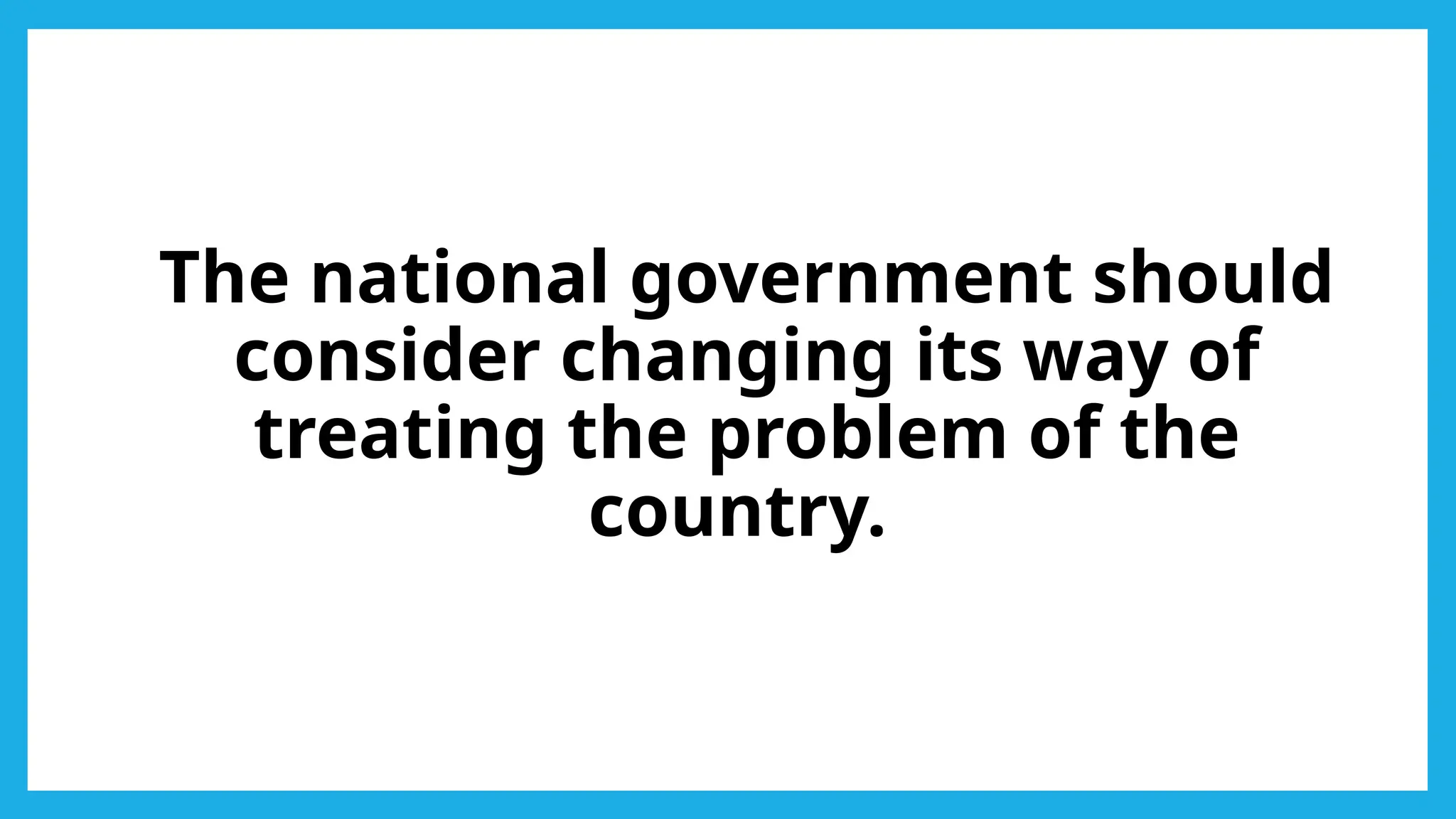
The national government should
consider changing its way of
treating the problem of the
country.
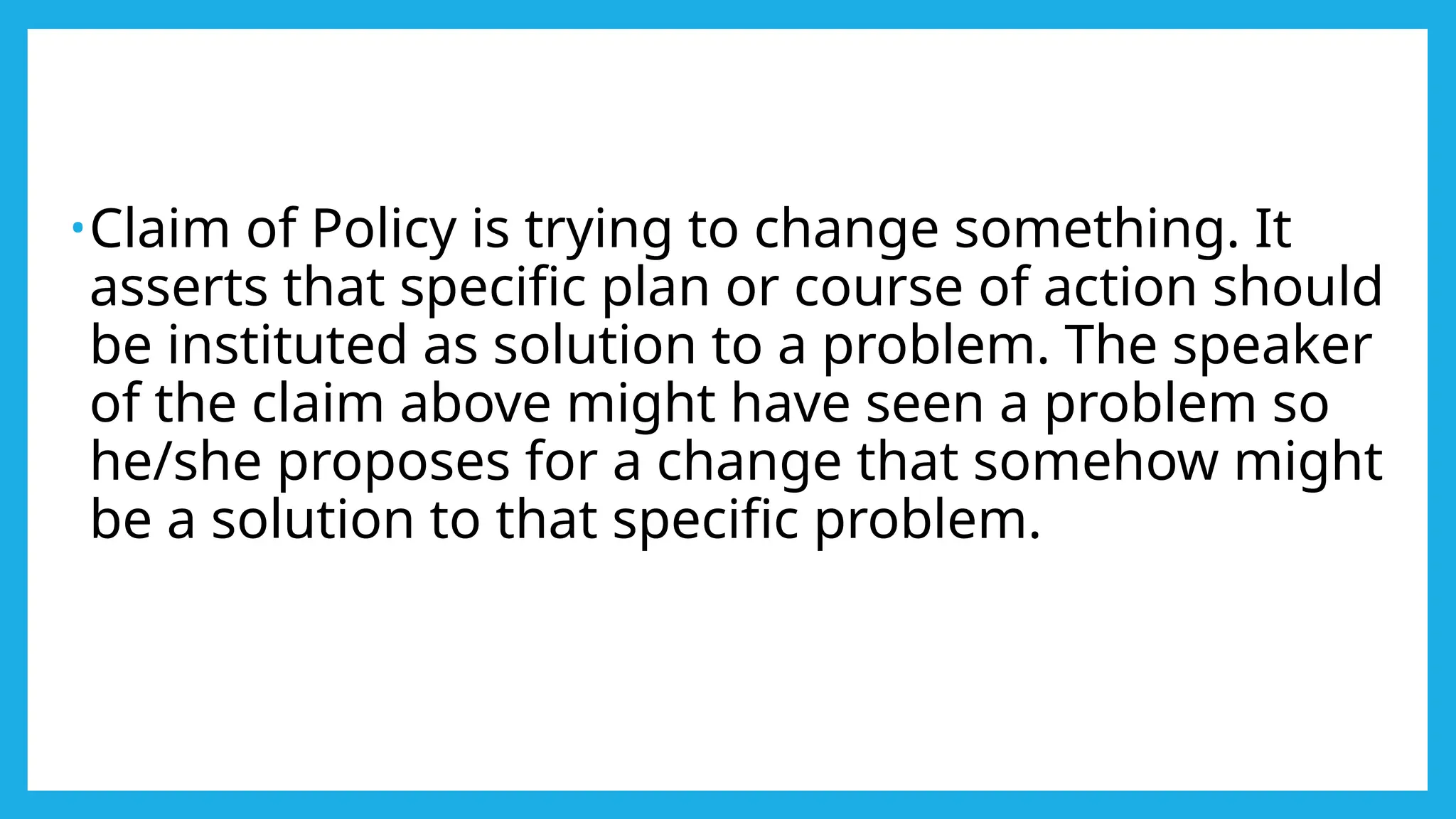
•Claim of Policy is trying to change something. It
asserts that specific plan or course of action should
be instituted as solution to a problem. The speaker
of the claim above might have seen a problem so
he/she proposes for a change that somehow might
be a solution to that specific problem.
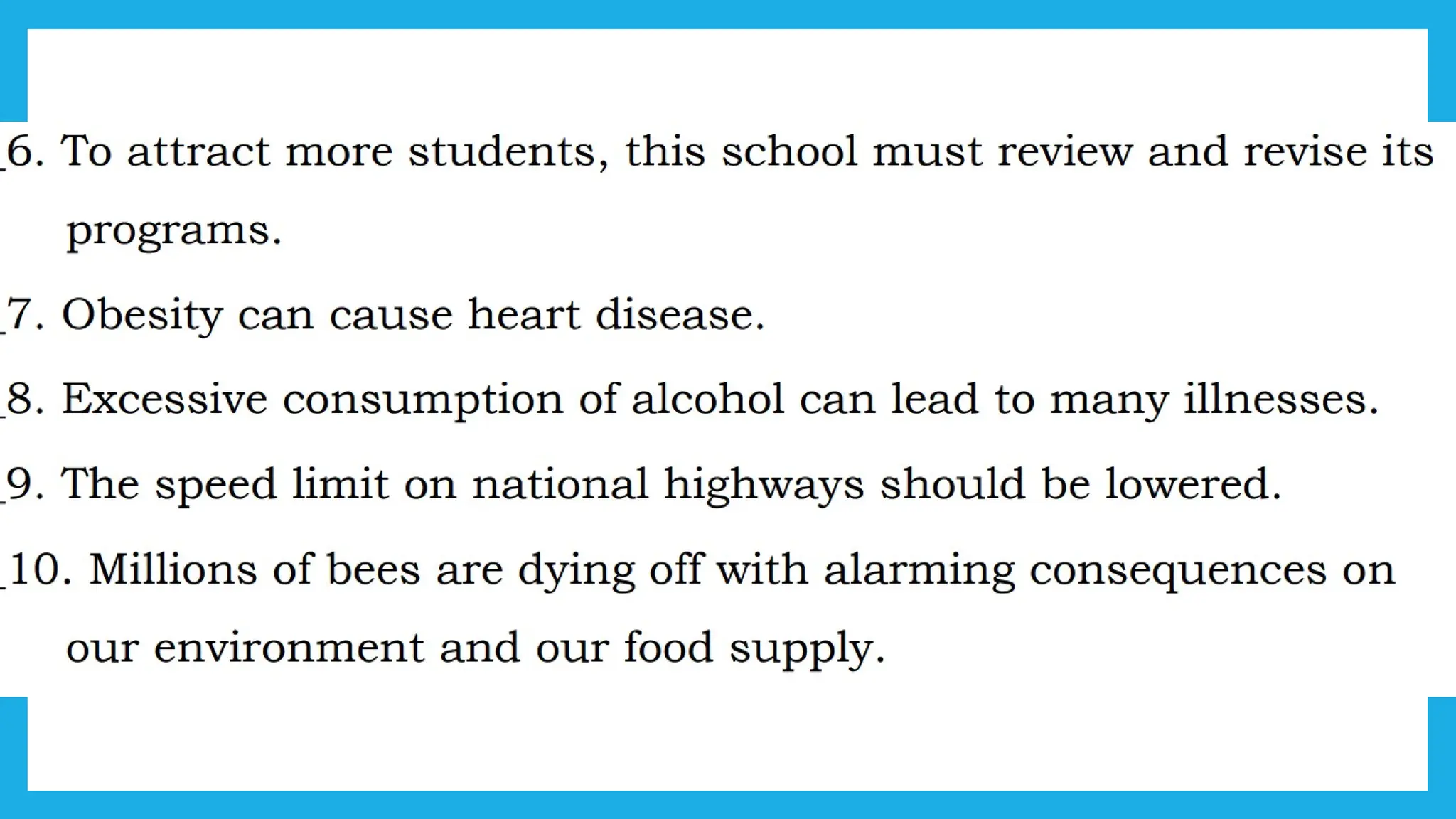
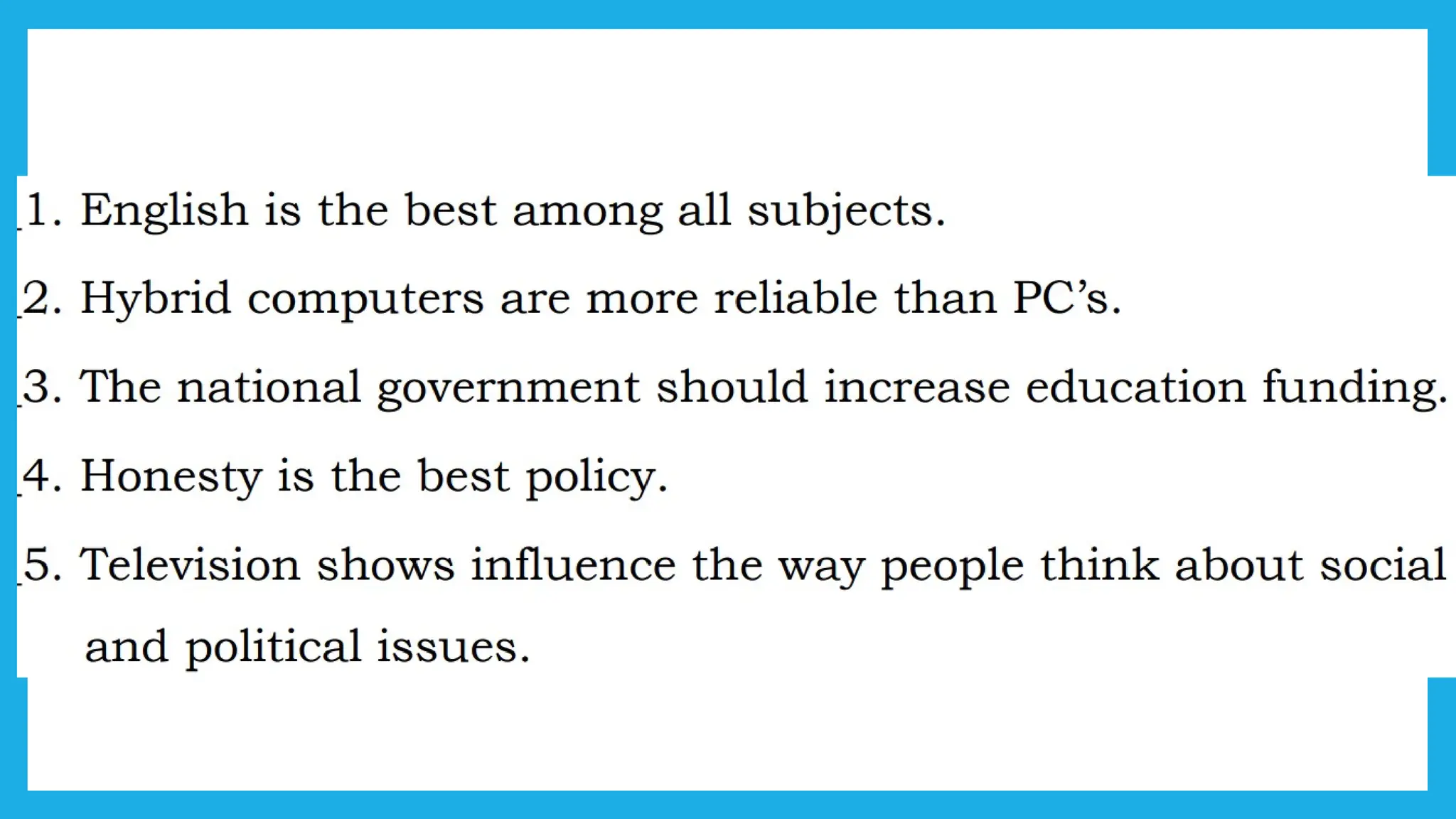
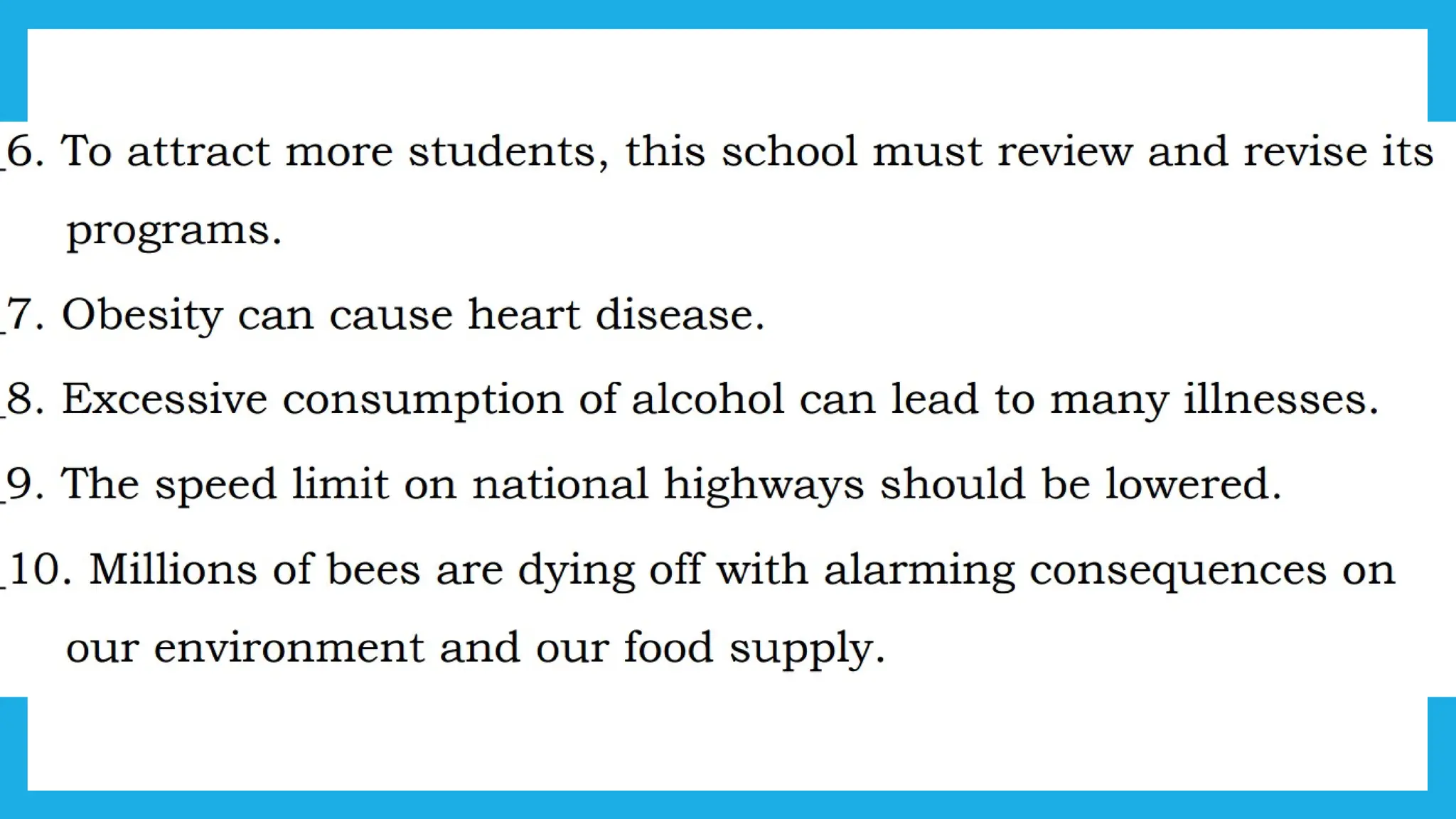
IDENTIFY THE TYPES OF
CLAIM PRESENTED IN EACH
NUMBER. WRITE THE
ANSWER ON THE SPACE
PROVIDED.
ACTIVIT
Y
ASSIGNMENT
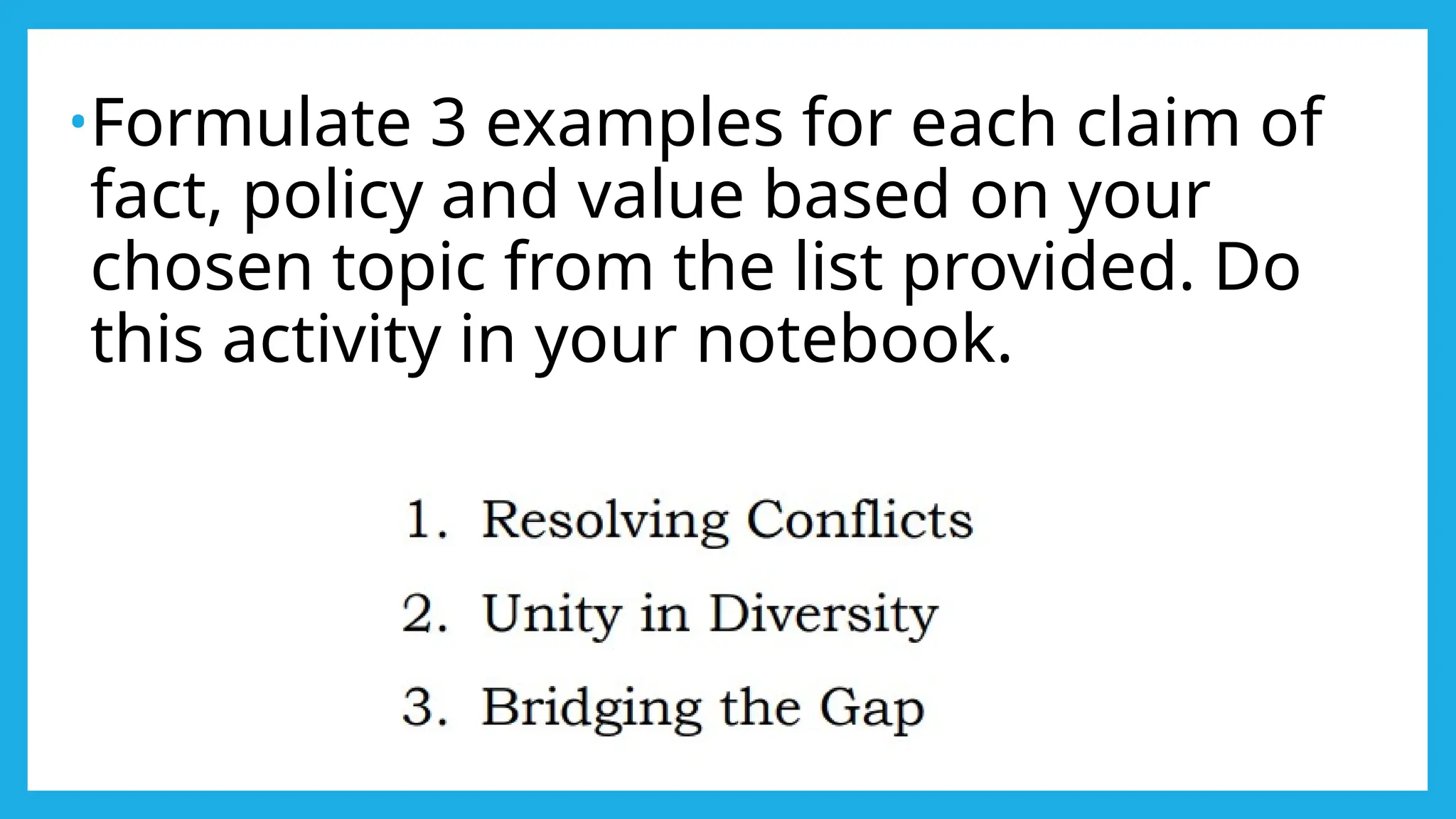
•Formulate 3 examples for each claim of
fact, policy and value based on your
chosen topic from the list provided. Do
this activity in your notebook.

Types of Claims, pptTypes of Claims, pptTypes of Claims, pptTypes of Claims, ppt

  • 1.
  • 2.
    OBJECTIVE 1. Differentiate typesof claim. 2. Formulate different types of claim.
  • 3.
    •We have learnedthat evidences are always the bases of an argument. •There is no argument if evidences are not in place. It will be hard for an individual to write a persuasive essay if his claims will not be supported by valid reasons
  • 4.
    •Nowadays, providing avalid argument is what we need. We cannot just express our opinions and not support it with logical reasons. Knowing how to do the proper reasoning could be a great tool in communicating at these times.
  • 5.
    CLAIM •A claim isa statement the advocate believes or is in the process of evaluating (Herrick, 2016, p. 17). •At the point that we are forced to justify a statement, it becomes a claim.
  • 6.
    CLAIM •A claim isa single statement; it will never be in a form of question. It is commonly the topic of an argument. If you are able to provide claim with evidences, you can probably win an argument and if your evidences are valid and reliable, it’s easy to persuade people.
  • 7.
    CLAIM •Just like howwe did it earlier, when you read the claims, you’re somehow unsure but when the evidences were provided, then you believe it’s true.
  • 8.
    THERE ARE THREETYPES OF CLAIM NAMELY; FACT, VALUE AND POLICY.
  • 9.
    Claims of FACT •Claims of Fact are statements that report, describe, predict or make causal claims. • Causal means the statement has to do with cause and effect relationship. It also means that the statement has existed, exists or will exist. It is purely based on how we see things as it is. Example: Cell phones pull students away from learning
  • 10.
    The oldest knowndisease in the world is leprosy.
  • 11.
    I am thepresident of the country. Claim of fact doesn’t need to be true, that’s why it is a claim. Again, a claim is under the process of evaluating, that’s the reason why you need to provide evidences to make it valid and reliable. It is an example of claim of fact because it simply reports something.
  • 12.
    Claims of VALUE •Claimsof Value are statements that advance judgements about morality, beauty, merit or wisdom. It is usually a judgement on aesthetic and morality preferences of an individual. It’s a claim out of what we believe in Example: Homosexuality is immoral because it violates religious standards.
  • 13.
    Providing students withdevices that they can use in the classroom is better than allowing them to use their cell phones in the class.
  • 14.
  • 15.
    Claims of POLICY •Claims of Policy are statements that indicate an action must be taken in specific policies. It also urges that an action be taken or discontinued. Almost always “should” or “ought to’ or “must” is expressed or implied in the claim. Students’ cell phones should be collected by office personnel when they enter school.
  • 16.
    Uniforms should be requiredin all public high schools.
  • 17.
    The national governmentshould consider changing its way of treating the problem of the country.
  • 18.
    •Claim of Policyis trying to change something. It asserts that specific plan or course of action should be instituted as solution to a problem. The speaker of the claim above might have seen a problem so he/she proposes for a change that somehow might be a solution to that specific problem.
  • 19.
    IDENTIFY THE TYPESOF CLAIM PRESENTED IN EACH NUMBER. WRITE THE ANSWER ON THE SPACE PROVIDED.
  • 22.
  • 25.
  • 26.
    •Formulate 3 examplesfor each claim of fact, policy and value based on your chosen topic from the list provided. Do this activity in your notebook.

Editor's Notes

  • #9 This is an example of claim of fact because it describes the day to day basis of a student who focuses more on gadgets. It also predicts because it tackles a cause and effect relationship. Using cell phones being the cause while the effect is students are being pulled away from learning.
  • #10 Another claim of fact, it reported something that existed in the past. It is not a causal claim because it already existed; you just have to provide evidences to make it valid.
  • #12 This is an example of claim of value because it judges something about morality. You can see that this claim needs to be evaluated thoroughly because of its level of sensibility.
  • #13 It’s a claim of value because of the keyword “better”. It means that the speaker has reasons why he/she prefers the one stated before. It attempts to prove that some things are more/less desirable than others. The speaker should enumerate her reasons to make his/her claim valid.
  • #14 It is basically a claim of value because it showcases preferences of a person. The speaker must have reasons behind liking milk among other drinks or maybe between coffees which is usually its contradicting product. It shows us that our likes and dislikes should always be supported by reference.
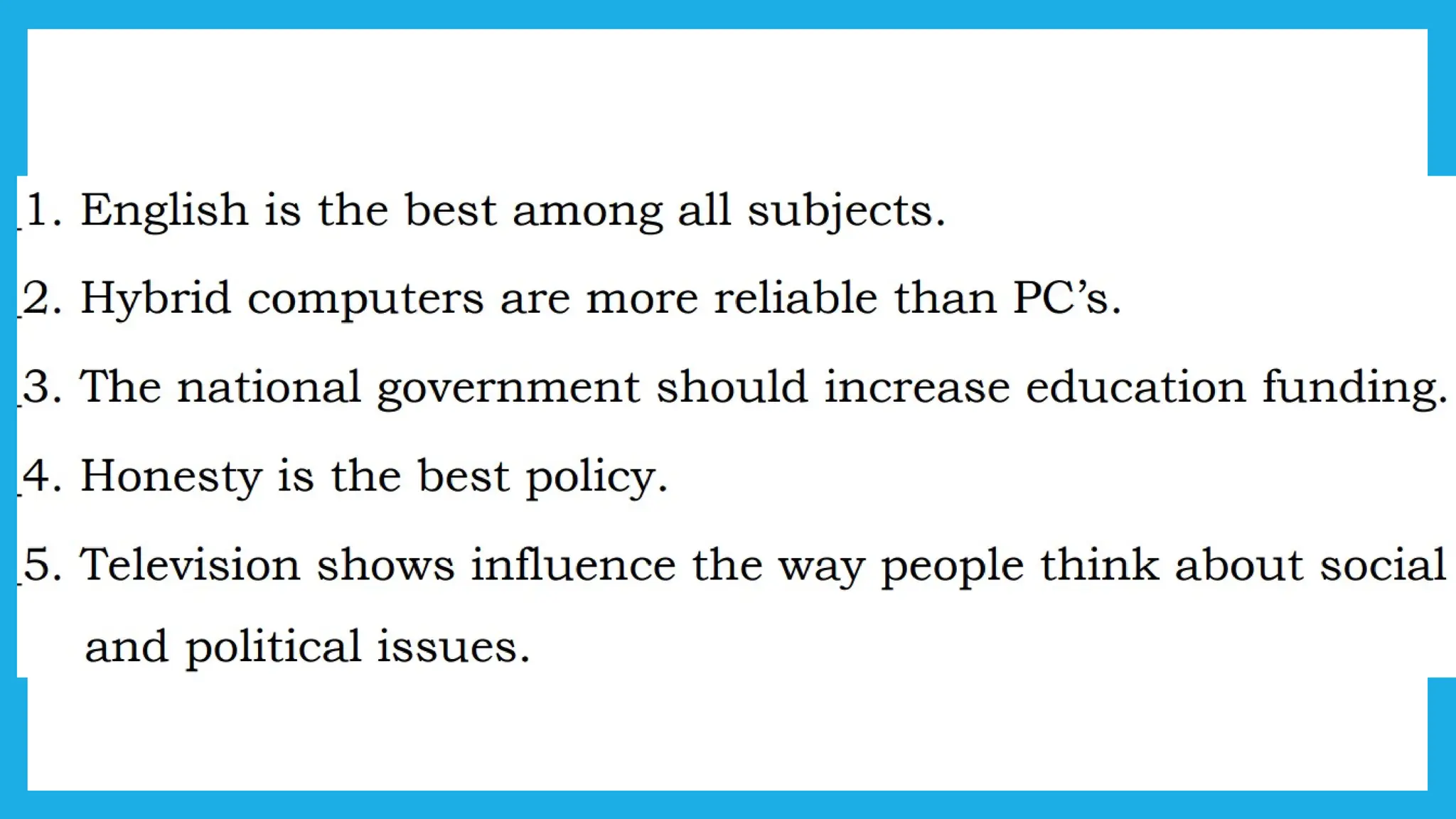
  • #23 VALUE VALUE POLICY VALUE FACT
  • #24 6. POLICY 7. FACT 8. FACT 9. POLICY 10. FACT