Nonresponse to Interferon-a Based Treatment for
Chronic Hepatitis C Infection Is Associated with
Increased Hazard of Cirrhosis
Myrna L. Cozen1
*.
, James C. Ryan1.
, Hui Shen1
, Robert Lerrigo1
, Russell M. Yee2
, Edward Sheen3
,
Richard Wu1
, Alexander Monto1
1 Department of Medicine, Veterans Affairs Medical Center and University of California San Francisco, San Francisco, California, United States of America, 2 Department of
Epidemiology, Mailman School of Public Health, Columbia University, New York, New York, United States of America, 3 Department of Medicine, Stanford University
School of Medicine, Stanford, California, United States of America
Abstract
Background: The long-term consequences of unsuccessful interferon-a based hepatitis C treatment on liver disease
progression and survival have not been fully explored.
Methods and Findings: We performed retrospective analyses to assess long-term clinical outcomes among treated and
untreated patients with hepatitis C virus in two independent cohorts from a United States Veterans Affairs Medical Center
and a University Teaching Hospital. Eligible patients underwent liver biopsy during consideration for interferon-a based
treatment between 1992 and 2007. They were assessed for the probability of developing cirrhosis and of dying during
follow-up using Cox proportional hazards models, stratified by pretreatment liver fibrosis stage and adjusted for known risk
factors for cirrhosis and characteristics affecting treatment selection. The major predictor was a time-dependent covariate
for treatment outcome among four patient groups: 1) patients with sustained virological response to treatment; 2)
treatment relapsers; 3) treatment nonresponders; and 4) never treated patients. Treatment nonresponders in both cohorts
had a statistically significantly increased hazard of cirrhosis compared to never treated patients, as stratified by pretreatment
liver fibrosis stage and adjusted for clinical and psychosocial risk factors that disproportionately affect patients who were
ineligible for treatment (Veterans Affairs HR = 2.35, CI 1.18–4.69, mean follow-up 10 years, and University Hospital HR = 5.90,
CI 1.50–23.24, mean follow-up 7.7 years). Despite their increased risk for liver disease progression, the overall survival of
nonresponders in both cohorts was not significantly different from that of never treated patients.
Conclusion: These unexpected findings suggest that patients who receive interferon-a based therapies but fail to clear the
hepatitis C virus may have an increased hazard of cirrhosis compared to untreated patients.
Citation: Cozen ML, Ryan JC, Shen H, Lerrigo R, Yee RM, et al. (2013) Nonresponse to Interferon-a Based Treatment for Chronic Hepatitis C Infection Is Associated
with Increased Hazard of Cirrhosis. PLoS ONE 8(4): e61568. doi:10.1371/journal.pone.0061568
Editor: Hans Tillmann, Duke University, United States of America
Received October 17, 2012; Accepted March 8, 2013; Published April 25, 2013
This is an open-access article, free of all copyright, and may be freely reproduced, distributed, transmitted, modified, built upon, or otherwise used by anyone for
any lawful purpose. The work is made available under the Creative Commons CC0 public domain dedication.
Funding: Funding provided by National Institutes of Health (NIH) RO1 AI 083113-01; NIH U19 AI 088790; NIH P30 DK026743 (University of California San
Francisco Liver Center); Veterans Affairs Merit Award Program and the Veterans Affairs Hepatitis C Resource Center. The funders had no role in study design, data
collection and analysis, decision to publish, or preparation of the manuscript.
Competing Interests: The authors have declared that no competing interests exist.
* E-mail: Myrna.Cozen@va.gov
. These authors contributed equally to this work.
Introduction
More than 3.2 million people in the United States (1% of the
population) are chronically infected with hepatitis C virus (HCV)
[1,2]. Until 2011, standard antiviral treatment consisted of
subcutaneous pegylated interferon-a (IFNa and oral ribavirin
(RBV), which failed to achieve a sustained virological response
(SVR, or cure) in approximately half of patients. The proportion
of treatment failures is greater among patients with HCV genotype
1, the most prevalent HCV subspecies in the U.S. [3,4,5,6]. The
recent addition of an oral protease inhibitor, either boceprevir or
telaprevir, to pegylated IFNa/RBV treatment for genotype 1
patients, has increased SVR rates to nearly 75% in treatment
naı¨ve patients [7,8,9]. SVR has been repeatedly associated with
reduced rates of cirrhosis, hepatic decompensation and hepato-
cellular carcinoma, but the long-term impact of treatment failure
on liver disease progression has not been fully explored [10,11,12].
Among treatment failures, it has been postulated that transient
reductions in viral load during treatment or anti-fibrotic effects of
IFNa may attenuate liver disease progression [13]. Alternatively,
immunostimulatory influences of IFNa could accelerate liver
injury in some patients by triggering hepatic inflammation and
scarring [14]. Early observational studies suggested altered short-
term progression of liver fibrosis in some treated patients who fail
to clear HCV [12,15,16,17,18]. Pockros, et al, pooled data from
eight IFNa-based clinical trials that analyzed paired liver biopsy
specimens taken immediately prior to treatment and up to 24
weeks post-treatment, but long-term outcomes were not examined
PLOS ONE | www.plosone.org 1 April 2013 | Volume 8 | Issue 4 | e61568
[15]. Short term histologic improvement was seen in some, but not
all, treatment failures, and fibrosis progressed in some patients
[5,12,15,16,17,18]. The evidence from these treatment and from
recent retreatment trials, such as HALT-C and EPIC3
, suggests
that failed IFNa-based therapy might have either beneficial, null,
or detrimental effects on liver related outcomes in HCV treatment
failures [19,20]. There have been no prospective studies, however,
comparing long-term clinical outcomes among chronic HCV
patients with IFNa-based treatment failure to that of never treated
patients. In the present study, we compared long-term clinical
outcomes in two independent cohorts of treated and untreated
patients with HCV. Our primary aims were to assess the long-term
hazards of cirrhosis and death among the following treatment
groups: those who achieved SVR, relapsers, nonresponders, and
those who were never treated.
Methods
Ethics Statement
This study was conducted in accordance with the ethical
principles stated in the Declaration of Helsinki and is consistent
with good clinical practice and applicable regulatory requirements
[21]. Specific approval was granted by the University of
California, San Francisco (UCSF) Institutional Review Board
and the SFVA Research and Development Committee for this
retrospective records review.
Study Design and Patient Recruitment
We conducted a medical records review of patients with chronic
HCV who were first seen at the San Francisco Veterans Affairs
(SFVA) Medical Center Liver Clinic between January, 1992 and
July 2007. Most patients had been prospectively consented at the
time of liver biopsy for inclusion in a longitudinal database.
Eligible patients were $18 years of age, had documented chronic
HCV, underwent a pre-treatment liver biopsy, received follow-up
care at the SFVA Liver Clinic for at least one year after the initial
visit, and had at least one follow-up liver imaging study, biopsy or
clinic visit. Patients were excluded if they were co-infected with
either HIV-1 or hepatitis B virus or if they had decompensated
cirrhosis, hepatocellular carcinoma, or liver transplantation prior
to their first clinic visit. The study was replicated using an
independent cohort of HCV patients from the UCSF Liver Clinic
to which the same selection criteria were applied. Each cohort is
comprised of all patients meeting study eligibility criteria who were
evaluated and followed in these two clinics during this time period.
Assessment of Clinical Parameters
The SFVA and UCSF electronic medical records were the
major sources of data for the study. Deaths were confirmed by
cross reference with the national Social Security Death Index
(SSDI). Data abstraction was performed by two teams, each
including one clinician and one research staff member, using a
standardized search algorithm. Two additional raters performed
data validation on a random sample of patient charts to confirm
the reliability of values for select variables.
Clinical parameters including body mass index (BMI), alanine
aminotransferase (ALT), and HCV viral load were collected from
the electronic medical record on the date closest to the initial liver
clinic visit. Follow-up ALT was obtained from the laboratory test
taken closest to 52 weeks following the end of treatment for treated
patients. To obtain a comparable ALT value for the never treated
patients, we used the ALT closest to 170.7 weeks following initial
liver clinic visit. This interval corresponds to the average time
between the first liver clinic visit and the completion of one year of
post therapy follow-up among treated patients.
Psychosocial, demographic, and behavioral risk factors were
assessed and recorded by clinic staff at the time of first liver clinic
visit. This assessment and subsequent progress notes were used to
determine the presence of risk factors affecting treatment eligibility
such as current injection drug use, other substance abuse, history
of depression and post-traumatic stress disorder (PTSD). Heavy
alcohol use was defined as five or more years of daily alcohol use
exceeding the equivalent of four to five drinks per day by patient
self-report [22,23]. Indicators of social instability included recent
or current homelessness, housing instability, familial dissolution,
social isolation or incarceration.
The Batts-Ludwig system was used to assess fibrosis stage and
inflammatory grade from liver biopsies [24,25]. These measures
were obtained from the biopsy taken closest to the first liver clinic
visit, although biopsies taken more than five years before or one
year following this visit were not considered. Cirrhosis was defined
as either (i) stage 4 fibrosis on biopsy or (ii) a nodular liver contour
plus at least one of three previously validated criteria: ascites,
evidence of venous collateral vessels, or splenomegaly as visualized
on CT scan, MRI, and/or ultrasound [26].
Patients were categorized into four HCV treatment-related
groups using previously described standard definitions: SVR,
relapsers, nonresponders, and never treated [6,27,28]. Relapsers
achieved undetectable viral load during treatment with detectable
virus found during a six month follow-up period. Nonresponders
were null and partial responders who were detectably viremic
throughout therapy. Those treated for ,12 weeks were designated
‘‘early treatment discontinuation’’ (ETD) patients. Patients who
were treated more than once were assigned the treatment category
corresponding to their last course of therapy.
Major Predictor and Outcome Measures
The primary outcome variables were time-to-cirrhosis and time-
to-all-cause-death during the follow-up period. Never treated
patients comprised the reference category. Time zero for all time-
to-event analyses was the date of first liver clinic visit. To overcome
the temporal bias associated with variations in treatment start
time, we constructed a time-dependent covariate, using standard
methods as previously described [29,30]. This covariate modifies
the major predictor (treatment outcome) by adjusting for
differences in waiting times between time zero and the beginning
of treatment. Time-to-cirrhosis was calculated from time zero to
the date cirrhosis was first diagnosed or to the date of last liver
clinic visit. Patients diagnosed with cirrhosis prior to time zero
were excluded from the time-to-cirrhosis analysis, but were
included in time-to-death analysis. For time-to-death analysis,
the study length extended from time zero to the date of either
death or liver transplantation. In surviving patients, the right
censoring time was the date of last medical service encounter or six
months before the date that the SSDI was searched, whichever
was later. As the SSDI only includes date but not cause of death,
all-cause death was used as the outcome variable. March 31, 2012
was the cut-off date for all observations.
Statistical Methods
All analyses were performed using SAS version 9.2 (SAS
Institute Inc., Cary, NC). Chi square tests were performed for
categorical data analysis, and the Student’s t test or Wilcoxon rank
sum test was used to evaluate the association of continuous
predictors on categorical dependent variables (such as patient
treatment group). Cox proportional hazards models were used to
analyze both univariate and multivariate effects on the outcomes
Cirrhosis in HCV Nonresponders
PLOS ONE | www.plosone.org 2 April 2013 | Volume 8 | Issue 4 | e61568
of interest. Since differences in baseline fibrosis stage likely have
nonlinear influences on long-term fibrosis progression, and
because the distribution of fibrosis stage violated the proportional
hazards assumption, all Cox proportional hazards models were
stratified by fibrosis stage groupings (0–1 and 2–3 in time-to-
cirrhosis analyses and 0–1, 2–3 and 4 in time-to-death analysis).
Time-to-cirrhosis analysis was repeated using an alternate fibrosis
stratification strategy to allow a closer examination of advanced
stage 3 compared to stages 0–2.
We used two strategies to adjust for the non-random
distribution of characteristics differentiating treated from untreat-
ed patients, including age at initial liver biopsy, race/ethnicity,
HCV genotype, history of heavy alcohol use, other substance use,
psychiatric comorbidities, and social stability. First, these factors
were assessed individually in univariate hazards models and
incorporated into the full multivariate model through backward
stepwise regression, as described in Statistical Methods S1.
Second, propensity scores were derived from non-collinear risk
factors and substituted into the final time-to-event models using
previously described methods to estimate a composite effect from
the factors related to treatment selection [31,32]. Adjusted hazard
ratios resulting from the two approaches were compared. After
stratification by fibrosis stage, age-adjusted proportional hazards
curves were generated to graph the hazard function for cirrhosis
and death or liver transplantation among the four treatment
outcome groups. These models assume proportional hazards for
age, but not for treatment group.
Results
Demographic and Clinical Characteristics
Among SFVA patients screened, 358 (99% male) met the study
inclusion criteria, and 159 patients (44.4%) received antiviral
treatment for HCV. Approximately 80% were between the ages of
45 and 65 at initial liver clinic visit, with a mean age of 51
(Table 1). This age distribution corresponds to the birth cohort of
Vietnam era veterans, a risk group known to have higher rates of
prior IDU and HCV seroprevalence than other groups of
veterans, which reflects likely exposure to HCV during and
shortly after their service years in the 1960s and 1970s [33] [34].
Approximately 55% of the cohort had little or no liver disease at
baseline, as measured by Batts-Ludwig fibrosis score, while 7.3%
were cirrhotic. Mean follow-up time was 10 years, and 22%
(n = 78) died during follow-up. One patient underwent liver
transplantation. Deaths occurred among 8.7% of patients achiev-
ing SVR, 18.2% of relapsers, 28.6% of nonresponders, and 23.8%
of the never treated patients (p,0.01).
Treated SFVA patients had higher liver fibrosis stage and
inflammation score at baseline, however when stratified by fibrosis
stage the influence of inflammation lost significance, suggesting
effect modification by fibrosis. Treated patients were followed for a
longer period than never treated patients (10.8 versus 9.4 years,
p,0.0001) and treatment nonresponders and relapsers had more
follow-up liver imaging (or liver biopsies) than never treated
patients (xx = 1.77, 2.77, 3.88 and 1.74 for SVR, relapsers,
nonresponders and never treated patients, respectively,
p,0.0001) (Table 1). Never treated patients were older (52 versus
50 years, p = 0.04), more likely to be African American and more
likely to be infected with ‘‘difficult to clear’’ genotypes HCV
genotypes 1 or 4 than 2 or 3 (Table 1). Treated patients had a
higher mean BMI at baseline than never treated patients (Table 1).
The most common reasons cited for the decision not to treat
during follow-up were minimal liver disease (21.6%), ongoing
alcohol and substance use (19.1%), active mental health problems
(11.1%), African American race (5.0%), advanced liver disease
(3.0%), and advanced age with or without other comorbidities
(8.5%). Compared with treated patients, never treated patients
were more likely to be active substance users and to have at least
one indicator of social instability (Table 2).
No statistically significant difference was found in mean baseline
ALT between treated and never treated groups (p = 0.15, data not
shown), although the SVR group had a marginally higher baseline
value as compared to the other treatment outcome groups
(Table 1). We compared the mean change in ALT before and
after treatment for nonresponders and relapsers (grouped together)
to that of never treated patients for a comparable time interval.
We found that nonresponders and relapsers had a mean decrease
in ALT of 15.0 U/L, while never treated patients had a mean
increase of ALT of 17.6 U/L (p = 0.05) (data not shown). In
further analysis we found that 69.2% of nonresponders and
relapsers had a decrease in ALT $25% following treatment as
compared to 45.2% of never treated patients, while 19.2% of
nonresponders and relapsers and 41.9% of never treated patients
had an increase in ALT of $25% (p = 0.03) (data not shown).
Predictors of treatment success. Among treated SFVA
patients, African Americans were less likely to achieve SVR than
other races/ethnic groups (p = 0.03) as were patients with HCV
genotypes 1 or 4 (p = 0.007) and those with higher pretreatment
fibrosis stage (p = 0.004). No significant difference was noted in
treatment success between the small number of SFVA patients
who received IFNa monotherapy and those treated with IFNa or
pegylated IFNa/RBV combination therapy (Table 1).
Cumulative incidence of cirrhosis. We examined the
cumulative incidence of cirrhosis among SFVA patients with
baseline fibrosis stages 2 and 3 using age adjusted proportional
hazards curves stratified by treatment group (Figure 1). A greater
proportion of treatment relapsers and nonresponders developed
cirrhosis than never treated patients. The overall incidence of
cirrhosis in the SFVA cohort was 25.8 cases per 1,000 person
years. While SVR and never treated patients had incidence rates
of 16.2 and 20.5 cases per 1,000 person years, respectively, these
rates rose to 28.9 and 58.9 cases per 1,000 person years among
relapsers and nonresponders. These differences, however, were
not statistically significant.
Time-to-cirrhosis analysis. In univariate proportional haz-
ards models stratified by baseline fibrosis stage (0–1 and 2–3) and
employing the time dependent covariate for SFVA treatment
group, nonresponders were twice as likely to develop cirrhosis
when compared to never treated patients (HR = 2.02, CI 1.11–
3.67, Table 3). Patients achieving SVR did not realize appreciable
protection from cirrhosis in these models, although their hazard
ratios trended in that direction. Histological inflammation score
was not predictive of cirrhosis once the cohort was stratified by
baseline fibrosis stage. As expected, age incrementally increased
the cirrhosis risk; for every additional year there was a 5% increase
in the hazard of developing cirrhosis (HR, 1.05 CI 1.01–1.09).
History of blood transfusion prior to 1992 was also associated with
an increased the hazard of cirrhosis (HR 2.04, CI 1.16–3.59).
African American patients were at considerably lower risk of
developing cirrhosis than were Caucasians (HR = 0.47, CI 0.20–
1.10), but this difference did not achieve statistical significance,
probably due to the low number of cirrhosis events among African
Americans. In contrast, Latinos were at greater risk of cirrhosis
compared to Caucasians, but again this increased hazard did not
attain statistical significance (HR = 1.82, CI 0.88–3.77). Neither
BMI, diabetes mellitus, history of heavy alcohol use or lack of
social stability were significantly associated with the hazard of
cirrhosis in univariate models. ALT was not entered into the
Cirrhosis in HCV Nonresponders
PLOS ONE | www.plosone.org 3 April 2013 | Volume 8 | Issue 4 | e61568
Table 1. Demographic and Clinical Characteristics of the SFVA HCV Cohort.
Variable Total SVR NR Relapser
ETD/
Unknown No Treatment p-value
(N = 358) (N = 69) (N = 49) (N = 22) (N = 19) (N = 199)
Age at 1st Liver Clinic Visit (Yr), Mean (SD)50.98 (6.68) 49.13 (6.87) 50.38 (5.18) 51.06 (4.82) 50.47 (7.68) 51.81 (6.92) 0.20**
Male Gender 354 (98.9%) 66 (95.7%) 49 (100.0%) 22 (100.0%) 19 (100.0%) 198 (99.5%) 0.16*
Race/Ethnicity
Caucasian 236 (66.1%) 59 (85.5%) 31 (64.6%) 18 (81.8%) 10 (52.6%) 118 (59.3%) 0.01
African-American 72 (20.2%) 4 (5.8%) 11 (22.9%) 3 (13.6%) 3 (15.8%) 51 (25.6%)
Latino 31 (8.7%) 3 (4.3%) 4 (8.3%) 1 (4.5%) 4 (21.1%) 19 (9.5%)
Asian/API/Native American 18 (5.0%) 3 (4.3%) 2 (4.2%) 0 (0.0%) 2 (10.5%) 11 (5.5%)
HCV Genotype{
Genotype 1 246 (68.7%) 33 (47.8%) 40 (81.6%) 13 (59.1%) 10 (52.6%) 150 (75.4%) ,0.0001
Genotype 2 52 (14.5%) 16 (23.2%) 3 (6.1%) 5 (22.7%) 3 (15.8%) 25 (12.6%)
Genotype 3 30 (8.4%) 10 (14.5%) 5 (10.2%) 3 (13.6%) 1 (5.3%) 11 (5.5%)
Genotype 4 6 (1.7%) 0 (0.0%) 0 (0.0%) 0 (0.0%) 1 (5.3%) 5 (2.5%)
Mixed genotype 2 (0.6%) 0 (0.0%) 1 (2.0%) 1 (4.5%) 0 (0.0%) 0 (0.0%)
Baseline Fibrosis Stage
0 111 (31.0%) 13 (18.8%) 5 (10.2%) 7 (31.8%) 2 (10.5%) 84 (42.2%) ,0.0001
1 87 (24.3%) 20 (29.0%) 10 (20.4%) 2 (9.1%) 5 (26.3%) 50 (25.1%)
2 92 (25.7%) 26 (37.7%) 13 (26.5%) 5 (22.7%) 3 (15.8%) 45 (22.6%)
3 42 (11.7%) 7 (10.1%) 13 (26.5%) 4 (18.2%) 6 (31.6%) 12 (6.0%)
4 26 (7.3%) 3 (4.3%) 8 (16.3%) 4 (18.2%) 3 (15.8%) 8 (4.0%)
Baseline Inflammation Grade`
0 17(4.9%) 1(1.5%) 0(0.0%) 0(0.0%) 2(11.1%) 14(7.3%) 0.003
1 107(31.0%) 17(25.0%) 9(20.0%) 6(28.6%) 2(11.1%) 73(37.8%)
2 195(56.5%) 42(61.8%) 33(73.3%) 11(52.4%) 14(77.8%) 95(49.2%)
3 26(7.5%) 8(11.8%) 3(6.7%) 4(19.0%) 0(0.0%) 11(5.7%)
Baseline ALT, Mean (SD) 94.01 (71.91) 109.84 (74.59) 92.89 (71.06) 99.69 (75.38) 76.47 (65.28) 89.17 (71.56) 0.09**
Baseline BMI, Mean (SD) 28.42 (5.25) 29.86 (5.10) 29.04 (5.23) 28.20 (4.71) 28.74 (7.62) 27.75 (5.02) 0.02**
Diabetes Mellitus 56 (15.6%) 9 (13.0%) 10 (20.4%) 5 (22.7%) 4 (21.1%) 28 (14.1%) 0.50*
Blood Transfusion before 1992 71 (21.1%) 14 (22.2%) 8(17.8%) 6 (30.0%) 3 (15.8%) 40 (21.2%) 0.82*
Number of Follow-up Images/Liver Biopsy,
Mean (SD)
2.10 (1.96) 1.77 (2.09) 3.88 (2.25) 2.77 (1.63) 1.68 (1.83) 1.74 (1.62) ,0.0001**
Cirrhosis during Follow-up 60 (18.1%) 7 (10.6%) 20 (48.8%) 4 (22.2%) 2 (12.5%) 27 (14.1%) ,0.0001*
HCC during Follow-up 20 (5.6%) 2 (2.9%) 6 (12.2%) 1 (4.5%) 2 (10.5%) 9 (4.5%) 0.14*
Liver Transplant during Follow-up 1 (0.3%) 0 (0.0%) 0 (0.0%) 0 (0.0%) 1 (5.3%) 0 (0.0%) 0.05*
Died during Follow-up 78 (21.8%) 6 (8.7%) 14 (28.6%) 4 (18.2%) 7 (36.8%) 47 (23.6%) 0.01*
Years of Follow-Up, Mean (SD) 10.00 (3.05) 10.76 (2.88) 11.72 (2.89) 10.46 (3.12) 8.97 (4.27) 9.36 (2.78) ,0.0001**
Treated Patients Only N = 159
Courses of IFNa Treatment
1 133 (83.6%) 62 (89.9%) 36 (73.5%) 19 (86.4%) 16 (84.2%) NA 0.13*
$2 26 (16.4%) 7 (10.1%) 13 (26.5%) 3 (13.6%) 3 (15.8%) NA
Length of IFNa treatment (wk), Mean (SD)40.45 (22.32) 43.38 (17.11) 40.00 (22.27) 51.18 (27.68) 18.53 (19.25) NA ,0.0001**
Therapeutic Regimen
IFNa monotherapy 20 (12.6%) 6 (8.7%) 9 (18.4%) 2 (9.1%) 3 (15.8%) NA 0.41*
IFNa/RBV therapy 139 (87.4%) 63 (91.3%) 40 (81.6%) 20 (90.9%) 16 (84.2%) NA
P-values were calculated from Chi-square test for category variables and ANOVA for continuous variables unless otherwise marked.
*P-values were calculated from Fisher’s Exact test.
**Variable was rank transformed.
{
22 cases missing HCV genotype data.
`
13 cases missing baseline inflammation grade.
doi:10.1371/journal.pone.0061568.t001
Cirrhosis in HCV Nonresponders
PLOS ONE | www.plosone.org 4 April 2013 | Volume 8 | Issue 4 | e61568
model as it was not a significant predictor of the hazard of
cirrhosis.
Results of multivariate proportional hazards analysis stratified
by pretreatment fibrosis stage in the SFVA cohort are presented in
Table 3. The increased hazard of progression to cirrhosis among
treatment nonresponders relative to never treated patients
remained significant in this model, after adjustment for demo-
graphic and clinical characteristics and the factors that differen-
tiated treated from never treated groups (HR = 2.35, CI 1.18–
4.69). Latino ethnicity now became significantly associated with
cirrhosis (HR = 2.50, CI 1.12–5.56), while African American race
was protective (HR = 0.30, CI 0.13–0.72). Age continued to have
an incremental effect as did BMI. Patients with HCV genotypes 1
or 4 were at increased risk of cirrhosis, even after correcting for the
interaction between genotype and treatment initiation. Restratify-
ing to compare more advanced baseline fibrosis stage 3 against
stages 0–2 and repeating these analyses, we found that treatment
nonresponders continued to exhibit an increased hazard of
cirrhosis compared to never treated patients (HR = 2.95, CI
1.34–6.52, in the multivariate model, data not shown).
Since fibrosis progression is thought to proceed more slowly in
African Americans compared to Caucasian patients with chronic
HCV, we attempted to reanalyze these data separately for African
American and non-African American patient groups [35,36,37].
There were too few cirrhosis events to develop a proportional
hazards model for cirrhosis development using the multivariate
modeling strategy described above, however when using a pre-
fitted model, we found that treatment non-response (HR = 2.05,
CI 0.99–4.26), age (HR = 1.07, CI 1.02–1.12) and BMI
(HR = 1.08, CI 1.02–1.15) were each significant predictors of an
increased hazard of cirrhosis among African Americans (data not
shown).
Finally, as an alternative strategy to account for the inherent
differences between treated and never treated groups, we
Table 2. Risk Factors Characterizing Treated and Untreated Patient Groups (SFVA Cohort).
Variable Total SVR NR Relapse
ETD/
Unknown No Treatment p-value
(N = 358) (N = 69) (N = 49) (N = 22) (N = 19) (N = 199)
History of Heavy Drinking 224 (62.6%) 35 (50.7%) 33 (67.3%) 13 (59.1%) 12 (63.2%) 131 (65.8%) 0.23
Active IDU 19 (5.3%) 1 (1.5%) 1 (2.0%) 0 (0.0%) 1 (5.3%) 16 (8.1%) 0.16*
Active Substance Use (non-IDU) 60 (17.2%) 6 (9.2%) 5 (10.9%) 4 (18.2%) 1 (5.3%) 44 (22.4%) 0.05*
Current Methadone 44 (12.4%) 5 (7.4%) 9 (18.4%) 1 (4.5%) 3 (15.8%) 26 (13.2%) 0.31*
History of Depression 133 (38.0%) 27 (39.7%) 24 (50.0%) 9 (42.9%) 8 (42.1%) 65 (33.5%) 0.45
PTSD 59 (16.9%) 14 (20.6%) 12 (24.5%) 4 (19.0%) 2 (10.5%) 27 (14.0%) 0.43
Social Stability 307 (86.5%) 67 (97.1%) 47 (97.9%) 20 (90.9%) 19 (100.0%) 154 (78.2%) ,0.0001
*P-values were calculated from Fisher’s Exact test.
doi:10.1371/journal.pone.0061568.t002
Figure 1. Cumulative incidence of cirrhosis among SFVA patients with baseline fibrosis stages 2 and 3. Age adjusted proportional
hazards curves indicate that treatment relapsers and nonresponders had a higher incidence of cirrhosis over the study period compared to never
treated patients, but these differences were not statistically significant unadjusted for other risk factors.
doi:10.1371/journal.pone.0061568.g001
Cirrhosis in HCV Nonresponders
PLOS ONE | www.plosone.org 5 April 2013 | Volume 8 | Issue 4 | e61568
substituted a propensity score for statistically significant psycho-
social risk factors in our multivariate proportional hazards models
as described in Statistical Methods S1. These results differed little
from the findings above, and again treatment nonresponders had a
significantly increased hazard of cirrhosis compared to never
treated patients (HR 2.68, CI 1.27–5.63, data not shown).
Replication Cohort
In order to confirm these unexpected findings, we used identical
data collection and analytic methods to replicate the study in an
independent cohort of patients with chronic HCV from the UCSF
Liver Clinic (N = 265, Replication Cohort S1, Table S1). These
patients were subject to the same eligibility criteria as the SFVA
patients. All UCSF patients had a baseline liver biopsy and follow-
up liver imaging or biopsy. UCSF cohort patients were
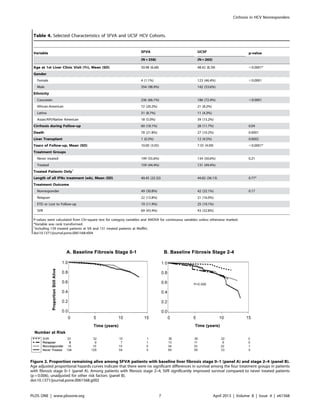
significantly younger than the SFVA group (baseline age 48
versus 51 years for the SFVA) and included 46% female patients,
whereas the SFVA group was 99% male (Table 4). There was a
significantly higher proportion of Caucasian and Asian patients
and a lower proportion of African American and Latino patients
in the UCSF cohort (p,0.0001). The mean follow-up time was 7.7
years as compared to 10 years for the SFVA (p,0.0001) (Table 4).
Descriptive characteristics of the UCSF cohort are provided in
Tables S1 and S2.
Cumulative incidence of cirrhosis among UCSF patients with
baseline fibrosis stages 2 and 3 was examined using age adjusted
proportional hazards curves (Figure S1), which indicate that there
were no differences in the incidence of cirrhosis among treatment
groups, when unadjusted for other risk factors. In univariate
proportional hazards models stratified by baseline liver fibrosis
stage (0–1 and 2–3), UCSF treatment nonresponders showed an
increased hazard for developing cirrhosis when compared to the
never treated group, but this result fell just short of statistical
significance (HR = 2.28, CI 0.93–5.59, Table S3). SVR was not
significantly protective against cirrhosis. In multivariate propor-
tional hazards models stratified by fibrosis stages (0–1 and 2–3)
and adjusted for other risk factors, treatment nonresponse
independently increased the long-term hazard of cirrhosis
(HR = 5.90, CI 1.50–23.24, Table S3). Consistent with the SFVA
cohort, incremental increases in age and BMI also contributed to
the hazard of cirrhosis. In this model, social stability was
significantly protective against cirrhosis (HR = 0.23, CI 0.07–
0.79, Table S3). Restratifying to compare patients with advanced
baseline fibrosis stage 3 to those with stages 0–2 still resulted in a
significantly increased hazard of progression to cirrhosis among
treatment non-responders in the final multivariate model
(HR = 4.30, CI 1.16–15.93, data not shown).
Survival
Figure 2 depicts the survival experience for SFVA patients in
age adjusted proportional hazards curves for two groups defined
by baseline liver fibrosis stage. No differences in survival were
observed among treatment groups for patients with baseline
fibrosis stage 0–1 (Figure 2, panel A), whereas SVR led to a
significant survival benefit compared to never treated patients
among those with baseline fibrosis stage 2–4 (p = 0.006) (Figure 2,
panel B).
Cox proportional hazards models were developed to examine
the contribution of multiple risk factors on time-to-death (Table 5).
Time-to-death models were stratified by baseline fibrosis stage 0–
1, 2–3, and 4, and incorporated the time dependent covariate
described above. In univariate analysis of the SFVA cohort, both
SVR and nonresponder patients had a lower hazard of dying
compared with never treated patients (HR = 0.24, CI 0.10–0.58
Table 3. Predictors of Development of Cirrhosis Stratified by Fibrosis Stage (SFVA Cohort, N = 332)*.
Characteristics` Univariate Model Multivariate Model
HR{
(95% CI) HR{
(95% CI)
Treatment outcome
SVR 0.67 (0.23–1.56) 0.68 (0.26–1.80)
Nonresponder 2.02 (1.11–3.67) 2.35 (1.18–4.69)
Relapser 1.24 (0.43–3.55) 1.00 (0.28–3.56)
ETD or Lost to Follow–up 1.07 (0.25–4.52) 1.28 (0.29–5.69)
Never Treated ref
Age at first liver clinic visit–per year increase1
1.05 (1.01–1.09) 1.09 (1.04–1.14)
Race1
African American 0.61 (0.27–1.36) 0.30 (0.13–0.72)
Latino 1.82 (0.88–3.77) 2.50 (1.12–5.56)
Asian/API/Native American 0.41 (0.06–3.09) 0.42 (0.06–3.17)
Caucasian ref Ref
HCV genotype 1 or 41
1.40 (0.77–2.56) 2.33 (1.10–4.93)
BMI-per unit increase1
1.03 (0.98–1.08) 1.07 (1.02–1.13)
Active Substance Use (non–IDU)1
1.10 (0.56–2.18) NA
Social Stability1
0.72 (0.35–1.46) 0.48 (0.21–1.09)
Transfusion before 1992 2.04 (1.16–3.59) NA
*Cox Proportional Hazards Models using time dependent covariate correcting for differences in waiting times from baseline to treatment initiation.
{
Hazard Ratio (HR) calculated using Cox Proportional Hazards Modeling.
`
Interaction terms not shown.
1
Risk factors that significantly differentiate the treated from never treated groups.
doi:10.1371/journal.pone.0061568.t003
Cirrhosis in HCV Nonresponders
PLOS ONE | www.plosone.org 6 April 2013 | Volume 8 | Issue 4 | e61568
Table 4. Selected Characteristics of SFVA and UCSF HCV Cohorts.
Variable SFVA UCSF p-value
(N = 358) (N = 265)
Age at 1st Liver Clinic Visit (Yr), Mean (SD) 50.98 (6.68) 48.42 (8.39) ,0.0001*
Gender
Female 4 (1.1%) 123 (46.4%) ,0.0001
Male 354 (98.9%) 142 (53.6%)
Ethnicity
Caucasian 236 (66.1%) 186 (72.4%) ,0.0001
African-American 72 (20.2%) 21 (8.2%)
Latino 31 (8.7%) 11 (4.3%)
Asian/API/Native American 18 (5.0%) 39 (15.2%)
Cirrhosis during Follow-up 60 (18.1%) 28 (11.7%) 0.04
Death 78 (21.8%) 27 (10.2%) 0.0001
Liver Transplant 1 (0.3%) 12 (4.5%) 0.0002
Years of Follow-up, Mean (SD) 10.00 (3.05) 7.55 (4.09) ,0.0001*
Treatment Groups
Never treated 199 (55.6%) 134 (50.6%) 0.21
Treated 159 (44.4%) 131 (49.4%)
Treated Patients Only{
Length of all IFNa treatment (wk), Mean (SD) 40.45 (22.32) 44.82 (36.13) 0.77*
Treatment Outcome
Nonresponder 49 (30.8%) 42 (32.1%) 0.17
Relapser 22 (13.8%) 21 (16.0%)
ETD or Lost to Follow-up 19 (11.9%) 25 (19.1%)
SVR 69 (43.4%) 43 (32.8%)
P-values were calculated from Chi-square test for category variables and ANOVA for continuous variables unless otherwise marked.
*Variable was rank transformed.
{
Including 159 treated patients at VA and 131 treated patients at Moffitt.
doi:10.1371/journal.pone.0061568.t004
Figure 2. Proportion remaining alive among SFVA patients with baseline liver fibrosis stage 0–1 (panel A) and stage 2–4 (panel B).
Age adjusted proportional hazards curves indicate that there were no significant differences in survival among the four treatment groups in patients
with fibrosis stage 0–1 (panel A). Among patients with fibrosis stage 2–4, SVR significantly improved survival compared to never treated patients
(p = 0.006), unadjusted for other risk factors (panel B).
doi:10.1371/journal.pone.0061568.g002
Cirrhosis in HCV Nonresponders
PLOS ONE | www.plosone.org 7 April 2013 | Volume 8 | Issue 4 | e61568
and HR = 0.51, CI 0.26–0.98, respectively, Table 5). The hazard
ratio for treatment relapsers also tended toward protection, but did
not achieve significance. Older age at baseline liver biopsy, Latino
ethnicity, heavy alcohol use, and prior blood transfusion each
significantly increased the hazard of death during follow-up in
univariate models (Table 5). After adjusting for psychosocial and
clinical risk factors in multivariate proportional hazards analysis,
SVR patients and relapsers each had a significant survival
advantage (HR = 0.23, CI 0.07–0.75 and HR = 0.11, CI 0.01–
0.95, respectively) compared to never treated patients. While the
hazard ratio for nonresponders tended toward protection, it did
not achieve statistical significance. Substituting propensity scores
for individual psychosocial risk factors did not affect the
directionality or significance of the hazard ratios for the major
predictors in time-to-death analysis (data not shown).
Time-to-death or liver transplantation analyses were repeated
for the UCSF cohort. Proportionally fewer UCSF patients died
and more underwent liver transplantation than SFVA patients
(Table 4). We examined the proportion remaining alive among
UCSF patients with baseline liver fibrosis stage 0–1 and stage 2–4
in age adjusted proportional hazards curves (Figure S2, panels A
and B, respectively). There were no deaths among treated patients
with baseline fibrosis stage 0–1 (panel A). Among patients with
baseline fibrosis stage 2–4, a greater proportion of relapsers and
never treated patients died during follow-up compared with either
SVR or nonresponder patients, but these differences were not
statistically significant (panel B). In univariate proportional
hazards models, stratified by baseline fibrosis stage, patients
achieving SVR had a marginally significant reduction in death
compared to never treated patients (HR = 0.24, CI 0.05–1.06,
Table S4). This advantage did not extend to either nonresponders
or relapsers. Incremental increases in baseline age were also
contributory (HR = 1.07, CI 1.02–1.12, Table S4). In multivariate
survival analysis, however, no risk factors achieved statistical
significance.
Discussion
The present study measured long-term outcomes in patients
with chronic HCV in two independent cohorts followed over the
course of 7.7 to 10 years. Cohort patients were heterogeneous with
regard to demographic and psychosocial characteristics, repre-
senting typical clinical practice, and data collection methods were
optimized to maximize validity and measure known confounders.
Unlike previously published studies, SVR was not associated with
significant protection against cirrhosis in either cohort, even after
stratifying for baseline levels of liver fibrosis and adjusting for liver
inflammation [16,17,38,39,40]. Surprisingly, we found that the
hazard of cirrhosis among treatment nonresponders was more
than twice that of never treated patients in both cohorts. These
results persisted after adjustment for clinical and psychosocial risk
factors using two alternative adjustment strategies. Also, unlike
previous studies, neither baseline ALT level nor change in ALT
before and after completion of treatment was associated with
progression to cirrhosis.
Although our study is not intended to identify an explanatory
mechanism for this finding, it raises the question of whether
hepatic inflammation and fibrosis could be increased by
immunostimulatory IFNa-based antiviral therapies in cases where
HCV is not eradicated. IFNa/RBV can trigger broad and robust
antiviral T cell responses, which are beneficial when they result in
SVR, but might contribute to worsened inflammation and scarring
(cirrhosis) in the continued presence of viral antigens
[41,42,43,44]. Lower rates of both cirrhosis and SVR among
African Americans illustrate the point that lower inflammatory
responses may be favorable in certain circumstances [35,37].
Further research is needed to explore this possibility.
The long-term effects of IFNa-based anti-HCV treatment on
liver disease progression in noncirrhotic patients have been
difficult to quantify from previous studies. In a meta-analysis of
HCV cohort studies with greater than one year of follow-up,
Table 5. Predictors of Death or Liver Transplant Stratified by Fibrosis Stage (SFVA Cohort, N = 358)*.
Characteristics` Univariate Model Multivariate Model
HR{
(95% CI) HR{
(95% CI)
Treatment Outcome
SVR 0.24 (0.10–0.58) 0.23 (0.07–0.75)
Nonresponder 0.51 (0.26–0.98) 0.56 (0.24–1.32)
Relapser 0.48 (0.17–1.35) 0.11 (0.01–0.95)
ETD or Lost to Follow-up 1.32 (0.59–2.94) 1.44 (0.52–4.03)
Never Treated ref Ref
Age at 1st liver clinic visit-per year increase 1.08 (1.05–1.12) 1.1 (1.06–1.15)
Race
African American 1.07 (0.59–1.97) 0.43 (0.20–0.93)
Latino 1.89 (1.00–3.57) 1.73 (0.74–4.02)
Asian/API/Native American 0.25 (0.03–1.82) 0.5 (0.07–3.77)
Caucasian ref Ref
BMI–per unit increase 1.02 (0.97–1.06) 1.07 (1.02–1.12)
History of Active Alcohol Abuse 1.67 (1.01–2.75) 1.82 (0.99–3.35)
Transfusion before 1992 1.66 (0.97–2.82) 3.36 (1.20–9.44)
*Cox Proportional Hazards Models.
{
Hazard Ratio (HR) calculated using Cox Proportional Hazards Modeling.
`
Interaction terms not shown.
doi:10.1371/journal.pone.0061568.t005
Cirrhosis in HCV Nonresponders
PLOS ONE | www.plosone.org 8 April 2013 | Volume 8 | Issue 4 | e61568
nearly 70% tracked subjects for less than seven years, whereas the
mean duration of follow-up among patients in our SFVA cohort
was 10 years [40]. Few previous studies have specifically compared
the experience of treated patients to those who were never treated,
and none specifically explored the hypothesis that failed IFNa-
based treatment could increase the long-term risk of cirrhosis
[38,45].
In recent years, there has been an emphasis on studies of IFNa-
based retreatment in previous nonresponders and relapsers and
their outcomes compared to those achieving SVR [46,47]. The
most notable of these were the HALT-C and EPIC3
trials which
enrolled previously treated patients with advanced fibrosis. These
two prospective studies examined histologic effects of low dose
maintenance pegylated IFNa in prior HCV treatment failures
with METAVIR F2 and F3 fibrosis at study initiation [48].
Patients were randomized to low dose maintenance pegylated
IFNa therapy or observation and assessed for fibrosis response
using repeat liver biopsies after a mean interval of 3.7 years.
Results from the EPIC3
study showed no statistically significant
differences between METAVIR fibrosis scores of the treated and
observation groups at the end of the study period [48]. HALT-C
investigators extended the study for up to an 8 year period of
observation and found that the annual rate of initial liver-related
complications was higher among the pegylated IFNa group than
among the controls [49]. Moreover, histologic features on
sequential liver biopsies led the HALT-C investigators to speculate
that pegylated IFNa might be associated with a long-term
worsening of liver related morbidity in treatment nonresponders
and in excess mortality among those with advanced liver disease
[50].
In one of the few large-scale studies to compare outcomes
between IFNa treated and untreated patients, the Japanese IHIT
Study Group followed patients who had been previously treated
with IFNa monotherapy over a median period of 3.7 years, using
paired biopsies to compare liver fibrosis progression among SVR
patients, patients without SVR and untreated patients, stratified by
fibrosis stage at initial biopsy [51,52]. Among patients with initial
METAVIR F2 or F3 fibrosis, a post hoc analysis of primary data
presented in this report found no significant difference in cirrhosis
development among patients without SVR and untreated patients
[51]. None of the patients with initial F2 or F3 fibrosis who
achieved SVR developed cirrhosis. These data suggest that failed
therapy may not increase the risk of cirrhosis during intermediate
(3–5 year) follow-up.
Unlike the patients in the Japanese cohort, the majority of our
patients were treated with IFNa/RBV combination therapy,
rather than with IFNa monotherapy, and our follow-up period
was more than twice as long. Our study included few Asian
patients, who have a higher probability of achieving SVR, but also
are more likely to progress to cirrhosis [28]. Our finding that
treatment failures have an increased long-term hazard of cirrhosis
is thus neither directly supported nor contradicted by this or any
other published report.
Previously published studies also found that never treated HCV
patients had a greater mortality risk than patients who achieve
SVR, and in some cases, those who fail treatment [38,52]. In
another IHIT study, Yoshida et al. found that the overall risk of
death was reduced among IFNa treated patients, including
treatment nonresponders, as compared to patients not receiving
treatment [52]. Their multivariate Cox proportional hazards
models were adjusted by gender, age and IFNa therapy outcome.
When survival analysis was further stratified by cirrhotic and
noncirrhotic patients, IFNa therapy was associated with improved
survival among the noncirrhotic patients only [52]. A recent
Cochrane Review of seven trials, including the HALT-C and
EPIC3
studies, found a significant increase in all-cause mortality in
IFNa maintenance patients and concluded that patients with
severe fibrosis who failed previous IFNa treatment did not derive a
survival benefit from further therapy with pegylated IFNa [46].
These studies did not assess the effects of clinical and behavioral
risk factors on liver disease outcomes as comprehensively as ours
did. Our multivariate time-to-death analyses reveal that, even
though nonresponders had more than twice the hazard of
cirrhosis, their survival was not significantly different from that
of never treated patients. The effects of cirrhosis on survival in our
cohort may be offset by the relatively younger age and more
beneficial clinical and psychosocial risk factor profile of nonre-
sponders compared with never treated patients. Our findings
suggest that some previously reported benefits of therapy among
treatment failures might be attributable to the lower concomitant
risks associated with treatment candidacy, rather than to disease
modifying benefits of pharmacologic therapy [38,52].
As is the case in most nonrandomized studies, the presence of
bias by indication can be difficult to resolve [53,54]. We were
especially concerned about confounding from risk factors that
independently could promote the development of cirrhosis among
patients with HCV and also influence the decision whether or not
to initiate antiviral therapy. We carefully assessed an array of
clinical and psychosocial risk factors and, not unexpectedly, found
that never treated patients were older, more likely to engage in
ongoing alcohol or other substance abuse, and to experience social
instability compared with treatment nonresponders. We speculat-
ed that differing biobehavioral risk profiles were unlikely to
account for the reduced incidence of cirrhosis in untreated patients
since many of these would be predicted to increase, rather than
reduce fibrosis progression. We used two alternative strategies to
statistically adjust for these potential confounders in our Cox
proportional hazards models [27]. Using either adjustment
method, treatment nonresponders were found to have a signifi-
cantly greater hazard of developing cirrhosis than the never
treated group–a finding that was observed in the both the SFVA
and UCSF cohorts. Some differences between treated and never
treated patients were identified that could not be completely
corrected in our statistical models. Treated patients were followed
for approximately 1.5 years longer than never treated patients and
had, on average, one additional diagnostic procedure. Both the
duration of follow-up and the number of diagnostic procedures
were entered into predictive models, but were not found to be
confounders for either outcome (time-to-cirrhosis or time-to-
death). It is still possible that unmeasured confounding factors
linked to treatment failure may have biased the results, but
rigorous data collection, robust statistical methods, and the
stability of a significant hazard ratio for cirrhosis among
nonresponders in both cohorts make a compelling case for the
validity of these findings. Furthermore the congruence of the
findings from two diverse patient populations–the SFVA cohort
comprised of comparably aged veterans with similar risk behavior
histories and the more demographically diverse UCSF cohort–
suggest that these results may be generalizable.
Our results suggest the possibility that treatment with IFNa-
based regimens without viral clearance may be associated with
progressive liver disease. Although these data reflect the long-term
outcomes for two entire patient cohorts at independent institu-
tions, they should be interpreted with caution as they are derived
from retrospective chart reviews. If confirmed, these results make a
compelling case for the enhanced use of sensitive diagnostic and
predictive tools, including recently described genetic tests, to
identify patients most likely to benefit from IFNa-based treatment
Cirrhosis in HCV Nonresponders
PLOS ONE | www.plosone.org 9 April 2013 | Volume 8 | Issue 4 | e61568
[36,55]. Moreover, the potential for adverse outcomes should be
considered in current and future studies examining HCV
treatment using pegylated-IFNa/RBV in combination with newer
agents such as HCV protease inhibitors, as a substantial
proportion of null or partial responders with advanced fibrosis
will emerge from these treatment groups. In particular, it may be
advisable not to retreat these patients with IFNa, but to keep them
under observation until IFNa-free regimens are available.
Supporting Information
Figure S1 Cumulative incidence of cirrhosis among
UCSF patients with baseline fibrosis stages 2 and 3.
Age adjusted proportional hazards curves indicate that there were
no differences in the incidence of cirrhosis among treatment
groups, unadjusted for other risk factors.
(TIF)
Figure S2 Proportion remaining alive among UCSF patients
with baseline liver fibrosis stage 0–1 (panel A) and stage 2–4 (panel
B). Age adjusted proportional hazards curves indicate that there
were no deaths among treated patients with baseline fibrosis stage
0–1 (panel A). Amongst patients with baseline fibrosis stage 2–4,
relapsers and never treated a greater proportion died during
follow-up than among SVR and nonresponders patients, but these
differences were not statistically significant.
(TIF)
Table S1 Demographic and Clinical Characteristics of
the UCSF Cohort.
(DOC)
Table S2 Risk Factors of Treated and Untreated Patient
Groups (UCSF Cohort).
(DOC)
Table S3 Predictors of Development of Cirrhosis Strat-
ified by Fibrosis Stage (UCSF Cohort).
(DOC)
Table S4 Predictors of Death or Liver Transplant
Stratified by Fibrosis Stage (UCSF Cohort).
(DOC)
Statistical Methods S1 Details of Construction and
Reduction of Statistical Models.
(DOC)
Replication Cohort S1 UCSF Medical Center Liver
Clinic.
(DOC)
Acknowledgments
Sally George, RN, and Amit Arunkumar, BS, for assistance with data
collection. Teresa Wright, MD, for her expert care and treatment of
patients in this study. Peter Bacchetti, PhD, for consultation on
biostatistical methods, and Kenneth R. McQuaid, MD, for his encour-
agement and intellectual guidance.
Author Contributions
Conceived and designed the experiments: MLC JCR AM. Performed the
experiments: MLC JCR HS ES RMY RL RW AM. Analyzed the data: HS
MLC JCR RL AM. Contributed reagents/materials/analysis tools: HS
MLC. Wrote the paper: MLC JCR AM.
References
1. Armstrong GL, Wasley A, Simard EP, McQuillan GM, Kuhnert WL, et al.
(2006) The prevalence of hepatitis C virus infection in the United States, 1999
through 2002. Ann Intern Med 144: 705–714.
2. Bialek SR, Terrault NA (2006) The changing epidemiology and natural history
of hepatitis C virus infection. Clin Liver Dis 10: 697–715.
3. Hoofnagle JH, Seeff LB (2006) Peginterferon and ribavirin for chronic hepatitis
C. N Engl J Med 355: 2444–2451.
4. McHutchison JG, Gordon SC, Schiff ER, Shiffman ML, Lee WM, et al. (1998)
Interferon alfa-2b alone or in combination with ribavirin as initial treatment for
chronic hepatitis C. Hepatitis Interventional Therapy Group. N Engl J Med
339: 1485–1492.
5. McHutchison JG, Manns M, Patel K, Poynard T, Lindsay KL, et al. (2002)
Adherence to combination therapy enhances sustained response in genotype-1-
infected patients with chronic hepatitis C. Gastroenterology 123: 1061–1069.
6. Yee HS, Chang MF, Pocha C, Lim J, Ross D, et al. (2012) Update on the
management and treatment of hepatitis C virus infection: recommendations
from the Department of Veterans Affairs Hepatitis C Resource Center Program
and the National Hepatitis C Program Office. Am J Gastroenterol 107: 669–
689; quiz 690.
7. Jacobson IM, McHutchison JG, Dusheiko G, Di Bisceglie AM, Reddy KR, et al.
(2011) Telaprevir for previously untreated chronic hepatitis C virus infection.
N Engl J Med 364: 2405–2416.
8. Pawlotsky JM (2011) The results of Phase III clinical trials with telaprevir and
boceprevir presented at the Liver Meeting 2010: a new standard of care for
hepatitis C virus genotype 1 infection, but with issues still pending.
Gastroenterology 140: 746–754.
9. Poordad F, McCone J, Bacon BR, Bruno S, Manns MP, et al. (2011) Boceprevir
for untreated chronic HCV genotype 1 infection. N Engl J Med 364: 1195–
1206.
10. Heathcote EJ, Shiffman ML, Cooksley WG, Dusheiko GM, Lee SS, et al. (2000)
Peginterferon alfa-2a in patients with chronic hepatitis C and cirrhosis.
N Engl J Med 343: 1673–1680.
11. Poynard T, McHutchison J, Manns M, Trepo C, Lindsay K, et al. (2002) Impact
of pegylated interferon alfa-2b and ribavirin on liver fibrosis in patients with
chronic hepatitis C. Gastroenterology 122: 1303–1313.
12. Shiffman ML, Hofmann CM, Thompson EB, Ferreira-Gonzalez A, Contos MJ,
et al. (1997) Relationship between biochemical, virological, and histological
response during interferon treatment of chronic hepatitis C. Hepatology 26:
780–785.
13. Mallat A, Preaux AM, Blazejewski S, Rosenbaum J, Dhumeaux D, et al. (1995)
Interferon alfa and gamma inhibit proliferation and collagen synthesis of human
Ito cells in culture. Hepatology 21: 1003–1010.
14. Goodman ZD, Stoddard AM, Bonkovsky HL, Fontana RJ, Ghany MG, et al.
(2009) Fibrosis progression in chronic hepatitis C: morphometric image analysis
in the HALT-C trial. Hepatology 50: 1738–1749.
15. Pockros PJ, Hamzeh FM, Martin P, Lentz E, Zhou X, et al. (2010) Histologic
outcomes in hepatitis C-infected patients with varying degrees of virologic
response to interferon-based treatments. Hepatology 52: 1193–1200.
16. Shiffman ML, Hofmann CM, Contos MJ, Luketic VA, Sanyal AJ, et al. (1999) A
randomized, controlled trial of maintenance interferon therapy for patients with
chronic hepatitis C virus and persistent viremia. Gastroenterology 117: 1164–
1172.
17. Poynard T, McHutchison J, Davis GL, Esteban-Mur R, Goodman Z, et al.
(2000) Impact of interferon alfa-2b and ribavirin on progression of liver fibrosis
in patients with chronic hepatitis C. Hepatology 32: 1131–1137.
18. Shiratori Y, Ito Y, Yokosuka O, Imazeki F, Nakata R, et al. (2005) Antiviral
therapy for cirrhotic hepatitis C: association with reduced hepatocellular
carcinoma development and improved survival. Ann Intern Med 142: 105–114.
19. Poynard T, Bruix J, Schiff ER, Diago M, Berg T, et al. (2012) Improved
inflammatory activity with peginterferon alfa-2b maintenance therapy in non-
cirrhotic prior non-responders: A randomized study. J Hepatol.
20. Dienstag JL, Ghany MG, Morgan TR, Di Bisceglie AM, Bonkovsky HL, et al.
(2011) A prospective study of the rate of progression in compensated,
histologically advanced chronic hepatitis C. Hepatology 54: 396–405.
21. Bruce-Chwatt LJ (1965) Declaration of Helsinki. Recommendations Guiding
Doctors in Clinical Research. WHO Chron 19: 31–32.
22. Seeff LB (2002) Natural history of chronic hepatitis C. Hepatology 36: S35–46.
23. Harris DR, Gonin R, Alter HJ, Wright EC, Buskell ZJ, et al. (2001) The
relationship of acute transfusion-associated hepatitis to the development of
cirrhosis in the presence of alcohol abuse. Ann Intern Med 134: 120–124.
24. Batts KP, Ludwig J (1995) Chronic hepatitis. An update on terminology and
reporting. Am J Surg Pathol 19: 1409–1417.
25. Brunt EM (2000) Grading and staging the histopathological lesions of chronic
hepatitis: the Knodell histology activity index and beyond. Hepatology 31: 241–
246.
26. Sofair AN, Barry V, Manos MM, Thomas A, Zaman A, et al. (2009) The
epidemiology and clinical characteristics of patients with newly diagnosed
alcohol-related liver disease: results from population-based surveillance. J Clin
Gastroenterol 44: 301–307.
Cirrhosis in HCV Nonresponders
PLOS ONE | www.plosone.org 10 April 2013 | Volume 8 | Issue 4 | e61568
27. Bini EJ, Brau N, Currie S, Shen H, Anand BS, et al. (2005) Prospective
multicenter study of eligibility for antiviral therapy among 4,084 U.S. veterans
with chronic hepatitis C virus infection. Am J Gastroenterol 100: 1772–1779.
28. Ghany MG, Strader DB, Thomas DL, Seeff LB (2009) Diagnosis, management,
and treatment of hepatitis C: an update. Hepatology 49: 1335–1374.
29. Allison PD (1995) Survival Analysis Using the SASH System: A Practical Guide
Cary, NC: SAS Institute Inc. 292 p.
30. Etzioni R, Pepe M, Longton G, Hu C, Goodman G (1999) Incorporating the
time dimension in receiver operating characteristic curves: a case study of
prostate cancer. Med Decis Making 19: 242–251.
31. Luo Z, Gardiner JC, Bradley CJ (2010) Applying propensity score methods in
medical research: pitfalls and prospects. Med Care Res Rev 67: 528–554.
32. Shah BR, Laupacis A, Hux JE, Austin PC (2005) Propensity score methods gave
similar results to traditional regression modeling in observational studies: a
systematic review. J Clin Epidemiol 58: 550–559.
33. Dominitz JA, Boyko EJ, Koepsell TD, Heagerty PJ, Maynard C, et al. (2005)
Elevated prevalence of hepatitis C infection in users of United States veterans
medical centers. Hepatology 41: 88–96.
34. Kayali Z, Tan S, Shinkunas L, Voigt M, LaBrecque DR, et al. (2007) Risk
factors for hepatitis C fibrosis: a prospective study of United States veterans
compared with nonveterans. J Viral Hepat 14: 11–21.
35. Conjeevaram HS, Fried MW, Jeffers LJ, Terrault NA, Wiley-Lucas TE, et al.
(2006) Peginterferon and ribavirin treatment in African American and
Caucasian American patients with hepatitis C genotype 1. Gastroenterology
131: 470–477.
36. Ge D, Fellay J, Thompson AJ, Simon JS, Shianna KV, et al. (2009) Genetic
variation in IL28B predicts hepatitis C treatment-induced viral clearance.
Nature 461: 399–401.
37. Terrault NA, Im K, Boylan R, Bacchetti P, Kleiner DE, et al. (2008) Fibrosis
progression in African Americans and Caucasian Americans with chronic
hepatitis C. Clin Gastroenterol Hepatol 6: 1403–1411.
38. Butt AA, Wang X, Moore CG (2009) Effect of hepatitis C virus and its treatment
on survival. Hepatology 50: 387–392.
39. Coverdale SA, Khan MH, Byth K, Lin R, Weltman M, et al. (2004) Effects of
interferon treatment response on liver complications of chronic hepatitis C: 9-
year follow-up study. Am J Gastroenterol 99: 636–644.
40. Singal AG, Volk ML, Jensen D, Di Bisceglie AM, Schoenfeld PS (2010) A
sustained viral response is associated with reduced liver-related morbidity and
mortality in patients with hepatitis C virus. Clin Gastroenterol Hepatol 8: 280–
288, 288 e281.
41. Thomas H, Foster G, Platis D (2003) Mechanisms of action of interferon and
nucleoside analogues. J Hepatol 39 Suppl 1: S93–98.
42. Brinkmann V, Geiger T, Alkan S, Heusser CH (1993) Interferon alpha increases
the frequency of interferon gamma-producing human CD4+ T cells. J Exp Med
178: 1655–1663.
43. Tam RC, Pai B, Bard J, Lim C, Averett DR, et al. (1999) Ribavirin polarizes
human T cell responses towards a Type 1 cytokine profile. J Hepatol 30: 376–
382.
44. Kamal SM, Ismail A, Graham CS, He Q, Rasenack JW, et al. (2004) Pegylated
interferon alpha therapy in acute hepatitis C: relation to hepatitis C virus-specific
T cell response kinetics. Hepatology 39: 1721–1731.
45. Veldt BJ, Heathcote EJ, Wedemeyer H, Reichen J, Hofmann WP, et al. (2007)
Sustained virologic response and clinical outcomes in patients with chronic
hepatitis C and advanced fibrosis. Ann Intern Med 147: 677–684.
46. Koretz RL, Pleguezuelo M, Arvaniti V, Barrera Baena P, Ciria R, et al. (2013)
Interferon for interferon nonresponding and relapsing patients with chronic
hepatitis C. Cochrane Database Syst Rev Art. No.: CD003617. DOI: 10.1002/
14651858.
47. Singal AG, Waljee AK, Shiffman M, Bacon BR, Schoenfeld PS (2010) Meta-
analysis: re-treatment of genotype I hepatitis C nonresponders and relapsers
after failing interferon and ribavirin combination therapy. Aliment Pharmacol
Ther 32: 969–983.
48. Poynard T, Bruix J, Schiff ER, Diago M, Berg T, et al. (2013) Improved
inflammatory activity with peginterferon alfa-2b maintenance therapy in non-
cirrhotic prior non-responders: A randomized study. J Hepatol 58: 452–459.
49. Dienstag JL, Ghany MG, Morgan TR, Di Bisceglie AM, Bonkovsky HL, et al.
(2011) A prospective study of the rate of progression in compensated,
histologically advanced chronic hepatitis C. Hepatology 54: 396–405.
50. Di Bisceglie AM, Stoddard AM, Dienstag JL, Shiffman ML, Seeff LB, et al.
(2011) Excess mortality in patients with advanced chronic hepatitis C treated
with long-term peginterferon. Hepatology 53: 1100–1108.
51. Shiratori Y, Imazeki F, Moriyama M, Yano M, Arakawa Y, et al. (2000)
Histologic improvement of fibrosis in patients with hepatitis C who have
sustained response to interferon therapy. Ann Intern Med 132: 517–524.
52. Yoshida H, Arakawa Y, Sata M, Nishiguchi S, Yano M, et al. (2002) Interferon
therapy prolonged life expectancy among chronic hepatitis C patients.
Gastroenterology 123: 483–491.
53. Bosco JL, Silliman RA, Thwin SS, Geiger AM, Buist DS, et al. (2010) A most
stubborn bias: no adjustment method fully resolves confounding by indication in
observational studies. J Clin Epidemiol 63: 64–74.
54. Stukel TA, Fisher ES, Wennberg DE, Alter DA, Gottlieb DJ, et al. (2007)
Analysis of observational studies in the presence of treatment selection bias:
effects of invasive cardiac management on AMI survival using propensity score
and instrumental variable methods. JAMA 297: 278–285.
55. Suppiah V, Gaudieri S, Armstrong NJ, O’Connor KS, Berg T, et al. (2011)
IL28B, HLA-C, and KIR variants additively predict response to therapy in
chronic hepatitis C virus infection in a European Cohort: a cross-sectional study.
PLoS Med 8: e1001092.
Cirrhosis in HCV Nonresponders
PLOS ONE | www.plosone.org 11 April 2013 | Volume 8 | Issue 4 | e61568

tx outcomes POne.0061568(1)

  • 1.
    Nonresponse to Interferon-aBased Treatment for Chronic Hepatitis C Infection Is Associated with Increased Hazard of Cirrhosis Myrna L. Cozen1 *. , James C. Ryan1. , Hui Shen1 , Robert Lerrigo1 , Russell M. Yee2 , Edward Sheen3 , Richard Wu1 , Alexander Monto1 1 Department of Medicine, Veterans Affairs Medical Center and University of California San Francisco, San Francisco, California, United States of America, 2 Department of Epidemiology, Mailman School of Public Health, Columbia University, New York, New York, United States of America, 3 Department of Medicine, Stanford University School of Medicine, Stanford, California, United States of America Abstract Background: The long-term consequences of unsuccessful interferon-a based hepatitis C treatment on liver disease progression and survival have not been fully explored. Methods and Findings: We performed retrospective analyses to assess long-term clinical outcomes among treated and untreated patients with hepatitis C virus in two independent cohorts from a United States Veterans Affairs Medical Center and a University Teaching Hospital. Eligible patients underwent liver biopsy during consideration for interferon-a based treatment between 1992 and 2007. They were assessed for the probability of developing cirrhosis and of dying during follow-up using Cox proportional hazards models, stratified by pretreatment liver fibrosis stage and adjusted for known risk factors for cirrhosis and characteristics affecting treatment selection. The major predictor was a time-dependent covariate for treatment outcome among four patient groups: 1) patients with sustained virological response to treatment; 2) treatment relapsers; 3) treatment nonresponders; and 4) never treated patients. Treatment nonresponders in both cohorts had a statistically significantly increased hazard of cirrhosis compared to never treated patients, as stratified by pretreatment liver fibrosis stage and adjusted for clinical and psychosocial risk factors that disproportionately affect patients who were ineligible for treatment (Veterans Affairs HR = 2.35, CI 1.18–4.69, mean follow-up 10 years, and University Hospital HR = 5.90, CI 1.50–23.24, mean follow-up 7.7 years). Despite their increased risk for liver disease progression, the overall survival of nonresponders in both cohorts was not significantly different from that of never treated patients. Conclusion: These unexpected findings suggest that patients who receive interferon-a based therapies but fail to clear the hepatitis C virus may have an increased hazard of cirrhosis compared to untreated patients. Citation: Cozen ML, Ryan JC, Shen H, Lerrigo R, Yee RM, et al. (2013) Nonresponse to Interferon-a Based Treatment for Chronic Hepatitis C Infection Is Associated with Increased Hazard of Cirrhosis. PLoS ONE 8(4): e61568. doi:10.1371/journal.pone.0061568 Editor: Hans Tillmann, Duke University, United States of America Received October 17, 2012; Accepted March 8, 2013; Published April 25, 2013 This is an open-access article, free of all copyright, and may be freely reproduced, distributed, transmitted, modified, built upon, or otherwise used by anyone for any lawful purpose. The work is made available under the Creative Commons CC0 public domain dedication. Funding: Funding provided by National Institutes of Health (NIH) RO1 AI 083113-01; NIH U19 AI 088790; NIH P30 DK026743 (University of California San Francisco Liver Center); Veterans Affairs Merit Award Program and the Veterans Affairs Hepatitis C Resource Center. The funders had no role in study design, data collection and analysis, decision to publish, or preparation of the manuscript. Competing Interests: The authors have declared that no competing interests exist. * E-mail: Myrna.Cozen@va.gov . These authors contributed equally to this work. Introduction More than 3.2 million people in the United States (1% of the population) are chronically infected with hepatitis C virus (HCV) [1,2]. Until 2011, standard antiviral treatment consisted of subcutaneous pegylated interferon-a (IFNa and oral ribavirin (RBV), which failed to achieve a sustained virological response (SVR, or cure) in approximately half of patients. The proportion of treatment failures is greater among patients with HCV genotype 1, the most prevalent HCV subspecies in the U.S. [3,4,5,6]. The recent addition of an oral protease inhibitor, either boceprevir or telaprevir, to pegylated IFNa/RBV treatment for genotype 1 patients, has increased SVR rates to nearly 75% in treatment naı¨ve patients [7,8,9]. SVR has been repeatedly associated with reduced rates of cirrhosis, hepatic decompensation and hepato- cellular carcinoma, but the long-term impact of treatment failure on liver disease progression has not been fully explored [10,11,12]. Among treatment failures, it has been postulated that transient reductions in viral load during treatment or anti-fibrotic effects of IFNa may attenuate liver disease progression [13]. Alternatively, immunostimulatory influences of IFNa could accelerate liver injury in some patients by triggering hepatic inflammation and scarring [14]. Early observational studies suggested altered short- term progression of liver fibrosis in some treated patients who fail to clear HCV [12,15,16,17,18]. Pockros, et al, pooled data from eight IFNa-based clinical trials that analyzed paired liver biopsy specimens taken immediately prior to treatment and up to 24 weeks post-treatment, but long-term outcomes were not examined PLOS ONE | www.plosone.org 1 April 2013 | Volume 8 | Issue 4 | e61568
  • 2.
    [15]. Short termhistologic improvement was seen in some, but not all, treatment failures, and fibrosis progressed in some patients [5,12,15,16,17,18]. The evidence from these treatment and from recent retreatment trials, such as HALT-C and EPIC3 , suggests that failed IFNa-based therapy might have either beneficial, null, or detrimental effects on liver related outcomes in HCV treatment failures [19,20]. There have been no prospective studies, however, comparing long-term clinical outcomes among chronic HCV patients with IFNa-based treatment failure to that of never treated patients. In the present study, we compared long-term clinical outcomes in two independent cohorts of treated and untreated patients with HCV. Our primary aims were to assess the long-term hazards of cirrhosis and death among the following treatment groups: those who achieved SVR, relapsers, nonresponders, and those who were never treated. Methods Ethics Statement This study was conducted in accordance with the ethical principles stated in the Declaration of Helsinki and is consistent with good clinical practice and applicable regulatory requirements [21]. Specific approval was granted by the University of California, San Francisco (UCSF) Institutional Review Board and the SFVA Research and Development Committee for this retrospective records review. Study Design and Patient Recruitment We conducted a medical records review of patients with chronic HCV who were first seen at the San Francisco Veterans Affairs (SFVA) Medical Center Liver Clinic between January, 1992 and July 2007. Most patients had been prospectively consented at the time of liver biopsy for inclusion in a longitudinal database. Eligible patients were $18 years of age, had documented chronic HCV, underwent a pre-treatment liver biopsy, received follow-up care at the SFVA Liver Clinic for at least one year after the initial visit, and had at least one follow-up liver imaging study, biopsy or clinic visit. Patients were excluded if they were co-infected with either HIV-1 or hepatitis B virus or if they had decompensated cirrhosis, hepatocellular carcinoma, or liver transplantation prior to their first clinic visit. The study was replicated using an independent cohort of HCV patients from the UCSF Liver Clinic to which the same selection criteria were applied. Each cohort is comprised of all patients meeting study eligibility criteria who were evaluated and followed in these two clinics during this time period. Assessment of Clinical Parameters The SFVA and UCSF electronic medical records were the major sources of data for the study. Deaths were confirmed by cross reference with the national Social Security Death Index (SSDI). Data abstraction was performed by two teams, each including one clinician and one research staff member, using a standardized search algorithm. Two additional raters performed data validation on a random sample of patient charts to confirm the reliability of values for select variables. Clinical parameters including body mass index (BMI), alanine aminotransferase (ALT), and HCV viral load were collected from the electronic medical record on the date closest to the initial liver clinic visit. Follow-up ALT was obtained from the laboratory test taken closest to 52 weeks following the end of treatment for treated patients. To obtain a comparable ALT value for the never treated patients, we used the ALT closest to 170.7 weeks following initial liver clinic visit. This interval corresponds to the average time between the first liver clinic visit and the completion of one year of post therapy follow-up among treated patients. Psychosocial, demographic, and behavioral risk factors were assessed and recorded by clinic staff at the time of first liver clinic visit. This assessment and subsequent progress notes were used to determine the presence of risk factors affecting treatment eligibility such as current injection drug use, other substance abuse, history of depression and post-traumatic stress disorder (PTSD). Heavy alcohol use was defined as five or more years of daily alcohol use exceeding the equivalent of four to five drinks per day by patient self-report [22,23]. Indicators of social instability included recent or current homelessness, housing instability, familial dissolution, social isolation or incarceration. The Batts-Ludwig system was used to assess fibrosis stage and inflammatory grade from liver biopsies [24,25]. These measures were obtained from the biopsy taken closest to the first liver clinic visit, although biopsies taken more than five years before or one year following this visit were not considered. Cirrhosis was defined as either (i) stage 4 fibrosis on biopsy or (ii) a nodular liver contour plus at least one of three previously validated criteria: ascites, evidence of venous collateral vessels, or splenomegaly as visualized on CT scan, MRI, and/or ultrasound [26]. Patients were categorized into four HCV treatment-related groups using previously described standard definitions: SVR, relapsers, nonresponders, and never treated [6,27,28]. Relapsers achieved undetectable viral load during treatment with detectable virus found during a six month follow-up period. Nonresponders were null and partial responders who were detectably viremic throughout therapy. Those treated for ,12 weeks were designated ‘‘early treatment discontinuation’’ (ETD) patients. Patients who were treated more than once were assigned the treatment category corresponding to their last course of therapy. Major Predictor and Outcome Measures The primary outcome variables were time-to-cirrhosis and time- to-all-cause-death during the follow-up period. Never treated patients comprised the reference category. Time zero for all time- to-event analyses was the date of first liver clinic visit. To overcome the temporal bias associated with variations in treatment start time, we constructed a time-dependent covariate, using standard methods as previously described [29,30]. This covariate modifies the major predictor (treatment outcome) by adjusting for differences in waiting times between time zero and the beginning of treatment. Time-to-cirrhosis was calculated from time zero to the date cirrhosis was first diagnosed or to the date of last liver clinic visit. Patients diagnosed with cirrhosis prior to time zero were excluded from the time-to-cirrhosis analysis, but were included in time-to-death analysis. For time-to-death analysis, the study length extended from time zero to the date of either death or liver transplantation. In surviving patients, the right censoring time was the date of last medical service encounter or six months before the date that the SSDI was searched, whichever was later. As the SSDI only includes date but not cause of death, all-cause death was used as the outcome variable. March 31, 2012 was the cut-off date for all observations. Statistical Methods All analyses were performed using SAS version 9.2 (SAS Institute Inc., Cary, NC). Chi square tests were performed for categorical data analysis, and the Student’s t test or Wilcoxon rank sum test was used to evaluate the association of continuous predictors on categorical dependent variables (such as patient treatment group). Cox proportional hazards models were used to analyze both univariate and multivariate effects on the outcomes Cirrhosis in HCV Nonresponders PLOS ONE | www.plosone.org 2 April 2013 | Volume 8 | Issue 4 | e61568
  • 3.
    of interest. Sincedifferences in baseline fibrosis stage likely have nonlinear influences on long-term fibrosis progression, and because the distribution of fibrosis stage violated the proportional hazards assumption, all Cox proportional hazards models were stratified by fibrosis stage groupings (0–1 and 2–3 in time-to- cirrhosis analyses and 0–1, 2–3 and 4 in time-to-death analysis). Time-to-cirrhosis analysis was repeated using an alternate fibrosis stratification strategy to allow a closer examination of advanced stage 3 compared to stages 0–2. We used two strategies to adjust for the non-random distribution of characteristics differentiating treated from untreat- ed patients, including age at initial liver biopsy, race/ethnicity, HCV genotype, history of heavy alcohol use, other substance use, psychiatric comorbidities, and social stability. First, these factors were assessed individually in univariate hazards models and incorporated into the full multivariate model through backward stepwise regression, as described in Statistical Methods S1. Second, propensity scores were derived from non-collinear risk factors and substituted into the final time-to-event models using previously described methods to estimate a composite effect from the factors related to treatment selection [31,32]. Adjusted hazard ratios resulting from the two approaches were compared. After stratification by fibrosis stage, age-adjusted proportional hazards curves were generated to graph the hazard function for cirrhosis and death or liver transplantation among the four treatment outcome groups. These models assume proportional hazards for age, but not for treatment group. Results Demographic and Clinical Characteristics Among SFVA patients screened, 358 (99% male) met the study inclusion criteria, and 159 patients (44.4%) received antiviral treatment for HCV. Approximately 80% were between the ages of 45 and 65 at initial liver clinic visit, with a mean age of 51 (Table 1). This age distribution corresponds to the birth cohort of Vietnam era veterans, a risk group known to have higher rates of prior IDU and HCV seroprevalence than other groups of veterans, which reflects likely exposure to HCV during and shortly after their service years in the 1960s and 1970s [33] [34]. Approximately 55% of the cohort had little or no liver disease at baseline, as measured by Batts-Ludwig fibrosis score, while 7.3% were cirrhotic. Mean follow-up time was 10 years, and 22% (n = 78) died during follow-up. One patient underwent liver transplantation. Deaths occurred among 8.7% of patients achiev- ing SVR, 18.2% of relapsers, 28.6% of nonresponders, and 23.8% of the never treated patients (p,0.01). Treated SFVA patients had higher liver fibrosis stage and inflammation score at baseline, however when stratified by fibrosis stage the influence of inflammation lost significance, suggesting effect modification by fibrosis. Treated patients were followed for a longer period than never treated patients (10.8 versus 9.4 years, p,0.0001) and treatment nonresponders and relapsers had more follow-up liver imaging (or liver biopsies) than never treated patients (xx = 1.77, 2.77, 3.88 and 1.74 for SVR, relapsers, nonresponders and never treated patients, respectively, p,0.0001) (Table 1). Never treated patients were older (52 versus 50 years, p = 0.04), more likely to be African American and more likely to be infected with ‘‘difficult to clear’’ genotypes HCV genotypes 1 or 4 than 2 or 3 (Table 1). Treated patients had a higher mean BMI at baseline than never treated patients (Table 1). The most common reasons cited for the decision not to treat during follow-up were minimal liver disease (21.6%), ongoing alcohol and substance use (19.1%), active mental health problems (11.1%), African American race (5.0%), advanced liver disease (3.0%), and advanced age with or without other comorbidities (8.5%). Compared with treated patients, never treated patients were more likely to be active substance users and to have at least one indicator of social instability (Table 2). No statistically significant difference was found in mean baseline ALT between treated and never treated groups (p = 0.15, data not shown), although the SVR group had a marginally higher baseline value as compared to the other treatment outcome groups (Table 1). We compared the mean change in ALT before and after treatment for nonresponders and relapsers (grouped together) to that of never treated patients for a comparable time interval. We found that nonresponders and relapsers had a mean decrease in ALT of 15.0 U/L, while never treated patients had a mean increase of ALT of 17.6 U/L (p = 0.05) (data not shown). In further analysis we found that 69.2% of nonresponders and relapsers had a decrease in ALT $25% following treatment as compared to 45.2% of never treated patients, while 19.2% of nonresponders and relapsers and 41.9% of never treated patients had an increase in ALT of $25% (p = 0.03) (data not shown). Predictors of treatment success. Among treated SFVA patients, African Americans were less likely to achieve SVR than other races/ethnic groups (p = 0.03) as were patients with HCV genotypes 1 or 4 (p = 0.007) and those with higher pretreatment fibrosis stage (p = 0.004). No significant difference was noted in treatment success between the small number of SFVA patients who received IFNa monotherapy and those treated with IFNa or pegylated IFNa/RBV combination therapy (Table 1). Cumulative incidence of cirrhosis. We examined the cumulative incidence of cirrhosis among SFVA patients with baseline fibrosis stages 2 and 3 using age adjusted proportional hazards curves stratified by treatment group (Figure 1). A greater proportion of treatment relapsers and nonresponders developed cirrhosis than never treated patients. The overall incidence of cirrhosis in the SFVA cohort was 25.8 cases per 1,000 person years. While SVR and never treated patients had incidence rates of 16.2 and 20.5 cases per 1,000 person years, respectively, these rates rose to 28.9 and 58.9 cases per 1,000 person years among relapsers and nonresponders. These differences, however, were not statistically significant. Time-to-cirrhosis analysis. In univariate proportional haz- ards models stratified by baseline fibrosis stage (0–1 and 2–3) and employing the time dependent covariate for SFVA treatment group, nonresponders were twice as likely to develop cirrhosis when compared to never treated patients (HR = 2.02, CI 1.11– 3.67, Table 3). Patients achieving SVR did not realize appreciable protection from cirrhosis in these models, although their hazard ratios trended in that direction. Histological inflammation score was not predictive of cirrhosis once the cohort was stratified by baseline fibrosis stage. As expected, age incrementally increased the cirrhosis risk; for every additional year there was a 5% increase in the hazard of developing cirrhosis (HR, 1.05 CI 1.01–1.09). History of blood transfusion prior to 1992 was also associated with an increased the hazard of cirrhosis (HR 2.04, CI 1.16–3.59). African American patients were at considerably lower risk of developing cirrhosis than were Caucasians (HR = 0.47, CI 0.20– 1.10), but this difference did not achieve statistical significance, probably due to the low number of cirrhosis events among African Americans. In contrast, Latinos were at greater risk of cirrhosis compared to Caucasians, but again this increased hazard did not attain statistical significance (HR = 1.82, CI 0.88–3.77). Neither BMI, diabetes mellitus, history of heavy alcohol use or lack of social stability were significantly associated with the hazard of cirrhosis in univariate models. ALT was not entered into the Cirrhosis in HCV Nonresponders PLOS ONE | www.plosone.org 3 April 2013 | Volume 8 | Issue 4 | e61568
  • 4.
    Table 1. Demographicand Clinical Characteristics of the SFVA HCV Cohort. Variable Total SVR NR Relapser ETD/ Unknown No Treatment p-value (N = 358) (N = 69) (N = 49) (N = 22) (N = 19) (N = 199) Age at 1st Liver Clinic Visit (Yr), Mean (SD)50.98 (6.68) 49.13 (6.87) 50.38 (5.18) 51.06 (4.82) 50.47 (7.68) 51.81 (6.92) 0.20** Male Gender 354 (98.9%) 66 (95.7%) 49 (100.0%) 22 (100.0%) 19 (100.0%) 198 (99.5%) 0.16* Race/Ethnicity Caucasian 236 (66.1%) 59 (85.5%) 31 (64.6%) 18 (81.8%) 10 (52.6%) 118 (59.3%) 0.01 African-American 72 (20.2%) 4 (5.8%) 11 (22.9%) 3 (13.6%) 3 (15.8%) 51 (25.6%) Latino 31 (8.7%) 3 (4.3%) 4 (8.3%) 1 (4.5%) 4 (21.1%) 19 (9.5%) Asian/API/Native American 18 (5.0%) 3 (4.3%) 2 (4.2%) 0 (0.0%) 2 (10.5%) 11 (5.5%) HCV Genotype{ Genotype 1 246 (68.7%) 33 (47.8%) 40 (81.6%) 13 (59.1%) 10 (52.6%) 150 (75.4%) ,0.0001 Genotype 2 52 (14.5%) 16 (23.2%) 3 (6.1%) 5 (22.7%) 3 (15.8%) 25 (12.6%) Genotype 3 30 (8.4%) 10 (14.5%) 5 (10.2%) 3 (13.6%) 1 (5.3%) 11 (5.5%) Genotype 4 6 (1.7%) 0 (0.0%) 0 (0.0%) 0 (0.0%) 1 (5.3%) 5 (2.5%) Mixed genotype 2 (0.6%) 0 (0.0%) 1 (2.0%) 1 (4.5%) 0 (0.0%) 0 (0.0%) Baseline Fibrosis Stage 0 111 (31.0%) 13 (18.8%) 5 (10.2%) 7 (31.8%) 2 (10.5%) 84 (42.2%) ,0.0001 1 87 (24.3%) 20 (29.0%) 10 (20.4%) 2 (9.1%) 5 (26.3%) 50 (25.1%) 2 92 (25.7%) 26 (37.7%) 13 (26.5%) 5 (22.7%) 3 (15.8%) 45 (22.6%) 3 42 (11.7%) 7 (10.1%) 13 (26.5%) 4 (18.2%) 6 (31.6%) 12 (6.0%) 4 26 (7.3%) 3 (4.3%) 8 (16.3%) 4 (18.2%) 3 (15.8%) 8 (4.0%) Baseline Inflammation Grade` 0 17(4.9%) 1(1.5%) 0(0.0%) 0(0.0%) 2(11.1%) 14(7.3%) 0.003 1 107(31.0%) 17(25.0%) 9(20.0%) 6(28.6%) 2(11.1%) 73(37.8%) 2 195(56.5%) 42(61.8%) 33(73.3%) 11(52.4%) 14(77.8%) 95(49.2%) 3 26(7.5%) 8(11.8%) 3(6.7%) 4(19.0%) 0(0.0%) 11(5.7%) Baseline ALT, Mean (SD) 94.01 (71.91) 109.84 (74.59) 92.89 (71.06) 99.69 (75.38) 76.47 (65.28) 89.17 (71.56) 0.09** Baseline BMI, Mean (SD) 28.42 (5.25) 29.86 (5.10) 29.04 (5.23) 28.20 (4.71) 28.74 (7.62) 27.75 (5.02) 0.02** Diabetes Mellitus 56 (15.6%) 9 (13.0%) 10 (20.4%) 5 (22.7%) 4 (21.1%) 28 (14.1%) 0.50* Blood Transfusion before 1992 71 (21.1%) 14 (22.2%) 8(17.8%) 6 (30.0%) 3 (15.8%) 40 (21.2%) 0.82* Number of Follow-up Images/Liver Biopsy, Mean (SD) 2.10 (1.96) 1.77 (2.09) 3.88 (2.25) 2.77 (1.63) 1.68 (1.83) 1.74 (1.62) ,0.0001** Cirrhosis during Follow-up 60 (18.1%) 7 (10.6%) 20 (48.8%) 4 (22.2%) 2 (12.5%) 27 (14.1%) ,0.0001* HCC during Follow-up 20 (5.6%) 2 (2.9%) 6 (12.2%) 1 (4.5%) 2 (10.5%) 9 (4.5%) 0.14* Liver Transplant during Follow-up 1 (0.3%) 0 (0.0%) 0 (0.0%) 0 (0.0%) 1 (5.3%) 0 (0.0%) 0.05* Died during Follow-up 78 (21.8%) 6 (8.7%) 14 (28.6%) 4 (18.2%) 7 (36.8%) 47 (23.6%) 0.01* Years of Follow-Up, Mean (SD) 10.00 (3.05) 10.76 (2.88) 11.72 (2.89) 10.46 (3.12) 8.97 (4.27) 9.36 (2.78) ,0.0001** Treated Patients Only N = 159 Courses of IFNa Treatment 1 133 (83.6%) 62 (89.9%) 36 (73.5%) 19 (86.4%) 16 (84.2%) NA 0.13* $2 26 (16.4%) 7 (10.1%) 13 (26.5%) 3 (13.6%) 3 (15.8%) NA Length of IFNa treatment (wk), Mean (SD)40.45 (22.32) 43.38 (17.11) 40.00 (22.27) 51.18 (27.68) 18.53 (19.25) NA ,0.0001** Therapeutic Regimen IFNa monotherapy 20 (12.6%) 6 (8.7%) 9 (18.4%) 2 (9.1%) 3 (15.8%) NA 0.41* IFNa/RBV therapy 139 (87.4%) 63 (91.3%) 40 (81.6%) 20 (90.9%) 16 (84.2%) NA P-values were calculated from Chi-square test for category variables and ANOVA for continuous variables unless otherwise marked. *P-values were calculated from Fisher’s Exact test. **Variable was rank transformed. { 22 cases missing HCV genotype data. ` 13 cases missing baseline inflammation grade. doi:10.1371/journal.pone.0061568.t001 Cirrhosis in HCV Nonresponders PLOS ONE | www.plosone.org 4 April 2013 | Volume 8 | Issue 4 | e61568
  • 5.
    model as itwas not a significant predictor of the hazard of cirrhosis. Results of multivariate proportional hazards analysis stratified by pretreatment fibrosis stage in the SFVA cohort are presented in Table 3. The increased hazard of progression to cirrhosis among treatment nonresponders relative to never treated patients remained significant in this model, after adjustment for demo- graphic and clinical characteristics and the factors that differen- tiated treated from never treated groups (HR = 2.35, CI 1.18– 4.69). Latino ethnicity now became significantly associated with cirrhosis (HR = 2.50, CI 1.12–5.56), while African American race was protective (HR = 0.30, CI 0.13–0.72). Age continued to have an incremental effect as did BMI. Patients with HCV genotypes 1 or 4 were at increased risk of cirrhosis, even after correcting for the interaction between genotype and treatment initiation. Restratify- ing to compare more advanced baseline fibrosis stage 3 against stages 0–2 and repeating these analyses, we found that treatment nonresponders continued to exhibit an increased hazard of cirrhosis compared to never treated patients (HR = 2.95, CI 1.34–6.52, in the multivariate model, data not shown). Since fibrosis progression is thought to proceed more slowly in African Americans compared to Caucasian patients with chronic HCV, we attempted to reanalyze these data separately for African American and non-African American patient groups [35,36,37]. There were too few cirrhosis events to develop a proportional hazards model for cirrhosis development using the multivariate modeling strategy described above, however when using a pre- fitted model, we found that treatment non-response (HR = 2.05, CI 0.99–4.26), age (HR = 1.07, CI 1.02–1.12) and BMI (HR = 1.08, CI 1.02–1.15) were each significant predictors of an increased hazard of cirrhosis among African Americans (data not shown). Finally, as an alternative strategy to account for the inherent differences between treated and never treated groups, we Table 2. Risk Factors Characterizing Treated and Untreated Patient Groups (SFVA Cohort). Variable Total SVR NR Relapse ETD/ Unknown No Treatment p-value (N = 358) (N = 69) (N = 49) (N = 22) (N = 19) (N = 199) History of Heavy Drinking 224 (62.6%) 35 (50.7%) 33 (67.3%) 13 (59.1%) 12 (63.2%) 131 (65.8%) 0.23 Active IDU 19 (5.3%) 1 (1.5%) 1 (2.0%) 0 (0.0%) 1 (5.3%) 16 (8.1%) 0.16* Active Substance Use (non-IDU) 60 (17.2%) 6 (9.2%) 5 (10.9%) 4 (18.2%) 1 (5.3%) 44 (22.4%) 0.05* Current Methadone 44 (12.4%) 5 (7.4%) 9 (18.4%) 1 (4.5%) 3 (15.8%) 26 (13.2%) 0.31* History of Depression 133 (38.0%) 27 (39.7%) 24 (50.0%) 9 (42.9%) 8 (42.1%) 65 (33.5%) 0.45 PTSD 59 (16.9%) 14 (20.6%) 12 (24.5%) 4 (19.0%) 2 (10.5%) 27 (14.0%) 0.43 Social Stability 307 (86.5%) 67 (97.1%) 47 (97.9%) 20 (90.9%) 19 (100.0%) 154 (78.2%) ,0.0001 *P-values were calculated from Fisher’s Exact test. doi:10.1371/journal.pone.0061568.t002 Figure 1. Cumulative incidence of cirrhosis among SFVA patients with baseline fibrosis stages 2 and 3. Age adjusted proportional hazards curves indicate that treatment relapsers and nonresponders had a higher incidence of cirrhosis over the study period compared to never treated patients, but these differences were not statistically significant unadjusted for other risk factors. doi:10.1371/journal.pone.0061568.g001 Cirrhosis in HCV Nonresponders PLOS ONE | www.plosone.org 5 April 2013 | Volume 8 | Issue 4 | e61568
  • 6.
    substituted a propensityscore for statistically significant psycho- social risk factors in our multivariate proportional hazards models as described in Statistical Methods S1. These results differed little from the findings above, and again treatment nonresponders had a significantly increased hazard of cirrhosis compared to never treated patients (HR 2.68, CI 1.27–5.63, data not shown). Replication Cohort In order to confirm these unexpected findings, we used identical data collection and analytic methods to replicate the study in an independent cohort of patients with chronic HCV from the UCSF Liver Clinic (N = 265, Replication Cohort S1, Table S1). These patients were subject to the same eligibility criteria as the SFVA patients. All UCSF patients had a baseline liver biopsy and follow- up liver imaging or biopsy. UCSF cohort patients were significantly younger than the SFVA group (baseline age 48 versus 51 years for the SFVA) and included 46% female patients, whereas the SFVA group was 99% male (Table 4). There was a significantly higher proportion of Caucasian and Asian patients and a lower proportion of African American and Latino patients in the UCSF cohort (p,0.0001). The mean follow-up time was 7.7 years as compared to 10 years for the SFVA (p,0.0001) (Table 4). Descriptive characteristics of the UCSF cohort are provided in Tables S1 and S2. Cumulative incidence of cirrhosis among UCSF patients with baseline fibrosis stages 2 and 3 was examined using age adjusted proportional hazards curves (Figure S1), which indicate that there were no differences in the incidence of cirrhosis among treatment groups, when unadjusted for other risk factors. In univariate proportional hazards models stratified by baseline liver fibrosis stage (0–1 and 2–3), UCSF treatment nonresponders showed an increased hazard for developing cirrhosis when compared to the never treated group, but this result fell just short of statistical significance (HR = 2.28, CI 0.93–5.59, Table S3). SVR was not significantly protective against cirrhosis. In multivariate propor- tional hazards models stratified by fibrosis stages (0–1 and 2–3) and adjusted for other risk factors, treatment nonresponse independently increased the long-term hazard of cirrhosis (HR = 5.90, CI 1.50–23.24, Table S3). Consistent with the SFVA cohort, incremental increases in age and BMI also contributed to the hazard of cirrhosis. In this model, social stability was significantly protective against cirrhosis (HR = 0.23, CI 0.07– 0.79, Table S3). Restratifying to compare patients with advanced baseline fibrosis stage 3 to those with stages 0–2 still resulted in a significantly increased hazard of progression to cirrhosis among treatment non-responders in the final multivariate model (HR = 4.30, CI 1.16–15.93, data not shown). Survival Figure 2 depicts the survival experience for SFVA patients in age adjusted proportional hazards curves for two groups defined by baseline liver fibrosis stage. No differences in survival were observed among treatment groups for patients with baseline fibrosis stage 0–1 (Figure 2, panel A), whereas SVR led to a significant survival benefit compared to never treated patients among those with baseline fibrosis stage 2–4 (p = 0.006) (Figure 2, panel B). Cox proportional hazards models were developed to examine the contribution of multiple risk factors on time-to-death (Table 5). Time-to-death models were stratified by baseline fibrosis stage 0– 1, 2–3, and 4, and incorporated the time dependent covariate described above. In univariate analysis of the SFVA cohort, both SVR and nonresponder patients had a lower hazard of dying compared with never treated patients (HR = 0.24, CI 0.10–0.58 Table 3. Predictors of Development of Cirrhosis Stratified by Fibrosis Stage (SFVA Cohort, N = 332)*. Characteristics` Univariate Model Multivariate Model HR{ (95% CI) HR{ (95% CI) Treatment outcome SVR 0.67 (0.23–1.56) 0.68 (0.26–1.80) Nonresponder 2.02 (1.11–3.67) 2.35 (1.18–4.69) Relapser 1.24 (0.43–3.55) 1.00 (0.28–3.56) ETD or Lost to Follow–up 1.07 (0.25–4.52) 1.28 (0.29–5.69) Never Treated ref Age at first liver clinic visit–per year increase1 1.05 (1.01–1.09) 1.09 (1.04–1.14) Race1 African American 0.61 (0.27–1.36) 0.30 (0.13–0.72) Latino 1.82 (0.88–3.77) 2.50 (1.12–5.56) Asian/API/Native American 0.41 (0.06–3.09) 0.42 (0.06–3.17) Caucasian ref Ref HCV genotype 1 or 41 1.40 (0.77–2.56) 2.33 (1.10–4.93) BMI-per unit increase1 1.03 (0.98–1.08) 1.07 (1.02–1.13) Active Substance Use (non–IDU)1 1.10 (0.56–2.18) NA Social Stability1 0.72 (0.35–1.46) 0.48 (0.21–1.09) Transfusion before 1992 2.04 (1.16–3.59) NA *Cox Proportional Hazards Models using time dependent covariate correcting for differences in waiting times from baseline to treatment initiation. { Hazard Ratio (HR) calculated using Cox Proportional Hazards Modeling. ` Interaction terms not shown. 1 Risk factors that significantly differentiate the treated from never treated groups. doi:10.1371/journal.pone.0061568.t003 Cirrhosis in HCV Nonresponders PLOS ONE | www.plosone.org 6 April 2013 | Volume 8 | Issue 4 | e61568
  • 7.
    Table 4. SelectedCharacteristics of SFVA and UCSF HCV Cohorts. Variable SFVA UCSF p-value (N = 358) (N = 265) Age at 1st Liver Clinic Visit (Yr), Mean (SD) 50.98 (6.68) 48.42 (8.39) ,0.0001* Gender Female 4 (1.1%) 123 (46.4%) ,0.0001 Male 354 (98.9%) 142 (53.6%) Ethnicity Caucasian 236 (66.1%) 186 (72.4%) ,0.0001 African-American 72 (20.2%) 21 (8.2%) Latino 31 (8.7%) 11 (4.3%) Asian/API/Native American 18 (5.0%) 39 (15.2%) Cirrhosis during Follow-up 60 (18.1%) 28 (11.7%) 0.04 Death 78 (21.8%) 27 (10.2%) 0.0001 Liver Transplant 1 (0.3%) 12 (4.5%) 0.0002 Years of Follow-up, Mean (SD) 10.00 (3.05) 7.55 (4.09) ,0.0001* Treatment Groups Never treated 199 (55.6%) 134 (50.6%) 0.21 Treated 159 (44.4%) 131 (49.4%) Treated Patients Only{ Length of all IFNa treatment (wk), Mean (SD) 40.45 (22.32) 44.82 (36.13) 0.77* Treatment Outcome Nonresponder 49 (30.8%) 42 (32.1%) 0.17 Relapser 22 (13.8%) 21 (16.0%) ETD or Lost to Follow-up 19 (11.9%) 25 (19.1%) SVR 69 (43.4%) 43 (32.8%) P-values were calculated from Chi-square test for category variables and ANOVA for continuous variables unless otherwise marked. *Variable was rank transformed. { Including 159 treated patients at VA and 131 treated patients at Moffitt. doi:10.1371/journal.pone.0061568.t004 Figure 2. Proportion remaining alive among SFVA patients with baseline liver fibrosis stage 0–1 (panel A) and stage 2–4 (panel B). Age adjusted proportional hazards curves indicate that there were no significant differences in survival among the four treatment groups in patients with fibrosis stage 0–1 (panel A). Among patients with fibrosis stage 2–4, SVR significantly improved survival compared to never treated patients (p = 0.006), unadjusted for other risk factors (panel B). doi:10.1371/journal.pone.0061568.g002 Cirrhosis in HCV Nonresponders PLOS ONE | www.plosone.org 7 April 2013 | Volume 8 | Issue 4 | e61568
  • 8.
    and HR =0.51, CI 0.26–0.98, respectively, Table 5). The hazard ratio for treatment relapsers also tended toward protection, but did not achieve significance. Older age at baseline liver biopsy, Latino ethnicity, heavy alcohol use, and prior blood transfusion each significantly increased the hazard of death during follow-up in univariate models (Table 5). After adjusting for psychosocial and clinical risk factors in multivariate proportional hazards analysis, SVR patients and relapsers each had a significant survival advantage (HR = 0.23, CI 0.07–0.75 and HR = 0.11, CI 0.01– 0.95, respectively) compared to never treated patients. While the hazard ratio for nonresponders tended toward protection, it did not achieve statistical significance. Substituting propensity scores for individual psychosocial risk factors did not affect the directionality or significance of the hazard ratios for the major predictors in time-to-death analysis (data not shown). Time-to-death or liver transplantation analyses were repeated for the UCSF cohort. Proportionally fewer UCSF patients died and more underwent liver transplantation than SFVA patients (Table 4). We examined the proportion remaining alive among UCSF patients with baseline liver fibrosis stage 0–1 and stage 2–4 in age adjusted proportional hazards curves (Figure S2, panels A and B, respectively). There were no deaths among treated patients with baseline fibrosis stage 0–1 (panel A). Among patients with baseline fibrosis stage 2–4, a greater proportion of relapsers and never treated patients died during follow-up compared with either SVR or nonresponder patients, but these differences were not statistically significant (panel B). In univariate proportional hazards models, stratified by baseline fibrosis stage, patients achieving SVR had a marginally significant reduction in death compared to never treated patients (HR = 0.24, CI 0.05–1.06, Table S4). This advantage did not extend to either nonresponders or relapsers. Incremental increases in baseline age were also contributory (HR = 1.07, CI 1.02–1.12, Table S4). In multivariate survival analysis, however, no risk factors achieved statistical significance. Discussion The present study measured long-term outcomes in patients with chronic HCV in two independent cohorts followed over the course of 7.7 to 10 years. Cohort patients were heterogeneous with regard to demographic and psychosocial characteristics, repre- senting typical clinical practice, and data collection methods were optimized to maximize validity and measure known confounders. Unlike previously published studies, SVR was not associated with significant protection against cirrhosis in either cohort, even after stratifying for baseline levels of liver fibrosis and adjusting for liver inflammation [16,17,38,39,40]. Surprisingly, we found that the hazard of cirrhosis among treatment nonresponders was more than twice that of never treated patients in both cohorts. These results persisted after adjustment for clinical and psychosocial risk factors using two alternative adjustment strategies. Also, unlike previous studies, neither baseline ALT level nor change in ALT before and after completion of treatment was associated with progression to cirrhosis. Although our study is not intended to identify an explanatory mechanism for this finding, it raises the question of whether hepatic inflammation and fibrosis could be increased by immunostimulatory IFNa-based antiviral therapies in cases where HCV is not eradicated. IFNa/RBV can trigger broad and robust antiviral T cell responses, which are beneficial when they result in SVR, but might contribute to worsened inflammation and scarring (cirrhosis) in the continued presence of viral antigens [41,42,43,44]. Lower rates of both cirrhosis and SVR among African Americans illustrate the point that lower inflammatory responses may be favorable in certain circumstances [35,37]. Further research is needed to explore this possibility. The long-term effects of IFNa-based anti-HCV treatment on liver disease progression in noncirrhotic patients have been difficult to quantify from previous studies. In a meta-analysis of HCV cohort studies with greater than one year of follow-up, Table 5. Predictors of Death or Liver Transplant Stratified by Fibrosis Stage (SFVA Cohort, N = 358)*. Characteristics` Univariate Model Multivariate Model HR{ (95% CI) HR{ (95% CI) Treatment Outcome SVR 0.24 (0.10–0.58) 0.23 (0.07–0.75) Nonresponder 0.51 (0.26–0.98) 0.56 (0.24–1.32) Relapser 0.48 (0.17–1.35) 0.11 (0.01–0.95) ETD or Lost to Follow-up 1.32 (0.59–2.94) 1.44 (0.52–4.03) Never Treated ref Ref Age at 1st liver clinic visit-per year increase 1.08 (1.05–1.12) 1.1 (1.06–1.15) Race African American 1.07 (0.59–1.97) 0.43 (0.20–0.93) Latino 1.89 (1.00–3.57) 1.73 (0.74–4.02) Asian/API/Native American 0.25 (0.03–1.82) 0.5 (0.07–3.77) Caucasian ref Ref BMI–per unit increase 1.02 (0.97–1.06) 1.07 (1.02–1.12) History of Active Alcohol Abuse 1.67 (1.01–2.75) 1.82 (0.99–3.35) Transfusion before 1992 1.66 (0.97–2.82) 3.36 (1.20–9.44) *Cox Proportional Hazards Models. { Hazard Ratio (HR) calculated using Cox Proportional Hazards Modeling. ` Interaction terms not shown. doi:10.1371/journal.pone.0061568.t005 Cirrhosis in HCV Nonresponders PLOS ONE | www.plosone.org 8 April 2013 | Volume 8 | Issue 4 | e61568
  • 9.
    nearly 70% trackedsubjects for less than seven years, whereas the mean duration of follow-up among patients in our SFVA cohort was 10 years [40]. Few previous studies have specifically compared the experience of treated patients to those who were never treated, and none specifically explored the hypothesis that failed IFNa- based treatment could increase the long-term risk of cirrhosis [38,45]. In recent years, there has been an emphasis on studies of IFNa- based retreatment in previous nonresponders and relapsers and their outcomes compared to those achieving SVR [46,47]. The most notable of these were the HALT-C and EPIC3 trials which enrolled previously treated patients with advanced fibrosis. These two prospective studies examined histologic effects of low dose maintenance pegylated IFNa in prior HCV treatment failures with METAVIR F2 and F3 fibrosis at study initiation [48]. Patients were randomized to low dose maintenance pegylated IFNa therapy or observation and assessed for fibrosis response using repeat liver biopsies after a mean interval of 3.7 years. Results from the EPIC3 study showed no statistically significant differences between METAVIR fibrosis scores of the treated and observation groups at the end of the study period [48]. HALT-C investigators extended the study for up to an 8 year period of observation and found that the annual rate of initial liver-related complications was higher among the pegylated IFNa group than among the controls [49]. Moreover, histologic features on sequential liver biopsies led the HALT-C investigators to speculate that pegylated IFNa might be associated with a long-term worsening of liver related morbidity in treatment nonresponders and in excess mortality among those with advanced liver disease [50]. In one of the few large-scale studies to compare outcomes between IFNa treated and untreated patients, the Japanese IHIT Study Group followed patients who had been previously treated with IFNa monotherapy over a median period of 3.7 years, using paired biopsies to compare liver fibrosis progression among SVR patients, patients without SVR and untreated patients, stratified by fibrosis stage at initial biopsy [51,52]. Among patients with initial METAVIR F2 or F3 fibrosis, a post hoc analysis of primary data presented in this report found no significant difference in cirrhosis development among patients without SVR and untreated patients [51]. None of the patients with initial F2 or F3 fibrosis who achieved SVR developed cirrhosis. These data suggest that failed therapy may not increase the risk of cirrhosis during intermediate (3–5 year) follow-up. Unlike the patients in the Japanese cohort, the majority of our patients were treated with IFNa/RBV combination therapy, rather than with IFNa monotherapy, and our follow-up period was more than twice as long. Our study included few Asian patients, who have a higher probability of achieving SVR, but also are more likely to progress to cirrhosis [28]. Our finding that treatment failures have an increased long-term hazard of cirrhosis is thus neither directly supported nor contradicted by this or any other published report. Previously published studies also found that never treated HCV patients had a greater mortality risk than patients who achieve SVR, and in some cases, those who fail treatment [38,52]. In another IHIT study, Yoshida et al. found that the overall risk of death was reduced among IFNa treated patients, including treatment nonresponders, as compared to patients not receiving treatment [52]. Their multivariate Cox proportional hazards models were adjusted by gender, age and IFNa therapy outcome. When survival analysis was further stratified by cirrhotic and noncirrhotic patients, IFNa therapy was associated with improved survival among the noncirrhotic patients only [52]. A recent Cochrane Review of seven trials, including the HALT-C and EPIC3 studies, found a significant increase in all-cause mortality in IFNa maintenance patients and concluded that patients with severe fibrosis who failed previous IFNa treatment did not derive a survival benefit from further therapy with pegylated IFNa [46]. These studies did not assess the effects of clinical and behavioral risk factors on liver disease outcomes as comprehensively as ours did. Our multivariate time-to-death analyses reveal that, even though nonresponders had more than twice the hazard of cirrhosis, their survival was not significantly different from that of never treated patients. The effects of cirrhosis on survival in our cohort may be offset by the relatively younger age and more beneficial clinical and psychosocial risk factor profile of nonre- sponders compared with never treated patients. Our findings suggest that some previously reported benefits of therapy among treatment failures might be attributable to the lower concomitant risks associated with treatment candidacy, rather than to disease modifying benefits of pharmacologic therapy [38,52]. As is the case in most nonrandomized studies, the presence of bias by indication can be difficult to resolve [53,54]. We were especially concerned about confounding from risk factors that independently could promote the development of cirrhosis among patients with HCV and also influence the decision whether or not to initiate antiviral therapy. We carefully assessed an array of clinical and psychosocial risk factors and, not unexpectedly, found that never treated patients were older, more likely to engage in ongoing alcohol or other substance abuse, and to experience social instability compared with treatment nonresponders. We speculat- ed that differing biobehavioral risk profiles were unlikely to account for the reduced incidence of cirrhosis in untreated patients since many of these would be predicted to increase, rather than reduce fibrosis progression. We used two alternative strategies to statistically adjust for these potential confounders in our Cox proportional hazards models [27]. Using either adjustment method, treatment nonresponders were found to have a signifi- cantly greater hazard of developing cirrhosis than the never treated group–a finding that was observed in the both the SFVA and UCSF cohorts. Some differences between treated and never treated patients were identified that could not be completely corrected in our statistical models. Treated patients were followed for approximately 1.5 years longer than never treated patients and had, on average, one additional diagnostic procedure. Both the duration of follow-up and the number of diagnostic procedures were entered into predictive models, but were not found to be confounders for either outcome (time-to-cirrhosis or time-to- death). It is still possible that unmeasured confounding factors linked to treatment failure may have biased the results, but rigorous data collection, robust statistical methods, and the stability of a significant hazard ratio for cirrhosis among nonresponders in both cohorts make a compelling case for the validity of these findings. Furthermore the congruence of the findings from two diverse patient populations–the SFVA cohort comprised of comparably aged veterans with similar risk behavior histories and the more demographically diverse UCSF cohort– suggest that these results may be generalizable. Our results suggest the possibility that treatment with IFNa- based regimens without viral clearance may be associated with progressive liver disease. Although these data reflect the long-term outcomes for two entire patient cohorts at independent institu- tions, they should be interpreted with caution as they are derived from retrospective chart reviews. If confirmed, these results make a compelling case for the enhanced use of sensitive diagnostic and predictive tools, including recently described genetic tests, to identify patients most likely to benefit from IFNa-based treatment Cirrhosis in HCV Nonresponders PLOS ONE | www.plosone.org 9 April 2013 | Volume 8 | Issue 4 | e61568
  • 10.
    [36,55]. Moreover, thepotential for adverse outcomes should be considered in current and future studies examining HCV treatment using pegylated-IFNa/RBV in combination with newer agents such as HCV protease inhibitors, as a substantial proportion of null or partial responders with advanced fibrosis will emerge from these treatment groups. In particular, it may be advisable not to retreat these patients with IFNa, but to keep them under observation until IFNa-free regimens are available. Supporting Information Figure S1 Cumulative incidence of cirrhosis among UCSF patients with baseline fibrosis stages 2 and 3. Age adjusted proportional hazards curves indicate that there were no differences in the incidence of cirrhosis among treatment groups, unadjusted for other risk factors. (TIF) Figure S2 Proportion remaining alive among UCSF patients with baseline liver fibrosis stage 0–1 (panel A) and stage 2–4 (panel B). Age adjusted proportional hazards curves indicate that there were no deaths among treated patients with baseline fibrosis stage 0–1 (panel A). Amongst patients with baseline fibrosis stage 2–4, relapsers and never treated a greater proportion died during follow-up than among SVR and nonresponders patients, but these differences were not statistically significant. (TIF) Table S1 Demographic and Clinical Characteristics of the UCSF Cohort. (DOC) Table S2 Risk Factors of Treated and Untreated Patient Groups (UCSF Cohort). (DOC) Table S3 Predictors of Development of Cirrhosis Strat- ified by Fibrosis Stage (UCSF Cohort). (DOC) Table S4 Predictors of Death or Liver Transplant Stratified by Fibrosis Stage (UCSF Cohort). (DOC) Statistical Methods S1 Details of Construction and Reduction of Statistical Models. (DOC) Replication Cohort S1 UCSF Medical Center Liver Clinic. (DOC) Acknowledgments Sally George, RN, and Amit Arunkumar, BS, for assistance with data collection. Teresa Wright, MD, for her expert care and treatment of patients in this study. Peter Bacchetti, PhD, for consultation on biostatistical methods, and Kenneth R. McQuaid, MD, for his encour- agement and intellectual guidance. Author Contributions Conceived and designed the experiments: MLC JCR AM. Performed the experiments: MLC JCR HS ES RMY RL RW AM. Analyzed the data: HS MLC JCR RL AM. Contributed reagents/materials/analysis tools: HS MLC. Wrote the paper: MLC JCR AM. References 1. Armstrong GL, Wasley A, Simard EP, McQuillan GM, Kuhnert WL, et al. (2006) The prevalence of hepatitis C virus infection in the United States, 1999 through 2002. Ann Intern Med 144: 705–714. 2. Bialek SR, Terrault NA (2006) The changing epidemiology and natural history of hepatitis C virus infection. Clin Liver Dis 10: 697–715. 3. Hoofnagle JH, Seeff LB (2006) Peginterferon and ribavirin for chronic hepatitis C. N Engl J Med 355: 2444–2451. 4. McHutchison JG, Gordon SC, Schiff ER, Shiffman ML, Lee WM, et al. (1998) Interferon alfa-2b alone or in combination with ribavirin as initial treatment for chronic hepatitis C. Hepatitis Interventional Therapy Group. N Engl J Med 339: 1485–1492. 5. McHutchison JG, Manns M, Patel K, Poynard T, Lindsay KL, et al. (2002) Adherence to combination therapy enhances sustained response in genotype-1- infected patients with chronic hepatitis C. Gastroenterology 123: 1061–1069. 6. Yee HS, Chang MF, Pocha C, Lim J, Ross D, et al. (2012) Update on the management and treatment of hepatitis C virus infection: recommendations from the Department of Veterans Affairs Hepatitis C Resource Center Program and the National Hepatitis C Program Office. Am J Gastroenterol 107: 669– 689; quiz 690. 7. Jacobson IM, McHutchison JG, Dusheiko G, Di Bisceglie AM, Reddy KR, et al. (2011) Telaprevir for previously untreated chronic hepatitis C virus infection. N Engl J Med 364: 2405–2416. 8. Pawlotsky JM (2011) The results of Phase III clinical trials with telaprevir and boceprevir presented at the Liver Meeting 2010: a new standard of care for hepatitis C virus genotype 1 infection, but with issues still pending. Gastroenterology 140: 746–754. 9. Poordad F, McCone J, Bacon BR, Bruno S, Manns MP, et al. (2011) Boceprevir for untreated chronic HCV genotype 1 infection. N Engl J Med 364: 1195– 1206. 10. Heathcote EJ, Shiffman ML, Cooksley WG, Dusheiko GM, Lee SS, et al. (2000) Peginterferon alfa-2a in patients with chronic hepatitis C and cirrhosis. N Engl J Med 343: 1673–1680. 11. Poynard T, McHutchison J, Manns M, Trepo C, Lindsay K, et al. (2002) Impact of pegylated interferon alfa-2b and ribavirin on liver fibrosis in patients with chronic hepatitis C. Gastroenterology 122: 1303–1313. 12. Shiffman ML, Hofmann CM, Thompson EB, Ferreira-Gonzalez A, Contos MJ, et al. (1997) Relationship between biochemical, virological, and histological response during interferon treatment of chronic hepatitis C. Hepatology 26: 780–785. 13. Mallat A, Preaux AM, Blazejewski S, Rosenbaum J, Dhumeaux D, et al. (1995) Interferon alfa and gamma inhibit proliferation and collagen synthesis of human Ito cells in culture. Hepatology 21: 1003–1010. 14. Goodman ZD, Stoddard AM, Bonkovsky HL, Fontana RJ, Ghany MG, et al. (2009) Fibrosis progression in chronic hepatitis C: morphometric image analysis in the HALT-C trial. Hepatology 50: 1738–1749. 15. Pockros PJ, Hamzeh FM, Martin P, Lentz E, Zhou X, et al. (2010) Histologic outcomes in hepatitis C-infected patients with varying degrees of virologic response to interferon-based treatments. Hepatology 52: 1193–1200. 16. Shiffman ML, Hofmann CM, Contos MJ, Luketic VA, Sanyal AJ, et al. (1999) A randomized, controlled trial of maintenance interferon therapy for patients with chronic hepatitis C virus and persistent viremia. Gastroenterology 117: 1164– 1172. 17. Poynard T, McHutchison J, Davis GL, Esteban-Mur R, Goodman Z, et al. (2000) Impact of interferon alfa-2b and ribavirin on progression of liver fibrosis in patients with chronic hepatitis C. Hepatology 32: 1131–1137. 18. Shiratori Y, Ito Y, Yokosuka O, Imazeki F, Nakata R, et al. (2005) Antiviral therapy for cirrhotic hepatitis C: association with reduced hepatocellular carcinoma development and improved survival. Ann Intern Med 142: 105–114. 19. Poynard T, Bruix J, Schiff ER, Diago M, Berg T, et al. (2012) Improved inflammatory activity with peginterferon alfa-2b maintenance therapy in non- cirrhotic prior non-responders: A randomized study. J Hepatol. 20. Dienstag JL, Ghany MG, Morgan TR, Di Bisceglie AM, Bonkovsky HL, et al. (2011) A prospective study of the rate of progression in compensated, histologically advanced chronic hepatitis C. Hepatology 54: 396–405. 21. Bruce-Chwatt LJ (1965) Declaration of Helsinki. Recommendations Guiding Doctors in Clinical Research. WHO Chron 19: 31–32. 22. Seeff LB (2002) Natural history of chronic hepatitis C. Hepatology 36: S35–46. 23. Harris DR, Gonin R, Alter HJ, Wright EC, Buskell ZJ, et al. (2001) The relationship of acute transfusion-associated hepatitis to the development of cirrhosis in the presence of alcohol abuse. Ann Intern Med 134: 120–124. 24. Batts KP, Ludwig J (1995) Chronic hepatitis. An update on terminology and reporting. Am J Surg Pathol 19: 1409–1417. 25. Brunt EM (2000) Grading and staging the histopathological lesions of chronic hepatitis: the Knodell histology activity index and beyond. Hepatology 31: 241– 246. 26. Sofair AN, Barry V, Manos MM, Thomas A, Zaman A, et al. (2009) The epidemiology and clinical characteristics of patients with newly diagnosed alcohol-related liver disease: results from population-based surveillance. J Clin Gastroenterol 44: 301–307. Cirrhosis in HCV Nonresponders PLOS ONE | www.plosone.org 10 April 2013 | Volume 8 | Issue 4 | e61568
  • 11.
    27. Bini EJ,Brau N, Currie S, Shen H, Anand BS, et al. (2005) Prospective multicenter study of eligibility for antiviral therapy among 4,084 U.S. veterans with chronic hepatitis C virus infection. Am J Gastroenterol 100: 1772–1779. 28. Ghany MG, Strader DB, Thomas DL, Seeff LB (2009) Diagnosis, management, and treatment of hepatitis C: an update. Hepatology 49: 1335–1374. 29. Allison PD (1995) Survival Analysis Using the SASH System: A Practical Guide Cary, NC: SAS Institute Inc. 292 p. 30. Etzioni R, Pepe M, Longton G, Hu C, Goodman G (1999) Incorporating the time dimension in receiver operating characteristic curves: a case study of prostate cancer. Med Decis Making 19: 242–251. 31. Luo Z, Gardiner JC, Bradley CJ (2010) Applying propensity score methods in medical research: pitfalls and prospects. Med Care Res Rev 67: 528–554. 32. Shah BR, Laupacis A, Hux JE, Austin PC (2005) Propensity score methods gave similar results to traditional regression modeling in observational studies: a systematic review. J Clin Epidemiol 58: 550–559. 33. Dominitz JA, Boyko EJ, Koepsell TD, Heagerty PJ, Maynard C, et al. (2005) Elevated prevalence of hepatitis C infection in users of United States veterans medical centers. Hepatology 41: 88–96. 34. Kayali Z, Tan S, Shinkunas L, Voigt M, LaBrecque DR, et al. (2007) Risk factors for hepatitis C fibrosis: a prospective study of United States veterans compared with nonveterans. J Viral Hepat 14: 11–21. 35. Conjeevaram HS, Fried MW, Jeffers LJ, Terrault NA, Wiley-Lucas TE, et al. (2006) Peginterferon and ribavirin treatment in African American and Caucasian American patients with hepatitis C genotype 1. Gastroenterology 131: 470–477. 36. Ge D, Fellay J, Thompson AJ, Simon JS, Shianna KV, et al. (2009) Genetic variation in IL28B predicts hepatitis C treatment-induced viral clearance. Nature 461: 399–401. 37. Terrault NA, Im K, Boylan R, Bacchetti P, Kleiner DE, et al. (2008) Fibrosis progression in African Americans and Caucasian Americans with chronic hepatitis C. Clin Gastroenterol Hepatol 6: 1403–1411. 38. Butt AA, Wang X, Moore CG (2009) Effect of hepatitis C virus and its treatment on survival. Hepatology 50: 387–392. 39. Coverdale SA, Khan MH, Byth K, Lin R, Weltman M, et al. (2004) Effects of interferon treatment response on liver complications of chronic hepatitis C: 9- year follow-up study. Am J Gastroenterol 99: 636–644. 40. Singal AG, Volk ML, Jensen D, Di Bisceglie AM, Schoenfeld PS (2010) A sustained viral response is associated with reduced liver-related morbidity and mortality in patients with hepatitis C virus. Clin Gastroenterol Hepatol 8: 280– 288, 288 e281. 41. Thomas H, Foster G, Platis D (2003) Mechanisms of action of interferon and nucleoside analogues. J Hepatol 39 Suppl 1: S93–98. 42. Brinkmann V, Geiger T, Alkan S, Heusser CH (1993) Interferon alpha increases the frequency of interferon gamma-producing human CD4+ T cells. J Exp Med 178: 1655–1663. 43. Tam RC, Pai B, Bard J, Lim C, Averett DR, et al. (1999) Ribavirin polarizes human T cell responses towards a Type 1 cytokine profile. J Hepatol 30: 376– 382. 44. Kamal SM, Ismail A, Graham CS, He Q, Rasenack JW, et al. (2004) Pegylated interferon alpha therapy in acute hepatitis C: relation to hepatitis C virus-specific T cell response kinetics. Hepatology 39: 1721–1731. 45. Veldt BJ, Heathcote EJ, Wedemeyer H, Reichen J, Hofmann WP, et al. (2007) Sustained virologic response and clinical outcomes in patients with chronic hepatitis C and advanced fibrosis. Ann Intern Med 147: 677–684. 46. Koretz RL, Pleguezuelo M, Arvaniti V, Barrera Baena P, Ciria R, et al. (2013) Interferon for interferon nonresponding and relapsing patients with chronic hepatitis C. Cochrane Database Syst Rev Art. No.: CD003617. DOI: 10.1002/ 14651858. 47. Singal AG, Waljee AK, Shiffman M, Bacon BR, Schoenfeld PS (2010) Meta- analysis: re-treatment of genotype I hepatitis C nonresponders and relapsers after failing interferon and ribavirin combination therapy. Aliment Pharmacol Ther 32: 969–983. 48. Poynard T, Bruix J, Schiff ER, Diago M, Berg T, et al. (2013) Improved inflammatory activity with peginterferon alfa-2b maintenance therapy in non- cirrhotic prior non-responders: A randomized study. J Hepatol 58: 452–459. 49. Dienstag JL, Ghany MG, Morgan TR, Di Bisceglie AM, Bonkovsky HL, et al. (2011) A prospective study of the rate of progression in compensated, histologically advanced chronic hepatitis C. Hepatology 54: 396–405. 50. Di Bisceglie AM, Stoddard AM, Dienstag JL, Shiffman ML, Seeff LB, et al. (2011) Excess mortality in patients with advanced chronic hepatitis C treated with long-term peginterferon. Hepatology 53: 1100–1108. 51. Shiratori Y, Imazeki F, Moriyama M, Yano M, Arakawa Y, et al. (2000) Histologic improvement of fibrosis in patients with hepatitis C who have sustained response to interferon therapy. Ann Intern Med 132: 517–524. 52. Yoshida H, Arakawa Y, Sata M, Nishiguchi S, Yano M, et al. (2002) Interferon therapy prolonged life expectancy among chronic hepatitis C patients. Gastroenterology 123: 483–491. 53. Bosco JL, Silliman RA, Thwin SS, Geiger AM, Buist DS, et al. (2010) A most stubborn bias: no adjustment method fully resolves confounding by indication in observational studies. J Clin Epidemiol 63: 64–74. 54. Stukel TA, Fisher ES, Wennberg DE, Alter DA, Gottlieb DJ, et al. (2007) Analysis of observational studies in the presence of treatment selection bias: effects of invasive cardiac management on AMI survival using propensity score and instrumental variable methods. JAMA 297: 278–285. 55. Suppiah V, Gaudieri S, Armstrong NJ, O’Connor KS, Berg T, et al. (2011) IL28B, HLA-C, and KIR variants additively predict response to therapy in chronic hepatitis C virus infection in a European Cohort: a cross-sectional study. PLoS Med 8: e1001092. Cirrhosis in HCV Nonresponders PLOS ONE | www.plosone.org 11 April 2013 | Volume 8 | Issue 4 | e61568