Micah Lucas
CI 350
Harold Blanco
Twitter Assignment
Alec Couros: @courosa
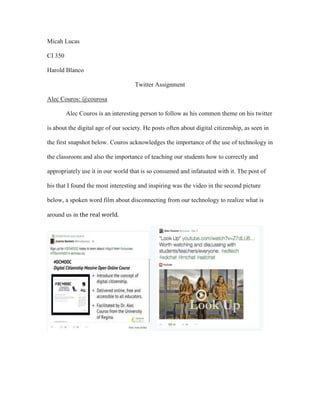
Alec Couros is an interesting person to follow as his common theme on his twitter
is about the digital age of our society. He posts often about digital citizenship, as seen in
the first snapshot below. Couros acknowledges the importance of the use of technology in
the classroom and also the importance of teaching our students how to correctly and
appropriately use it in our world that is so consumed and infatuated with it. The post of
his that I found the most interesting and inspiring was the video in the second picture
below, a spoken word film about disconnecting from our technology to realize what is
around us in the real world.
Steven Anderson: @web20classroom
The second person I chose to follow, Steven Anderson, who is an instructional
technologists. He is an advocate of using technology in the classroom. There were two
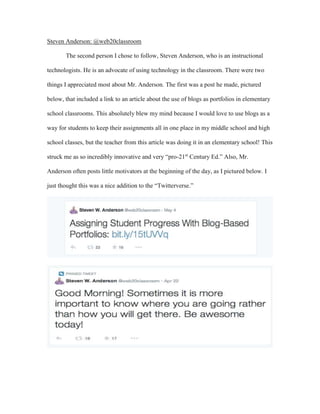
things I appreciated most about Mr. Anderson. The first was a post he made, pictured
below, that included a link to an article about the use of blogs as portfolios in elementary
school classrooms. This absolutely blew my mind because I would love to use blogs as a
way for students to keep their assignments all in one place in my middle school and high
school classes, but the teacher from this article was doing it in an elementary school! This
struck me as so incredibly innovative and very “pro-21st
Century Ed.” Also, Mr.
Anderson often posts little motivators at the beginning of the day, as I pictured below. I
just thought this was a nice addition to the “Twitterverse.”
Josh Stumpenhorst: @stumpteacher
The next person I followed was Josh Stumpenhorst. Mr. Stumpenhorst was also
an interesting individual to follow. I could tell through his posts that he sincerely cared
about his students, and that he is passionate about teaching and making school a safe and
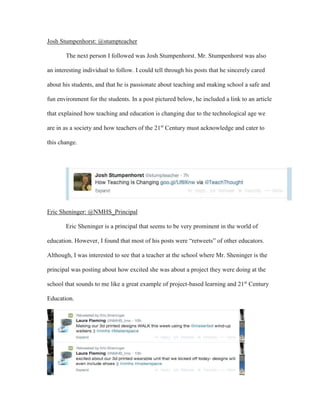
fun environment for the students. In a post pictured below, he included a link to an article
that explained how teaching and education is changing due to the technological age we
are in as a society and how teachers of the 21st
Century must acknowledge and cater to
this change.
Eric Sheninger: @NMHS_Principal
Eric Sheninger is a principal that seems to be very prominent in the world of
education. However, I found that most of his posts were “retweets” of other educators.
Although, I was interested to see that a teacher at the school where Mr. Sheninger is the
principal was posting about how excited she was about a project they were doing at the
school that sounds to me like a great example of project-based learning and 21st
Century
Education.
Harold Blanco: @CI350class
I enjoyed the posts from this Twitter page because it emphasizes the uses of social
media in the classroom. It includes guides for teachers on social media “etiquette” or
appropriateness for classroom use, and also good alternatives for teachers to social media.
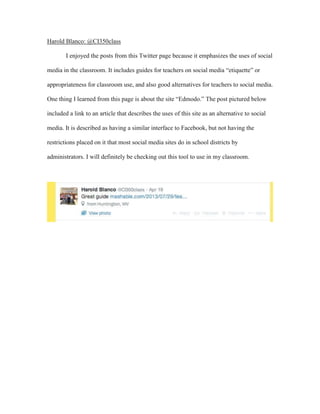
One thing I learned from this page is about the site “Edmodo.” The post pictured below
included a link to an article that describes the uses of this site as an alternative to social
media. It is described as having a similar interface to Facebook, but not having the
restrictions placed on it that most social media sites do in school districts by
administrators. I will definitely be checking out this tool to use in my classroom.

Twitter assignment

  • 1.
    Micah Lucas CI 350 HaroldBlanco Twitter Assignment Alec Couros: @courosa Alec Couros is an interesting person to follow as his common theme on his twitter is about the digital age of our society. He posts often about digital citizenship, as seen in the first snapshot below. Couros acknowledges the importance of the use of technology in the classroom and also the importance of teaching our students how to correctly and appropriately use it in our world that is so consumed and infatuated with it. The post of his that I found the most interesting and inspiring was the video in the second picture below, a spoken word film about disconnecting from our technology to realize what is around us in the real world.
  • 2.
    Steven Anderson: @web20classroom Thesecond person I chose to follow, Steven Anderson, who is an instructional technologists. He is an advocate of using technology in the classroom. There were two things I appreciated most about Mr. Anderson. The first was a post he made, pictured below, that included a link to an article about the use of blogs as portfolios in elementary school classrooms. This absolutely blew my mind because I would love to use blogs as a way for students to keep their assignments all in one place in my middle school and high school classes, but the teacher from this article was doing it in an elementary school! This struck me as so incredibly innovative and very “pro-21st Century Ed.” Also, Mr. Anderson often posts little motivators at the beginning of the day, as I pictured below. I just thought this was a nice addition to the “Twitterverse.”
  • 3.
    Josh Stumpenhorst: @stumpteacher Thenext person I followed was Josh Stumpenhorst. Mr. Stumpenhorst was also an interesting individual to follow. I could tell through his posts that he sincerely cared about his students, and that he is passionate about teaching and making school a safe and fun environment for the students. In a post pictured below, he included a link to an article that explained how teaching and education is changing due to the technological age we are in as a society and how teachers of the 21st Century must acknowledge and cater to this change. Eric Sheninger: @NMHS_Principal Eric Sheninger is a principal that seems to be very prominent in the world of education. However, I found that most of his posts were “retweets” of other educators. Although, I was interested to see that a teacher at the school where Mr. Sheninger is the principal was posting about how excited she was about a project they were doing at the school that sounds to me like a great example of project-based learning and 21st Century Education.
  • 4.
    Harold Blanco: @CI350class Ienjoyed the posts from this Twitter page because it emphasizes the uses of social media in the classroom. It includes guides for teachers on social media “etiquette” or appropriateness for classroom use, and also good alternatives for teachers to social media. One thing I learned from this page is about the site “Edmodo.” The post pictured below included a link to an article that describes the uses of this site as an alternative to social media. It is described as having a similar interface to Facebook, but not having the restrictions placed on it that most social media sites do in school districts by administrators. I will definitely be checking out this tool to use in my classroom.