트위터는사회운동 미디어인가? :트윗애드온즈 사용 사례를 중심으로Sujin ChoiDept. of Radio-Television-FilmUniversity of Texas at Austin, U.S.A.Ji-Young ParkMaster’s degree candidate Han Woo Park (corresponding author) Associate Professor, Dept. of Media & CommunicationYeungnam University, South Korea
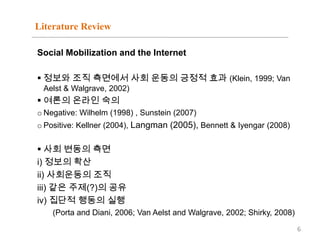
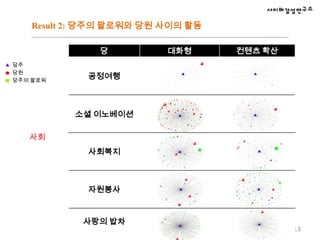
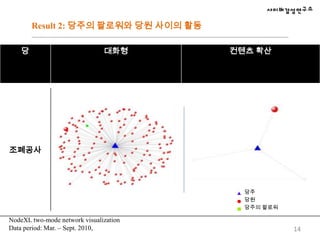
사회 변동의 측면i)정보의 확산ii) 사회운동의 조직iii) 같은 주제(?)의 공유iv) 집단적 행동의 실행 (Porta and Diani, 2006; Van Aelst and Walgrave, 2002; Shirky, 2008)6
Editor's Notes
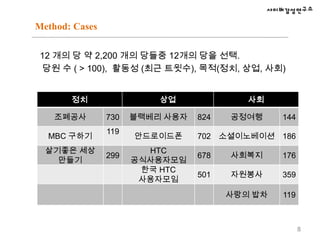
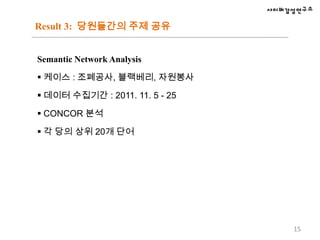
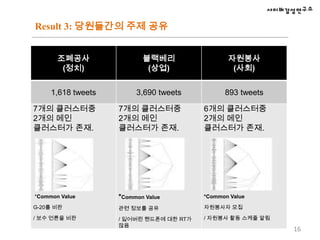
#16 <보고서 관련내용 중 일부>Semantic network analysis was conducted against “Chopae,” “Blackberry,” and “Volunteer,” all of which topped within the groups respectively in terms of the number of members. Semantic network analysis is useful for identifying “thematically shared” cognitive structure among party members. During this analysis, CONCOR was adopted to cluster tweets and the top 20 words were identified. Collecting all the tweets of the three parties from November 5 to 25, 2010, the present research examined how many clusters of discourses were generated and whether they were in accordance to the mission statements of each party.
#17 <보고서 관련내용 중 일부>Through a semantic network analysis of all the tweets generated by “Chopae,” “Blackberry,” and “Volunteer” from November 5 to 25, 2010, the present research found six to seven clusters of discourse for each party, mainly containing two large clusters respectively (see Table 4). Along with the close examination on the top 20 words and their occurring frequencies (see Table 5), this analysis suggests that party members formed shared values with their mission statements, having two main discussions and a few sub-clusters of relevant topics during the studied period.