Tweets and Truth
Journalism as a discipline of collaborative verification

Alfred Hermida

Future of Journalism 2011
Cardiff University, 8 – 9 September
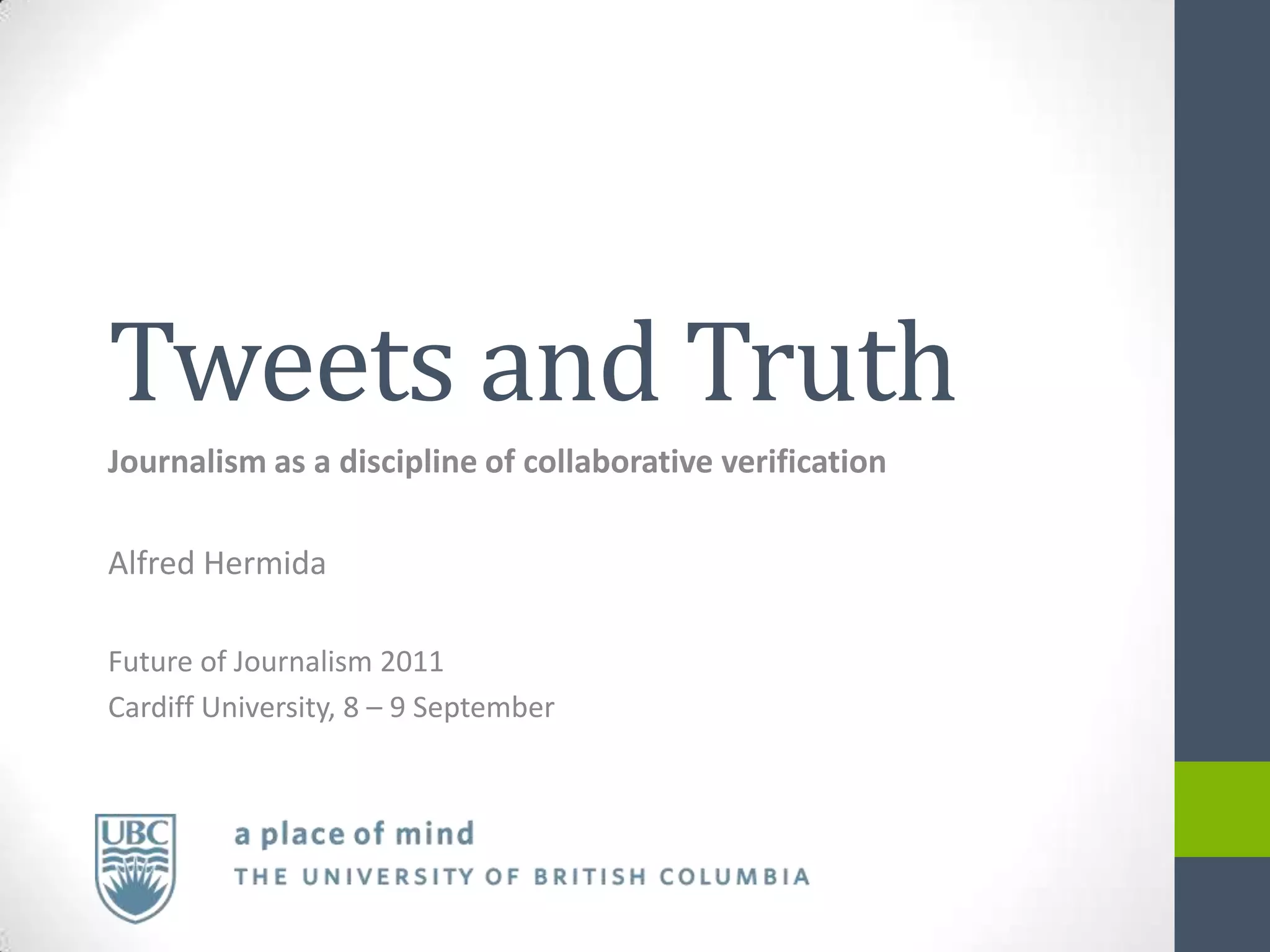
Social awareness streams
• “They disrupt
  established concepts
  of communication,
  prevailing notions of
  space and time and
  the distinction
  between public and
  private spheres.”
  • Arceneaux and Schmitz
    Weiss, 2010


                Photo: Tasayu Tasnaphun Legay http://www.flickr.com/photos/tasayu/
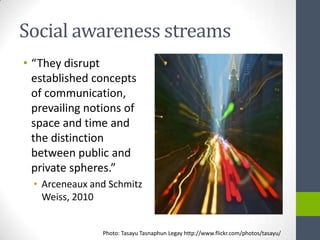
Facts, truth, reality
Verification as the essence of journalism (Kovach and Rosenstiel, 2001)


                      Photo: MeganMorris http://www.flickr.com/photos/megangoodchild/
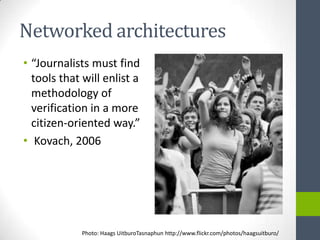
Networked architectures
• “Journalists must find
  tools that will enlist a
  methodology of
  verification in a more
  citizen-oriented way.”
• Kovach, 2006


             Photo: Haags UitburoTasnaphun http://www.flickr.com/photos/haagsuitburo/
Twitter users as network of news sensors
              Sakaki et al, 2010
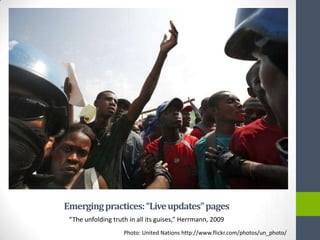
Emerging practices: “Live updates” pages
 “The unfolding truth in all its guises,” Herrmann, 2009
                    Photo: United Nations http://www.flickr.com/photos/un_photo/
Discussion
• “Facts are messy,
  difficult to determine
  and they are often
  dependent on
  interpretation.”
  • Brennen, 2009


                    Photo: Rudoni Productions http://www.flickr.com/photos/rudoni/
Discussion
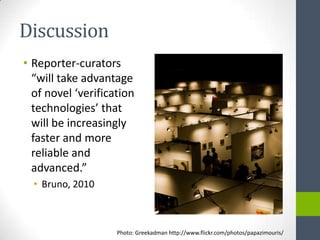
• Reporter-curators
  “will take advantage
  of novel ‘verification
  technologies’ that
  will be increasingly
  faster and more
  reliable and
  advanced.”
  • Bruno, 2010


                    Photo: Greekadman http://www.flickr.com/photos/papazimouris/
Conclusion
• Journalism as a
  tentative and iterative
  process where
  contested accounts
  are examined and
  evaluated in public in
  real-time on social
  awareness streams.


                    Photo: Patrick Hoesly http://www.flickr.com/photos/zooboing/
Thank you

• alfred.hermida@ubc.ca
• @hermida


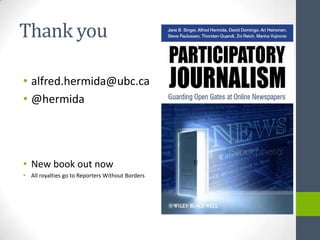
• New book out now
• All royalties go to Reporters Without Borders

Tweets and Truth

  • 1.
    Tweets and Truth Journalismas a discipline of collaborative verification Alfred Hermida Future of Journalism 2011 Cardiff University, 8 – 9 September
  • 2.
    Social awareness streams •“They disrupt established concepts of communication, prevailing notions of space and time and the distinction between public and private spheres.” • Arceneaux and Schmitz Weiss, 2010 Photo: Tasayu Tasnaphun Legay http://www.flickr.com/photos/tasayu/
  • 3.
    Facts, truth, reality Verificationas the essence of journalism (Kovach and Rosenstiel, 2001) Photo: MeganMorris http://www.flickr.com/photos/megangoodchild/
  • 4.
    Networked architectures • “Journalistsmust find tools that will enlist a methodology of verification in a more citizen-oriented way.” • Kovach, 2006 Photo: Haags UitburoTasnaphun http://www.flickr.com/photos/haagsuitburo/
  • 5.
    Twitter users asnetwork of news sensors Sakaki et al, 2010
  • 6.
    Emerging practices: “Liveupdates” pages “The unfolding truth in all its guises,” Herrmann, 2009 Photo: United Nations http://www.flickr.com/photos/un_photo/
  • 7.
    Discussion • “Facts aremessy, difficult to determine and they are often dependent on interpretation.” • Brennen, 2009 Photo: Rudoni Productions http://www.flickr.com/photos/rudoni/
  • 8.
    Discussion • Reporter-curators “will take advantage of novel ‘verification technologies’ that will be increasingly faster and more reliable and advanced.” • Bruno, 2010 Photo: Greekadman http://www.flickr.com/photos/papazimouris/
  • 9.
    Conclusion • Journalism asa tentative and iterative process where contested accounts are examined and evaluated in public in real-time on social awareness streams. Photo: Patrick Hoesly http://www.flickr.com/photos/zooboing/
  • 10.
    Thank you • alfred.hermida@ubc.ca •@hermida • New book out now • All royalties go to Reporters Without Borders