MADHAV INSTITUTE OF TECHNOLOGY AND SCIENCE
SEMINAR
SUBMITTED TO - SUBMITTED BY-
Prof. Santosh Sharma Shubham Yadav
BE ET VIII SEM
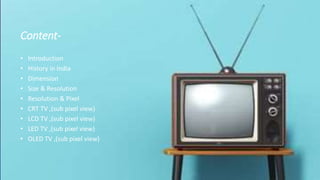
Content-
• Introduction
• History in India
• Dimension
• Size & Resolution
• Resolution & Pixel
• CRT TV ,(sub pixel view)
• LCD TV ,(sub pixel view)
• LED TV ,(sub pixel view)
• OLED TV ,(sub pixel view)
Introduction to TV-
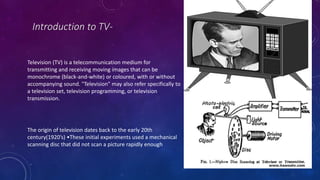
Television (TV) is a telecommunication medium for
transmitting and receiving moving images that can be
monochrome (black-and-white) or coloured, with or without
accompanying sound. "Television" may also refer specifically to
a television set, television programming, or television
transmission.
The origin of television dates back to the early 20th
century(1920’s) •These initial experiments used a mechanical
scanning disc that did not scan a picture rapidly enough
In India –
•1956:The General Conference of UNESCO which was hosted by India in New Delhi to study the use of TV as
a medium of education, rural uplift and community development.
•1959:Philips offered to the govt of India a transmitter at a reduced cost. •September 15,1959:Television
was introduced in India Delhi Television centre
•The range of the transmitter was forty kilometers round about Delhi. Soon programmes began t o be
beamed twice a week each of 20 minutes duration.
•1961:Doordarshan was used as a support to middle and higher secondary school education.
•August1964:In addition to social education programmes entertainment and information programmes were
introduced
•April,1965:a general service was started. It was for one hour a day on four days of the week
•15th august,1965:service was made daily.
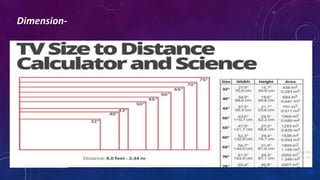
Dimension-
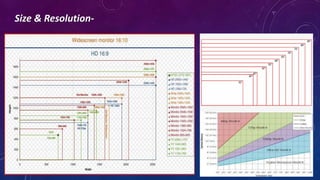
Size & Resolution-
480p 720x480 345,600
720p
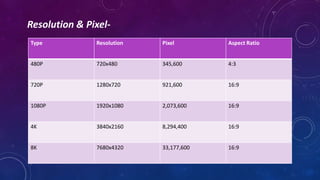
Type Resolution Pixel Aspect Ratio
480P 720x480 345,600 4:3
720P 1280x720 921,600 16:9
1080P 1920x1080 2,073,600 16:9
4K 3840x2160 8,294,400 16:9
8K 7680x4320 33,177,600 16:9
Resolution & Pixel-
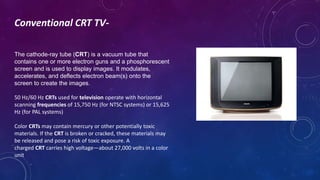
Conventional CRT TV-
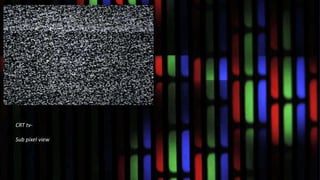
The cathode-ray tube (CRT) is a vacuum tube that
contains one or more electron guns and a phosphorescent
screen and is used to display images. It modulates,
accelerates, and deflects electron beam(s) onto the
screen to create the images.
50 Hz/60 Hz CRTs used for television operate with horizontal
scanning frequencies of 15,750 Hz (for NTSC systems) or 15,625
Hz (for PAL systems)
Color CRTs may contain mercury or other potentially toxic
materials. If the CRT is broken or cracked, these materials may
be released and pose a risk of toxic exposure. A
charged CRT carries high voltage—about 27,000 volts in a color
unit
CRT tv-
Sub pixel view
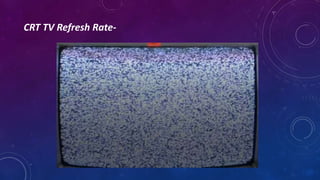
CRT TV Refresh Rate-
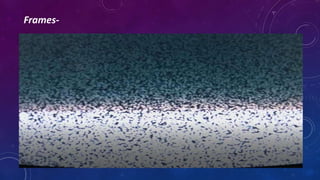
Frames-
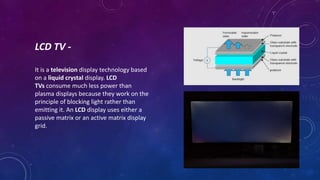
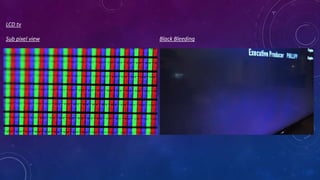
LCD TV -
It is a television display technology based
on a liquid crystal display. LCD
TVs consume much less power than
plasma displays because they work on the
principle of blocking light rather than
emitting it. An LCD display uses either a
passive matrix or an active matrix display
grid.
LCD tv
Sub pixel view Black Bleeding
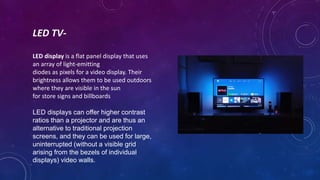
LED TV-
LED display is a flat panel display that uses
an array of light-emitting
diodes as pixels for a video display. Their
brightness allows them to be used outdoors
where they are visible in the sun
for store signs and billboards
LED displays can offer higher contrast
ratios than a projector and are thus an
alternative to traditional projection
screens, and they can be used for large,
uninterrupted (without a visible grid
arising from the bezels of individual
displays) video walls.
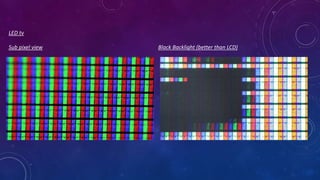
LED tv
Sub pixel view Black Backlight (better than LCD)
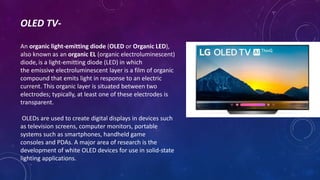
OLED TV-
An organic light-emitting diode (OLED or Organic LED),
also known as an organic EL (organic electroluminescent)
diode,is a light-emitting diode (LED) in which
the emissive electroluminescent layer is a film of organic
compound that emits light in response to an electric
current. This organic layer is situated between two
electrodes; typically, at least one of these electrodes is
transparent.
OLEDs are used to create digital displays in devices such
as television screens, computer monitors, portable
systems such as smartphones, handheld game
consoles and PDAs. A major area of research is the
development of white OLED devices for use in solid-state
lighting applications.
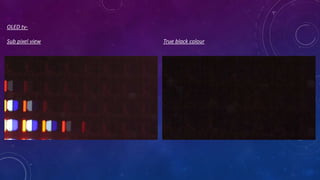
OLED tv-
Sub pixel view True black colour

TV- Television

  • 1.
    MADHAV INSTITUTE OFTECHNOLOGY AND SCIENCE SEMINAR SUBMITTED TO - SUBMITTED BY- Prof. Santosh Sharma Shubham Yadav BE ET VIII SEM
  • 2.
    Content- • Introduction • Historyin India • Dimension • Size & Resolution • Resolution & Pixel • CRT TV ,(sub pixel view) • LCD TV ,(sub pixel view) • LED TV ,(sub pixel view) • OLED TV ,(sub pixel view)
  • 3.
    Introduction to TV- Television(TV) is a telecommunication medium for transmitting and receiving moving images that can be monochrome (black-and-white) or coloured, with or without accompanying sound. "Television" may also refer specifically to a television set, television programming, or television transmission. The origin of television dates back to the early 20th century(1920’s) •These initial experiments used a mechanical scanning disc that did not scan a picture rapidly enough
  • 4.
    In India – •1956:TheGeneral Conference of UNESCO which was hosted by India in New Delhi to study the use of TV as a medium of education, rural uplift and community development. •1959:Philips offered to the govt of India a transmitter at a reduced cost. •September 15,1959:Television was introduced in India Delhi Television centre •The range of the transmitter was forty kilometers round about Delhi. Soon programmes began t o be beamed twice a week each of 20 minutes duration. •1961:Doordarshan was used as a support to middle and higher secondary school education. •August1964:In addition to social education programmes entertainment and information programmes were introduced •April,1965:a general service was started. It was for one hour a day on four days of the week •15th august,1965:service was made daily.
  • 5.
  • 6.
  • 7.
    480p 720x480 345,600 720p TypeResolution Pixel Aspect Ratio 480P 720x480 345,600 4:3 720P 1280x720 921,600 16:9 1080P 1920x1080 2,073,600 16:9 4K 3840x2160 8,294,400 16:9 8K 7680x4320 33,177,600 16:9 Resolution & Pixel-
  • 8.
    Conventional CRT TV- Thecathode-ray tube (CRT) is a vacuum tube that contains one or more electron guns and a phosphorescent screen and is used to display images. It modulates, accelerates, and deflects electron beam(s) onto the screen to create the images. 50 Hz/60 Hz CRTs used for television operate with horizontal scanning frequencies of 15,750 Hz (for NTSC systems) or 15,625 Hz (for PAL systems) Color CRTs may contain mercury or other potentially toxic materials. If the CRT is broken or cracked, these materials may be released and pose a risk of toxic exposure. A charged CRT carries high voltage—about 27,000 volts in a color unit
  • 9.
  • 10.
  • 11.
  • 12.
    LCD TV - Itis a television display technology based on a liquid crystal display. LCD TVs consume much less power than plasma displays because they work on the principle of blocking light rather than emitting it. An LCD display uses either a passive matrix or an active matrix display grid.
  • 13.
    LCD tv Sub pixelview Black Bleeding
  • 14.
    LED TV- LED displayis a flat panel display that uses an array of light-emitting diodes as pixels for a video display. Their brightness allows them to be used outdoors where they are visible in the sun for store signs and billboards LED displays can offer higher contrast ratios than a projector and are thus an alternative to traditional projection screens, and they can be used for large, uninterrupted (without a visible grid arising from the bezels of individual displays) video walls.
  • 15.
    LED tv Sub pixelview Black Backlight (better than LCD)
  • 16.
    OLED TV- An organiclight-emitting diode (OLED or Organic LED), also known as an organic EL (organic electroluminescent) diode,is a light-emitting diode (LED) in which the emissive electroluminescent layer is a film of organic compound that emits light in response to an electric current. This organic layer is situated between two electrodes; typically, at least one of these electrodes is transparent. OLEDs are used to create digital displays in devices such as television screens, computer monitors, portable systems such as smartphones, handheld game consoles and PDAs. A major area of research is the development of white OLED devices for use in solid-state lighting applications.
  • 17.
    OLED tv- Sub pixelview True black colour