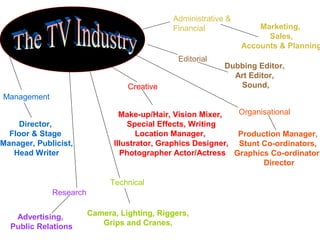
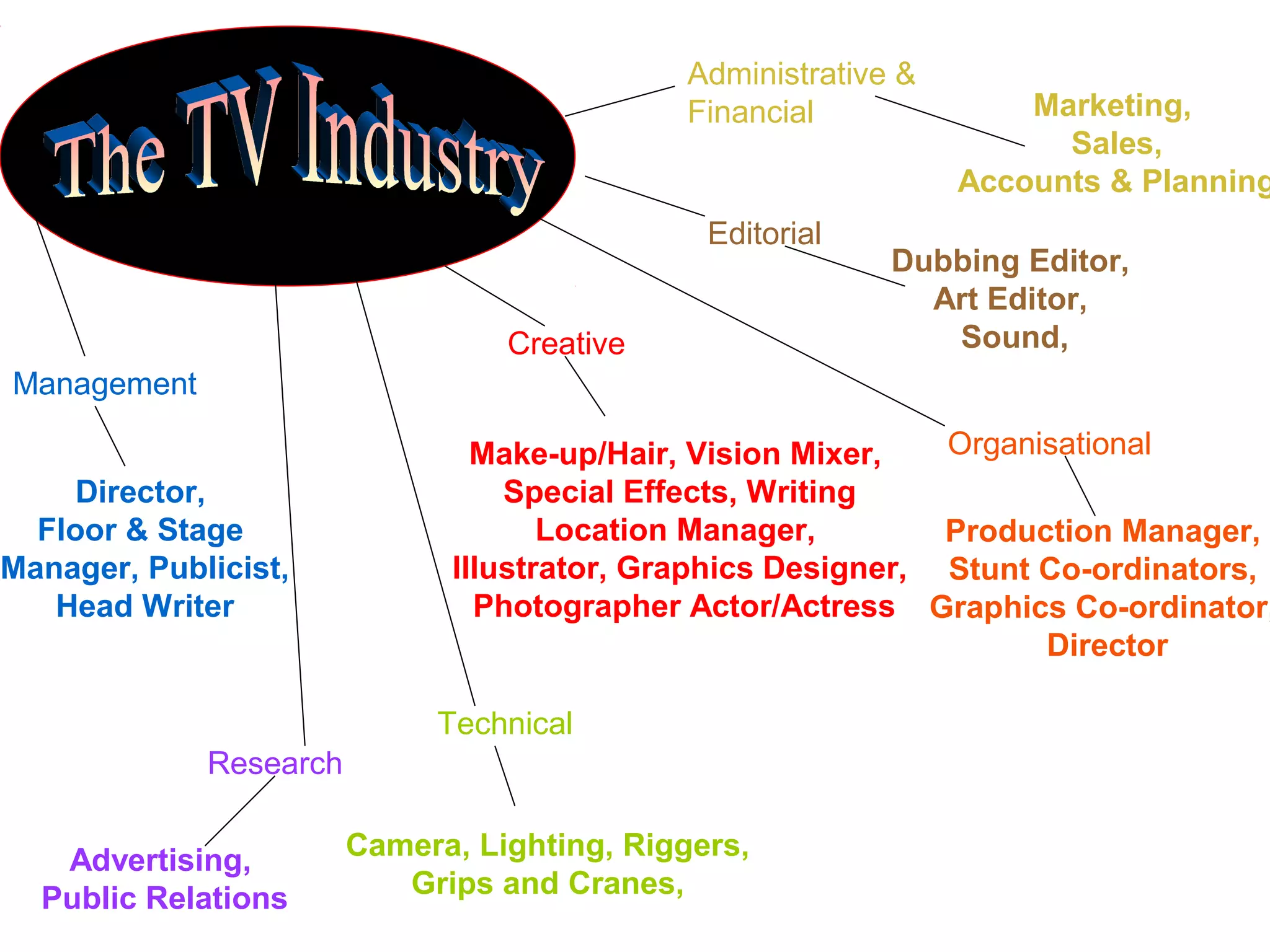
Administrative &
Financial

Editorial
Creative

Marketing,
Sales,
Accounts & Planning

Dubbing Editor,
Art Editor,
Sound,

Management
Director,
Floor & Stage
Manager, Publicist,
Head Writer

Organisational
Make-up/Hair, Vision Mixer,
Special Effects, Writing
Location Manager,
Production Manager,
Illustrator, Graphics Designer, Stunt Co-ordinators,
Photographer Actor/Actress Graphics Co-ordinator,
Director
Technical

Research
Advertising,
Public Relations

Camera, Lighting, Riggers,
Grips and Cranes,
Management
Director
Firstly, the duties of a Director varies depending
on the type of production, but overall the
Director is part of a crew who develop and
produce the television program. Being a director
means you work closely with the producers and
writers embellishing, educating and eventually
finalizing ideas into fully finished programmes.
The responsibilities of a director includes
cautious planning to ensure success, the
organisation of the shooting schedule as well as
providing the required recording budget and
deadlines. Being the director also means
responsibilities of supervision of the placements
of professional video cameras, lighting, props,
actors, cues and microphones are given unto
them. Skills needed for the jobs tend to be
degrees in directing, communication, drama
and other related fields

Technical
Cameras

Research
Advertising
The role of Advertising means people
are given both the jobs to do research
into their consumers base and to create
an illustration of what the programme is
going to show; their main responsibility
is deciding the best ways of reaching the
target audience as the skills needed are
good skills of people, written and spoken
communication. They would work closely
to the art designers and graphics
designers as well as the programmes
marketing group to ensure success.

A camera operator usually begins their work at the end of the pre-production, they work closely with the director
of photography the director and grip team. They are involved in the setting up of shots, choice of lenses and the
motion of the camera moving. In general the operator is responsible for maintaining composition and angles
throughout the scene/shot. This is closely related to the cinematographer who is above the camera operator as
they are chief of the camera lighting crew and generally speak with director of photography and the director
themselves. The skills needed include a technical basis of photography and knowledge of film/TV specific
photography equipment: lenses, speeds exposures, dollies, hand-held, movement, blue screen as well as both
basis knowledge of set-up and operation.
Creative
Make-up Artist
Make-up and Hair are key elements in the overall
design of films or television productions, creating a look
for the characters in relation to social class, and time
periods, and any other elements required to create the
desired illusion. Make-up and Hair Designers are
responsible for the overall design, application, continuity
and care of make-up and hair throughout the preproduction and production periods.
The work involved ranges from creating contemporary
looks to recreating period designs and styles, and
transforming actors' physical appearance. Make-up and
hair effects include the design and application of wigs,
hairpieces, hair extensions, facial hair, bald caps,
tattoos, body paint; as well as medical effects such as
cuts, scars, bullet wounds, burns, bruises, blood and the
physical symptoms of various diseases. Ageing and
death effects are also the responsibility of the Make-up
and Hair department.
Makeup artists must learn important skills even before
picking up a sponge or brush. They learn to assess a
client's skin type, including coloring, condition and
sensitivity. These factors determine the type and colors
of makeup to use. Learning color principles is an
intricate skill that takes into account race, ethnicity,
obvious skin color and undertones of color. Makeup
artists must also study a client's bone structure to
decide where and how to apply types and colors of
makeup to achieve the desired results.

Organisational
Production Manager
The Graphics Coordinator manages a company's
graphics design projects from concept to
delivery. An experienced Graphics Coordinator
creates an action plan that coordinates the goal
of a project with the steps needed to complete
it. Graphics coordinators manage the their
branding programs, multimedia projects, and
their ongoing need for marketing materials.
One of the major responsibilities of a Graphics
Coordinator is being the liaison to the client,
staff, and vendors involved in the production of
the project.
Skills
•
Excellent organisational, communication and
project management skills.
•
Thorough understanding of the visual effects
process and the ability to interpret the artistic
brief from the VFX supervisor.
•
Good technical understanding of CG pipelines
and the ability to specify efficient workflows and
identify additional tools required.
•
A good understanding of modelling, texturing,
look development, lighting, particles, fluids and
dynamics.
•
Previous experience with team management
and task assignment.
Editorial
Sound
In sound recording and reproduction, audio mixing is the
process by which multiple recorded sounds are combined into
one or more channels, for instance 2-channel stereo.
It is employed in a variety of disciplines
including filmmaking, television production, theatre, sound
recording and reproduction, live performance, sound art, postproduction, and video game software development.
The sound mixer is considered a department head, and is thus
completely responsible for all aspects of production sound
including the hiring of a boom operator and utility sound
technician, planning the technical setup involving sound
including both sound equipment and ancillary devices involved
in syncing and time offsets, anticipating and discussing soundrelated problems with the rest of the crew, and ordering and
preparing the sound equipment to be used on the set

Administrative & Financial
Marketing
In the field of marketing, the job requires
skills in collecting and analysing
information as you will be doing this to
help understand the consumers attitudes
towards their programme or their
programme’s product. Using your
confidence and creativity you would also
market your products across TV, radio
and the press. Networking with your
clients and the public would also be a
part of your job. You may work with the
public during market research or in focus
group meetings. You will also need to
attend exhibitions and product launches
where you will meet with clients, suppliers
and the media.
You will plan marketing campaigns and
make sure they run smoothly. You could
also have control of a campaign budget.
You may be responsible for checking how
effective a campaign is by collecting data
and feedback and reporting this to
management.
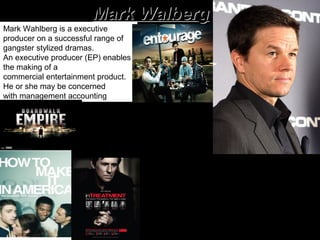
Mark Walberg
Mark Wahlberg is a executive
producer on a successful range of
gangster stylized dramas.
An executive producer (EP) enables
the making of a
commercial entertainment product.
He or she may be concerned
with management accounting
Wahlberg has served as an
executive producer to Entourage,
Own the Night, In Treatment, How
to Make It in America and
Boardwalk Empire
American actor Mark Wahlberg is one of a
handful of respected entertainers who
successfully made the transition from teen pop
idol to respected actor. A Best Supporting
Actor Oscar nominee for The Departed (2006)
who went on to receive positive critical reviews for
his performance in The Fighter (2010), Wahlberg
also is a solid comedy actor, proven by his
starring role in Ted (2012).
TV industry
TV industry
TV industry

TV industry

  • 1.
    Administrative & Financial Editorial Creative Marketing, Sales, Accounts &Planning Dubbing Editor, Art Editor, Sound, Management Director, Floor & Stage Manager, Publicist, Head Writer Organisational Make-up/Hair, Vision Mixer, Special Effects, Writing Location Manager, Production Manager, Illustrator, Graphics Designer, Stunt Co-ordinators, Photographer Actor/Actress Graphics Co-ordinator, Director Technical Research Advertising, Public Relations Camera, Lighting, Riggers, Grips and Cranes,
  • 2.
    Management Director Firstly, the dutiesof a Director varies depending on the type of production, but overall the Director is part of a crew who develop and produce the television program. Being a director means you work closely with the producers and writers embellishing, educating and eventually finalizing ideas into fully finished programmes. The responsibilities of a director includes cautious planning to ensure success, the organisation of the shooting schedule as well as providing the required recording budget and deadlines. Being the director also means responsibilities of supervision of the placements of professional video cameras, lighting, props, actors, cues and microphones are given unto them. Skills needed for the jobs tend to be degrees in directing, communication, drama and other related fields Technical Cameras Research Advertising The role of Advertising means people are given both the jobs to do research into their consumers base and to create an illustration of what the programme is going to show; their main responsibility is deciding the best ways of reaching the target audience as the skills needed are good skills of people, written and spoken communication. They would work closely to the art designers and graphics designers as well as the programmes marketing group to ensure success. A camera operator usually begins their work at the end of the pre-production, they work closely with the director of photography the director and grip team. They are involved in the setting up of shots, choice of lenses and the motion of the camera moving. In general the operator is responsible for maintaining composition and angles throughout the scene/shot. This is closely related to the cinematographer who is above the camera operator as they are chief of the camera lighting crew and generally speak with director of photography and the director themselves. The skills needed include a technical basis of photography and knowledge of film/TV specific photography equipment: lenses, speeds exposures, dollies, hand-held, movement, blue screen as well as both basis knowledge of set-up and operation.
  • 3.
    Creative Make-up Artist Make-up andHair are key elements in the overall design of films or television productions, creating a look for the characters in relation to social class, and time periods, and any other elements required to create the desired illusion. Make-up and Hair Designers are responsible for the overall design, application, continuity and care of make-up and hair throughout the preproduction and production periods. The work involved ranges from creating contemporary looks to recreating period designs and styles, and transforming actors' physical appearance. Make-up and hair effects include the design and application of wigs, hairpieces, hair extensions, facial hair, bald caps, tattoos, body paint; as well as medical effects such as cuts, scars, bullet wounds, burns, bruises, blood and the physical symptoms of various diseases. Ageing and death effects are also the responsibility of the Make-up and Hair department. Makeup artists must learn important skills even before picking up a sponge or brush. They learn to assess a client's skin type, including coloring, condition and sensitivity. These factors determine the type and colors of makeup to use. Learning color principles is an intricate skill that takes into account race, ethnicity, obvious skin color and undertones of color. Makeup artists must also study a client's bone structure to decide where and how to apply types and colors of makeup to achieve the desired results. Organisational Production Manager The Graphics Coordinator manages a company's graphics design projects from concept to delivery. An experienced Graphics Coordinator creates an action plan that coordinates the goal of a project with the steps needed to complete it. Graphics coordinators manage the their branding programs, multimedia projects, and their ongoing need for marketing materials. One of the major responsibilities of a Graphics Coordinator is being the liaison to the client, staff, and vendors involved in the production of the project. Skills • Excellent organisational, communication and project management skills. • Thorough understanding of the visual effects process and the ability to interpret the artistic brief from the VFX supervisor. • Good technical understanding of CG pipelines and the ability to specify efficient workflows and identify additional tools required. • A good understanding of modelling, texturing, look development, lighting, particles, fluids and dynamics. • Previous experience with team management and task assignment.
  • 4.
    Editorial Sound In sound recordingand reproduction, audio mixing is the process by which multiple recorded sounds are combined into one or more channels, for instance 2-channel stereo. It is employed in a variety of disciplines including filmmaking, television production, theatre, sound recording and reproduction, live performance, sound art, postproduction, and video game software development. The sound mixer is considered a department head, and is thus completely responsible for all aspects of production sound including the hiring of a boom operator and utility sound technician, planning the technical setup involving sound including both sound equipment and ancillary devices involved in syncing and time offsets, anticipating and discussing soundrelated problems with the rest of the crew, and ordering and preparing the sound equipment to be used on the set Administrative & Financial Marketing In the field of marketing, the job requires skills in collecting and analysing information as you will be doing this to help understand the consumers attitudes towards their programme or their programme’s product. Using your confidence and creativity you would also market your products across TV, radio and the press. Networking with your clients and the public would also be a part of your job. You may work with the public during market research or in focus group meetings. You will also need to attend exhibitions and product launches where you will meet with clients, suppliers and the media. You will plan marketing campaigns and make sure they run smoothly. You could also have control of a campaign budget. You may be responsible for checking how effective a campaign is by collecting data and feedback and reporting this to management.
  • 5.
    Mark Walberg Mark Wahlbergis a executive producer on a successful range of gangster stylized dramas. An executive producer (EP) enables the making of a commercial entertainment product. He or she may be concerned with management accounting Wahlberg has served as an executive producer to Entourage, Own the Night, In Treatment, How to Make It in America and Boardwalk Empire American actor Mark Wahlberg is one of a handful of respected entertainers who successfully made the transition from teen pop idol to respected actor. A Best Supporting Actor Oscar nominee for The Departed (2006) who went on to receive positive critical reviews for his performance in The Fighter (2010), Wahlberg also is a solid comedy actor, proven by his starring role in Ted (2012).