TuxCon, 2025
Plovdiv, May 10th
IoT experiments with ESP-NOW
Comparison with WiFi, Zigbee,
Bluetooth and Thread/Matter
$whoami
Tsvetan Usunov === OLIMEX Ltd
www.olimex.com
OLIMEX company is dealing with electronic design and
production more than 30 years.
1000+ originally designed products, most of them OSHW.
All OLIMEX products are manufactured in Plovdiv, Bulgaria.
What is ESP-NOW? ?
ESP-NOW is a communication protocol developed by
Espressif for their ESP devices.
It allows fast wireless communication with low latency and
low power consumption between different devices, without
the need for a router.
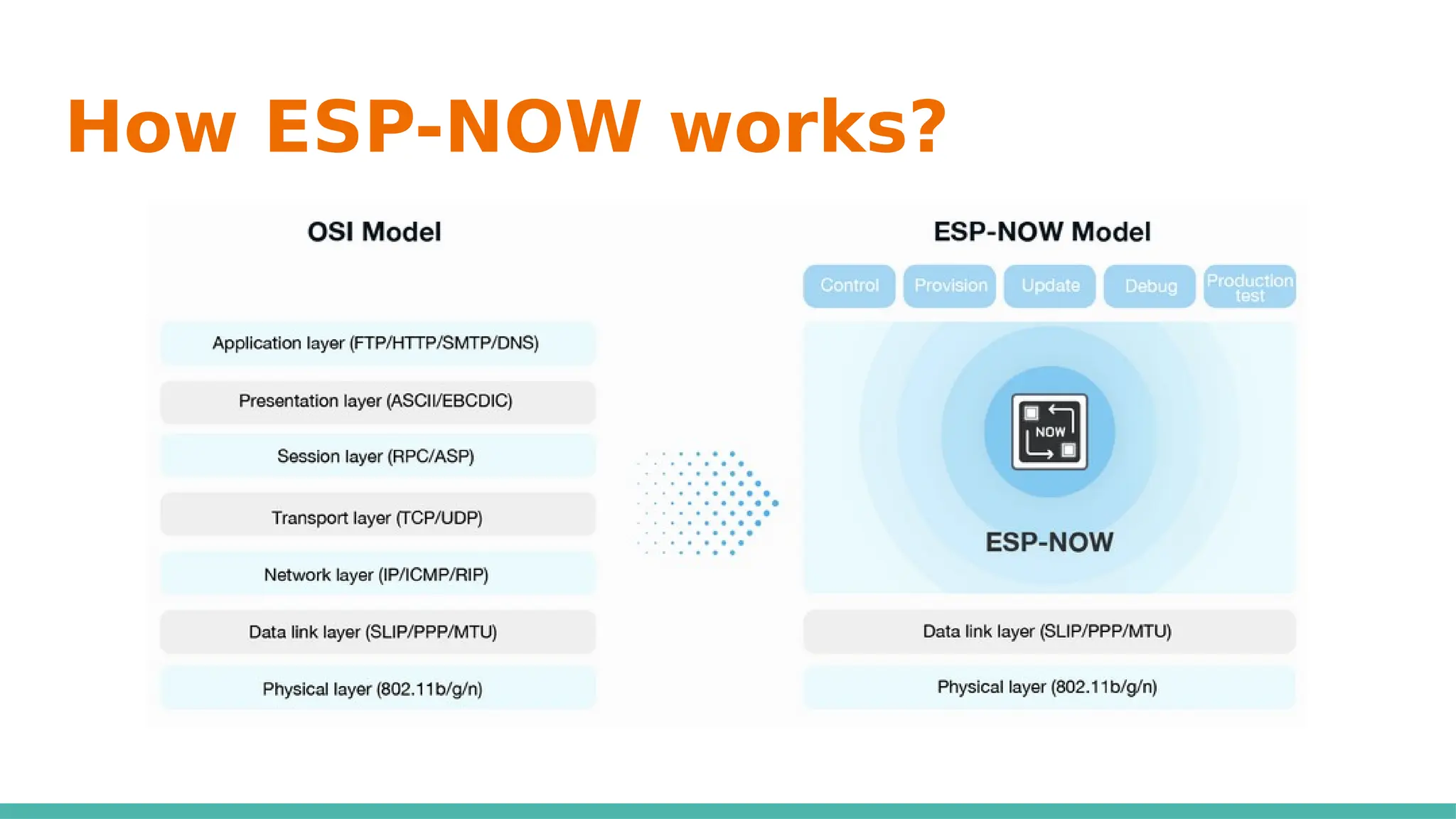
How ESP-NOW works?
How ESP-NOW works?
ESP-NOW uses the ESP devices build-in WiFi hardware
and cleverly uses IEEE 802.11 vendor-specific action
frames to transmit small data packets between ESP
devices, avoiding the overhead of Wi-Fi association and
IP layers.
These frames are lightweight, fast, and ideal for low-
power or peer-to-peer communication.
What is 802.11 action frames used for?
An 802.11 Action Frame is a type of management
frame in the IEEE 802.11 Wi-Fi standard.
It is used for specialized control and signaling
between wireless devices (like access points and
clients), beyond the basic association and
authentication processes.
What is 802.11 action frames used for?
Action frames are used for advanced features such as:
Wi-Fi Direct (P2P), Mesh networking, Fast roaming
(802.11r), Spectrum management, Block
acknowledgment setup.
They can be sent to a specific device (unicast) or all
devices (broadcast), depending on the application.
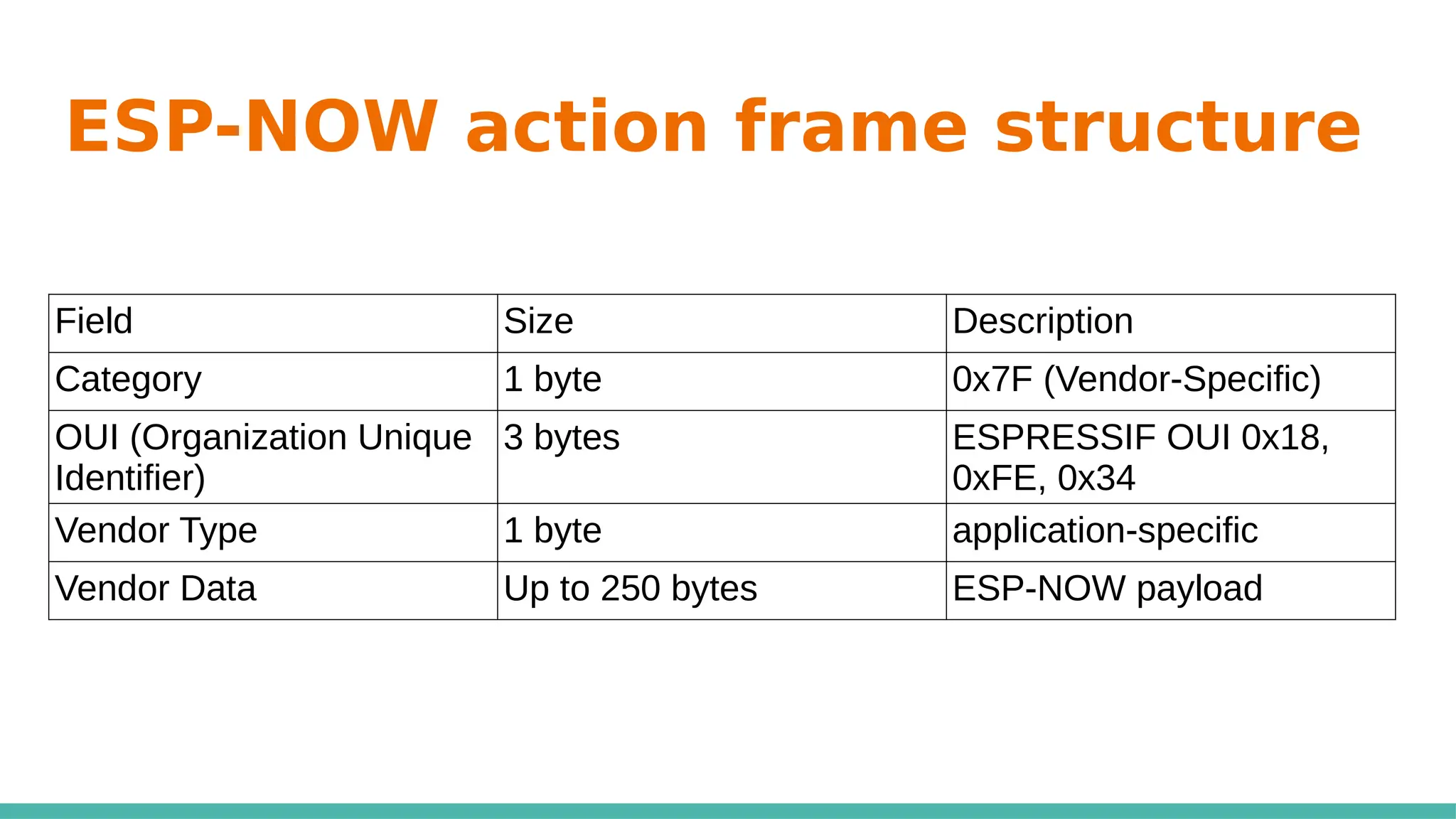
ESP-NOW action frame structure
Field Size Description
Category 1 byte 0x7F (Vendor-Specific)
OUI (Organization Unique
Identifier)
3 bytes ESPRESSIF OUI 0x18,
0xFE, 0x34
Vendor Type 1 byte application-specific
Vendor Data Up to 250 bytes ESP-NOW payload
What ESP-NOW does?
ESP-NOW interacts directly from device to device and
does not require a router to forward data.
The messages can be from one to one (unicast) or
from one to many (broadcast).
One ESP device can act as AP/STA and ESP-NOW at
the same time if necessary.
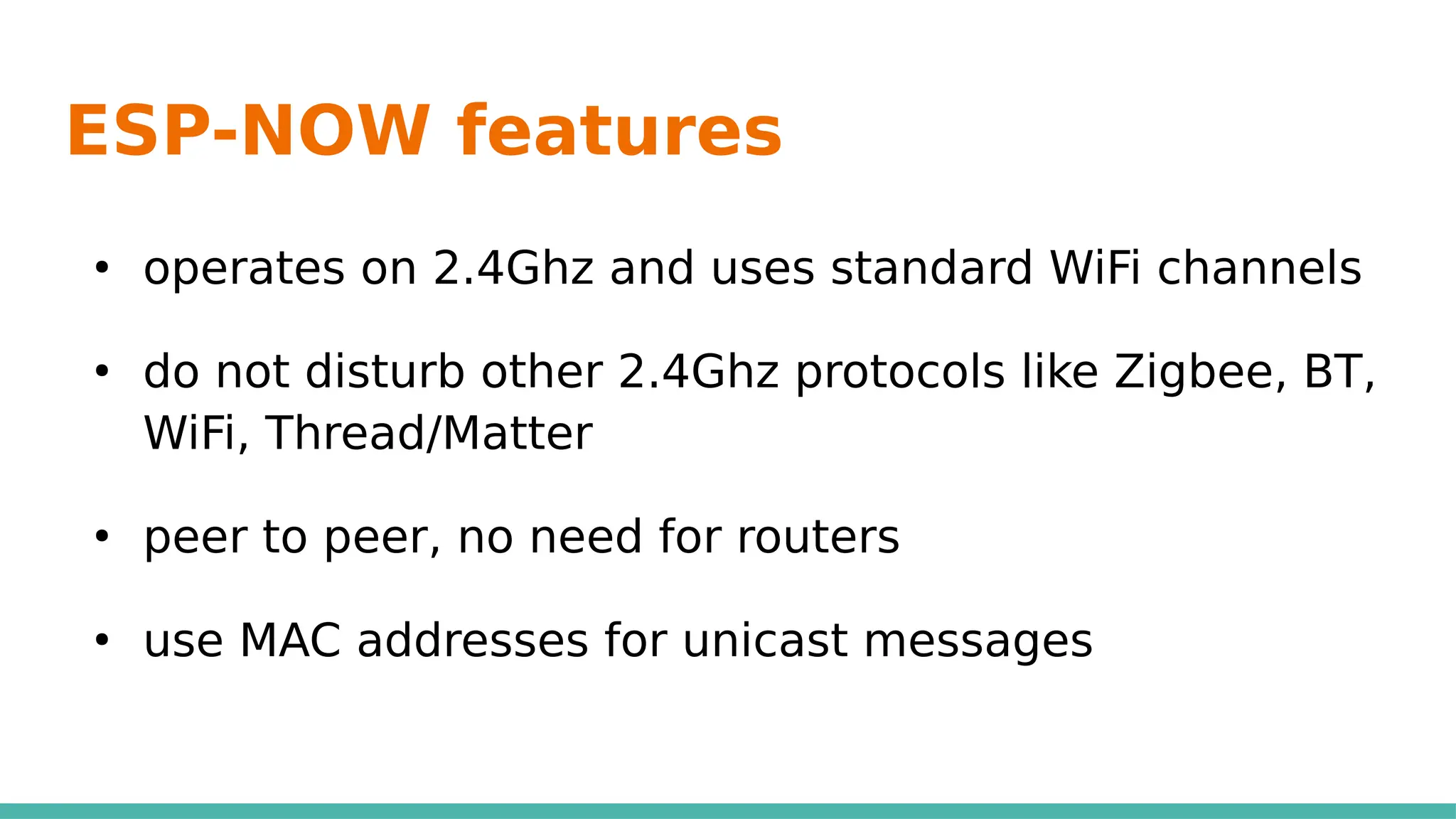
ESP-NOW features
●
operates on 2.4Ghz and uses standard WiFi channels
●
do not disturb other 2.4Ghz protocols like Zigbee, BT,
WiFi, Thread/Matter
●
peer to peer, no need for routers
●
use MAC addresses for unicast messages
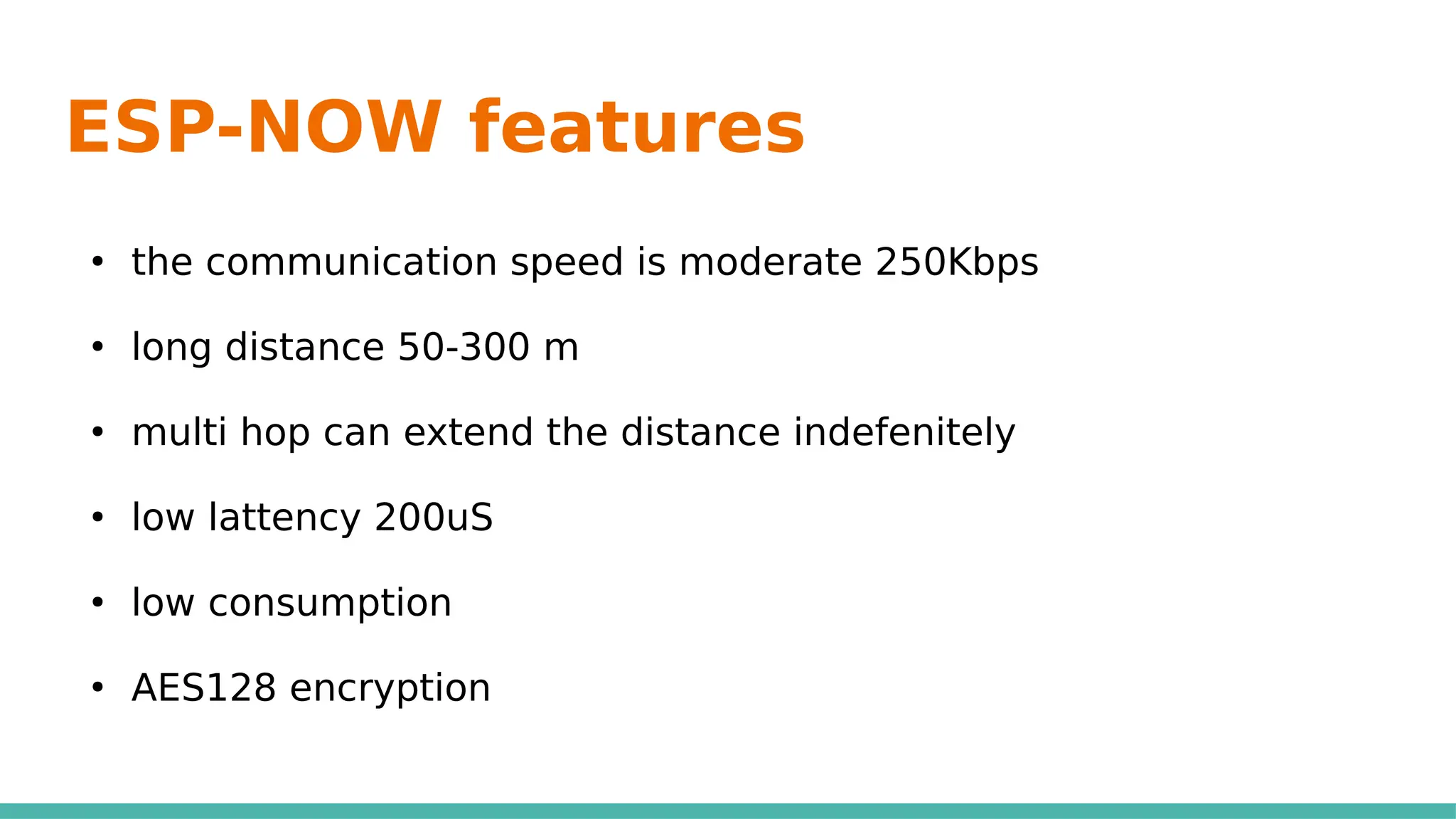
ESP-NOW features
●
the communication speed is moderate 250Kbps
●
long distance 50-300 m
●
multi hop can extend the distance indefenitely
●
low lattency 200uS
●
low consumption
●
AES128 encryption
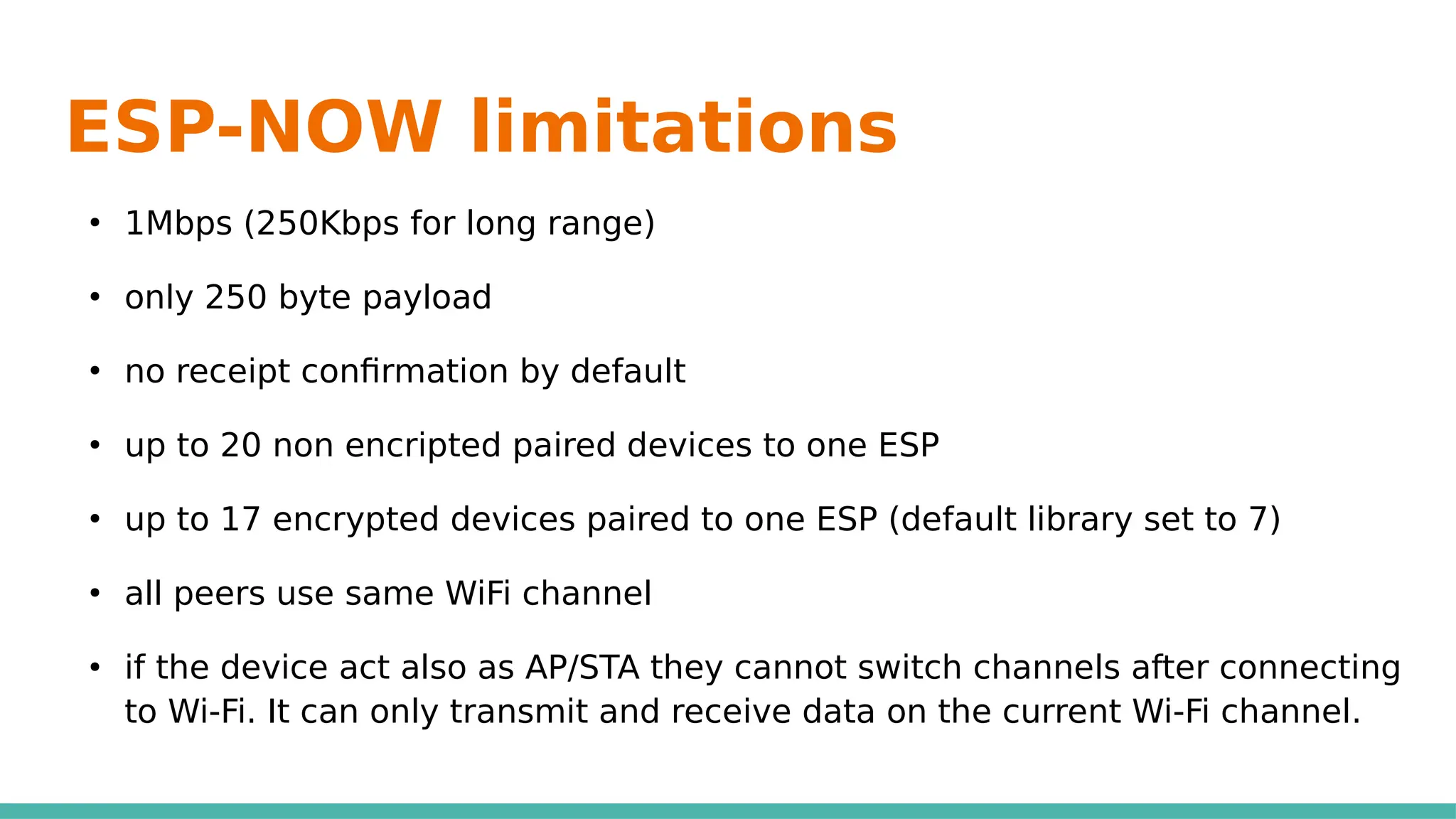
ESP-NOW limitations
●
1Mbps (250Kbps for long range)
●
only 250 byte payload
●
no receipt confirmation by default
●
up to 20 non encripted paired devices to one ESP
●
up to 17 encrypted devices paired to one ESP (default library set to 7)
●
all peers use same WiFi channel
●
if the device act also as AP/STA they cannot switch channels after connecting
to Wi-Fi. It can only transmit and receive data on the current Wi-Fi channel.
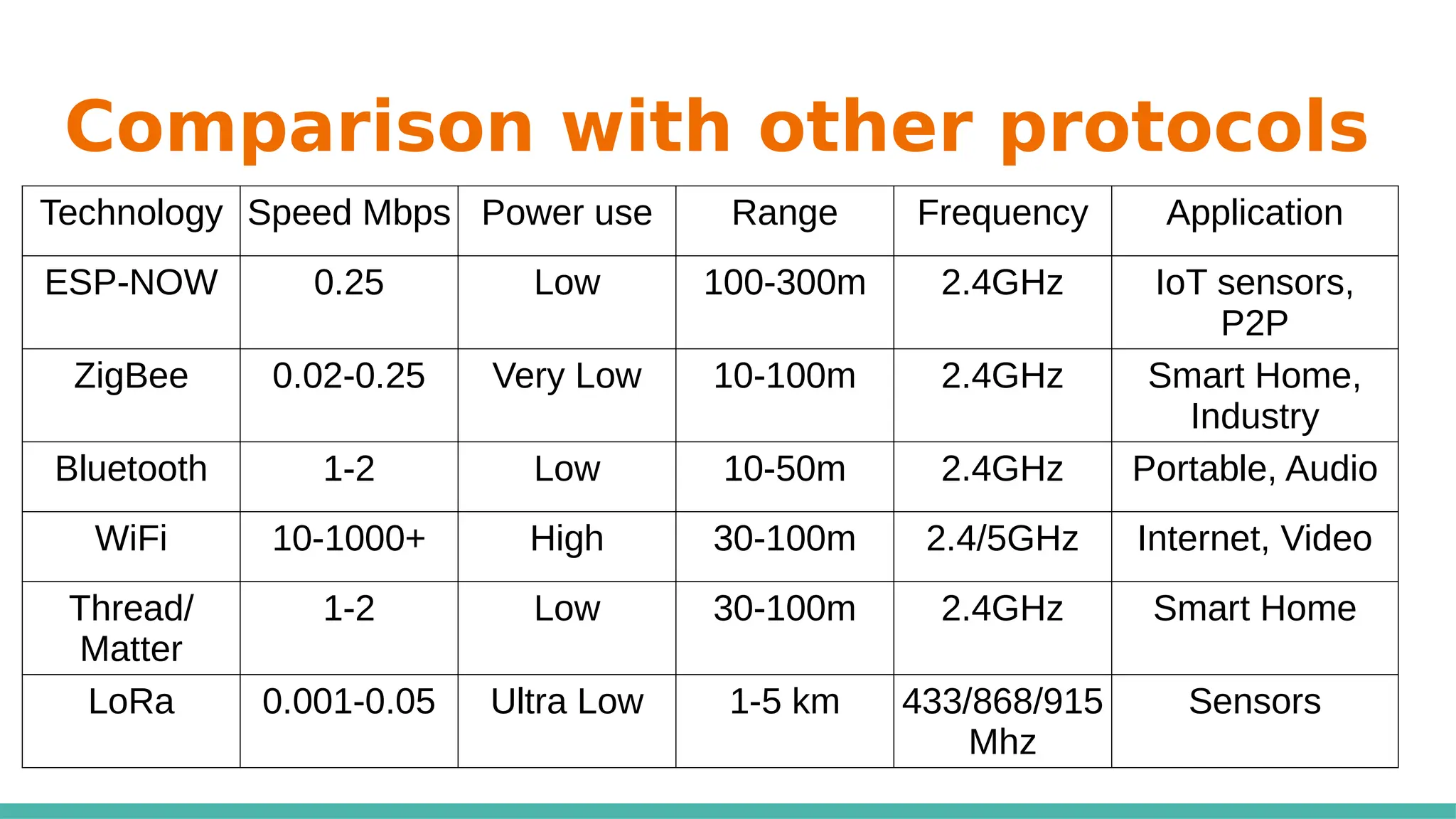
Comparison with other protocols
Technology Speed Mbps Power use Range Frequency Application
ESP-NOW 0.25 Low 100-300m 2.4GHz IoT sensors,
P2P
ZigBee 0.02-0.25 Very Low 10-100m 2.4GHz Smart Home,
Industry
Bluetooth 1-2 Low 10-50m 2.4GHz Portable, Audio
WiFi 10-1000+ High 30-100m 2.4/5GHz Internet, Video
Thread/
Matter
1-2 Low 30-100m 2.4GHz Smart Home
LoRa 0.001-0.05 Ultra Low 1-5 km 433/868/915
Mhz
Sensors
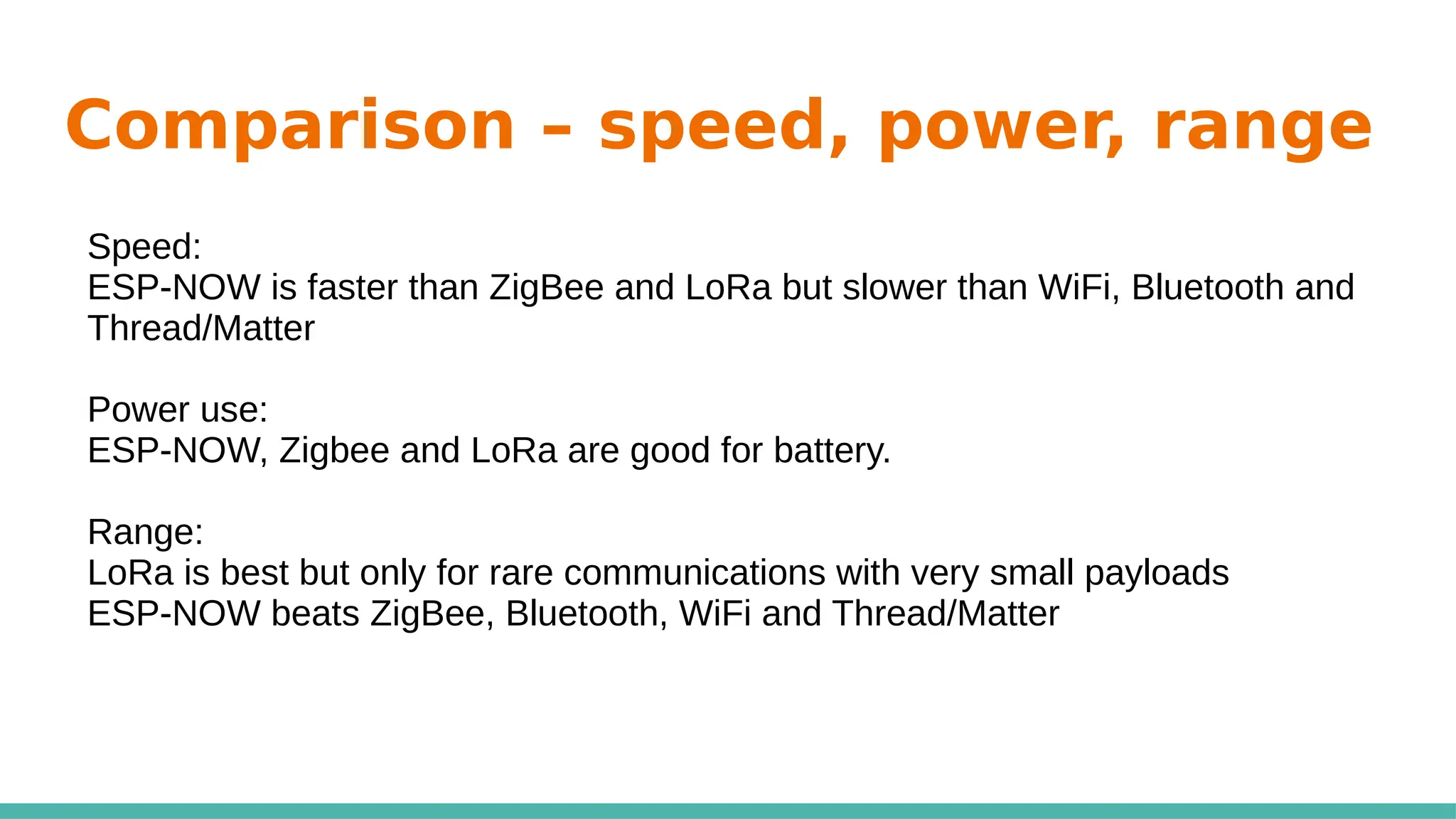
Comparison – speed, power, range
Speed:
ESP-NOW is faster than ZigBee and LoRa but slower than WiFi, Bluetooth and
Thread/Matter
Power use:
ESP-NOW, Zigbee and LoRa are good for battery.
Range:
LoRa is best but only for rare communications with very small payloads
ESP-NOW beats ZigBee, Bluetooth, WiFi and Thread/Matter
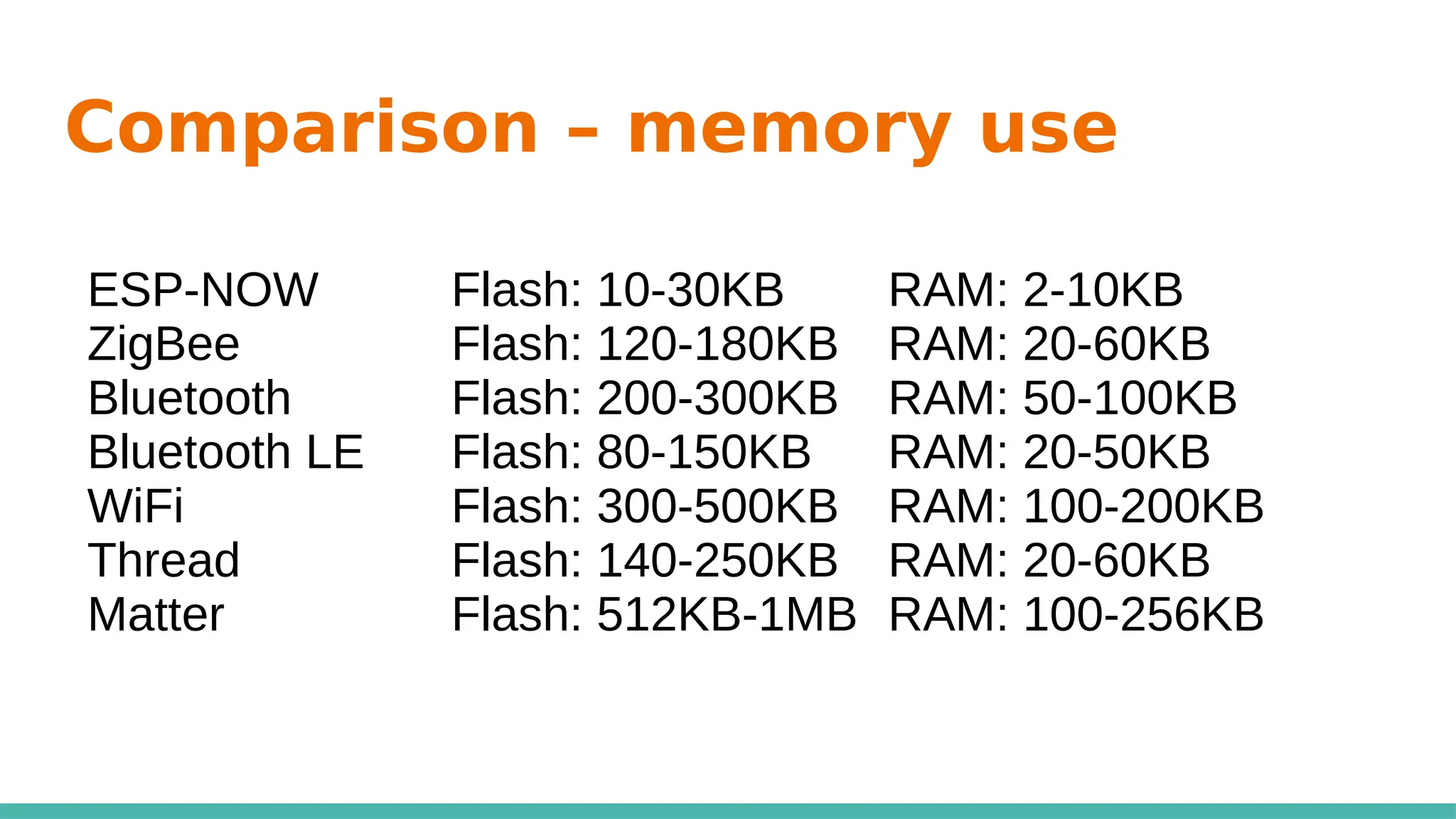
Comparison – memory use
ESP-NOW Flash: 10-30KB RAM: 2-10KB
ZigBee Flash: 120-180KB RAM: 20-60KB
Bluetooth Flash: 200-300KB RAM: 50-100KB
Bluetooth LE Flash: 80-150KB RAM: 20-50KB
WiFi Flash: 300-500KB RAM: 100-200KB
Thread Flash: 140-250KB RAM: 20-60KB
Matter Flash: 512KB-1MB RAM: 100-256KB
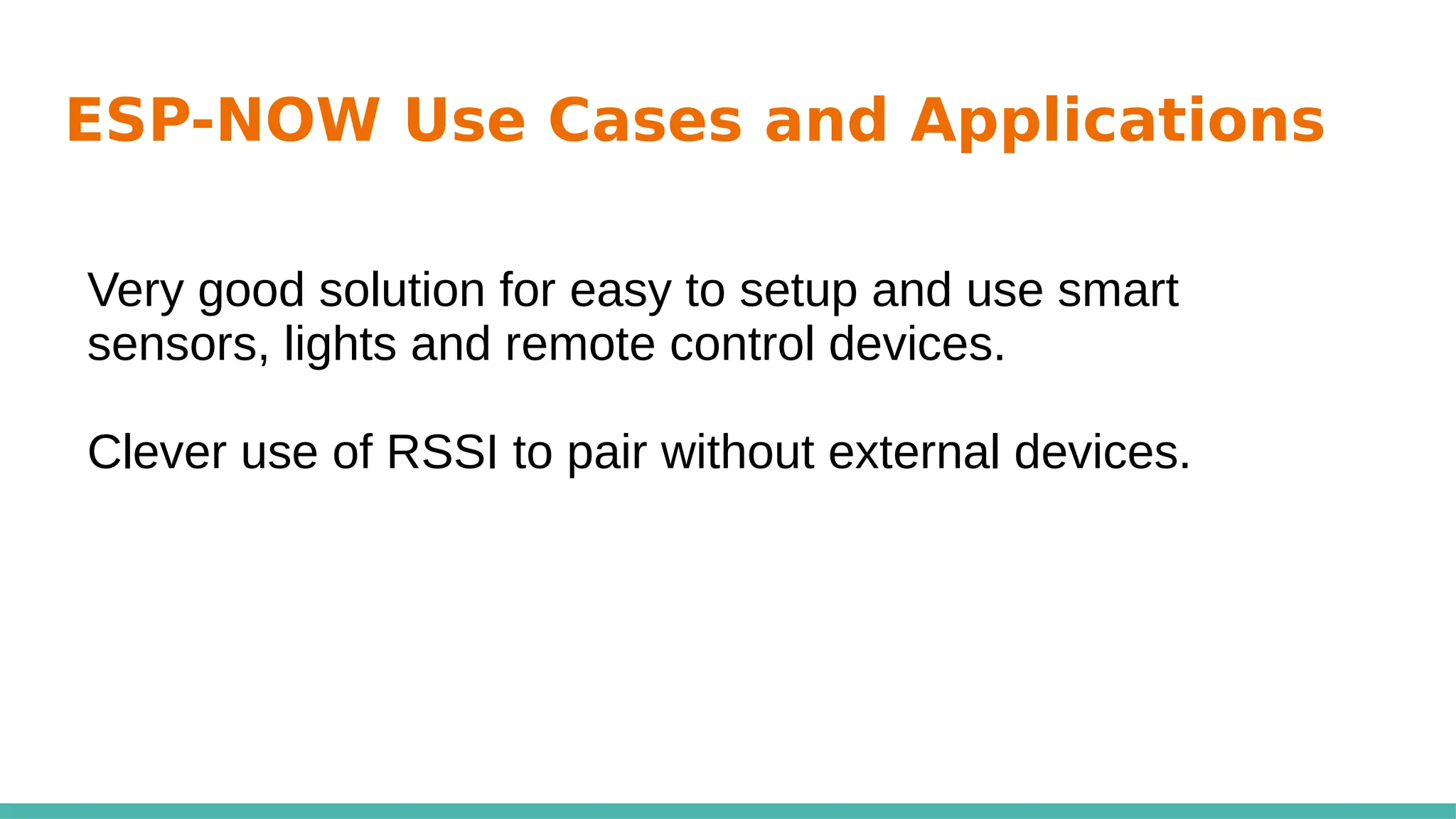
ESP-NOW Use Cases and Applications
Very good solution for easy to setup and use smart
sensors, lights and remote control devices.
Clever use of RSSI to pair without external devices.
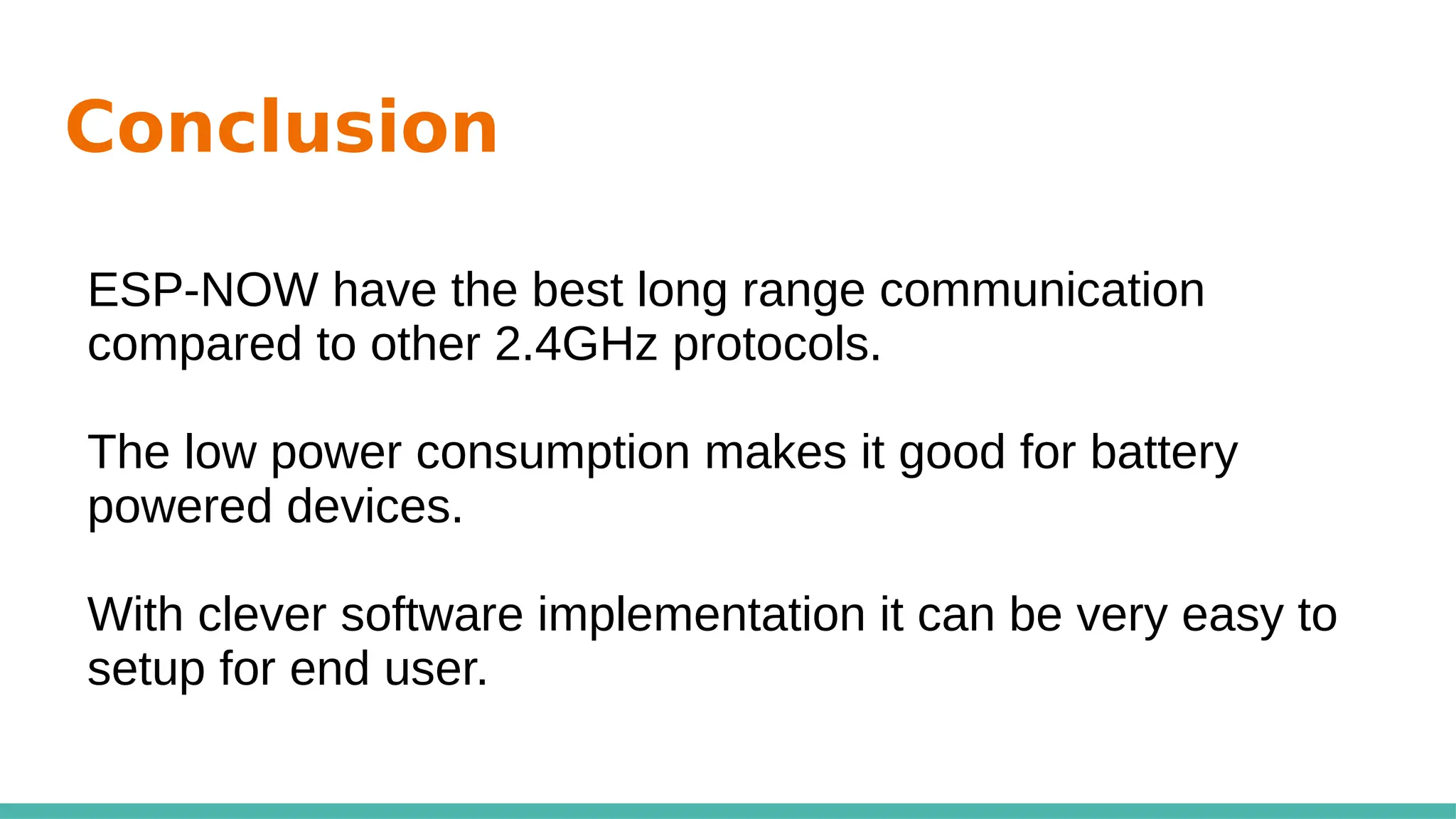
Conclusion
ESP-NOW have the best long range communication
compared to other 2.4GHz protocols.
The low power consumption makes it good for battery
powered devices.
With clever software implementation it can be very easy to
setup for end user.
Questions?
Follow us:
Web www.olimex.com
Wordpress https://olimex.wordpress.com/
Twitter https://twitter.com/Olimex
Facebook https://www.facebook.com/OLINUXINO
Mastodon https://mastodon.social/@olimex
Discord https://discord.gg/QQEBXZk7y8

TuxCon 2025 Experiments with ESP-NOW protocol and comparison to Zigbee, WiFi, Bluetooth, LoRa, Thread, Matter

  • 1.
    TuxCon, 2025 Plovdiv, May10th IoT experiments with ESP-NOW Comparison with WiFi, Zigbee, Bluetooth and Thread/Matter
  • 2.
    $whoami Tsvetan Usunov ===OLIMEX Ltd www.olimex.com OLIMEX company is dealing with electronic design and production more than 30 years. 1000+ originally designed products, most of them OSHW. All OLIMEX products are manufactured in Plovdiv, Bulgaria.
  • 3.
    What is ESP-NOW?? ESP-NOW is a communication protocol developed by Espressif for their ESP devices. It allows fast wireless communication with low latency and low power consumption between different devices, without the need for a router.
  • 4.
  • 5.
    How ESP-NOW works? ESP-NOWuses the ESP devices build-in WiFi hardware and cleverly uses IEEE 802.11 vendor-specific action frames to transmit small data packets between ESP devices, avoiding the overhead of Wi-Fi association and IP layers. These frames are lightweight, fast, and ideal for low- power or peer-to-peer communication.
  • 6.
    What is 802.11action frames used for? An 802.11 Action Frame is a type of management frame in the IEEE 802.11 Wi-Fi standard. It is used for specialized control and signaling between wireless devices (like access points and clients), beyond the basic association and authentication processes.
  • 7.
    What is 802.11action frames used for? Action frames are used for advanced features such as: Wi-Fi Direct (P2P), Mesh networking, Fast roaming (802.11r), Spectrum management, Block acknowledgment setup. They can be sent to a specific device (unicast) or all devices (broadcast), depending on the application.
  • 8.
    ESP-NOW action framestructure Field Size Description Category 1 byte 0x7F (Vendor-Specific) OUI (Organization Unique Identifier) 3 bytes ESPRESSIF OUI 0x18, 0xFE, 0x34 Vendor Type 1 byte application-specific Vendor Data Up to 250 bytes ESP-NOW payload
  • 9.
    What ESP-NOW does? ESP-NOWinteracts directly from device to device and does not require a router to forward data. The messages can be from one to one (unicast) or from one to many (broadcast). One ESP device can act as AP/STA and ESP-NOW at the same time if necessary.
  • 10.
    ESP-NOW features ● operates on2.4Ghz and uses standard WiFi channels ● do not disturb other 2.4Ghz protocols like Zigbee, BT, WiFi, Thread/Matter ● peer to peer, no need for routers ● use MAC addresses for unicast messages
  • 11.
    ESP-NOW features ● the communicationspeed is moderate 250Kbps ● long distance 50-300 m ● multi hop can extend the distance indefenitely ● low lattency 200uS ● low consumption ● AES128 encryption
  • 12.
    ESP-NOW limitations ● 1Mbps (250Kbpsfor long range) ● only 250 byte payload ● no receipt confirmation by default ● up to 20 non encripted paired devices to one ESP ● up to 17 encrypted devices paired to one ESP (default library set to 7) ● all peers use same WiFi channel ● if the device act also as AP/STA they cannot switch channels after connecting to Wi-Fi. It can only transmit and receive data on the current Wi-Fi channel.
  • 13.
    Comparison with otherprotocols Technology Speed Mbps Power use Range Frequency Application ESP-NOW 0.25 Low 100-300m 2.4GHz IoT sensors, P2P ZigBee 0.02-0.25 Very Low 10-100m 2.4GHz Smart Home, Industry Bluetooth 1-2 Low 10-50m 2.4GHz Portable, Audio WiFi 10-1000+ High 30-100m 2.4/5GHz Internet, Video Thread/ Matter 1-2 Low 30-100m 2.4GHz Smart Home LoRa 0.001-0.05 Ultra Low 1-5 km 433/868/915 Mhz Sensors
  • 14.
    Comparison – speed,power, range Speed: ESP-NOW is faster than ZigBee and LoRa but slower than WiFi, Bluetooth and Thread/Matter Power use: ESP-NOW, Zigbee and LoRa are good for battery. Range: LoRa is best but only for rare communications with very small payloads ESP-NOW beats ZigBee, Bluetooth, WiFi and Thread/Matter
  • 15.
    Comparison – memoryuse ESP-NOW Flash: 10-30KB RAM: 2-10KB ZigBee Flash: 120-180KB RAM: 20-60KB Bluetooth Flash: 200-300KB RAM: 50-100KB Bluetooth LE Flash: 80-150KB RAM: 20-50KB WiFi Flash: 300-500KB RAM: 100-200KB Thread Flash: 140-250KB RAM: 20-60KB Matter Flash: 512KB-1MB RAM: 100-256KB
  • 16.
    ESP-NOW Use Casesand Applications Very good solution for easy to setup and use smart sensors, lights and remote control devices. Clever use of RSSI to pair without external devices.
  • 17.
    Conclusion ESP-NOW have thebest long range communication compared to other 2.4GHz protocols. The low power consumption makes it good for battery powered devices. With clever software implementation it can be very easy to setup for end user.
  • 18.
    Questions? Follow us: Web www.olimex.com Wordpresshttps://olimex.wordpress.com/ Twitter https://twitter.com/Olimex Facebook https://www.facebook.com/OLINUXINO Mastodon https://mastodon.social/@olimex Discord https://discord.gg/QQEBXZk7y8